2014 SUBARU TRIBECA tires
[x] Cancel search: tiresPage 284 of 426
.You must install four tires that areof the same size, circumferences,construction, manufacturer,brand (tread pattern), degree ofwear, speed symbol and loadindex. Mixing tires of other sizes,circumferences or constructionsmay result in severe mechanicaldamage to the drive train of yourvehicle and may affect ride,handling, braking and speed-ometer/odometer calibration. Italso may be dangerous and leadto loss of vehicle control.
CAUTION
If you use a temporary spare tire toreplace a flat tire, be sure to use theoriginaltemporary spare tire storedin the vehicle. Using other sizes mayresult in severe mechanical damageto the drive train of your vehicle.
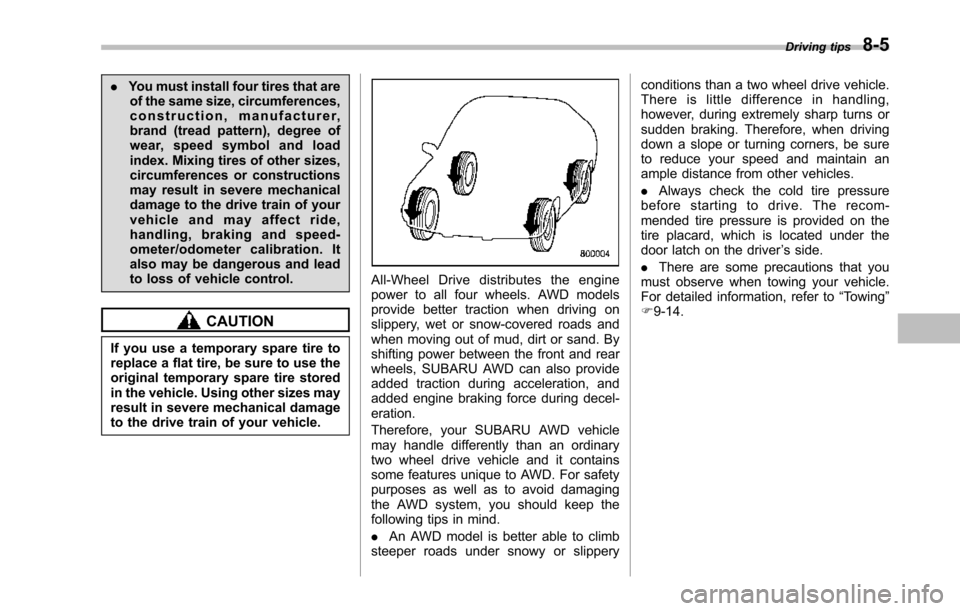
All-Wheel Drive distributes the enginepower to all four wheels. AWD modelsprovidebetter traction when driving onslippery, wet or snow-covered roads andwhen moving out of mud, dirt or sand. Byshifting power between the front and rearwheels, SUBARU AWD can also provideadded traction during acceleration, andadded engine braking force during decel-eration.
Therefore, your SUBARU AWD vehiclemay handle differently than an ordinarytwo wheel drive vehicle and it containssome features unique to AWD. For safetypurposes as well as to avoid damagingthe AWD system, you should keep thefollowing tips in mind.
.An AWD model is better able to climbsteeper roads under snowy or slippery
conditions than a two wheel drive vehicle.There is little difference in handling,however, during extremely sharp turns orsudden braking. Therefore, when drivingdown a slope or turning corners, be sureto reduce your speed and maintain anample distance from other vehicles.
.Always check the cold tire pressurebefore starting to drive. The recom-mended tire pressure is provided on thetire placard, which is located under thedoor latch on the driver’s side.
.There are some precautions that youmust observe when towing your vehicle.For detailed information, refer to“Towing”F9-14.
Driving tips8-5
Page 286 of 426
depth of the water and the bottom of thestream bed for firmness and ensure thatthe bed of the stream is flat. Drive slowlyand completely through the stream. Thewater should be shallow enough that itdoes not reach the vehicle’s undercar-riage. Water entering the engine air intakeor the exhaust pipe or water splashingonto electrical parts may damage yourvehicle and may cause it to stall. Neverattempt to drive through rushing water;regardless of its depth, it can wash awaythe ground from under your tires, resultingin possible loss of traction and evenvehicle rollover.
.Always check your brakes for effec-tiveness immediately after driving in sand,mud or water. Do this by driving slowlyand stepping on the brake pedal. Repeatthat process several times to dry out thebrake discsand brake pads.
.Do not drive or park over or nearflammable materials such as dry grass orfallen leaves,as they may burn easily. Theexhaust system is very hot while theengine is running and right after enginestops. This could create a fire hazard.
.After driving through tall grass, mud,rocks, sand, rivers, etc., check that thereis no grass, bush, paper, rags, stones,sand, etc. adhering to or trapped on theunderbody. Clear off any such matter from
the underbody. If the vehicle is used withthese materials trapped or adhering to theunderbody, a mechanical breakdown orfire could occur.
.Secure all cargo carried inside thevehicle and make certain that it is notpiled higher than the seatbacks. Duringsudden stops or jolts, unsecured cargocould be thrown around in the vehicle andcause injury. Do not pile heavy loads onthe roof. Those loads raise the vehicle’scenter of gravity and make it more proneto tip over.
.If you must rock the vehicle to free itfrom sand or mud, depress the acceleratorpedal slightly andmove the select leverback and forth between“D”and“R”repeatedly. Do not race the engine. Forthe best possible traction, avoid spinningthe wheels when trying to free the vehicle.
.When the road surface is extremelyslippery, you can obtain better traction bystarting the vehicle with the transmissionin 2nd than 1st.
.Never equip your vehicle with tireslarger than thosespecified in this manual.
.Wash the vehicle’s underbody after off-road driving. Suspension components areparticularly prone to dirt buildup, so theyneed to be washed thoroughly.
.Frequent driving of an AWD modelunder hard-driving conditions such as
rough roads or off roads will necessitatemore frequent replacement of engine oil,brake fluid and transmission oil than thatspecified in the maintenance scheduledescribed in the“Warranty and Mainte-nance Booklet”.
Remember that damage done to yourSUBARU while operating it off-road andnot using common sense precautionssuch as those listed above is not eligiblefor warranty coverage.
Driving tips8-7
Page 288 of 426
could make the pedals slippery anddriving dangerous.
While warming up the vehicle beforedriving, check that the accelerator pedal,brake pedal, and all other controls operatesmoothly.
Clear away ice and snow that hasaccumulated under the fenders to avoidmaking steering difficult. During severewinter driving, stop when and where it issafe to do so and check under the fendersperiodically.
!Parking in cold weather
WARNING
Snow can trap dangerous exhaustgases under your vehicle. Keepsnow clear of the exhaust pipe andfrom around your vehicle if you parkthe vehicle in snow with the enginerunning.
Do not use the parking brake whenparking for long periods in cold weathersince it could freeze in that position.Instead, you should observe the followingtips.
1. Place the select lever in“P”position.
2. Use tire stops under the tires toprevent the vehicle from moving.
When the vehicle is parked in snow orwhen it snows, raise the wiper blades offthe glass to prevent damage to them.
When the vehicle has been left parkedafter use on roads heavily covered withsnow, or has been left parked during asnowstorm, icing may develop on thebrake system, which could cause poorbraking action.Check for snow or icebuildup on the suspension, disc brakesand brake hoses underneath the vehicle.
If there is caked snow or ice, remove it,being careful not to damage the discbrakes and brake hoses and ABS har-ness.
!Refueling in cold weather
To help prevent moisture from forming inthe fuel system and the risk of its freezing,use of an antifreeze additive in the fueltank is recommended during cold weather.
Use only additives that are specificallydesigned for this purpose. When anantifreeze additive is used, its effect lastslonger if the tank is refilled whenever thefuel level reaches half empty.
If your SUBARU is not going to be usedfor an extended period, it is best to havethe fuel tank filled to capacity.
&Driving on snowy and icy
roads
WARNING
Do not use the cruise control onslippery roads such as snowy or icyroads. This may cause loss ofvehicle control.
CAUTION
Avoid prolonged continuous drivingin snowstorms. Snow will enter theengine’sintakesystemandmayhinder the airflow, which could re-sult in engine shutdown or evenbreakdown.
To prevent skidding and slipping, avoidsudden braking, abrupt acceleration, high-speed driving, and sharp turning whendriving on snowy or icy roads.
Always maintain ample distance betweenyour vehicle and the vehicle ahead of youto avoid the need for sudden braking.
To supplement the foot brake, use theengine brake effectively to control thevehicle speed. (Shift into a lower gearwhen necessary.)
Avoid shifting down abruptly. Such beha-
Driving tips8-9
–CONTINUED–
Page 289 of 426
8-10Driving tips
vior can cause the wheels to lock, possiblyleading to loss of vehicle control.
An anti-lock brake system (ABS) en-hances your vehicle’sbrakingperfor-mance on snowy and icy roads. Forinformation about braking on slipperysurfaces, refer to“ABS (Anti-lock BrakeSystem)”F7-20 and“Vehicle DynamicsControl system”F7-23.
!Wiper operation when snowing
Before driving in cold weather, make surethe wiper blades are not frozen to thewindshield or rear window. If the wiperblades are frozen to the windshield or rearwindow, use the defroster with the airflowcontrol button in the“”position and thetemperature control dial set for maximumwarmth until the wiper blades are com-pletely thawed out. The wiper deicer ishelpful to thaw the windshield wiperblades. To thaw out the rear wiper blade,use the rear window defogger.
When driving in snow, if frozen snow startsto stick on the surface of the windshielddespite wiper operation, use the defrosterwith the airflow control button in“”andthe temperature control dial set for max-imum warmth. After the windshield getswarmed enoughto melt the frozen snowon it, wash it away using the windshieldwasher.
Snow stuck on the wiper arm prevents thewiper from working effectively. If snow isstuck on the wiper arm, pull off the road toa safe place, then remove it. If you stopthe vehicle at road side, use the hazardwarning flasher to alert other drivers.
We recommend use of non-freezing typewiper blades (winter blades) during theseasons in which you could have snowand freezing temperatures. Blades of thistype givesuperior wiping performance insnowy conditions. Be sure to use bladesthat are suitable for your vehicle.
CAUTION
During high-speed driving, non-freezing type wiper blades may notperformas well as standard wiperblades. If this happens, reduce thevehicle speed.
NOTE
When the season requiring non-freez-ing type wiper blades is over, replacethem with standard wiper blades.
&Corrosion protection
Refer to“Corrosion protection”F10-4.
&Snow tires
WARNING
.When replacing original tires withwinter (snow) tires, make sureyou use only tires of the samesize, circumference, speed sym-bol and load index as the originaltires listed on the tire placard.Using tires of other sizes orconstructions may affect speed-ometer/odometer calibration andclearance between the body andtires. It also may be dangerousand lead to loss of vehicle con-trol.
.You must install four winter tiresthat are of the same size, circum-ferences,construction, manufac-turer, brand (tread pattern), de-gree of wear, speed symbol andload index. Mixing tires of othersizes, circumferences or con-structions may result in severemechanical damage to the drivetrain of your vehicle and mayaffect ride, handling, braking andspeedometer/odometer calibra-tion. It also may be dangerousand lead to loss of vehicle con-trol.
Page 290 of 426
.Do not use a combination ofradial, belted bias or bias tiressince it may cause dangeroushandling characteristics and leadto an accident.
Your vehicle is equipped with“all seasontires”which are designed to provide anadequate measure of traction, handlingand braking performance in year-rounddriving. In winter, it may be possible toenhance performance through use of tiresdesigned specifically for winter drivingconditions.
If you choose to install winter tires on yourvehicle, be sure to use the correct tire sizeand type. You must install four winter tiresthat areof the same size, construction,brand and load range and you shouldnever mix radial, belted bias or bias tiressince this may result in dangerous hand-ling characteristics. When you choose atire, make sure that there is enoughclearance between the tire and vehiclebody.
Remember to drive with care at all timesregardless of the type of tires on yourvehicle.
Your vehicle comes with P255/55R18“all season tires”as original equip-ment. You should be aware that some
winter tires with that same size desig-nation may actually be too large for thevehicle and may cause rubbing onsharp turns. Listed in the following isthe winter tire size that we recommend.
Recommended winter (snow) tire size
P255/55R18 stud less
&Tire chains
CAUTION
Tire chains cannot be used on yourvehicle because of the lack ofclearance between the tires andvehicle body.
&Rocking the vehicle
If you must rock the vehicle to free it fromsnow, sand, or mud, depress the accel-erator pedal slightly and move the selectlever back and forth between“D”and“R”repeatedly. Do not race the engine. Forthe best possible traction, avoid spinningthe wheels when trying to free the vehicle.
When the road surface is extremelyslippery, you can obtain better traction bystartingthe vehicle with the transmission
in 2nd than 1st.
For information about holding the trans-mission in the 2nd position, refer to“Selection of manual mode”F7-16 and“Driving tips”F7-17.
Driving tips8-11
Page 292 of 426
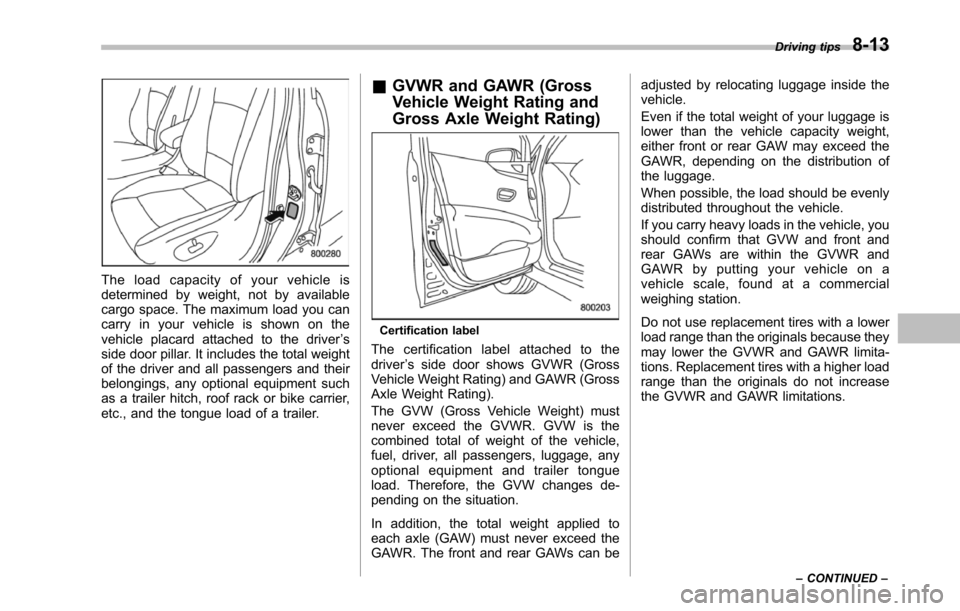
The load capacity of your vehicle isdetermined by weight, not by availablecargospace. The maximum load you cancarry in your vehicle is shown on thevehicle placard attached to the driver’sside door pillar. It includes the total weightof the driver and all passengers and theirbelongings, any optional equipment suchas a trailer hitch, roof rack or bike carrier,etc., and the tongue load of a trailer.
&GVWR and GAWR (Gross
Vehicle Weight Rating and
Gross Axle Weight Rating)
Certification label
The certification label attached to thedriver’s side door shows GVWR (GrossVehicle Weight Rating) and GAWR (GrossAxle Weight Rating).
The GVW (Gross Vehicle Weight) mustnever exceed the GVWR. GVW is thecombined total of weight of the vehicle,fuel, driver, all passengers, luggage, anyoptional equipment and trailer tongueload. Therefore, the GVW changes de-pending on the situation.
In addition, the total weight applied toeach axle (GAW) must never exceed theGAWR. The front and rear GAWs can be
adjusted by relocating luggage inside thevehicle.
Even if the total weight of your luggage islower than the vehicle capacity weight,either front or rear GAW may exceed theGAWR, depending on the distribution ofthe luggage.
When possible, the load should be evenlydistributedthroughout the vehicle.
If you carry heavy loads in the vehicle, youshould confirm that GVW and front andrearGAWs are within the GVWR andGAWR by putting your vehicle on avehicle scale, found at a commercialweighing station.
Do not use replacement tires with a lowerload range than the originals because theymay lower the GVWR and GAWR limita-tions. Replacement tires with a higher loadrange than the originals do not increasethe GVWR and GAWR limitations.
Driving tips8-13
–CONTINUED–
Page 300 of 426
Trailer towing
Your vehicle is designed and intended tobe used primarily as a passenger-carryingvehicle. Towing a trailer puts additionalloads on your vehicle’s engine, drivetrain,brakes, tires and suspension and has anadverse effect on fuel economy.
If you do decide to tow a trailer, your safetyand satisfaction depend upon proper useof correct equipment and cautious opera-tion of your vehicle. Seek the advice ofyour SUBARU dealer to assist you inpurchasing a hitch and other necessarytowing equipment appropriate for yourvehicle. In addition, be sure to follow theinstructionson correct installation and useprovided by the trailer and other towingequipment manufacturers.
SUBARUassumes no responsibility forinjuries or vehicle damage that result fromtrailer towing equipment, or from anyerrors or omissions in the instructionsaccompanying such equipment or for yourfailure to follow the proper instructions.
&Warranties and maintenance
SUBARU warranties do not apply tovehicle damage or malfunction causedby trailer towing. If you use your vehicle totow a trailer, more frequent maintenancewill be required due to the additional load.
(Refer to“Maintenance schedule undersevere driving conditions”in the“Warrantyand Maintenance Booklet”.)
Under no circumstances should a trailerbe towed with a new vehicle or a vehiclewith any new powertrain component (en-gine, transmission, differential, wheelbearings, etc.) for the first 1,000 miles(1,600 km) of driving.
&Maximum load limits
WARNING
Never exceed the maximum loadlimits explained in the following.Exceeding the maximum load limitscould cause personal injury and/orvehicle damage.
CAUTION
.Adequate size trailer brakes arerequired when the trailer and itscargo exceed1,000 lbs (453 kg)total weight.
.Before towing a trailer, check thetrailer total weight, GVW, GAWsand tongue load. Make sure theload and its distribution in yourvehicle and trailer are accepta-
ble.
!Total trailer weight
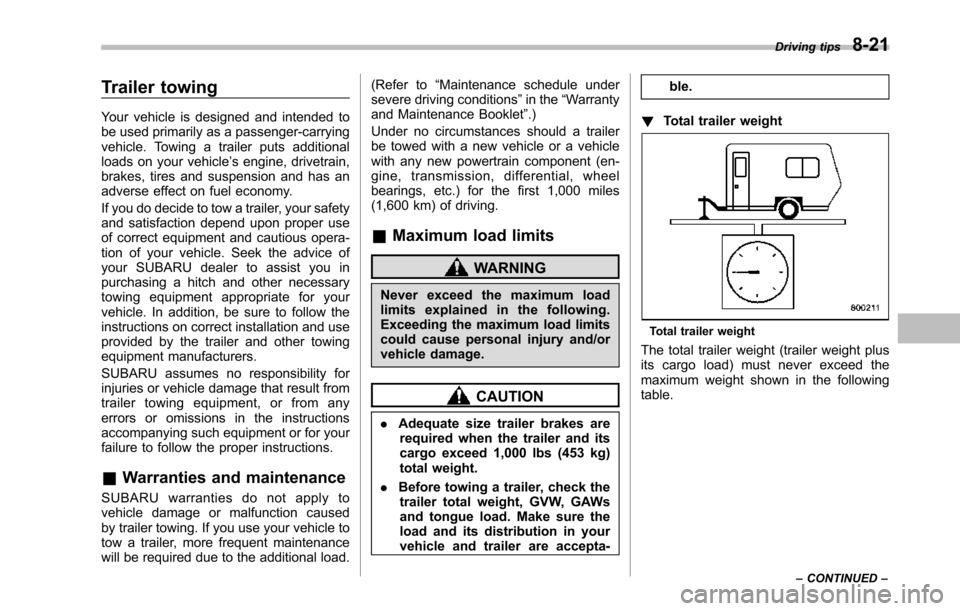
Total trailer weight
The total trailer weight (trailer weight plusits cargo load) must never exceed themaximum weight shown in the followingtable.
Driving tips8-21
–CONTINUED–
Page 303 of 426
8-24Driving tips
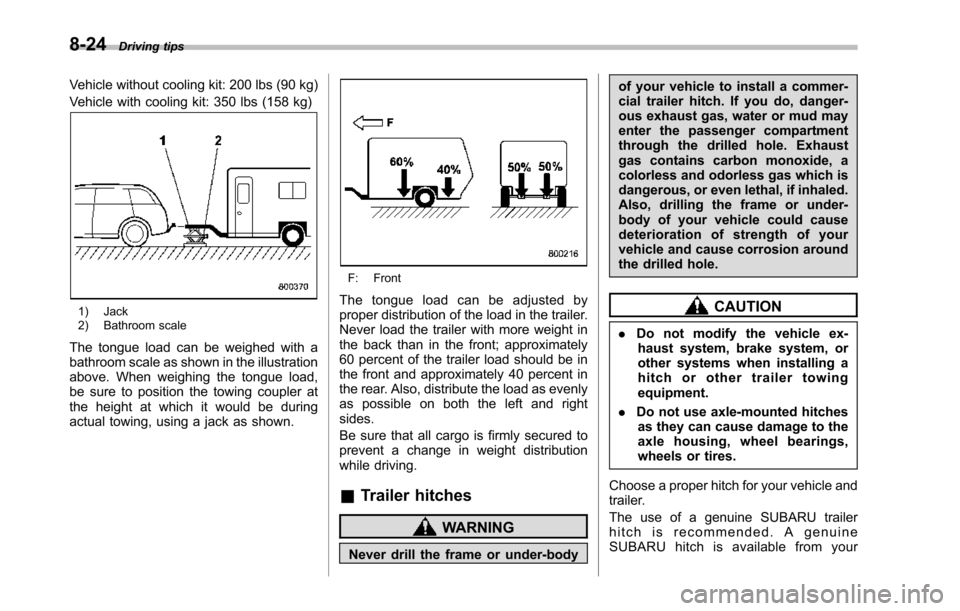
Vehicle without cooling kit: 200 lbs (90 kg)
Vehicle with cooling kit: 350 lbs (158 kg)
1) Jack2) Bathroom scale
The tongue load can be weighed with abathroomscale as shown in the illustrationabove. When weighing the tongue load,be sure to position the towing coupler atthe height at which it would be duringactual towing, using a jack as shown.
F: Front
The tongue load can be adjusted byproper distribution of the load in the trailer.Never load the trailer with more weight inthe back thanin the front; approximately60 percent of the trailer load should be inthe front and approximately 40 percent inthe rear. Also, distribute the load as evenlyas possible on both the left and rightsides.
Be sure that all cargo is firmly secured toprevent a change in weight distributionwhile driving.
&Trailer hitches
WARNING
Never drill the frame or under-body
of your vehicle to install a commer-cial trailer hitch. If you do, danger-ous exhaust gas, water or mud mayenter the passenger compartmentthrough the drilled hole. Exhaustgas contains carbon monoxide, acolorless and odorless gas which isdangerous, or even lethal, if inhaled.Also, drilling the frame or under-body of your vehicle could causedeterioration of strength of yourvehicle and cause corrosion aroundthe drilled hole.
CAUTION
.Do not modify the vehicle ex-haust system, brake system, orother systems when installing ahitch or other trailer towingequipment.
.Do not use axle-mounted hitchesas they can cause damage to theaxle housing, wheel bearings,wheels or tires.
Choose a proper hitch for your vehicle andtrailer.
The use of a genuine SUBARU trailerhitch is recommended. A genuineSUBARU hitch is available from your