2014 SUBARU TRIBECA tires
[x] Cancel search: tiresPage 318 of 426
SUBARU dealer as soon as possiblefor tire and sensor replacement and/or system resetting.
Do not inject any tire liquid oraerosol tire sealant into the tires,as this may cause a malfunction ofthe tire pressure sensors.
If the light illuminates steadily afterblinking for approximately one min-ute, promptly contact a SUBARUdealer to have the system inspected.
Jump starting
WARNING
.Battery fluid is SULFURIC ACID.Do not let it come in contact withthe eyes, skin, clothing or thevehicle.
If battery fluid gets on you,thoroughly flush the exposedarea with water immediately. Getmedical help if the fluid hasentered your eyes.
If battery fluid is accidentallyswallowed, immediately drink alarge amount of milk or water,and obtain immediate medicalhelp.
Keep everyone including chil-dren away from the battery.
.The gas generated by a batteryexplodes if a flame or spark isbrought near it. Do not smoke orlight a match while jump starting.
.Never attempt jump starting if thedischarged battery is frozen. Itcould cause the battery to burstor explode.
.Whenever working on or arounda battery, always wear suitable
eye protectors, and remove metalobjects such as rings, bands orother metal jewelry.
.Be sure the jumper cables andclamps on them do not haveloose or missing insulation.Do not jump start unless cablesin suitable condition are avail-able.
.A running engine can be danger-ous. Keep your fingers, hands,clothing, hair and tools awayfrom the cooling fan, belts andany other moving engine parts.Removing rings, watches andties is advisable.
.Jump starting is dangerous if it isdone incorrectly. If you are un-sure about the proper procedureforjump starting, consult a com-petent mechanic.
When your vehicle does not start due to arun down (discharged) battery, the vehiclemay be jump started by connecting yourbattery to another battery (called thebooster battery) with jumper cables.
In case of emergency9-11
–CONTINUED–
Page 324 of 426
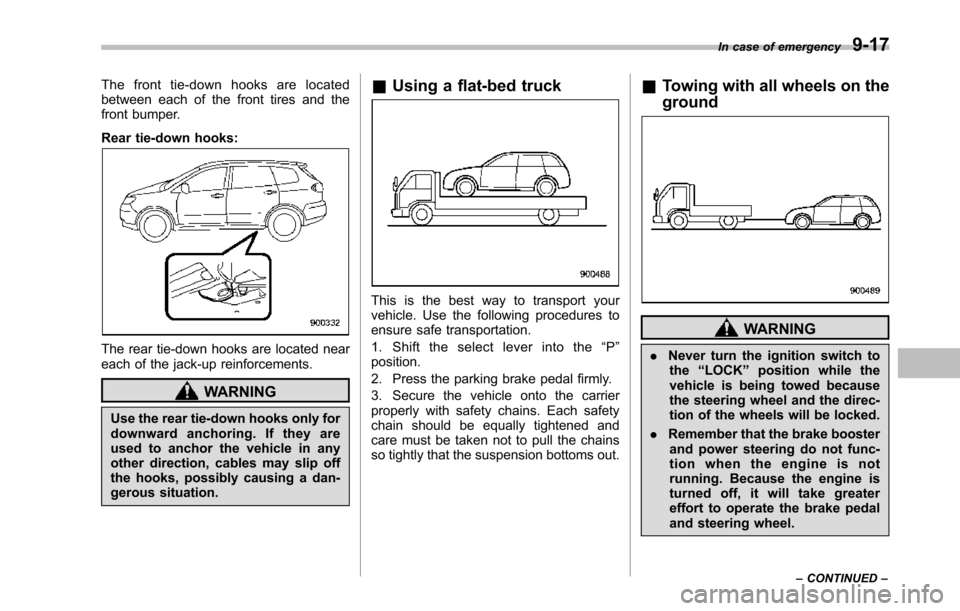
The front tie-down hooks are locatedbetween each of the front tires and thefront bumper.
Rear tie-down hooks:
The rear tie-down hooks are located neareach of the jack-up reinforcements.
WARNING
Use the rear tie-down hooks only fordownward anchoring. If they areused to anchor the vehicle in anyother direction, cables may slip offthe hooks,possibly causing a dan-gerous situation.
&Using a flat-bed truck
This is the best way to transport yourvehicle. Use the following procedures toensure safe transportation.
1. Shift the select lever into the“P”position.
2. Press the parking brake pedal firmly.
3. Secure the vehicle onto the carrierproperly with safety chains. Each safetychain should be equally tightened andcare must be taken not to pull the chainsso tightly that the suspension bottoms out.
&Towing with all wheels on the
ground
WARNING
.Never turn the ignition switch tothe“LOCK”position while thevehicle is being towed becausethe steeringwheel and the direc-tion of the wheels will be locked.
.Remember that the brake boosterand power steering do not func-tion when the engine is notrunning. Because the engine isturned off, it will take greatereffort to operate the brake pedaland steering wheel.
In case of emergency9-17
–CONTINUED–
Page 326 of 426
Maintenance tools
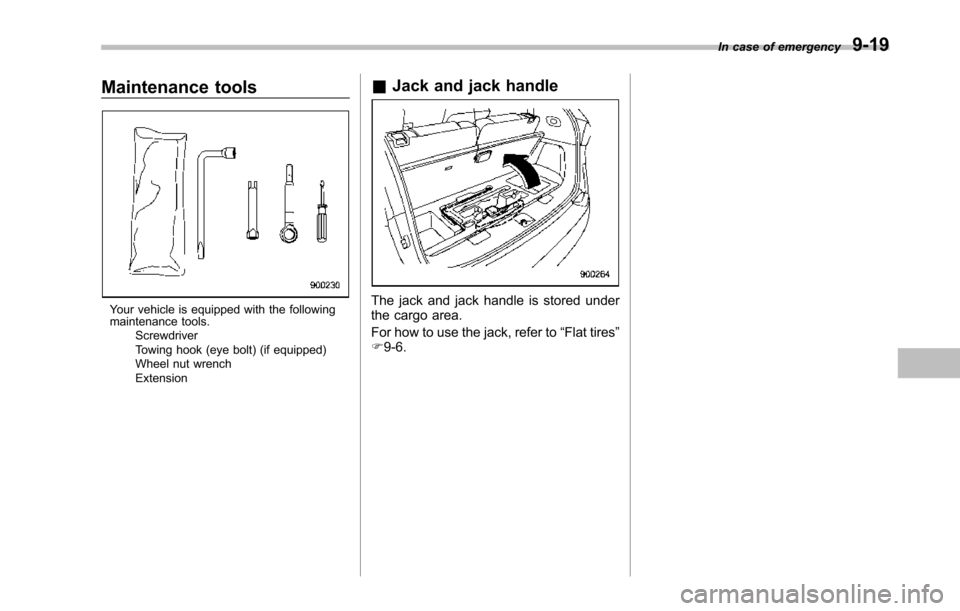
Your vehicle is equipped with the followingmaintenance tools.ScrewdriverTowing hook (eye bolt) (if equipped)Wheel nut wrenchExtension
&Jack and jack handle
The jack and jack handle is stored underthe cargo area.
For how to use the jack, refer to“Flat tires”F9-6.
In case of emergency9-19
Page 334 of 426

Maintenance schedule....................................... 11-3
Maintenance precautions................................... 11-3Before checking or servicing in the enginecompartment.................................................... 11-4When you do checking or servicing in the enginecompartment while the engine is running.......... 11-4
Engine hood....................................................... 11-4
Engine compartment overview.......................... 11-6
Engine oil............................................................ 11-7Checking the oil level......................................... 11-7Changing the oil and oil filter.............................. 11-8Recommendedgrade and viscosity.................... 11-9Synthetic oil....................................................... 11-9
Cooling system................................................ 11-10Hose and connections...................................... 11-10Engine coolant................................................. 11-11
Air cleaner element.......................................... 11-12Replacing the air cleaner element..................... 11-12
Spark plugs...................................................... 11-13Recommended spark plugs.............................. 11-13
Drive belts........................................................ 11-13
Automatic transmission fluid.......................... 11-14Checking the fluid level.................................... 11-14Recommended fluid......................................... 11-15
Front differential gear oil................................. 11-15Checking the oil level....................................... 11-15Recommended grade and viscosity.................. 11-16
Rear differential gear oil.................................. 11-16Recommended grade and viscosity.................. 11-16
Power steering fluid........................................ 11-16Checking the fluid level.................................... 11-16Recommended fluid......................................... 11-17
Brake fluid........................................................ 11-17Checking the fluid level.................................... 11-17Recommended brake fluid............................... 11-18
Brakebooster.................................................. 11-18
Brake pedal...................................................... 11-19Checking the brake pedal free play.................. 11-19Checking the brake pedal reserve distance....... 11-19
Replacement of brake pad and lining............ 11-19Breaking-in of new brake pads and linings....... 11-20
Parking brake stroke....................................... 11-20
Tires and wheels.............................................. 11-21Types of tires................................................... 11-21Tire pressure monitoring system (TPMS).......... 11-21Tire inspection................................................. 11-22Tire pressuresand wear.................................. 11-23Wheel balance................................................. 11-25Wear indicators............................................... 11-25Tire rotation direction mark.............................. 11-25Tire rotation..................................................... 11-26Tire replacement.............................................. 11-26Wheel replacement.......................................... 11-27
Aluminum wheels............................................ 11-27
Windshield washer fluid.................................. 11-28
Replacement of wiper blades......................... 11-29Windshield wiper blade assembly..................... 11-30Windshield wiper blade rubber ......................... 11-30Rear window wiper blade assembly.................. 11-31
Maintenance and service
11
Page 354 of 426
Tires and wheels
&Types of tires
You should be familiar with type of tirespresent on your vehicle.
!All season tires
The factory-installed tires on your newvehicle are all season tires.
All season tires are designed to providean adequate measure of traction, handlingand braking performance in year-rounddriving including snowy and icy roadconditions. However all season tires donot offer as much traction performance aswinter (snow) tires in heavy or loose snowor on icy roads.
All season tires are identified by“ALLSEASON”and/or“M+S”(Mud & Snow) onthe tire sidewall.
!Summer tires
Summer tires are high-speed capabilitytires best suited for highway driving underdry conditions.
Summer tires are inadequate for drivingon slippery roads such as on snow-covered or icy roads.
If you drive your vehicle on snow-coveredor icy roads, we strongly recommend theuse of winter (snow) tires.
When installing winter tires, be sure to
replace all four tires.
!Winter (snow) tires
Winter tires are best suited for driving onsnow-covered and icy roads. Howeverwinter tires do not perform as well assummer tires and all season tires on roadsother than snow-covered and icy roads.
&Tire pressure monitoring
system (TPMS)
The tire pressure monitoring system pro-vides the driver with a warning messageby sending a signal from a sensor that isinstalled in each wheel when tire pressureis severely low. The tire pressure monitor-ing system will activate only when thevehicle is driven. Also, this system maynot react immediately to a sudden drop intire pressure (for example, a blow-outcausedby running over a sharp object).
If you adjust the tire pressures in a warmgarage and will then drive the vehicle incold outside air, the resulting drop in tirepressures may cause the low tire pressurewarning light to illuminate. To avoid thisproblem when adjusting the tire pressuresin a warm garage, inflate the tires topressures higher than those shown on thetire placard. Specifically, inflate them by anextra 1 psi (6.9 kPa, 0.07 kgf/cm2) forevery difference of 108F (5.68C) between
the temperature in the garage and thetemperature outside. By way of example,the following table shows the required tirepressures that correspond to various out-side temperatures when the temperaturein the garage is 608F (15.68C).
Standard tire pressures:
Front: 33 psi (230 kPa, 2.3 kgf/cm2)
Rear: 32 psi (220 kPa, 2.2 kgf/cm2)
Garage temperature: 608F (15.68C)
OutsidetemperatureAdjusted pressure[psi (kPa, kgf/cm2)]
FrontRear
308F(!18C)36 (250, 2.5) 35 (240, 2.4)
108F(!128C)38(265, 2.65)37(255, 2.55)
!108F(!238C)40 (280, 2.8)39 (270, 2.7)
If the low tire pressure warning lightilluminates when you drive the vehicle incold outside air after adjusting the tirepressures in a warm garage, re-adjust thetire pressures using the method describedabove. Then, increase the vehicle speedto at least 20 mph (32 km/h) and check tosee that the low tire pressure warning lightturns off a few minutes later. If the low tirepressure warning light does not turn off,the tire pressure monitoring system may
Maintenance and service11-21
–CONTINUED–
Page 355 of 426

11-22Maintenance and service
not be functioning normally. In this event,go to a SUBARU dealer to have thesystem inspected as soon as possible.
While the vehicle is driven, friction be-tween tires and the road surface causesthe tires to warm up. After illumination ofthe low tire pressure warning light, anyincrease in the tire pressures caused byan increase in the outside air temperatureor by an increase in the temperature in thetires can cause the low tire pressurewarning light to turn off.
System resetting is necessary when thewheels are changed (for example, aswitch to snow tires) and new TPMSvalves are installed on the newly fittedwheels. Have this work performed by aSUBARU dealer following wheel replace-ment.
It may not be possible to install TPMSvalves on certain wheels that are on themarket. Therefore, if you change thewheels (for example, a switch to snowtires), use wheels that have the same partnumber as the standard-equipmentwheels. Without four operational TPMSvalve/sensors on the wheels, the TPMSwill not fully function and the warning lightin the instrument panel will illuminatesteadily after blinking for approximatelyone minute.
When a tire is replaced, adjustments arenecessary to ensure continued normaloperation of the tire pressure monitoringsystem. As with wheel replacement, there-fore, you should have the work performedby a SUBARU dealer.
WARNING
If the low tire pressure warning lightdoes not illuminate briefly after theignition switch is turned ON or thelight illuminates steadily after blink-ing for approximately one minute,you shouldhave your Tire PressureMonitoring System checked at aSUBARU dealer as soon as possi-ble.
If this light illuminates while driving,never brake suddenly and keepdriving straight ahead while gradu-ally reducing speed. Then slowlypull off the road to a safe place.Otherwise an accident involvingserious vehicle damage and seriouspersonal injury could occur.
If this light still illuminates whiledriving after adjusting the tire pres-sure, a tire may have significantdamage and a fast leak that causesthe tire to lose air rapidly. If you havea flat tire, replace it with a spare tire
as soon as possible.
When a spare tire is mounted or awheel rim is replaced without theoriginal pressure sensor/transmitterbeing transferred, the low tire pres-sure warning light will illuminatesteadily after blinking for approxi-mately one minute. This indicatesthe TPMS is unable to monitor allfour road wheels. Contact yourSUBARU dealer as soon as possiblefor tire and sensor replacement and/or system resetting. If the lightilluminates steadily after blinkingfor approximately one minute,promptly contact a SUBARU dealerto have the system inspected.
&Tire inspection
Checkon a daily basis that the tires arefree from serious damage, nails, andstones. At the same time, check the tiresfor abnormal wear.
Contact your SUBARU dealer immedi-ately if you find any problem.
NOTE
.When the wheels and tires strikecurbs or are subjected to harsh treat-ment as when the vehicle is driven on arough surface, they can suffer damage
Page 356 of 426
that cannot be seen with the naked eye.This type of damage does not becomeevident until time has passed. Try notto drive over curbs, potholes or onother rough surfaces. If doing so isunavoidable, keep the vehicle’s speeddown to a walking pace or less, andapproach the curbs as squarely aspossible. Also, make sure the tires arenot pressed against the curb when youpark the vehicle..If you feel unusual vibration whiledriving or find it difficult to steer thevehicle in a straight line, one of thetires and/or wheels may be damaged.Drive slowly to the nearest authorizedSUBARU dealer and have the vehicleinspected.
&Tire pressures and wear
Maintaining the correct tire pressureshelps to maximize the tires’service livesand is essential for good running perfor-mance. Check and, if necessary, adjustthe pressure of each tire (including thespare) at least once a month (for example,during a fuel stop) and before any longjourney.
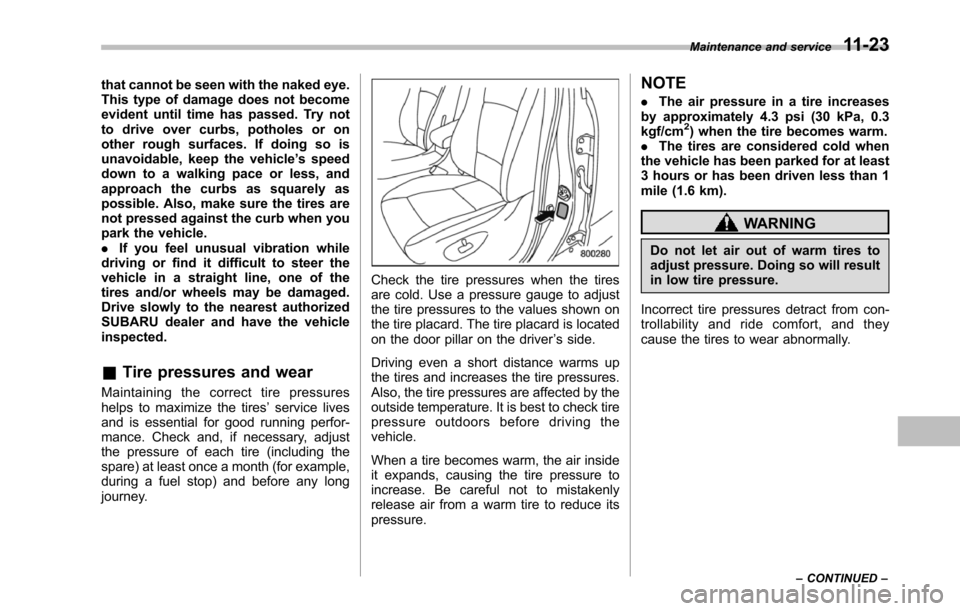
Check the tire pressures when the tiresare cold. Use a pressure gauge to adjustthe tirepressures to the values shown onthe tire placard. The tire placard is locatedon the door pillar on the driver’s side.
Driving even a short distance warms upthe tires and increases the tire pressures.Also, the tire pressures are affected by theoutside temperature. It is best to check tirepressure outdoors before driving thevehicle.
When a tire becomes warm, the air insideit expands, causing the tire pressure toincrease. Be careful not to mistakenlyreleaseair from a warm tire to reduce itspressure.
NOTE
.The air pressure in a tire increasesby approximately 4.3 psi (30 kPa, 0.3kgf/cm2) when the tire becomes warm..The tires are considered cold whenthe vehicle has been parked for at least3 hours or has been driven less than 1mile (1.6 km).
WARNING
Do not let air out of warm tires toadjust pressure. Doing so will resultin low tire pressure.
Incorrect tire pressures detract from con-trollability and ride comfort, and theycause the tires to wear abnormally.
Maintenance and service11-23
–CONTINUED–
Page 357 of 426
11-24Maintenance and service
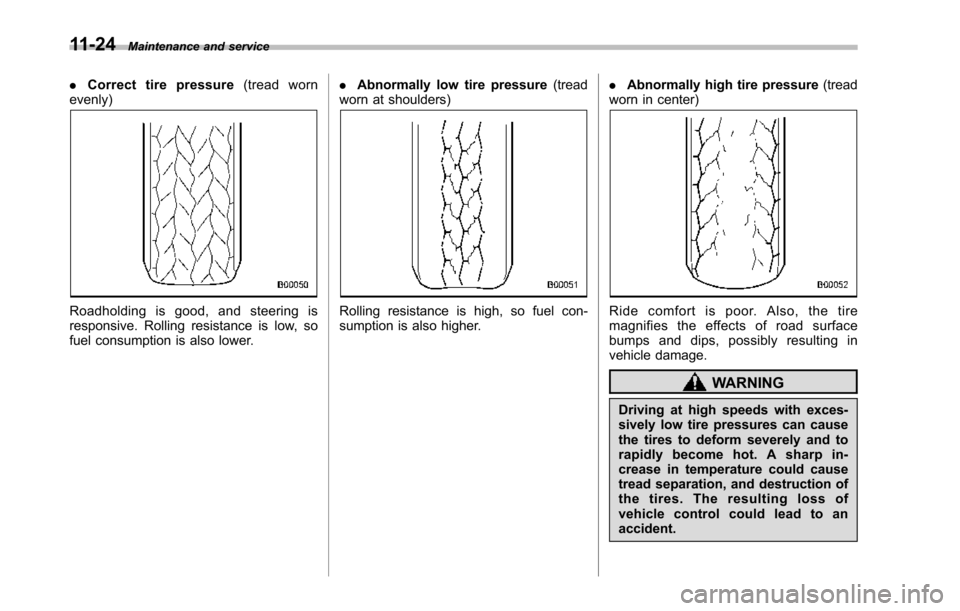
.Correct tire pressure(tread wornevenly)
Roadholding is good, and steering isresponsive.Rolling resistance is low, sofuel consumption is also lower.
.Abnormally low tire pressure(treadworn at shoulders)
Rolling resistance is high, so fuel con-sumption is also higher.
.Abnormally high tire pressure(treadworn in center)
Ride comfort is poor. Also, the tiremagnifies the effects of road surfacebumps and dips, possibly resulting invehicle damage.
WARNING
Driving at high speeds with exces-sively low tire pressures can causethe tires to deform severely and torapidly become hot. A sharp in-crease in temperature could causetread separation, and destruction ofthe tires. The resulting loss ofvehicle control could lead to anaccident.