2014 SUBARU TRIBECA tires
[x] Cancel search: tiresPage 398 of 426
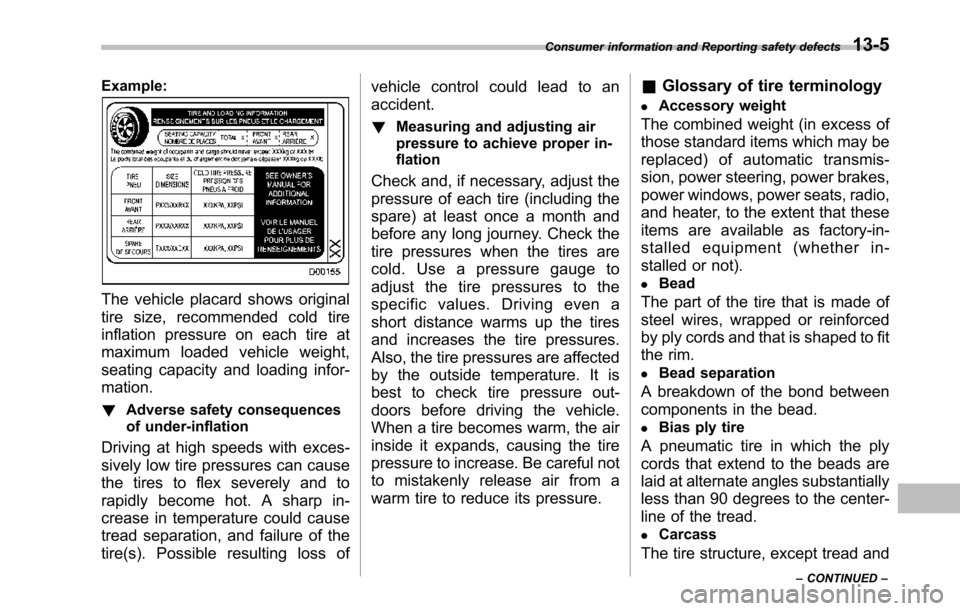
Example:
The vehicle placard shows original
tire size, recommended cold tire
inflation pressure on each tire at
maximum loaded vehicle weight,
seating capacity and loading infor-
mation.
!Adverse safety consequences
of under-inflation
Driving at high speeds with exces-
sively low tire pressures can cause
the tires to flex severely and to
rapidly become hot. A sharp in-
crease in temperature could cause
tread separation, and failure of the
tire(s). Possible resulting loss of
vehicle control could lead to an
accident.
!Measuring and adjusting air
pressure to achieve proper in-
flation
Check and, if necessary, adjust the
pressure of each tire (including the
spare) at least once a month and
before any long journey. Check the
tire pressures when the tires are
cold. Use a pressure gauge to
adjust the tire pressures to the
specific values. Driving even a
short distance warms up the tires
and increases the tire pressures.
Also, the tire pressures are affected
by the outside temperature. It is
best to check tire pressure out-
doors before driving the vehicle.
When a tire becomes warm, the air
inside it expands, causing the tire
pressure to increase. Be careful not
to mistakenly release air from a
warm tire to reduce its pressure.
&Glossary of tire terminology
.Accessory weight
The combined weight (in excess of
those standard items which may be
replaced) of automatic transmis-
sion, power steering, power brakes,
power windows, power seats, radio,
and heater, to the extent that these
items are available as factory-in-
stalled equipment (whether in-
stalled or not).
.Bead
The part of the tire that is made of
steel wires, wrapped or reinforced
by ply cords and that is shaped to fit
the rim.
.Bead separation
A breakdown of the bond between
components in the bead.
.Bias ply tire
A pneumatic tire in which the ply
cords that extend to the beads are
laid at alternate angles substantially
less than 90 degrees to the center-
line of the tread.
.Carcass
The tire structure, except tread and
Consumer information and Reporting safety defects13-5
–CONTINUED–
Page 402 of 426
Table 1—Occupant loading and distribution for vehicle normal load for
various designated seating capacities
Designated seatingcapacity, number ofoccupants
Vehicle normal load,number of occupantsOccupant distribution in anormally loaded vehicle
2 through 4 2 2 in front.
5 through 10 32 in front, 1 in secondseat.
11 through 15 52 in front, 1 in secondseat, 1 in third seat, 1 infourth seat.
16 through 22 72 in front, 2 in secondseat, 2 in third seat, 1 infourth seat.
&Tire care–maintenance and
safety practices
.Check on a daily basis that the
tires are free from serious damage,
nails, and stones. At the same time,
check the tires for abnormal wear.
.Inspect the tire tread regularly
and replace the tires before their
tread wear indicators become visi-
ble. When a tire’streadwear
indicator becomes visible, the tire
is worn beyond the acceptable limit
and must be replaced immediately.
With a tire in this condition, driving
at even low speeds in wet weather
can cause the vehicle to hydro-
plane. Possible resulting loss of
vehicle control can lead to an
accident.
Consumer information and Reporting safety defects13-9
–CONTINUED–
Page 403 of 426
13-10Consumer information and Reporting safety defects
.To maximize the life of each tire
and ensure that the tires wear
uniformly, it is best to rotate the
tires every 7,500 miles (12,000 km).
For information about the tire rota-
tion order, refer to“Tire rotation”
F11-26.Replace any damaged or
unevenly worn tires at the time of
rotation. After tire rotation, adjust
the tire pressures and make sure
the wheel nuts are correctly tigh-
tened. For information about the
tightening torque and tightening
sequence for the wheel nuts, refer
to“Flat tires”F9-6.
&Vehicle load limit–how to
determine
The load capacity of your vehicle is
determined by weight, not by avail-
able cargo space. The load limit of
your vehicle is shown on the
vehicle placard attached to the
driver’ssideB-pillar.Locatethe
statement“The combined weight
of occupants and cargo should
never exceed XXX kg or XXX lbs”
on your vehicle’s placard.
The vehicle placard also shows
seating capacity of your vehicle.
The total load capacity includes the
total weight of driver and all pas-
sengers and their belongings, any
cargo, any optional equipment such
as a trailer hitch, roof rack or bike
carrier, etc., and the tongue load of
a trailer. Therefore cargo capacity
can be calculated by the following
method.
Cargo capacity = Load limit!(total
weight of occupants + total weight
of optional equipment + tongue
load of a trailer (if applicable))
For information about vehicle load-
ing, refer to“Loading your vehicle”
F8-12.
For information about towing capa-
city and weight limits, refer to
“Trailer towing”F8-21.
!Calculating total and load ca-
pacities varying seating con-
figurations
Calculate the available load capa-
city as shown in the following
examples.
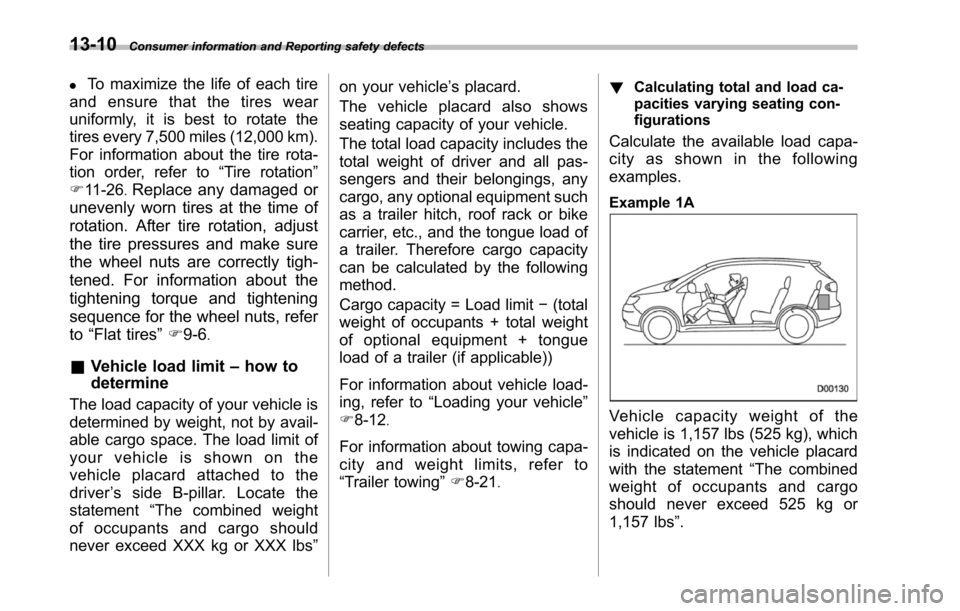
Example 1A
Vehicle capacity weight of the
vehicle is 1,157 lbs (525 kg), which
is indicated on the vehicle placard
with the statement“The combined
weight of occupants and cargo
should never exceed 525 kg or
1,157 lbs”.
Page 406 of 426
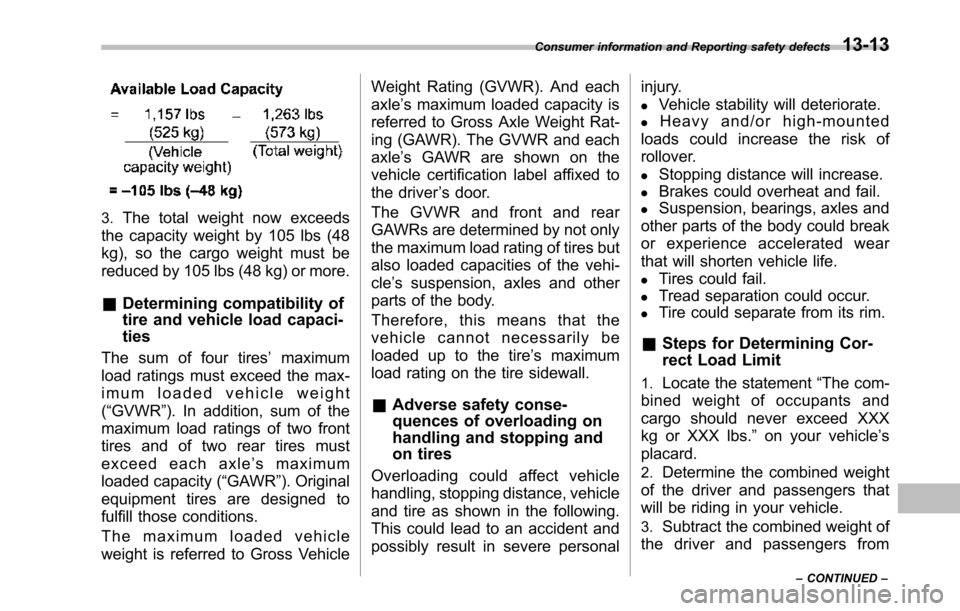
3.The total weight now exceeds
the capacity weight by 105 lbs (48
kg), so the cargo weight must be
reduced by 105 lbs (48 kg) or more.
&Determining compatibility of
tire and vehicle load capaci-
ties
The sum of four tires’maximum
load ratings must exceed the max-
imum loaded vehicle weight
(“GVWR”). In addition, sum of the
maximum load ratings of two front
tires and of two rear tires must
exceed each axle’smaximum
loaded capacity (“GAWR”). Original
equipment tires are designed to
fulfill those conditions.
The maximum loaded vehicle
weight is referred to Gross Vehicle
Weight Rating (GVWR). And each
axle’s maximum loaded capacity is
referred to Gross Axle Weight Rat-
ing (GAWR). The GVWR and each
axle’s GAWR are shown on the
vehicle certification label affixed to
the driver’s door.
The GVWR and front and rear
GAWRs are determined by not only
the maximum load rating of tires but
also loaded capacities of the vehi-
cle’s suspension, axles and other
parts of the body.
Therefore, this means that the
vehicle cannot necessarily be
loaded up to the tire’s maximum
load rating on the tire sidewall.
&Adverse safety conse-
quences of overloading on
handling and stopping and
on tires
Overloading could affect vehicle
handling, stopping distance, vehicle
and tire as shown in the following.
This could lead to an accident and
possibly result in severe personal
injury.
.Vehicle stability will deteriorate.
.Heavy and/or high-mounted
loads could increase the risk of
rollover.
.Stopping distance will increase.
.Brakes could overheat and fail.
.Suspension, bearings, axles and
other parts of the body could break
or experience accelerated wear
that will shorten vehicle life.
.Tires could fail.
.Tread separation could occur.
.Tire could separate from its rim.
&Steps for Determining Cor-
rect Load Limit
1.Locate the statement“The com-
bined weight of occupants and
cargo should never exceed XXX
kg or XXX lbs.”on your vehicle’s
placard.
2.Determine the combined weight
of the driver and passengers that
will be riding in your vehicle.
3.Subtract the combined weight of
the driver and passengers from
Consumer information and Reporting safety defects13-13
–CONTINUED–
Page 407 of 426
13-14Consumer information and Reporting safety defects
XXX kg or XXX lbs.
4.The resulting figure equals the
available amount of cargo and
luggage load capacity. For exam-
ple, if the“XXX”amount equals
1,400 lbs (635 kg) and there will be
five- 150 lbs (68 kg) passengers in
your vehicle, the amount of avail-
able cargo and luggage load capa-
city is 650 lbs. (1,400!750 (56
150) = 650 lbs).
5.Determine the combined weight
of luggage and cargo being loaded
on the vehicle. That weight may not
safely exceed the available cargo
and luggage load capacity calcu-
lated in Step 4.
6.If your vehicle will be towing a
trailer, load from your trailer will be
transferred to your vehicle. Consult
this manual to determine how this
reduces the available cargo and
luggage load capacity of your ve-
hicle.
Uniform tire quality grading
standards
This information indicates the rela-
tive performance of passenger car
tires in the area of treadwear,
traction, and temperature resis-
tance. This is to aid the consumer
in making an informed choice in the
purchase of tires.
Quality grades can be found where
applicable on the tire sidewall be-
tween tread shoulder and maxi-
mum section width. For example:
Treadwear 200 Traction AA Tem-
perature A
The quality grades apply to new
pneumatic tires for use on passen-
ger cars. However, they do not
apply to deep tread, winter type
snow tires, space-saver or tempor-
ary use spare tires, tires with
nominal rim diameters of 12 inches
or less, or to some limited produc-
tion tires.
All passenger car tires must con-
form to Federal Safety Require-
ments in addition to these grades.
&Treadwear
The treadwear grade is a compara-
tive rating based on the wear rate of
the tire when tested under con-
trolled conditions on a specified
government test course.
For example, a tire graded 150
would wear one and one-half (1-
1/2) times as well on the govern-
ment course as a tire graded 100.
The relative performance of tires
depends upon the actual conditions
of their use, however, and may
depart significantly from the norm
due to variations in driving habits,
service practices and differences in
road characteristics and climate.
&Traction AA, A, B, C
The traction grades, from highest to
lowest, are AA, A, B and C. Those
grades represent the tire’s ability to
stop on wet pavement as measured
under controlled conditions on spe-
Page 408 of 426
cified government test surfaces of
asphalt and concrete. A tire marked
C may have poor traction perfor-
mance.
WARNING
The traction grade assigned to
this tire is based on straight-
ahead braking traction tests,
and does not include accel-
eration, cornering, hydroplan-
ing, or peak traction charac-
teristics.
&Temperature A, B, C
The temperature grades are A (the
highest), B, and C, representing the
tire’s resistance to the generation of
heat and its ability to dissipate heat
when tested under controlled con-
ditions on a specified indoor labora-
tory test wheel. Sustained high
temperature can cause the material
of the tire to degenerate and reduce
tire life, and excessive temperature
can lead to sudden tire failure. The
grade C corresponds to a level of
performance which all passenger
car tires must meet under the
Federal Motor Vehicle Safety Stan-
dards No. 109. Grades B and A
represent higher levels of perfor-
mance on the laboratory test wheel
than the minimum required by law.
WARNING
The temperature grade for this
tire is established for a tire
that is properly inflated and
not overloaded. Excessive
speed, underinflation, or ex-
cessive loading, either sepa-
rately or in combination, can
cause heat buildup and possi-
ble tire failure.
Reporting safety defects
(U.S.A.)
If you believe that your vehicle has
adefectwhichcouldcausea
crash or could cause injury or
death, you should immediately in-
form the National Highway Traffic
Safety Administration (NHTSA) in
addition to notifying Subaru of
America, Inc.
If NHTSA receives similar com-
plaints, it may open an investiga-
tion, and if it finds that a safety
defect exists in a group of vehi-
cles, it may order a recall and
remedy campaign. However,
NHTSA cannot become involved
in individual problems between
you, your dealer, or Subaru of
America, Inc. To contact NHTSA,
you may call the Vehicle Safety
Hotline toll-free at 1-888-327-4236
(TTY: 1-800-424-9153); go to
http://www.safercar.gov; or write
to: Administrator, NHTSA, 1200
New Jersey Avenue, SE, West
Consumer information and Reporting safety defects13-15
–CONTINUED–
Page 413 of 426
14-4Index
Second-row seat...................................................... 6-9Third-row seat......................................................... 6-9
DDaytime running light system....................................... 3-29Differential gear oilFront........................................................... 11-15, 12-6Rear............................................................ 11-16, 12-6Dimensions............................................................... 12-2Disarming the alarm system........................................ 2-18Disc brake pad wear warning indicators........................ 7-20Dome light........................................................ 6-2, 11-42DoorLocks..................................................................... 2-5Open warning light................................................. 3-17Step light............................................................. 11-43Drive belts................................................................ 11-13DrivingAll-Wheel Drive warning light................................... 3-18AWD vehicles.......................................................... 8-4Car phone/cell phone.................................................. 8Drinking..................................................................... 7Drugs........................................................................ 7Foreign countries..................................................... 8-4Pets.......................................................................... 8Snowy and icy roads................................................ 8-9Tips . . . . . . . . . . . . . . . . . . . . . . . . . . . . . . . . . . . . . . . . . . . . . . . . . . . . . . . . . . . . . . . . . . 8-2, 8-4Tired or sleepy............................................................ 7Winter.................................................................... 8-8
EElectrical system........................................................ 12-7Electronic Brake Force Distribution (EBD) system... 3-16, 7-22Emergency Locking Retractor (ELR)............................. 1-18EngineCompartment overview............................................ 11-6Coolant....................................................... 11-11, 12-7Exhaust gas (carbon monoxide)............................. 6, 8-2Hood.................................................................... 11-4Oil ................................................................ 11-7, 12-4Overheating........................................................... 9-14Starting.................................................................. 7-7Stopping................................................................. 7-8Exterior care.............................................................. 10-2
FFlat tires..................................................................... 9-6Floor mat................................................................... 6-13Fluid levelAutomatic transmission......................................... 11-14Brake.................................................................. 11-17Power steering..................................................... 11-16Fog lightBulb.......................................................... 11-39, 12-12Indicator light......................................................... 3-22Switch................................................................... 3-32Folding mirror switch................................................... 3-43FrontDifferential gear oil........................................ 11-15, 12-6Fog light............................................ 3-32, 11-39, 12-12Fog light indicator light............................................ 3-22
Page 418 of 426
Folding down......................................................... 1-10Forward and backward adjustment............................. 1-8Head restraint adjustment....................................... 1-12Reclining................................................................. 1-9SecurityAlarm system........................................................ 2-16ID plate................................................................... 2-3Immobilizer.............................................................. 2-3Indicator light................................................... 2-4, 3-21Shock sensors....................................................... 2-20Select lever............................................................... 7-13Position indicator................................................... 3-21Shift lock function................................................... 7-14Shift lock release................................................... 7-14Shock sensors........................................................... 2-20Shopping bag hook.................................................... 6-13Snow tires........................................................ 8-10, 11-21Snowy and icy roads.................................................... 8-9Sounding a panic alarm.............................................. 2-11Spare tire.................................................................... 9-2Spark plugs...................................................... 11-13, 12-7Specifications............................................................ 12-2Speedometer............................................................... 3-6SPORT mode............................................................ 7-18Indicator light......................................................... 3-21SRSCurtain airbag........................................................ 1-60Frontal airbag........................................................ 1-49Side airbag........................................................... 1-60SRS airbag (Supplemental Restraint System airbag) ... 5, 1-45
SRS airbag systemMonitors................................................................ 1-71Servicing............................................................... 1-72Warning light.......................................................... 3-11Starting the engine...................................................... 7-7State emission testing (U.S. only).................................. 7-5Steering wheelPower................................................................... 7-18Tilt . . . . . . . . . . . . . . . . . . . . . . . . . . . . . . . . . . . . . . . . . . . . . . . . . . . . . . . . . . . . . . . . . . . . . . . . 3-44Stop light................................................................. 11-39Stopping the engine..................................................... 7-8Storage compartment................................................... 6-6Sun shade................................................................. 2-27Sun visors.................................................................. 6-4SupplementalRestraint System airbag (SRS)................ 1-45Synthetic leather upholstery......................................... 10-5
TTachometer................................................................. 3-7Temperature gauge...................................................... 3-8Temperature warning lightAT OIL TEMP......................................................... 3-13Rear differential oil.................................................. 3-13Temporary spare tire.................................................... 9-5Tether (child restraint system).............................. 1-37, 1-40Third-row seats.......................................................... 1-13Access to the third-row seat..................................... 1-14Folding down......................................................... 1-15Head restraint adjustment........................................ 1-16Tie-down hooks.......................................................... 9-15Tilt steering wheel....................................................... 3-44
Index14-9