2014 MITSUBISHI OUTLANDER SPORT engine
[x] Cancel search: enginePage 315 of 388
Engine overheating9-4 For emergencies
9
7. Start the engine in the vehicle which hasthe booster battery, let the engine idle afew minutes, then start the Plug-in HybridEV system in your vehicle.8. Check that the ready indicator illuminates.If the ready indicator does not illuminate,contact a MITSUBISHI MOTORSAuthorised Service Point.9. When the ready indicator illuminates, dis-connect the jumper cables in the reverseorder of connection.
10. Check that the select position can be
shifted to all positions other than the “P”(PARK) position.
11. Have the auxiliary battery inspected by
your nearest MITSUBISHI MOTORSAuthorised Service Point.
E00800603745
When the engine is overheating, the informa-tion screen in the multi information displaywill be interrupted and the engine coolanttemperature warning display will appear.If this occurs, take the following correctivemeasures:1. Stop the vehicle in a safe place.
2. Check whether steam is coming from theengine compartment.[If steam does not come from the enginecompartment]Wi t h t h e Pl ug - i n H yb r i d E V s ys t em s t i l lstarting, raise the bonnet to ventilate theengine compartment.[If steam is coming from the engine com-partment]Stop the Plug-in Hybrid EV system, andwhen the steam stops, raise the bonnet toventilate the engine compartment. Restartthe Plug-in Hybrid EV system.
WA R N I N GzWhen connecting the jumper cables, donot connect the positive (+) cable to thenegative (-) terminal. Otherwise sparksmight cause explosion of the battery.CAUTIONzUse care not to get the jumper cable caughtin the cooling fan or other rotating part in theengine compartment.NOTE
zIf the jumper cable is
connected to the any
position other than a
ppointed position, it
may could cause damage to the vehicle.
CAUTIONzYo u r v e h i c l e i s e q u i p p e d w i t h a n e x c l u s i v eauxiliary battery. Even if the battery type isthe same, the battery may not be correctlyinstalled in your vehicle. When replacing theauxiliary battery, request a MITSUBISHIMOTORS Authorised Service Point to do so.
Engine overheating
WA R N I N GzDo not open the bonnet while steam iscoming from the engine compartment. Itcould cause steam or hot water to spurtout, causing burns. Hot water could spurtout even when there is no steam comingout, and some parts will be very hot. Bevery careful when opening the bonnet.zBe careful of hot steam, which could beblowing off the reserve tank cap.zDo not attempt to remove the radiator capwhile the engine is hot.
BK0203201EN.book 4 ページ 2013年11月19日 火曜日 午前11時50分
Page 316 of 388
![MITSUBISHI OUTLANDER SPORT 2014 3.G Owners Manual Engine overheating
For emergencies 9-5
9
3. Confirm that the cooling fans (A) areturning.[If the cooling fans are turning]After the high coolant temperature warn-ing has gone off, stop](/manual-img/19/7545/w960_7545-315.png "MITSUBISHI OUTLANDER SPORT 2014 3.G Owners Manual Engine overheating
For emergencies 9-5
9
3. Confirm that the cooling fans (A) areturning.[If the cooling fans are turning]After the high coolant temperature warn-ing has gone off, stop")
Engine overheating
For emergencies 9-5
9
3. Confirm that the cooling fans (A) areturning.[If the cooling fans are turning]After the high coolant temperature warn-ing has gone off, stop the Plug-in HybridEV system.[If the cooling fans are not turning]Stop the Plug-in Hybrid EV systemimmediately and contact a MITSUBISHIMOTORS Authorised Service Point forassistance.
4. Check the coolant level in the reserve tank(B and C).*:Front of the vehicleWA R N I N GzBe careful not to get your hands or clothescaught in the cooling fan.B: Reserve tank for engine coolingC: Reserve tank for EV cooling system
FULLLOW
FULLLOW
BK0203201EN.book 5 ページ 2013年11月19日 火曜日 午前11時50分
Page 317 of 388
Tools and jack9-6 For emergencies
9
5. Add coolant to the radiator and/or reservetank if necessary. (Refer to the “Mainte-nance” section.)6. Examine the radiator hoses for coolantleakage and the drive belt for looseness ordamage.If there is anything wrong with the cool-ing system or drive belt, we recommendyou to have it checked and repaired.
E00800902507
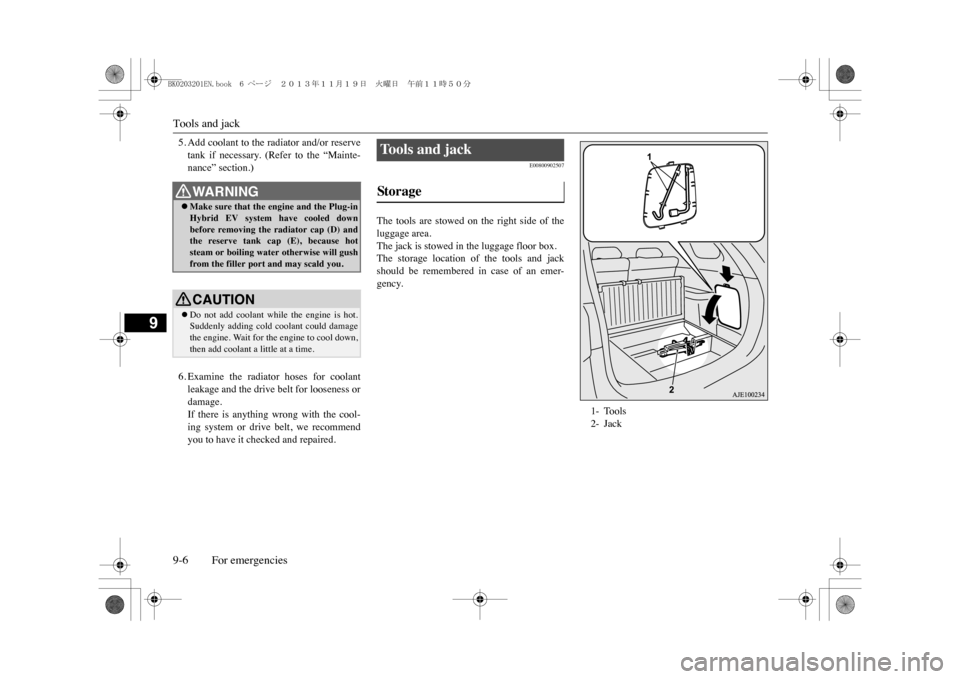
The tools are stowed on the right side of theluggage area.The jack is stowed in the luggage floor box.The storage location of the tools and jackshould be remembered in case of an emer-gency.
WA R N I N GzMake sure that the engine and the Plug-inHybrid EV system
have cooled down
before removing the
radiator cap (D) and
the reserve tank cap (E), because hotsteam or boiling water otherwise will gushfrom the filler port and may scald you.CAUTIONzDo not add coolant while the engine is hot.Suddenly adding cold
coolant could damage
the engine. Wait for the engine to cool down,then add coolant a little at a time.
To o l s a n d j a c k Stor age
1- Tools2- Jack
BK0203201EN.book 6 ページ 2013年11月19日 火曜日 午前11時50分
Page 339 of 388
Cleaning the exterior of your vehicle10-4 Vehicle care
10
Sea water contains salt, which generallyaccelerates corrosion of both ferrous and non-ferrous materials. Wind born spray from thesea can distribute salt for a distance of up to20 km from the shore line with prevailing on-shore winds, although the effect is generallyworse within 2 km of the shore. Salt spraycovers roads, and may be passed to your vehi-cle as dust, or as salt spray after rain. For thisreason it is important to wash all the vehicleincluding the underside (not forgetting theplug-in hybrid EV system bay and plug-inhybrid EV system bay components). See sec-tion entitled “Engine compartment” for rec-ommended cleaning practices.Ensure you request a MITSUBISHIMOTORS Authorised Service Point to con-duct the scheduled Preventative Maintenancecorrosion inspection if you live within 20 kmof the sea. Sea water spray in coastal condi-tions
WA R N I N GzDo not wash the vehicle while charging thetraction battery.Doing so could cause a fire or an electricshock.
zBefore washing the vehicle, make surethat the charging lid
and the inner lid are
completely closed.If the lid is open, the charging unit isexposed to water, resulting in a fire or anelectric shock.CAUTIONzWhen washing the under
side of your vehicle
or wheel, be careful not to injure your hands.zIf your vehicle has rain sensor wipers, placethe wiper switch lever in the “OFF” positionto deactivate the rain sensor before washingthe vehicle. Otherwise, the wipers will oper-ate in the presence of water spray on thewindscreen and may get damaged as a result.zRefrain from excessively using a car wash asits brushes may scratch the paint surface,causing it to lose its gloss. Scratches will beespecially visible on da
rker coloured vehi-
cles.zNever spray or splash
water on the electrical
components in the engine compartment.Doing so could have an adverse effect on theplug-in hybrid EV system startability.Exercise caution also when washing theunderbody; be careful not to spray water intothe engine compartment.WA R N I N G
zSome types of hot wa
ter washing equipment
apply high pressure and
heat to the vehicle.
They may cause heat distortion and damageto the vehicle resin parts and may result inflooding of the vehicle interior.Therefore;•Maintain a distance of approx. 70 cm ormore between the vehicle body and thewashing nozzle.•When washing around the door glass, holdthe nozzle at a distance of more than 70 cmand at right angles to the glass surface.
zAfter washing the vehicle, drive the vehicleslowly while lightly depressing the brakepedal several times in order to dry out thebrakes.Leaving the brakes wet could result inreduced braking performance. Also, there isa possibility that they could freeze up orbecome inoperative due
to rust, rendering the
vehicle unable to move.zUsing an automatic car wash, pay attentionto the following items, referring to the opera-tion manual or consulting a car wash opera-tor. If the following procedure is notfollowed, it could result in damage to yourvehicle.•The outside rear-view mirrors are retracted.•The antenna is removed.•The wiper arms are secured in place withtape.CAUTION
BK0203201EN.book 4 ページ 2013年11月19日 火曜日 午前11時50分
Page 340 of 388
Cleaning the exterior of your vehicle
Vehicle care 10-5
10
The salt and other chemicals spread on theroads in some areas in winter can have aharmful effect on the vehicle body. Youshould therefore wash the vehicle as often aspossible in accordance with our care-instruc-tions. It is recommended to have a preserva-tive applied and the underfloor protectionchecked before and after the cold weatherseason.After washing your vehicle, wipe off allwaterdrops from the rubber parts around thedoors to prevent the doors from freezing.
E00901000919
Wa x i n g t h e v e h i c l e w i l l h e l p p r e v e n t t h eadherence of dust and road chemicals to thepaintwork. Apply a wax solution after wash-ing the vehicle, or at least once every threemonths to assist di
splacing of water.
Do not wax your vehicle in direct sunlight.Yo u s h o u l d w a x a f t e r t h e s u r f a c e s h a v ecooled.For information on how to use wax refer tothe instruction manual of the wax.
E00901100066
The vehicle should only be polished if thepaintwork has become stained or lost its lus-tre. Do not polish parts with a mat coatingand the plastic bumpers. Doing so couldcause stains or damage the finish.
E00901300808
Use a sponge or chamois leather.If a car wax adheres on a grey or black roughsurface of the bumper, moulding or lamps,the surface becomes white. In such a case,wipe it off using lukewarm water and softcloth or chamois leather.
E00901400098
In order to prevent spots and corrosion ofchrome parts, wash with water, dry thor-oughly, and apply a special protective coat-ing. This should be done more frequently inwinter.
•If your vehicle is equi
pped with a roof rails,
consult a car wash opera
tor before using the
car washer.•If your vehicle has rain
sensor wipers, place
the wiper switch lever in the “OFF” posi-tion to deactivate the rain sensor.
During cold weather
NOTE
zTo p r e v e n t f r e e z i n g o f
the weatherstripping
on the doors, bonnet, etc., they should betreated with silicone spray.CAUTION
Wa x in g
CAUTIONzWa x e s c o n t a i n i n g h i
gh abrasive compounds
should not be used.zOn vehicles with the sunroof, be carefulwhen waxing the area around the sunroofopening, not to put any wax on the weather-strip (black rubber). If stained with wax, theweatherstrip cannot maintain a weatherproofseal with the sunroof.
Polishing
Cleaning plastic parts
CAUTIONzDo not use a scrubbing brush or other hardtools as they may damage the plastic partsurface.zDo not bring the plastic parts into contactwith petrol, light oil,
brake fluids, engine
oils, greases, paint thinners, and sulphuricacid (battery electrolyte) which may crack,stain or discolour
the plastic parts.
If they touch the plastic
parts, wipe them off
with soft cloth, chamois or the like and anaqueous solution of neutral detergent thenimmediately rinse the affected parts withwater.
Chrome parts
BK0203201EN.book 5 ページ 2013年11月19日 火曜日 午前11時50分
Page 341 of 388
Cleaning the exterior of your vehicle10-6 Vehicle care
10
E00901500347
1. Remove dirt using a sponge while sprin-kling water on the vehicle.2. Use neutral detergent on any dirt that can-not be removed easily with water.Rinse off the neutral detergent after wash-ing the vehicle.3. Dry the vehicle thoroughly using a cham-ois leather or a soft cloth.
E00901600117
The window glass can normally be cleanedusing only a sponge and water.Glass cleaner can be used to remove oil,grease, insect carcasses, etc. After washing
the glass, wipe it dry with a clean, dry, softcloth. Never use a cloth that is used for clean-ing a painted surface to clean a window. Waxfrom the painted surface could get on theglass and lower glass transparency and visi-bility.
E00901700062
Use a soft cloth and glass cleaner to removegrease, dead insects, etc., from the wiperblades. Replace the wiper blades when theyno longer wipe properly. (Refer to page11-12.)
E00902200051
Use a soft cloth to clean the inner side of thesunroof. Hard deposits should be wiped awaywith a cloth dipped in warm, neutral deter-gent solution. Wipe away the solution with asponge dipped in fresh water.
E00902100483
Clean the engine compartment at the begin-ning of autumn and end of winter. Pay partic-ular attention to flanges, crevices andperipheral parts where dust containing roadchemicals and other corrosive materialsmight collect.If salt and other chemicals are used on theroads in your area, or you live within 20 kmof the sea, clean the engine compartment atleast every three months.Never spray or splash water on the electricalcomponents in the engine compartment, asthis may cause damage.Do not bring the nearby parts, the plasticparts and so on into contact with sulphuricacid (battery electrolyte) which may crack,stain or discolour them.If they are in contact, wipe off with soft cloth,chamois or the like and an aqueous solutionof neutral detergent then immediately rinsethe affected parts with plenty of water.
Aluminium wheels*
CAUTIONzDo not use a brush or other hard implementon the wheels.Doing so could scratch the wheels.zDo not use any cleaner th
at contains an abra-
sive substance or is aci
dic or alkaline. Doing
so could cause the coating on the wheels topeel or become discoloured or stained.zDo not directly apply
hot water using a steam
cleaner or by any other means.zContact with seawater and road deicer cancause corrosion. Rinse off such substances assoon as possible.
Window glass
NOTE
zTo c l e a n t h e i n s i d e o f t h e r e a r w i n d o w,always use a soft cloth and wipe the windowglass along the demister heater element so asnot to cause damage.
Wiper blades Cleaning the sunroof*
NOTE
zThe surface treatment on the inside of theglass may be removed if hard cloth ororganic solvent (benzi
ne, kerosene, thinner,
etc.) is used.
Engine compartment
BK0203201EN.book 6 ページ 2013年11月19日 火曜日 午前11時50分
Page 342 of 388
11
MaintenanceService precautions ......................................................................... 11-2Catalytic converter .......................................................................... 11-3Bonnet ............................................................................................. 11-3Engine oil ........................................................................................ 11-5Engine coolant/Plug-in hybrid EV system coolant ......................... 11-6Wa s h e r f l u i d . . . . . . . . . . . . . . . . . . . . . . . . . . . . . . . . . . . . . . . . . . . . . . . . . . . . . . . . . . . . . . . . . . . . . . . . . . . . . . . . . . . . 11 - 7Brake fluid ...................................................................................... 11-7Auxiliary battery ............................................................................. 11-8Ty r e s . . . . . . . . . . . . . . . . . . . . . . . . . . . . . . . . . . . . . . . . . . . . . . . . . . . . . . . . . . . . . . . . . . . . . . . . . . . . . . . . . . . . . . . . . . . . . . . 11 - 9Wiper blade rubber replacement ................................................... 11-12General maintenance .................................................................... 11-14Fusible links .................................................................................. 11-15Fuses ............................................................................................. 11-15Replacement of lamp bulbs .......................................................... 11-21
BK0203201EN.book 1 ページ 2013年11月19日 火曜日 午前11時50分
Page 343 of 388
Service precautions11-2 Maintenance
11
E01000102032
Adequate care of your vehicle at regularintervals serves to preserve the value andappearance as long as possible.Maintenance items as described in thisowner’s manual can be performed by theowner.We r e c o m m e n d y o u t o h a v e t h e p e r i o d i cinspection and maintenance performed by aMITSUBISHI MOTORS Authorised ServicePoint or another specialist.In the event a malfunction or a problem isdiscovered, we recommend you to have itchecked and repaired. This section containsinformation on inspection maintenance pro-cedures that you can do yourself. Follow theinstructions and cautions for each of the vari-ous procedures.Service precautions
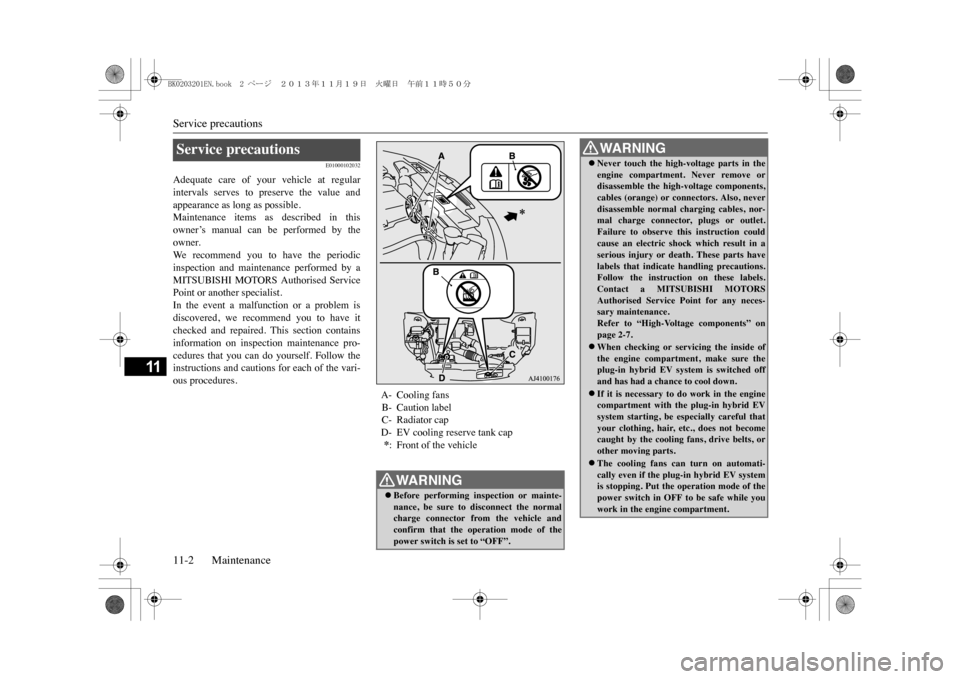
A- Cooling fansB- Caution labelC- Radiator capD- EV cooling reserve tank cap*:Front of the vehicleWA R N I N GzBefore performing inspection or mainte-nance, be sure to disconnect the normalcharge connector from the vehicle andconfirm that the operation mode of thepower switch is set to “OFF”.
zNever touch the high-voltage parts in theengine compartment. Never remove ordisassemble the high-voltage components,cables (orange) or connectors. Also, neverdisassemble normal ch
arging cables, nor-
mal charge connector, plugs or outlet.Failure to observe this instruction couldcause an electric shock which result in aserious injury or death. These parts havelabels that indicate handling precautions.Follow the instruction on these labels.Contact a MITSUBISHI MOTORSAuthorised Service Point for any neces-sary maintenance.Refer to “High-Voltage components” onpage 2-7.zWhen checking or servicing the inside ofthe engine compartment, make sure theplug-in hybrid EV system is switched offand has had a chance to cool down.zIf it is necessary to do work in the enginecompartment with the plug-in hybrid EVsystem starting, be especially careful thatyour clothing, hair, etc., does not becomecaught by the cooling fans, drive belts, orother moving parts.zThe cooling fans can turn on automati-cally even if the plug-in hybrid EV systemis stopping. Put the operation mode of thepower switch in OFF to be safe while youwork in the engine compartment.WA R N I N G
BK0203201EN.book 2 ページ 2013年11月19日 火曜日 午前11時50分