2014 MERCEDES-BENZ B-CLASS SPORTS four wheel drive
[x] Cancel search: four wheel drivePage 321 of 360
Checking tir
epressures manually To determine and set th
ecorrec ttire
pressure ,procee dasfollows:
X Remove th evalvec ap of th etiret hatisto
be checked.
X Press th etirep ressure gauge securely onto
th ev alve.
X Read th etirep ressure and compar eitwith
th er ecommended value on th eTire and
Loading Information placard on the
B-pillar on th edriver' sside of your vehicle.
X If necessary, increas ethe tirep ressure to
th er ecommended value ( Ypage 315).
X If th etirep ressure is to ohigh,release air
by pressin gdown th emetal pin in th evalve
usin gthe tip of apen,for example .Then,
check the tire pressure again using the tire
pressure gauge.
X Screw the valve cap onto the valve.
X Repeatt hese steps for the other tires. Tire pressurel
oss warning system
General notes While the vehicle is in motion, the tire
pressure loss warning system monitors the
set tire pressure using the rotational speed of
the wheels. This enables the system to detect
significant pressure loss in atire. If the speed
of rotation of awheel changes as aresult of
al oss of pressure, acorresponding warning
message will appearint he multifunction
display.
You can recognizet he tire pressure loss
warning by the Run Flat Indicator Active Press 'OK' to Restart message
which appears in the Service menu of the
multifunction display. Further information on
the message displayc an be found under
"Restarting the tire pressure loss warning
system" (Y page 319). Important safety notes The tire pressure warning system does not
warn you of an incorrectly set tire pressure.
Observe the notes on the recommended tire
pressure (Y
page 315).
The tire pressure loss warning does not
replace the need to regularly check the tire
pressure. An even loss of pressure on several
tires at the same time cannot be detected by
the tire pressure loss warning system.
The tire pressure monitor is not able to warn
you of asudden loss of pressure, e.g. if the
tire is penetrated by aforeign object.Int he
event of asudden loss of pressure, bring the
vehicle to ahalt by braking carefully. Avoid
abrupt steering maneuvers.
The function of the tire pressure loss warning
system is limited or delayed if:
R snow chains are mounted on your vehicle's
tires.
R road conditionsa re wintry.
R you are driving on sand or gravel.
R you adopt avery sporty driving style
(corneringath igh speeds or driving with
high rates of acceleration).
R you are driving with aheavy load (in the
vehicle or on the roof).
Restarting the tire pressurel oss
warning system Restart the tire pressure loss warning system
if you have:
R
changed the tire pressure
R changed the wheels or tires
R mounted new wheels or tires
X Before restarting, make sure that the tire
pressures are set properly on all four tires
for the respective operating conditions.
The recommended tire pressure can be
found on the Tire and Loading Information
placard on the B-pillar on the driver's side.
Additionally, atire pressure table is
attached to the fuel filler flap. The tire Tire pressure
319Wheels and tires Z
Page 322 of 360
pressure loss warning system can only give
reliable warning
sifyou have set the correct
tire pressure. If an incorrec ttire pressure
is set, these incorrec tvalues will be
monitored.
X Als oobserv ethe note sinthesectio nontire
pressures (Y page 315).
X Make sure that the SmartKey is in position
2in the ignition lock (Y page 137).
X Press 000Aor0004 on the steerin gwheel
to selec tthe Service menu.
X Press the 0006or0005 button to select
Tire Pressure .
X Press the 000Cbutton.
The Run Flat Indicator Active Press 'OK' to Restart message
appears in the multifunction display.
If you wish to confirm the restart:
X Press the 000Cbutton.
The Tire Pressure Now OK? message
appears in the multifunction display.
X Press the 0006or0005 button to select
Yes .
X Press the 000Cbutton.
The Run Flat Indicator Restarted message appears in the multifunction
display.
After
ateach-in period, the tire pressure
loss warning system will monitor the set
tire pressures of all four tires.
If you wish to cancel the restart:
X Press the 0002button.
or
X When the Tire Pressure Now OK? message appears, press the
0006
or 0005 button to select Cancel .
X Press the 000Cbutton.
The tire pressure values stored at the last
restart will continue to be monitored. Tire pressurem
onitor
General notes If
at ire pressure monitor is installed, the
vehicle's wheels have sensors that monitor
the tire pressures in all four tires. The tire
pressure monitor warns you if the pressure
drops in one or more of the tires. The tire
pressure monitor only functions if the correct
sensors are installed on all wheels.
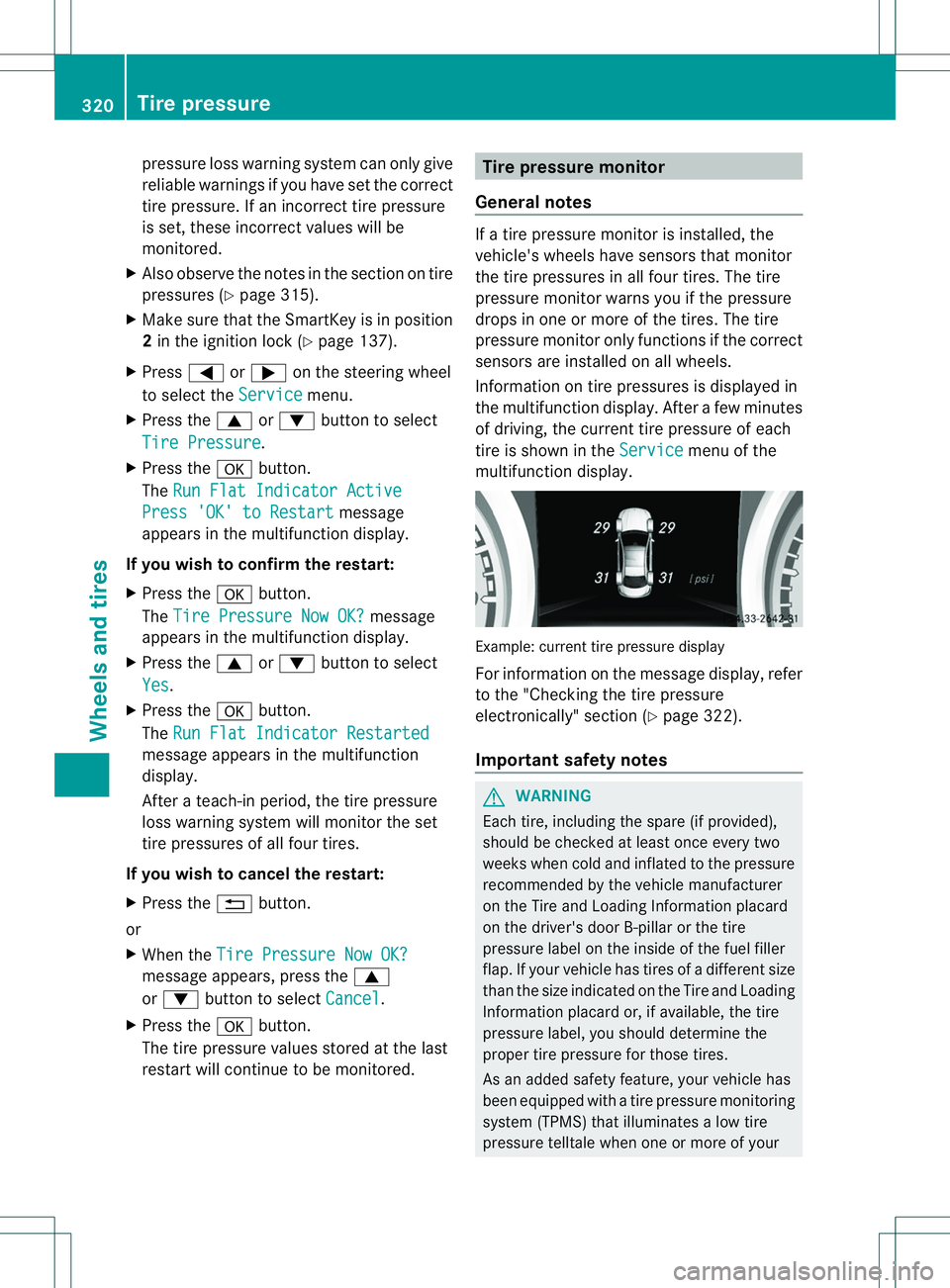
Information on tire pressures is displayed in
the multifunction display. After afew minutes
of driving, the current tire pressure of each
tire is shown in the Service menu of the
multifunction display. Example: current tire pressure display
For information on the message display, refer
to the "Checking the tire pressure
electronically"s
ection (Ypage 322).
Important safety notes G
WARNING
Each tire, including the spare (if provided),
should be checked at least once every two
weeks when cold and inflated to the pressure
recommended by the vehicle manufacturer
on the Tire and Loading Information placard
on the driver's door B-pillar or the tire
pressure label on the inside of the fuel filler
flap. If your vehicle has tires of adifferent size
than the size indicated on the Tire and Loading
Information placard or, if available, the tire
pressure label, you should determine the
proper tire pressure for those tires.
As an added safety feature, your vehicle has
been equipped with atire pressure monitoring
system (TPMS) that illuminates alow tire
pressure telltale when one or more of your 320
Tire pressureWheels and tires
Page 325 of 360
X
Set the tire pressure to the value
recommended for the corresponding
driving situation on the Tire and Loading
Information placard on the driver' sside
B-pillar (Y page 315).
Additiona ltire pressure value sfor different
load scan also be found on the tire pressure
table on the inside of the fue lfille rflap
(Y page 315).
X Make sure that the tir epressure is correct
on all four wheels.
X Make sure that the SmartKey is in position
2in the ignition lock.
X Press 000Aor0004 on the steerin gwheel
to selec tthe Service menu.
X Press the 0006or0005 button to select
Tire Pressure .
X Press the 000Cbutton.
The multifunction displays hows the
current tire pressure for the individualt ires
or the Tire pressures will be displayed after driving
afew minutes message.
X Press the 0005button.
The Use Current Pressures as New Reference Values message appears in
the multifunction display.
If you wish to confirm the restart:
X Press the 000Cbutton.
The Tire Pressure Monitor Restarted message appears in the
multifunction display.
After driving for afew minutes, the system
checksw hether the current tire pressures
are within the specified range. The new tire
pressures are then accepted as reference
values and monitored.
If you wish to cancel the restart:
X Press the 0002button.
The tire pressure values stored at the last
restart will continue to be monitored. Loading the vehicle
Instruction labels for tires and loads
G
WARNING
Overloaded tires can overheat, causing a
blowout. Overloaded tires can also impair the
steering and driving characteristics and lead
to brake failure. There is arisk of accident.
Observe the load rating of the tires. The load
rating must be at least half of the GAWR of
your vehicle. Never overload the tires by
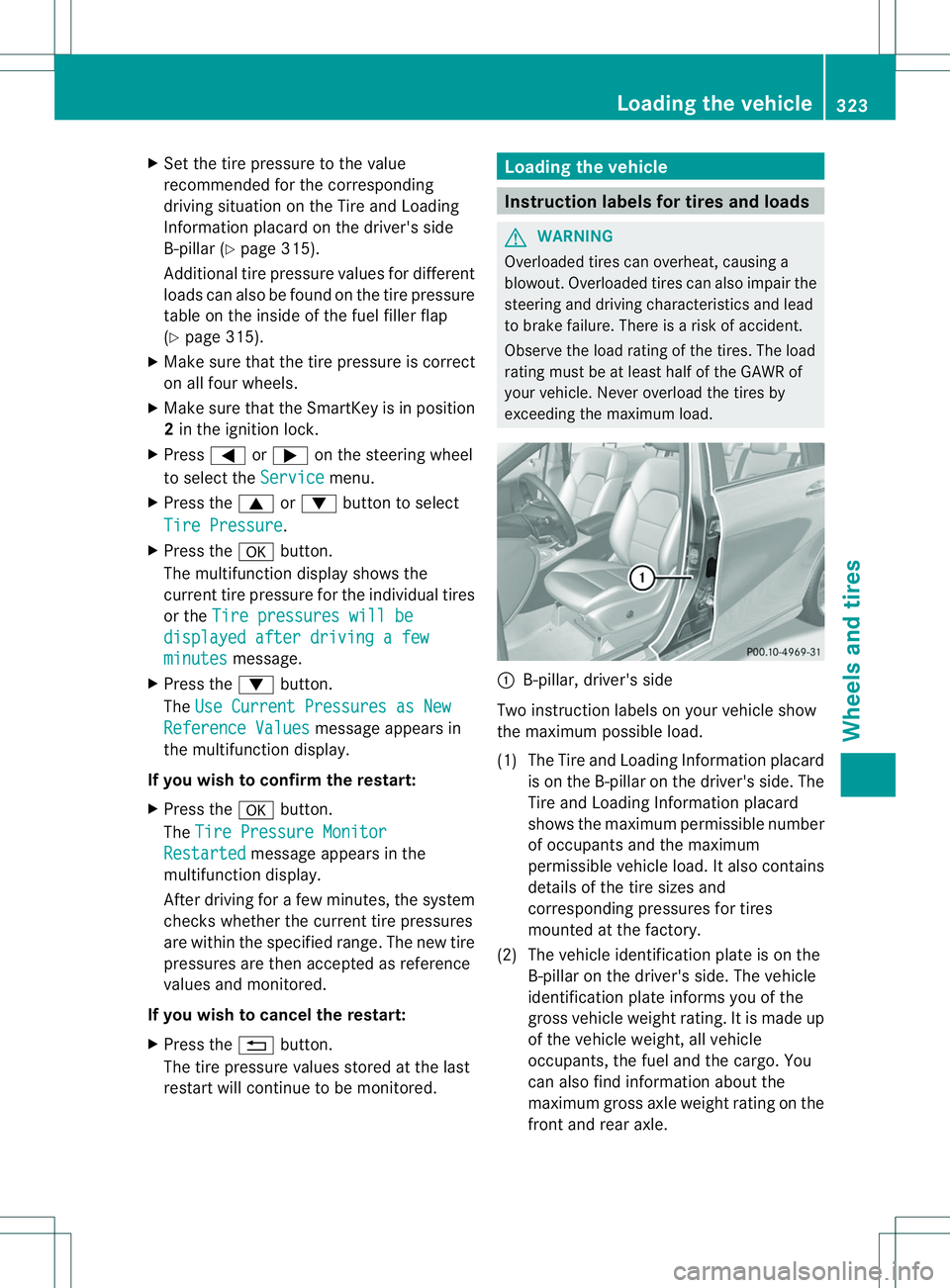
exceeding the maximum load. 001A
B-pillar, driver's side
Two instruction labelsony our vehicle show
the maximum possible load.
(1) The Tire and Loading Information placard is on the B-pillar on the driver's side. The
Tire and Loading Information placard
shows the maximum permissible number
of occupants and the maximum
permissible vehicle load. It also contains
details of the tire sizes and
corresponding pressures for tires
mounted at the factory.
(2) The vehicle identification plate is on the B-pillar on the driver's side. The vehicle
identification plate informs you of the
gross vehicle weight rating. It is made up
of the vehicle weight, all vehicle
occupants, the fuel and the cargo. You
can also find information about the
maximum gross axle weight rating on the
front and rear axle. Loading the vehicle
323Wheels and tires Z
Page 330 of 360
Uniform Tir
eQualit yGrading
Standards Overview of Tir
eQualit yGrading
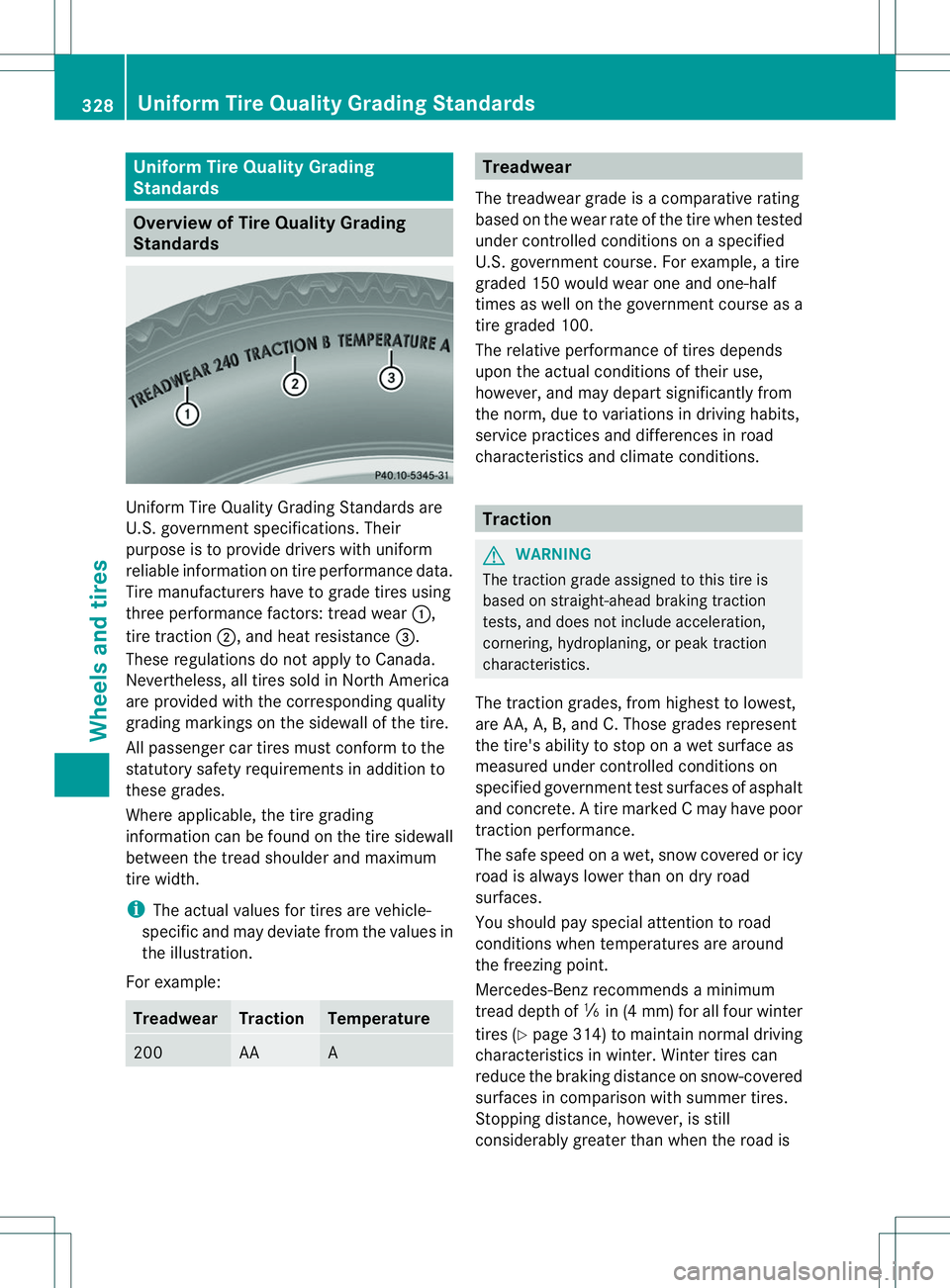
Standards Uniform Tire Quality Grading Standards are
U.S
.government specifications. Their
purpose is to provide drivers with uniform
reliable information on tire performanc edata.
Tire manufacturer shave to grade tires using
three performanc efactors: tread wear 001A,
tire traction 0010,and heat resistance 0023.
These regulation sdonot apply to Canada.
Nevertheless ,all tires sold in Nort hAmerica
are provided with the correspondin gquality
grading markings on the sidewall of the tire.
All passenger car tires must conform to the
statutory safet yrequirements in addition to
thes egrades.
Where applicable, the tire grading
information can be found on the tire sidewall
between the tread shoulder and maximum
tire width.
i The actual values for tires are vehicle-
specific and may deviate from the values in
the illustration.
For example: Treadwear Traction Temperature
200 AA A Treadwear
The treadwear grade is acomparative rating
based on the wear rate of the tire when tested
under controlled condition sonaspecified
U.S .government course. For example, atire
graded 150 would wear one and one-half
times as well on the government course as a
tire graded 100.
The relative performanc eoftires depends
upon the actual condition softheir use,
however, and may depart significantly from
the norm, due to variation sindrivinghabits,
servic epractices and differences in road
characteristic sand climat econditions. Traction
G
WARNING
The traction grade assigned to this tire is
based on straight-ahead braking traction
tests, and does not include acceleration,
cornering, hydroplaning, or peak traction
characteristics.
The traction grades, from highest to lowest,
are AA, A, B, and C. Those grades represent
the tire's ability to stop on awet surface as
measured under controlled conditions on
specified government test surfaces of asphalt
and concrete. Atire marked Cmay have poor
traction performance.
The safe speed on awet, sno wcovered or icy
road is always lower than on dry road
surfaces.
You should pay special attention to road
conditions when temperatures are around
the freezin gpoint.
Mercedes-Ben zrecommends aminimum
tread dept hof0015in(4 mm )for all four winter
tires (Y page314) to maintai nnormal driving
characteristics in winter. Winter tires can
reduce the braking distance on snow-covered
surfaces in comparison with summer tires.
Stoppin gdistance, however, is still
considerably greater than when the road is 328
Uniform TireQ
uality Grading StandardsWheels and tires