Page 343 of 422

09 Maintenance and service
Wiper blades and washer fluid09
341 Wiper blades
Service position
Wiper blades in service position.
In order to change, clean or lift the wiper blades
(for scraping off ice from the windscreen, for
example) they must be in service position.
IMPORTANT
Before placing the wiper blades in the serv-
ice position, make sure that they are not fro-
zen down.
1. Insert the remote control key in the ignition
switch1 and briefly press the START/
STOP ENGINE button to set the car's elec-trical system to key position I. (For detailed
information on key positions, see page 78.)
2.
Briefly press the START/STOP ENGINE
button again to set the car’s electrical sys-
tem in key position 0.
3. Within 3 seconds, move the right stalk
switch up and hold it in position for
approx. 1 second.
> The wipers then move to standing
straight up.
The wipers return to their starting position
when you briefly press the START/STOP
ENGINE button to set the car’s electrical sys-
tem to key position I (or when the car is
started).
IMPORTANT
If the wiper arms in service position have
been folded up from the windscreen, they
must be folded back down onto the wind-
screen before the wipers are allowed to
return to their starting position. This is to
avoid scraping the paint on the bonnet.
NOTE
Once the wiper arms have been in service
position, the wipers must be activated and
deactivated before service position can be
used again.
Replacing the wiper blades
1Not necessary in cars with Keyless function.
ProCarManuals.com
Page 344 of 422

09 Maintenance and service
Wiper blades and washer fluid 09
342
Fold up the wiper arm when it is in service
position. Press the button located on the
wiper blade mounting and pull straight out
parallel with the wiper arm.
Slide in the new wiper blade until a "click"
is heard.
Check that the blade is firmly installed.
4. Fold the wiper arm back towards the wind-
screen.
The wipers return from service position to their
starting position when you briefly press the
START/STOP ENGINE button to set the car’s
electrical system to key position I (or when the
car is started).
G021763
NOTE
The wiper blades are different lengths. The
blade on the driver's side is longer than the
blade on the passenger side.
Replacing the wiper blades, rear window
1. Fold out the wiper arm.
2. Grip the inner section of the blade (by the
arrow).
3. Turn anticlockwise to use the blade's end
position against the wiper arm as a lever to
detach the blade more easily.
4. Press the new wiper blade into position.
Check that it is firmly installed.
5. Lower the wiper arm.
CleaningFor cleaning wiper blades and windscreen, see
page 361 and onwards.
IMPORTANT
Check the wiper blades regularly.
Neglected maintenance shortens the serv-
ice life of the wiper blades.
ProCarManuals.com
Page 349 of 422
09 Maintenance and service
Battery09
* Option/accessory, for more information, see Introduction.347
NOTE
Tighten the screws to 30 Nm. Check the
torque with a torque wrench.
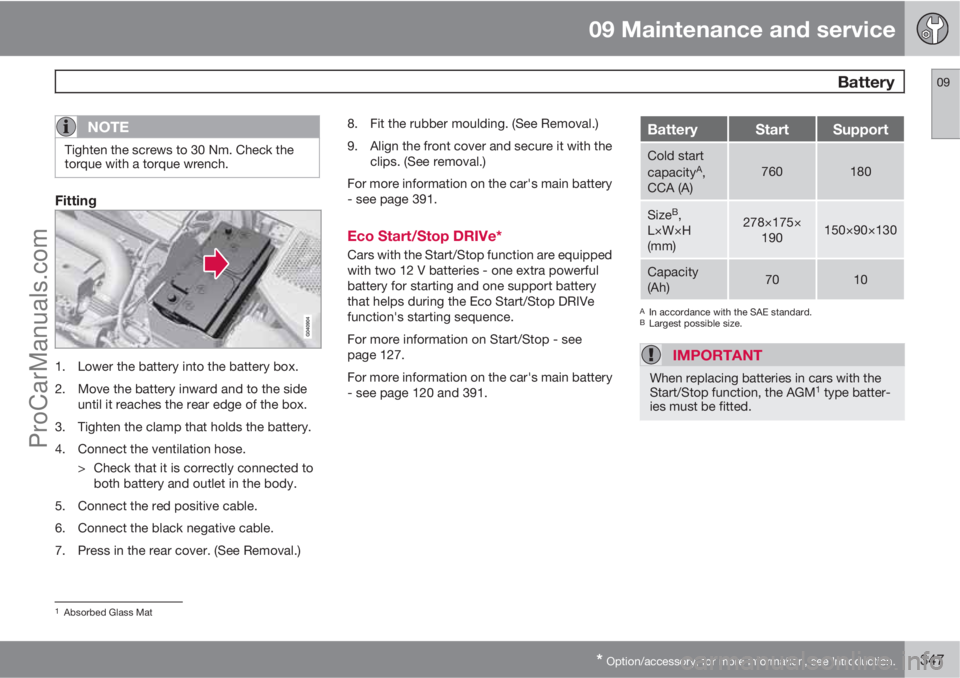
Fitting
1. Lower the battery into the battery box.
2. Move the battery inward and to the side
until it reaches the rear edge of the box.
3. Tighten the clamp that holds the battery.
4. Connect the ventilation hose.
> Check that it is correctly connected to
both battery and outlet in the body.
5. Connect the red positive cable.
6. Connect the black negative cable.
7. Press in the rear cover. (See Removal.)8. Fit the rubber moulding. (See Removal.)
9. Align the front cover and secure it with the
clips. (See removal.)
For more information on the car's main battery
- see page 391.
Eco Start/Stop DRIVe*
Cars with the Start/Stop function are equipped
with two 12 V batteries - one extra powerful
battery for starting and one support battery
that helps during the Eco Start/Stop DRIVe
function's starting sequence.
For more information on Start/Stop - see
page 127.
For more information on the car's main battery
- see page 120 and 391.
BatteryStartSupport
Cold start
capacityA,
CCA (A)760180
SizeB,
L×W×H
(mm)278×175×
190150×90×130
Capacity
(Ah)7010
AIn accordance with the SAE standard.BLargest possible size.
IMPORTANT
When replacing batteries in cars with the
Start/Stop function, the AGM1 type batter-
ies must be fitted.
1Absorbed Glass Mat
ProCarManuals.com
Page 350 of 422
09 Maintenance and service
Battery 09
348
NOTE
•The higher the current take-off in the car
(extra cooling/heating, etc.) the more
the batteries must be charged =
increased fuel consumption.
•When the capacity of the battery has
fallen below the lowest permissible level
then the Start/Stop function is disen-
gaged.
Temporarily reduced Start/Stop function due
to high current take-off means:
•The engine starts automatically2 without
the driver depressing the clutch pedal
(manual gearbox).
•The engine starts automatically without the
driver lifting his/her foot off the foot brake
pedal (automatic gearbox).
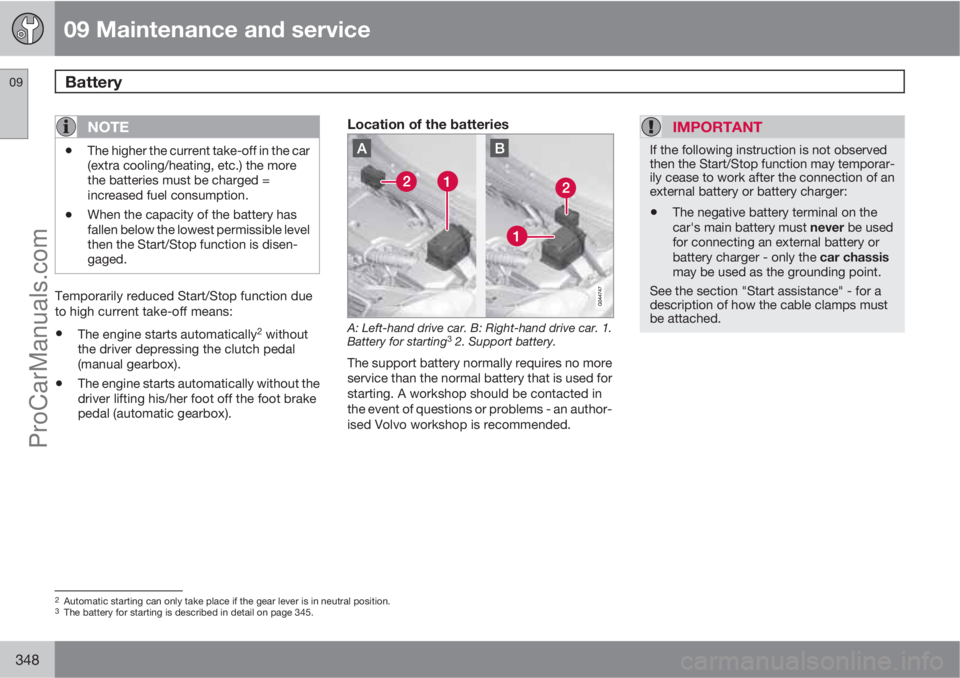
Location of the batteries
A: Left-hand drive car. B: Right-hand drive car. 1.
Battery for starting3 2. Support battery.
The support battery normally requires no more
service than the normal battery that is used for
starting. A workshop should be contacted in
the event of questions or problems - an author-
ised Volvo workshop is recommended.
IMPORTANT
If the following instruction is not observed
then the Start/Stop function may temporar-
ily cease to work after the connection of an
external battery or battery charger:
•The negative battery terminal on the
car's main battery must never be used
for connecting an external battery or
battery charger - only the car chassis
may be used as the grounding point.
See the section "Start assistance" - for a
description of how the cable clamps must
be attached.
2Automatic starting can only take place if the gear lever is in neutral position.3The battery for starting is described in detail on page 345.
ProCarManuals.com
Page 351 of 422
09 Maintenance and service
Battery09
349
NOTE
If the battery has become so discharged
that everything is "black" and in principle
the car does not have all the normal electri-
cal functions and the engine is subsequently
started using an external battery or battery
charger, then the Start/Stop function will be
activated. It will then be possible for the
engine to be auto-stopped but in the event
of an auto-stop the Start/Stop function may
fail to auto-start the engine due to inade-
quate capacity in the battery.
The battery must first be charged in order to
ensure a successful auto-start after an auto-
stop. At an outside temperature of +15 °C
the battery needs to be charged for at least
1 hour. At a lower outside temperature a
charging time of 3-4 hours is recom-
mended. The recommendation is that the
battery is charged using an external battery
charger.
If this is not possible then the recommen-
dation is to temporarily deactivate the
Start/Stop function until the battery has
been adequately recharged.
For more information about recharging the
battery, see the section "Battery" in the
chapter "Maintenance and service".
ProCarManuals.com
Page 352 of 422
09 Maintenance and service
Fuses 09
350
General
All electrical functions and components are
protected by a number of fuses in order to pro-
tect the car's electrical system from damage by
short circuiting or overloading.
If an electrical component or function does not
work, it may be because the component's fuse
was temporarily overloaded and failed. If the
same fuse fails repeatedly then there is a fault
in the circuit. Volvo recommends that you visit
an authorised Volvo workshop for checking.
Changing1. Look in the fuse diagram to locate the fuse.
2. Pull out the fuse and check from the side
to see whether the curved wire has blown.
3. If this is the case, replace it with a new fuse
of the same colour and amperage.
WARNING
Never use a foreign object, or a fuse with an
amperage higher than that specified when
replacing a fuse. This could cause signifi-
cant damage to the electrical system and
possibly lead to fire.
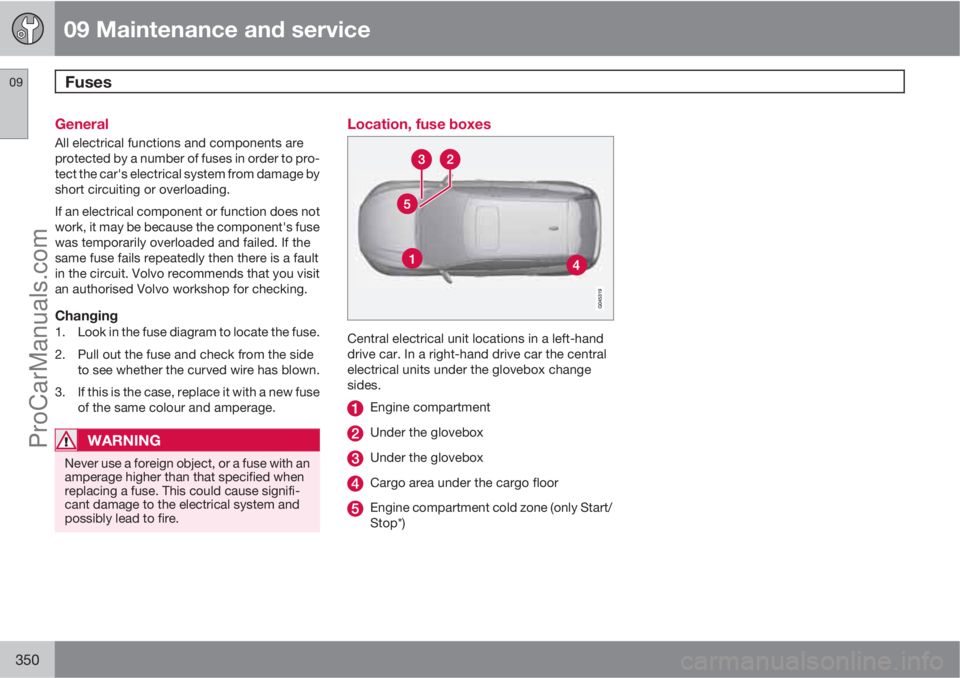
Location, fuse boxes
Central electrical unit locations in a left-hand
drive car. In a right-hand drive car the central
electrical units under the glovebox change
sides.
Engine compartment
Under the glovebox
Under the glovebox
Cargo area under the cargo floor
Engine compartment cold zone (only Start/
Stop*)
ProCarManuals.com
Page 355 of 422

09 Maintenance and service
Fuses09
��
* Option/accessory, for more information, see Introduction.353
FunctionA
--
Headlamp control5
--
--
--
Internal relay coils5
Auxiliary lamps*20
Horn15
Relay coil in main relay for
engine management system;
Engine control module (5, 6-cyl.
petrol)10
Transmission control module15
Solenoid clutch A/C (not 5-cyl.
diesel); Coolant pump (5-cyl.
diesel Start/Stop)15
FunctionA
Relay coil in relay for solenoid
clutch A/C (not 5-cyl. diesel);
Relay coil in relay for coolant
pump (5-cyl. diesel Start/Stop);
Relay coils in central electrical
unit in engine compartment cold
zone (Start/Stop)5
Start relayA30
Ignition coils (4-cyl. petrol);
Glow control module (5-cyl. die-
sel)10
Ignition coils (5, 6-cyl. petrol);
Capacitor (6-cyl.)20
Engine control module (petrol)10
Engine control module (diesel)15
FunctionA
Valves (1.6 l petrol); Mass air
flow sensor (1.6 l petrol)
Mass air flow sensor (D4162T);
Control valve, fuel flow
(D4162T)10
Mass air flow sensor (5-cyl. die-
sel, 6-cyl.); Control valves (5-
cyl. diesel); Injectors (5, 6-cyl.
petrol); Engine control module
(5-cyl. petrol, 6-cyl.)15
Solenoid clutch A/C (5, 6-cyl.);
Valves, Engine control module
(6-cyl.) Solenoids (6-cyl. without
turbo); Actuator motors, intake
manifold (6-cyl. without turbo);
Mass air flow sensor (4-cyl. 2.0
l petrol, 5-cyl. petrol); Oil level
sensor (5-cyl. diesel)
Coolant pump (D4162T)10
Lambda-sonds (4-cyl. petrol);
Lambda-sond (diesel); Control
module, radiator roller cover
(manual 5-cyl. 2.0 l diesel)10
EVAP valve (5, 6-cyl. petrol);
Lambda-sonds (5, 6-cyl. petrol)15
ProCarManuals.com
Page 356 of 422
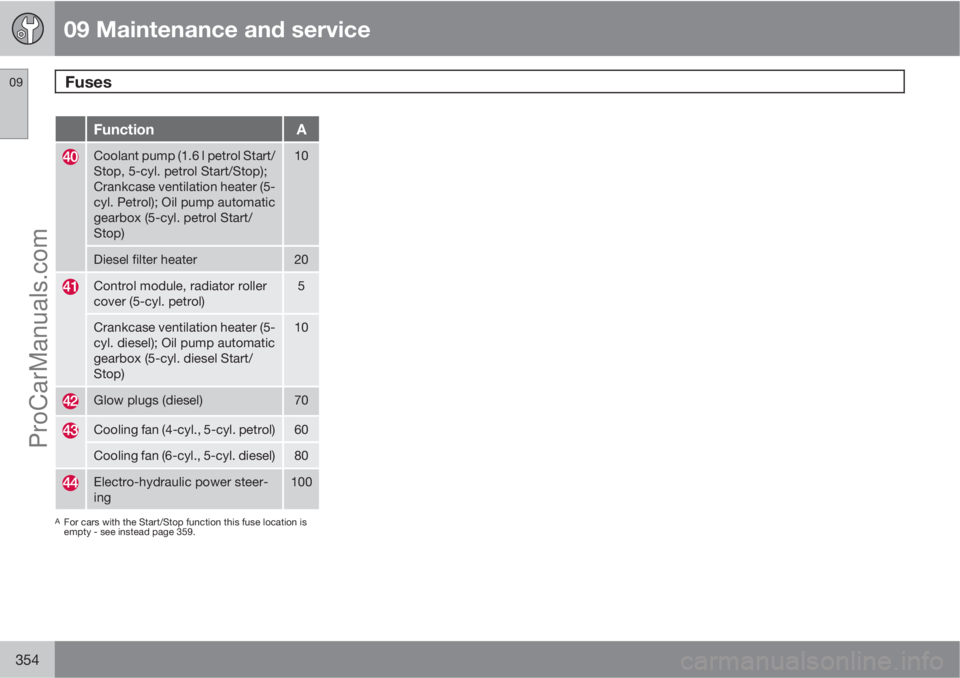
09 Maintenance and service
Fuses 09
354
FunctionA
Coolant pump (1.6 l petrol Start/
Stop, 5-cyl. petrol Start/Stop);
Crankcase ventilation heater (5-
cyl. Petrol); Oil pump automatic
gearbox (5-cyl. petrol Start/
Stop)10
Diesel filter heater20
Control module, radiator roller
cover (5-cyl. petrol)5
Crankcase ventilation heater (5-
cyl. diesel); Oil pump automatic
gearbox (5-cyl. diesel Start/
Stop)10
Glow plugs (diesel)70
Cooling fan (4-cyl., 5-cyl. petrol)60
Cooling fan (6-cyl., 5-cyl. diesel)80
Electro-hydraulic power steer-
ing100
AFor cars with the Start/Stop function this fuse location is
empty - see instead page 359.
ProCarManuals.com