2010 JAGUAR XFR Exhaust
[x] Cancel search: ExhaustPage 1370 of 3039

Symptom Possible Cause Action (EGR) valve stuck open
Fuel pump
Evaporative emissions purge
valve care manual and the relevant sections of the
workshop manual.
Read DTCs and refer to DTC Index in this
section for electronic engine control tests
Refer to the relevant section of the
workshop manual and check the Exhaust Gas
Recirculation (EGR) valve and associated
hoses and connections.
For fuel system tests refer to the relevant
section of the workshop manual
Refer to the relevant section of the
workshop manual and check the purge valve
and associated hoses and connections. Difficult hot start
Injector leak
Electronic engine controls
Evaporative emissions purge
valve
Fuel pump
Ignition system
EGR valve stuck open
Refer to the relevant section of the
workshop manual, carry out injector leak
tests, install new injectors as necessary.
Read DTCs and refer to DTC Index in this
section for electronic engine control tests
Refer to the relevant section of the
workshop manual and check the purge valve
and associated hoses and connections.
For fuel system tests refer to the relevant
section of the workshop manual
For ignition system tests refer to the
relevant section of the workshop manual
Refer to the relevant section of the
workshop manual and check the Exhaust Gas
Recirculation (EGR) valve and associated
hoses and connections. Difficult to start after hot soak
(vehicle standing, engine off, after
engine has reached operating
temperature)
Injector leak
Electronic engine controls
Evaporative emissions purge
valve
Fuel pump
Ignition system
EGR valve stuck open
Refer to the relevant section of the
workshop manual, carry out injector leak
tests, install new injectors as necessary.
Read DTCs and refer to DTC Index in this
section for electronic engine control tests
Refer to the relevant section of the
workshop manual and check the purge valve
and associated hoses and connections.
For fuel system tests refer to the relevant
section of the workshop manual
For ignition system tests refer to the
relevant section of the workshop manual
Refer to the relevant section of the
workshop manual and check the Exhaust Gas
Recirculation (EGR) valve and associated
hoses and connections. Engine cranks too fast/slow
Compressions high/low
Battery
Starting system
Refer to the relevant section of the
workshop manual, carry out compression
tests.
Ensure the battery is in a fully charged and
serviceable condition. Refer to the battery
care manual and the relevant sections of the
workshop manual.
For starting system tests refer to the
relevant section of the workshop manual Engine stalls Engine stalls soon after start
Breather system
disconnected/restricted
ECM relay
Electronic engine controls
Ignition system
Air intake system restricted
Air leakage
Fuel lines
Ensure the engine breather system is free
from restriction and is correctly installed
Read DTCs and refer to DTC Index in this
section for ECM relay tests
Read DTCs and refer to DTC Index in this
section for electronic engine control tests
For ignition system tests refer to the
relevant section of the workshop manual
Check for blockage in air cleaner element
and air intake system
Check for leakage in air intake system
For fuel system tests refer to the relevant
section of the workshop manual
Page 1371 of 3039

Symptom Possible Cause Action Engine stalls on overrun
ECM relay
Throttle position (TP)
sensors
Read DTCs and refer to DTC Index in this
section for ECM relay and TP sensor tests Engine stalls at steady speed
ECM relay
crankshaft position sensor
TP sensors
Read DTCs and refer to DTC Index in this
section for ECM relay, crankshaft position
sensor, and TP sensor tests Engine stalls with speed control
enabled
ECM relay
Read DTCs and refer to DTC Index in this
section for ECM relay tests Engine stalls when manoeuvring
ECM relay
TP sensors
Additional engine loads
(PAS, air conditioning, etc)
Transmission malfunction
CAN malfunction
Read DTCs and refer to DTC Index in this
section for ECM relay, and TP sensor tests
Check for excessive loads being placed on
the engine from PAS, air conditioning
systems etc.
Refer to the workshop manual or
transmission troubleshooting guide for
transmission system tests.
Refer to the relevant section of the
workshop manual and the electrical wiring
diagrams to perform CAN network tests. Poor driveability Engine hesitates/poor acceleration
Fuel pressure, fuel pump,
fuel lines
Injector leak
Air leakage
Electronic engine controls
Ignition system
EGR valve stuck
Transmission malfunction
Restricted pedal travel
(carpet, etc)
For fuel system tests refer to the relevant
section of the workshop manual
Carry out fuel injector leak tests, install new
injectors as necessary.
Check for leakage from air intake system
Read DTCs and refer to DTC Index in this
section for electronic engine control tests
For ignition system tests refer to the
relevant section of the workshop manual
Refer to the relevant section of the
workshop manual and check the Exhaust Gas
Recirculation (EGR) valve and associated
hoses and connections.
Refer to the workshop manual or
transmission troubleshooting guide for
transmission system tests.
Ensure accelerator pedal is free from
restriction Engine backfires
Fuel pump, fuel lines
Air leakage
Electronic engine controls
Ignition system
Sticking variable camshaft
timing (VCT) hub
For fuel system tests refer to the relevant
section of the workshop manual
Check for leakage from air intake system
Read DTCs and refer to DTC Index in this
section for electronic engine control tests
For ignition system tests refer to the
relevant section of the workshop manual
Read DTCs and refer to DTC Index in this
section for VCT system tests Engine surges
Fuel pump, fuel lines
Electronic engine controls
Ignition system
For fuel system tests refer to the relevant
section of the workshop manual
Read DTCs and refer to DTC Index in this
section for electronic engine control tests
For ignition system tests refer to the
relevant section of the workshop manual Engine detonates/knocks
Electronic engine controls
Fuel pump, fuel lines, fuel
quality
Air leakage
Sticking VCT hub
Read DTCs and refer to DTC Index in this
section for electronic engine control tests
For fuel system tests refer to the relevant
section of the workshop manual
Check for leakage from air intake system
Read DTCs and refer to DTC Index in this
section for VCT system tests www.JagDocs.com
Page 1379 of 3039
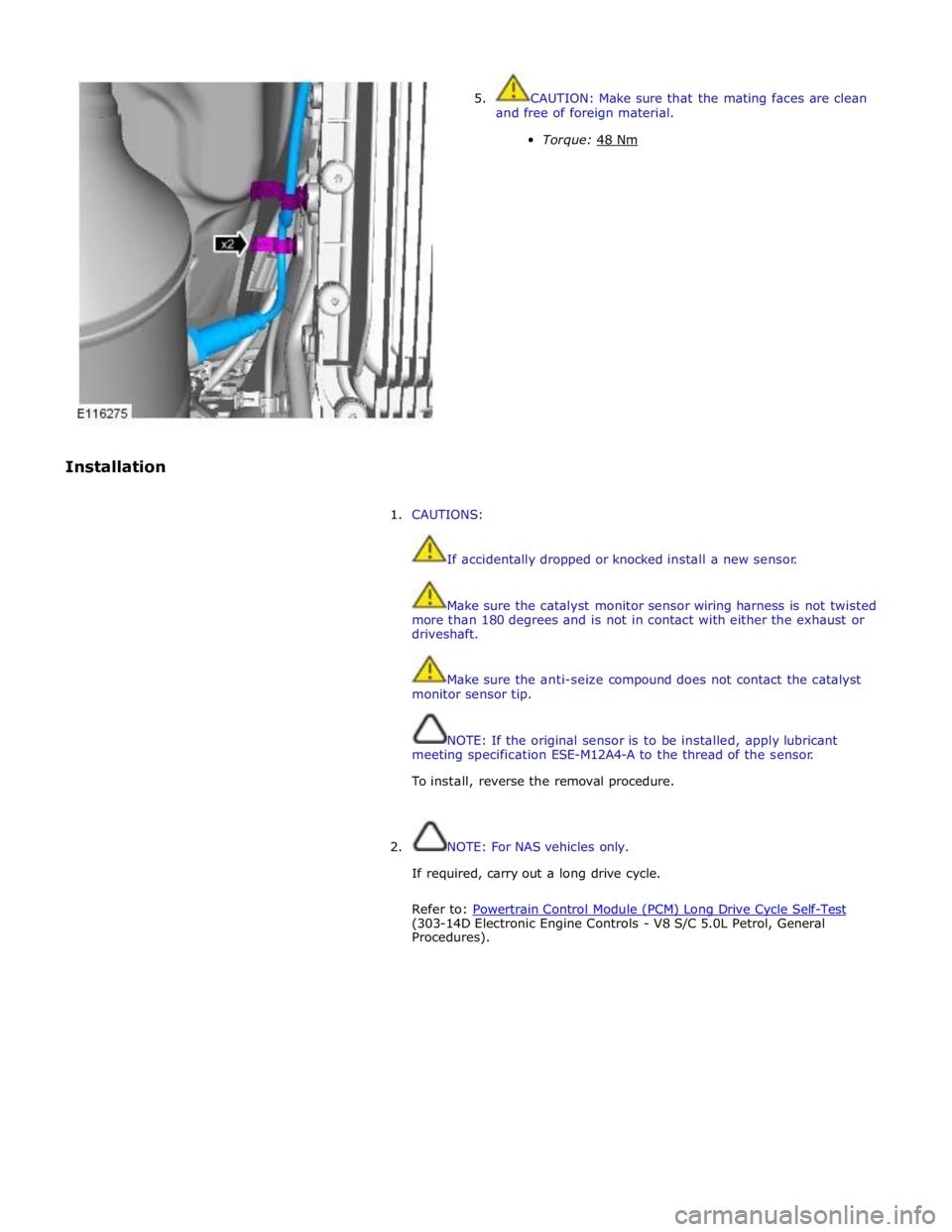
Installation 5. CAUTION: Make sure that the mating faces are clean
and free of foreign material.
Torque: 48 Nm
1. CAUTIONS:
If accidentally dropped or knocked install a new sensor.
Make sure the catalyst monitor sensor wiring harness is not twisted
more than 180 degrees and is not in contact with either the exhaust or
driveshaft.
Make sure the anti-seize compound does not contact the catalyst
monitor sensor tip.
NOTE: If the original sensor is to be installed, apply lubricant
meeting specification ESE-M12A4-A to the thread of the sensor.
To install, reverse the removal procedure.
2. NOTE: For NAS vehicles only.
If required, carry out a long drive cycle.
Refer to: Powertrain Control Module (PCM) Long Drive Cycle Self-Test (303-14D Electronic Engine Controls - V8 S/C 5.0L Petrol, General
Procedures).
Page 1381 of 3039
Installation
1. CAUTIONS:
Make sure the anti-seize compound does not contact the catalyst
monitor sensor tip.
If accidentally dropped or knocked install a new sensor.
Make sure the catalyst monitor sensor wiring harness is not twisted
more than 180 degrees and is not in contact with either the exhaust or
driveshaft.
NOTE: If the original sensor is to be installed, apply lubricant
meeting specification ESE-M12A4-A to the thread of the sensor.
To install, reverse the removal procedure.
2. NOTE: For NAS vehicles only.
If required, carry out a long drive cycle.
Refer to: Powertrain Control Module (PCM) Long Drive Cycle Self-Test (303-14D Electronic Engine Controls - V8 S/C 5.0L Petrol, General
Procedures). www.JagDocs.com
Page 1387 of 3039
Published: 19-Aug-2013
Electronic Engine Controls - V8 S/C 5.0L Petrol - Engine Coolant Temperature
(ECT) Sensor
Removal and Installation
Removal
NOTES:
Some variation in the illustrations may occur, but the essential information is always correct.
Removal steps in this procedure may contain installation details.
1. WARNING: Do not work on or under a vehicle supported only by a jack.
Always support the vehicle on safety stands.
Raise and support the vehicle.
2. Refer to: Cooling System Partial Draining, Filling and Bleeding (303-03B Engine Cooling - V6 3.0L Petrol, General Procedures).
3. Refer to: Catalytic Converter RH (309-00C Exhaust System - V8 5.0L Petrol/V8 S/C 5.0L Petrol, Removal and Installation).
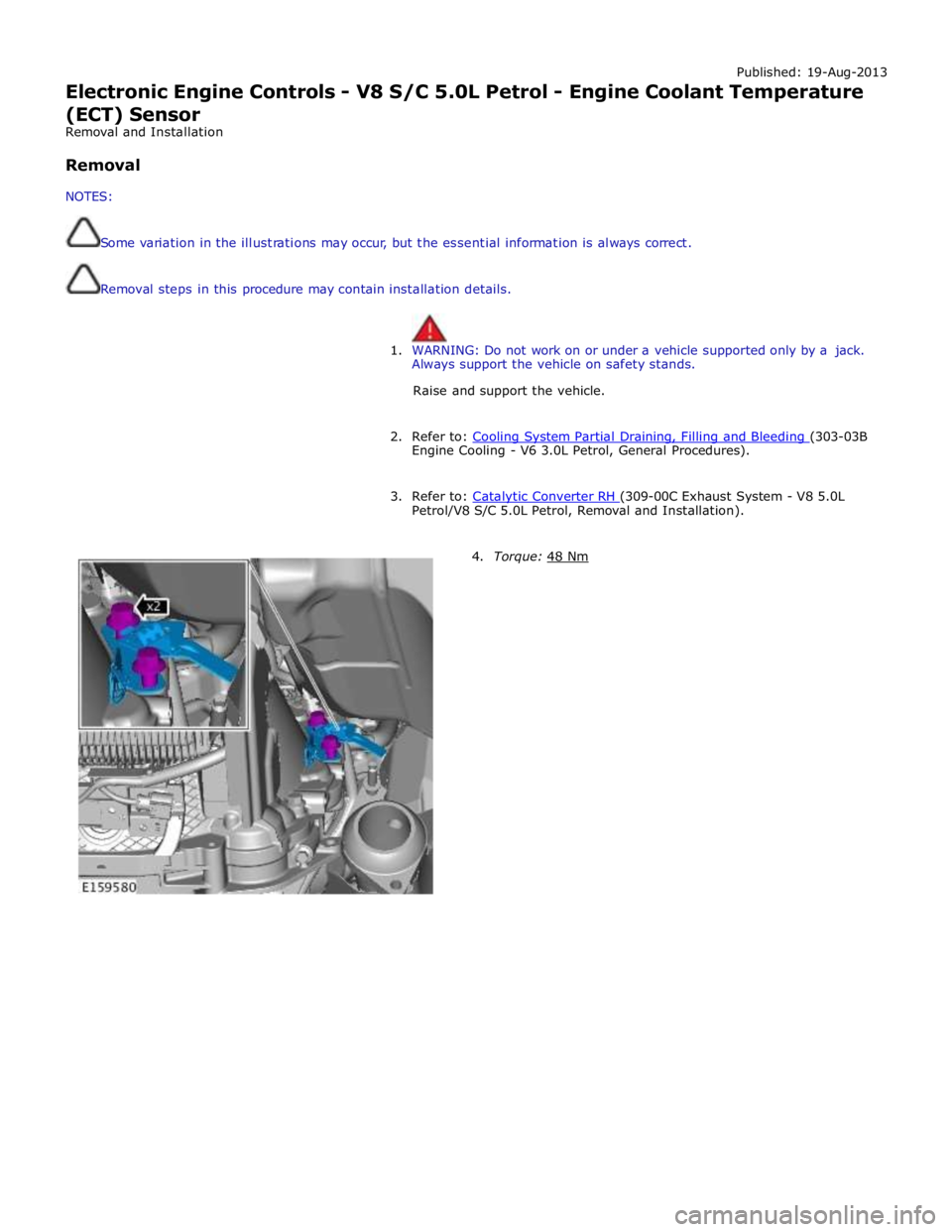
4. Torque: 48 Nm
Page 1394 of 3039
Published: 11-May-2011
Electronic Engine Controls - V8 S/C 5.0L Petrol - Heated Oxygen Sensor
(HO2S) LH
Removal and Installation
Removal
NOTE: Removal steps in this procedure may contain installation details.
1. Refer to: Battery Disconnect and Connect (414-01 Battery, Mounting and Cables, General Procedures).
2. WARNING: Do not work on or under a vehicle supported only by a jack.
Always support the vehicle on safety stands.
Raise and support the vehicle.
3. Refer to: Air Deflector (501-02 Front End Body Panels, Removal and Installation).
4. Refer to: Catalytic Converter LH (309-00C Exhaust System - V8 5.0L Petrol/V8 S/C 5.0L Petrol, Removal and Installation).
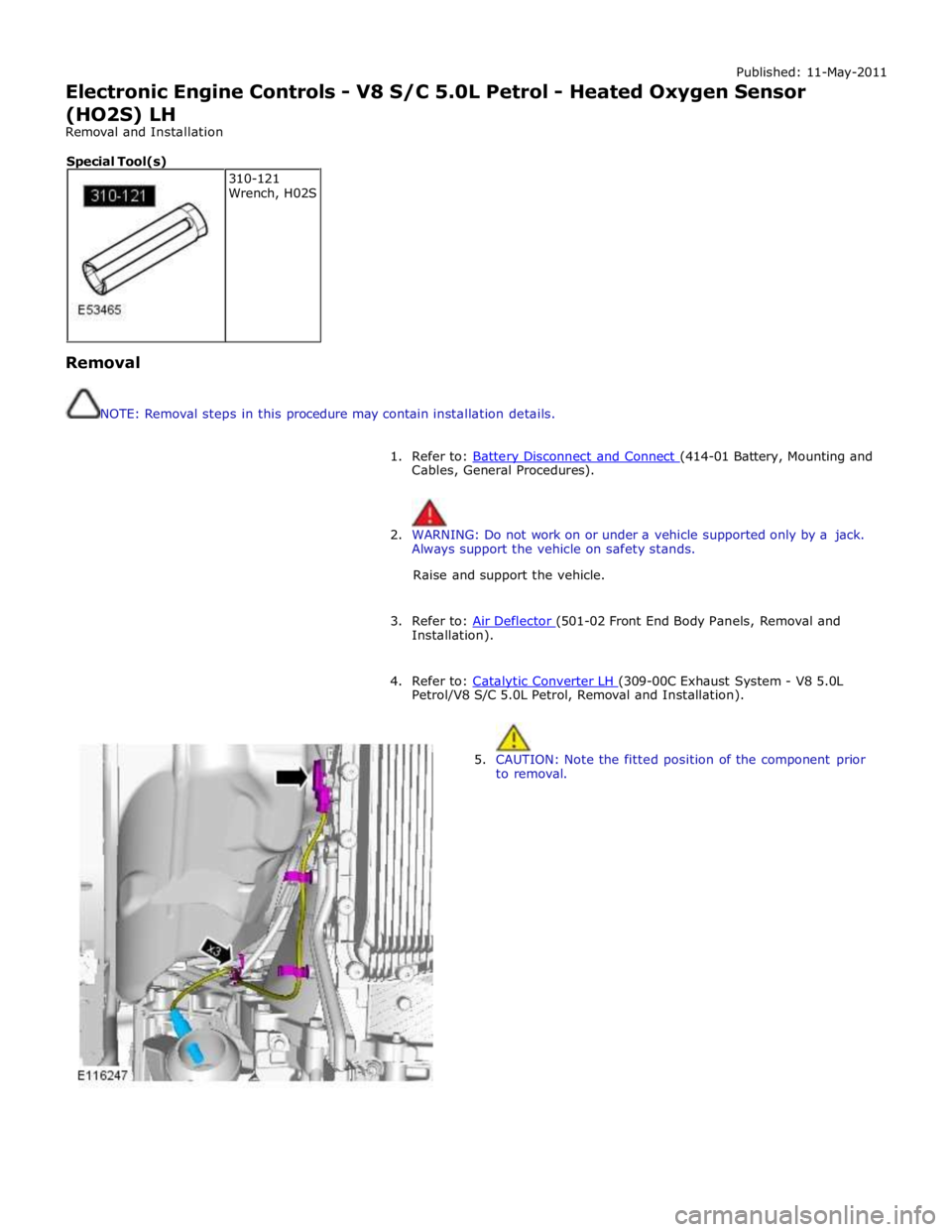
5. CAUTION: Note the fitted position of the component prior
to removal. 310-121
Wrench, H02S Special Tool(s)
Page 1395 of 3039
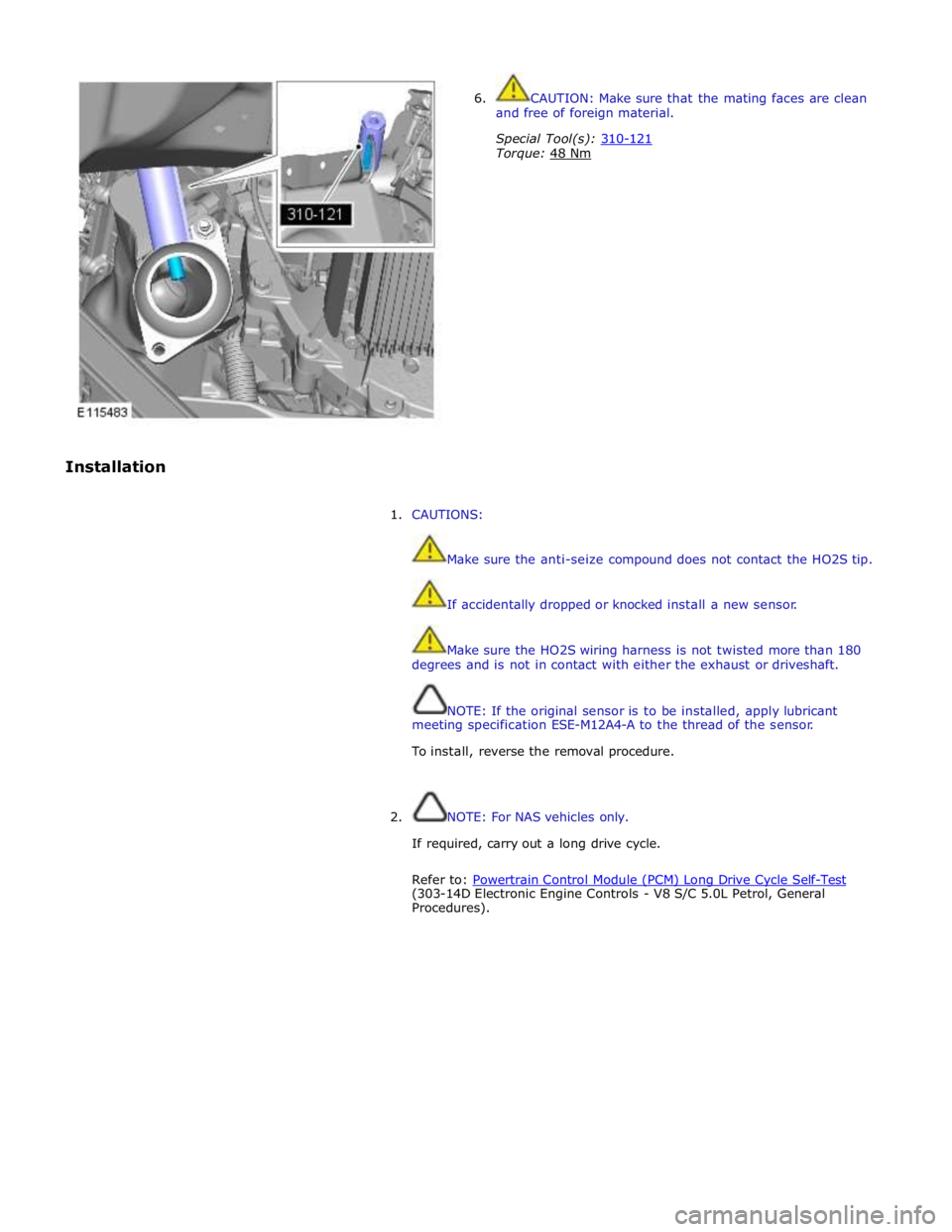
Installation 6. CAUTION: Make sure that the mating faces are clean
and free of foreign material.
Special Tool(s): 310-121 Torque: 48 Nm
1. CAUTIONS:
Make sure the anti-seize compound does not contact the HO2S tip.
If accidentally dropped or knocked install a new sensor.
Make sure the HO2S wiring harness is not twisted more than 180
degrees and is not in contact with either the exhaust or driveshaft.
NOTE: If the original sensor is to be installed, apply lubricant
meeting specification ESE-M12A4-A to the thread of the sensor.
To install, reverse the removal procedure.
2. NOTE: For NAS vehicles only.
If required, carry out a long drive cycle.
Refer to: Powertrain Control Module (PCM) Long Drive Cycle Self-Test (303-14D Electronic Engine Controls - V8 S/C 5.0L Petrol, General
Procedures).
Page 1396 of 3039
Published: 11-May-2011
Electronic Engine Controls - V8 S/C 5.0L Petrol - Heated Oxygen Sensor
(HO2S) RH
Removal and Installation
Removal
NOTE: Removal steps in this procedure may contain installation details.
1. Refer to: Battery Disconnect and Connect (414-01 Battery, Mounting and Cables, General Procedures).
2. WARNING: Do not work on or under a vehicle supported only by a jack.
Always support the vehicle on safety stands.
Raise and support the vehicle.
3. Refer to: Air Deflector (501-02 Front End Body Panels, Removal and Installation).
4. Refer to: Catalytic Converter RH (309-00C Exhaust System - V8 5.0L Petrol/V8 S/C 5.0L Petrol, Removal and Installation).
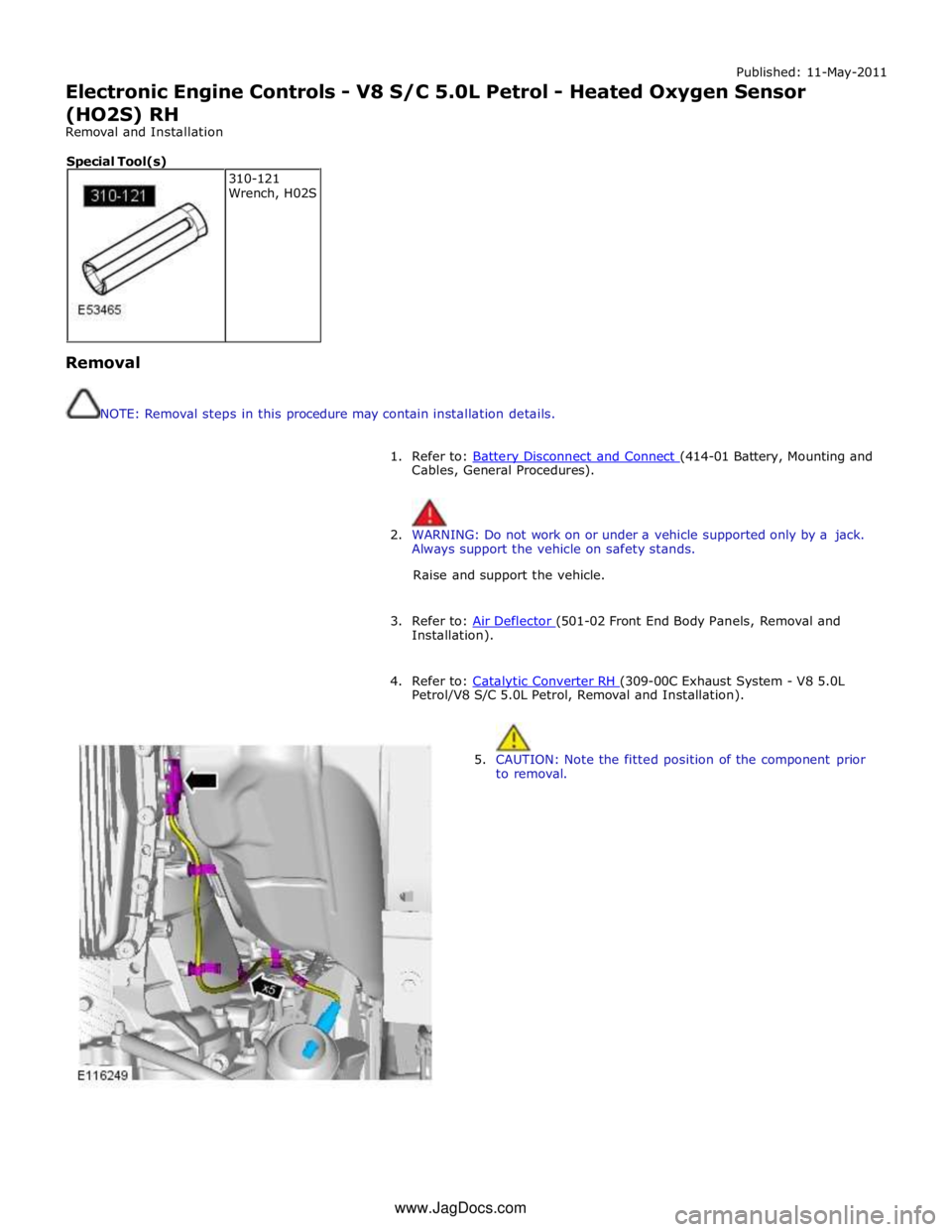
5. CAUTION: Note the fitted position of the component prior
to removal. 310-121
Wrench, H02S Special Tool(s) www.JagDocs.com