2010 JAGUAR XFR pinpoint
[x] Cancel search: pinpointPage 2349 of 3039

DTC Description Possible Causes Action approved diagnostic system to confirm
rectification. Alternatively, carry out any pinpoint
tests associated with this DTC using the
manufacturer approved diagnostic system B1225-13
Right Seat Back Temperature Sensor -
Circuit open
Connectors disconnected or
connector pin damage
Seat backrest temperature
sensor right circuit - Open
circuit
Front seat climate control
module failure
Check for any disconnected connectors or damaged
connector pins
Carry out on demand self test using manufacturer
approved diagnostic system to confirm the fault is
present
Refer to the electrical circuit diagrams and check
the front seat climate control module - Circuit
reference RH_SEAT_BACK_SENSOR, Circuit
reference RH_SEAT_BACK_SENSOR_RTN - For open
circuit. Repair circuit as required, clear DTC and
retest
Carry out on demand self test using manufacturer
approved diagnostic system to confirm
rectification. Alternatively, carry out any pinpoint
tests associated with this DTC using the
manufacturer approved diagnostic system B1229-13
Left Seat Back Temperature Sensor -
Circuit open
Connectors disconnected or
connector pin damage
Seat backrest temperature
sensor left circuit - Open
circuit
Front seat climate control
module failure
Check for any disconnected connectors or damaged
connector pins
Carry out on demand self test using manufacturer
approved diagnostic system to confirm the fault is
present
Refer to the electrical circuit diagrams and check
the front seat climate control module - Circuit
reference LH_SEAT_BACK_SENSOR, Circuit
reference LH_SEAT_BACK_SENSOR_RTN - For open
circuit. Repair circuit as required, clear DTC and
retest
Carry out on demand self test using manufacturer
approved diagnostic system to confirm
rectification. Alternatively, carry out any pinpoint
tests associated with this DTC using the
manufacturer approved diagnostic system B122A-11
Right Seat Cushion
Blower Speed Sensor -
Circuit short to ground
Seat cushion blower speed
right circuit - Short circuit
to ground
Blower motor assembly -
Short circuit to ground
Front seat climate control
module failure
Carry out on demand self test using manufacturer
approved diagnostic system to confirm the fault is
present
Refer to the electrical circuit diagrams and check
the front seat climate control module - Circuit
reference RH_CUSHION_FAN_SPEED - For short
circuit to ground. Repair circuit as required, clear
DTC and retest
Carry out on demand self test using manufacturer
approved diagnostic system to confirm
rectification. Alternatively, carry out any pinpoint
tests associated with this DTC using the
manufacturer approved diagnostic system B122A-12
Right Seat Cushion
Blower Speed Sensor -
Circuit short to battery
Seat cushion blower speed
right circuit - Short circuit
to power
Blower motor assembly -
Short circuit to power
Front seat climate control
module failure
Carry out on demand self test using manufacturer
approved diagnostic system to confirm the fault is
present
Refer to the electrical circuit diagrams and check
the front seat climate control module - Circuit
reference RH_CUSHION_FAN_SPEED - For short
circuit to power. Repair circuit as required, clear
DTC and retest
Carry out on demand self test using manufacturer
approved diagnostic system to confirm
rectification. Alternatively, carry out any pinpoint
tests associated with this DTC using the
manufacturer approved diagnostic system B122B-11
Right Seat Back Blower
Speed Sensor - Circuit
short to ground
Seat backrest blower speed
right circuit - Short circuit
to ground
Blower motor assembly -
Short circuit to ground
Front seat climate control
module failure
Carry out on demand self test using manufacturer
approved diagnostic system to confirm the fault is
present
Refer to the electrical circuit diagrams and check
the front seat climate control module - Circuit
reference RH_SEAT_BACK_FAN_SPEED - For short
circuit to ground. Repair circuit as required, clear www.JagDocs.com
Page 2350 of 3039

DTC Description Possible Causes Action DTC and retest
Carry out on demand self test using manufacturer
approved diagnostic system to confirm
rectification. Alternatively, carry out any pinpoint
tests associated with this DTC using the
manufacturer approved diagnostic system B122B-12
Right Seat Back Blower
Speed Sensor - Circuit
short to battery
Seat backrest blower speed
right circuit - Short circuit
to power
Blower motor assembly -
Short circuit to power
Front seat climate control
module failure
Carry out on demand self test using manufacturer
approved diagnostic system to confirm the fault is
present
Refer to the electrical circuit diagrams and check
the front seat climate control module - Circuit
reference RH_SEAT_BACK_FAN_SPEED - For short
circuit to power. Repair circuit as required, clear
DTC and retest
Carry out on demand self test using manufacturer
approved diagnostic system to confirm
rectification. Alternatively, carry out any pinpoint
tests associated with this DTC using the
manufacturer approved diagnostic system B122C-11
Left Seat Cushion
Blower Speed Sensor -
Circuit short to ground
Seat cushion blower speed
left circuit - Short circuit to
ground
Blower motor assembly -
Short circuit to ground
Front seat climate control
module failure
Carry out on demand self test using manufacturer
approved diagnostic system to confirm the fault is
present
Refer to the electrical circuit diagrams and check
the front seat climate control module - Circuit
reference LH_CUSHION_FAN_SPEED - For short
circuit to ground. Repair circuit as required, clear
DTC and retest
Carry out on demand self test using manufacturer
approved diagnostic system to confirm
rectification. Alternatively, carry out any pinpoint
tests associated with this DTC using the
manufacturer approved diagnostic system B122C-12
Left Seat Cushion
Blower Speed Sensor -
Circuit short to battery
Seat cushion blower speed
left circuit - Short circuit to
power
Blower motor assembly -
Short circuit to power
Front seat climate control
module failure
Carry out on demand self test using manufacturer
approved diagnostic system to confirm the fault is
present
Refer to the electrical circuit diagrams and check
the front seat climate control module - Circuit
reference LH_CUSHION_FAN_SPEED - For short
circuit to power. Repair circuit as required, clear
DTC and retest
Carry out on demand self test using manufacturer
approved diagnostic system to confirm
rectification. Alternatively, carry out any pinpoint
tests associated with this DTC using the
manufacturer approved diagnostic system B122D-11
Left Seat Back Blower
Speed Sensor - Circuit
short to ground
Seat backrest blower speed
left circuit - Short circuit to
ground
Blower motor assembly -
Short circuit to ground
Front seat climate control
module failure
Carry out on demand self test using manufacturer
approved diagnostic system to confirm the fault is
present
Refer to the electrical circuit diagrams and check
the front seat climate control module - Circuit
reference LH_SEAT_BACK_FAN_SPEED - For short
circuit to ground. Repair circuit as required, clear
DTC and retest
Carry out on demand self test using manufacturer
approved diagnostic system to confirm
rectification. Alternatively, carry out any pinpoint
tests associated with this DTC using the
manufacturer approved diagnostic system B122D-12
Left Seat Back Blower
Speed Sensor - Circuit
short to battery
Seat backrest blower speed
left circuit - Short circuit to
power
Blower motor assembly -
Short circuit to power
Front seat climate control
module failure
Carry out on demand self test using manufacturer
approved diagnostic system to confirm the fault is
present
Refer to the electrical circuit diagrams and check
the front seat climate control module - Circuit
reference LH_SEAT_BACK_FAN_SPEED - For short
circuit to power. Repair circuit as required, clear
DTC and retest
Carry out on demand self test using manufacturer
approved diagnostic system to confirm
rectification. Alternatively, carry out any pinpoint
Page 2351 of 3039
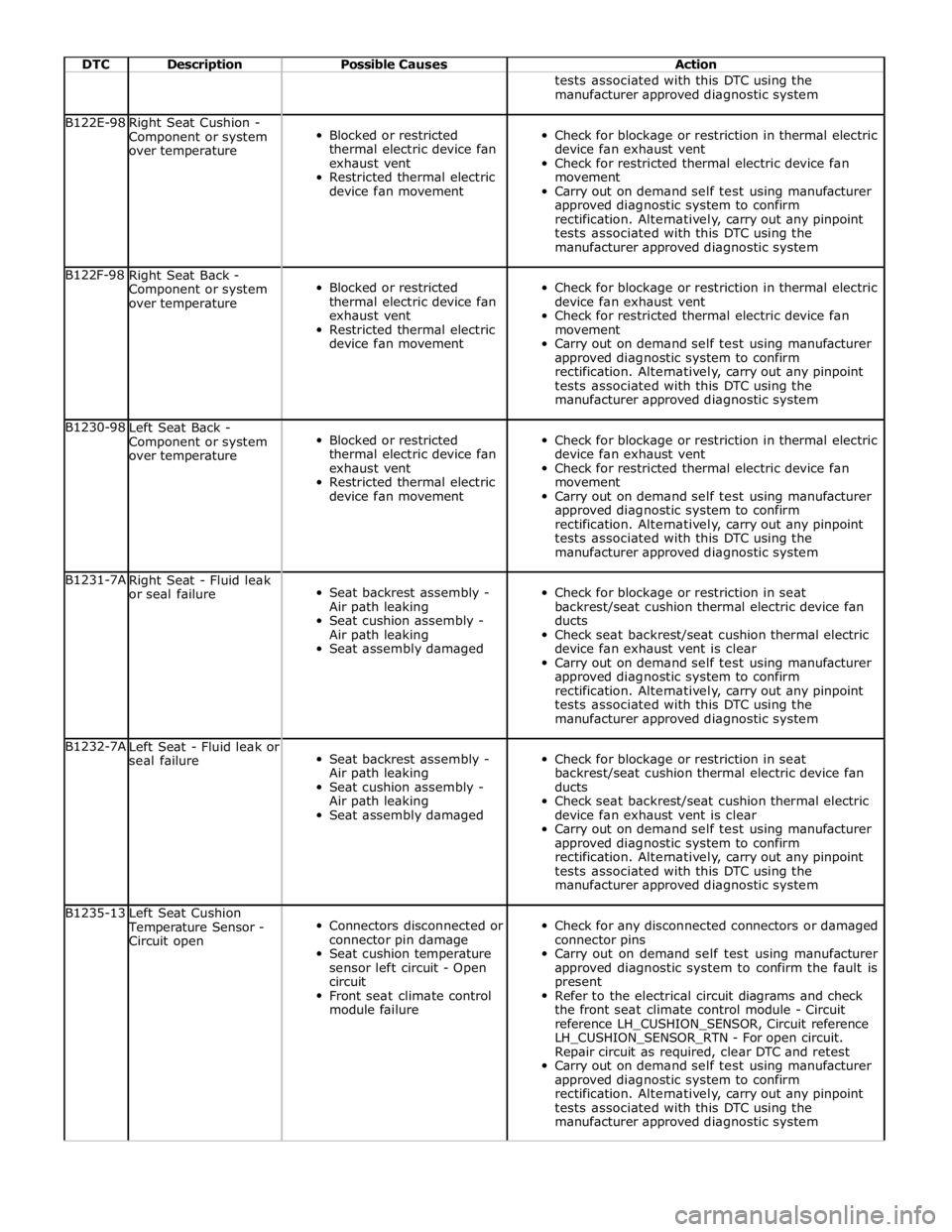
DTC Description Possible Causes Action tests associated with this DTC using the
manufacturer approved diagnostic system B122E-98
Right Seat Cushion -
Component or system
over temperature
Blocked or restricted
thermal electric device fan
exhaust vent
Restricted thermal electric
device fan movement
Check for blockage or restriction in thermal electric
device fan exhaust vent
Check for restricted thermal electric device fan
movement
Carry out on demand self test using manufacturer
approved diagnostic system to confirm
rectification. Alternatively, carry out any pinpoint
tests associated with this DTC using the
manufacturer approved diagnostic system B122F-98
Right Seat Back -
Component or system
over temperature
Blocked or restricted
thermal electric device fan
exhaust vent
Restricted thermal electric
device fan movement
Check for blockage or restriction in thermal electric
device fan exhaust vent
Check for restricted thermal electric device fan
movement
Carry out on demand self test using manufacturer
approved diagnostic system to confirm
rectification. Alternatively, carry out any pinpoint
tests associated with this DTC using the
manufacturer approved diagnostic system B1230-98
Left Seat Back -
Component or system
over temperature
Blocked or restricted
thermal electric device fan
exhaust vent
Restricted thermal electric
device fan movement
Check for blockage or restriction in thermal electric
device fan exhaust vent
Check for restricted thermal electric device fan
movement
Carry out on demand self test using manufacturer
approved diagnostic system to confirm
rectification. Alternatively, carry out any pinpoint
tests associated with this DTC using the
manufacturer approved diagnostic system B1231-7A
Right Seat - Fluid leak
or seal failure
Seat backrest assembly -
Air path leaking
Seat cushion assembly -
Air path leaking
Seat assembly damaged
Check for blockage or restriction in seat
backrest/seat cushion thermal electric device fan
ducts
Check seat backrest/seat cushion thermal electric
device fan exhaust vent is clear
Carry out on demand self test using manufacturer
approved diagnostic system to confirm
rectification. Alternatively, carry out any pinpoint
tests associated with this DTC using the
manufacturer approved diagnostic system B1232-7A
Left Seat - Fluid leak or
seal failure
Seat backrest assembly -
Air path leaking
Seat cushion assembly -
Air path leaking
Seat assembly damaged
Check for blockage or restriction in seat
backrest/seat cushion thermal electric device fan
ducts
Check seat backrest/seat cushion thermal electric
device fan exhaust vent is clear
Carry out on demand self test using manufacturer
approved diagnostic system to confirm
rectification. Alternatively, carry out any pinpoint
tests associated with this DTC using the
manufacturer approved diagnostic system B1235-13
Left Seat Cushion Temperature Sensor -
Circuit open
Connectors disconnected or
connector pin damage
Seat cushion temperature
sensor left circuit - Open
circuit
Front seat climate control
module failure
Check for any disconnected connectors or damaged
connector pins
Carry out on demand self test using manufacturer
approved diagnostic system to confirm the fault is
present
Refer to the electrical circuit diagrams and check
the front seat climate control module - Circuit
reference LH_CUSHION_SENSOR, Circuit reference
LH_CUSHION_SENSOR_RTN - For open circuit.
Repair circuit as required, clear DTC and retest
Carry out on demand self test using manufacturer
approved diagnostic system to confirm
rectification. Alternatively, carry out any pinpoint
tests associated with this DTC using the
manufacturer approved diagnostic system
Page 2417 of 3039
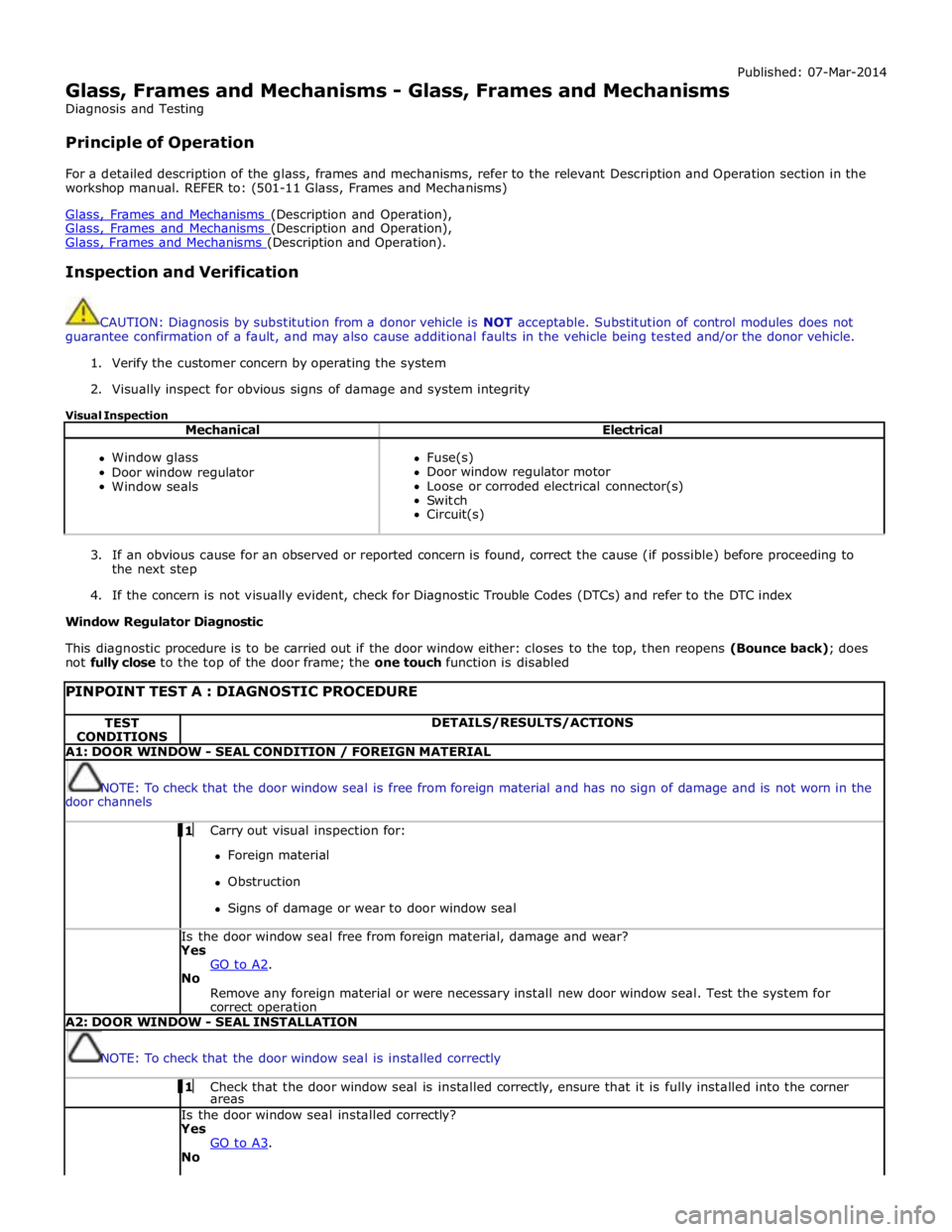
Published: 07-Mar-2014
Glass, Frames and Mechanisms - Glass, Frames and Mechanisms
Diagnosis and Testing
Principle of Operation
For a detailed description of the glass, frames and mechanisms, refer to the relevant Description and Operation section in the
workshop manual. REFER to: (501-11 Glass, Frames and Mechanisms)
Glass, Frames and Mechanisms (Description and Operation), Glass, Frames and Mechanisms (Description and Operation), Glass, Frames and Mechanisms (Description and Operation).
Inspection and Verification
CAUTION: Diagnosis by substitution from a donor vehicle is NOT acceptable. Substitution of control modules does not
guarantee confirmation of a fault, and may also cause additional faults in the vehicle being tested and/or the donor vehicle.
1. Verify the customer concern by operating the system
2. Visually inspect for obvious signs of damage and system integrity
Visual Inspection
Mechanical Electrical
Window glass
Door window regulator
Window seals
Fuse(s)
Door window regulator motor
Loose or corroded electrical connector(s)
Switch
Circuit(s)
3. If an obvious cause for an observed or reported concern is found, correct the cause (if possible) before proceeding to
the next step
4. If the concern is not visually evident, check for Diagnostic Trouble Codes (DTCs) and refer to the DTC index
Window Regulator Diagnostic
This diagnostic procedure is to be carried out if the door window either: closes to the top, then reopens (Bounce back); does
not fully close to the top of the door frame; the one touch function is disabled
PINPOINT TEST A : DIAGNOSTIC PROCEDURE TEST
CONDITIONS DETAILS/RESULTS/ACTIONS A1: DOOR WINDOW - SEAL CONDITION / FOREIGN MATERIAL
NOTE: To check that the door window seal is free from foreign material and has no sign of damage and is not worn in the
door channels 1 Carry out visual inspection for: Foreign material
Obstruction
Signs of damage or wear to door window seal Is the door window seal free from foreign material, damage and wear?
Yes
GO to A2. No
Remove any foreign material or were necessary install new door window seal. Test the system for
correct operation A2: DOOR WINDOW - SEAL INSTALLATION
NOTE: To check that the door window seal is installed correctly 1 Check that the door window seal is installed correctly, ensure that it is fully installed into the corner areas Is the door window seal installed correctly?
Yes
GO to A3. No
Page 2419 of 3039
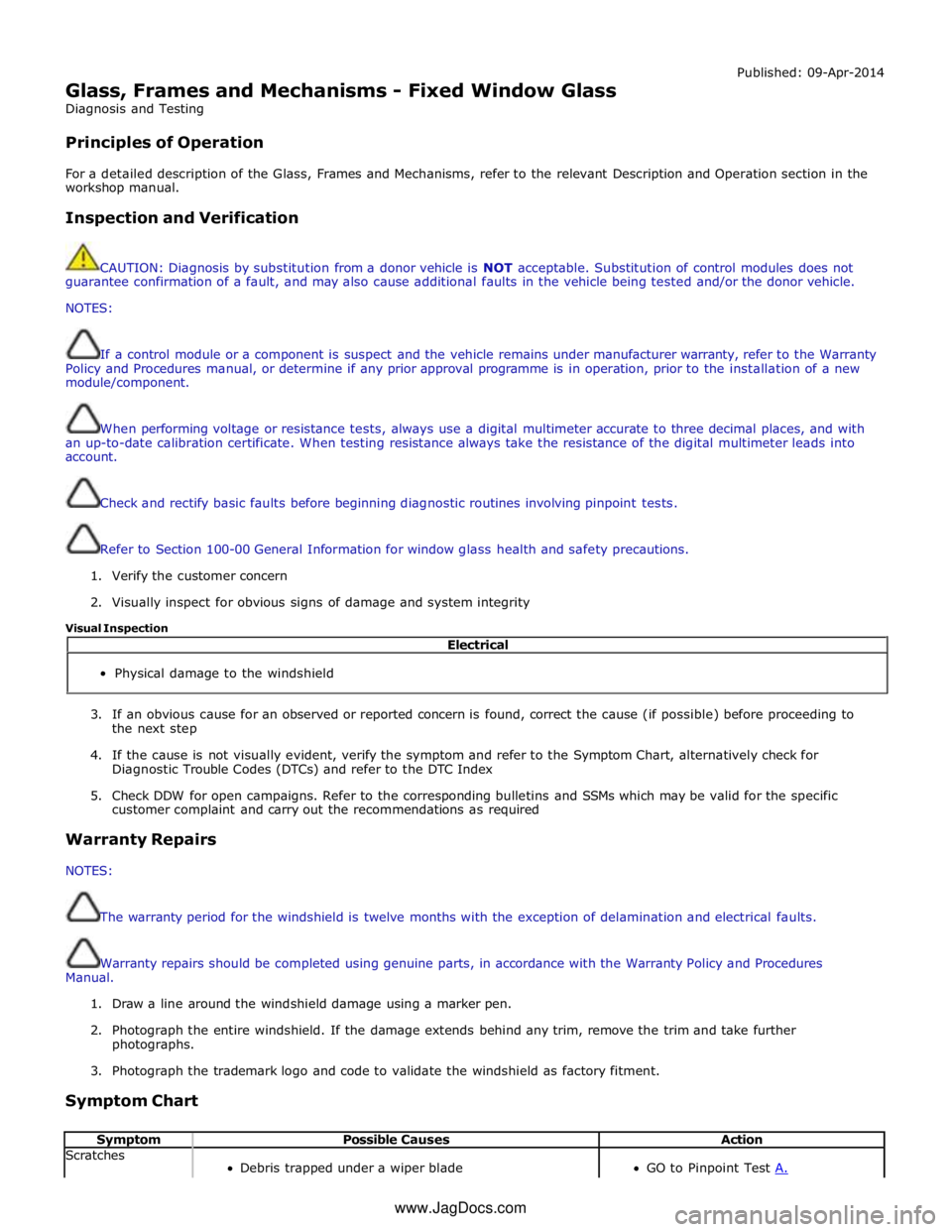
Glass, Frames and Mechanisms - Fixed Window Glass
Diagnosis and Testing
Principles of Operation Published: 09-Apr-2014
For a detailed description of the Glass, Frames and Mechanisms, refer to the relevant Description and Operation section in the
workshop manual.
Inspection and Verification
CAUTION: Diagnosis by substitution from a donor vehicle is NOT acceptable. Substitution of control modules does not
guarantee confirmation of a fault, and may also cause additional faults in the vehicle being tested and/or the donor vehicle.
NOTES:
If a control module or a component is suspect and the vehicle remains under manufacturer warranty, refer to the Warranty
Policy and Procedures manual, or determine if any prior approval programme is in operation, prior to the installation of a new
module/component.
When performing voltage or resistance tests, always use a digital multimeter accurate to three decimal places, and with
an up-to-date calibration certificate. When testing resistance always take the resistance of the digital multimeter leads into
account.
Check and rectify basic faults before beginning diagnostic routines involving pinpoint tests.
Refer to Section 100-00 General Information for window glass health and safety precautions.
1. Verify the customer concern
2. Visually inspect for obvious signs of damage and system integrity
Visual Inspection
3. If an obvious cause for an observed or reported concern is found, correct the cause (if possible) before proceeding to
the next step
4. If the cause is not visually evident, verify the symptom and refer to the Symptom Chart, alternatively check for
Diagnostic Trouble Codes (DTCs) and refer to the DTC Index
5. Check DDW for open campaigns. Refer to the corresponding bulletins and SSMs which may be valid for the specific
customer complaint and carry out the recommendations as required
Warranty Repairs
NOTES:
The warranty period for the windshield is twelve months with the exception of delamination and electrical faults.
Warranty repairs should be completed using genuine parts, in accordance with the Warranty Policy and Procedures
Manual.
1. Draw a line around the windshield damage using a marker pen.
2. Photograph the entire windshield. If the damage extends behind any trim, remove the trim and take further
photographs.
3. Photograph the trademark logo and code to validate the windshield as factory fitment.
Symptom Chart
Symptom Possible Causes Action Scratches
Debris trapped under a wiper blade
GO to Pinpoint Test A. Electrical
Physical damage to the windshield
www.JagDocs.com
Page 2420 of 3039
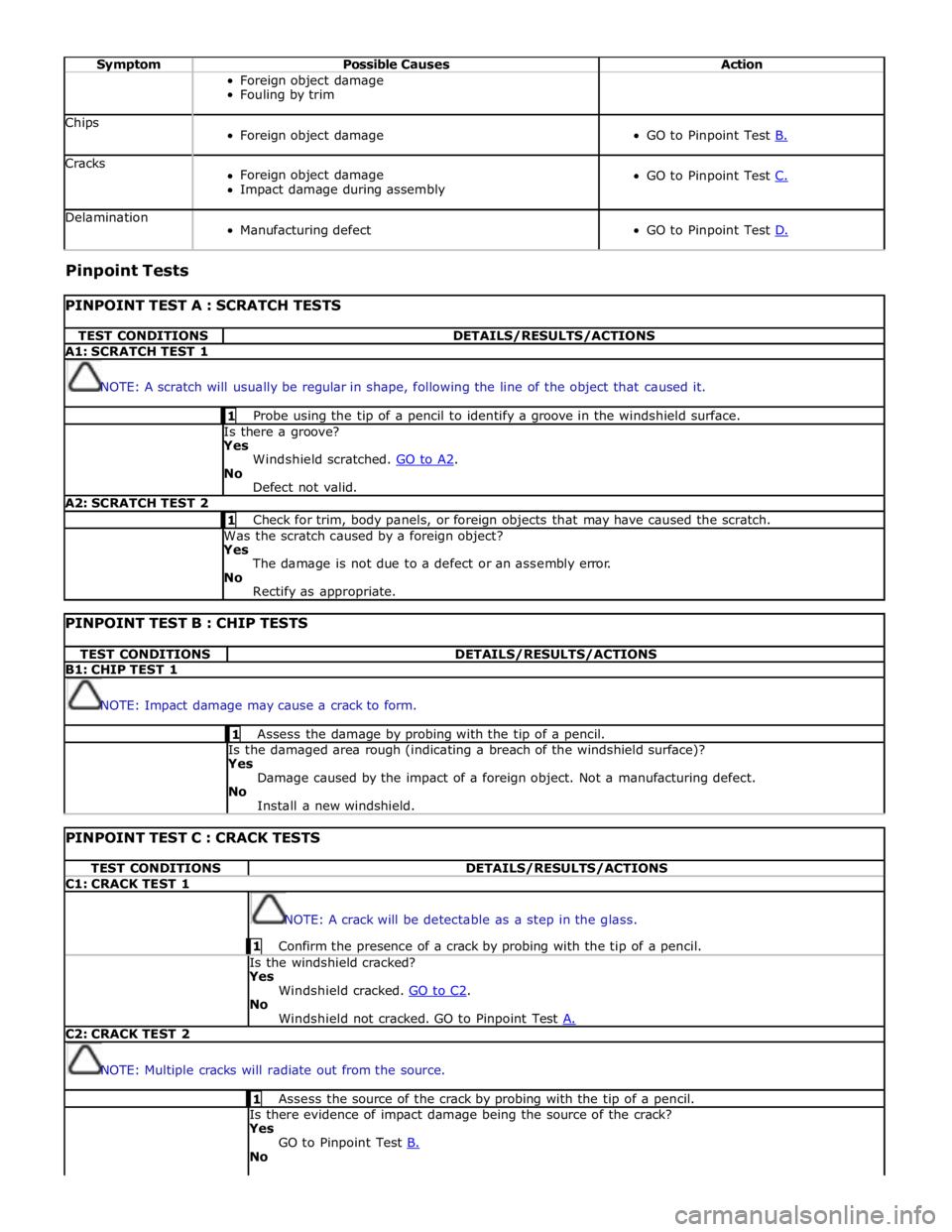
Symptom Possible Causes Action Foreign object damage
Fouling by trim Chips
Foreign object damage
GO to Pinpoint Test B. Cracks
Foreign object damage
Impact damage during assembly
GO to Pinpoint Test C. Delamination
Manufacturing defect
GO to Pinpoint Test D. Pinpoint Tests
PINPOINT TEST A : SCRATCH TESTS TEST CONDITIONS DETAILS/RESULTS/ACTIONS A1: SCRATCH TEST 1
NOTE: A scratch will usually be regular in shape, following the line of the object that caused it. 1 Probe using the tip of a pencil to identify a groove in the windshield surface. Is there a groove? Yes
Windshield scratched. GO to A2. No
Defect not valid. A2: SCRATCH TEST 2 1 Check for trim, body panels, or foreign objects that may have caused the scratch. Was the scratch caused by a foreign object? Yes
The damage is not due to a defect or an assembly error.
No
Rectify as appropriate.
PINPOINT TEST B : CHIP TESTS TEST CONDITIONS DETAILS/RESULTS/ACTIONS B1: CHIP TEST 1
NOTE: Impact damage may cause a crack to form. 1 Assess the damage by probing with the tip of a pencil. Is the damaged area rough (indicating a breach of the windshield surface)? Yes
Damage caused by the impact of a foreign object. Not a manufacturing defect.
No
Install a new windshield.
PINPOINT TEST C : CRACK TESTS TEST CONDITIONS DETAILS/RESULTS/ACTIONS C1: CRACK TEST 1
NOTE: A crack will be detectable as a step in the glass. 1 Confirm the presence of a crack by probing with the tip of a pencil. Is the windshield cracked?
Yes
Windshield cracked. GO to C2. No
Windshield not cracked. GO to Pinpoint Test A. C2: CRACK TEST 2
NOTE: Multiple cracks will radiate out from the source. 1 Assess the source of the crack by probing with the tip of a pencil. Is there evidence of impact damage being the source of the crack?
Yes
GO to Pinpoint Test B. No
Page 2495 of 3039
Published: 18-Mar-2014
Handles, Locks, Latches and Entry Systems - Locks, Latches and Entry Systems
Diagnosis and Testing
Principle of Operation
For a detailed description of the locks, latches and entry systems and operation, refer to the relevant Description and
Operation section of the workshop manual. REFER to: Handles, Locks, Latches and Entry Systems (501-14, Description and
Operation).
Inspection and Verification
CAUTION: Diagnosis by substitution from a donor vehicle is NOT acceptable. Substitution of control modules does not
guarantee confirmation of a fault and may also cause additional faults in the vehicle being checked and/or the donor vehicle
NOTE: Check and rectify basic faults before beginning diagnostic routines involving pinpoint tests
1. Verify the customer concern, to be sure the correct issue is investigated
2. Visually inspect for obvious signs of damage and system integrity
Visual Inspection
Mechanical Electrical
Incorrectly aligned door(s), hood or tailgate
Fuel filler door lock actuator
Hood release handle
Hood release cables
Hood latch(es)
Exterior door handle(s)
Interior door handle(s)
Cable(s)
Tailgate release switch
Rear window release switch
Fuses
Wiring harness
Wiring connector(s)
Door lock actuator(s)
Remote transmitter (key-fob or smart key)
Central locking switches
Controller Area Network (CAN) circuits
Radio frequency (RF) receiver
Central junction box (CJB)
Loose or corroded connections
3. If an obvious cause for an observed or reported concern is found, correct the cause (if possible) before proceeding to
the next step
4. If the cause is not visually evident verify the symptom and refer to the Symptom Chart, alternatively check for
Diagnostic Trouble Codes (DTCs) and refer to the DTC Index
Symptom Chart
NOTE: Complete the diagnostic steps below to confirm any concern prior to replacing any component
Symptom Possible Causes Action The message center indicates that the
hood, the luggage compartment is
open when it appears to be closed
Incorrect striker
alignment/adjustment
Ajar switch circuit short circuit to
ground
Ajar switch failure
Check/adjust the strikers as
necessary
Check for DTCs indicating an ajar
switch fault. Refer to the DTC index Vehicle indicates a miss-lock when the
hood, luggage compartment appear to
be closed Fuel flap does not lock/unlock
Fuel flap cable detached from body
Fuel flap actuator detached from
mounting bracket
Fuel flap actuator disconnected
Fuel flap actuator failure
Check the condition and installation
of the fuel flap cable
Check the security of the fuel flap
actuator and bracket
Check the security of the actuator
electrical connector
Check for DTCs indicating a fuel flap
actuator fault. Refer to the DTC
index Door(s) will not unlatch/open when
using outside door handle
Exterior door handle
condition/installation
Exterior release cable disconnected
from exterior door handle or door
latch
Check the exterior door handle
condition and installation
Check the condition and security of
the exterior release cable
Single door will not open from the
Page 2496 of 3039
Symptom Possible Causes Action outside (but opens from the
inside) GO to Pinpoint Test A. Door(s) will not unlatch/open when
using inside door handle
Child lock(s) engaged
Interior door handle
condition/installation
Interior release cable disconnected
from interior door handle or door
latch
Check that the child locks are
disengaged
Check the interior door handle
condition and installation
Check the condition and security of
the interior release cable
Single Door Will Not Open From
The Inside (but opens from the
outside) GO to Pinpoint Test B. Door(s) will not lock/unlock from key
fob, key or internal lock switch
Wiring harness/connectors
Central junction box (CJB)
Door lock switch
Cable fault
Check for relevant stored DTCs
Once any DTC related faults have
been rectified continue with the
diagnostic steps below
No lock / unlock function from
key-fob GO to Pinpoint Test C. Door ajar or miss lock signal at
message centre when door(s) are
closed or alarm triggering
Wiring harness
Instrument cluster
Incorrect striker
alignment/adjustment
Ajar switch circuit short circuit to
ground
Ajar switch failure
Latch Mounted Door Ajar Switch
Test GO to Pinpoint Test D. DTC Index
For a list of Diagnostic Trouble Codes (DTCs) that could be logged on this vehicle, please refer to Section 100-00.
REFER to: Communications Network (418-00, Diagnosis and Testing) /
Locks, Latches and Entry Systems - DTC: With (501-14, Diagnosis and Testing).
Pinpoint Test
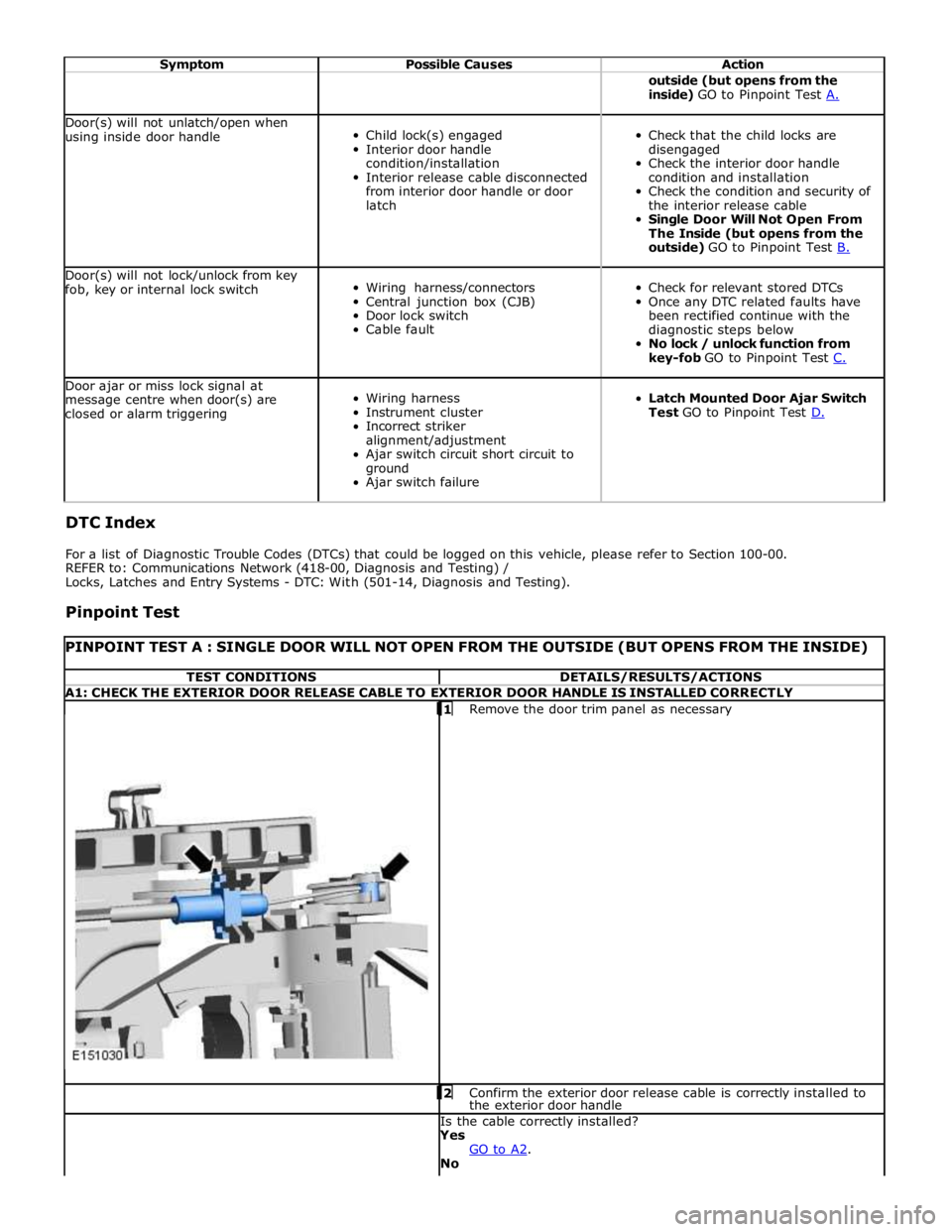
PINPOINT TEST A : SINGLE DOOR WILL NOT OPEN FROM THE OUTSIDE (BUT OPENS FROM THE INSIDE) TEST CONDITIONS DETAILS/RESULTS/ACTIONS A1: CHECK THE EXTERIOR DOOR RELEASE CABLE TO EXTERIOR DOOR HANDLE IS INSTALLED CORRECTLY
1 Remove the door trim panel as necessary 2 Confirm the exterior door release cable is correctly installed to the exterior door handle Is the cable correctly installed?
Yes
GO to A2. No