2009 SUBARU TRIBECA Negative
[x] Cancel search: NegativePage 850 of 2453

FS-2
General Description
FRONT SUSPENSION
1. General Description
A: SPECIFICATION
NOTE:
•Front and rear toe–in and front camber can be adjusted. Adjust if the toe–in or camber tolerance exceeds
specifications.
•Other items indicated in the specifications table cannot be adjusted. If other items exceed specifications,
check the suspension parts and connections for deformation, and replace with new ones as required.
Fr o nt
Wheel arch height
442 (17.4)[Tolerance: +12 mm –24 mm
( +0.47 in –0.94 in)]
mm (in)
Camber (Tolerance: Differences between RH
and LH: 45′ or less)0°00′
Caster (Referential Value) 4°04′
Steering angle (Tolerance: ±1.5°)Inner wheel 37.0°
Outer wheel 32.0°
To e – i n m m ( i n ) 0±3 (0±0.12) Toe angle (sum of both wheels): 0°±0°14′
Kingpin angle (Referential Value) 12°12′
Diameter of stabilizer mm (in) 25 (0.98)
Rear
Wheel arch height
439 (17.3)[Tolerance: +12 mm – 24 mm
( +0.47 in – 0.94 in)]
mm (in)
Camber (Tolerance: Differences between RH
and LH: 45′ or less)–0°31′
To e – i n m m ( i n ) 2±2 (0.08±0.08) Toe angle (sum of both wheels): 0°±0°14′
Thrust angle (Tolerance: ±0°30′)0°
Diameter of stabilizer mm (in) 16 (0.63)
(1) Front
A – B = Positive: Toe-in, Negative: Toe–out
α = Individual toe angles
FS-00001
B
A
(1)
Page 935 of 2453

RS-2
General Description
REAR SUSPENSION
1. General Description
A: SPECIFICATION
NOTE:
•Front and rear toe–in and front camber can be
adjusted. Adjust if the toe–in or camber tolerance
exceeds specifications.
•Other items indicated in the specifications table
cannot be adjusted. If other items exceed specifica-
tions, check the suspension parts and connections
for deformation, and replace with new ones as re-
quired.
Wheel arch height
[Tolerance: +12 mm -24 mm ( +0.47 in -0.94 in)]mm (in) 439 (17.3)
Camber
[Tolerance: ±0°45′ Difference between RH and LH 45′ or less]–0°31′
To e – i n m m ( i n ) 2±2 (0.08±0.08) Toe angle (sum of both wheels): 0°9'±0°9'
Thrust angle [Tolerance: ±0°30′]0°
Diameter of stabilizer mm (in) 16 (0.63)
(1) Front
A – B = Positive: Toe-in, Negative: Toe–out
α = Individual toe angles
FS-00001
B
A
(1)
Page 1043 of 2453
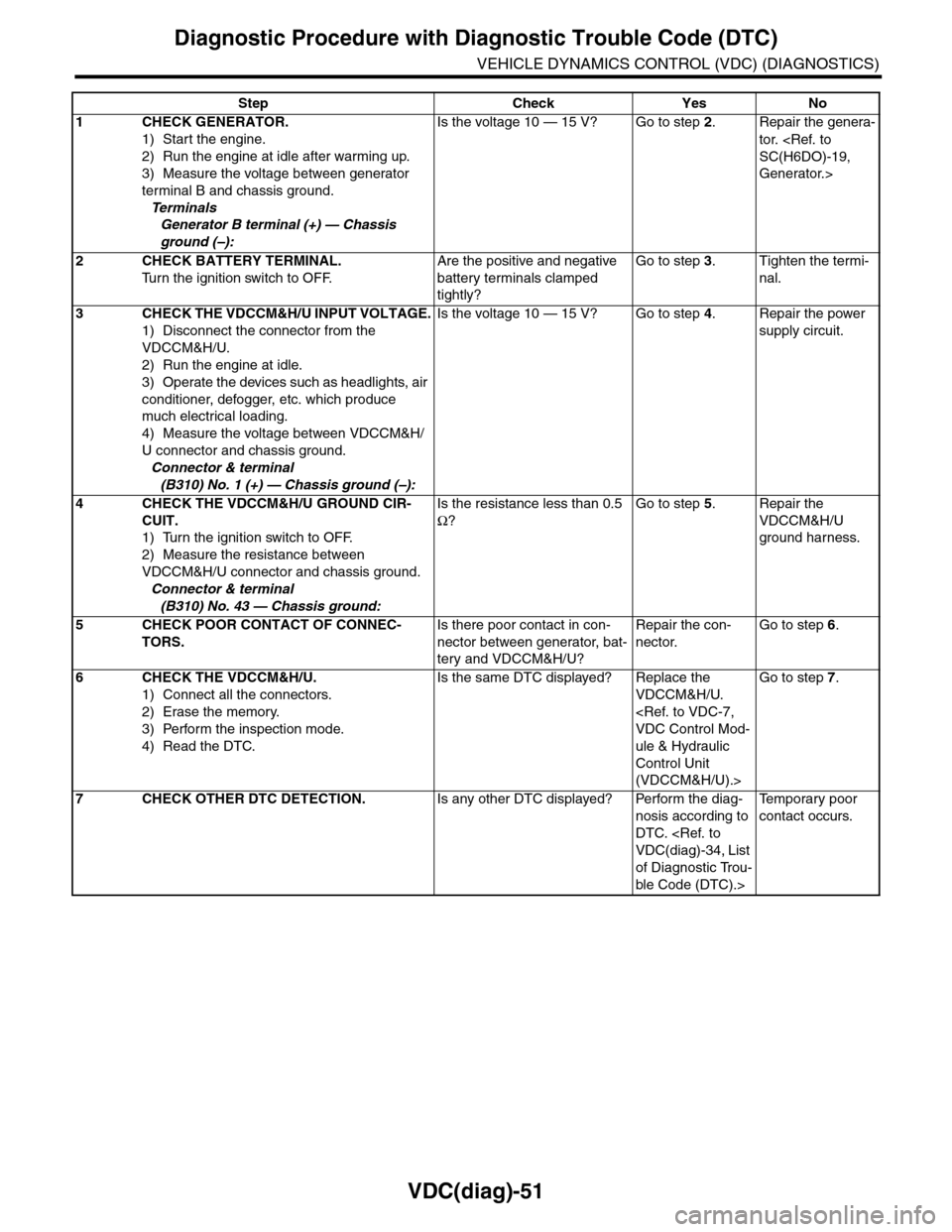
VDC(diag)-51
Diagnostic Procedure with Diagnostic Trouble Code (DTC)
VEHICLE DYNAMICS CONTROL (VDC) (DIAGNOSTICS)
Step Check Yes No
1CHECK GENERATOR.
1) Start the engine.
2) Run the engine at idle after warming up.
3) Measure the voltage between generator
terminal B and chassis ground.
Te r m i n a l s
Generator B terminal (+) — Chassis
ground (–):
Is the voltage 10 — 15 V? Go to step 2.Repair the genera-
tor.
Generator.>
2CHECK BATTERY TERMINAL.
Tu r n t h e i g n i t i o n s w i t c h t o O F F.
Are the positive and negative
battery terminals clamped
tightly?
Go to step 3.Tighten the termi-
nal.
3CHECK THE VDCCM&H/U INPUT VOLTAGE.
1) Disconnect the connector from the
VDCCM&H/U.
2) Run the engine at idle.
3) Operate the devices such as headlights, air
conditioner, defogger, etc. which produce
much electrical loading.
4) Measure the voltage between VDCCM&H/
U connector and chassis ground.
Connector & terminal
(B310) No. 1 (+) — Chassis ground (–):
Is the voltage 10 — 15 V? Go to step 4.Repair the power
supply circuit.
4CHECK THE VDCCM&H/U GROUND CIR-
CUIT.
1) Turn the ignition switch to OFF.
2) Measure the resistance between
VDCCM&H/U connector and chassis ground.
Connector & terminal
(B310) No. 43 — Chassis ground:
Is the resistance less than 0.5
Ω?
Go to step 5.Repair the
VDCCM&H/U
ground harness.
5CHECK POOR CONTACT OF CONNEC-
TORS.
Is there poor contact in con-
nector between generator, bat-
tery and VDCCM&H/U?
Repair the con-
nector.
Go to step 6.
6CHECK THE VDCCM&H/U.
1) Connect all the connectors.
2) Erase the memory.
3) Perform the inspection mode.
4) Read the DTC.
Is the same DTC displayed? Replace the
VDCCM&H/U.
ule & Hydraulic
Control Unit
(VDCCM&H/U).>
Go to step 7.
7CHECK OTHER DTC DETECTION.Is any other DTC displayed? Perform the diag-
nosis according to
DTC.
of Diagnostic Trou-
ble Code (DTC).>
Te m p o r a r y p o o r
contact occurs.
Page 1622 of 2453
GD(H6DO)-10
Diagnostic Trouble Code (DTC) Detecting Criteria
GENERAL DESCRIPTION
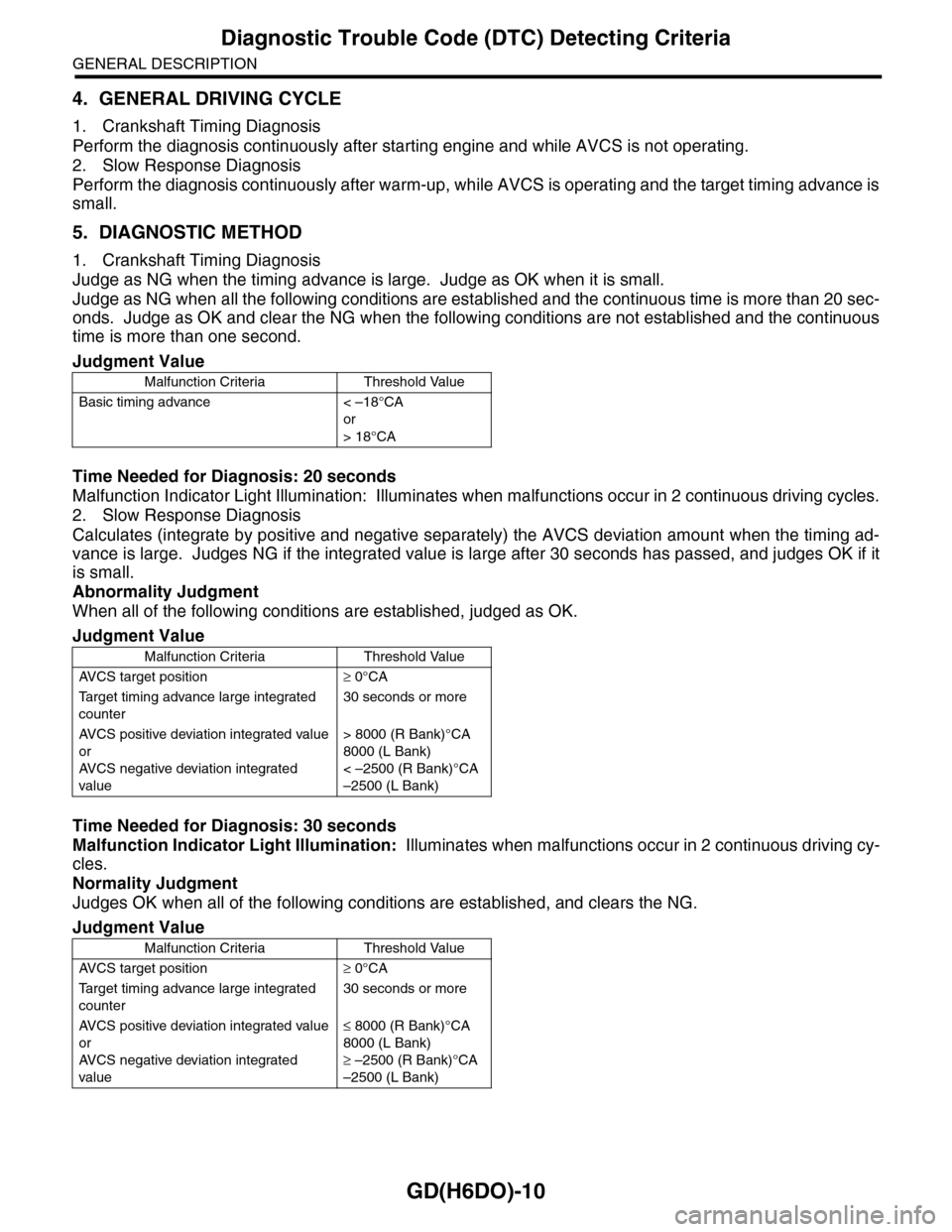
4. GENERAL DRIVING CYCLE
1. Crankshaft Timing Diagnosis
Perform the diagnosis continuously after starting engine and while AVCS is not operating.
2. Slow Response Diagnosis
Perform the diagnosis continuously after warm-up, while AVCS is operating and the target timing advance is
small.
5. DIAGNOSTIC METHOD
1. Crankshaft Timing Diagnosis
Judge as NG when the timing advance is large. Judge as OK when it is small.
Judge as NG when all the following conditions are established and the continuous time is more than 20 sec-
onds. Judge as OK and clear the NG when the following conditions are not established and the continuous
time is more than one second.
Time Needed for Diagnosis: 20 seconds
Malfunction Indicator Light Illumination: Illuminates when malfunctions occur in 2 continuous driving cycles.
2. Slow Response Diagnosis
Calculates (integrate by positive and negative separately) the AVCS deviation amount when the timing ad-
vance is large. Judges NG if the integrated value is large after 30 seconds has passed, and judges OK if it
is small.
Abnormality Judgment
When all of the following conditions are established, judged as OK.
Time Needed for Diagnosis: 30 seconds
Malfunction Indicator Light Illumination: Illuminates when malfunctions occur in 2 continuous driving cy-
cles.
Normality Judgment
Judges OK when all of the following conditions are established, and clears the NG.
Judgment Value
Malfunction Criteria Threshold Value
Basic timing advance < –18°CA
or
> 18°CA
Judgment Value
Malfunction Criteria Threshold Value
AV C S t a r g e t p o s i t i o n≥ 0°CA
Ta r g e t t i m i n g a d v a n c e l a r g e i n t e g r a t e d
counter
30 seconds or more
AV C S p o s i t i v e d ev i a t i o n i n t e g r a t e d va l u e
or
AV C S n e g a t i v e d ev i a t i o n i n t e g r a t e d
value
> 8000 (R Bank)°CA
8000 (L Bank)
< –2500 (R Bank)°CA
–2500 (L Bank)
Judgment Value
Malfunction Criteria Threshold Value
AV C S t a r g e t p o s i t i o n≥ 0°CA
Ta r g e t t i m i n g a d v a n c e l a r g e i n t e g r a t e d
counter
30 seconds or more
AV C S p o s i t i v e d ev i a t i o n i n t e g r a t e d va l u e
or
AV C S n e g a t i v e d ev i a t i o n i n t e g r a t e d
value
≤ 8000 (R Bank)°CA
8000 (L Bank)
≥ –2500 (R Bank)°CA
–2500 (L Bank)
Page 1718 of 2453
GD(H6DO)-106
Diagnostic Trouble Code (DTC) Detecting Criteria
GENERAL DESCRIPTION
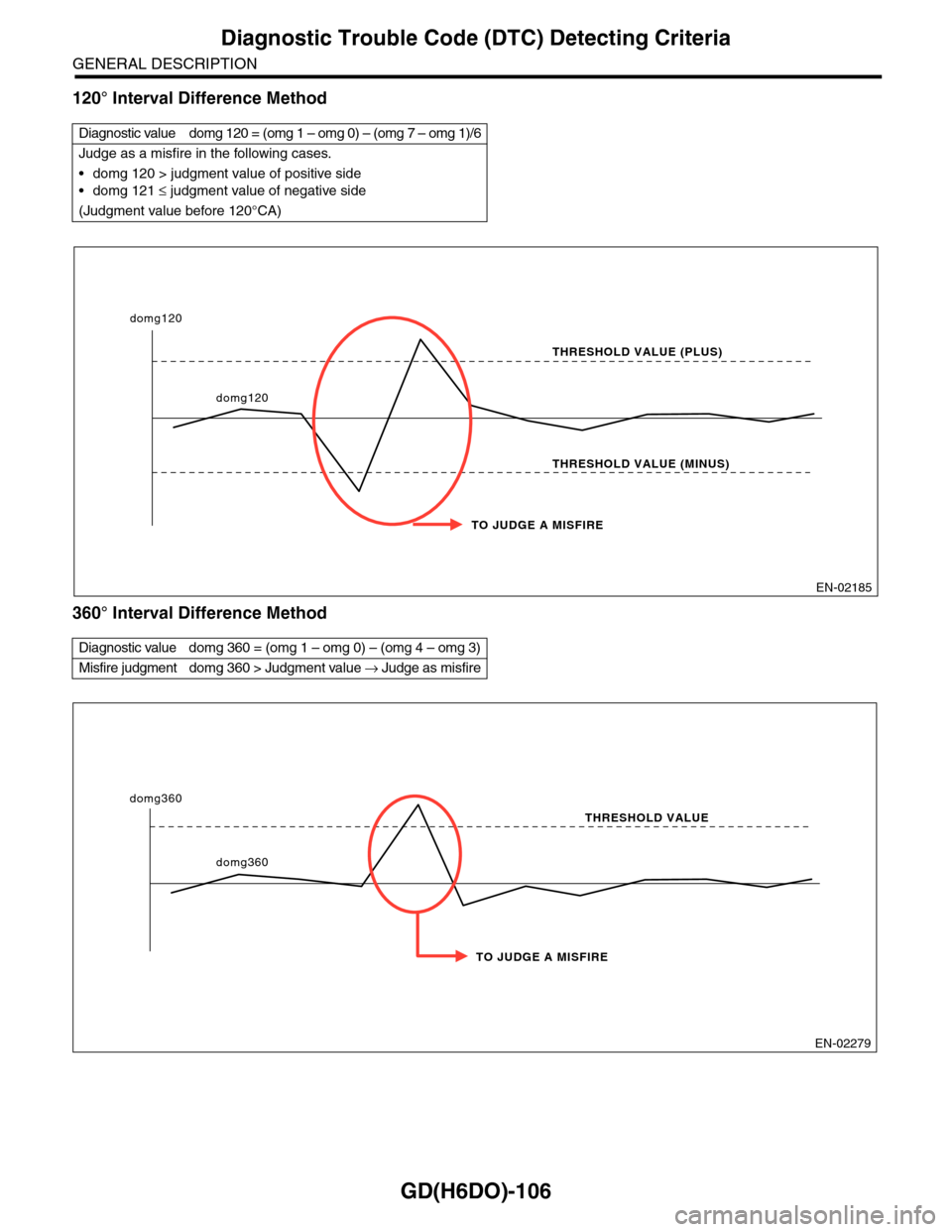
120° Interval Difference Method
360° Interval Difference Method
Diagnostic value domg 120 = (omg 1 – omg 0) – (omg 7 – omg 1)/6
Judge as a misfire in the following cases.
•domg 120 > judgment value of positive side
•domg 121 ≤ judgment value of negative side
(Judgment value before 120°CA)
Diagnostic value domg 360 = (omg 1 – omg 0) – (omg 4 – omg 3)
Misfire judgment domg 360 > Judgment value → Judge as misfire
EN-02185
TO JUDGE A MISFIRE
THRESHOLD VALUE (PLUS)
THRESHOLD VALUE (MINUS)
domg120
domg120
EN-02279
TO JUDGE A MISFIRE
THRESHOLD VALUE
domg360
domg360
Page 1737 of 2453
GD(H6DO)-125
Diagnostic Trouble Code (DTC) Detecting Criteria
GENERAL DESCRIPTION
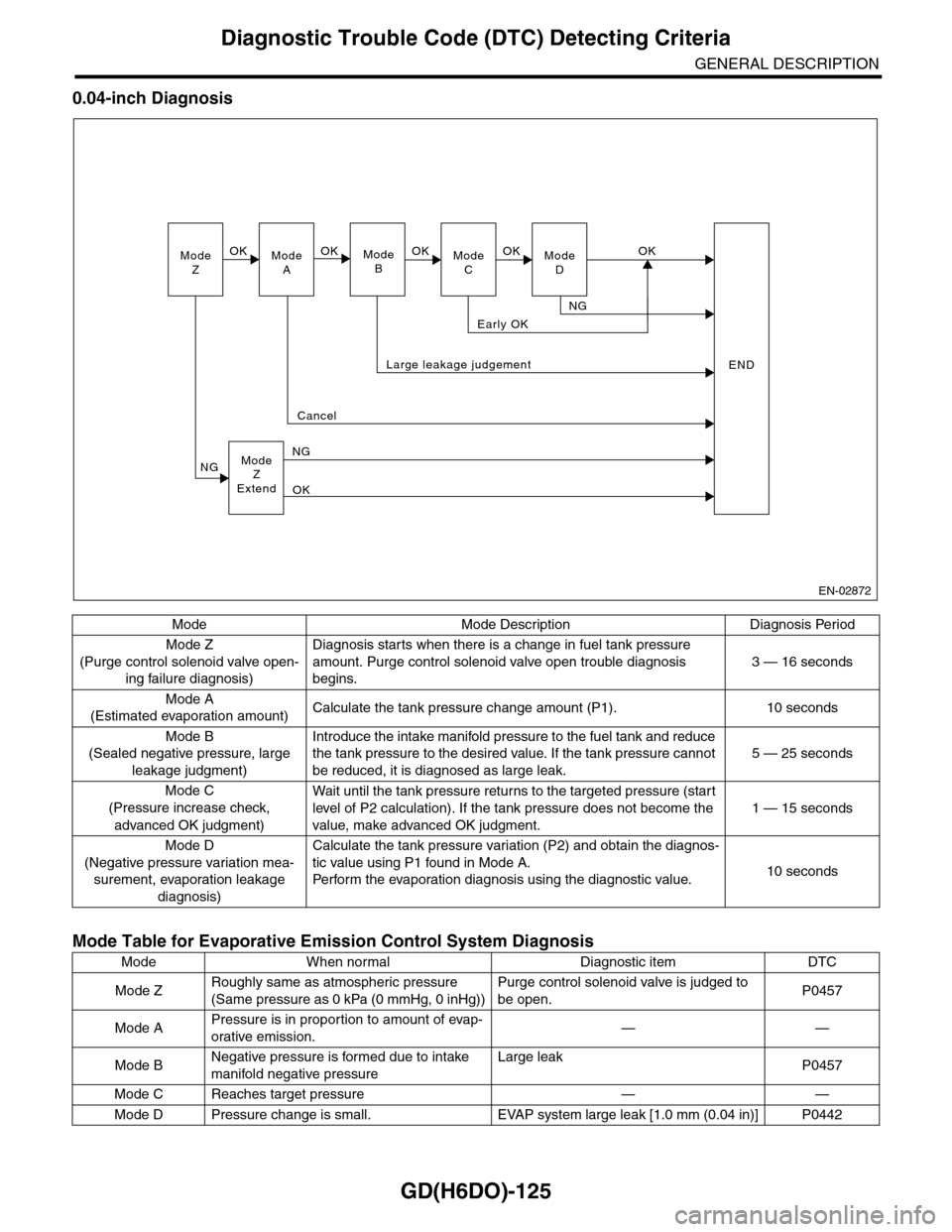
0.04-inch Diagnosis
Mode Mode Description Diagnosis Period
Mode Z
(Purge control solenoid valve open-
ing failure diagnosis)
Diagnosis starts when there is a change in fuel tank pressure
amount. Purge control solenoid valve open trouble diagnosis
begins.
3 — 16 seconds
Mode A
(Estimated evaporation amount)Calculate the tank pressure change amount (P1). 10 seconds
Mode B
(Sealed negative pressure, large
leakage judgment)
Introduce the intake manifold pressure to the fuel tank and reduce
the tank pressure to the desired value. If the tank pressure cannot
be reduced, it is diagnosed as large leak.
5 — 25 seconds
Mode C
(Pressure increase check,
advanced OK judgment)
Wait until the tank pressure retur ns to the targeted pressure (star t
level of P2 calculation). If the tank pressure does not become the
value, make advanced OK judgment.
1 — 15 seconds
Mode D
(Negative pressure variation mea-
surement, evaporation leakage
diagnosis)
Calculate the tank pressure variation (P2) and obtain the diagnos-
tic value using P1 found in Mode A.
Pe r fo r m t he eva po ra ti o n d ia g no si s u si n g t h e d ia g no st i c val u e.10 seconds
Mode Table for Evaporative Emission Control System Diagnosis
Mode When normal Diagnostic item DTC
Mode ZRoughly same as atmospheric pressure
(Same pressure as 0 kPa (0 mmHg, 0 inHg))
Purge control solenoid valve is judged to
be open.P0457
Mode APressure is in proportion to amount of evap-
orative emission.——
Mode BNegative pressure is formed due to intake
manifold negative pressure
Large leakP0457
Mode C Reaches target pressure — —
Mode D Pressure change is small. EVAP system large leak [1.0 mm (0.04 in)] P0442
ModeZModeAModeBModeCModeD
OKOKOKOKOK
NG
Early OK
Large leakage judgement
Cancel
ModeZExtend
NG
NG
OK
END
EN-02872
Page 1738 of 2453
GD(H6DO)-126
Diagnostic Trouble Code (DTC) Detecting Criteria
GENERAL DESCRIPTION
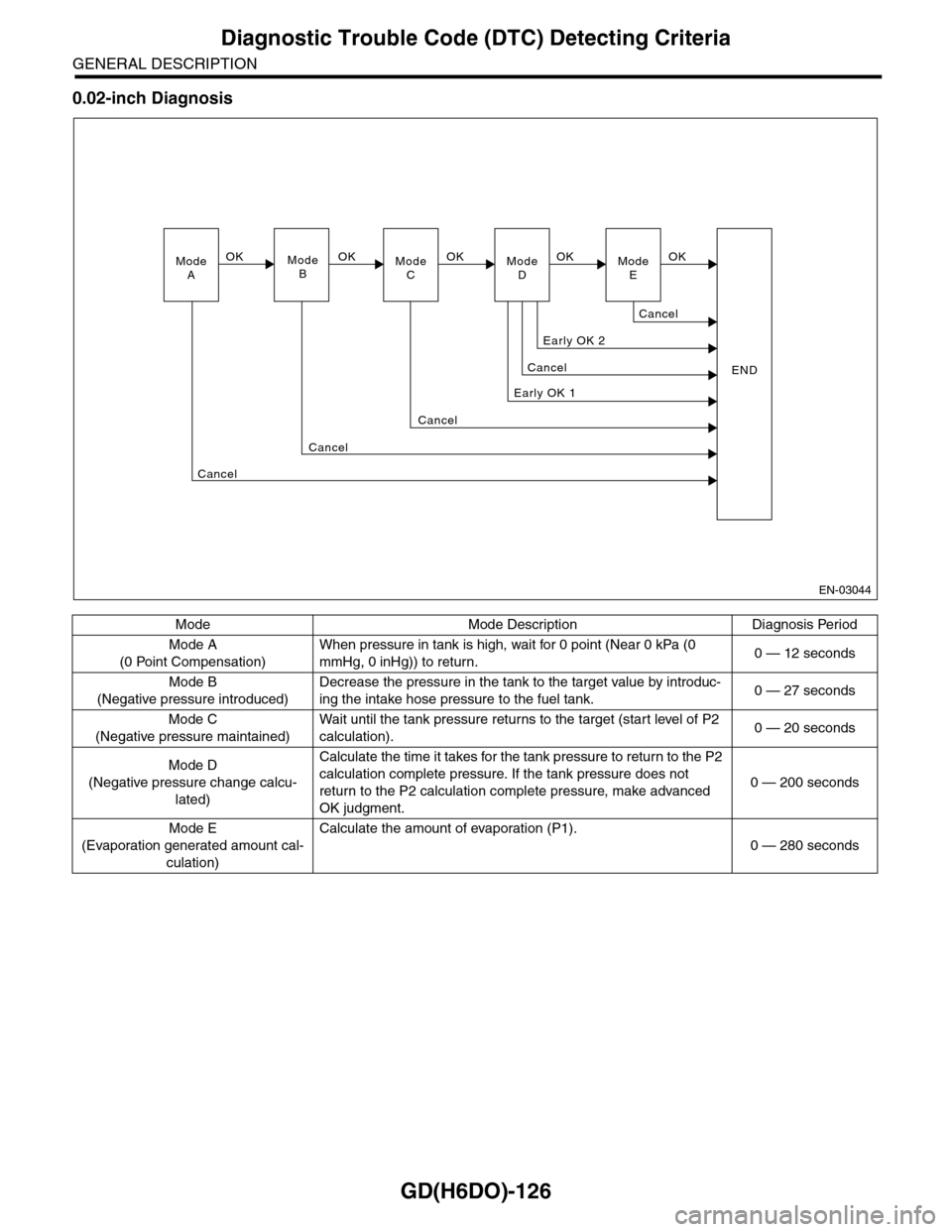
0.02-inch Diagnosis
Mode Mode Description Diagnosis Period
Mode A
(0 Point Compensation)
When pressure in tank is high, wait for 0 point (Near 0 kPa (0
mmHg, 0 inHg)) to return.0 — 12 seconds
Mode B
(Negative pressure introduced)
Decrease the pressure in the tank to the target value by introduc-
ing the intake hose pressure to the fuel tank.0 — 27 seconds
Mode C
(Negative pressure maintained)
Wa i t u nt i l t h e t a nk pr e ss ur e r et u r ns to t he t ar g e t ( s ta r t leve l o f P 2
calculation).0 — 20 seconds
Mode D
(Negative pressure change calcu-
lated)
Calculate the time it takes for the tank pressure to return to the P2
calculation complete pressure. If the tank pressure does not
return to the P2 calculation complete pressure, make advanced
OK judgment.
0 — 200 seconds
Mode E
(Evaporation generated amount cal-
culation)
Calculate the amount of evaporation (P1).
0 — 280 seconds
EN-03044
ModeAModeBModeCModeD
OKOKOK
Early OK 1
Cancel
Cancel
END
Cancel
Cancel
Early OK 2
OKModeE
Cancel
OK
Page 1744 of 2453
GD(H6DO)-132
Diagnostic Trouble Code (DTC) Detecting Criteria
GENERAL DESCRIPTION
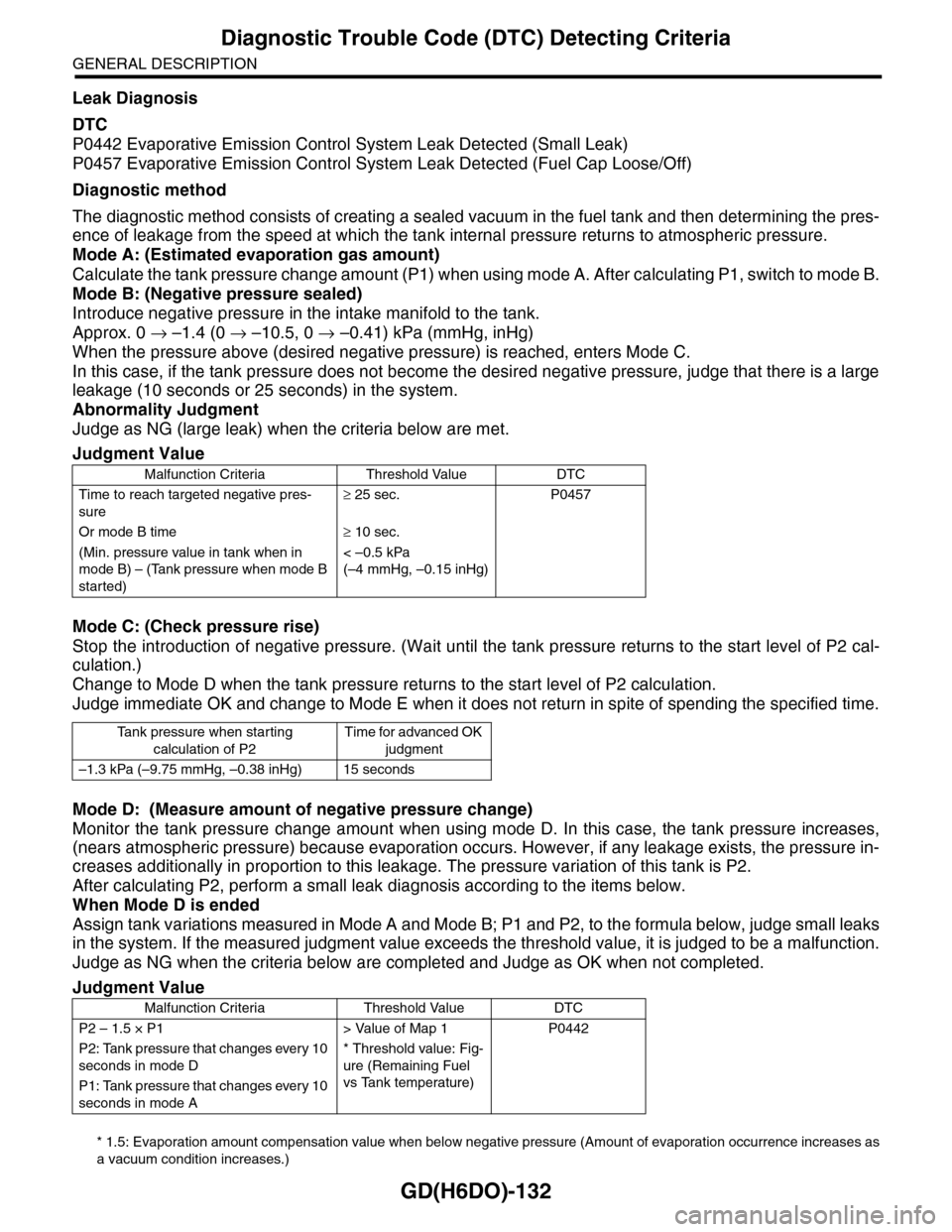
Leak Diagnosis
DTC
P0442 Evaporative Emission Control System Leak Detected (Small Leak)
P0457 Evaporative Emission Control System Leak Detected (Fuel Cap Loose/Off)
Diagnostic method
The diagnostic method consists of creating a sealed vacuum in the fuel tank and then determining the pres-
ence of leakage from the speed at which the tank internal pressure returns to atmospheric pressure.
Mode A: (Estimated evaporation gas amount)
Calculate the tank pressure change amount (P1) when using mode A. After calculating P1, switch to mode B.
Mode B: (Negative pressure sealed)
Introduce negative pressure in the intake manifold to the tank.
Approx. 0 → –1.4 (0 → –10.5, 0 → –0.41) kPa (mmHg, inHg)
When the pressure above (desired negative pressure) is reached, enters Mode C.
In this case, if the tank pressure does not become the desired negative pressure, judge that there is a large
leakage (10 seconds or 25 seconds) in the system.
Abnormality Judgment
Judge as NG (large leak) when the criteria below are met.
Mode C: (Check pressure rise)
Stop the introduction of negative pressure. (Wait until the tank pressure returns to the start level of P2 cal-
culation.)
Change to Mode D when the tank pressure returns to the start level of P2 calculation.
Judge immediate OK and change to Mode E when it does not return in spite of spending the specified time.
Mode D: (Measure amount of negative pressure change)
Monitor the tank pressure change amount when using mode D. In this case, the tank pressure increases,
(nears atmospheric pressure) because evaporation occurs. However, if any leakage exists, the pressure in-
creases additionally in proportion to this leakage. The pressure variation of this tank is P2.
After calculating P2, perform a small leak diagnosis according to the items below.
When Mode D is ended
Assign tank variations measured in Mode A and Mode B; P1 and P2, to the formula below, judge small leaks
in the system. If the measured judgment value exceeds the threshold value, it is judged to be a malfunction.
Judge as NG when the criteria below are completed and Judge as OK when not completed.
* 1.5: Evaporation amount compensation value when below negative pressure (Amount of evaporation occurrence increases as
a vacuum condition increases.)
Judgment Value
Malfunction Criteria Threshold Value DTC
Time to reach targeted negative pres-
sure
≥ 25 sec. P0457
Or mode B time≥ 10 sec.
(Min. pressure value in tank when in
mode B) – (Tank pressure when mode B
started)
< –0.5 kPa
(–4 mmHg, –0.15 inHg)
Ta n k p r e s s u r e w h e n s t a r t i n g
calculation of P2
Time for advanced OK
judgment
–1.3 kPa (–9.75 mmHg, –0.38 inHg) 15 seconds
Judgment Value
Malfunction Criteria Threshold Value DTC
P2 – 1.5 × P1 > Value of Map 1 P0442
P2: Tank pressure that changes every 10
seconds in mode D
* Threshold value: Fig-
ure (Remaining Fuel
vs Tank temperature)
P1: Tank pressure that changes every 10
seconds in mode A