2008 NISSAN TEANA check engine
[x] Cancel search: check enginePage 2599 of 5121
HA-30
< ON-VEHICLE MAINTENANCE >
REFRIGERATION SYSTEM
REFRIGERATION SYSTEM
InspectionINFOID:0000000003795977
1.CHECK BLOWER MOTOR OPERATION
Check blower motor operation. Refer to the following.
HAC-68, "
ComponentFunctionCheck" (WITHOUT 7 INCH DISPLAY)
HAC-193, "
ComponentFunctionCheck" (WITH 7 INCH DISPLAY)
Is the inspection result normal?
YES >> GO TO 2.
NO >> Repair or replace the parts according to the inspection results.
2.CHECK COMPRESSOR OPERATION
Check compressor operation. Refer to the following.
HAC-72, "
Component Function Check" (WITHOUT 7 INCH DISPLAY)
HAC-197, "
Component Function Check" (WITH 7 INCH DISPLAY)
Is the inspection result normal?
YES >> GO TO 3.
NO >> Repair or replace the parts according to the inspection results.
3.CHECK REFRIGERANT CYCLE PRESSURE
Connect recovery/recycling recharging equipment to the vehicle and perform the diagnosis with the gauge
pressure. Refer to HA-8, "
Trouble Diagnosis For Unusual Pressure".
Is the inspection result normal?
YES >> Perform the performance test. Refer to HA-30, "Performance Chart".
NO >> Repair or replace the parts according to the inspection results.
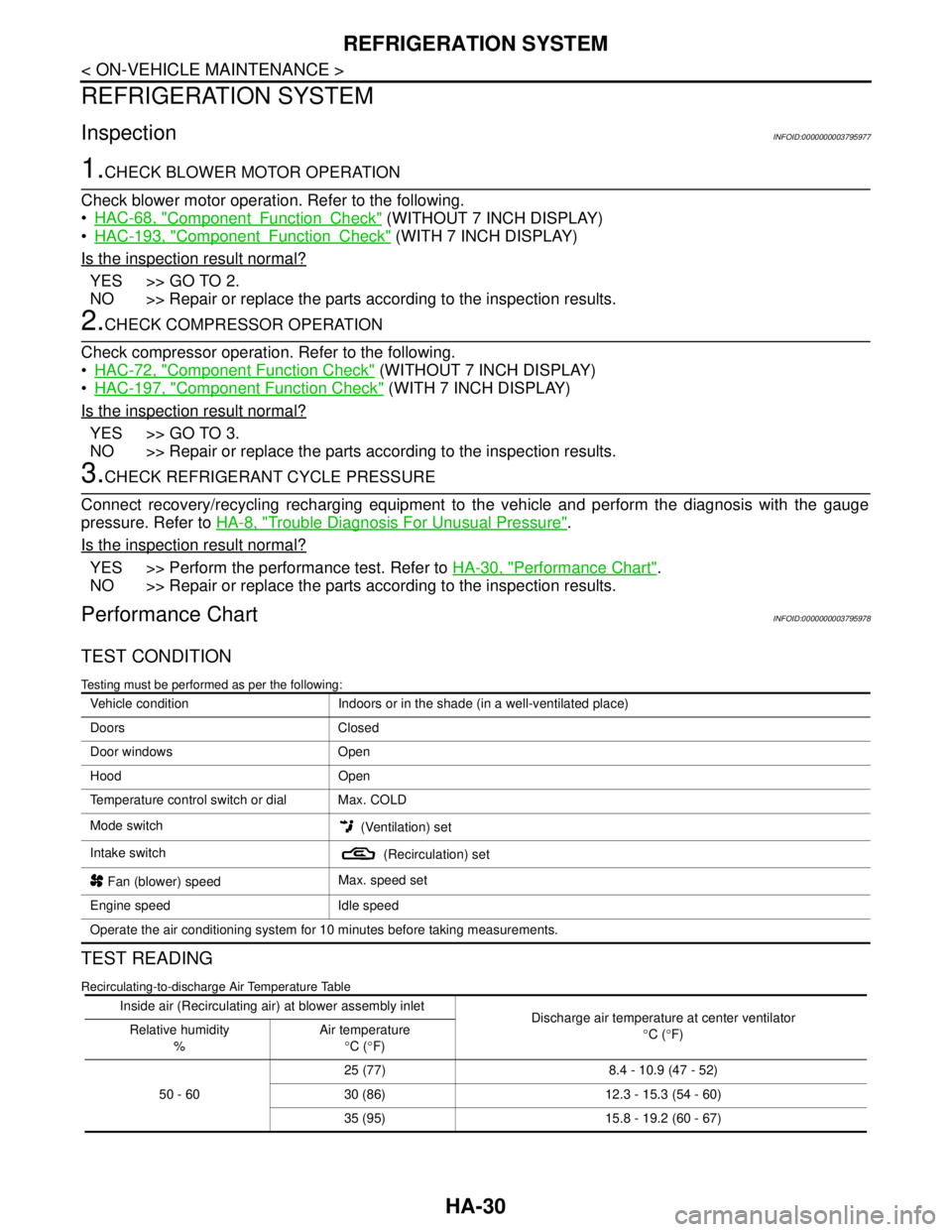
Performance ChartINFOID:0000000003795978
TEST CONDITION
Testing must be performed as per the following:
TEST READING
Recirculating-to-discharge Air Temperature Table
Vehicle condition Indoors or in the shade (in a well-ventilated place)
Doors Closed
Door windows Open
Hood Open
Temperature control switch or dial Max. COLD
Mode switch
(Ventilation) set
Intake switch
(Recirculation) set
Fan (blower) speedMax. speed set
Engine speed Idle speed
Operate the air conditioning system for 10 minutes before taking measurements.
Inside air (Recirculating air) at blower assembly inlet
Discharge air temperature at center ventilator
°C (°F) Relative humidity
%Air temperature
°C (°F)
50 - 6025 (77) 8.4 - 10.9 (47 - 52)
30 (86) 12.3 - 15.3 (54 - 60)
35 (95) 15.8 - 19.2 (60 - 67)
Page 2601 of 5121

HA-32
< ON-VEHICLE MAINTENANCE >
FLUORESCENT LEAK DETECTOR
FLUORESCENT LEAK DETECTOR
InspectionINFOID:0000000003795981
CHECKING SYSTEM FOR LEAKAGES USING THE FLUORESCENT LEAK DETECTOR
1. Check A/C system for leakages using the UV lamp and safety goggles (SST: J-42220) in a low sunlight
area (area without windows preferable). Illuminate all components, fittings and lines. The dye appears as
a bright green/yellow area at the point of leakage. Fluorescent dye observed at the evaporator drain open-
ing indicates an evaporator core assembly (tubes, core or expansion valve) leakage.
2. Use an adjustable mirror or wipe the area with a clean shop rag or cloth, with the UV lamp for dye residue
if the suspected area is difficult to see.
3. Remove any residual dye using dye cleaner (SST: J-43872) to prevent future misdiagnosis after the leak-
age is repaired.
4. Perform a system performance check and verify the leakage repair with an approved electrical leak detec-
tor.
NOTE:
Other gases in the work area or substances on the A/C components, for example, anti-freeze, windshield
washer fluid, solvents and lubricants, may falsely trigger the leak detector. Make sure the surfaces to be
checked are clean.
Clean with a dry cloth or blow off with shop air.
Do not allow the sensor tip of the detector to contact with any substance. This may also cause false readings
and may damage the detector.
DYE INJECTION
(This procedure is only necessary when recharging the system or when the compressor has seized and was
replaced.)
1. Check A/C system static (at rest) pressure. Pressure must be at least 345 kPa (3.45 bar, 3.52 kg/cm
2, 50
psi).
2. Pour one bottle (1/4 ounce / 7.4 cc) of the A/C refrigerant dye into the injector tool (SST: J-41459).
3. Connect the injector tool to the A/C low-pressure side service valve.
4. Start the engine. Then switch A/C ON.
5. Inject one bottle (1/4 ounce / 7.4 cc) of fluorescent dye through the low-pressure service valve using dye
injector tool (SST: J-41459) (refer to the manufacture’s operating instructions) when the A/C operating
(compressor running).
6. Disconnect the injector tool from the service valve with the engine still running.
CAUTION:
Be careful when replacing the A/C system or a component, pour the dye directly into the open sys-
tem connection and proceed with the service procedures.
7. Operate the A/C system for a minimum of 20 minutes to mix the dye with the system oil. Depending on the
leakage size, operating conditions and location of the leakage, it may take from minutes to days for the
dye to penetrate a leakage and become visible.
8. Attach a blue label if necessary.
Page 2602 of 5121
ELECTRICAL LEAK DETECTOR
HA-33
< ON-VEHICLE MAINTENANCE >
C
D
E
F
G
H
J
K
L
MA
B
HA
N
O
P
ELECTRICAL LEAK DETECTOR
InspectionINFOID:0000000003795982
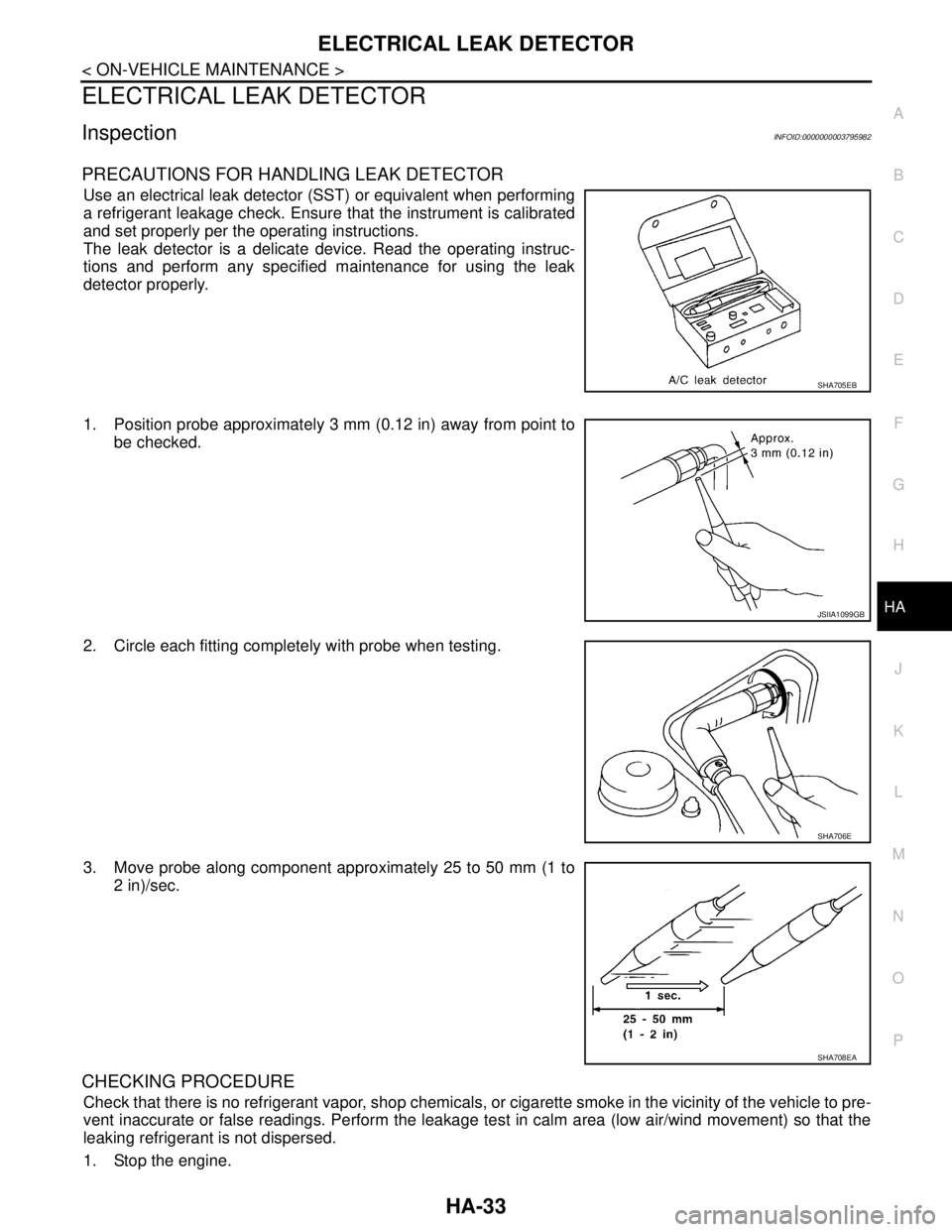
PRECAUTIONS FOR HANDLING LEAK DETECTOR
Use an electrical leak detector (SST) or equivalent when performing
a refrigerant leakage check. Ensure that the instrument is calibrated
and set properly per the operating instructions.
The leak detector is a delicate device. Read the operating instruc-
tions and perform any specified maintenance for using the leak
detector properly.
1. Position probe approximately 3 mm (0.12 in) away from point to
be checked.
2. Circle each fitting completely with probe when testing.
3. Move probe along component approximately 25 to 50 mm (1 to
2 in)/sec.
CHECKING PROCEDURE
Check that there is no refrigerant vapor, shop chemicals, or cigarette smoke in the vicinity of the vehicle to pre-
vent inaccurate or false readings. Perform the leakage test in calm area (low air/wind movement) so that the
leaking refrigerant is not dispersed.
1. Stop the engine.
SHA705EB
JSIIA1099GB
SHA706E
SHA708EA
Page 2603 of 5121
HA-34
< ON-VEHICLE MAINTENANCE >
ELECTRICAL LEAK DETECTOR
2. Connect a suitable A/C manifold gauge set (SST) to the A/C service valves.
3. Check if the A/C refrigerant pressure is at least 345 kPa (3.45 bar, 3.52 kg/cm
2, 50 psi) above 16°C
(61°F). Recover/evacuate and recharge the system with the specified amount of refrigerant if less than
specification.
NOTE:
Leakages may not be detected since the system may not reach 345 kPa (3.45 bar, 3.52 kg/cm
2, 50 psi) at
temperatures below 16°C (61°F).
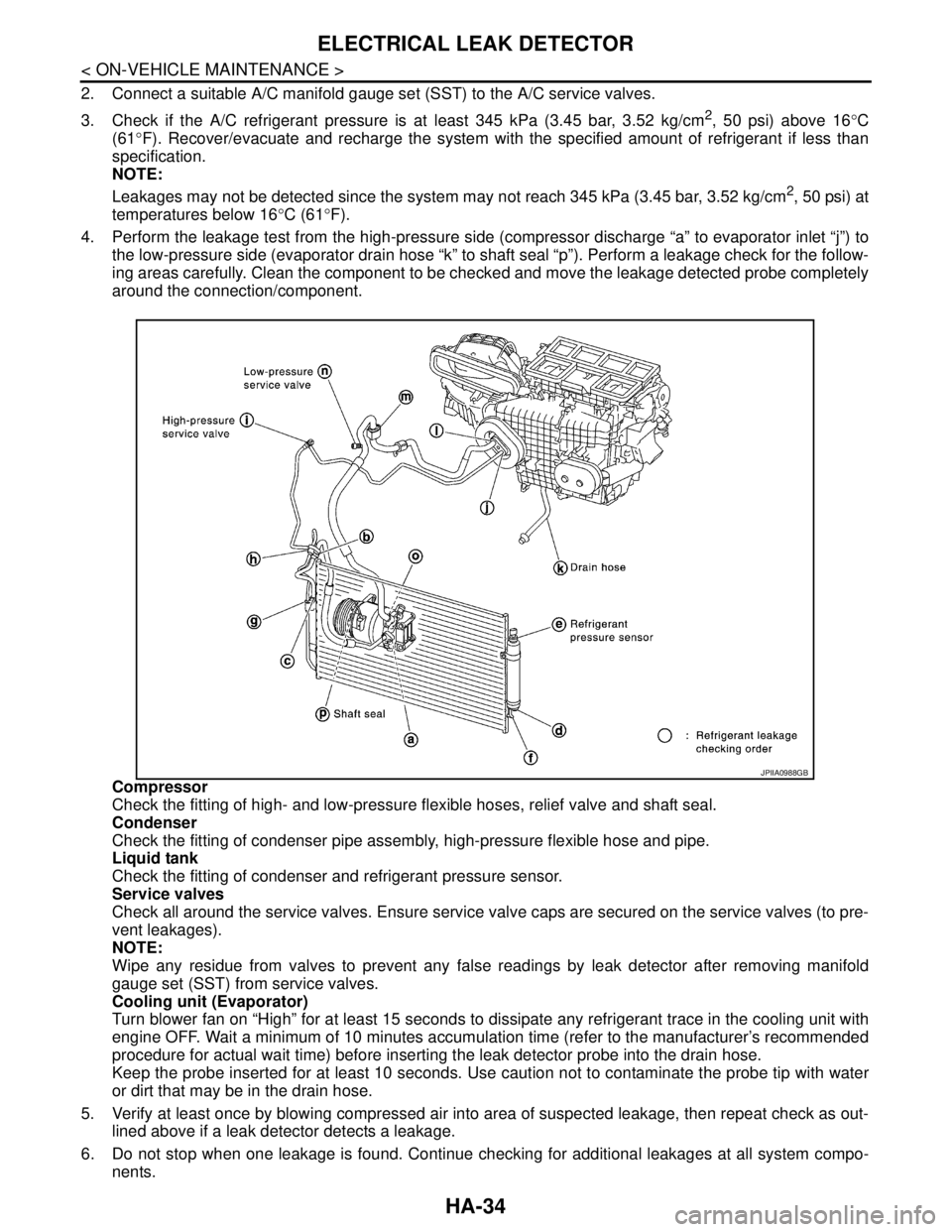
4. Perform the leakage test from the high-pressure side (compressor discharge “a” to evaporator inlet “j”) to
the low-pressure side (evaporator drain hose “k” to shaft seal “p”). Perform a leakage check for the follow-
ing areas carefully. Clean the component to be checked and move the leakage detected probe completely
around the connection/component.
Compressor
Check the fitting of high- and low-pressure flexible hoses, relief valve and shaft seal.
Condenser
Check the fitting of condenser pipe assembly, high-pressure flexible hose and pipe.
Liquid tank
Check the fitting of condenser and refrigerant pressure sensor.
Service valves
Check all around the service valves. Ensure service valve caps are secured on the service valves (to pre-
vent leakages).
NOTE:
Wipe any residue from valves to prevent any false readings by leak detector after removing manifold
gauge set (SST) from service valves.
Cooling unit (Evaporator)
Turn blower fan on “High” for at least 15 seconds to dissipate any refrigerant trace in the cooling unit with
engine OFF. Wait a minimum of 10 minutes accumulation time (refer to the manufacturer’s recommended
procedure for actual wait time) before inserting the leak detector probe into the drain hose.
Keep the probe inserted for at least 10 seconds. Use caution not to contaminate the probe tip with water
or dirt that may be in the drain hose.
5. Verify at least once by blowing compressed air into area of suspected leakage, then repeat check as out-
lined above if a leak detector detects a leakage.
6. Do not stop when one leakage is found. Continue checking for additional leakages at all system compo-
nents.
JPIIA0988GB
Page 2604 of 5121
ELECTRICAL LEAK DETECTOR
HA-35
< ON-VEHICLE MAINTENANCE >
C
D
E
F
G
H
J
K
L
MA
B
HA
N
O
P
If no leakages are found, perform steps 7 - 10.
7. Start the engine.
8. Set the A/C control as per the following;
a. A/C switch: ON
b. Air flow: VENT (Ventilation)
c. Intake door position: Recirculation
d. Temperature setting: Max. cold
e. Fan speed: High
9. Run engine at 1,500 rpm for at least 2 minutes.
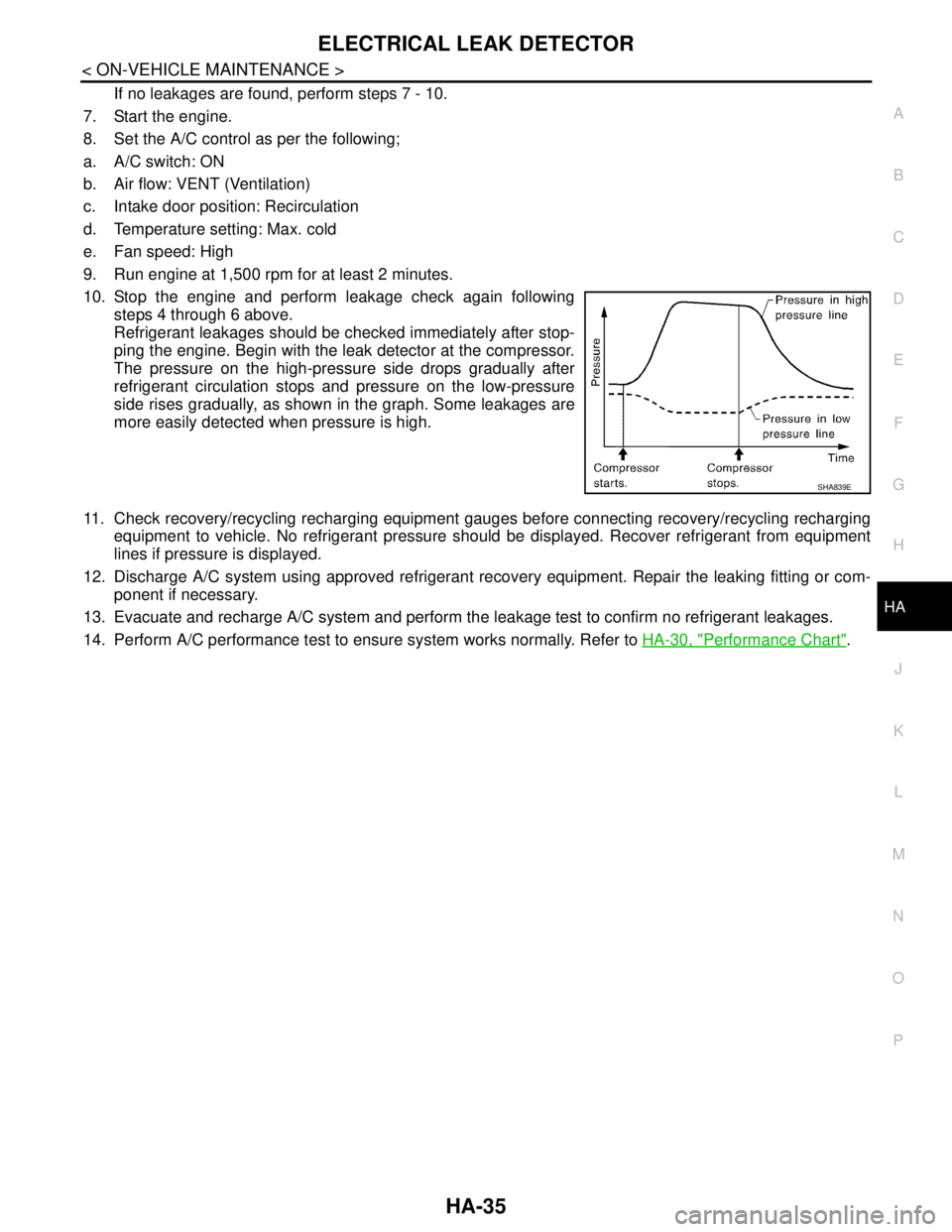
10. Stop the engine and perform leakage check again following
steps 4 through 6 above.
Refrigerant leakages should be checked immediately after stop-
ping the engine. Begin with the leak detector at the compressor.
The pressure on the high-pressure side drops gradually after
refrigerant circulation stops and pressure on the low-pressure
side rises gradually, as shown in the graph. Some leakages are
more easily detected when pressure is high.
11. Check recovery/recycling recharging equipment gauges before connecting recovery/recycling recharging
equipment to vehicle. No refrigerant pressure should be displayed. Recover refrigerant from equipment
lines if pressure is displayed.
12. Discharge A/C system using approved refrigerant recovery equipment. Repair the leaking fitting or com-
ponent if necessary.
13. Evacuate and recharge A/C system and perform the leakage test to confirm no refrigerant leakages.
14. Perform A/C performance test to ensure system works normally. Refer to HA-30, "
Performance Chart".
SHA839E
Page 2636 of 5121
![NISSAN TEANA 2008 Service Manual HAC-8
< BASIC INSPECTION >[WITHOUT 7 INCH DISPLAY]
INSPECTION AND ADJUSTMENT
INSPECTION AND ADJUSTMENT
Description & InspectionINFOID:0000000003846291
DESCRIPTION
The purpose of the operational check](/manual-img/5/57391/w960_57391-2635.png "NISSAN TEANA 2008 Service Manual HAC-8
< BASIC INSPECTION >[WITHOUT 7 INCH DISPLAY]
INSPECTION AND ADJUSTMENT
INSPECTION AND ADJUSTMENT
Description & InspectionINFOID:0000000003846291
DESCRIPTION
The purpose of the operational check")
HAC-8
< BASIC INSPECTION >[WITHOUT 7 INCH DISPLAY]
INSPECTION AND ADJUSTMENT
INSPECTION AND ADJUSTMENT
Description & InspectionINFOID:0000000003846291
DESCRIPTION
The purpose of the operational check is to check that the individual system operates normally.
INSPECTION PROCEDURE
1.CHECK MEMORY FUNCTION
1. Start the engine.
2. Operate the temperature control switch (driver side) and raise the temperature setting to 32°C (90°F).
3. Press the OFF switch.
4. Turn the ignition switch OFF.
5. Turn the ignition switch ON.
6. Press the AUTO switch.
7. Check that the temperature setting before turning the ignition switch OFF is stored.
Is the inspection result normal?
YES >> GO TO 2.
NO >> Memory function malfunction: HAC-96, "
Inspection procedure".
2.CHECK BLOWER MOTOR SPEED
1. Start the engine.
2. Operate the fan control dial. Check that the fan speed changes. Check the operation for all fan speeds.
3. Set the fan speed to speed 7.
Is the inspection result normal?
YES >> GO TO 3.
NO >> Blower motor system malfunction: HAC-68, "
Diagnosis Procedure".
3.CHECK DISCHARGE AIR
1. Press the MODE switch and the DEF switch.
2. Each position indicator should change shape.
3. Confirm that discharge air comes out according to the air distribution table. Refer to HAC-17, "
System
Description".
NOTE:
Confirm that the compressor clutch is engaged (sound or visual inspection) and the intake door position is at
the FRE when DEF is selected.
Is the inspection result normal?
YES >> GO TO 4.
NO >> Mode door system malfunction: HAC-61, "
Diagnosis Procedure". Conditions : Engine running at normal operating temperature
JPIIA0877GB
Page 2637 of 5121
![NISSAN TEANA 2008 Service Manual INSPECTION AND ADJUSTMENT
HAC-9
< BASIC INSPECTION >[WITHOUT 7 INCH DISPLAY]
C
D
E
F
G
H
J
K
L
MA
B
HAC
N
O
P
4.CHECK INTAKE AIR
1. Press the REC switch. REC indicator is turned ON.
2. Press the FRE s](/manual-img/5/57391/w960_57391-2636.png "NISSAN TEANA 2008 Service Manual INSPECTION AND ADJUSTMENT
HAC-9
< BASIC INSPECTION >[WITHOUT 7 INCH DISPLAY]
C
D
E
F
G
H
J
K
L
MA
B
HAC
N
O
P
4.CHECK INTAKE AIR
1. Press the REC switch. REC indicator is turned ON.
2. Press the FRE s")
INSPECTION AND ADJUSTMENT
HAC-9
< BASIC INSPECTION >[WITHOUT 7 INCH DISPLAY]
C
D
E
F
G
H
J
K
L
MA
B
HAC
N
O
P
4.CHECK INTAKE AIR
1. Press the REC switch. REC indicator is turned ON.
2. Press the FRE switch. FRE indicator is turned ON.
3. Listen for the intake door position change. (Slight change of blower sound can be heard.)
NOTE:
Confirm that the compressor clutch is engaged (sound or visual inspection) and the intake door position is at
the FRE when the DEF is selected.
Is the inspection result normal?
YES >> GO TO 5.
NO >> Intake door system malfunction: HAC-64, "
Diagnosis Procedure".
5.CHECK A/C SWITCH
1. Press the A/C switch.
2. The A/C switch indicator is turned ON.
Confirm that the compressor clutch engages (sound or visual inspection).
Is the inspection result normal?
YES >> GO TO 6.
NO >> Magnet clutch system malfunction: HAC-72, "
Diagnosis Procedure".
6.CHECK WITH TEMPERATURE SETTING LOWERED
1. Operate the compressor.
2. Operate the temperature control switch (driver side) and lower the temperature setting to 18°C (60°F).
3. Check that the cool air blows from the outlets.
Is the inspection result normal?
YES >> GO TO 7.
NO >> Insufficient cooling: HAC-88, "
Inspection procedure".
7.CHECK WITH TEMPERATURE SETTING RAISED
1. Operate the temperature control switch (driver side) and raise the temperature setting to 32°C (90°F) after
warming up the engine.
2. Check that the warm air blows from the outlets.
Is the inspection result normal?
YES >> GO TO 8.
NO >> Insufficient heating: HAC-91, "
Inspection procedure".
8.CHECK LEFT AND RIGHT VENTILATION TEMPERATURE SEPARATELY CONTROL SYSTEM FUNC-
TION
1. Press the DUAL switch, and then check that “DUAL” is shown on the display.
2. Operate the temperature control switch (driver side). Check that the discharge air temperature (driver
side) changes.
3. Operate the temperature control switch (passenger side). Check that the discharge air temperature (pas-
senger side) changes.
4. Press the DUAL switch, and then check that the temperature setting (LH/RH) is unified to the driver side
temperature setting.
Is the inspection result normal?
YES >> GO TO 9.
NO >> Refer to HAC-87, "
Diagnosis Chart By Symptom" and perform the appropriate diagnosis.
9.CHECK AUTO MODE
1. Press the AUTO switch, and then check that “AUTO” is shown on the display.
2. Operate the temperature control switch (driver side). Check that the fan speed or outlet changes (the dis-
charge air temperature or fan speed varies depending on the ambient temperature, in-vehicle tempera-
ture, and temperature setting).
Is the inspection result normal?
YES >> GO TO 10.
NO >> Refer to HAC-87, "
Diagnosis Chart By Symptom" and perform the appropriate diagnosis.
Page 2668 of 5121
![NISSAN TEANA 2008 Service Manual HAC-40
< FUNCTION DIAGNOSIS >[WITHOUT 7 INCH DISPLAY]
DIAGNOSIS SYSTEM (HVAC)
ACTIVE TEST
HVAC TEST
NOTE:
Perform the inspection of each output device after starting the engine because the compresso](/manual-img/5/57391/w960_57391-2667.png "NISSAN TEANA 2008 Service Manual HAC-40
< FUNCTION DIAGNOSIS >[WITHOUT 7 INCH DISPLAY]
DIAGNOSIS SYSTEM (HVAC)
ACTIVE TEST
HVAC TEST
NOTE:
Perform the inspection of each output device after starting the engine because the compresso")
HAC-40
< FUNCTION DIAGNOSIS >[WITHOUT 7 INCH DISPLAY]
DIAGNOSIS SYSTEM (HVAC)
ACTIVE TEST
HVAC TEST
NOTE:
Perform the inspection of each output device after starting the engine because the compressor is operated.
When choosing to “MODE 7”, error message is displayed but it is not malfunction.
WORK SUPPORT
INT TEMP CAL [°C] Intake sensor value calculated by A/C auto amp.
SUNL SEN CAL
[w/m
2]Sunload sensor value calculated by A/C auto amp.
FAN DUTY [%] Duty ratio of blower motor judged by A/C auto amp.
XMTarget discharge air temperature judged by A/C auto amp. according to the tempera-
ture setting and the value from each sensor
ENG COOL TEMP [°C] Water temperature signal value received from ECM via CAN communication
VEHICLE SPEED[Mph
(km/h)]Vehicle speed signal value received from meter via CAN communication Monitor item [Unit] Description
Test item Description
ALL SEG Indicator all segment lighting
HVAC TESTThe operation check of A/C system can be performed by selecting the mode. Refer to the fol-
lowing table for the conditions of each mode.
Te s t i t e m
MODE 1 MODE 2 MODE 3 MODE 4 MODE 5 MODE 6 MODE 7
Mode door position VENT B/L1 B/L2 AUTO FOOT D/F DEF -
Intake door position REC REC 20% FRE FRE FRE FRE -
Air mix door position
(driver & passenger
side)FULL COLD FULL COLD FULL HOT FULL HOT FULL HOT FULL HOT -
Blower motor duty ratio 37% 91% 65% 65% 65% 91% -
Compressor (Magnet
clutch)ON ON OFF OFF ON ON -
Work item Description Reference
TEMP SET CORRECTIf the temperature felt by the customer is different than the air flow
temperature controlled by the temperature setting, the auto ampli-
fier control temperature can be adjusted to compensate for the
temperature setting. HAC-10, "
Temperature
Setting Trimmer"
BLOW SETIn the FOOT mode, the air blowing to the DEF can change ON/
OFF. HAC-10, "Foot Position
Setting Trimmer"