Page 2907 of 5121
INL-28
< COMPONENT DIAGNOSIS >
PUSH-BUTTON IGNITION SWITCH ILLUMINATION CIRCUIT
PUSH-BUTTON IGNITION SWITCH ILLUMINATION CIRCUIT
DescriptionINFOID:0000000003774564
Provides the power supply and the ground to control the push-button ignition switch illumination.
Component Function CheckINFOID:0000000003774565
1.CHECK PUSH-BUTTON IGNITION SWITCH ILLUMINATION OPERATION
CONSULT-III ACTIVE TEST
1. Turn the ignition switch ON.
2. Select “ENGINE SW ILLUMI” of BCM (INTELLIGENT KEY) active test item.
3. With operating the test items, check that the push-button ignition switch illumination turns ON/OFF.
Does the push-button ignition switch illumination turn ON/OFF?
YES >> Push-button ignition switch illumination circuit is normal.
NO >> Refer to INL-28, "
Diagnosis Procedure".
Diagnosis ProcedureINFOID:0000000003774566
1.CHECK PUSH-BUTTON IGNITION SWITCH ILLUMINATION POWER SUPPLY OUTPUT
CONSULT-III ACTIVE TEST
1. Turn the ignition switch ON.
2. Select “ENGINE SW ILLUMI” of BCM (INTELLIGENT KEY) active test item.
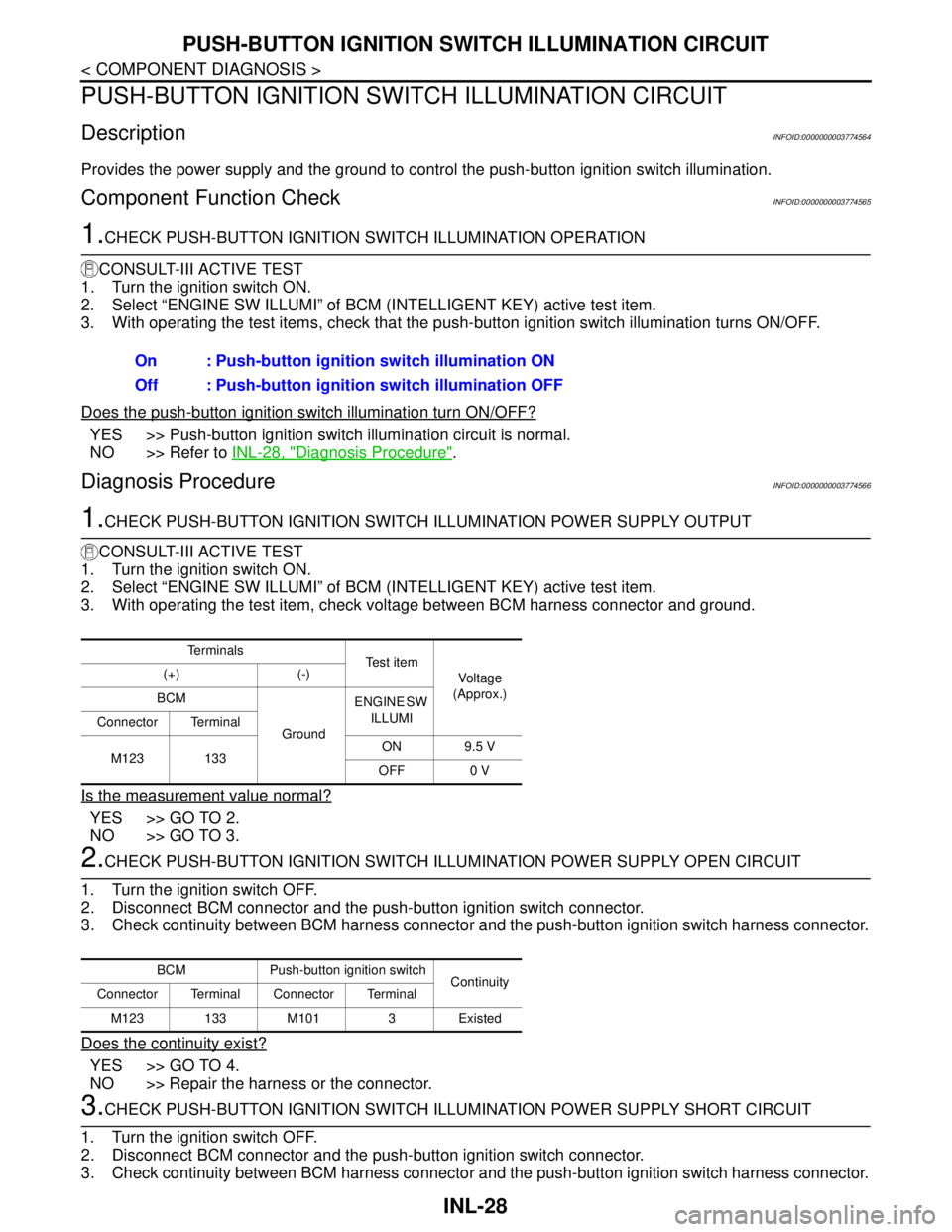
3. With operating the test item, check voltage between BCM harness connector and ground.
Is the measurement value normal?
YES >> GO TO 2.
NO >> GO TO 3.
2.CHECK PUSH-BUTTON IGNITION SWITCH ILLUMINATION POWER SUPPLY OPEN CIRCUIT
1. Turn the ignition switch OFF.
2. Disconnect BCM connector and the push-button ignition switch connector.
3. Check continuity between BCM harness connector and the push-button ignition switch harness connector.
Does the continuity exist?
YES >> GO TO 4.
NO >> Repair the harness or the connector.
3.CHECK PUSH-BUTTON IGNITION SWITCH ILLUMINATION POWER SUPPLY SHORT CIRCUIT
1. Turn the ignition switch OFF.
2. Disconnect BCM connector and the push-button ignition switch connector.
3. Check continuity between BCM harness connector and the push-button ignition switch harness connector.On : Push-button ignition switch illumination ON
Off : Push-button ignition switch illumination OFF
Te r m i n a l s
Te s t i t e m
Voltag e
(Approx.) (+) (-)
BCM
GroundENGINE SW
ILLUMI
Connector Terminal
M123 133ON 9.5 V
OFF 0 V
BCM Push-button ignition switch
Continuity
Connector Terminal Connector Terminal
M123 133 M101 3 Existed
Page 3089 of 5121
LAN-22
< FUNCTION DIAGNOSIS >[CAN]
CAN COMMUNICATION SYSTEM
FUNCTION DIAGNOSIS
CAN COMMUNICATION SYSTEM
CAN System Specification ChartINFOID:0000000003767684
Determine CAN system type from the following specification chart.
NOTE:
Refer to LAN-14, "
Trouble Diagnosis Procedure" for how to use CAN system specification chart.
×: Applicable
VEHICLE EQUIPMENT IDENTIFICATION INFORMATION
NOTE:
Check CAN system type from the vehicle shape and equipment.
CAN Communication Signal ChartINFOID:0000000003767685
Refer to LAN-13, "How to Use CAN Communication Signal Chart" for how to use CAN communication signal
chart.
Body typeSedan
Axle2WD
Engine VQ25DE VQ35DE
TransmissionCVT
Brake control ABS VDC
Automatic drive positioner××
Color display×××
CAN system type 2469
Start CAN Diagnosis (CONSULT-III) 2469
JPMIA1011GB
Page 3179 of 5121
ENGINE OIL
LU-7
< ON-VEHICLE MAINTENANCE >
C
D
E
F
G
H
I
J
K
L
MA
LU
N
P O
ON-VEHICLE MAINTENANCE
ENGINE OIL
InspectionINFOID:0000000003793121
ENGINE OIL LEVEL
NOTE:
Before starting engine, put vehicle horizontally and check the engine oil level. If engine is already started, stop
it and allow 10 minutes before checking.
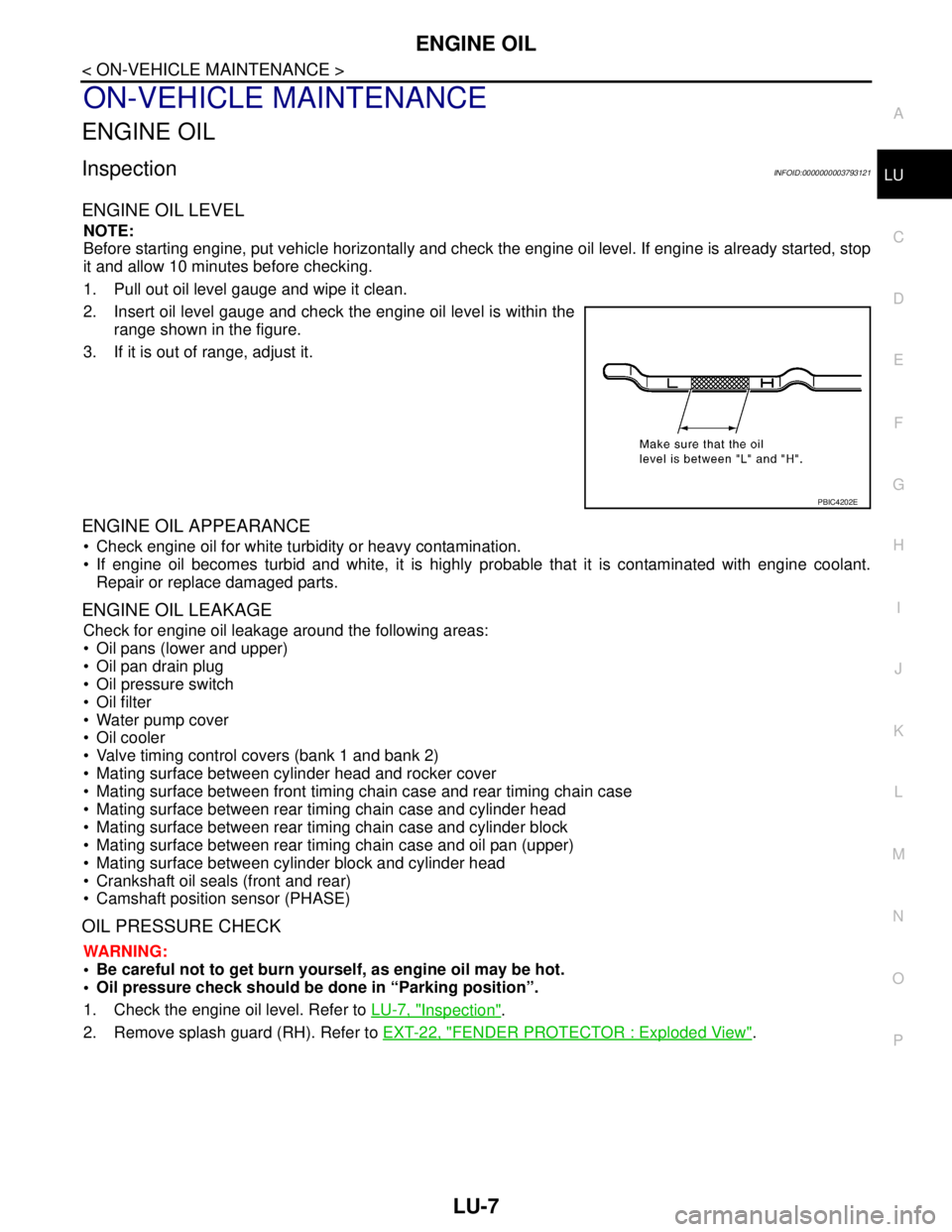
1. Pull out oil level gauge and wipe it clean.
2. Insert oil level gauge and check the engine oil level is within the
range shown in the figure.
3. If it is out of range, adjust it.
ENGINE OIL APPEARANCE
Check engine oil for white turbidity or heavy contamination.
If engine oil becomes turbid and white, it is highly probable that it is contaminated with engine coolant.
Repair or replace damaged parts.
ENGINE OIL LEAKAGE
Check for engine oil leakage around the following areas:
Oil pans (lower and upper)
Oil pan drain plug
Oil pressure switch
Oil filter
Water pump cover
Oil cooler
Valve timing control covers (bank 1 and bank 2)
Mating surface between cylinder head and rocker cover
Mating surface between front timing chain case and rear timing chain case
Mating surface between rear timing chain case and cylinder head
Mating surface between rear timing chain case and cylinder block
Mating surface between rear timing chain case and oil pan (upper)
Mating surface between cylinder block and cylinder head
Crankshaft oil seals (front and rear)
Camshaft position sensor (PHASE)
OIL PRESSURE CHECK
WARNING:
• Be careful not to get burn yourself, as engine oil may be hot.
Oil pressure check should be done in “Parking position”.
1. Check the engine oil level. Refer to LU-7, "
Inspection".
2. Remove splash guard (RH). Refer to EXT-22, "
FENDER PROTECTOR : Exploded View".
PBIC4202E
Page 3180 of 5121
LU-8
< ON-VEHICLE MAINTENANCE >
ENGINE OIL
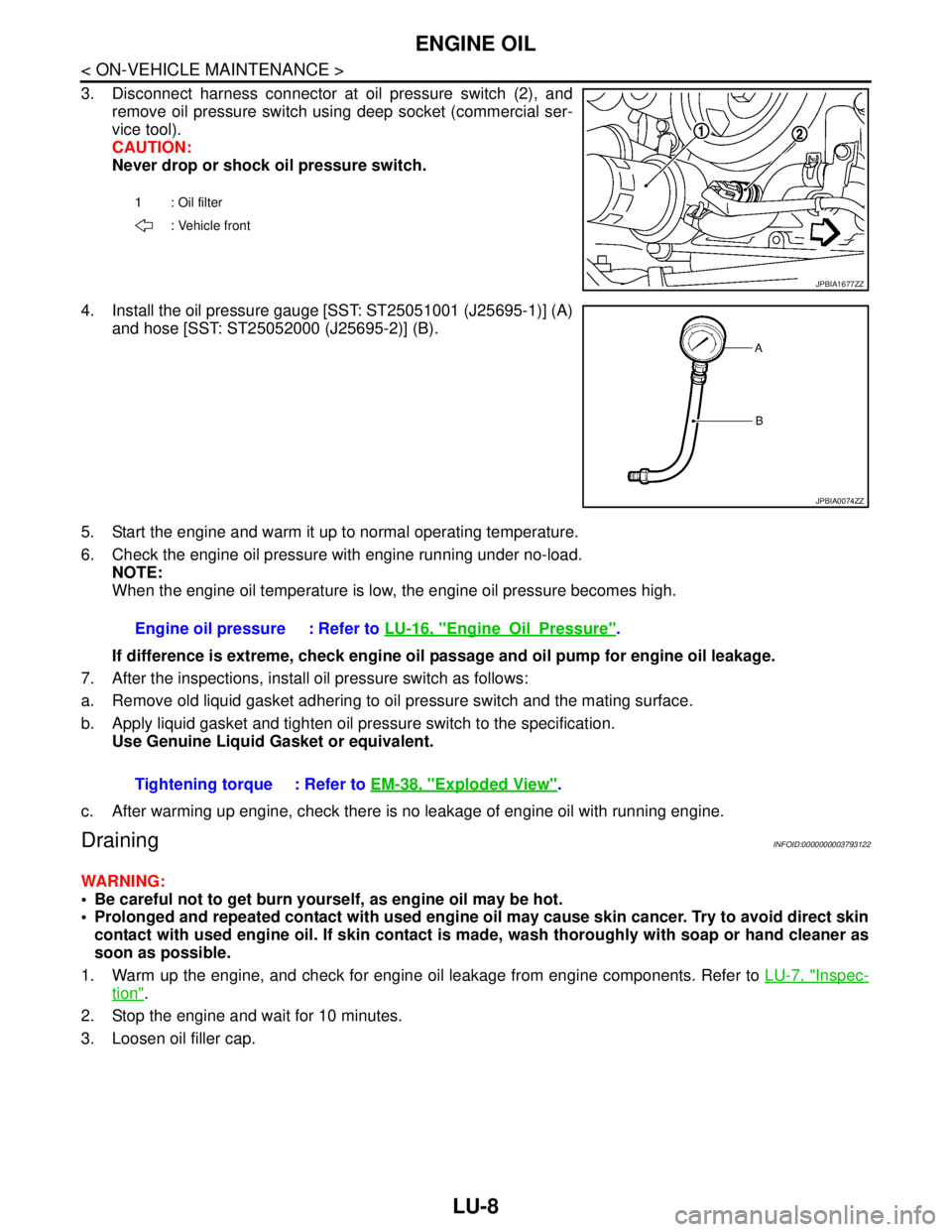
3. Disconnect harness connector at oil pressure switch (2), and
remove oil pressure switch using deep socket (commercial ser-
vice tool).
CAUTION:
Never drop or shock oil pressure switch.
4. Install the oil pressure gauge [SST: ST25051001 (J25695-1)] (A)
and hose [SST: ST25052000 (J25695-2)] (B).
5. Start the engine and warm it up to normal operating temperature.
6. Check the engine oil pressure with engine running under no-load.
NOTE:
When the engine oil temperature is low, the engine oil pressure becomes high.
If difference is extreme, check engine oil passage and oil pump for engine oil leakage.
7. After the inspections, install oil pressure switch as follows:
a. Remove old liquid gasket adhering to oil pressure switch and the mating surface.
b. Apply liquid gasket and tighten oil pressure switch to the specification.
Use Genuine Liquid Gasket or equivalent.
c. After warming up engine, check there is no leakage of engine oil with running engine.
DrainingINFOID:0000000003793122
WARNING:
Be careful not to get burn yourself, as engine oil may be hot.
Prolonged and repeated contact with used engine oil may cause skin cancer. Try to avoid direct skin
contact with used engine oil. If skin contact is made, wash thoroughly with soap or hand cleaner as
soon as possible.
1. Warm up the engine, and check for engine oil leakage from engine components. Refer to LU-7, "
Inspec-
tion".
2. Stop the engine and wait for 10 minutes.
3. Loosen oil filler cap.
1 : Oil filter
: Vehicle front
JPBIA1677ZZ
JPBIA0074ZZ
Engine oil pressure : Refer to LU-16, "EngineOilPressure".
Tightening torque : Refer to EM-38, "
Exploded View".
Page 3181 of 5121
ENGINE OIL
LU-9
< ON-VEHICLE MAINTENANCE >
C
D
E
F
G
H
I
J
K
L
MA
LU
N
P O
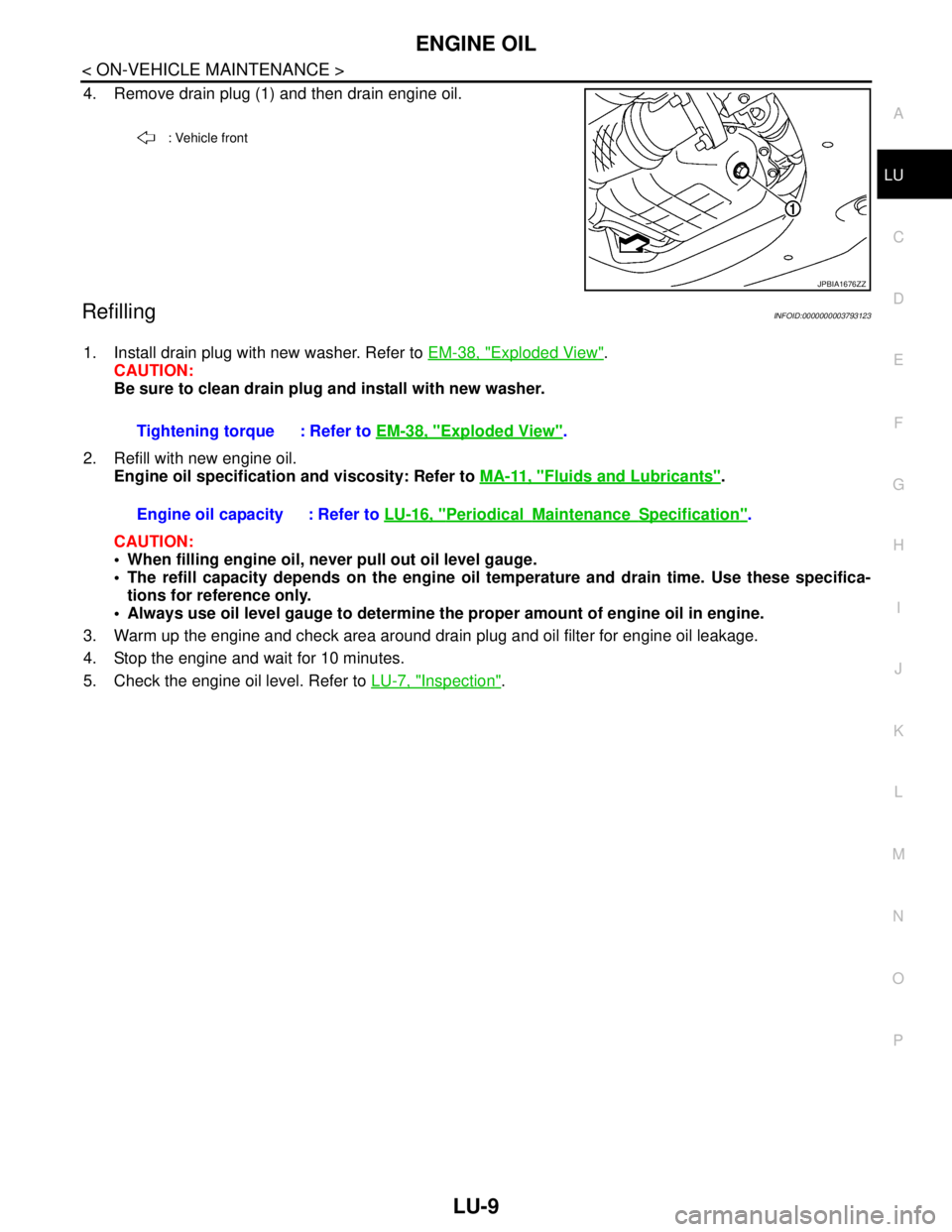
4. Remove drain plug (1) and then drain engine oil.
RefillingINFOID:0000000003793123
1. Install drain plug with new washer. Refer to EM-38, "Exploded View".
CAUTION:
Be sure to clean drain plug and install with new washer.
2. Refill with new engine oil.
Engine oil specification and viscosity: Refer to MA-11, "
Fluids and Lubricants".
CAUTION:
When filling engine oil, never pull out oil level gauge.
The refill capacity depends on the engine oil temperature and drain time. Use these specifica-
tions for reference only.
Always use oil level gauge to determine the proper amount of engine oil in engine.
3. Warm up the engine and check area around drain plug and oil filter for engine oil leakage.
4. Stop the engine and wait for 10 minutes.
5. Check the engine oil level. Refer to LU-7, "
Inspection".
: Vehicle front
JPBIA1676ZZ
Tightening torque : Refer to EM-38, "Exploded View".
Engine oil capacity : Refer to LU-16, "
PeriodicalMaintenanceSpecification".
Page 3182 of 5121
LU-10
< ON-VEHICLE MAINTENANCE >
OIL FILTER
OIL FILTER
Removal and InstallationINFOID:0000000003793124
REMOVAL
CAUTION:
Oil filter is provided with relief valve. Use genuine NISSAN oil filter or equivalent.
Be careful not to get burned when engine and engine oil may be hot.
When removing, prepare a shop cloth to absorb any engine oil leakage or spillage.
Never allow engine oil to adhere to drive belt.
Completely wipe off any engine oil that adheres to engine and vehicle.
1. Remove splash guard (RH). Refer to EXT-22, "
FENDER PROTECTOR : Exploded View".
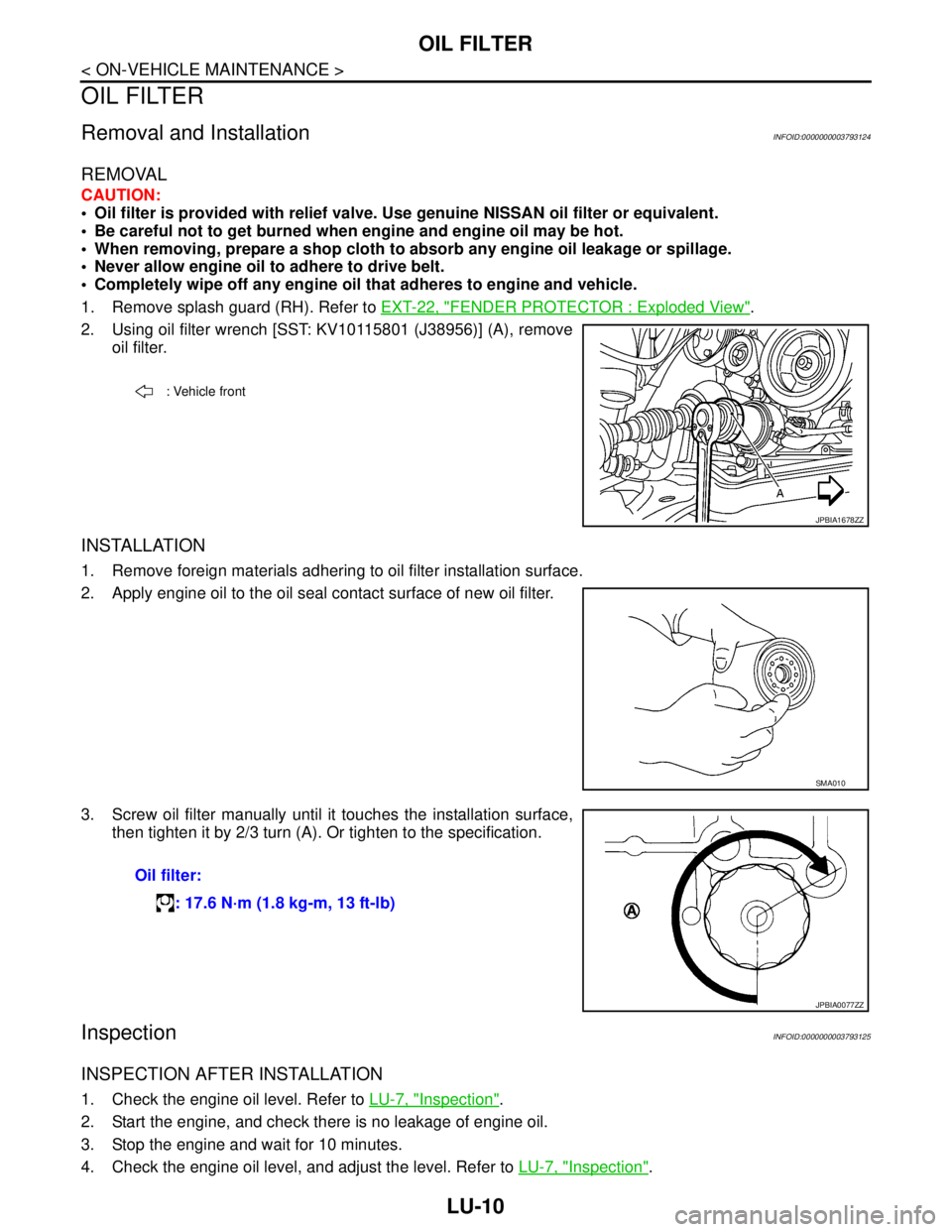
2. Using oil filter wrench [SST: KV10115801 (J38956)] (A), remove
oil filter.
INSTALLATION
1. Remove foreign materials adhering to oil filter installation surface.
2. Apply engine oil to the oil seal contact surface of new oil filter.
3. Screw oil filter manually until it touches the installation surface,
then tighten it by 2/3 turn (A). Or tighten to the specification.
InspectionINFOID:0000000003793125
INSPECTION AFTER INSTALLATION
1. Check the engine oil level. Refer to LU-7, "Inspection".
2. Start the engine, and check there is no leakage of engine oil.
3. Stop the engine and wait for 10 minutes.
4. Check the engine oil level, and adjust the level. Refer to LU-7, "
Inspection".
: Vehicle front
JPBIA1678ZZ
SMA010
Oil filter:
: 17.6 N·m (1.8 kg-m, 13 ft-lb)
JPBIA0077ZZ
Page 3184 of 5121
LU-12
< ON-VEHICLE REPAIR >
OIL COOLER
4. Disconnect water hoses from oil cooler.
When removing oil cooler only, pinching water hoses near oil cooler to prevent engine coolant from spill-
ing out.
Remaining engine coolant in piping will come out. Use a tray to collect it.
CAUTION:
Perform this step when the engine is cold.
Never spill engine coolant on drive belt.
5. Remove connector bolt, and remove oil cooler.
CAUTION:
Never spill engine oil to rubber parts such as drive belt.
6. Remove water pipes, as necessary.
INSTALLATION
Note the following, and install in the reverse order of removal.
Check that no foreign objects are adhering to the installation surfaces of oil cooler and oil pan (upper).
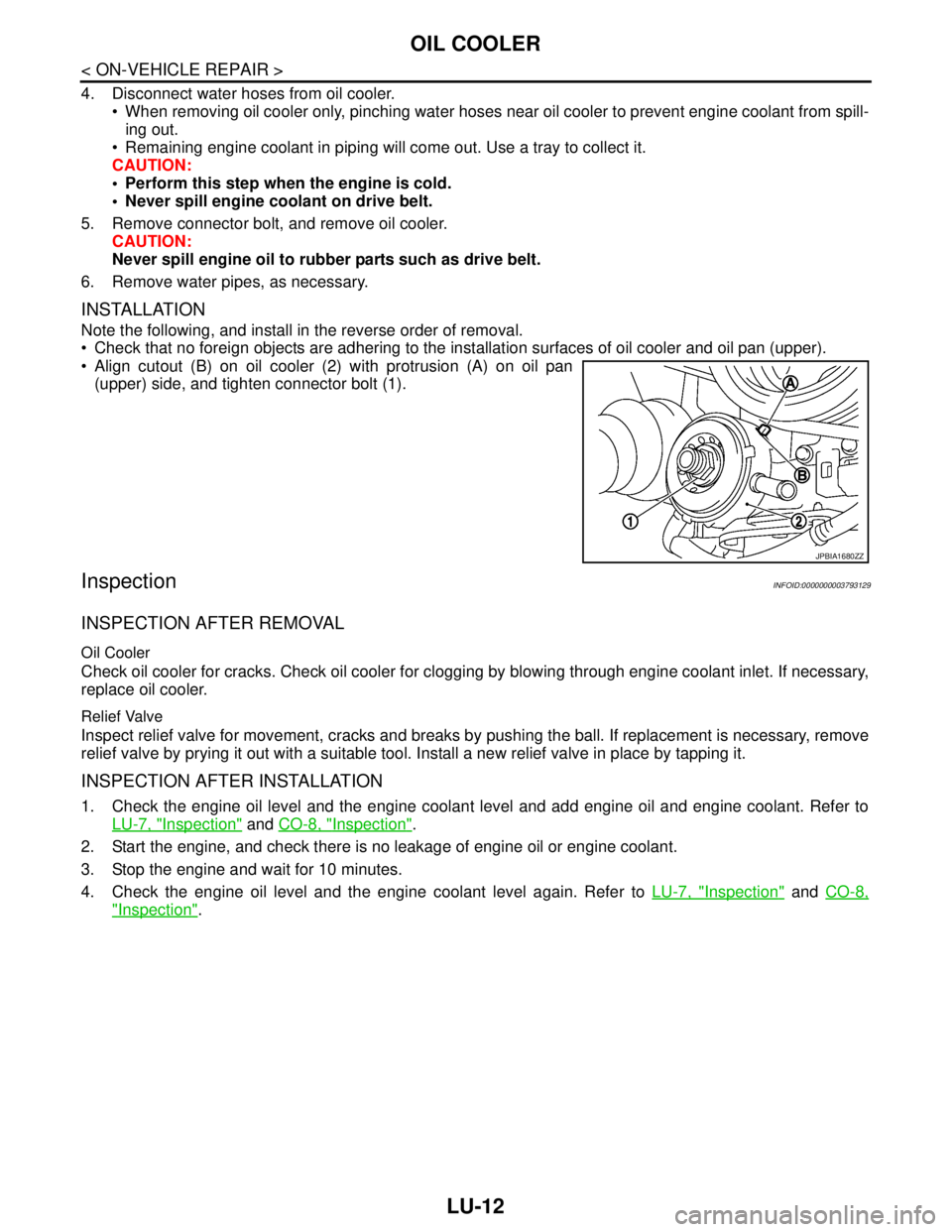
Align cutout (B) on oil cooler (2) with protrusion (A) on oil pan
(upper) side, and tighten connector bolt (1).
InspectionINFOID:0000000003793129
INSPECTION AFTER REMOVAL
Oil Cooler
Check oil cooler for cracks. Check oil cooler for clogging by blowing through engine coolant inlet. If necessary,
replace oil cooler.
Relief Valve
Inspect relief valve for movement, cracks and breaks by pushing the ball. If replacement is necessary, remove
relief valve by prying it out with a suitable tool. Install a new relief valve in place by tapping it.
INSPECTION AFTER INSTALLATION
1. Check the engine oil level and the engine coolant level and add engine oil and engine coolant. Refer to
LU-7, "
Inspection" and CO-8, "Inspection".
2. Start the engine, and check there is no leakage of engine oil or engine coolant.
3. Stop the engine and wait for 10 minutes.
4. Check the engine oil level and the engine coolant level again. Refer to LU-7, "
Inspection" and CO-8,
"Inspection".
JPBIA1680ZZ
Page 3187 of 5121
OIL PUMP
LU-15
< DISASSEMBLY AND ASSEMBLY >
C
D
E
F
G
H
I
J
K
L
MA
LU
N
P O
If measured/calculated values are out of the standard, replace oil pump assembly.
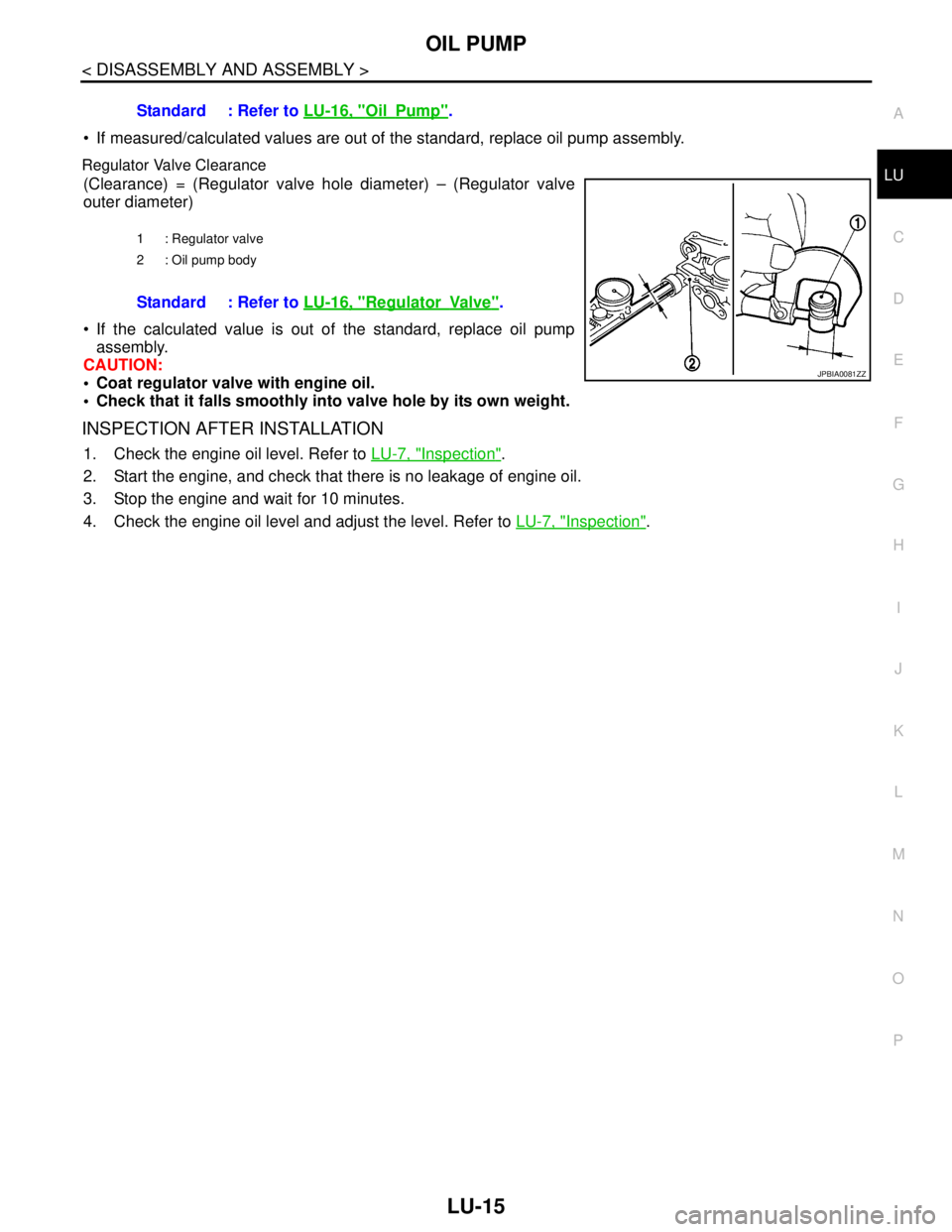
Regulator Valve Clearance
(Clearance) = (Regulator valve hole diameter) – (Regulator valve
outer diameter)
If the calculated value is out of the standard, replace oil pump
assembly.
CAUTION:
Coat regulator valve with engine oil.
Check that it falls smoothly into valve hole by its own weight.
INSPECTION AFTER INSTALLATION
1. Check the engine oil level. Refer to LU-7, "Inspection".
2. Start the engine, and check that there is no leakage of engine oil.
3. Stop the engine and wait for 10 minutes.
4. Check the engine oil level and adjust the level. Refer to LU-7, "
Inspection". Standard : Refer to LU-16, "
OilPump".
1 : Regulator valve
2 : Oil pump body
Standard : Refer to LU-16, "RegulatorVa lv e".
JPBIA0081ZZ
![NISSAN TEANA 2008 Service Manual LAN-22
< FUNCTION DIAGNOSIS >[CAN]
CAN COMMUNICATION SYSTEM
FUNCTION DIAGNOSIS
CAN COMMUNICATION SYSTEM
CAN System Specification ChartINFOID:0000000003767684
Determine CAN system type from the followi](/manual-img/5/57391/w960_57391-3088.png "NISSAN TEANA 2008 Service Manual LAN-22
< FUNCTION DIAGNOSIS >[CAN]
CAN COMMUNICATION SYSTEM
FUNCTION DIAGNOSIS
CAN COMMUNICATION SYSTEM
CAN System Specification ChartINFOID:0000000003767684
Determine CAN system type from the followi")