2008 NISSAN TEANA Trans
[x] Cancel search: TransPage 1967 of 5121
EM-92
< DISASSEMBLY AND ASSEMBLY >
CAMSHAFT
b. Disconnect ignition coil and injector harness connectors. Refer to EM-49, "Exploded View" and EM-44,
"Exploded View".
3. Remove intake valve timing control solenoid valve. Refer to EM-79, "
Exploded View".
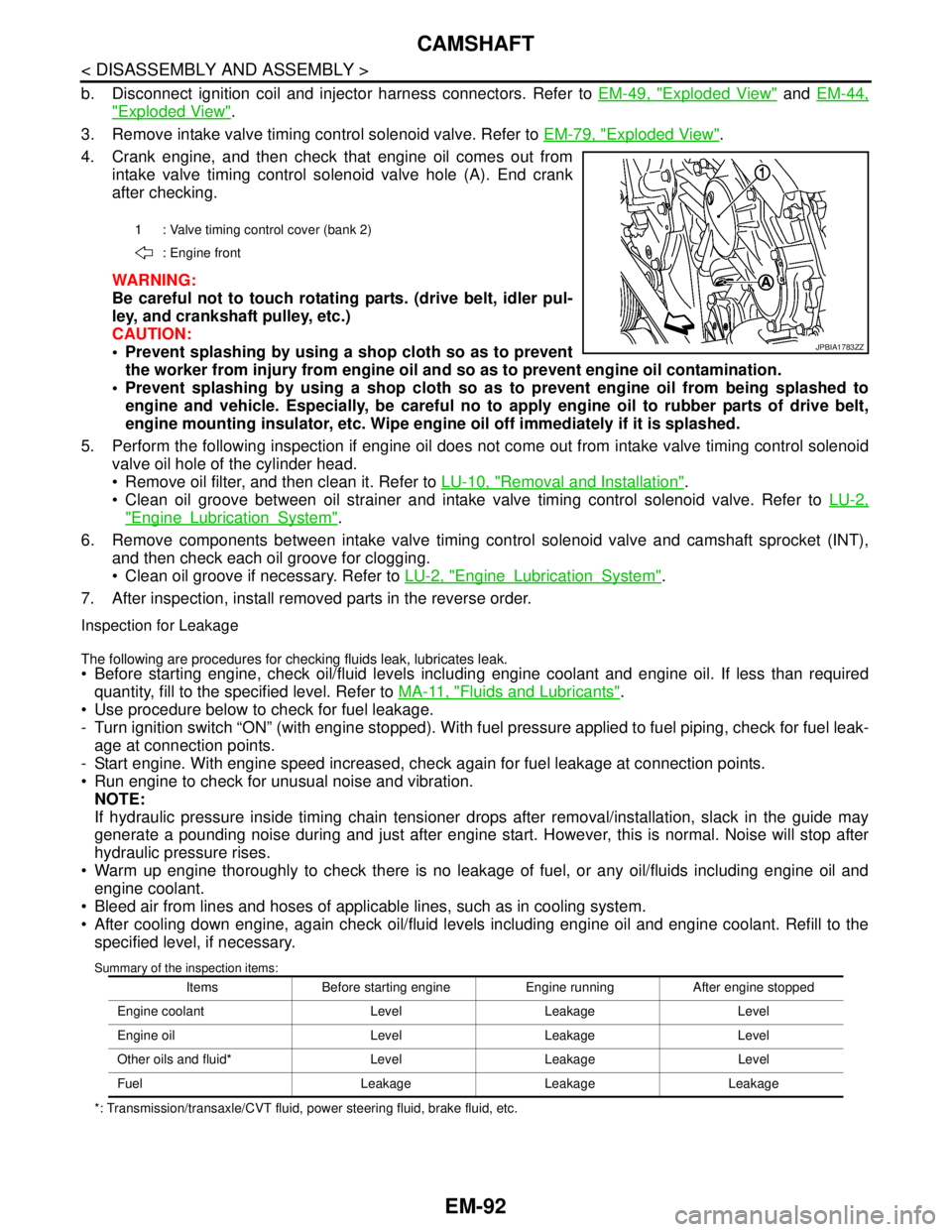
4. Crank engine, and then check that engine oil comes out from
intake valve timing control solenoid valve hole (A). End crank
after checking.
WARNING:
Be careful not to touch rotating parts. (drive belt, idler pul-
ley, and crankshaft pulley, etc.)
CAUTION:
Prevent splashing by using a shop cloth so as to prevent
the worker from injury from engine oil and so as to prevent engine oil contamination.
Prevent splashing by using a shop cloth so as to prevent engine oil from being splashed to
engine and vehicle. Especially, be careful no to apply engine oil to rubber parts of drive belt,
engine mounting insulator, etc. Wipe engine oil off immediately if it is splashed.
5. Perform the following inspection if engine oil does not come out from intake valve timing control solenoid
valve oil hole of the cylinder head.
Remove oil filter, and then clean it. Refer to LU-10, "
Removal and Installation".
Clean oil groove between oil strainer and intake valve timing control solenoid valve. Refer to LU-2,
"EngineLubricationSystem".
6. Remove components between intake valve timing control solenoid valve and camshaft sprocket (INT),
and then check each oil groove for clogging.
Clean oil groove if necessary. Refer to LU-2, "
EngineLubricationSystem".
7. After inspection, install removed parts in the reverse order.
Inspection for Leakage
The following are procedures for checking fluids leak, lubricates leak. Before starting engine, check oil/fluid levels including engine coolant and engine oil. If less than required
quantity, fill to the specified level. Refer to MA-11, "
Fluids and Lubricants".
Use procedure below to check for fuel leakage.
- Turn ignition switch “ON” (with engine stopped). With fuel pressure applied to fuel piping, check for fuel leak-
age at connection points.
- Start engine. With engine speed increased, check again for fuel leakage at connection points.
Run engine to check for unusual noise and vibration.
NOTE:
If hydraulic pressure inside timing chain tensioner drops after removal/installation, slack in the guide may
generate a pounding noise during and just after engine start. However, this is normal. Noise will stop after
hydraulic pressure rises.
Warm up engine thoroughly to check there is no leakage of fuel, or any oil/fluids including engine oil and
engine coolant.
Bleed air from lines and hoses of applicable lines, such as in cooling system.
After cooling down engine, again check oil/fluid levels including engine oil and engine coolant. Refill to the
specified level, if necessary.
Summary of the inspection items:
*: Transmission/transaxle/CVT fluid, power steering fluid, brake fluid, etc.1 : Valve timing control cover (bank 2)
: Engine front
JPBIA1783ZZ
Items Before starting engine Engine running After engine stopped
Engine coolant Level Leakage Level
Engine oil Level Leakage Level
Other oils and fluid* Level Leakage Level
Fuel Leakage Leakage Leakage
Page 1969 of 5121
EM-94
< DISASSEMBLY AND ASSEMBLY >
OIL SEAL
1. Remove the following parts:
Road wheel and tire (RH)
Splash guard (RH): Refer to EXT-22, "
FENDER PROTECTOR : Exploded View".
Drive belt: Refer to EM-12, "
Removal and Installation".
Crankshaft pulley: Refer to EM-52, "
Exploded View".
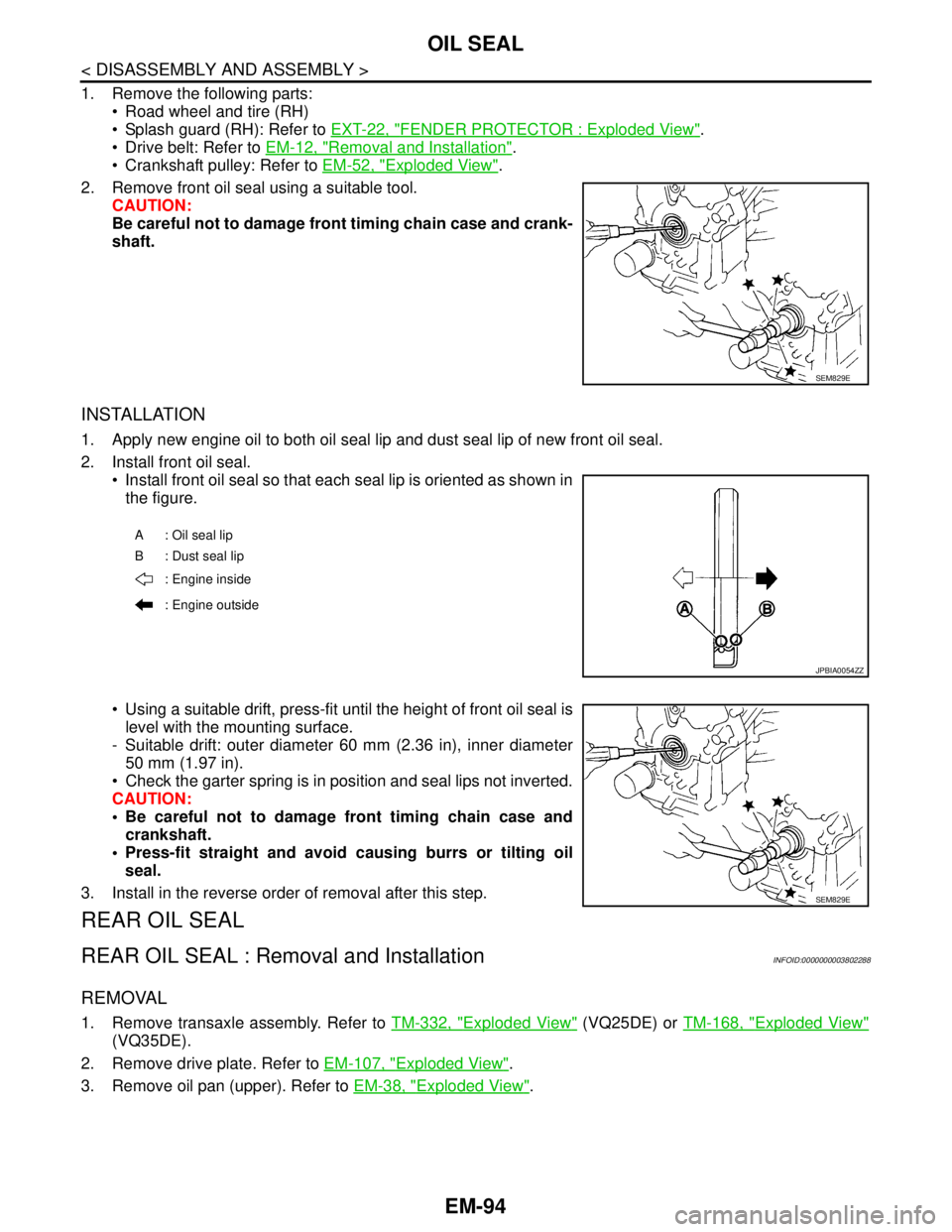
2. Remove front oil seal using a suitable tool.
CAUTION:
Be careful not to damage front timing chain case and crank-
shaft.
INSTALLATION
1. Apply new engine oil to both oil seal lip and dust seal lip of new front oil seal.
2. Install front oil seal.
Install front oil seal so that each seal lip is oriented as shown in
the figure.
Using a suitable drift, press-fit until the height of front oil seal is
level with the mounting surface.
- Suitable drift: outer diameter 60 mm (2.36 in), inner diameter
50 mm (1.97 in).
Check the garter spring is in position and seal lips not inverted.
CAUTION:
Be careful not to damage front timing chain case and
crankshaft.
Press-fit straight and avoid causing burrs or tilting oil
seal.
3. Install in the reverse order of removal after this step.
REAR OIL SEAL
REAR OIL SEAL : Removal and InstallationINFOID:0000000003802288
REMOVAL
1. Remove transaxle assembly. Refer to TM-332, "Exploded View" (VQ25DE) or TM-168, "Exploded View"
(VQ35DE).
2. Remove drive plate. Refer to EM-107, "
Exploded View".
3. Remove oil pan (upper). Refer to EM-38, "
Exploded View".
SEM829E
A: Oil seal lip
B : Dust seal lip
: Engine inside
: Engine outside
JPBIA0054ZZ
SEM829E
Page 1981 of 5121
EM-106
< DISASSEMBLY AND ASSEMBLY >
CYLINDER HEAD
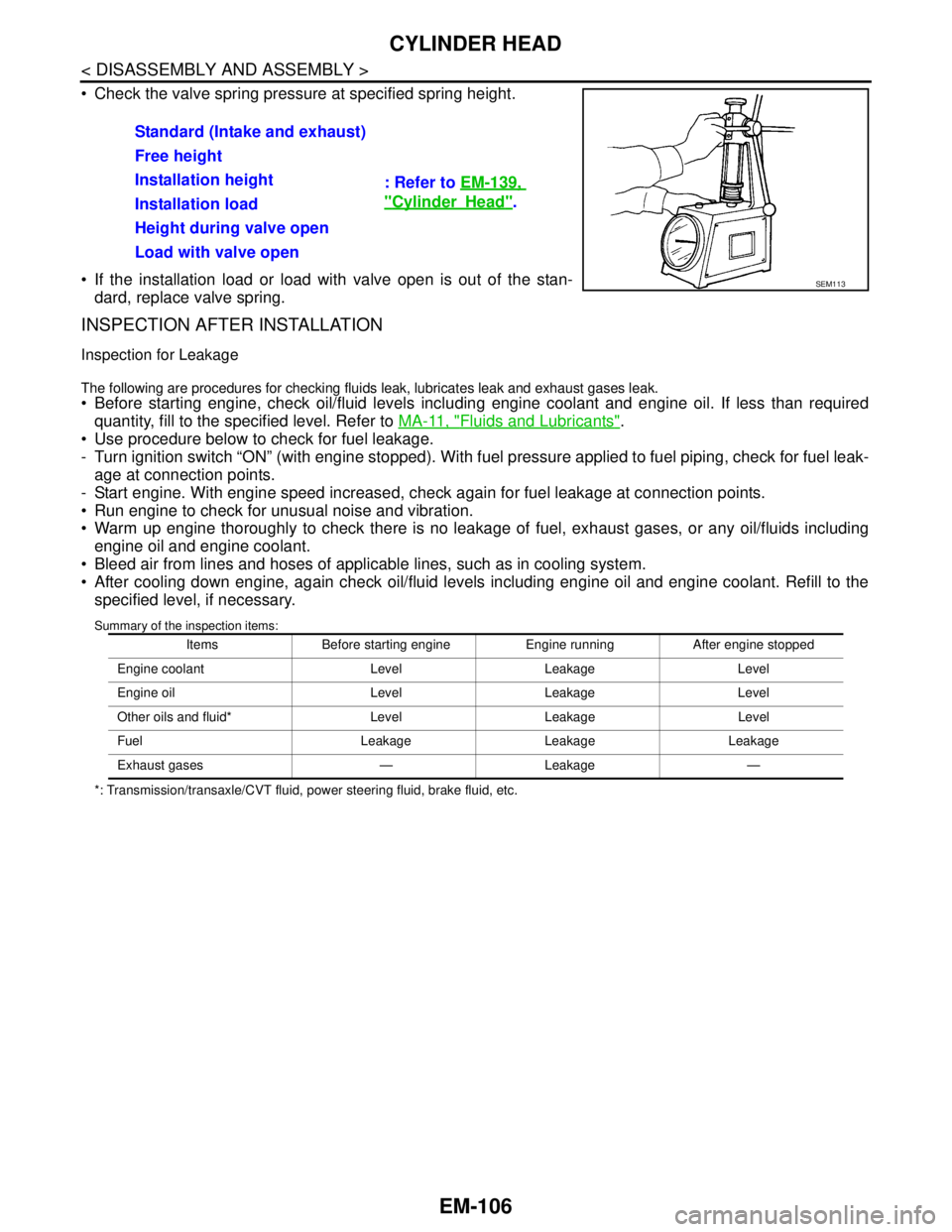
Check the valve spring pressure at specified spring height.
If the installation load or load with valve open is out of the stan-
dard, replace valve spring.
INSPECTION AFTER INSTALLATION
Inspection for Leakage
The following are procedures for checking fluids leak, lubricates leak and exhaust gases leak.
Before starting engine, check oil/fluid levels including engine coolant and engine oil. If less than required
quantity, fill to the specified level. Refer to MA-11, "
Fluids and Lubricants".
Use procedure below to check for fuel leakage.
- Turn ignition switch “ON” (with engine stopped). With fuel pressure applied to fuel piping, check for fuel leak-
age at connection points.
- Start engine. With engine speed increased, check again for fuel leakage at connection points.
Run engine to check for unusual noise and vibration.
Warm up engine thoroughly to check there is no leakage of fuel, exhaust gases, or any oil/fluids including
engine oil and engine coolant.
Bleed air from lines and hoses of applicable lines, such as in cooling system.
After cooling down engine, again check oil/fluid levels including engine oil and engine coolant. Refill to the
specified level, if necessary.
Summary of the inspection items:
*: Transmission/transaxle/CVT fluid, power steering fluid, brake fluid, etc.
Standard (Intake and exhaust)
: Refer to EM-139,
"CylinderHead". Free height
Installation height
Installation load
Height during valve open
Load with valve open
SEM113
Items Before starting engine Engine running After engine stopped
Engine coolant Level Leakage Level
Engine oil Level Leakage Level
Other oils and fluid* Level Leakage Level
Fuel Leakage Leakage Leakage
Exhaust gases — Leakage —
Page 2040 of 5121
![NISSAN TEANA 2008 Service Manual HEADLAMP SYSTEM
EXL-11
< FUNCTION DIAGNOSIS >[XENON TYPE]
C
D
E
F
G
H
I
J
K
MA
B
EXL
N
O
P
FUNCTION DIAGNOSIS
HEADLAMP SYSTEM
System DiagramINFOID:0000000003774356
System DescriptionINFOID:00000000037](/manual-img/5/57391/w960_57391-2039.png "NISSAN TEANA 2008 Service Manual HEADLAMP SYSTEM
EXL-11
< FUNCTION DIAGNOSIS >[XENON TYPE]
C
D
E
F
G
H
I
J
K
MA
B
EXL
N
O
P
FUNCTION DIAGNOSIS
HEADLAMP SYSTEM
System DiagramINFOID:0000000003774356
System DescriptionINFOID:00000000037")
HEADLAMP SYSTEM
EXL-11
< FUNCTION DIAGNOSIS >[XENON TYPE]
C
D
E
F
G
H
I
J
K
MA
B
EXL
N
O
P
FUNCTION DIAGNOSIS
HEADLAMP SYSTEM
System DiagramINFOID:0000000003774356
System DescriptionINFOID:0000000003774357
OUTLINE
Headlamp is controlled by combination switch reading function and headlamp control function of BCM, and
relay control function of IPDM E/R.
HEADLAMP (LO) OPERATION
BCM detects the combination switch condition with the combination switch reading function.
BCM transmits the low beam request signal to IPDM E/R with CAN communication according to the head-
lamp (LO) ON condition.
Headlamp (LO) ON condition- Lighting switch 2ND
- Lighting switch AUTO (auto light function ON judgment)
IPDM E/R turns the integrated headlamp low relay ON, and turns the headlamp ON according to the low
beam request signal.
HEADLAMP (HI) OPERATION
BCM transmits the high beam request signal to IPDM E/R and the combination meter with CAN communica-
tion according to the headlamp (HI) ON condition.
Headlamp (HI) ON condition- Lighting switch HI with the lighting switch 2ND or AUTO (auto light function ON judgment)
- Lighting switch PASS
Combination meter turns the high beam indicator lamp ON according to the high beam request signal.
IPDM E/R turns the integrated headlamp high relay ON, and turns the headlamp ON according to the high
beam request signal.
JPLIA0168GB
Page 2042 of 5121
![NISSAN TEANA 2008 Service Manual AUTO LIGHT SYSTEM
EXL-13
< FUNCTION DIAGNOSIS >[XENON TYPE]
C
D
E
F
G
H
I
J
K
MA
B
EXL
N
O
P
AUTO LIGHT SYSTEM
System DiagramINFOID:0000000003773527
System DescriptionINFOID:0000000003773528
OUTLINE
](/manual-img/5/57391/w960_57391-2041.png "NISSAN TEANA 2008 Service Manual AUTO LIGHT SYSTEM
EXL-13
< FUNCTION DIAGNOSIS >[XENON TYPE]
C
D
E
F
G
H
I
J
K
MA
B
EXL
N
O
P
AUTO LIGHT SYSTEM
System DiagramINFOID:0000000003773527
System DescriptionINFOID:0000000003773528
OUTLINE
")
AUTO LIGHT SYSTEM
EXL-13
< FUNCTION DIAGNOSIS >[XENON TYPE]
C
D
E
F
G
H
I
J
K
MA
B
EXL
N
O
P
AUTO LIGHT SYSTEM
System DiagramINFOID:0000000003773527
System DescriptionINFOID:0000000003773528
OUTLINE
Auto light system is controlled by each function of BCM and IPDM E/R.
Control by BCM- Combination switch reading function
- Headlamp control function
- Auto light function
- Delay timer function
Control by IPDM E/R- Relay control function
Auto light system has the auto light function and the delay timer function.
- Auto light function turns the exterior lamps* and each illumination ON/OFF automatically according to the
outside brightness.
- When auto light system turns the exterior lamps ON with the ignition switch OFF, delay timer function turns
the exterior lamps OFF depending on the vehicle condition with the auto light function after a certain period
of time.
*: Headlamp (LO/HI), parking lamp, tail lamp and front fog lamp (Headlamp HI and front fog lamp depend on
the combination switch condition.)
AUTO LIGHT FUNCTION
BCM detects the combination switch condition with the combination switch reading function.
BCM supplies voltage to optical sensor when the ignition switch is turned ON or ACC.
Optical sensor converts outside brightness (lux) to voltage and transmits the optical sensor signal to BCM.
BCM judges outside brightness from the optical sensor signal and judges ON/OFF condition of the exterior
lamp and each illumination according to the outside brightness.
BCM transmits each request signal to IPDM E/R with CAN communication according to ON/OFF condition
by the auto light function.
NOTE:
ON/OFF timing differs based on the sensitivity from the setting. The setting can be set by CONSULT-III. Refer
to EXL-28, "
HEADLAMP : CONSULT-III Function (BCM - HEAD LAMP)".
DELAY TIMER FUNCTION
BCM turns the exterior lamp OFF depending on the vehicle condition with the auto light function when the igni-
tion switch is turned OFF.
Turns the exterior lamp OFF 5 minutes after detecting that any door opens (Door switch ON).
Turns the exterior lamp OFF a certain period of time* after closing all doors (Door switch ON→OFF).
JPLIA0804GB
Page 2046 of 5121
![NISSAN TEANA 2008 Service Manual FRONT FOG LAMP SYSTEM
EXL-17
< FUNCTION DIAGNOSIS >[XENON TYPE]
C
D
E
F
G
H
I
J
K
MA
B
EXL
N
O
P
FRONT FOG LAMP SYSTEM
System DiagramINFOID:0000000003773531
System DescriptionINFOID:0000000003773532
O](/manual-img/5/57391/w960_57391-2045.png "NISSAN TEANA 2008 Service Manual FRONT FOG LAMP SYSTEM
EXL-17
< FUNCTION DIAGNOSIS >[XENON TYPE]
C
D
E
F
G
H
I
J
K
MA
B
EXL
N
O
P
FRONT FOG LAMP SYSTEM
System DiagramINFOID:0000000003773531
System DescriptionINFOID:0000000003773532
O")
FRONT FOG LAMP SYSTEM
EXL-17
< FUNCTION DIAGNOSIS >[XENON TYPE]
C
D
E
F
G
H
I
J
K
MA
B
EXL
N
O
P
FRONT FOG LAMP SYSTEM
System DiagramINFOID:0000000003773531
System DescriptionINFOID:0000000003773532
OUTLINE
Front fog lamp is controlled by combination switch reading function and front fog lamp control function of BCM,
and relay control function of IPDM E/R.
FRONT FOG LAMP OPERATION
BCM detects the combination switch condition by the combination switch reading function.
BCM transmits the front fog light request signal to IPDM E/R with CAN communication according to the front
fog lamp ON condition.
Front fog lamp ON condition
- Front fog lamp switch ON
- Lighting switch 1ST, 2ND or AUTO (auto light function ON judgment)
IPDM E/R turns the integrated front fog lamp relay ON, and turns the front fog lamp ON according to the
front fog light request signal.
Combination meter turns the front fog lamp indicator lamp ON according to the front fog light request signal.
JPLIA1083GB
Page 2048 of 5121
![NISSAN TEANA 2008 Service Manual TURN SIGNAL AND HAZARD WARNING LAMP SYSTEM
EXL-19
< FUNCTION DIAGNOSIS >[XENON TYPE]
C
D
E
F
G
H
I
J
K
MA
B
EXL
N
O
P
TURN SIGNAL AND HAZARD WARNING LAMP SYSTEM
System DiagramINFOID:0000000003773535
S](/manual-img/5/57391/w960_57391-2047.png "NISSAN TEANA 2008 Service Manual TURN SIGNAL AND HAZARD WARNING LAMP SYSTEM
EXL-19
< FUNCTION DIAGNOSIS >[XENON TYPE]
C
D
E
F
G
H
I
J
K
MA
B
EXL
N
O
P
TURN SIGNAL AND HAZARD WARNING LAMP SYSTEM
System DiagramINFOID:0000000003773535
S")
TURN SIGNAL AND HAZARD WARNING LAMP SYSTEM
EXL-19
< FUNCTION DIAGNOSIS >[XENON TYPE]
C
D
E
F
G
H
I
J
K
MA
B
EXL
N
O
P
TURN SIGNAL AND HAZARD WARNING LAMP SYSTEM
System DiagramINFOID:0000000003773535
System DescriptionINFOID:0000000003773536
OUTLINE
Turn signal lamp and the hazard warning lamp is controlled by combination switch reading function and the
flasher control function of BCM.
TURN SIGNAL LAMP OPERATION
BCM detects the combination switch condition by the combination switch reading function.
BCM supplies voltage to the right (left) turn signal lamp circuit when the ignition switch is turned ON and the
turn signal switch is in the right (left) position. BCM blinks the turn signal lamp.
HAZARD WARNING LAMP OPERATION
BCM supplies voltage to both turn signal lamp circuit when the hazard switch is turned ON. BCM blinks the
hazard warning lamp.
TURN SIGNAL INDICATOR LAMP AND TURN SIGNAL SOUND OPERATION
BCM transmits the turn indicator signal to the combination meter with CAN communication while the turn sig-
nal lamp and the hazard warning lamp are operating.
Combination meter outputs the turn signal sound with the integrated buzzer while blinking the turn signal
indicator lamp according to the turn indicator signal.
HIGH FLASHER OPERATION (FAIL-SAFE)
BCM detects the turn signal lamp circuit status by the terminal current value.
BCM increases the turn signal lamp blinking speed if the bulb or harness open is detected with the turn sig-
nal lamp operating.
NOTE:
The blinking speed is normal while operating the hazard warning lamp.
JPLIA0180GB
Page 2050 of 5121
![NISSAN TEANA 2008 Service Manual PARKING, LICENSE PLATE AND TAIL LAMPS SYSTEM
EXL-21
< FUNCTION DIAGNOSIS >[XENON TYPE]
C
D
E
F
G
H
I
J
K
MA
B
EXL
N
O
P
PARKING, LICENSE PLATE AND TAIL LAMPS SYSTEM
System DiagramINFOID:00000000037735](/manual-img/5/57391/w960_57391-2049.png "NISSAN TEANA 2008 Service Manual PARKING, LICENSE PLATE AND TAIL LAMPS SYSTEM
EXL-21
< FUNCTION DIAGNOSIS >[XENON TYPE]
C
D
E
F
G
H
I
J
K
MA
B
EXL
N
O
P
PARKING, LICENSE PLATE AND TAIL LAMPS SYSTEM
System DiagramINFOID:00000000037735")
PARKING, LICENSE PLATE AND TAIL LAMPS SYSTEM
EXL-21
< FUNCTION DIAGNOSIS >[XENON TYPE]
C
D
E
F
G
H
I
J
K
MA
B
EXL
N
O
P
PARKING, LICENSE PLATE AND TAIL LAMPS SYSTEM
System DiagramINFOID:0000000003773539
System DescriptionINFOID:0000000003773540
OUTLINE
Parking, license plate and tail lamps are controlled by combination switch reading function and headlamp con-
trol function of BCM, and relay control function of IPDM E/R.
PARKING, LICENSE PLATE AND TAIL LAMPS OPERATION
BCM detects the combination switch condition by the combination switch reading function.
BCM transmits the position light request signal to IPDM E/R and the combination meter with CAN communi-
cation according to the ON/OFF condition of the parking, license plate and tail lamps.
Parking, license plate and tail lamps ON condition
- Lighting switch 1ST
- Lighting switch 2ND
- Lighting switch AUTO (auto light function ON judgment)
IPDM E/R turns the integrated tail lamp relay ON and turns the parking lamp, license plate and tail lamps ON
according to the position light request signal.
Combination meter turns the tail lamp indicator lamp ON according to the position light request signal.
JPLIA0181GB