2007 MITSUBISHI LANCER EVOLUTION engine mount
[x] Cancel search: engine mountPage 529 of 1449
ENGINE LUBRICATION -On-vehicle Service12-5
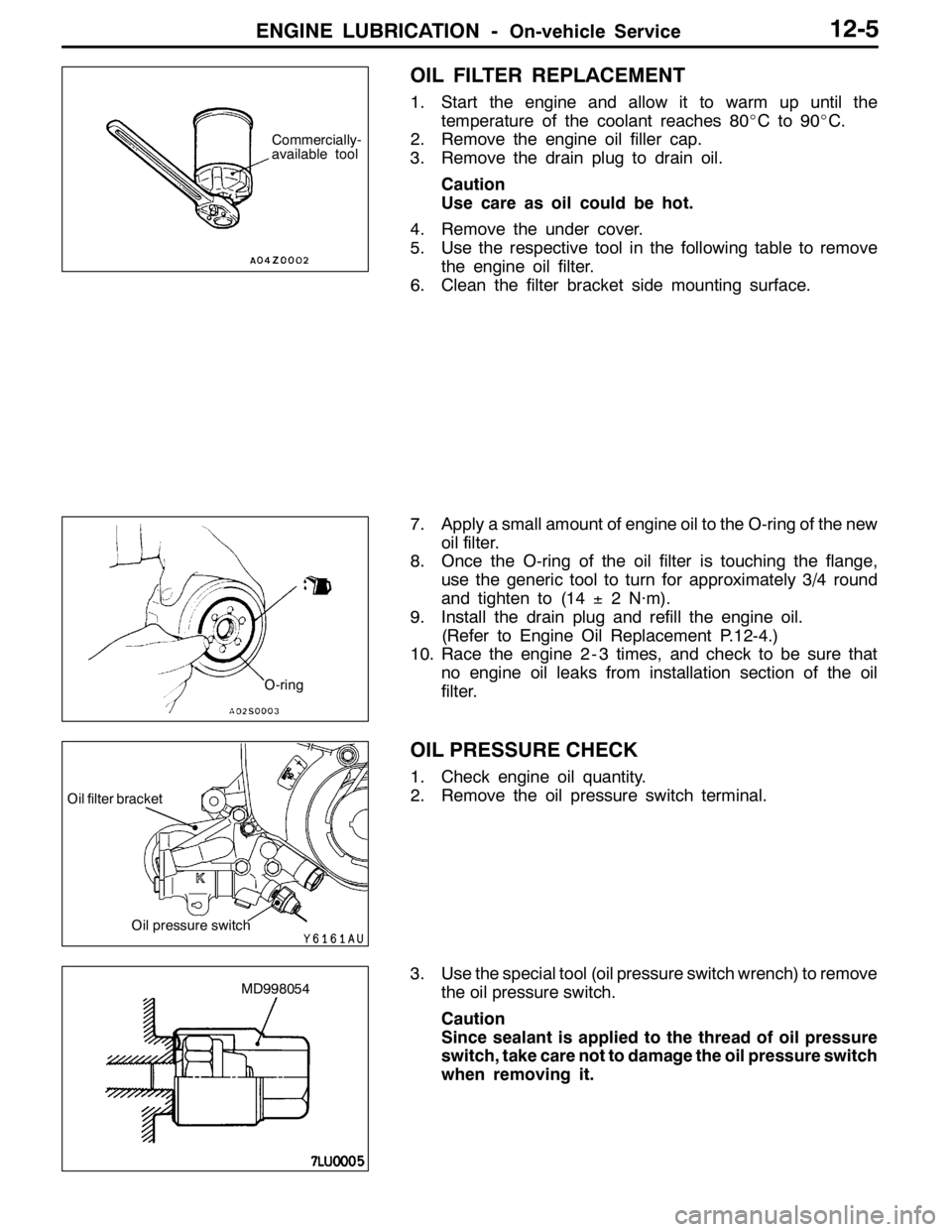
OIL FILTER REPLACEMENT
1. Start the engine and allow it to warm up until the
temperature of the coolant reaches 80_Cto90_C.
2. Remove the engine oil filler cap.
3. Remove the drain plug to drain oil.
Caution
Use care as oil could be hot.
4. Remove the under cover.
5. Use the respective tool in the following table to remove
the engine oil filter.
6. Clean the filter bracket side mounting surface.
7. Apply a small amount of engine oil to the O-ring of the new
oil filter.
8. Once the O-ring of the oil filter is touching the flange,
use the generic tool to turn for approximately 3/4 round
and tighten to (14±2 N·m).
9. Install the drain plug and refill the engine oil.
(Refer to Engine Oil Replacement P.12-4.)
10. Race the engine 2 - 3 times, and check to be sure that
no engine oil leaks from installation section of the oil
filter.
OIL PRESSURE CHECK
1. Check engine oil quantity.
2. Remove the oil pressure switch terminal.
3. Use the special tool (oil pressure switch wrench) to remove
the oil pressure switch.
Caution
Since sealant is applied to the thread of oil pressure
switch, take care not to damage the oil pressure switch
when removing it.
Commercially-
available tool
O-ring
Oil pressure switch
Oil filter bracket
MD998054
Page 535 of 1449

MPI -General Information13A-3
GENERAL INFORMATION
The Multipoint Fuel Injection System consists
of sensors which detect the engine conditions,
the engine-ECU which controls the system
based on signals from these sensors, and
actuators which operate under the control of
the engine-ECU. The engine-ECU carries outactivities such as fuel injection control, idle
speed control and ignition timing control. In
addition, the engine-ECU is equipped with
several diagnosis modes which simplify
troubleshooting when a problem develops.
FUEL INJECTION CONTROL
The injector drive times and injector timing are
controlled so that the optimum air/fuel mixture
is supplied to the engine to correspond to the
continually-changing engine operation condi-
tions.
A single injector is mounted at the intake port
of each cylinder. Fuel is sent under pressure
from the fuel tank by the fuel pump, with the
pressure being regulated by the fuel pressure
regulator. The fuel thus regulated is distributed
to each of the injectors.
Fuel injection is normally carried out once for
each cylinder for every two rotations of the
crankshaft. The firing order is 1-3-4-2. This iscalled sequential fuel injection. The
engine-ECU provides a richer air/fuel mixture
by carrying out “open-loop” control when the
engine is cold or operating under high load
conditions in order to maintain engine
performance. In addition, when the engine is
warm or operating under normal conditions,
the engine-ECU controls the air/fuel mixture
by using the oxygen sensor signal to carry out
“closed-loop” control in order to obtain the
theoretical air/fuel mixture ratio that provides
the maximum cleaning performance from the
three way catalyst.
IDLE AIR CONTROL
The idle speed is kept at the optimum speed
by controlling the amount of air that bypasses
the throttle valve in accordance with changes
in idling conditions and engine load during
idling. The engine-ECU drives the idle speed
control motor to keep the engine running at
the pre-set idle target speed in accordance
with the engine coolant temperature and airconditioner load. In addition, when the air
conditioner switch is turned off and on while
the engine is idling, the idle speed control motor
operates to adjust the throttle valve bypass
air amount in accordance with the engine load
conditions in order to avoid fluctuations in the
engine speed.
IGNITION TIMING CONTROL
The power transistor located in the ignition
primary circuit turns ON and OFF to control
the primary current flow to the ignition coil. This
controls the ignition timing in order to provide
the optimum ignition timing with respect to theengine operating conditions. The ignition timing
is determined by the engine-ECU from the
engine speed, intake air volume, engine coolant
temperature and barometric pressure.
SELF-DIAGNOSIS FUNCTION
DWhen an abnormality is detected in one
of the sensors or actuators related to
emission control, the engine warning lamp
(check engine lamp) illuminates as a
warning to the driver.
DWhen an abnormality is detected in one
of the sensors or actuators, a diagnosis
code corresponding to the abnormality is
output.DThe RAM data inside the engine-ECU that
is related to the sensors and actuators can
be read by means of the MUT-II. In addition,
the actuators can be force-driven under
certain circumstances.
Page 543 of 1449

MPI -TroubleshootingMPI -Troubleshooting13A-11
CONFIRMING FREEZE FRAME DATA
When the engine-ECU detects a malfunction and stores a diagnosis code, it also stores a current status
of the engine. This function is called “Freeze frame” data. By analyzing this “Freeze frame” data with
MUT-II, an effective troubleshooting can be performed.
NOTE
If mulfunctions have been detected in multiple systems, engine-ECU stores one malfunction only, which
has been detected first.
Item No.Data itemUnit/StateItem No.Data itemUnit/State
21Engine coolant temperature
sensor_C81Learn value%
22Crank angle sensorr/min82Feedback%
24Vehicle speedkm/h87Engine load%
FAIL-SAFE FUNCTION REFERENCE TABLE
When the main sensor malfunctions are detected by the diagnosis function, the vehicle is controlled
by means of the pre-set control logic to maintain safe conditions for driving.
Malfunctioning itemControl contents during malfunction
Air flow sensor1. Uses the throttle position sensor signal and engine speed signal (crank angle sensor
signal) to take reading of the basic injector drive time and basic ignition timing from
the pre-set mapping.
2. Fixes the idle speed control servo in the appointed position so idle control is not
performed.
Intake air temperature
sensorControls as if the intake air temperature is 25_C.
Throttle position
sensorNo increase in fuel injection amount during acceleration due to the throttle position sensor
signal.
Engine coolant
temperature sensor1. Controls as if the engine coolant temperature is 80_C.
(Even after sensor signal is correctly recovered, continues until the ignition switch
is set to the “LOCK” (OFF) position.)
2. Rotates radiator fan and condenser fan at high speed.
Camshaft position
sensor1. Inject all fuel cylinders simultaneously. (However, when the No.1 cylinder top dead
centre is not detected at all after the ignition switch is turned to “ON” position.)
2. Shuts off fuel supply after 4 seconds have passed since a failure was detected.
(However, when the No.1 cylinder top dead centre is not detected at all after the
ignition switch is turned to “ON” position.)
Barometric pressure
sensorControls as if the barometric pressure is 101 kPa.
Detonation sensorSwitches the ignition timing from ignition timing for super petrol to ignition timing for standard
petrol.
Alternator FR terminalDoes not control the output of the alternator according to an electrical load. (works as a
normal alternator)
Page 600 of 1449

MPI -Troubleshooting13A-68
Inspection Procedure 11
Pulsation (Hesitation, sag), poor acceleration, stumbling,
surging
Probable cause
Causes shown on right are suspected.DAir/fuel ratio control system malfunction
DIgnition system malfunction
DFuel system malfunction
DIntake and exhaust system malfunction
DExhaust gas purifier system malfunction
DImproper compression pressure
DTurbocharger system malfunction
OK
To the next page
OK
MUT-IIData list
DNo. 59: Oxygen sensor (rear) (Refer to P.13A-105.)
(Refer to P.13A-27.)
OK
MUT-IIData list
DNo. 11: Oxygen sensor (front) (Refer to P.13A-102.)NGCheck the Code No. P0130: Oxygen sensor (front) system.
(Refer to P.13A-24.)
OK
Check the EGR valve for sticking.
(Refer to GROUP 17 - Exhaust Gas Purifier Check.)NGReplace the EGR valve.
OK
Check the EGR control solenoid valve.
(Refer to GROUP 17 - Exhaust Gas Purifier Check.)NGReplace the EGR control solenoid valve.
OK
Check the purge control solenoid valve.
(Refer to GROUP 17 - Exhaust Gas Purifier Check.)NGReplace the purge control solenoid valve.
OK
MUT-IIData list
DNo. 13: Intake air temperature sensor
DNo. 14: Throttle position sensor
DNo. 21: Engine coolant temperature sensor
DNo. 25: Barometric pressure sensor
(Refer to P.13A-102.)
Proceed to OK if all service data values are correct.
Proceed to NG if there is even one abnormal service data value.NGRefer to inspections for diagnosis code of sensor showing
abnormal service data. (Refer to P.13A-12.)
OK
Check the injector operation sound. (Use sound scope.)NGCheck the Code No. P0201 - 204: Injector system for faulty
cylinder.
NO
Check the ignition timing.
(Refer to GROUP 11 - Engine Adjustment.)NGCheck mounting state of crank angle sensor and timing belt cover.
MUT-IISelf-Diag code
DIs a diagnosis code output?YESINSPECTION CHART FOR DIAGNOSIS CODE
(Refer to P.13A-12.)
Page 605 of 1449
MPI -Troubleshooting13A-73
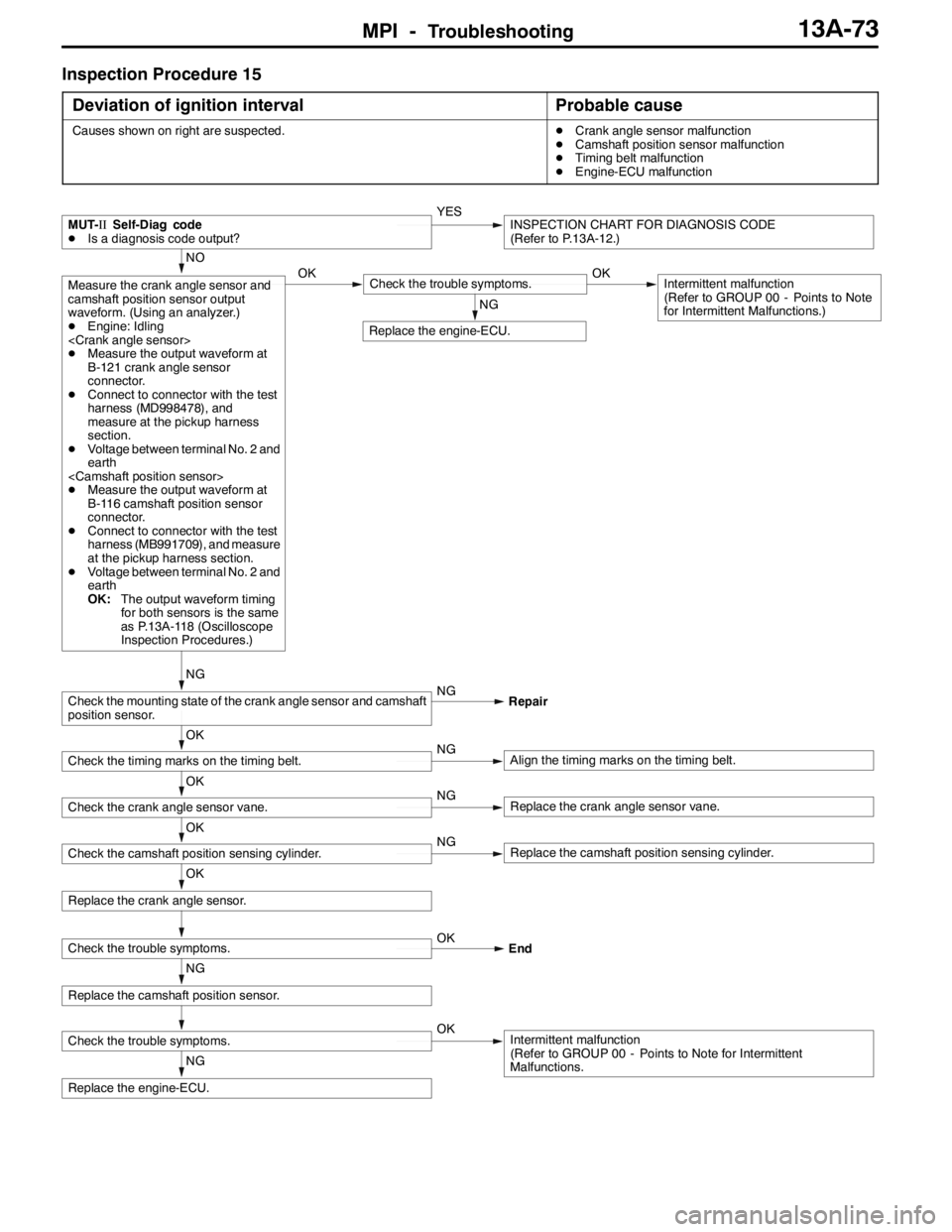
Inspection Procedure 15
Deviation of ignition interval
Probable cause
Causes shown on right are suspected.DCrank angle sensor malfunction
DCamshaft position sensor malfunction
DTiming belt malfunction
DEngine-ECU malfunction
NG
Replace the engine-ECU.
Check the trouble symptoms.OKIntermittent malfunction
(Refer to GROUP 00 - Points to Note for Intermittent
Malfunctions.
NG
Replace the camshaft position sensor.
Check the trouble symptoms.OK
End
OK
Replace the crank angle sensor.
NG
Replace the engine-ECU.
OK
Check the camshaft position sensing cylinder.NGReplace the camshaft position sensing cylinder.
OK
Check the crank angle sensor vane.NGReplace the crank angle sensor vane.
OK
Check the timing marks on the timing belt.NGAlign the timing marks on the timing belt.
NG
Check the mounting state of the crank angle sensor and camshaft
position sensor.NG
Repair
NO
Measure the crank angle sensor and
camshaft position sensor output
waveform. (Using an analyzer.)
DEngine: Idling
DMeasure the output waveform at
B-121 crank angle sensor
connector.
DConnect to connector with the test
harness (MD998478), and
measure at the pickup harness
section.
DVoltage between terminal No. 2 and
earth
DMeasure the output waveform at
B-116 camshaft position sensor
connector.
DConnect to connector with the test
harness (MB991709), and measure
at the pickup harness section.
DVoltage between terminal No. 2 and
earth
OK:The output waveform timing
for both sensors is the same
as P.13A-118 (Oscilloscope
Inspection Procedures.)OKCheck the trouble symptoms.OKIntermittent malfunction
(Refer to GROUP 00 - Points to Note
for Intermittent Malfunctions.)
MUT-IISelf-Diag code
DIs a diagnosis code output?YESINSPECTION CHART FOR DIAGNOSIS CODE
(Refer to P.13A-12.)
Page 613 of 1449
MPI -Troubleshooting13A-81
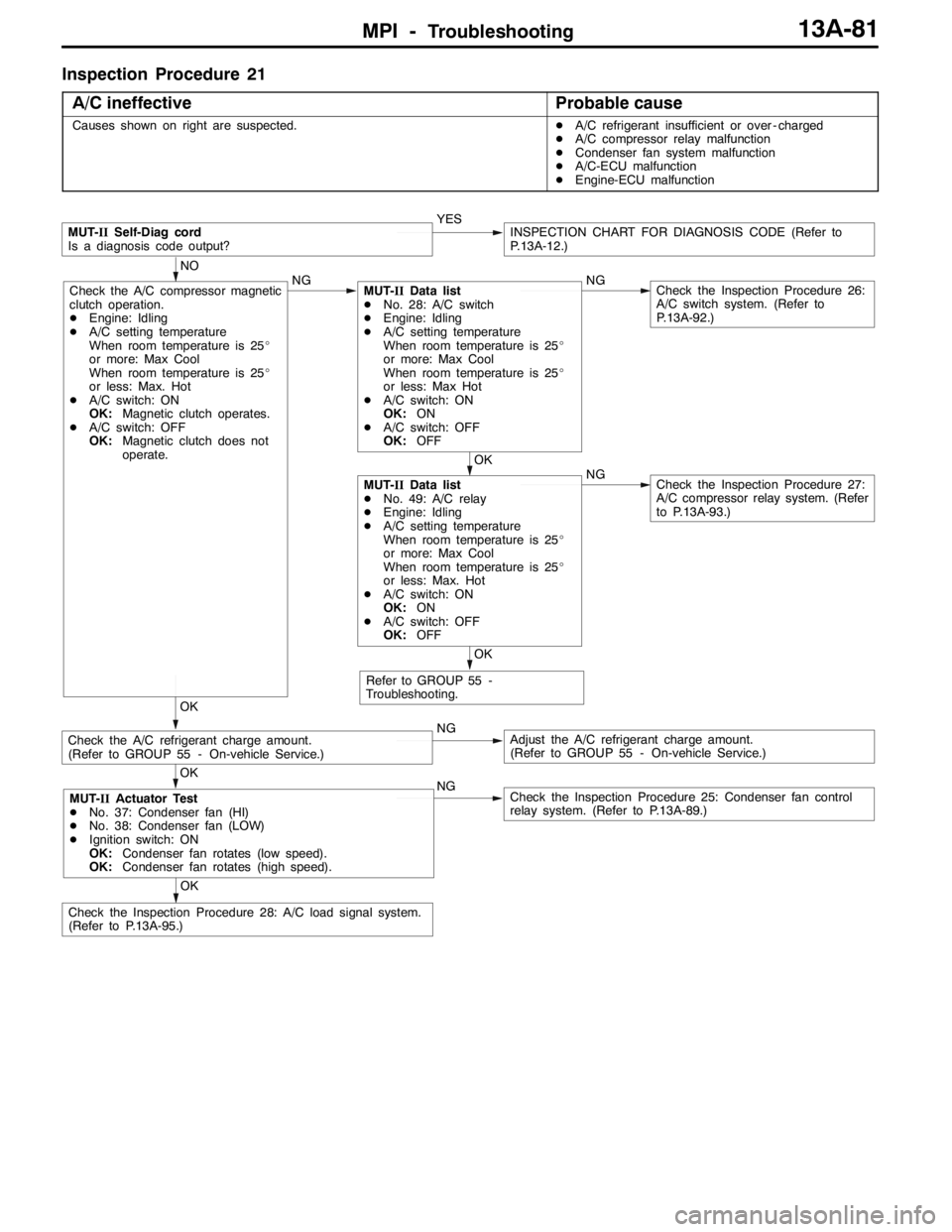
Inspection Procedure 21
A/C ineffective
Probable cause
Causes shown on right are suspected.DA/C refrigerant insufficient or over - charged
DA/C compressor relay malfunction
DCondenser fan system malfunction
DA/C-ECU malfunction
DEngine-ECU malfunction
NGCheck the Inspection Procedure 25: Condenser fan control
relay system. (Refer to P.13A-89.)
NGAdjust the A/C refrigerant charge amount.
(Refer to GROUP 55 - On-vehicle Service.)
MUT-IISelf-Diag cord
Is a diagnosis code output?YESINSPECTION CHART FOR DIAGNOSIS CODE (Refer to
P.13A-12.)
Refer to GROUP 55 -
Troubleshooting.
OK
OK
Check the A/C compressor magnetic
clutch operation.
DEngine: Idling
DA/C setting temperature
When room temperature is 25_
or more: Max Cool
When room temperature is 25_
or less: Max. Hot
DA/C switch: ON
OK:Magnetic clutch operates.
DA/C switch: OFF
OK:Magnetic clutch does not
operate.NGMUT-IIData list
DNo. 28: A/C switch
DEngine: Idling
DA/C setting temperature
When room temperature is 25_
or more: Max Cool
When room temperature is 25_
or less: Max Hot
DA/C switch: ON
OK:ON
DA/C switch: OFF
OK:OFFNGCheck the Inspection Procedure 26:
A/C switch system. (Refer to
P.13A-92.)
NO
OK
MUT-IIData list
DNo. 49: A/C relay
DEngine: Idling
DA/C setting temperature
When room temperature is 25_
or more: Max Cool
When room temperature is 25_
or less: Max. Hot
DA/C switch: ON
OK:ON
DA/C switch: OFF
OK:OFFNGCheck the Inspection Procedure 27:
A/C compressor relay system. (Refer
to P.13A-93.)
Check the A/C refrigerant charge amount.
(Refer to GROUP 55 - On-vehicle Service.)
OK
OK
Check the Inspection Procedure 28: A/C load signal system.
(Refer to P.13A-95.)
MUT-IIActuator Test
DNo. 37: Condenser fan (HI)
DNo. 38: Condenser fan (LOW)
DIgnition switch: ON
OK:Condenser fan rotates (low speed).
OK:Condenser fan rotates (high speed).
Page 617 of 1449
MPI -Troubleshooting13A-85
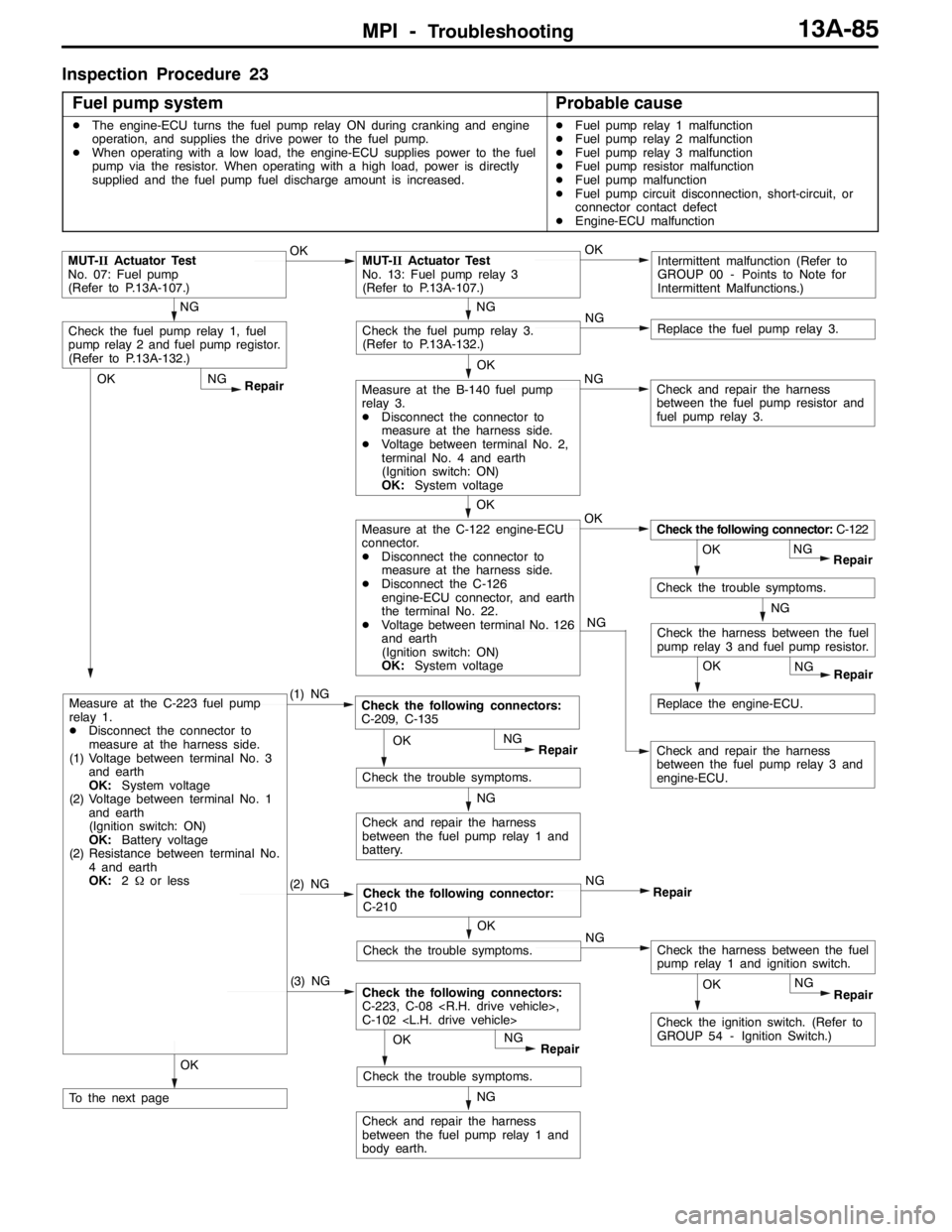
Inspection Procedure 23
Fuel pump system
Probable cause
DThe engine-ECU turns the fuel pump relay ON during cranking and engine
operation, and supplies the drive power to the fuel pump.
DWhen operating with a low load, the engine-ECU supplies power to the fuel
pump via the resistor. When operating with a high load, power is directly
supplied and the fuel pump fuel discharge amount is increased.DFuel pump relay 1 malfunction
DFuel pump relay 2 malfunction
DFuel pump relay 3 malfunction
DFuel pump resistor malfunction
DFuel pump malfunction
DFuel pump circuit disconnection, short-circuit, or
connector contact defect
DEngine-ECU malfunction
NG
Intermittent malfunction (Refer to
GROUP 00 - Points to Note for
Intermittent Malfunctions.)OKMUT-IIActuator Test
No. 07: Fuel pump
(Refer to P.13A-107.)
NGMUT-IIActuator Test
No. 13: Fuel pump relay 3
(Refer to P.13A-107.)OK
NG
Replace the fuel pump relay 3.NG
NG
Repair
Check the fuel pump relay 1, fuel
pump relay 2 and fuel pump registor.
(Refer to P.13A-132.)
OK
Measure at the B-140 fuel pump
relay 3.
DDisconnect the connector to
measure at the harness side.
DVoltage between terminal No. 2,
terminal No. 4 and earth
(Ignition switch: ON)
OK:System voltageNG
OK
Check the fuel pump relay 3.
(Refer to P.13A-132.)
OK
Check and repair the harness
between the fuel pump resistor and
fuel pump relay 3. OK
NG
Repair OK
NG
Check the trouble symptoms.
RepairOK
Check the harness between the fuel
pump relay 3 and fuel pump resistor.
Replace the engine-ECU.
Check and repair the harness
between the fuel pump relay 3 and
engine-ECU.
Check the following connector:C-122Measure at the C-122 engine-ECU
connector.
DDisconnect the connector to
measure at the harness side.
DDisconnect the C-126
engine-ECU connector, and earth
the terminal No. 22.
DVoltage between terminal No. 126
and earth
(Ignition switch: ON)
OK:System voltageNG
OK
Check the following connectors:
C-209, C-135(1) NG
Repair NG
NG
Check the trouble symptoms.
Check and repair the harness
between the fuel pump relay 1 and
battery.
(2) NGNG
OK
Check the following connector:
C-210Repair
NGCheck the trouble symptoms.
OK
Check the following connectors:
C-223, C-08
C-102
NG
Repair
NG
Check and repair the harness
between the fuel pump relay 1 and
body earth.
Check the trouble symptoms.OK
To the next page
Measure at the C-223 fuel pump
relay 1.
DDisconnect the connector to
measure at the harness side.
(1) Voltage between terminal No. 3
and earth
OK:System voltage
(2) Voltage between terminal No. 1
and earth
(Ignition switch: ON)
OK:Battery voltage
(2) Resistance between terminal No.
4 and earth
OK:2Ωor less
Repair OK
Check the ignition switch. (Refer to
GROUP 54 - Ignition Switch.)
Check the harness between the fuel
pump relay 1 and ignition switch.
NG
Page 648 of 1449

MPI -Troubleshooting13A-116
INSPECTION PROCEDURE USING AN
ANALYZER
AIR FLOW SENSOR
Measurement Method
1. Disconnect the air flow sensor connector, and connect
the special tool (test harness: MB991709) in between.
(All terminals should be connected.)
2. Connect the analyzer special patterns pickup to air flow
sensor connector terminal No. 3.
Alternate Method (Test harness not available)
1. Connect the analyzer special patterns pickup to
engine-ECU terminal No. 65.
Standard Wave Pattern
Observation conditions
FunctionSpecial patterns
Pattern heightLow
Pattern selectorDisplay
Engine r/minIdle speed
Standard wave pattern
(V)
10
0The time (cycle time) T is reduced when
the amount of intake air increases.
Times T1 and T2 are equal.
Time T
T1 T2
Observation conditions (from conditions above engine speed is increased by racing.)
Time (V)
10
0T
Wave Pattern Observation Points
Check that cycle time T becomes shorter and the frequency increases when the engine speed is increased.
Analyzer
Special
patterns
pickup