2007 MITSUBISHI LANCER EVOLUTION service
[x] Cancel search: servicePage 1296 of 1449

SRS - Air Bag Modules and Clock Spring52B-52
AIR BAG MODULES AND CLOCK SPRING
Caution
1. Disconnect the negative ( - ) battery terminal
and wait for 60 seconds or more before
starting work. Also, the disconnected
battery terminal should be insulated with
tape. (Refer to P.52B-3.)
2. Never attempt to disassemble or repair the
air bag modules and clock spring.
If faulty, just replace with new one(s).
3. Do not drop the air bag modules or clock
spring or allow contact with water, grease
or oil.
Replace if a dent, crack, deformation or rust
are present.
4. Store the air bag modules on a flat surface
with the deployment surface facing up.
Do not place anything on top of them.5. Do not store the air bag modules in a place
more than 93_C.
6. When the driver’s and front passenger’s air
bags have been deployed, replace the
driver’s and passenger’s air bag modules
with new ones.
7. Put on gloves and safety glasses when
handling deployed air bags.
8. When discarding the undeployed air bag
module(s), be sure to deploy the air bag(s)
in advance as specified in the service
procedure. (Refer to to P.52B-64.)
Page 1299 of 1449

SRS - Air Bag Modules and Clock Spring52B-55
1
Removal steps
DInstrument panel assembly
(Refer to GROUP 52A - Instrument
panel.)
A
F"1. Passenger’s air bag moduleInstallation steps
"AADPre-installation inspection
1. Passenger’s air bag module
DInstrument panel assembly
(Refer to GROUP 52A - Instrument
panel.)
DNegative ( - ) battery cable connection
"DADPost-installation inspection
REMOVAL SERVICE POINTS
AA"DRIVER’S AIR BAG MODULE REMOVAL
1. Remove the air bag module mounting screw (torque
screw) from the steering wheel side.
2. Spread the lock outward to remove the connector by
prying with a flat-tipped screw driver as shown in the
illustration at left.
Caution
(1) Be careful not to remove the connector forcibly.
(2) Keep the removed driver’s air bag module facing
the pad surface upward in a clean and dry place.
locked
Connector
Flat-tipped screw
driver
locked
Page 1301 of 1449

SRS - Air Bag Modules and Clock Spring52B-57
AF"PASSENGER’S AIR BAG MODULE REMOVAL
Insert the screwdriver ( - ) into the position specified in the
figure and lift the screwdriver upward to release the pawls
engaged, and then remove the passenger’s air bag module.
Caution
1. When the passenger’s air bag module is removed,
do not damage the engagement of the pawls.
2. The removed passenger’s air bag module should be
stored in a clean, dry place with facing the deployment
surface facing up.
INSTALLATION SERVICE POINTS
"AAPRE-INSTALLATION INSPECTION
1. Pre-installation inspection is carried out even if installing
a new air bag module or clock spring. (Refer to P.52B-59.)
Caution
A used air bag module must be discarded after
deoloyment according to the specified procedure.
(Refer to P.52B-64.)
2. Connect the negative ( - ) terminal of the battery.
3. Connect the MUT-II to the diagnosis connector (16 pin).
Caution
Connection and disconnection of the MUT-IImust
be carried out after turning the ignition switch to the
LOCK (OFF) position.
4. Turn the ignition switch to ON.
5. Check that there is no abnormality except for open circuit
in the air bag module after reading diagnostic codes.
6. Turn the ignition switch to LOCK (OFF) position.
7. Release the negative ( - ) terminal cable of the battery
and wrap a tape around it for insulation.
Caution
Wait for at least 60 seconds after disconnecting the
negative ( - ) battery cable before starting any
operation. (Refer to P.52B-3.)
"BACLOCK SPRING INSTALLATION
1. Check that the steering wheel is positioned in the forward
direction.
2. Install the column switch to the clock spring after centering
of the clock spring is carried out as follows.
Centering of the clock spring
After turning the clock spring clockwise fully, turning approximately
3 rounds in the opposite direction, and align mating marks.
Caution
If centering of the clock spring is not properly done, the
SRS air bag system does not function normally due to
possible malfunctions that the steering wheel may not turn
in the way or cables in the clock spring may be torn.
Mating marks
Page 1303 of 1449
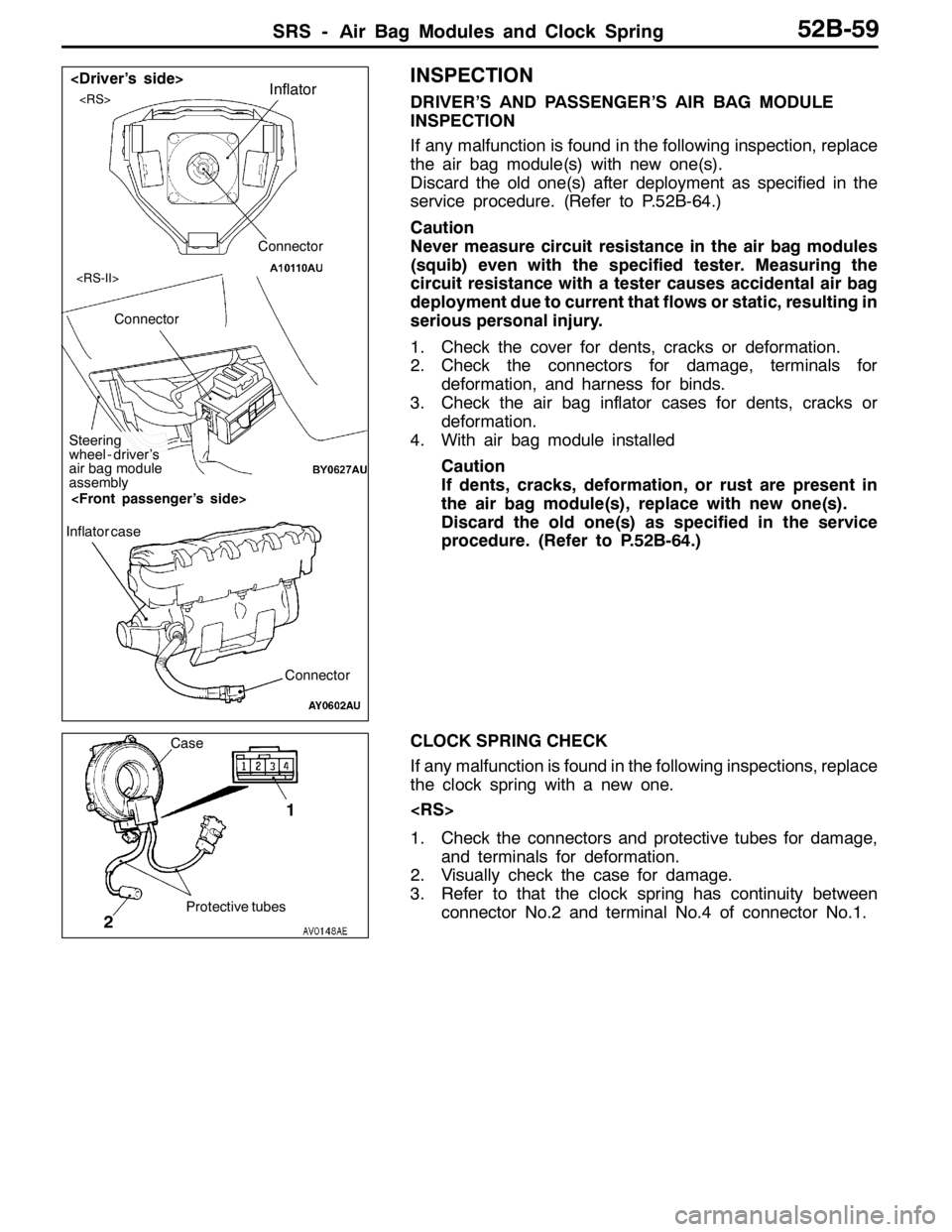
SRS - Air Bag Modules and Clock Spring52B-59
INSPECTION
DRIVER’S AND PASSENGER’S AIR BAG MODULE
INSPECTION
If any malfunction is found in the following inspection, replace
the air bag module(s) with new one(s).
Discard the old one(s) after deployment as specified in the
service procedure. (Refer to P.52B-64.)
Caution
Never measure circuit resistance in the air bag modules
(squib) even with the specified tester. Measuring the
circuit resistance with a tester causes accidental air bag
deployment due to current that flows or static, resulting in
serious personal injury.
1. Check the cover for dents, cracks or deformation.
2. Check the connectors for damage, terminals for
deformation, and harness for binds.
3. Check the air bag inflator cases for dents, cracks or
deformation.
4. With air bag module installed
Caution
If dents, cracks, deformation, or rust are present in
the air bag module(s), replace with new one(s).
Discard the old one(s) as specified in the service
procedure. (Refer to P.52B-64.)
CLOCK SPRING CHECK
If any malfunction is found in the following inspections, replace
the clock spring with a new one.
1. Check the connectors and protective tubes for damage,
and terminals for deformation.
2. Visually check the case for damage.
3. Refer to that the clock spring has continuity between
connector No.2 and terminal No.4 of connector No.1.Inflator
Connector
Connector
Steering
wheel - driver’s
air bag module
assembly
Connector Inflator case
Protective tubes Case
1
2
Page 1306 of 1449

SRS -Seat Belt with Pre-tensioner52B-62
INSTALLATION SERVICE POINTS
"AAPRE-INSTALLATION INSPECTION
1. Pre-installation inspection must be carried out even when
installing a new seat belt with pre-tensioner. (Refer to
Inspections.)
Caution
If the seat belt with pre-tensioner is discarded, discard
it after operating the seat belt pre-tensioner according
to the specified procedure. (Refer to P.52B-64.)
2. Connect the negative ( - ) terminal of the battery.
3. Connect the MUT-II to the diagnosis connector (16 pin).
Caution
Connection and disconnection of the MUT-II must be
carried out after turning the ignition switch to the
LOCK (OFF) position.
4. Turn the ignition switch to ON position.
5. Check that there is no abnormality except for open circuit
in the seat belt pre-tensioner after reading diagnostic
codes.
6. Turn the ignition key to LOCK (OFF) position.
7. Release the negative ( - ) terminal cable of the battery
and wrap a tape around it for insulation.
Caution
Wait for at least 60 seconds after disconnecting the
negative ( - ) battery cable before starting any
operation. (Refer to P.52B-3.)
"BAPOST-INSTALLATION INSPECTION
1. Turn the ignition switch to the ON position.
2. Check that the SRS warning lamp illuminates for 6 to
8 seconds and goes out.
3. Carry out troubleshooting if the lamp does not go out.
(Refer to P.52B-6.)
SRS warning lamp
Page 1322 of 1449

54A-2
CHASSIS
ELECTRICAL
CONTENTS
BATTERY 4..............................
SERVICE SPECIFICATION 4....................
ON-VEHICLE SERVICE 4......................
Fluid Level and Specific Gravity Check 4........
Charging 4.................................
Battery Testing Procedure 5...................
IGNITION SWITCH AND IMMOBILIZER
SYSTEM 6...............................
SPECIAL TOOLS 6............................
TROUBLESHOOTING 6........................
IMMOBILIZER-ECU CHECK 10.................
IGNITION SWITCH 11..........................
COMBINATION METER 14................
SERVICE SPECIFICATIONS 14.................
SEALANT 14..................................
SPECIAL TOOLS 15...........................
TROUBLESHOOTING 15.......................
ON-VEHICLE SERVICE 19.....................Speedometer Check 19......................
Tachometer Check 20........................
Fuel Gauge Unit Check 20....................
Engine Coolant Temperature Gauge
Unit Check 21...............................
COMBINATION METER 22.....................
HEADLAMP ASSEMBLY 24...............
SERVICE SPECIFICATIONS 24.................
TROUBLESHOOTING 24.......................
ON-VEHICLE SERVICE 24.....................
Headlamp Aiming 24.........................
Headlamp Intensity Measurement 28...........
Headlamp Bulb(low beam)Replacement28 ....
Headlamp Bulb(high beam)Replacement29 ...
Position Lamp Bulb Replacement29 ...........
Front Turn Signal Lamp Bulb Replacement29 ...
Headlamp Auto Cut Adjustment Procedure29 ...
HeadlampAuto Cut Function Check 29.........
HEADLAMP ASSEMBLY 30....................
CONTINUED ON NEXT PAGE
Page 1323 of 1449

54A-3
SIDE TURN-SIGNAL LAMP 31............
SPECIAL TOOL 31............................
SIDE TURN-SIGNAL LAMP 31..................
ROOM LAMP 31.........................
TROUBLESHOOTING 31.......................
REAR COMBINATION LAMP 32...........
SPECIAL TOOL 32............................
TROUBLESHOOTING 32.......................
REAR COMBINATION LAMP 32................
HIGH-MOUNTED STOP LAMP 34.........
ON-VEHICLE SERVICE 34......................
High-mounted Stop Lamp Bulb Replacement 34.
HIGH-MOUNTED STOP LAMP 34................
LICENCE PLATE LAMP 35...............
ON-VEHICLE SERVICE 35.....................
License Plate Lamp Replacement 35...........
LICENCE PLATE LAMP 35.....................
HAZARD WARNING LAMP SWITCH 36....
SPECIAL TOOL 36............................
HAZARD WARNING LAMP SWITCH 36.........
HORN 37................................
CIGARETTE LIGHTER 37.................
COLUMN SWITCH 38....................
SPECIAL TOOL 38............................
COLUMN SWITCH 38..........................
CLOCK 40...............................
SPECIAL TOOL 40............................
CLOCK 40....................................
POLE ANTENNA 41......................
ROOF ANTENNA 42......................
DEFOGGER 42...........................
TROUBLESHOOTING 42......................
ON-VEHICLE SERVICE 43.....................
Printed Heater Check 43......................
Defogger Relay Continuity Check 43...........
DEFOGGER SWITCH 43.......................
Page 1324 of 1449
![MITSUBISHI LANCER EVOLUTION 2007 Service Repair Manual CHASSIS ELECTRICAL -BatteryCHASSIS ELECTRICAL -Battery54A-4
BATTERY
SERVICE SPECIFICATION
ItemSpecification
Specific gravity of the battery fluid1.220 - 1.290 [20_C]
ON-VEHICLE SERVICE
FLUID LEVEL AND](/manual-img/19/57084/w960_57084-1323.png "MITSUBISHI LANCER EVOLUTION 2007 Service Repair Manual CHASSIS ELECTRICAL -BatteryCHASSIS ELECTRICAL -Battery54A-4
BATTERY
SERVICE SPECIFICATION
ItemSpecification
Specific gravity of the battery fluid1.220 - 1.290 [20_C]
ON-VEHICLE SERVICE
FLUID LEVEL AND")
CHASSIS ELECTRICAL -BatteryCHASSIS ELECTRICAL -Battery54A-4
BATTERY
SERVICE SPECIFICATION
ItemSpecification
Specific gravity of the battery fluid1.220 - 1.290 [20_C]
ON-VEHICLE SERVICE
FLUID LEVEL AND SPECIFIC GRAVITY CHECK
1. Inspect whether or not the battery fluid is between the
UPPER LEVEL and LOWER LEVEL marks.
Caution
(1) If the battery fluid is below the LOWER LEVEL,
the battery could explode in using.
(2) If the battery fluid is over the UPPER LEVEL,
leakage could result.
2. Use a hydrometer and thermometer to check the specific
gravity of the battery fluid.
Standard value: 1.220 - 1.290 [20_C]
The specific gravity of the battery fluid varies with the
temperature, so use the following formula to calculate
the specific gravity for 20_C. Use the calculated value
to determine whether or not the specific gravity is
satisfactory.
D20 = (t - 20)×0.0007 + Dt
D20: Specific gravity of the battery fluid calculated
for 20_C.
Dt: Actually measured specific gravity
t: Actually measured temperature
CHARGING
1. Remove the battery from the vehicle.
2. The normal charging current is a value in amperes which is 1/10th of the battery capacity. If the
battery needs to be charged rapidly because of reasons such as time limitations, the maximum charging
current for rapid charging is the battery capacity expressed as an ampere value.
Battery typeCapacity (5-hour rate)Normal charging currentRapid charging current
44B2034 A3.4 A34 A
3. Determine when charging is finished.
DWhen the specific gravity of the battery electrolyte is constantly within 1.250 - 1.290 for a
continuous period of one hour or more
DWhen the voltage per cell during charging is 2.5 - 2.8 V constantly for a continuous period
of one hour or more
Thermometer
HydrometerGood