Page 404 of 1449

GENERAL -Support Locations for Lifting and Jacking00-26
PLATE TYPE LIFT
To avoid damaging the side sill garnish, put a wooden block between the side sill and a lift.
NOTE
The wooden block should be 100 mm wide and 50 mm high.
SUPPORT POSITIONS AND SUPPORT METHOD
FOR AN H-BAR LIFT
Caution
When service procedures require removing the rear
suspension, fuel tank, spare tyre and rear bumper, place
additional weight on rear end of vehicle or anchor vehicle
to hoist to prevent tipping of centre of gravity changes.
When H-bar lift is used to lift up vehicles, use of metallic
attachment attached to the H-bar lift may cause damage
to the suspension arm etc. Therefore, lift up the vehicle by
the following procedure.
1. Place the vehicle on the H-bar lift (same direction).
2. Place attachments on the H-bar lift at the designated
chassis-support positions. When making the attachments,
refer to the section concerning making them.
Caution
If support is at any location other than the designated
positions, the body or suspension might be deformed
or otherwise damaged, so care should be taken to
support only at the correct (designated) positions.
3. Raise the H-bar lift to the height at which the vehicle
is slightly raised and check to be sure that the vehicle
is correctly and sufficiently secured; then raise the vehicle.
H-bar lift
H-bar lift
A
Chassis-sup-
port position
(side sill)
Attachment
H-bar liftSection A - A
Side sill
AttachmentH-bar lift
A
Page 408 of 1449
11A-2
ENGINE
CONTENTS
GENERAL INFORMATION 3..................
SERVICE SPECIFICATIONS 4.................
SEALANTS 4................................
SPECIAL TOOLS 5...........................
ON-VEHICLE SERVICE 7.....................
Drive Belt Tension Check 7.....................
Auto-tensioner Check 7.........................
Ignition Timing Check 9.........................
Idle Speed Check 9............................
Idle Mixture Check 10..........................
Compression Pressure Check 11................Manifold Vacuum Check 12.....................
Lash Adjuster Check 12........................
CRANKSHAFT PULLEY 15....................
CAMSHAFT AND CAMSHAFT OIL
SEAL 16.....................................
OIL PAN 23..................................
CRANKSHAFT OIL SEAL 26..................
CYLINDER HEAD GASKET 28................
TIMING BELT AND TIMING BELT B 34.......
ENGINE ASSEMBLY 43.......................
Page 410 of 1449

ENGINE -Service Specifications/Sealants11A-4
SERVICE SPECIFICATIONS
ItemsStandard valueLimit
Drive belt tensionVibration frequency Hz (Reference)110 - 144-
Tension N (Reference)245 - 412-
Basic ignition timing5_BTDC±3_-
Ignition timingApproximetely
5_BTDC-
Idle speed r/min850±100-
CO contents %0.1 or less-
HC contents ppm100 or less-
Compression pressure (250 - 400 r/min) kPa1,128951
Compression pressure difference of all cylinder kPa-Max. 98
Intake manifold vacuum kPa-Min. 60
Cylinder head bolt shank length mm-99.4
Timing belt B tension
(Whenchecked)
Vibration frequency Hz52 - 92-
(When checked)Deflection mm (Reference)5-10-
Timing belt B tension
(Whenadjusted)
Vibration frequency Hz76 - 92-
(When adjusted)Deflection mm (Reference)5-7-
Timing belt B tension
(Whenreplaced)
Vibration frequency Hz76 - 92-
(When replaced)Deflection mm (Reference)5-7-
Auto-tensioner rod protrusion amount mm3.8 - 4.5-
Auto-tensioner rod sink in amount mmWithin 1-
SEALANTS
ItemsSpecified SealantsRemarks
Rocker coverMITSUBISHI GENUINE PART MD970389 or
equivalent
Semi-drying
sealant
Rocker cover gasket
equivalentsealant
Cylinder head
Camshaft position sensor support
Oil pan
Camshaft end seal3M ATD Part No. 8660 or equivalent
Page 412 of 1449
ENGINE -Special Tools11A-6
Tool UseName Number
MB991367Special spannerFor retaining the crankshaft sprocket
MB991385Pin
MB991704Battery harnessMeasuring the timing belt B tension
(used together with MUT-II)
MD998767Tensioner pulley
socket wrenchFor adjusting timing belt tension
MD998738Adjusting boltFor retaining the tensioner arm and the
auto-tensioner
MB991453Engine hanger
attachment
setSupporting the engine assembly during
removal and installation of the transmission
GENERAL
SERVICE
TOOL
MZ203827Engine lifter
Page 413 of 1449

ENGINE -On-vehicle Service11A-7
ON-VEHICLE SERVICE
DRIVE BELT TENSION CHECK
1. Check that the indicator marking of the auto-tensioner
is within the range as shown in the illustration A of the
tensioner bracket.
Caution
Inspection must be carried out after turning the
crankshaft clockwise for more than once.
2. If the marking is outside the range as shown in the
illustration A, replace the drive belt.
NOTE
Due to the adoption of the auto-tensioner, no adjustment
for belt tension is required.
AUTO-TENSIONER CHECK
1. Check that the driver belt stays within the width of the
pulley of the auto-tensioner after turning off the engine
at idle.
2. Remove the drive belt.(Refer to P.11C-15.)
3. Use the 12.7sq. spinner handle and etc. to check that
the auto-tensioner is not stuck by turning it in both
directions.
4. If there is any abnormality in the above - mentioned 1
or 3, replace the auto-tensioner.
5. Install the drive belt.(Refer to P.11C-15.)
To determine whether the auto-tensioner is acceptable can
be done by checking the drive belt tension.
1. Use the following procedure to check the drive belt tension.
(1) Connect the special tool (MB991668) to the MUT-II.
(2) Connect the MUT-IIto the diagnosis connector.
Caution
Connection and disconnection of the MUT-IImust
be carried out after turning the ignition switch
to the “LOCK” (OFF) position.
(3) Turn the ignition switch to the “ON” position and select
“Belt Tension Measurement” from the menu screen.
Indicator
marking
A
Page 414 of 1449
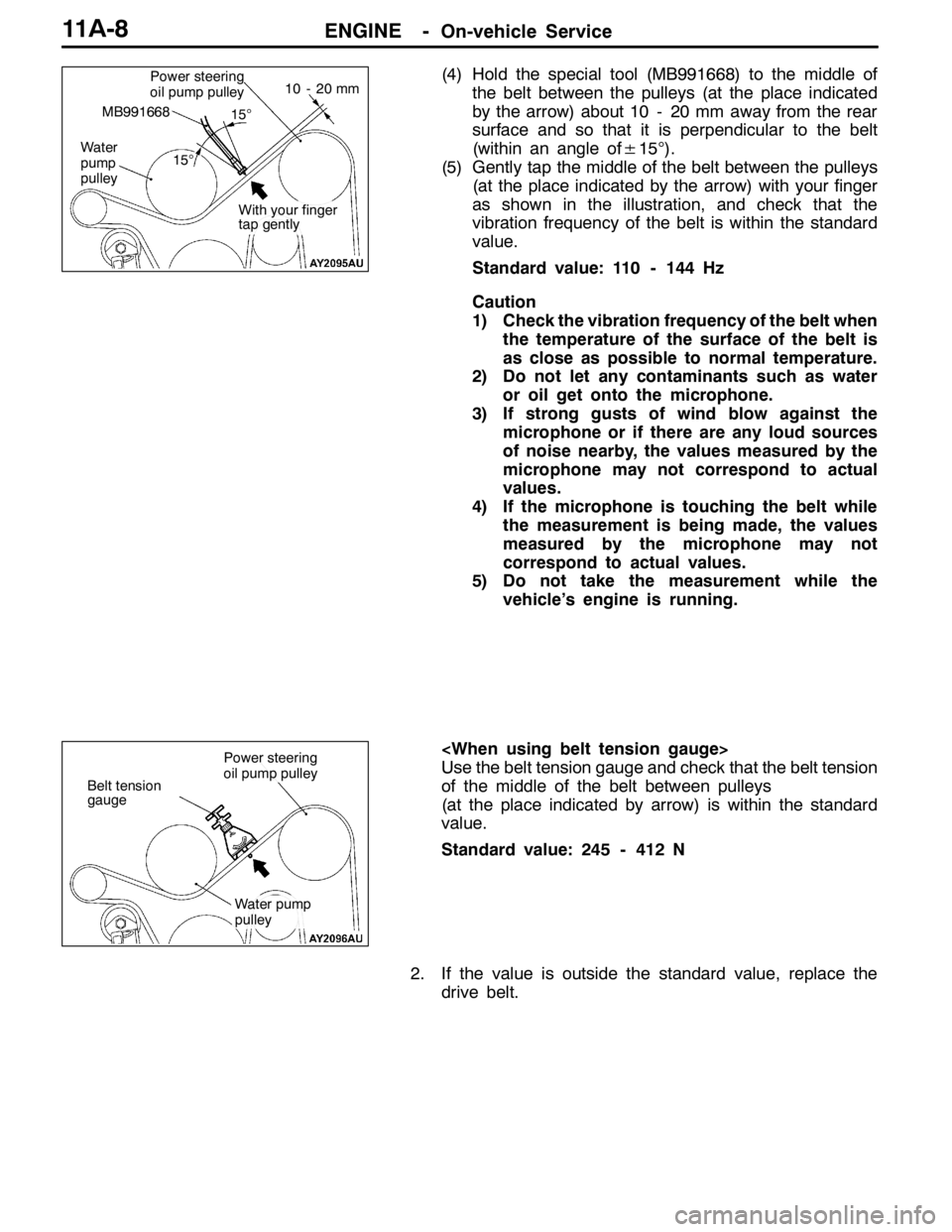
ENGINE -On-vehicle Service11A-8
(4) Hold the special tool (MB991668) to the middle of
the belt between the pulleys (at the place indicated
by the arrow) about 10 - 20 mm away from the rear
surface and so that it is perpendicular to the belt
(within an angle of±15°).
(5) Gently tap the middle of the belt between the pulleys
(at the place indicated by the arrow) with your finger
as shown in the illustration, and check that the
vibration frequency of the belt is within the standard
value.
Standard value: 110 - 144 Hz
Caution
1) Check the vibration frequency of the belt when
the temperature of the surface of the belt is
as close as possible to normal temperature.
2) Do not let any contaminants such as water
or oil get onto the microphone.
3) If strong gusts of wind blow against the
microphone or if there are any loud sources
of noise nearby, the values measured by the
microphone may not correspond to actual
values.
4) If the microphone is touching the belt while
the measurement is being made, the values
measured by the microphone may not
correspond to actual values.
5) Do not take the measurement while the
vehicle’s engine is running.
Use the belt tension gauge and check that the belt tension
of the middle of the belt between pulleys
(at the place indicated by arrow) is within the standard
value.
Standard value: 245 - 412 N
2. If the value is outside the standard value, replace the
drive belt.Power steering
oil pump pulley
Water
pump
pulley
MB991668
10 - 20 mm
15°
15°
With your finger
tap gently
Belt tension
gauge
Power steering
oil pump pulley
Water pump
pulley
Page 415 of 1449

ENGINE -On-vehicle ServiceENGINE -On-vehicle Service11A-9
IGNITION TIMING CHECK
1. Before inspection, set the vehicle to the pre-inspection
condition.
2. Turn the ignition switch to “LOCK” (OFF) position and
then connect the MUT-IIto the diagnosis connector.
3. Set up a timing light.
4. Start the engine and run at idle.
5. Check that engine idle speed is within the standard value.
Standard value: 850±100 r/min
6. Select No.17 of the MUT-IIActuator test.
7. Check that basic ignition timing is within the standard
value.
Standard value: 5_BTDC±3_
8. If the basic ignition timing is outside the standard value,
inspect the MPI system while referring to GROUP 13A
- Troubleshooting.
9. Press the MUT-IIclear key (Select a forced driving cancel
mode) to release the Actuator test.
Caution
If the test is not cancelled, a forced driving will
continue for 27 minutes. Driving under this condition
may damage the engine.
10. Check that ignition timing is at the standard value.
Standard value: approximately 5_BTDC
NOTE
(1) Ignition timing is variable within about±7, even under
normal operating.
(2) And it is automatically further advanced by
approximately 5_from standard value at higher
altitudes.
11. Remove the timing light.
12. Turn the ignition switch to “LOCK” (OFF) position and
then remove the MUT-II.
IDLE SPEED CHECK
1. Before inspection, set the vehicle to the pre-inspection
condition.
2. Turn the ignition switch to “LOCK” (OFF) position, and
then connect the MUT-IIto the diagnosis connector.
3. Set the timing light.
4. Check that the basic ignition timing is within the standard
value.
MUT-II
MUT-II
Page 416 of 1449

ENGINE -On-vehicle ServiceENGINE -On-vehicle Service11A-10
Standard value: 5_BTDC±3_
5. Run the engine at idle for 2 minutes.
6. Check the idle speed. Select item No. 22 and take a
reading of the idle speed.
Curb idle speed: 850±100 r/min
NOTE
The idle speed is controlled automatically by the idle speed
control (ISC) system.
7. If the idle speed is outside the standard value, check
the MPI components by referring to GROUP 13A -
Troubleshooting.
8. Remove the timing light.
9. Turn the ignition switch to the “LOCK” (OFF) position
and then remove the MUT-II.
IDLE MIXTURE CHECK
1. Before inspection, set the vehicle to the pre-inspection
condition.
2. Turn the ignition switch to the “LOCK” (OFF) position,
and then connect the MUT-IIto the diagnosis connector.
3. Set the timing light.
4. Check that the basic ignition timing is within the standard
value.
Standard value: 5_BTDC±3_
5. Run the engine at 2,500 r/min for 2 minutes.
6. Set the CO, HC tester.
7. Check the CO contents and the HC contents at idle.
Standard value
CO contents: 0.1% or less
HC contents: 100 ppm or less
8. If there is a deviation from the standard value, check the
following items:
DDiagnosis output
DClosed-loop control (When the closed-loop control
is normal, the output signal of the oxygen sensor
changes between 0 - 400 mV and 600 - 1,000 mV
at idle.)
DFuel pressure
DInjector
DIgnition coil, spark plug cable, spark plug
DEvaporative emission control system
DCompression pressure
NOTE
Replace the three way catalyst when the CO and HC
contents are not within the standard value, even though
the result of the inspection is normal on all items.
9. Remove the timing light.
MUT-II