2007 MITSUBISHI LANCER EVOLUTION service
[x] Cancel search: servicePage 1074 of 1449

ABS <4WD> -Special Tools/Troubleshooting35B-4
SPECIAL TOOLS
ToolNumberNameUse
MB991502MUT-IIsub
assemblyFor checking of ABS
(Diagnosis code display when using the
MUT-II)
MB991529Diagnosis code
check harnessFor checking of ABS
(Diagnosis code display when using the ABS
warning lamp)
MB991348Test harness setFor checking of G sensor
TROUBLESHOOTING
STANDARD FLOW OF DIAGNOSTIC TROUBLESHOOTING
Refer to GROUP 00 - How to Use Troubleshooting/Inspection Service Points.
NOTES WITH REGARD TO DIAGNOSIS
1. The phenomena listed in the following table are not abnormal.
PhenomenonExplanation of phenomenon
System check soundWhen starting the engine, a thudding sound can sometimes be heard coming from inside
the engine compartment, but this is because the system operation check is being
performed, and is not an abnormality.
ABS operation sound1. Sound of the motor inside the ABS hydraulic unit operation. (whine)
2. Sound is the generated along with vibration of the brake pedal. (scraping)
3. When ABS operates, sound is generated from the vehicle chassis due to repeated
brake application and release.
(Thump: suspension; squeak: tyres)
System check soundWhen depressing the brake pedal during driving, a shock is sometime felt.
2. For road surfaces such as snow-covered roads and gravel roads, the braking distance for vehicles
with ABS can sometimes be longer than that for other vehicles. Accordingly, advise the customer
to drive safely on such roads by lowering the vehicle speed and not being too overconfident.
3. Diagnosis detection condition can vary depending on the diagnosis code.
Make sure that checking requirements listed in the “Comment” are satisfied when checking the trouble
symptom again.
Page 1075 of 1449
ABS <4WD> -Troubleshooting35B-5
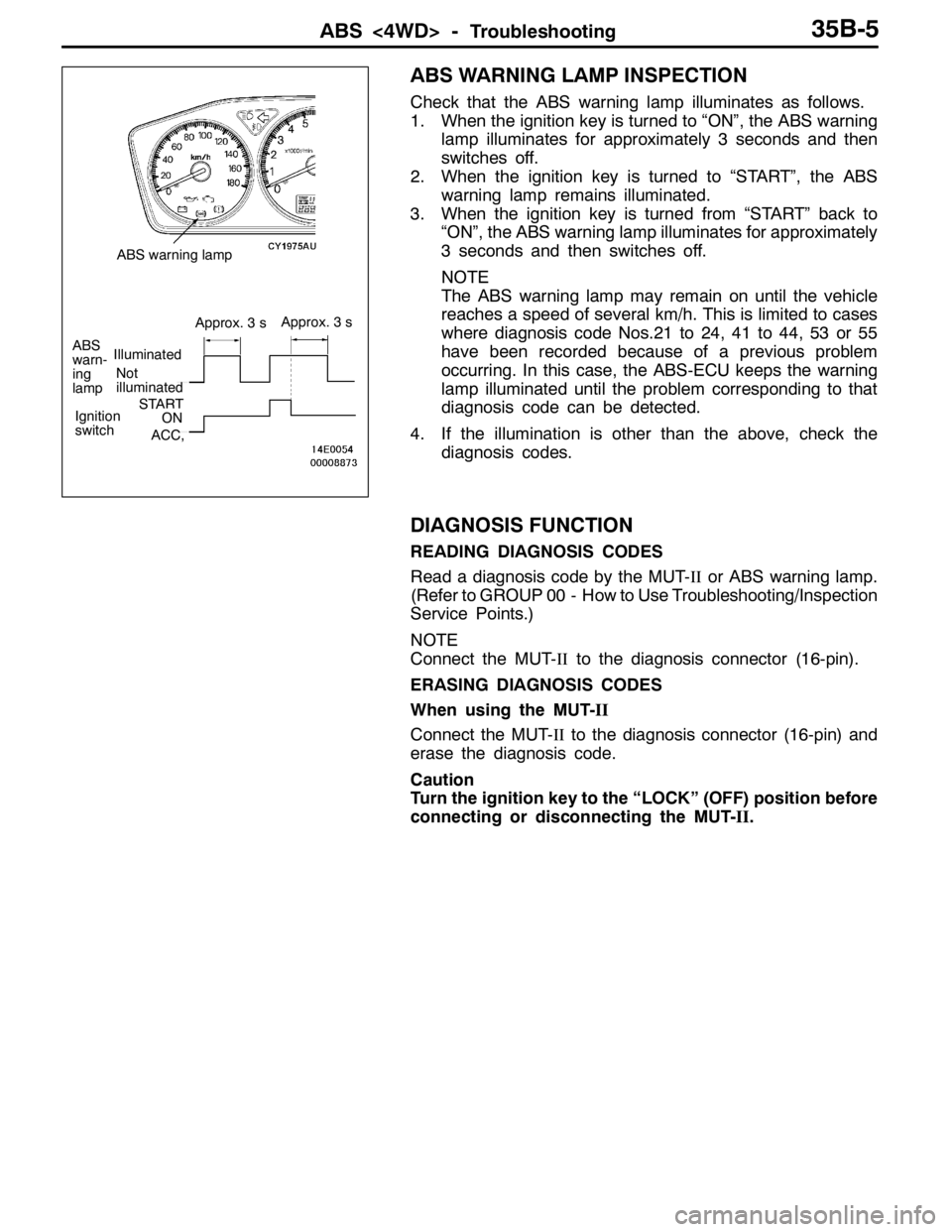
ABS WARNING LAMP INSPECTION
Check that the ABS warning lamp illuminates as follows.
1. When the ignition key is turned to “ON”, the ABS warning
lamp illuminates for approximately 3 seconds and then
switches off.
2. When the ignition key is turned to “START”, the ABS
warning lamp remains illuminated.
3. When the ignition key is turned from “START” back to
“ON”, the ABS warning lamp illuminates for approximately
3 seconds and then switches off.
NOTE
The ABS warning lamp may remain on until the vehicle
reaches a speed of several km/h. This is limited to cases
where diagnosis code Nos.21 to 24, 41 to 44, 53 or 55
have been recorded because of a previous problem
occurring. In this case, the ABS-ECU keeps the warning
lamp illuminated until the problem corresponding to that
diagnosis code can be detected.
4. If the illumination is other than the above, check the
diagnosis codes.
DIAGNOSIS FUNCTION
READING DIAGNOSIS CODES
Read a diagnosis code by the MUT-IIor ABS warning lamp.
(Refer to GROUP 00 - How to Use Troubleshooting/Inspection
Service Points.)
NOTE
Connect the MUT-IIto the diagnosis connector (16-pin).
ERASING DIAGNOSIS CODES
When using the MUT-II
Connect the MUT-IIto the diagnosis connector (16-pin) and
erase the diagnosis code.
Caution
Turn the ignition key to the “LOCK” (OFF) position before
connecting or disconnecting the MUT-II.
Not
illuminated
ABS
warn-
ing
lampIlluminated
Approx. 3 sApprox. 3 s
Ignition
switchSTARTON
ACC,
ABS warning lamp
Page 1079 of 1449
ABS <4WD> -Troubleshooting35B-9
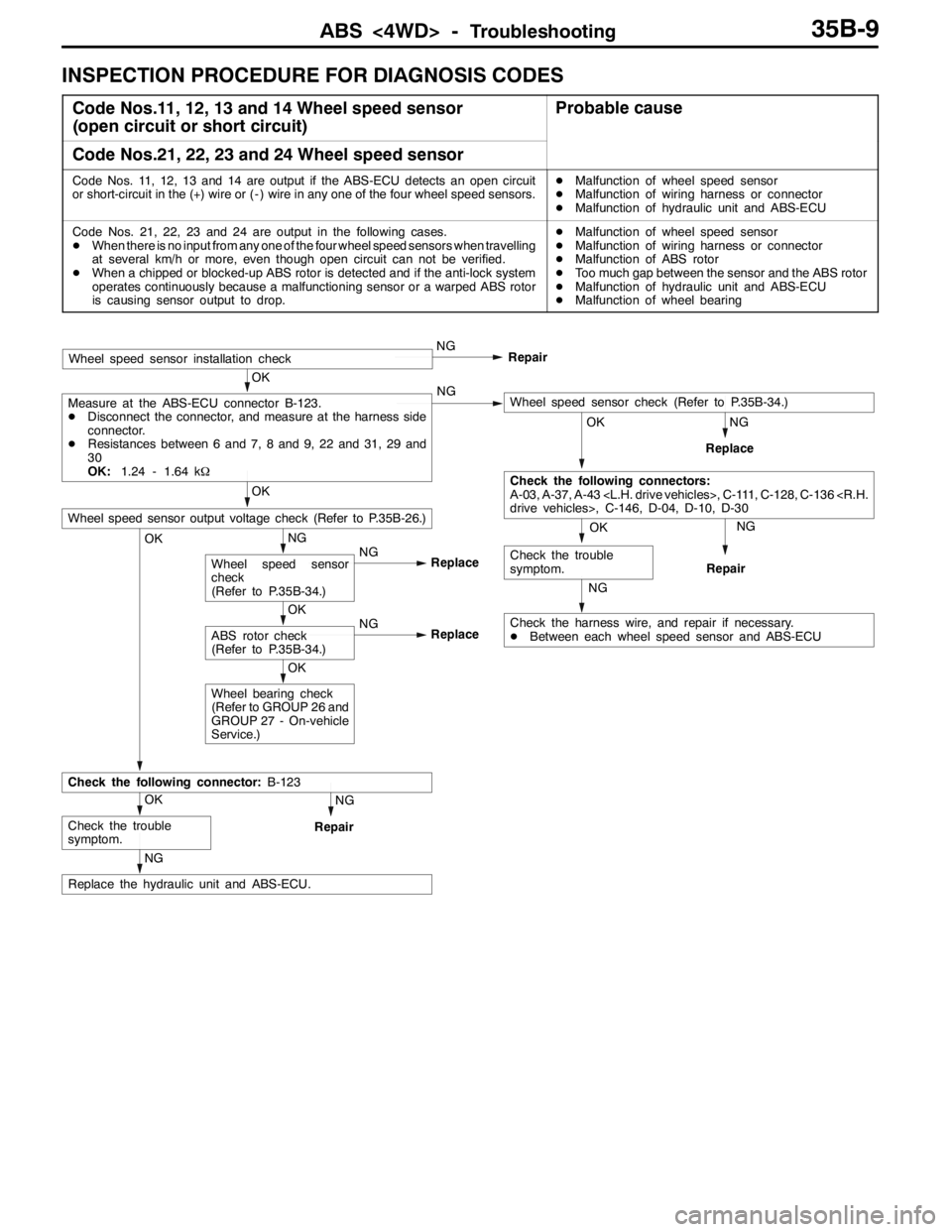
INSPECTION PROCEDURE FOR DIAGNOSIS CODES
Code Nos.11, 12, 13 and 14 Wheel speed sensor
(open circuit or short circuit)Probable cause
Code Nos.21, 22, 23 and 24 Wheel speed sensor
Code Nos. 11, 12, 13 and 14 are output if the ABS-ECU detects an open circuit
or short-circuit in the (+) wire or ( - ) wire in any one of the four wheel speed sensors.DMalfunction of wheel speed sensor
DMalfunction of wiring harness or connector
DMalfunction of hydraulic unit and ABS-ECU
Code Nos. 21, 22, 23 and 24 are output in the following cases.
DWhen there is no input from any one of the four wheel speed sensors when travelling
at several km/h or more, even though open circuit can not be verified.
DWhen a chipped or blocked-up ABS rotor is detected and if the anti-lock system
operates continuously because a malfunctioning sensor or a warped ABS rotor
is causing sensor output to drop.DMalfunction of wheel speed sensor
DMalfunction of wiring harness or connector
DMalfunction of ABS rotor
DToo much gap between the sensor and the ABS rotor
DMalfunction of hydraulic unit and ABS-ECU
DMalfunction of wheel bearing
NG
NG
Replace
OK
Check the harness wire, and repair if necessary.
DBetween each wheel speed sensor and ABS-ECU
NG
Repair
OK
Wheel bearing check
(Refer to GROUP 26 and
GROUP 27 - On-vehicle
Service.)
NG
Repair
NG
Replace the hydraulic unit and ABS-ECU.
OK
Check the trouble
symptom.
Check the following connector:B-123
OK
ABS rotor check
(Refer to P.35B-34.)NG
Replace
NG
Wheel speed sensor
check
(Refer to P.35B-34.)NG
Replace
OK
Wheel speed sensor output voltage check (Refer to P.35B-26.)OK
Check the trouble
symptom.
OK
Check the following connectors:
A-03, A-37, A-43
OK
Measure at the ABS-ECU connector B-123.
DDisconnect the connector, and measure at the harness side
connector.
DResistances between 6 and 7, 8 and 9, 22 and 31, 29 and
30
OK:1.24 - 1.64 kΩNGWheel speed sensor check (Refer to P.35B-34.)
Wheel speed sensor installation checkNG
Repair
Page 1085 of 1449

ABS <4WD> -Troubleshooting35B-15
INSPECTION CHART FOR TROUBLE SYMPTOMS
Trouble symptomsInspection procedure
No.Reference page
Communication between the MUT-IIand the whole system is not
possible.135B-16
Communication between the MUT-IIand the ABS-ECU is not possible.235B-17
When the ignition key is turned to “ON” (engine stopped), the ABS
warning lamp does not illuminate.335B-18
Even after the engine is started, the ABS warning lamp remains
illuminated.435B-18
In the inspection with MUT-II service data, the parking brake switch is not
turned ON or turn OFF.535B-19
The neutral position learning of the steering wheel sensor is not finished.635B-20
Faulty ABS operation735B-21
Caution
1. If steering movements are made when driving at high speed, or when driving on road surfaces
with low frictional resistance, or when passing over bumps, the ABS may operate even though
sudden braking is not being applied. Because of this, when getting information from the customer,
check if the problem occurred while driving under such conditions as these.
2. During ABS operation, the brake pedal may vibrate or may not be able to be depressed. Such
phenomena are due to intermittent changes in hydraulic pressure inside the brake line to prevent
the wheels from locking and is not an abnormality.
Page 1089 of 1449
ABS <4WD> -Troubleshooting35B-19
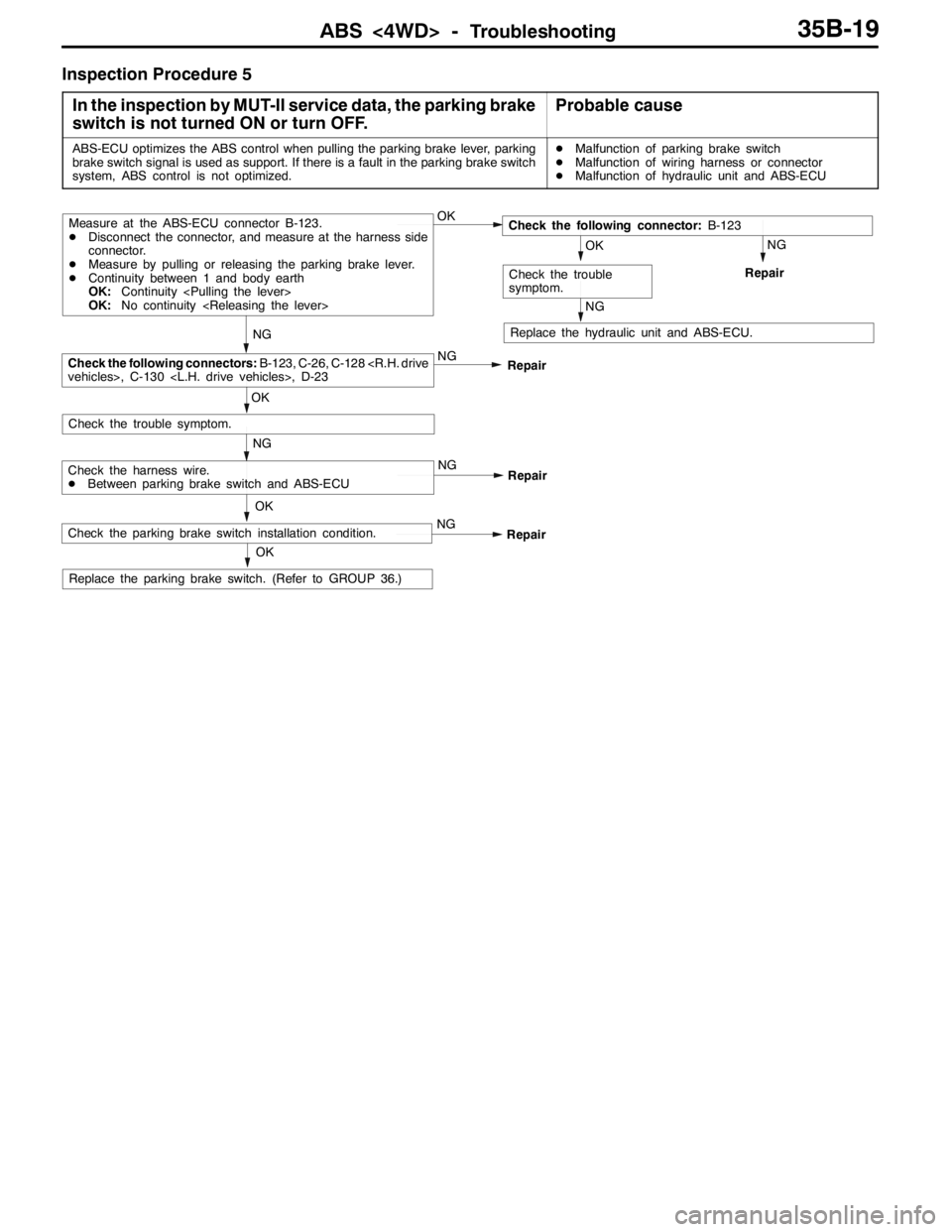
Inspection Procedure 5
In the inspection by MUT-II service data, the parking brake
switch is not turned ON or turn OFF.
Probable cause
ABS-ECU optimizes the ABS control when pulling the parking brake lever, parking
brake switch signal is used as support. If there is a fault in the parking brake switch
system, ABS control is not optimized.DMalfunction of parking brake switch
DMalfunction of wiring harness or connector
DMalfunction of hydraulic unit and ABS-ECU
OK
NG
NG
Check the harness wire.
DBetween parking brake switch and ABS-ECU
Replace the hydraulic unit and ABS-ECU.
OK
NG
OK
Check the trouble symptom.
Repair
NG
RepairCheck the following connectors:B-123, C-26, C-128
Measure at the ABS-ECU connector B-123.
DDisconnect the connector, and measure at the harness side
connector.
DMeasure by pulling or releasing the parking brake lever.
DContinuity between 1 and body earth
OK:Continuity
OK:No continuity
NG
Repair
NG
OK
Check the trouble
symptom.
Check the following connector:B-123
OK
Replace the parking brake switch. (Refer to GROUP 36.)
NG
RepairCheck the parking brake switch installation condition.
Page 1090 of 1449
ABS <4WD> -Troubleshooting35B-20
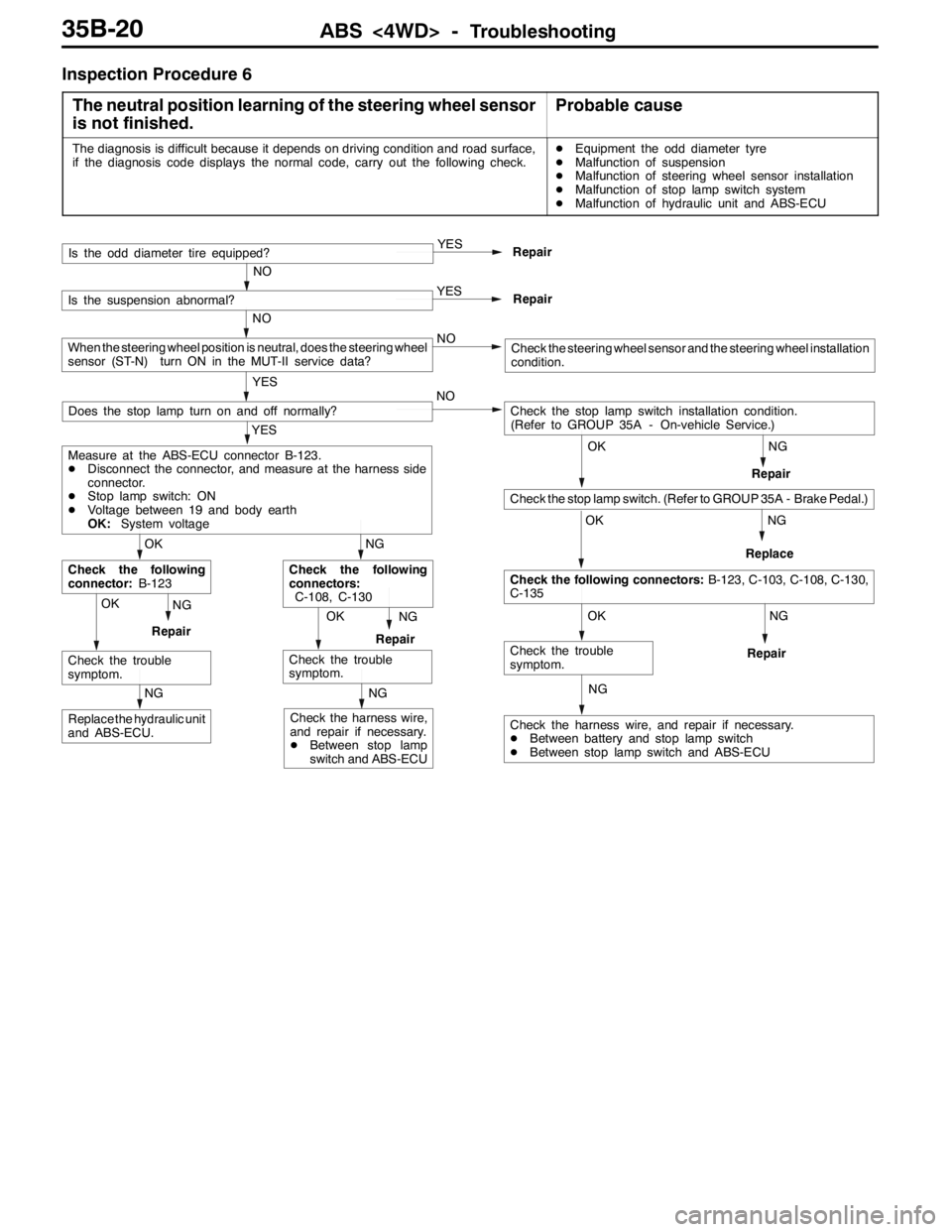
Inspection Procedure 6
The neutral position learning of the steering wheel sensor
is not finished.
Probable cause
The diagnosis is difficult because it depends on driving condition and road surface,
if the diagnosis code displays the normal code, carry out the following check.DEquipment the odd diameter tyre
DMalfunction of suspension
DMalfunction of steering wheel sensor installation
DMalfunction of stop lamp switch system
DMalfunction of hydraulic unit and ABS-ECU
NG
NG
NG
NG
Check the harness wire, and repair if necessary.
DBetween battery and stop lamp switch
DBetween stop lamp switch and ABS-ECU
OK
Check the trouble
symptom.
OK
Check the following connectors:B-123, C-103, C-108, C-130,
C-135
OK
Check the stop lamp switch. (Refer to GROUP 35A - Brake Pedal.)
Check the stop lamp switch installation condition.
(Refer to GROUP 35A - On-vehicle Service.) NO
Repair
OKNG
RepairOKNG
RepairReplace
NG
Replace the hydraulic unit
and ABS-ECU.
NG
Check the harness wire,
and repair if necessary.
DBetween stop lamp
switch and ABS-ECURepair
Check the trouble
symptom.
NG
Check the following
connectors:
C-108, C-130
Check the trouble
symptom.
OK
Check the following
connector:B-123
YES
Measure at the ABS-ECU connector B-123.
DDisconnect the connector, and measure at the harness side
connector.
DStop lamp switch: ON
DVoltage between 19 and body earth
OK:System voltage
Does the stop lamp turn on and off normally?
YES
Repair
NO
Is the odd diameter tire equipped?
YES
Repair
NO
Is the suspension abnormal?
NO
YES
When the steering wheel position is neutral, does the steering wheel
sensor (ST-N) turn ON in the MUT-II service data?Check the steering wheel sensor and the steering wheel installation
condition.
Page 1091 of 1449
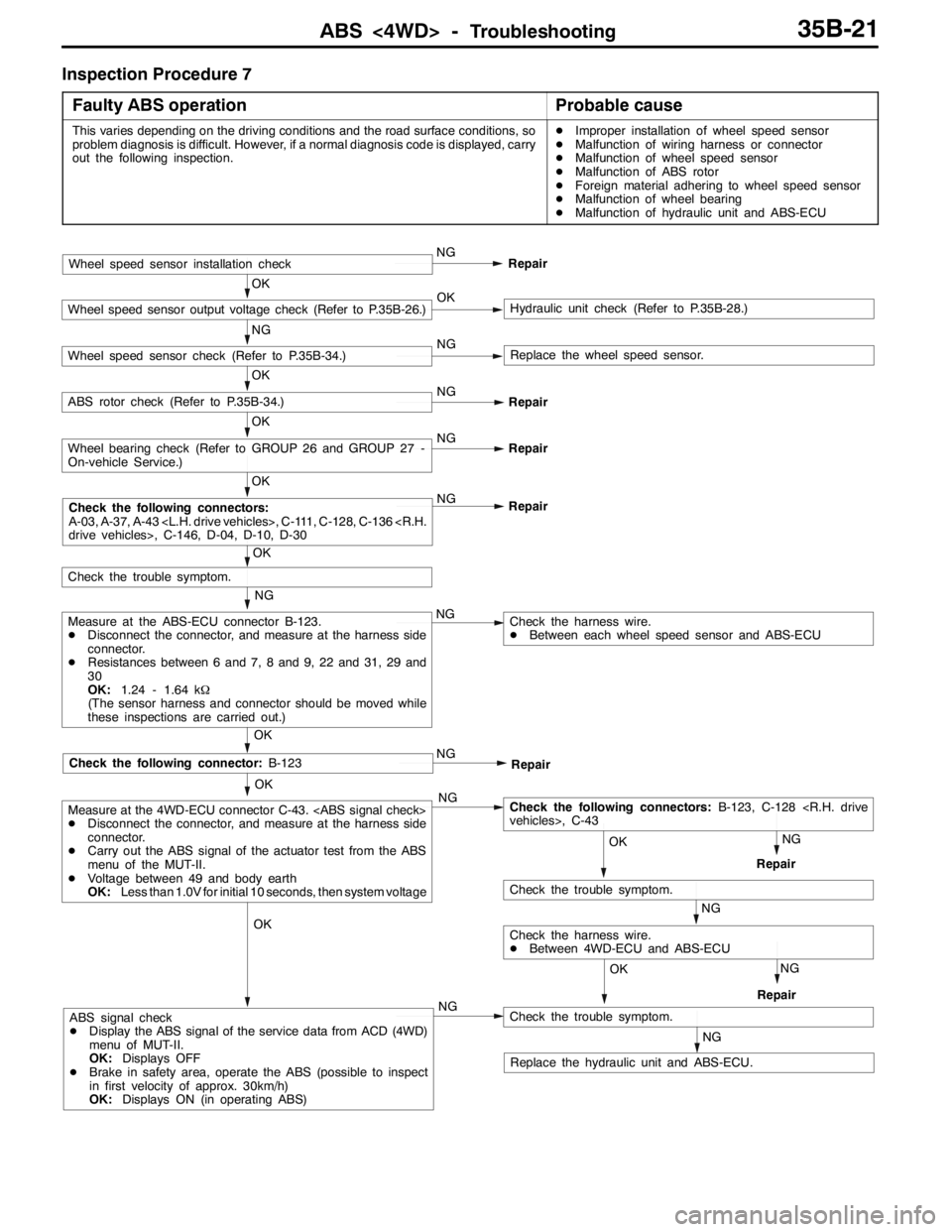
ABS <4WD> -Troubleshooting35B-21
Inspection Procedure 7
Faulty ABS operation
Probable cause
This varies depending on the driving conditions and the road surface conditions, so
problem diagnosis is difficult. However, if a normal diagnosis code is displayed, carry
out the following inspection.DImproper installation of wheel speed sensor
DMalfunction of wiring harness or connector
DMalfunction of wheel speed sensor
DMalfunction of ABS rotor
DForeign material adhering to wheel speed sensor
DMalfunction of wheel bearing
DMalfunction of hydraulic unit and ABS-ECU
OK
OK
Check the following connector:B-123
NG
Measure at the ABS-ECU connector B-123.
DDisconnect the connector, and measure at the harness side
connector.
DResistances between 6 and 7, 8 and 9, 22 and 31, 29 and
30
OK:1.24 - 1.64 kΩ
(The sensor harness and connector should be moved while
these inspections are carried out.)NG
OK
Check the trouble symptom.
OK
NG
Repair
OK
Wheel bearing check (Refer to GROUP 26 and GROUP 27 -
On-vehicle Service.)NG
Repair
OK
ABS rotor check (Refer to P.35B-34.)NG
Repair
NG
Wheel speed sensor check (Refer to P.35B-34.)NGReplace the wheel speed sensor.
OK
Wheel speed sensor output voltage check (Refer to P.35B-26.)OKHydraulic unit check (Refer to P.35B-28.)
Wheel speed sensor installation checkNG
Repair
Check the harness wire.
DBetween each wheel speed sensor and ABS-ECU
NG
Repair
NG
NG
RepairOK
Check the following connectors:B-123, C-128
NG
Check the trouble symptom.
RepairNG
OK
Check the harness wire.
DBetween 4WD-ECU and ABS-ECU OK
Measure at the 4WD-ECU connector C-43.
DDisconnect the connector, and measure at the harness side
connector.
DCarry out the ABS signal of the actuator test from the ABS
menu of the MUT-II.
DVoltage between 49 and body earth
OK:Less than 1.0V for initial 10 seconds, then system voltage
NGABS signal check
DDisplay the ABS signal of the service data from ACD (4WD)
menu of MUT-II.
OK:Displays OFF
DBrake in safety area, operate the ABS (possible to inspect
in first velocity of approx. 30km/h)
OK:Displays ON (in operating ABS)
NG
Check the trouble symptom.
Replace the hydraulic unit and ABS-ECU.
Check the following connectors:
A-03, A-37, A-43
Page 1092 of 1449

ABS <4WD> -Troubleshooting35B-22
DATA LIST REFERENCE TABLE
The following items can be read by the MUT-IIfrom the ABS-ECU input data.
1. When the system is normal
Item No.Check itemChecking requirementsNormal value
11Front-right wheel speed sensorPerform a test runVehicle speeds
displayedonthe
12Front-left wheel speed sensor
displayedonthe
speedometer and
MUTIIareidentical13Rear-right wheel speed sensorMUT-IIareidentical.
14Rear-left wheel speed sensor
21Power supply voltageIgnition switch: ON10 - 16 V
29Parking brake switchPull the parking brake lever.ON
Release the parking brake lever.OFF
36Stop lamp switchDepress the brake pedal.ON
Release the brake pedal.OFF
37Steering wheel sensor neutral
position learningAfter driving straightly with vehicle speed more
than 10km/hON
Before driving with ignition switch ONOFF
71Lateral G sensorWhen vehicle stops2.4 - 2.6 V
When vehicle drives1.0 - 4.0 V
74Steering wheel sensor (ST-N)Ignition switch: ONSteering:
Neutral position and
position near by±
360_ON
Steering:
Except for aboveOFF
75Steering wheel sensor (ST-1)Ignition switch: ONSteering:
Turnlaterallyslowly
Display ON and OFF
alternately
76Steering wheel sensor (ST-2)
Turnlaterallyslowlyalternately
86Steering degreeIgnition switch: ON
Steering wheel sensor
tlitili
Steering: Steer by
90_to the right+90_
g
neutral position learning
is finished (service data
N37di lON)
Steering: NeutralOFF(
No. 37 displays ON)Steering: Steer by
90_to the left-90_
2. When the ABS-ECU shut off ABS operation
When the diagnosis system stops the ABS-ECU, the MUT-IIdisplay data will be unreliable.