Page 1036 of 1449
FRONT SUSPENSION -Lower Arm Assembly33A-10
REMOVAL SERVICE POINT
AA"LOWER ARM AND CROSSMEMBER
DISCONNECTION
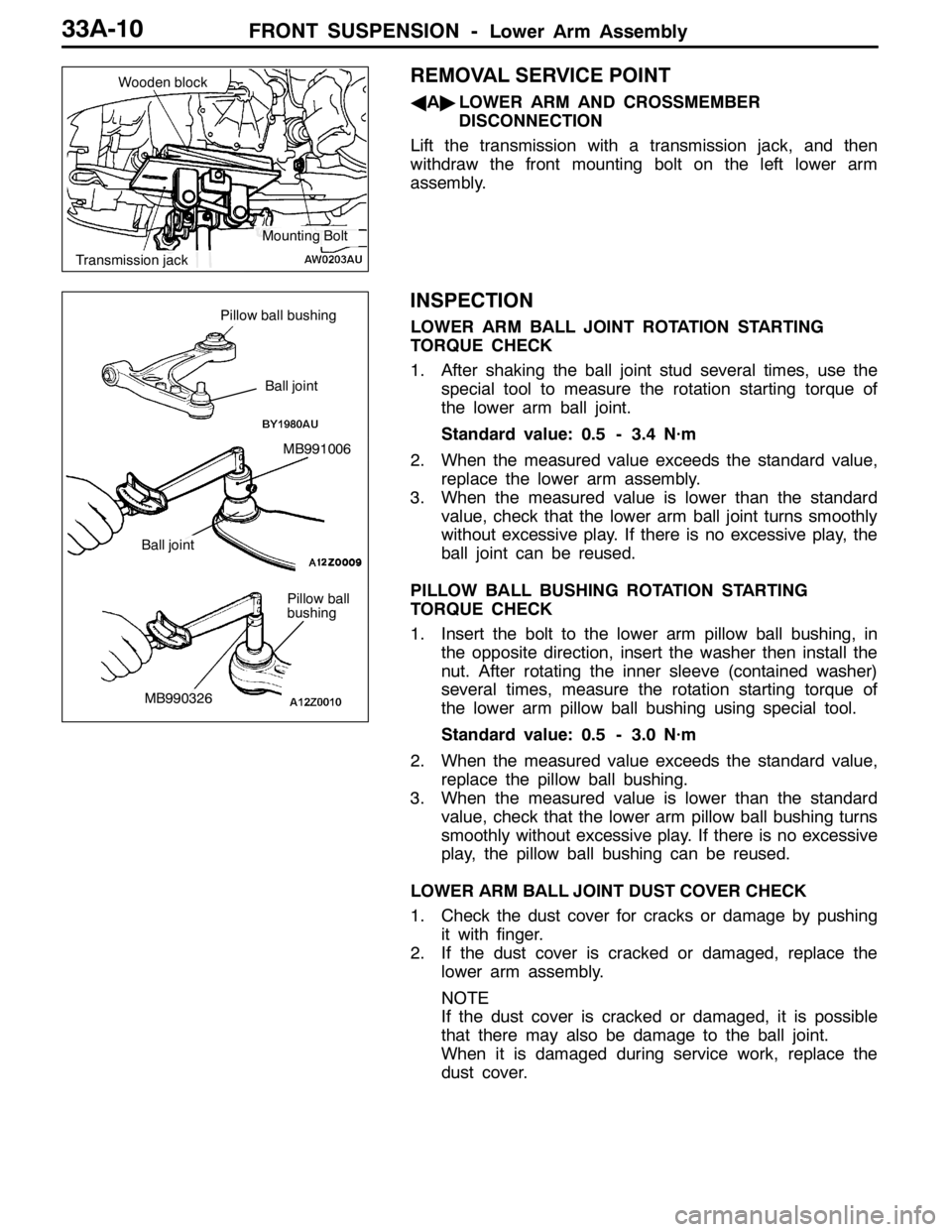
Lift the transmission with a transmission jack, and then
withdraw the front mounting bolt on the left lower arm
assembly.
INSPECTION
LOWER ARM BALL JOINT ROTATION STARTING
TORQUE CHECK
1. After shaking the ball joint stud several times, use the
special tool to measure the rotation starting torque of
the lower arm ball joint.
Standard value: 0.5 - 3.4 N·m
2. When the measured value exceeds the standard value,
replace the lower arm assembly.
3. When the measured value is lower than the standard
value, check that the lower arm ball joint turns smoothly
without excessive play. If there is no excessive play, the
ball joint can be reused.
PILLOW BALL BUSHING ROTATION STARTING
TORQUE CHECK
1. Insert the bolt to the lower arm pillow ball bushing, in
the opposite direction, insert the washer then install the
nut. After rotating the inner sleeve (contained washer)
several times, measure the rotation starting torque of
the lower arm pillow ball bushing using special tool.
Standard value: 0.5 - 3.0 N·m
2. When the measured value exceeds the standard value,
replace the pillow ball bushing.
3. When the measured value is lower than the standard
value, check that the lower arm pillow ball bushing turns
smoothly without excessive play. If there is no excessive
play, the pillow ball bushing can be reused.
LOWER ARM BALL JOINT DUST COVER CHECK
1. Check the dust cover for cracks or damage by pushing
it with finger.
2. If the dust cover is cracked or damaged, replace the
lower arm assembly.
NOTE
If the dust cover is cracked or damaged, it is possible
that there may also be damage to the ball joint.
When it is damaged during service work, replace the
dust cover.
Wooden block
Transmission jack
Mounting Bolt
Pillow ball
bushing
MB991006
Pillow ball bushing
Ball joint
Ball joint
MB990326
Page 1037 of 1449
FRONT SUSPENSION -Lower Arm Assembly33A-11
LOWER ARM BALL JOINT DUST COVER
REPLACEMENT
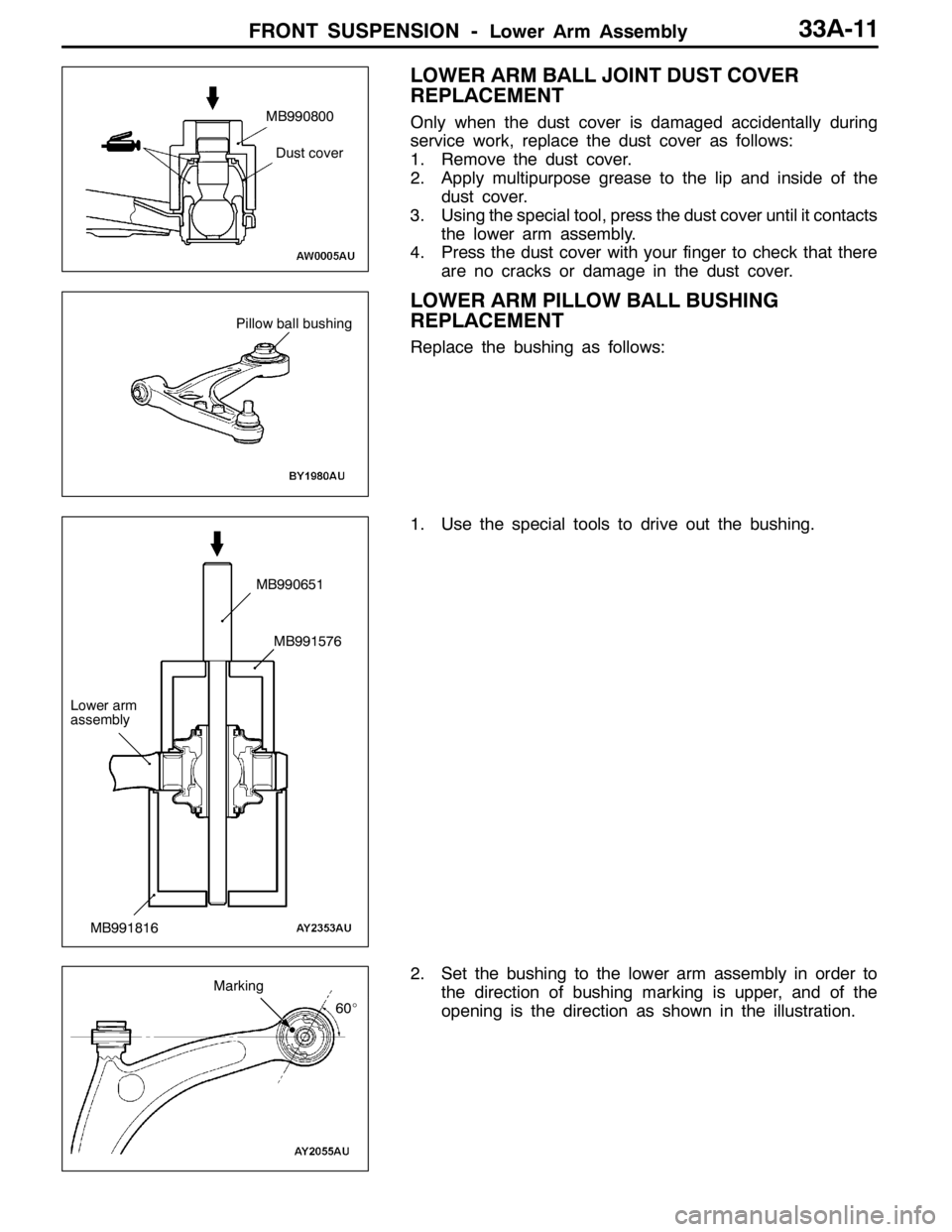
Only when the dust cover is damaged accidentally during
service work, replace the dust cover as follows:
1. Remove the dust cover.
2. Apply multipurpose grease to the lip and inside of the
dust cover.
3. Using the special tool, press the dust cover until it contacts
the lower arm assembly.
4. Press the dust cover with your finger to check that there
are no cracks or damage in the dust cover.
LOWER ARM PILLOW BALL BUSHING
REPLACEMENT
Replace the bushing as follows:
1. Use the special tools to drive out the bushing.
2. Set the bushing to the lower arm assembly in order to
the direction of bushing marking is upper, and of the
opening is the direction as shown in the illustration.
MB990800
Dust cover
Pillow ball bushing
Lower arm
assembly
MB990651
MB991576
MB991816
60_
Marking
Page 1038 of 1449
FRONT SUSPENSION -Lower Arm Assembly/Stabilizer Bar33A-12
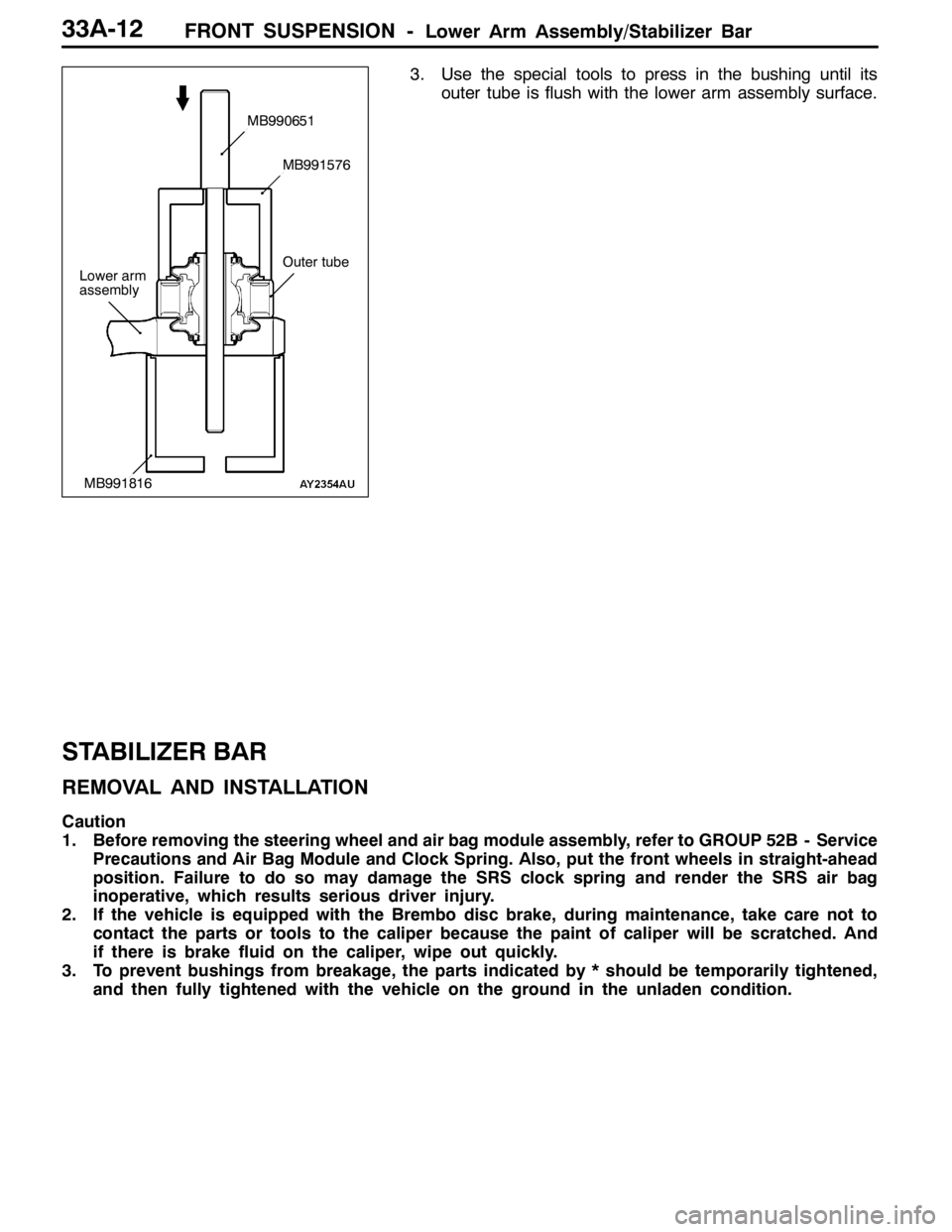
3. Use the special tools to press in the bushing until its
outer tube is flush with the lower arm assembly surface.
STABILIZER BAR
REMOVAL AND INSTALLATION
Caution
1. Before removing the steering wheel and air bag module assembly, refer to GROUP 52B - Service
Precautions and Air Bag Module and Clock Spring. Also, put the front wheels in straight-ahead
position. Failure to do so may damage the SRS clock spring and render the SRS air bag
inoperative, which results serious driver injury.
2. If the vehicle is equipped with the Brembo disc brake, during maintenance, take care not to
contact the parts or tools to the caliper because the paint of caliper will be scratched. And
if there is brake fluid on the caliper, wipe out quickly.
3. To prevent bushings from breakage, the parts indicated by * should be temporarily tightened,
and then fully tightened with the vehicle on the ground in the unladen condition.
Lower arm
assembly
MB990651
MB991576
MB991816
Outer tube
Page 1040 of 1449
FRONT SUSPENSION -Stabilizer Bar33A-14
REMOVAL SERVICE POINTS
AA"TIE ROD END AND KNUCKLE DISCONNECTION
Caution
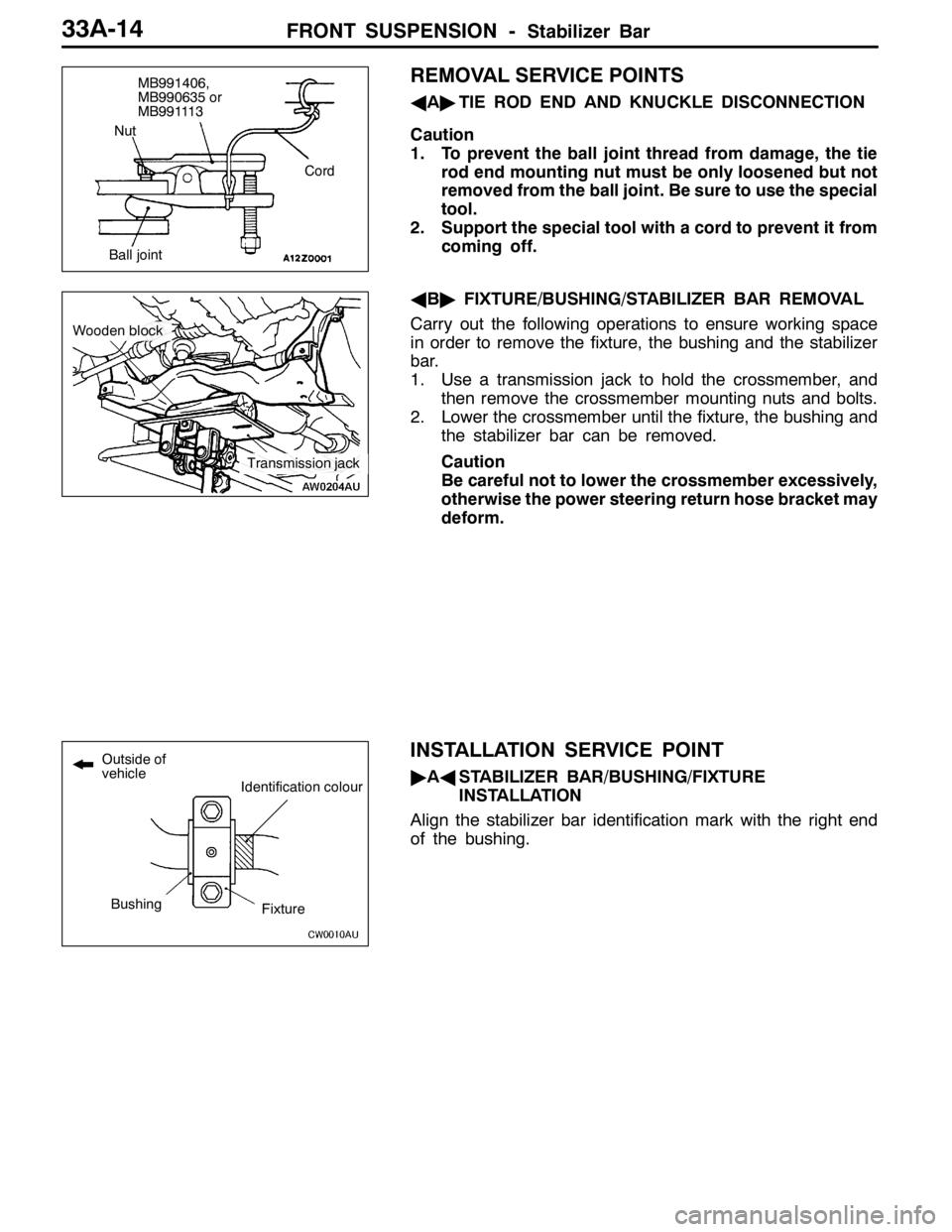
1. To prevent the ball joint thread from damage, the tie
rod end mounting nut must be only loosened but not
removed from the ball joint. Be sure to use the special
tool.
2. Support the special tool with a cord to prevent it from
coming off.
AB"FIXTURE/BUSHING/STABILIZER BAR REMOVAL
Carry out the following operations to ensure working space
in order to remove the fixture, the bushing and the stabilizer
bar.
1. Use a transmission jack to hold the crossmember, and
then remove the crossmember mounting nuts and bolts.
2. Lower the crossmember until the fixture, the bushing and
the stabilizer bar can be removed.
Caution
Be careful not to lower the crossmember excessively,
otherwise the power steering return hose bracket may
deform.
INSTALLATION SERVICE POINT
"AASTABILIZER BAR/BUSHING/FIXTURE
INSTALLATION
Align the stabilizer bar identification mark with the right end
of the bushing.
Cord
Ball jointNut
MB991406,
MB990635 or
MB991113
Transmission jack
Woodenblock
Identification colour
BushingFixture
Outside of
vehicle
Page 1043 of 1449
BASIC BRAKE SYSTEM 35A.........................................
ANTI-SKID BRAKING SYSTEM (ABS) <4WD> 35B......................
35A-1
SERVICE BRAKES
CONTENTS
Page 1044 of 1449
35A-2
BASIC BRAKE
SYSTEM
CONTENTS
GENERAL INFORMATION 3..................
SERVICE SPECIFICATIONS 5.................
LUBRICANTS 6..............................
SEALANT 6..................................
SPECIAL TOOLS 6...........................
ON-VEHICLE SERVICE 7.....................
Brake Pedal Check and Adjustment 7............
Brake Booster Operating Test 8.................
Check Valve Operation Check 9.................
Proportioning Valve Function Test
9......................Bleeding 10....................................
Brake Fluid Level Sensor Check 11.............
Disc Brake Pad Check and Replacement 11......
Disc Brake Rotor Check 13.....................
Brake Disc Thickness Check 14.................
Brake Disc Run-out Check and Correction 14....
BRAKE PEDAL 16...........................
PROPORTIONING VALVE, MASTER
CYLINDER AND BRAKE BOOSTER 17........
Master Cylinder 19.............................
DISC BRAKE 20.............................
Page 1045 of 1449

BASIC BRAKE SYSTEM -General Information35A-3
GENERAL INFORMATION
The brake system offers high dependability and durability along with improved braking performance and
brake sensitivity.
SERVICE PRECAUTION
Take care not to contact the parts or tools to the caliper because the paint of caliper will be scratched.
SPECIFICATIONS
ItemsSpecifications
Master cylinderTypeTandem type
I.D. mm26.9
Brake boosterTypeVacuum type, tandem
Effective dia. of power cylinder mm205 + 230
Boosting ratio4.5 (Pedal depressing force: 230 N)
Rear wheel hydraulic
controlmethod
Vehicles with ABS Electronic brake-force distribution (EBD)
control methodVehicles without ABS Proportioning valves
Proportioning valves
VehicleswithoutABS
TypeSingle type¢2
Decompression ratio0.25
Front brakes
RS(standard)
TypeFloating caliper, 2 piston, ventilated disc
Disc effective dia.¢thickness mm227¢24
Wheel cylinder I.D. mm42.9 (¢2)
Pad thickness mm10.0
Clearance adjustmentAutomatic
Front brakes
Type4 opposed piston, ventilated disc
Disc effective dia.¢thickness mm263¢32
Wheel cylinder I.D. mm40.0 (¢2), 46.0 (¢2)
Pad thickness mm10.0
Clearance adjustmentAutomatic
Rear brakes
RS(standard)
TypeFloating caliper, 1 piston, ventilated disc
Disc effective dia.¢thickness mm237¢20
Wheel cylinder I.D. mm34.9
Pad thickness mm10.0
Clearance adjustmentAutomatic
Rear brakes
Type2 opposed piston, ventilated disc
Disc effective dia.¢thickness mm252¢22
Wheel cylinder I.D. mm40.0 (¢2)
Pad thickness mm9.0
Clearance adjustmentAutomatic
Brake fluidDOT3 or DOT4
Page 1047 of 1449