Page 1104 of 1449

ABS <4WD> -Wheel Speed Sensor35B-34
INSTALLATION SERVICE POINT
"AAWHEEL SPEED SENSOR
INSTALLATION
Install the wheel speed sensor crossing with the parking brake
cable.
INSPECTION
CHECK OF RESISTANCE BETWEEN WHEEL SPEED
SENSOR TERMINALS
Caution
The pole piece can become magnetized because of the
magnet built into the wheel speed sensor, with the result
that metallic foreign material easily adheres to it.
Moreover, the pole piece may not be able to function to
correctly sense the wheel rotation speed if it is damaged.
1. Measure the resistance between the wheel speed sensor
terminals.
Standard value: 1.24 - 1.64 kΩ
If the internal resistance of the wheel speed sensor is
not within the standard value, replace with a new wheel
speed sensor.
2. Check the wheel speed sensor cable for breakage,
damage or disconnection; replace with a new one if a
problem is found.
NOTE
When checking for cable damage, remove the cable clamp
part from the body and then bend and pull the cable
near the clamp to check whether or not temporary
disconnection occurs. Also check the connection of the
connector and that the terminals are inserted correctly.
ABS ROTOR CHECK
Check whether ABS rotor teeth are broken or deformed, and,
if so, replace the ABS rotor.
WHEEL SPEED SENSOR INSULATION INSPECTION
1. Remove all connections from the wheel speed sensor,
and then measure the resistance between terminal 1 and
the body of the wheel speed sensor, and terminal 2 and
the body of the wheel speed sensor.
Standard value: 100 kΩor more
2. If the speed sensor insulation resistance is outside the
standard value range, replace with a new speed sensor.
Wheeel speed sensor
Parking brake cable
Page 1107 of 1449
36-1
PARKING BRAKES
CONTENTS
GENERAL INFORMATION 2..................
SERVICE SPECIFICATIONS 2.................
LUBRICANTS 2..............................
ON-VEHICLE SERVICE 3.....................
Parking Brake Lever Stroke Check and
Adjustment 3..................................Parking Brake Switch Check 3..................
Lining Running-In 4............................
PARKING BRAKE LEVER 5..................
PARKING BRAKE CABLE 6..................
PARKING BRAKE DRUM 7...................
Page 1108 of 1449
PARKING BRAKES -General Information/Service Specifications/Lubricants36-2
GENERAL INFORMATION
The parking brake is of a mechanical control type
acting on the rear wheels. A lever is used to apply
the parking brake.
CONSTRUCTION DIAGRAM
Parking brake lever
Parking brake lever
SERVICE SPECIFICATIONS
ItemsStandard valueLimit
Parking brake lever stroke5 - 7 notches-
Rear brake lining thickness mm2.81.0
Rear drum inside diameter mm168.0169.0
LUBRICANTS
ItemsSpecified lubricants
Backing plateMultipurpose grease
Shoe and lining assembly
Adjuster
Page 1109 of 1449
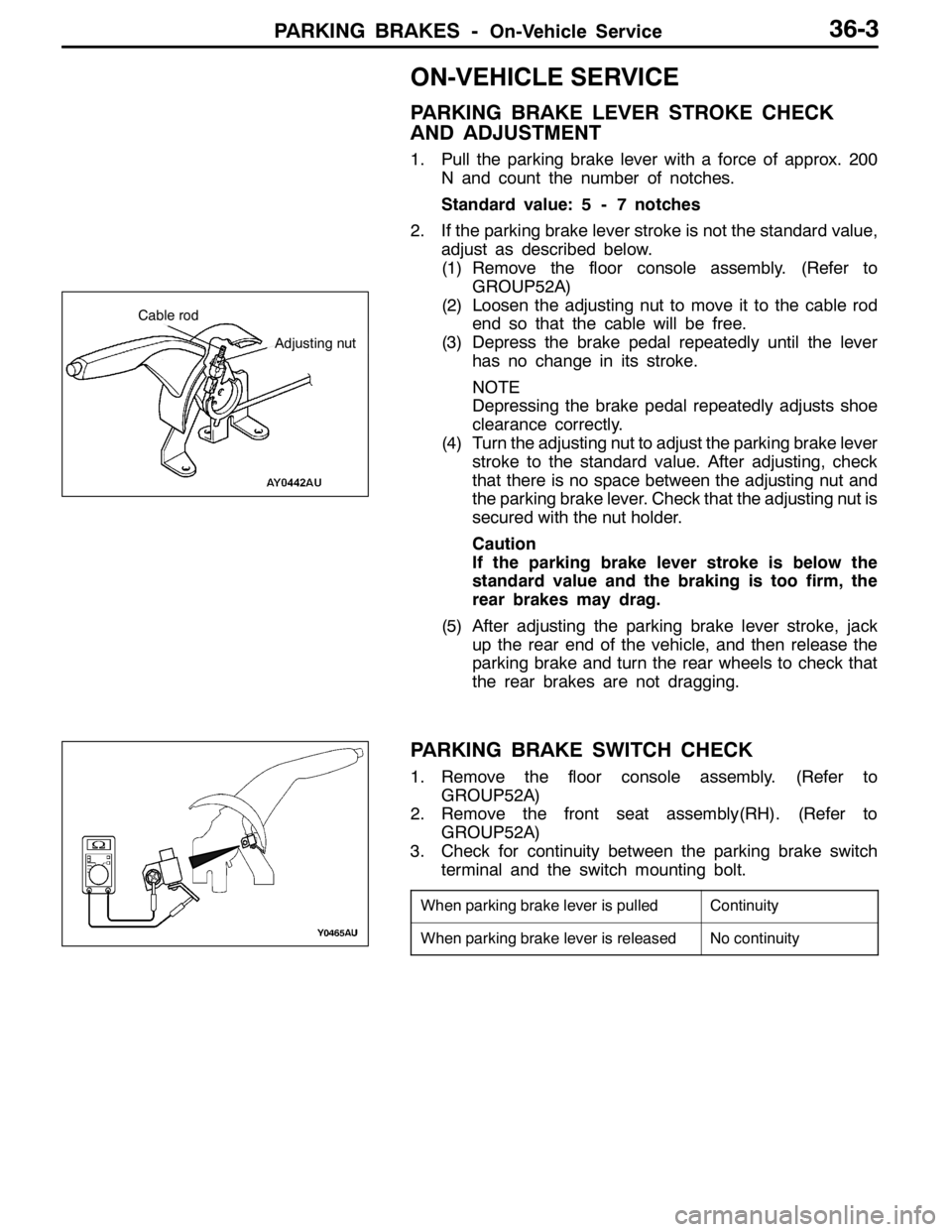
PARKING BRAKES -On-Vehicle Service36-3
ON-VEHICLE SERVICE
PARKING BRAKE LEVER STROKE CHECK
AND ADJUSTMENT
1. Pull the parking brake lever with a force of approx. 200
N and count the number of notches.
Standard value: 5 - 7 notches
2. If the parking brake lever stroke is not the standard value,
adjust as described below.
(1) Remove the floor console assembly. (Refer to
GROUP52A)
(2) Loosen the adjusting nut to move it to the cable rod
end so that the cable will be free.
(3) Depress the brake pedal repeatedly until the lever
has no change in its stroke.
NOTE
Depressing the brake pedal repeatedly adjusts shoe
clearance correctly.
(4) Turn the adjusting nut to adjust the parking brake lever
stroke to the standard value. After adjusting, check
that there is no space between the adjusting nut and
the parking brake lever. Check that the adjusting nut is
secured with the nut holder.
Caution
If the parking brake lever stroke is below the
standard value and the braking is too firm, the
rear brakes may drag.
(5) After adjusting the parking brake lever stroke, jack
up the rear end of the vehicle, and then release the
parking brake and turn the rear wheels to check that
the rear brakes are not dragging.
PARKING BRAKE SWITCH CHECK
1. Remove the floor console assembly. (Refer to
GROUP52A)
2. Remove the front seat assembly(RH). (Refer to
GROUP52A)
3. Check for continuity between the parking brake switch
terminal and the switch mounting bolt.
When parking brake lever is pulledContinuity
When parking brake lever is releasedNo continuity
Adjusting nut
Cable rod
Page 1110 of 1449
PARKING BRAKES -On-Vehicle Service36-4
LINING RUNNING-IN
Carry out running-in by the following procedure when replacing
the parking brake linings or the rear brake disc rotors, or
when brake performance is insufficient.
Caution
Carry out running-in in a place with good visibility, and
pay careful attention to safety.
1. Adjust the parking brake stroke to the specified value.
Standard value [Operation force: Approx. 200 N] :
5 - 7 notches
2. Hook a spring balance onto the centre of the parking
brake lever grip and pull it with a force of 100 - 150
N in a direction perpendicular to the handle.
3. Drive the vehicle at a constant speed of 35 - 50 km/h
for 100 metres.
4. Release the parking brake and let the brakes cool for
5 - 10 minutes.
5. Repeat the procedure in steps 2 to 4 four or five times.
Pull
Spring balance
Approx.
40 mm
Page 1114 of 1449

PARKING BRAKES -Parking Brake Drum36-8
REMOVAL SERVICE POINT
AA"REAR BRAKE CALIPER ASSEMBLY REMOVAL
Remove the rear brake caliper assembly and support it with
wire or similar.
CAUTION: Brembo disc brake
Take care not to contact the parts or tools to the caliper
because the paint of caliper will be scratched. And if
there is brake fluid on the caliper, wipe out quickly.
INSTALLATION SERVICE POINTS
"AAADJUSTER ASSEMBLY INSTALLATION
Install the adjuster assembly so that the shoe adjusting bolt
of left hand wheel is attached towards the rear of the vehicle,
and the shoe adjusting bolt of right hand wheel is towards
the front of the vehicle.
"BASHOE-TO-ANCHOR SPRING INSTALLATION
Install the shoe-to-anchor springs in the order shown in the
illustration.
NOTE
The figure shows the left wheel; for the right wheel, the position
is symmetrical.
INSPECTION
BRAKE LINING AND BRAKE DRUM CHECK
1. Measure the thickness of the brake lining at several places.
Standard value: 2.8 mm
Limit: 1.0 mm
2. If the thickness of the brake lining has worn down to
the limit value or more, replace the shoe and lining
assemblies on both sides of the vehicle.
3. Measure the inside diameter of the brake disc in two
places or more.
Standard value: 168.0 mm
Limit: 169.0 mm
4. If the inside of the brake disc has worn down to the
limit value or more, or if it is excessively worn on one
side, replace the brake disc.
Shoe adjusting
bolt
Rear side
of the ve-
hicle
A14N0009
12
Paint
Page 1115 of 1449

37A-1
STEERING
CONTENTS
GENERAL INFORMATION 2..................
SERVICE SPECIFICATIONS 4.................
LUBRICANTS 4..............................
SEALANT 4..................................
SPECIAL TOOLS 4...........................
ON-VEHICLE SERVICE 7.....................
Steering Wheel Free Play Check 7..............
Steering Angle Check 7........................
Tie Rod End Ball Joint Turning Torque Check 7..
Stationary Steering Effort Check 8...............
Checking Steering Wheel Return to Centre 8.....
Drive Belt Tension Check 8.....................Power Steering Fluid Level Check 9.............
Power Steering Fluid Replacement 9.............
Power Steering System Bleeding 9..............
Oil Pump Pressure Test 10.....................
Power Steering Oil Pressure Switch Check 11....
Ball Joint Dust Cover Check 11.................
STEERING WHEEL* 12.......................
STEERING SHAFT* 14.......................
POWER STEERING GEAR BOX AND
LINKAGE* 16................................
POWER STEERING OIL PUMP 29............
POWER STEERING OIL HOSES 30...........
WARNINGS REGARDING SERVICING OF SUPPLEMENTAL RESTRAINT SYSTEM (SRS) EQUIPPED VEHICLES
WARNING!
(1) Improper service or maintenance of any component of the SRS, or any SRS-related component, can lead to personal
injury or death to service personnel (from inadvertent firing of the air bag) or to the driver and passenger (from rendering
the SRS inoperative).
(2) Service or maintenance of any SRS component or SRS-related component must be performed only at an authorized
MITSUBISHI dealer.
(3) MITSUBISHI dealer personnel must thoroughly review this manual, and especially its GROUP 52B - Supplemental
Restraint System (SRS) before beginning any service or maintenance of any component of the SRS or any SRS-related
component.
NOTE
The SRS includes the following components: SRS-ECU, SRS warning lamp, air bag module, clock spring and interconnecting
wiring. Other SRS-related components (that may have to be removed/installed in connection with SRS service or maintenance) are
indicated in the table of contents by an asterisk (*).
Page 1118 of 1449

STEERING -Service Specifications/Lubricants/Sealant/Special Tools37A-4
SERVICE SPECIFICATIONS
ItemsStandard valueLimit
Steering wheel free play mmwhen engine running-30 or less
with engine stopped0-10-
Steering angleInner wheel31_45’±1_30’-
Outer wheel 27_15’-
Ball joint turning torque N·m1.0 - 3.0-
Stationary steering effort NSteering effort32 or less-
Fluctuation allowance6.0 or less-
Oil pump relief pressure MPa8.4 - 9.0-
Pressure under no-load conditions MPa0.2 - 0.8-
Steering gear retention hydraulic pressure MPa8.4 - 9.0-
Oil pressure switch operating
pressureMPa
OFF→ON1.8 - 2.4-
pressure MPaON→OFF1.0 - 2.4-
Total pinion torque N·mTotal rotation torque0.8 - 1.8-
Torque variation0.49 or less-
Tie rod joint swing resistance N (Tie rod joint swing torque N·m)8 - 27 (1.5 - 4.9)-
Opening dimension of special tool (MB991561) mm2.9-
Band crimped width mm2.4 - 2.8-
LUBRICANTS
ItemsSpecified lubricantQuantity
Power steering fluidAutomatic transmission fluid DEXRONIIApprox. 1.0 L
Tie rod bellowsSilicone greaseAs required
Pinion and valve assemblyRepair kit greaseAs required
Rack assembly
SEALANT
ItemsSpecified sealantRemarks
Toe boad (steering shaft cover
mounting bolt hole)3M ATD Part No. 8513 or equivalentDrying sealant
Rack support cover end plug3M ATD Part No. 8661, 8663 or equivalentSemi-drying sealant
SPECIAL TOOLS
ToolNumberNameUse
MB990635,
MB991113 or
MB991406Steering linkage
pullerDisconnection of tie rod end