2007 MITSUBISHI LANCER EVOLUTION engine coolant
[x] Cancel search: engine coolantPage 460 of 1449

ENGINE OVERHAUL -Specifications11B-6
Items Tightening torque N·m
Camshaft sprocket bolt88±10
Fuel system
Throttle body bolt19±3
EGR valve bolt20±2
Fuel pressure regulator bolt8.8±2.0
Delivery pipe and injector bolt11±1
Vacuum hose and pipe bolt11±1
Solenoid assembly bolt9±1
Vacuum tank bracket bolt9±1
Secondary air system, intake manifold
Exhaust manifold heat protector bolt14±1
Vacuum hose and pipe bolt11±1
Air pipe assembly bolt (eye bolt)49±5
Air pipe assembly bolt (M6 flange)11±1
Air pipe assembly bolt (M8 flange)24±3
Air pipe assembly bolt (M8 washer)14±1
Air control valve assembly bolt22±4
Air control valve bracket bolt22±4
MDP sensor bolt5±1
Intake manifold stay bolt31±3
Intake manifold bolt (M8)20±2
Intake manifold bolt nut (M8)36±6
Exhaust manifold
Engine hanger bolt19±3
Turbocharger heat protector bolt14±1
O2sensor44±5
Exhaust fitting bracket bolt47±6
Exhaust fitting bolt nut59±5
Air outlet fitting bolt19±1
Oil return pipe bolt (flange)14±1
Oil return pipe bolt (washer)9±1
Turbocharger assembly and pipe bolt, nut59±5
Oil pipe bolt (M10 eye bolt)17±2
Oil pipe bolt (M12 eye bolt)31±2
Oil pipe bolt (M12 flange)11±1
Water pipe bolt (flange)10±1
Water pipe bolt (eye bolt)42±7
Exhaust manifold nut (M8)33±6
Exhaust manifold nut (M10)55±10
Water pump, water hose
Engine coolant temperature sensor29±10
Engine coolant temperature gauge unit10.8±1.0
Page 462 of 1449

ENGINE OVERHAUL -Specifications11B-8
SEALANTS
ItemSpecified sealantQuantity
Engine support bracket bolt3MTMAAD Part No. 8672 or equivalentAs required
Semi-circular packing3MTMAAD Part No. 8672 or equivalentAs required
Rocker cover3MTMAAD Part No. 8672 or equivalentAs required
Water outlet fittingMitsubishi Genuine Part No. MD970389 or
equivalentAs required
Engine coolant temperature gauge unit3MTMAAD Part No. 8672 or equivalentAs required
Engine coolant temperature sensor3MTMAAD Part No. 8672 or equivalentAs required
Cylinder head (camshaft bearing cap mounting
section)3MTMAAD Part No. 8672 or equivalentAs required
Cam position sensor supportMitsubishi Genuine Part No. MD970389 or
equivalentAs required
Oil pressure switch3MTMAAD Part No. 8672 or equivalentAs required
Oil panMitsubishi Genuine Part No. MD970389 or
equivalentAs required
Oil seal caseMitsubishi Genuine Part No. MD970389 or
equivalentAs required
FORM-IN-PLACE-GASKET
FIPG is used for several members of this engine. With this gasket, caution is required to the application
amount, application procedure and state of the application surface so that the performance is sufficiently
attained.
If sufficient gasket is not applied, leaks could occur, and if too much is applied, the gasket could protrude
and plug or restrict the oil and water flow passage. Thus, to prevent leaks from the joined sections,
it is absolutely necessary to evenly apply the correct amount.
The FIPG used for the engine parts reacts with moisture in the air and hardens so use it for the normal
metal flange parts.
DISASSEMBLY
The parts assembled with FIPG can be easily disassembled without special means. However, in some
cases, the sealant on the seams must be broken by lightly tapping with a wood hammer or similar tool.
A smooth and thin gasket scraper can be lightly tapped into the seams but in this case, take care not
to damage the seams.
The special tool oil pan remover (MD998727) is set for this purpose.
WASHING THE GASKET SURFACE
Completely remove all matters adhered on the gasket surfaces with a gasket scraper or wire brush.
Confirm that the FIPG application surface is smooth. There must be no grease or foreign matter on
the gasket surface.
Always remove the old FIPG that has entered the mounting holes and screw holes.
APPLICATION PROCEDURES
Apply an even coat of FIPG within the predetermined radius. Completely cover the areas around the
mounting holes. The FIPG can be wiped off if it has not hardened. Install at the set position while the
FIPG is still wet (within 15 minutes). When installing, maker sure that the FIPG does not get on areas
other than the required areas. After installing, do not subject the application areas to oil or water or
start the engine until the FIPG has sufficiently hardened (approx. one hour). The FIPG application procedures
differ according to the member, so follow the procedures given in this manual and apply the FIPG.
Page 486 of 1449

ENGINE OVERHAUL -Water Pump and Water Hose11B-32
WATER PUMP AND WATER HOSE
REMOVAL AND INSTALLATION
1
2
3
45
67
8
9
10 11
12
13
10±1N•m
14±1N•m 23±2N•m10±1N•m
13±2N•m10.8±1.0 N•m
29±10 N•m
1415 16
23±4N•m
23±4N•m
Removal steps
1. Water hose
2. Water hose
3. Water hose
4. Water hose
"DA5. Engine coolant temperature sensor
"CA6. Engine coolant temperature gauge
unit
"BA7. Water outlet fitting
8. Thermostat9. Thermostat housing
10. Gasket
"AA11. O-ring
"AA12. Water inlet pipe
"AA13. O-ring
14. Water pump
15. Water pump gasket
16. Knock sensor
Page 487 of 1449

ENGINE OVERHAUL -Water Pump and Water Hose11B-33
INSTALLATION SERVICE POINTS
"AAO-RING/WATER INLET PIPE INSTALLATION
Replace the O-ring for the water inlet pipe with a new part,
and apply water on the periphery of the O-ring so that it
can be inserted easily into the water pump and thermostat
housing.
Caution
(1) Never apply grease or oil, such as engine oil, on the
O-ring.
(2) Install the water inlet pipe onto the thermostat
housing, and then fix.
"BAWATER OUTLET FITTING INSTALLATION
Squeeze out form-in-place gasket at a 3 mm width, and apply
at the position shown in the illustration.
Form-in-place gasket
Specified gasket:
Mitsubishi Genuine Part No. MD970389 or
equivalent
"CAENGINE COOLANT TEMPERATURE GAUGE UNIT
INSTALLATION
When reusing the bolts, apply the specified sealant on the
threads.
Sealant
Specified sealant:
3M
TMAAD Part No. 8672 or equivalent
"DAENGINE COOLANT TEMPERATURE SENSOR
INSTALLATION
Apply the specified sealant onto the threads.
Sealant
Specified sealant:
3M
TMAAD Part No. 8731 or equivalent
Caution
Make sure that the tool does not contact the connector
section (resin section).
Page 528 of 1449
ENGINE LUBRICATION -On-vehicle Service12-4
ON-VEHICLE SERVICE
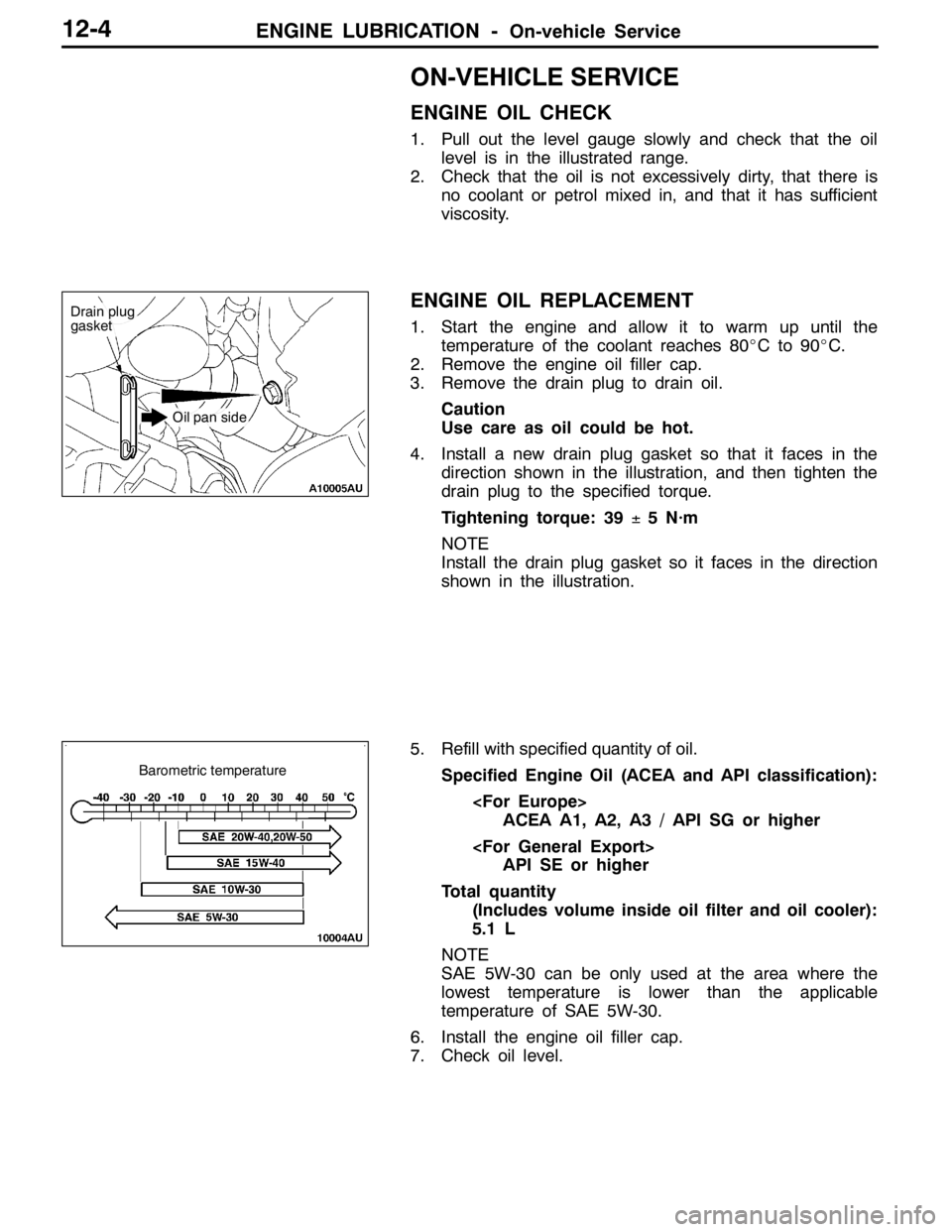
ENGINE OIL CHECK
1. Pull out the level gauge slowly and check that the oil
level is in the illustrated range.
2. Check that the oil is not excessively dirty, that there is
no coolant or petrol mixed in, and that it has sufficient
viscosity.
ENGINE OIL REPLACEMENT
1. Start the engine and allow it to warm up until the
temperature of the coolant reaches 80_Cto90_C.
2. Remove the engine oil filler cap.
3. Remove the drain plug to drain oil.
Caution
Use care as oil could be hot.
4. Install a new drain plug gasket so that it faces in the
direction shown in the illustration, and then tighten the
drain plug to the specified torque.
Tightening torque: 39±5 N·m
NOTE
Install the drain plug gasket so it faces in the direction
shown in the illustration.
5. Refill with specified quantity of oil.
Specified Engine Oil (ACEA and API classification):
ACEA A1, A2, A3 / API SG or higher
API SE or higher
Total quantity
(Includes volume inside oil filter and oil cooler):
5.1 L
NOTE
SAE 5W-30 can be only used at the area where the
lowest temperature is lower than the applicable
temperature of SAE 5W-30.
6. Install the engine oil filler cap.
7. Check oil level.
Drain plug
gasket
Oil pan side
Barometric temperature
Page 529 of 1449
ENGINE LUBRICATION -On-vehicle Service12-5
OIL FILTER REPLACEMENT
1. Start the engine and allow it to warm up until the
temperature of the coolant reaches 80_Cto90_C.
2. Remove the engine oil filler cap.
3. Remove the drain plug to drain oil.
Caution
Use care as oil could be hot.
4. Remove the under cover.
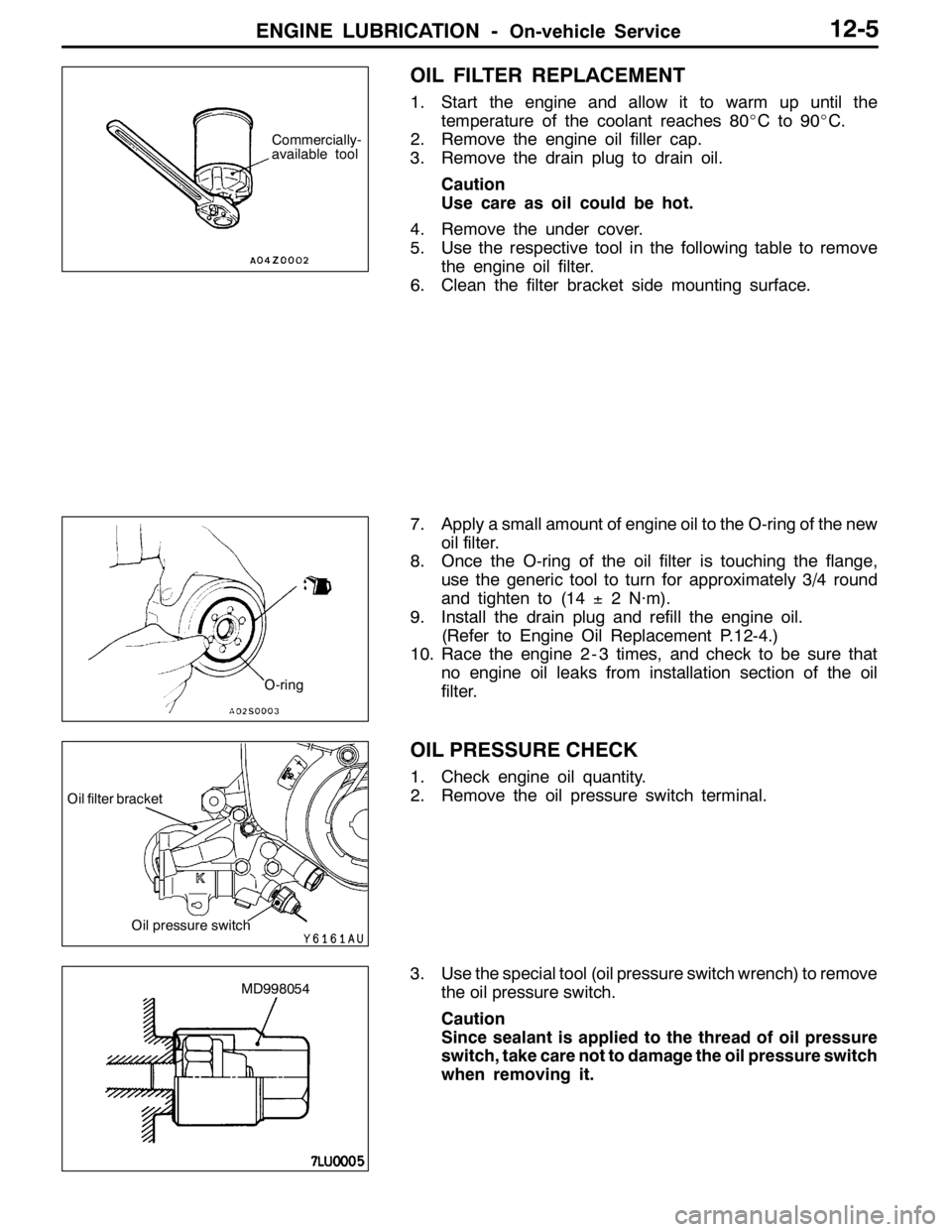
5. Use the respective tool in the following table to remove
the engine oil filter.
6. Clean the filter bracket side mounting surface.
7. Apply a small amount of engine oil to the O-ring of the new
oil filter.
8. Once the O-ring of the oil filter is touching the flange,
use the generic tool to turn for approximately 3/4 round
and tighten to (14±2 N·m).
9. Install the drain plug and refill the engine oil.
(Refer to Engine Oil Replacement P.12-4.)
10. Race the engine 2 - 3 times, and check to be sure that
no engine oil leaks from installation section of the oil
filter.
OIL PRESSURE CHECK
1. Check engine oil quantity.
2. Remove the oil pressure switch terminal.
3. Use the special tool (oil pressure switch wrench) to remove
the oil pressure switch.
Caution
Since sealant is applied to the thread of oil pressure
switch, take care not to damage the oil pressure switch
when removing it.
Commercially-
available tool
O-ring
Oil pressure switch
Oil filter bracket
MD998054
Page 534 of 1449

13A-2
MULTIPOINT FUEL
INJECTION (MPI)
CONTENTS
GENERAL INFORMATION 3...................
SERVICE SPECIFICATIONS 6.................
SEALANT 6..................................
SPECIAL TOOLS 7...........................
TROUBLESHOOTING 9.......................
ON-VEHICLE SERVICE 125..................
Fuel Pump Connector Disconnection
(How to Reduce the Fuel Pressure) 125...........
Fuel Pump Operation Check 125.................
Throttle Body (Throttle Valve Area)
Cleaning 126..................................
Throttle Position Sensor Adjustment 126...........
Basic Idle Speed Adjustment 127.................
Fuel Pressure Test 128..........................
Component Location 131........................
Engine Control Relay Continuity Check 132........
Fuel Pump Relay 1, 2 Continuity Check 132........Fuel Pump Relay 3 Continuity Check 132..........
Fuel Pump Resistor Check 132...................
Intake Air Temperature Sensor Check 132.........
Engine Coolant Temperature Sensor Check 133....
Throttle Position Sensor Check 134...............
Oxygen Sensor Check 134......................
Injector Check 136..............................
Resistor (for Injector) Check 138..................
Idle Speed Control Servo (Stepper Motor)
Check 138.....................................
Fuel Pressure Control Solenoid Valve Check 140...
Purge Control Solenoid Valve Check 140..........
EGR Control Solenoid Valve Check 140...........
INJECTOR 141..............................
THROTTLE BODY 143.......................
ENGINE CONTROL RESISTOR, RELAY 146....
ENGINE-ECU 147...........................
Page 535 of 1449

MPI -General Information13A-3
GENERAL INFORMATION
The Multipoint Fuel Injection System consists
of sensors which detect the engine conditions,
the engine-ECU which controls the system
based on signals from these sensors, and
actuators which operate under the control of
the engine-ECU. The engine-ECU carries outactivities such as fuel injection control, idle
speed control and ignition timing control. In
addition, the engine-ECU is equipped with
several diagnosis modes which simplify
troubleshooting when a problem develops.
FUEL INJECTION CONTROL
The injector drive times and injector timing are
controlled so that the optimum air/fuel mixture
is supplied to the engine to correspond to the
continually-changing engine operation condi-
tions.
A single injector is mounted at the intake port
of each cylinder. Fuel is sent under pressure
from the fuel tank by the fuel pump, with the
pressure being regulated by the fuel pressure
regulator. The fuel thus regulated is distributed
to each of the injectors.
Fuel injection is normally carried out once for
each cylinder for every two rotations of the
crankshaft. The firing order is 1-3-4-2. This iscalled sequential fuel injection. The
engine-ECU provides a richer air/fuel mixture
by carrying out “open-loop” control when the
engine is cold or operating under high load
conditions in order to maintain engine
performance. In addition, when the engine is
warm or operating under normal conditions,
the engine-ECU controls the air/fuel mixture
by using the oxygen sensor signal to carry out
“closed-loop” control in order to obtain the
theoretical air/fuel mixture ratio that provides
the maximum cleaning performance from the
three way catalyst.
IDLE AIR CONTROL
The idle speed is kept at the optimum speed
by controlling the amount of air that bypasses
the throttle valve in accordance with changes
in idling conditions and engine load during
idling. The engine-ECU drives the idle speed
control motor to keep the engine running at
the pre-set idle target speed in accordance
with the engine coolant temperature and airconditioner load. In addition, when the air
conditioner switch is turned off and on while
the engine is idling, the idle speed control motor
operates to adjust the throttle valve bypass
air amount in accordance with the engine load
conditions in order to avoid fluctuations in the
engine speed.
IGNITION TIMING CONTROL
The power transistor located in the ignition
primary circuit turns ON and OFF to control
the primary current flow to the ignition coil. This
controls the ignition timing in order to provide
the optimum ignition timing with respect to theengine operating conditions. The ignition timing
is determined by the engine-ECU from the
engine speed, intake air volume, engine coolant
temperature and barometric pressure.
SELF-DIAGNOSIS FUNCTION
DWhen an abnormality is detected in one
of the sensors or actuators related to
emission control, the engine warning lamp
(check engine lamp) illuminates as a
warning to the driver.
DWhen an abnormality is detected in one
of the sensors or actuators, a diagnosis
code corresponding to the abnormality is
output.DThe RAM data inside the engine-ECU that
is related to the sensors and actuators can
be read by means of the MUT-II. In addition,
the actuators can be force-driven under
certain circumstances.