2007 MITSUBISHI LANCER EVOLUTION engine coolant
[x] Cancel search: engine coolantPage 553 of 1449
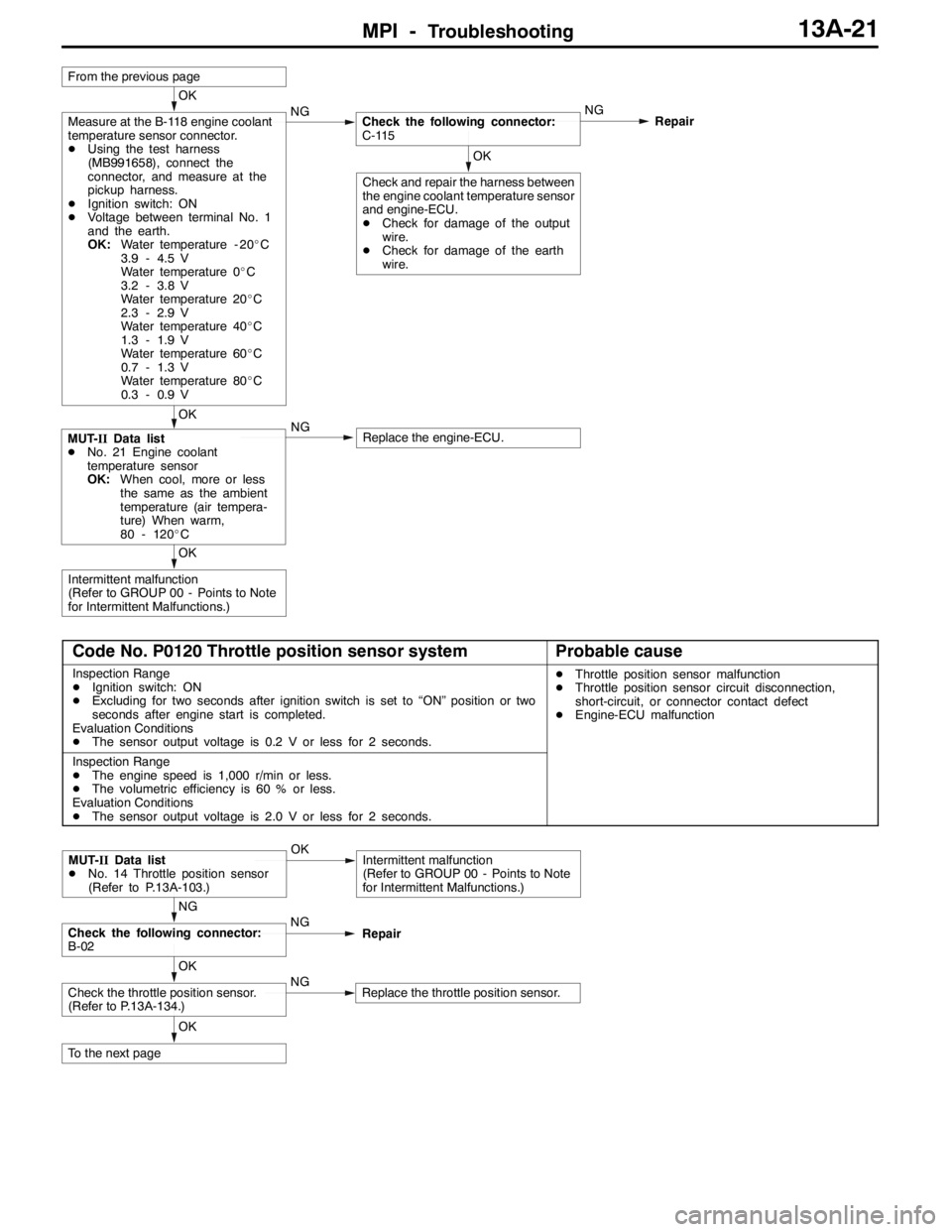
MPI -Troubleshooting13A-21
OK
Intermittent malfunction
(Refer to GROUP 00 - Points to Note
for Intermittent Malfunctions.)
OK
MUT-IIData list
DNo. 21 Engine coolant
temperature sensor
OK:When cool, more or less
the same as the ambient
temperature (air tempera-
ture) When warm,
80 - 120_CNGReplace the engine-ECU.
OK
Check and repair the harness between
the engine coolant temperature sensor
and engine-ECU.
DCheck for damage of the output
wire.
DCheck for damage of the earth
wire.
OK
Measure at the B-118 engine coolant
temperature sensor connector.
DUsing the test harness
(MB991658), connect the
connector, and measure at the
pickup harness.
DIgnition switch: ON
DVoltage between terminal No. 1
and the earth.
OK:Water temperature - 20_C
3.9 - 4.5 V
Water temperature 0_C
3.2 - 3.8 V
Water temperature 20_C
2.3 - 2.9 V
Water temperature 40_C
1.3 - 1.9 V
Water temperature 60_C
0.7 - 1.3 V
Water temperature 80_C
0.3 - 0.9 VNGCheck the following connector:
C-115NG
Repair
From the previous page
Code No. P0120 Throttle position sensor systemProbable cause
Inspection Range
DIgnition switch: ON
DExcluding for two seconds after ignition switch is set to “ON” position or two
seconds after engine start is completed.
Evaluation Conditions
DThe sensor output voltage is 0.2 V or less for 2 seconds.DThrottle position sensor malfunction
DThrottle position sensor circuit disconnection,
short-circuit, or connector contact defect
DEngine-ECU malfunction
Inspection Range
DThe engine speed is 1,000 r/min or less.
DThe volumetric efficiency is 60 % or less.
Evaluation Conditions
DThe sensor output voltage is 2.0 V or less for 2 seconds.
OK
To the next page
OK
Check the throttle position sensor.
(Refer to P.13A-134.)NGReplace the throttle position sensor.
NG
Check the following connector:
B-02NG
Repair
MUT-IIData list
DNo. 14 Throttle position sensor
(Refer to P.13A-103.)OKIntermittent malfunction
(Refer to GROUP 00 - Points to Note
for Intermittent Malfunctions.)
Page 556 of 1449
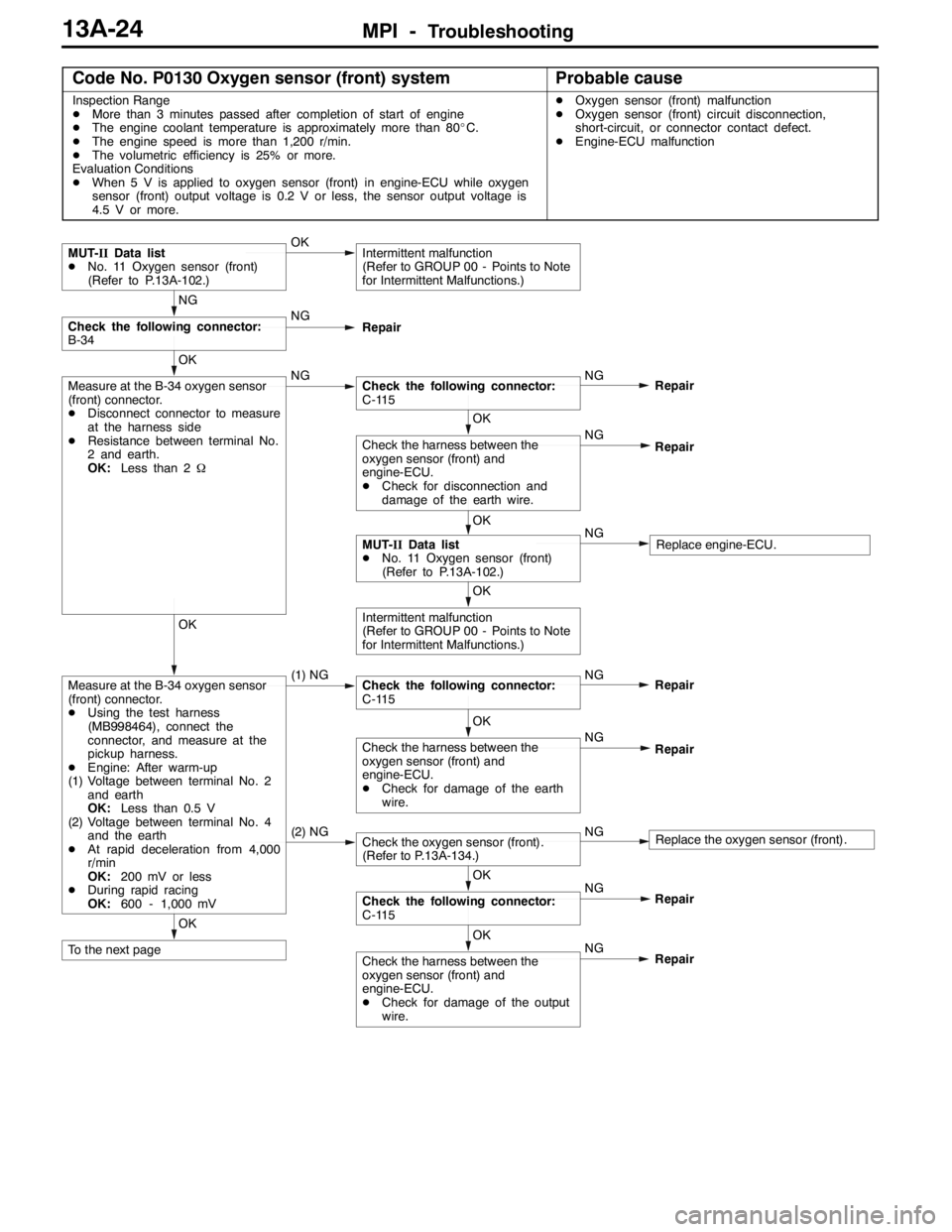
MPI -Troubleshooting13A-24
Code No. P0130 Oxygen sensor (front) systemProbable cause
Inspection Range
DMore than 3 minutes passed after completion of start of engine
DThe engine coolant temperature is approximately more than 80_C.
DThe engine speed is more than 1,200 r/min.
DThe volumetric efficiency is 25% or more.
Evaluation Conditions
DWhen 5 V is applied to oxygen sensor (front) in engine-ECU while oxygen
sensor (front) output voltage is 0.2 V or less, the sensor output voltage is
4.5 V or more.DOxygen sensor (front) malfunction
DOxygen sensor (front) circuit disconnection,
short-circuit, or connector contact defect.
DEngine-ECU malfunction
OK
To the next pageOK
Check the harness between the
oxygen sensor (front) and
engine-ECU.
DCheck for damage of the output
wire.NG
Repair NG
OK
Check the following connector:
C-115Repair
(2) NGCheck the oxygen sensor (front).
(Refer to P.13A-134.)NGReplace the oxygen sensor (front).
OK
Check the harness between the
oxygen sensor (front) and
engine-ECU.
DCheck for damage of the earth
wire.NG
Repair
OK
Measure at the B-34 oxygen sensor
(front) connector.
DUsing the test harness
(MB998464), connect the
connector, and measure at the
pickup harness.
DEngine: After warm-up
(1) Voltage between terminal No. 2
and earth
OK:Less than 0.5 V
(2) Voltage between terminal No. 4
and the earth
DAt rapid deceleration from 4,000
r/min
OK:200 mV or less
DDuring rapid racing
OK:600 - 1,000 mV(1) NGCheck the following connector:
C-115NG
Repair
OK
Intermittent malfunction
(Refer to GROUP 00 - Points to Note
for Intermittent Malfunctions.)
OK
MUT-IIData list
DNo. 11 Oxygen sensor (front)
(Refer to P.13A-102.)NGReplace engine-ECU.
OK
Check the harness between the
oxygen sensor (front) and
engine-ECU.
DCheck for disconnection and
damage of the earth wire.NG
Repair
OK
Measure at the B-34 oxygen sensor
(front) connector.
DDisconnect connector to measure
at the harness side
DResistance between terminal No.
2 and earth.
OK:Less than 2ΩNGCheck the following connector:
C-115NG
Repair
NG
Check the following connector:
B-34NG
Repair
MUT-IIData list
DNo. 11 Oxygen sensor (front)
(Refer to P.13A-102.)OKIntermittent malfunction
(Refer to GROUP 00 - Points to Note
for Intermittent Malfunctions.)
Page 558 of 1449
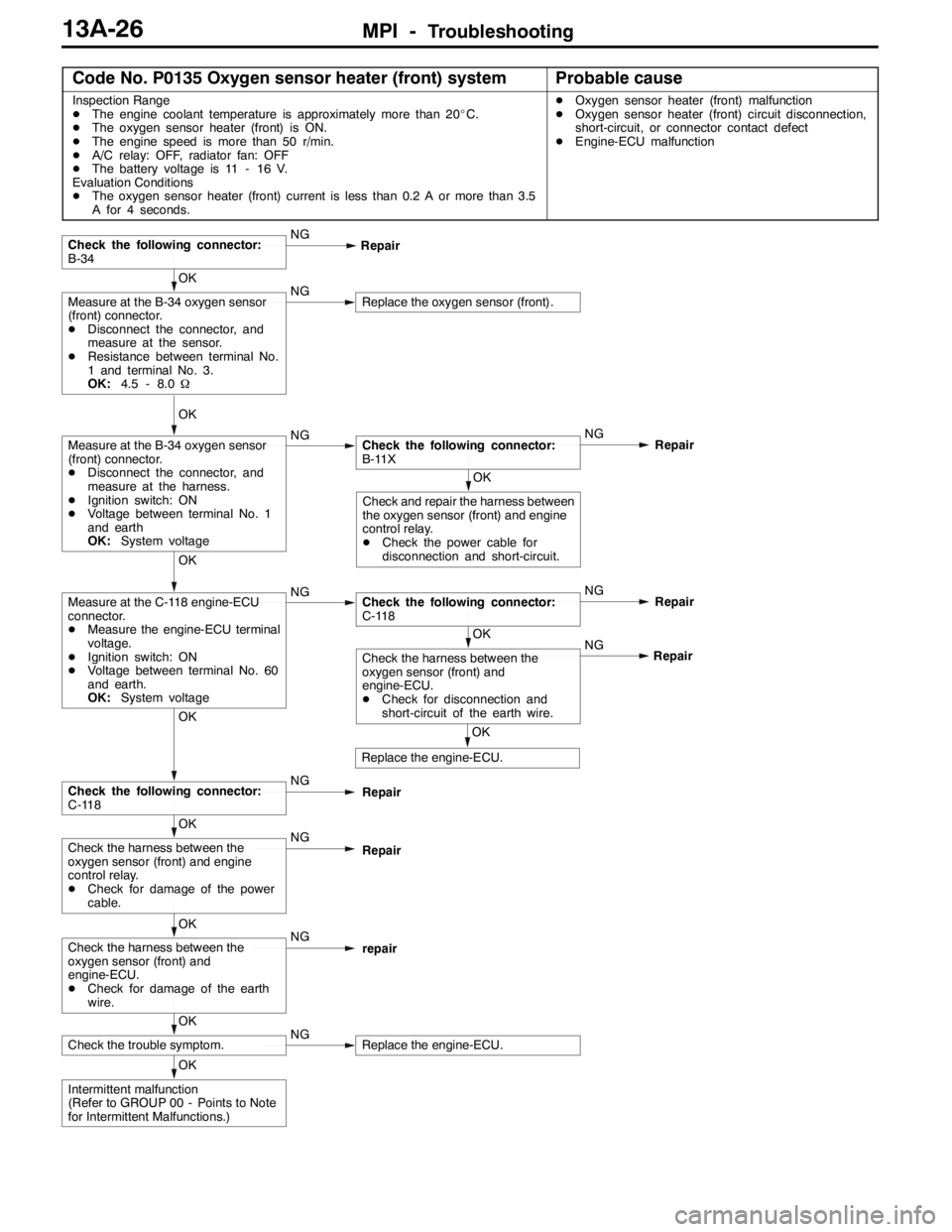
MPI -Troubleshooting13A-26
Code No. P0135 Oxygen sensor heater (front) systemProbable cause
Inspection Range
DThe engine coolant temperature is approximately more than 20_C.
DThe oxygen sensor heater (front) is ON.
DThe engine speed is more than 50 r/min.
DA/C relay: OFF, radiator fan: OFF
DThe battery voltage is 11 - 16 V.
Evaluation Conditions
DThe oxygen sensor heater (front) current is less than 0.2 A or more than 3.5
A for 4 seconds.DOxygen sensor heater (front) malfunction
DOxygen sensor heater (front) circuit disconnection,
short-circuit, or connector contact defect
DEngine-ECU malfunction
OK
Intermittent malfunction
(Refer to GROUP 00 - Points to Note
for Intermittent Malfunctions.)
OK
Check the trouble symptom.NGReplace the engine-ECU.
OK
Check the harness between the
oxygen sensor (front) and
engine-ECU.
DCheck for damage of the earth
wire.NG
repair
OK
Check the harness between the
oxygen sensor (front) and engine
control relay.
DCheck for damage of the power
cable.NG
Repair
OK
Check the following connector:
C-118NG
Repair
OK
Replace the engine-ECU.NG
OK
Check the harness between the
oxygen sensor (front) and
engine-ECU.
DCheck for disconnection and
short-circuit of the earth wire.Repair
OK
Measure at the C-118 engine-ECU
connector.
DMeasure the engine-ECU terminal
voltage.
DIgnition switch: ON
DVoltage between terminal No. 60
and earth.
OK:System voltageNGCheck the following connector:
C-118NG
Repair
OK
Check and repair the harness between
the oxygen sensor (front) and engine
control relay.
DCheck the power cable for
disconnection and short-circuit.
OK
Measure at the B-34 oxygen sensor
(front) connector.
DDisconnect the connector, and
measure at the harness.
DIgnition switch: ON
DVoltage between terminal No. 1
and earth
OK:System voltageNGCheck the following connector:
B-11XNG
Repair
OK
Measure at the B-34 oxygen sensor
(front) connector.
DDisconnect the connector, and
measure at the sensor.
DResistance between terminal No.
1 and terminal No. 3.
OK:4.5 - 8.0ΩNGReplace the oxygen sensor (front).
Check the following connector:
B-34NG
Repair
Page 559 of 1449
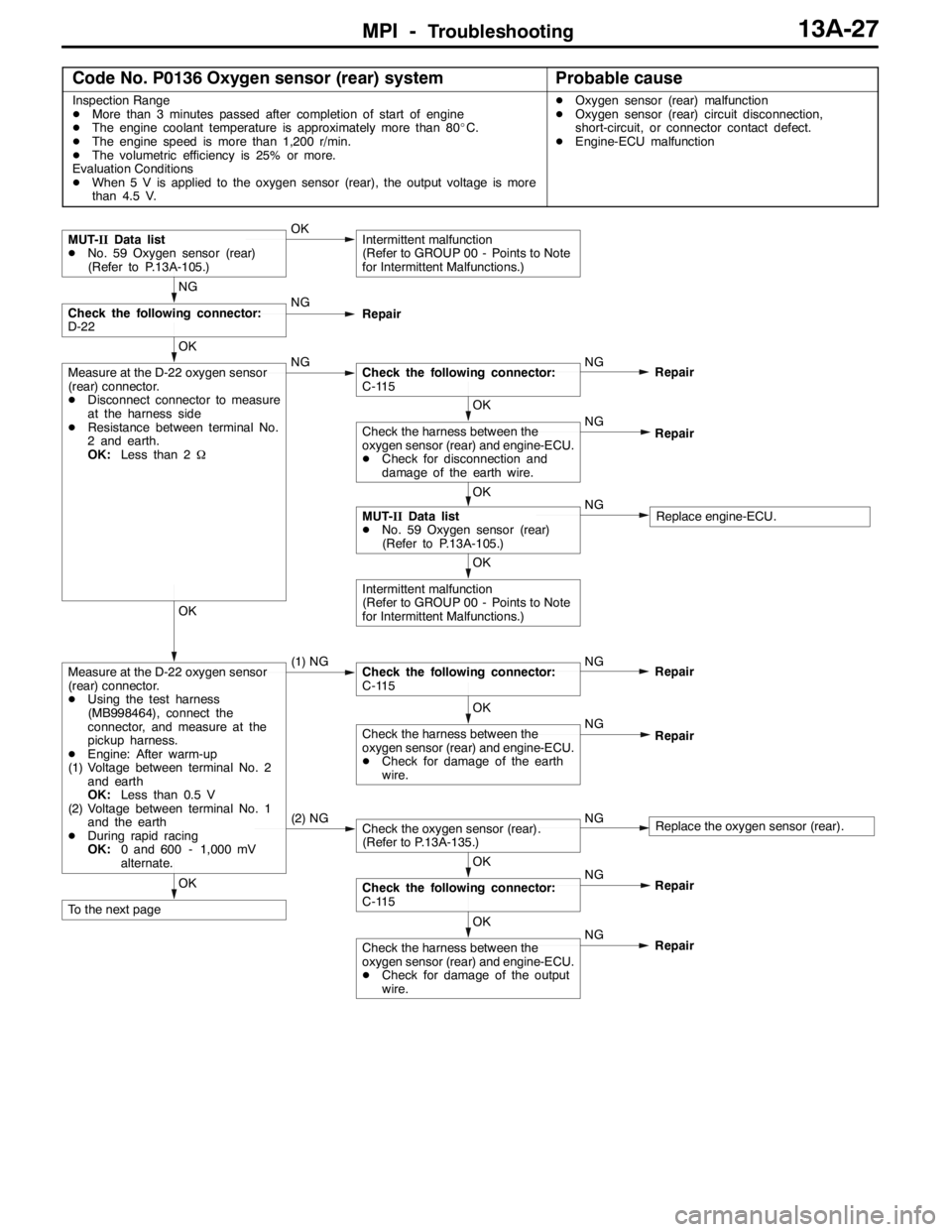
MPI -Troubleshooting13A-27
Code No. P0136 Oxygen sensor (rear) systemProbable cause
Inspection Range
DMore than 3 minutes passed after completion of start of engine
DThe engine coolant temperature is approximately more than 80_C.
DThe engine speed is more than 1,200 r/min.
DThe volumetric efficiency is 25% or more.
Evaluation Conditions
DWhen 5 V is applied to the oxygen sensor (rear), the output voltage is more
than 4.5 V.DOxygen sensor (rear) malfunction
DOxygen sensor (rear) circuit disconnection,
short-circuit, or connector contact defect.
DEngine-ECU malfunction
OK
To the next pageOK
Check the harness between the
oxygen sensor (rear) and engine-ECU.
DCheck for damage of the output
wire.NG
Repair NG
OK
Check the following connector:
C-115Repair
(2) NGCheck the oxygen sensor (rear).
(Refer to P.13A-135.)NGReplace the oxygen sensor (rear).
OK
Check the harness between the
oxygen sensor (rear) and engine-ECU.
DCheck for damage of the earth
wire.NG
Repair
OK
Measure at the D-22 oxygen sensor
(rear) connector.
DUsing the test harness
(MB998464), connect the
connector, and measure at the
pickup harness.
DEngine: After warm-up
(1) Voltage between terminal No. 2
and earth
OK:Less than 0.5 V
(2) Voltage between terminal No. 1
and the earth
DDuring rapid racing
OK:0 and 600 - 1,000 mV
alternate.(1) NGCheck the following connector:
C-115NG
Repair
OK
Intermittent malfunction
(Refer to GROUP 00 - Points to Note
for Intermittent Malfunctions.)
OK
MUT-IIData list
DNo. 59 Oxygen sensor (rear)
(Refer to P.13A-105.)NGReplace engine-ECU.
OK
Check the harness between the
oxygen sensor (rear) and engine-ECU.
DCheck for disconnection and
damage of the earth wire.NG
Repair
OK
Measure at the D-22 oxygen sensor
(rear) connector.
DDisconnect connector to measure
at the harness side
DResistance between terminal No.
2 and earth.
OK:Less than 2ΩNGCheck the following connector:
C-115NG
Repair
NG
Check the following connector:
D-22NG
Repair
MUT-IIData list
DNo. 59 Oxygen sensor (rear)
(Refer to P.13A-105.)OKIntermittent malfunction
(Refer to GROUP 00 - Points to Note
for Intermittent Malfunctions.)
Page 561 of 1449
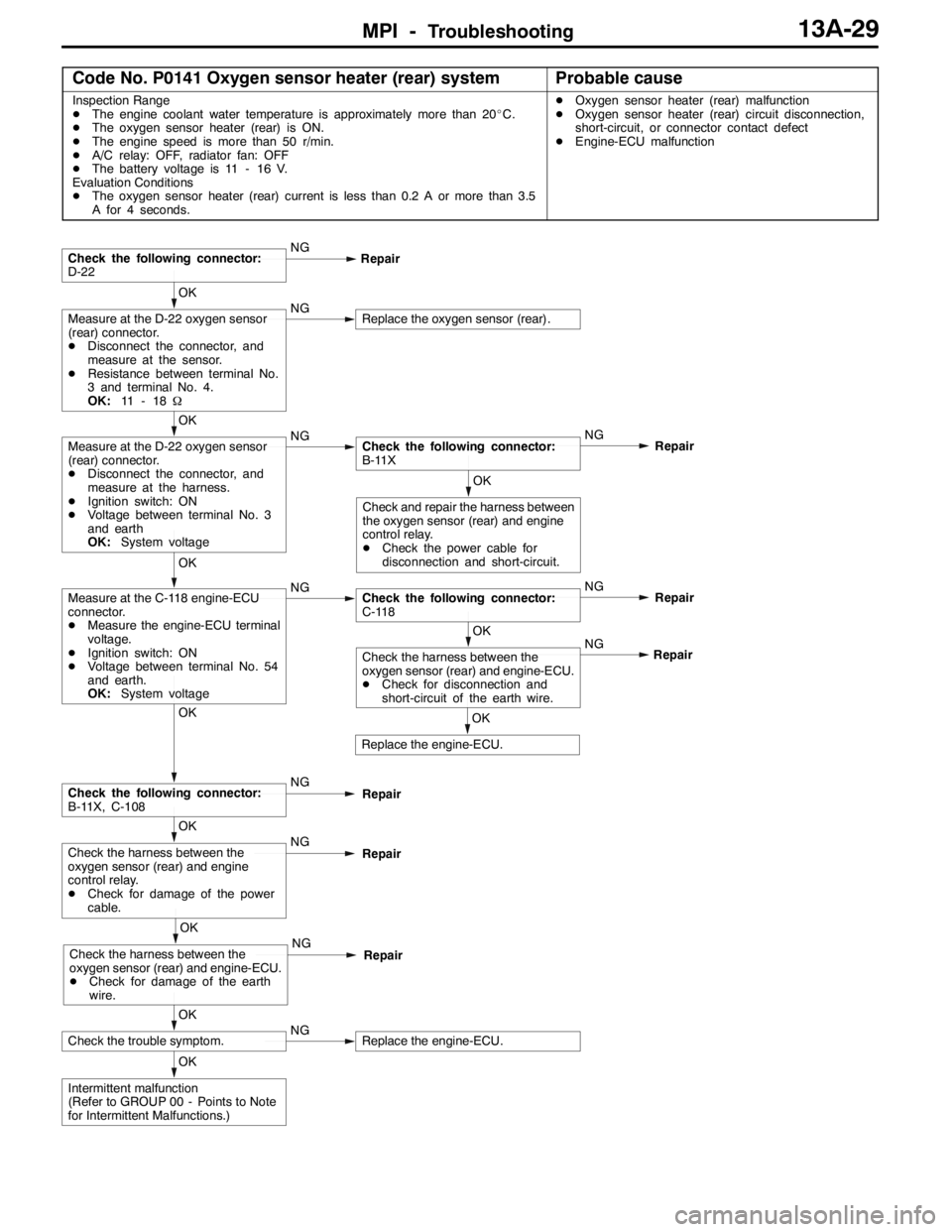
MPI -Troubleshooting13A-29
Code No. P0141 Oxygen sensor heater (rear) systemProbable cause
Inspection Range
DThe engine coolant water temperature is approximately more than 20_C.
DThe oxygen sensor heater (rear) is ON.
DThe engine speed is more than 50 r/min.
DA/C relay: OFF, radiator fan: OFF
DThe battery voltage is 11 - 16 V.
Evaluation Conditions
DThe oxygen sensor heater (rear) current is less than 0.2 A or more than 3.5
A for 4 seconds.DOxygen sensor heater (rear) malfunction
DOxygen sensor heater (rear) circuit disconnection,
short-circuit, or connector contact defect
DEngine-ECU malfunction
OK
Intermittent malfunction
(Refer to GROUP 00 - Points to Note
for Intermittent Malfunctions.)
OK
Check the trouble symptom.NGReplace the engine-ECU.
OK
Check the harness between the
oxygen sensor (rear) and engine-ECU.
DCheck for damage of the earth
wire.NG
Repair
OK
Check the harness between the
oxygen sensor (rear) and engine
control relay.
DCheck for damage of the power
cable.NG
Repair
OK
Check the following connector:
B-11X, C-108NG
Repair
OK
Replace the engine-ECU.NG
OK
Check the harness between the
oxygen sensor (rear) and engine-ECU.
DCheck for disconnection and
short-circuit of the earth wire.Repair
OK
Measure at the C-118 engine-ECU
connector.
DMeasure the engine-ECU terminal
voltage.
DIgnition switch: ON
DVoltage between terminal No. 54
and earth.
OK:System voltageNGCheck the following connector:
C-118NG
Repair
OK
Check and repair the harness between
the oxygen sensor (rear) and engine
control relay.
DCheck the power cable for
disconnection and short-circuit.
OK
Measure at the D-22 oxygen sensor
(rear) connector.
DDisconnect the connector, and
measure at the harness.
DIgnition switch: ON
DVoltage between terminal No. 3
and earth
OK:System voltageNGCheck the following connector:
B-11XNG
Repair
OK
Measure at the D-22 oxygen sensor
(rear) connector.
DDisconnect the connector, and
measure at the sensor.
DResistance between terminal No.
3 and terminal No. 4.
OK:11 - 1 8ΩNGReplace the oxygen sensor (rear).
Check the following connector:
D-22NG
Repair
Page 576 of 1449

MPI -Troubleshooting13A-44
Code No. P0505 Idle speed control systemProbable cause
Range of Check
DVehicle speed has reached 1.5 Km/h at least once.
DUnder the closed loop idle speed control.
Set Conditions
DActual idle speed has continued to be higher than the target idle speed by 300
r/min or more for 10 seconds.
Range fo Check
DVehicle speed has reached 1.5 km/h at least once.
DDuring idle speed closed loop control.
DThe highest temperature at the last drive is 45_C or less.
DEngine coolant temperature is approximately 80_C or more.
DBattery voltage is 10 V or more.
DBarometric pressure is 76 kPa or higher.
DIntake air temperature is - 10_C or more.
Set Conitions
DActual idle speed has been minimum 200 r/min higher than the target idle speed
for 10 seconds.
Range of Check
DDuring idle speed closed loop control.
DEngine coolant temperature is approximately 80_C or higher.
DBattery voltage is 10 V or higher.
DPower steering switch is off.
DVolumetric efficiency is 40 % or lower.
DBarometric pressure is 76 kPa or higher.
DIntake air temperature is - 10_C or more.
Set Conitions
DActual idle speed has been minimum 100 r/min higher than the target idle speed
for 10 seconds.DMalfunction of idle speed control servo
DOpen or short circuit in the idle speed control servo
circuit or loose connector contact
DMalfunction of engine-ECU
Page 578 of 1449

MPI -Troubleshooting13A-46
Code No. P0551 Power steering fluid pressure switch
systemProbable cause
Range of Check
DIntake air temperature is - 10_C or higher.
DBarometric pressure is 76 kPa or more.
DEngine coolant temperature is 30_C or more.
DRepeat the *1 drive and *2 stop ten times or more.
*1: Engine speed is 2500 r/min or higher, volumetric efficiency is 55 % or higher and
vehicle speed is 5 km/h or higher for 4 seconds or more.
*2: Vehicle speed is 1.5 km/h or lower.
Set Conditions
DPower steering fluid pressure switch remains on.DPower steering fliud pressure switch failed
DOpen or short circuit in the power steering fluid
pressure switch circuit or loose conector contact
DMulfunction of engine-ECU
NG
OKOK
NGCheck the following connectors:
C-122, C-136
NG
OKNG
OK
Check the harness between the
power steering fluid pressure switch
and engine-ECU.
DCheck for short-circuit of the
output cable.Repair Repair
OKIntermittent malfunction (Refer to GROUP 00 - Points to Note
for Intermittent Malfunctions.)
NG
OK
Measure at the A-48 power steering
fluid pressure switch connector.
DDisconnect the connector to
measure at the harness side.
DIgnition switch: ON
DVoltage between terminal No. 1
and earth
OK:System voltageNGMeasure at the C-122 engine-ECU
connector.
DMeasure the engine-ECU terminal
voltage.
DIgnition switch: ON
DVoltage between terminal No. 37
and earth
OK:System voltage
OK
NG
Replace the engine-ECU.
MUT-IIData list
DNo. 27: Power steering fluid pressure switch (Refer to
P.13A-103.)
OK
Check the following connector:A-48NG
Repair
NG
Repair OK
Check the following connector:
C-126, C-136
Check and repair the harness
between the power steering fluid
pressure switch and engine-ECU.
DCheck for disconnection of the
output cable.
Replace the engine-ECU.
OK
NG
MUT-IIData list
DNo. 27: Power steering fluid
pressure switch (Refer to
P.13A-103.)Intermittent malfunction (Refer to
GROUP 00 - Points to Note for
Intermittent Malfunctions.)
Measure at the C-122 engine-ECU connector.
DMeasure the engine-ECU terminal voltage.
DEngine: Idling
DVoltage between terminal No. 37 and earth
DSteering wheel: Stationary state
OK:System voltage
DSteering wheel: Steered state
OK:1 V or less
OK
Replace the power steering fluid
pressure switch.Repair
Check the following connector:
C-122NG
Repair
Check the following connector:C-122
Check the harness between the
power steering fluid pressure switch
and engine-ECU.
DCheck for damage of the output
cable.OK
Repair NG
Page 593 of 1449
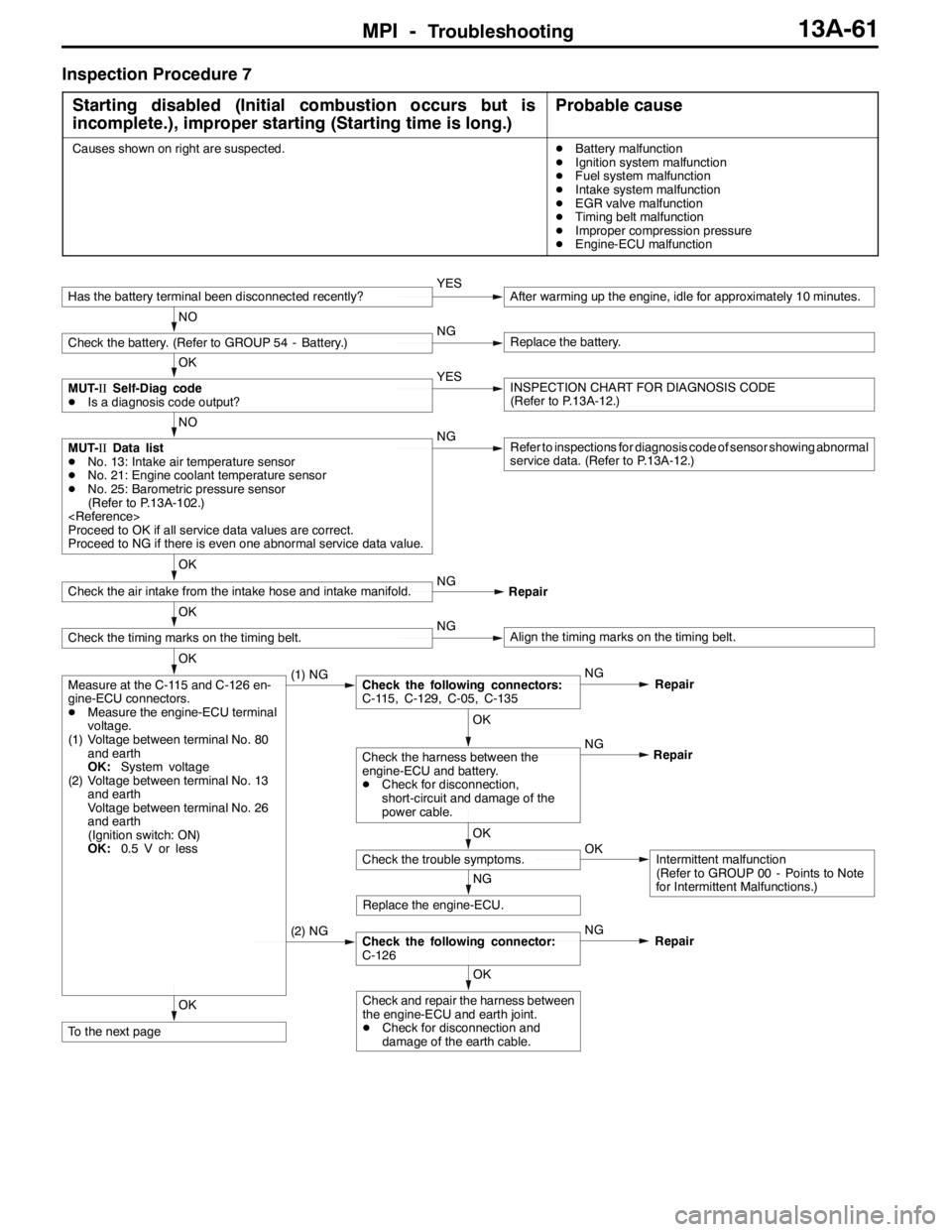
MPI -Troubleshooting13A-61
Inspection Procedure 7
Starting disabled (Initial combustion occurs but is
incomplete.), improper starting (Starting time is long.)
Probable cause
Causes shown on right are suspected.DBattery malfunction
DIgnition system malfunction
DFuel system malfunction
DIntake system malfunction
DEGR valve malfunction
DTiming belt malfunction
DImproper compression pressure
DEngine-ECU malfunction
OK
To the next page
OK
Check and repair the harness between
the engine-ECU and earth joint.
DCheck for disconnection and
damage of the earth cable.
(2) NGCheck the following connector:
C-126NG
Repair
NG
Replace the engine-ECU.
OK
Check the trouble symptoms.OKIntermittent malfunction
(Refer to GROUP 00 - Points to Note
for Intermittent Malfunctions.) NG
OK
Check the harness between the
engine-ECU and battery.
DCheck for disconnection,
short-circuit and damage of the
power cable.Repair
OK
Measure at the C-115 and C-126 en-
gine-ECU connectors.
DMeasure the engine-ECU terminal
voltage.
(1) Voltage between terminal No. 80
and earth
OK:System voltage
(2) Voltage between terminal No. 13
and earth
Voltage between terminal No. 26
and earth
(Ignition switch: ON)
OK:0.5 V or less(1) NGCheck the following connectors:
C-115, C-129, C-05, C-135NG
Repair
OK
Check the timing marks on the timing belt.NGAlign the timing marks on the timing belt.
OK
Check the air intake from the intake hose and intake manifold.NG
Repair
NO
MUT-IIData list
DNo. 13: Intake air temperature sensor
DNo. 21: Engine coolant temperature sensor
DNo. 25: Barometric pressure sensor
(Refer to P.13A-102.)
Proceed to OK if all service data values are correct.
Proceed to NG if there is even one abnormal service data value.NGRefer to inspections for diagnosis code of sensor showing abnormal
service data. (Refer to P.13A-12.)
OK
MUT-IISelf-Diag code
DIs a diagnosis code output?YESINSPECTION CHART FOR DIAGNOSIS CODE
(Refer to P.13A-12.)
NO
Check the battery. (Refer to GROUP 54 - Battery.)NGReplace the battery.
Has the battery terminal been disconnected recently?YESAfter warming up the engine, idle for approximately 10 minutes.