Page 173 of 1575
8.Clean the inside surface of the terminal clamps with a suitable battery cleaning tool. Replace damaged or frayed
cables and broken terminal clamps.
9. Install the battery in the vehicle.
10. Connect the cable terminals to the battery post, making sure tops of the terminals are flush with the tops of the
posts.
11. Tighten the terminal nuts securely.
12. Coat all connections with light mineral grease after tightening.
When batteries are being charged, an explosive gas forms beneath the cover of each cell. Do not smoke
near batteries being charged or which have recently been charged. Do not break live circuit at the terminals
of batteries being charged.
A spark will occur when the circuit is broken. Keep open flames away form battery.
Page 175 of 1575
2007 > 2.7L V6 GASOLINE >
DESCRIPTION
The starting system includes the battery, starter, solenoid switch, ignition switch, inhibitor switch (A/T), ignition lock
switch, connection wires and the battery cable.
When the ignition key is turned to the start position, current flows and energizes the starter motor's solenoid coil.
The solenoid plunger and clutch shift lever are activated, and the clutch pinion engages the ring gear.
The contacts close and the starter motor cranks. In order to prevent damage caused by excessive rotation of the
starter armature when the engine starts, the clutch pinion gear overruns.
Page 176 of 1575

2007 > 2.7L V6 GASOLINE >
STARTER CIRCUIT TROUBLESHOOTING
The battery must be in good condition and fully charged.
1. Remove the fuel pump relay(A) from the fuse box.
2. With the shift lever in N or P (A/T) or clutch pedal pressed (M/T), turn the ignition switch to "START"
If the starter normally cranks the engine, starting system is OK. If the starter will not crank the engine at all, go to
next step.
If it won't disengage from the ring gear when you release key, check for the following until you find the cause.
a. Solenoid plunger and switch malfunction.
b. Dirty pinion gear or damaged overrunning clutch.
3. Check the battery condition. Check electrical connections at the battery, battery negative cable connected to the
body, engine ground cables, and the starter for looseness and corrosion. Then try starting the engine again.
If the starter cranks normally the engine, repairing the loose connection repaired the problem. The starting system
is now OK.
If the starter still does not crank the engine, go to next step.
4. Disconnect the connector from the S- terminal of solenoid. Connect a jumper wire from the B- terminal of solenoid to
the S- terminal of solenoid.
If the starter cranks the engine, go to next step.
If the starter still does not crank the engine, remove the starter, and repair or replace as necessary.
5. Check the following items in the order listed until you find the open circuit.
a. Check the wire and connectors between the driver's under - dash fuse/relay box and the ignition switch, and
between the driver's under - dash fuse/relay box and the starter.
b. Check the ignition switch (Refer to BE group - ignition system)
c. Check the transaxle range switch connector or ignition lock switch connector.
d. Inspect the starter relay.
STATER SOLENOID TEST
1.Disconnect the field coil wire from the M- terminal of solenoid switch.
2. Connect the battery as shown. If the starter pinion pops out, it is working properly. To avoid damaging the starter,
do not leave the battery connected for more than 10 seconds.
3.Disconnect the battery from the M terminal.
If the pinion does not retract, the hold- in coil is working properly. To avoid damaging the starter, do not leave the
battery connected for more than 10 seconds.
Page 177 of 1575
4.Disconnect the battery also from the body. If the pinion retracts immediately, it is working properly. To avoid
damaging the starter, do not leave the battery connected for more than 10 seconds.
FREE RUNNING TEST
1.Place the starter motor in a vise equipped with soft jaws and connect a fully - charged 12- volt battery to starter
motor as follows.
2. Connect a test ammeter (100 - ampere scale) and carbon pile rheostats shown is the illustration.
3. Connect a voltmeter (15- volt scale) across starter motor.
4.Rotate carbon pile to the off position.
5. Connect the battery cable from battery's negative post to the starter motor body.
6. Adjust until battery voltage shown on the voltmeter reads 11volts.
7. Confirm that the maximum amperage is within the specifications and that the starter motor turns smoothly and
freely.
Current : 900A
Speed : 2,800 rpm
Page 180 of 1575
2007 > 2.7L V6 GASOLINE >
REMOVAL
STATATER
1. Disconnect the battery negative cable.
2. Disconnect the starter cable (A) from the B terminal (B) on the solenoid (C), then disconnect the connector (D)
from the S terminal (E).
3.Remove the 2 bolts holding the starter, then remove the starter.
4. Installation is the reverse of removal.
5. Connect the battery negative cable to the battery.
DISASSEMBLY
1.Disconnect the M- terminal (A) on the magnet switch assembly (B).
2.After loosening the 3 screws (A), detach the magnet switch assembly (B).
3.Loosen the through bolts (A).
Page 210 of 1575

2007 > 2.7L V6 GASOLINE >
INSPECTION
When disconnecting the vacuum hose, make an identification mark on it so that it can be reconnected to its
original position.
1. Disconnect the vacuum hose from the solenoid valve.
2. Detach the harness connector.
3. Connect a vacuum pump to the nipple which is connected to intake manifold.
4. Apply vacuum and check when voltage is applied to the PCSV and when the voltage is discontinued.
Battery voltage Normal condition
When applied Vacuum is released
When discontinued Vacuum is maintained
5. Measure the resistance between the terminals of the solenoid valve.
PCSV coil resistance(Ω) :
14.0 ~ 18.0Ω at 20°C (68°F)
INSPECTION
FUNCTION AND OPERATION PRICIPLE
Purge Control Solenoid Valve (PCSV) is installed on the surge tank and controls the passage between the canister
and the intake manifold. It is a solenoid valve and is open when the PCM grounds the valve control line. When the
passage is open (PCSV ON), fuel vapors stored in the canister is transferred to the intake manifold.
SPECIFICATION
Item Specification
Coil Resistance (Ω) 14.0 ~ 18.0Ω at 20°C (68°F)
CIRCUIT DIAGRAM
Page 230 of 1575
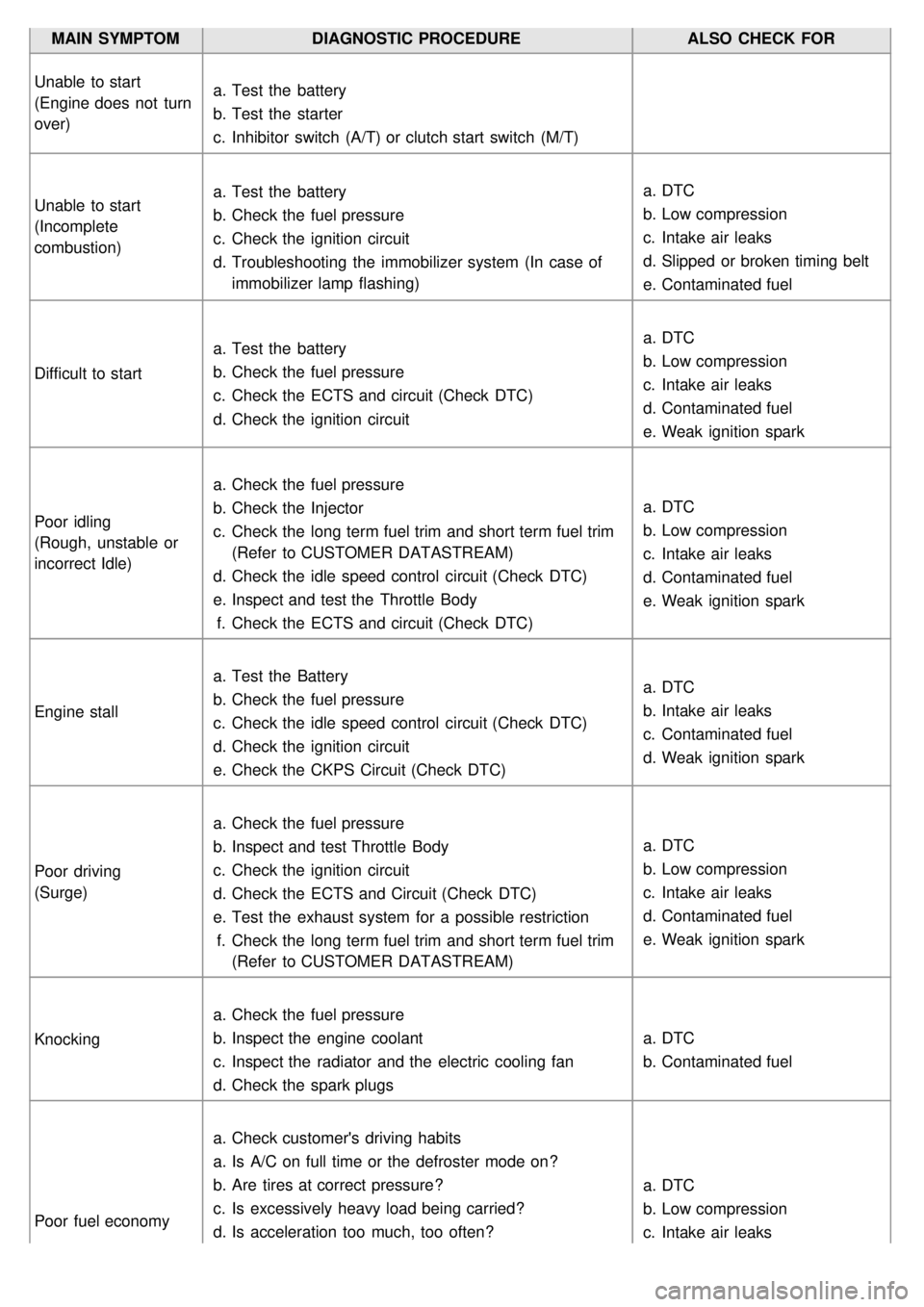
MAIN SYMPTOMDIAGNOSTIC PROCEDURE ALSO CHECK FOR
Unable to start
(Engine does not turn
over) a.
Test the battery
b. Test the starter
c. Inhibitor switch (A/T) or clutch start switch (M/T)
Unable to start
(Incomplete
combustion) a.
Test the battery
b. Check the fuel pressure
c. Check the ignition circuit
d. Troubleshooting the immobilizer system (In case of
immobilizer lamp flashing) a.
DTC
b. Low compression
c. Intake air leaks
d. Slipped or broken timing belt
e. Contaminated fuel
Difficult to start a.
Test the battery
b. Check the fuel pressure
c. Check the ECTS and circuit (Check DTC)
d. Check the ignition circuit a.
DTC
b. Low compression
c. Intake air leaks
d. Contaminated fuel
e. Weak ignition spark
Poor idling
(Rough, unstable or
incorrect Idle) a.
Check the fuel pressure
b. Check the Injector
c. Check the long term fuel trim and short term fuel trim
(Refer to CUSTOMER DATASTREAM)
d. Check the idle speed control circuit (Check DTC)
e. Inspect and test the Throttle Body
f. Check the ECTS and circuit (Check DTC) a.
DTC
b. Low compression
c. Intake air leaks
d. Contaminated fuel
e. Weak ignition spark
Engine stall a.
Test the Battery
b. Check the fuel pressure
c. Check the idle speed control circuit (Check DTC)
d. Check the ignition circuit
e. Check the CKPS Circuit (Check DTC) a.
DTC
b. Intake air leaks
c. Contaminated fuel
d. Weak ignition spark
Poor driving
(Surge) a.
Check the fuel pressure
b. Inspect and test Throttle Body
c. Check the ignition circuit
d. Check the ECTS and Circuit (Check DTC)
e. Test the exhaust system for a possible restriction
f. Check the long term fuel trim and short term fuel trim
(Refer to CUSTOMER DATASTREAM) a.
DTC
b. Low compression
c. Intake air leaks
d. Contaminated fuel
e. Weak ignition spark
Knocking a.
Check the fuel pressure
b. Inspect the engine coolant
c. Inspect the radiator and the electric cooling fan
d. Check the spark plugs a.
DTC
b. Contaminated fuel
Poor fuel economy a.
Check customer's driving habits
a. Is A/C on full time or the defroster mode on?
b. Are tires at correct pressure?
c. Is excessively heavy load being carried?
d. Is acceleration too much, too often? a.
DTC
b. Low compression
c. Intake air leaks
Page 239 of 1575
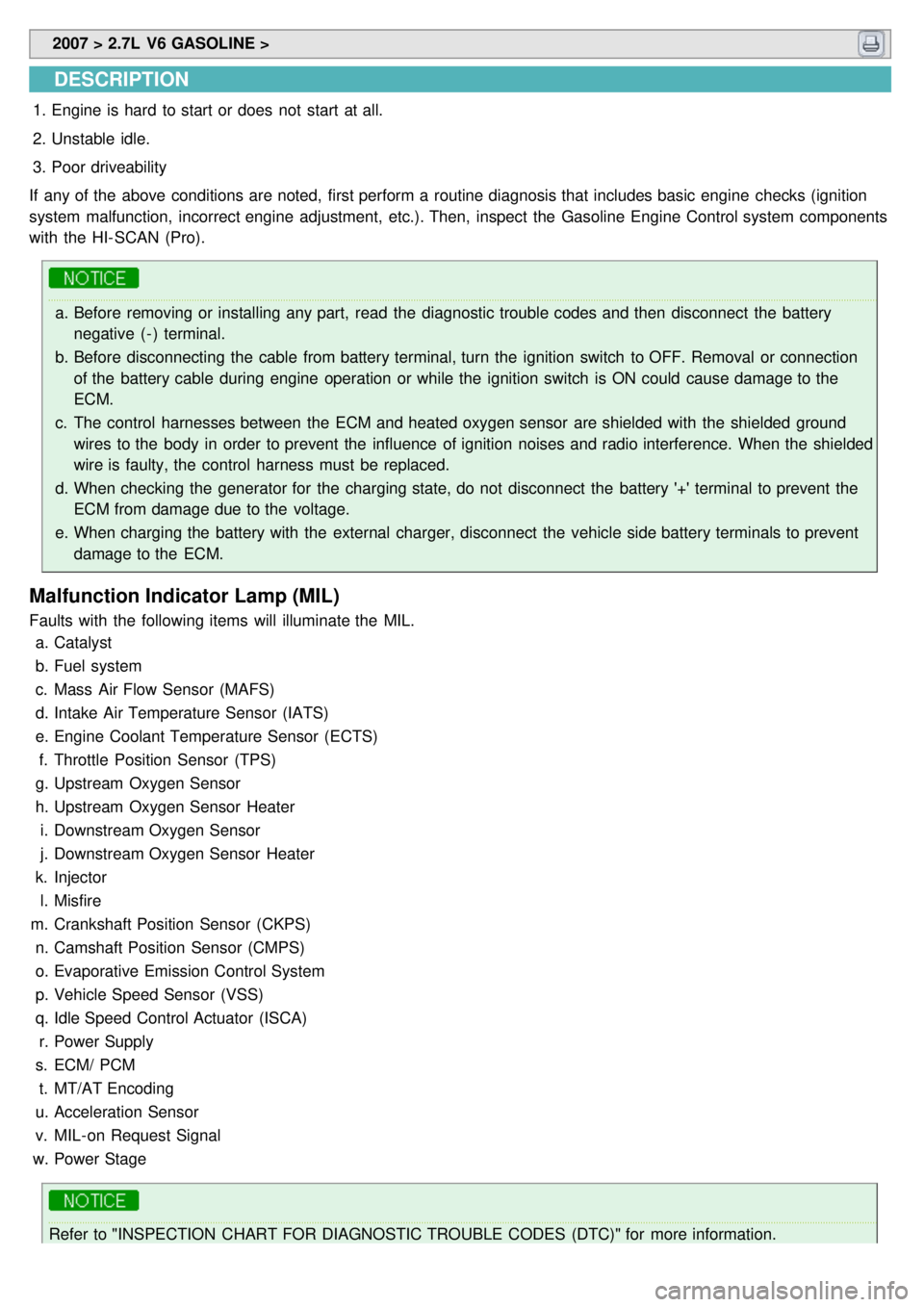
2007 > 2.7L V6 GASOLINE >
DESCRIPTION
1.Engine is hard to start or does not start at all.
2. Unstable idle.
3. Poor driveability
If any of the above conditions are noted, first perform a routine diagnosis that includes basic engine checks (ignition
system malfunction, incorrect engine adjustment, etc.). Then, inspect the Gasoline Engine Control system components
with the HI- SCAN (Pro).
a. Before removing or installing any part, read the diagnostic trouble codes and then disconnect the battery
negative ( - ) terminal.
b. Before disconnecting the cable from battery terminal, turn the ignition switch to OFF. Removal or connection
of the battery cable during engine operation or while the ignition switch is ON could cause damage to the
ECM.
c. The control harnesses between the ECM and heated oxygen sensor are shielded with the shielded ground
wires to the body in order to prevent the influence of ignition noises and radio interference. When the shielded
wire is faulty, the control harness must be replaced.
d. When checking the generator for the charging state, do not disconnect the battery '+' terminal to prevent the
ECM from damage due to the voltage.
e. When charging the battery with the external charger, disconnect the vehicle side battery terminals to prevent
damage to the ECM.
Malfunction Indicator Lamp (MIL)
Faults with the following items will illuminate the MIL.
a. Catalyst
b. Fuel system
c. Mass Air Flow Sensor (MAFS)
d. Intake Air Temperature Sensor (IATS)
e. Engine Coolant Temperature Sensor (ECTS)
f. Throttle Position Sensor (TPS)
g. Upstream Oxygen Sensor
h. Upstream Oxygen Sensor Heater
i. Downstream Oxygen Sensor
j. Downstream Oxygen Sensor Heater
k. Injector
l. Misfire
m. Crankshaft Position Sensor (CKPS)
n. Camshaft Position Sensor (CMPS)
o. Evaporative Emission Control System
p. Vehicle Speed Sensor (VSS)
q. Idle Speed Control Actuator (ISCA)
r. Power Supply
s. ECM/ PCM
t. MT/AT Encoding
u. Acceleration Sensor
v. MIL- on Request Signal
w. Power Stage
Refer to "INSPECTION CHART FOR DIAGNOSTIC TROUBLE CODES (DTC)" for more information.


