Page 146 of 1575
6.The MICRO 570 will detect the amount of ripple from the charging system to the battery. Excessive ripple usually
means the stator is damaged or that one or more generator diodes have failed.
7.The MICRO 570 will prompt you to turn on accessary loads. It will then test at idle and prompt you to rev the
engine. The analyzer will determine if the charging system can provide enough current for the demands of the
vehicle's electrical system.
When asked to turn of the accessory loads, turn of the blower to high(heater), the high beam beadlights, and
rear defogger. DO NOT use cyclical loads such as air conditioning or wind- shield wipers.
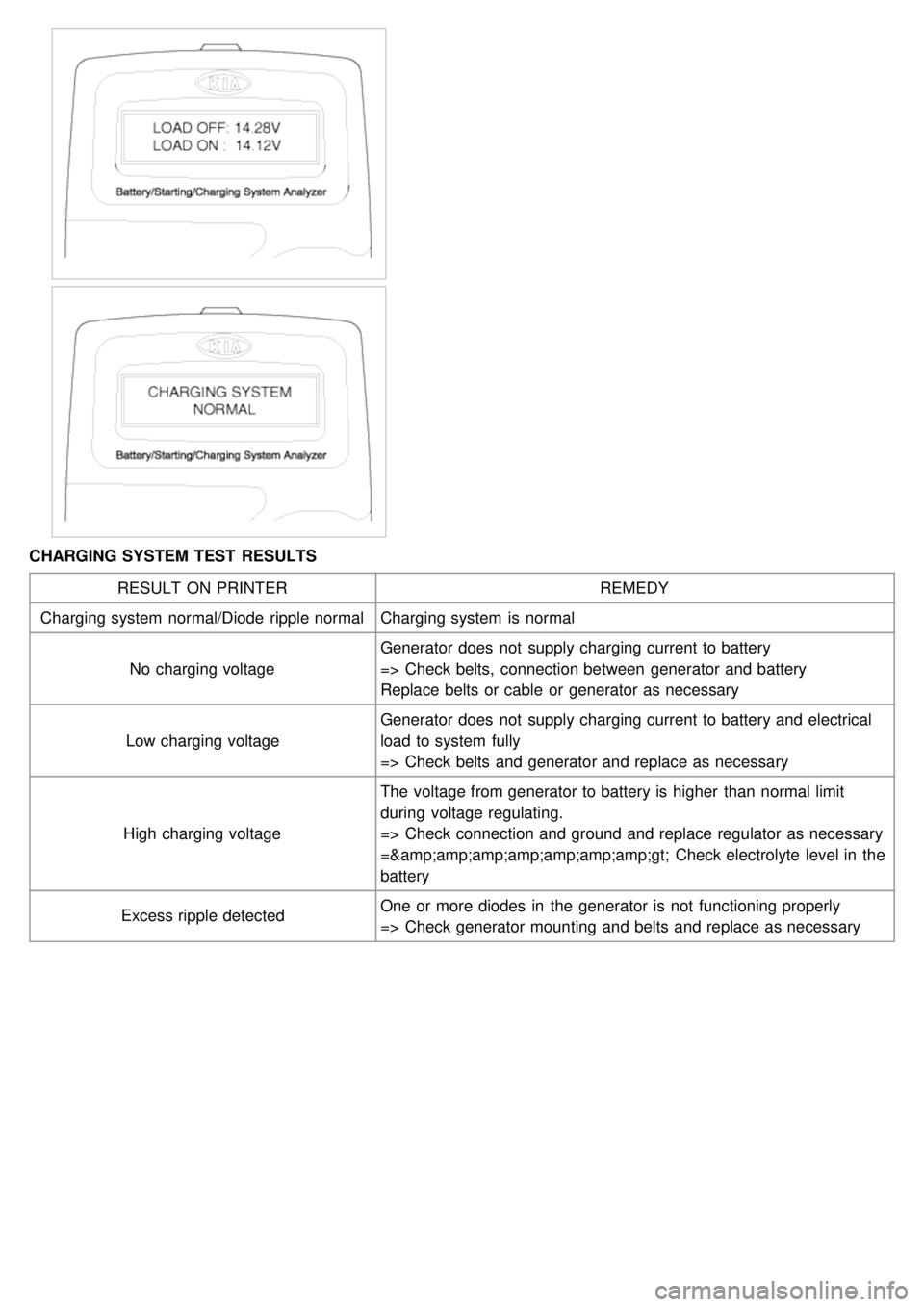
8. After the test, the MICRO 570 will display the idle voltage, load voltage and the state results.
Page 147 of 1575
CHARGING SYSTEM TEST RESULTSRESULT ON PRINTER REMEDY
Charging system normal/Diode ripple normal Charging system is normal
No charging voltage Generator does not supply charging current to battery
=> Check belts, connection between generator and battery
Replace belts or cable or generator as necessary
Low charging voltage Generator does not supply charging current to battery and electrical
load to system fully
=> Check belts and generator and replace as necessary
High charging voltage The voltage from generator to battery is higher than normal limit
during voltage regulating.
=> Check connection and ground and replace regulator as necessary
=> Check electrolyte level in the
battery
Excess ripple detected One or more diodes in the generator is not functioning properly
=> Check generator mounting and belts and replace as necessary
Page 148 of 1575
2007 > 2.7L V6 GASOLINE >
SPECIAL SERVICE TOOL
Tool (Number and name) IllustrationUse
Alternator pulley remover wrench
(09373- 27000)
Removal and installation of alternator
pulley
REFERENCE SERVICE TOOLS
Tool (Number and name) IllustrationUse
Micro- 570
Battery checker
a. Check the battery condition
b. Check the charging and starting
system
Page 149 of 1575

2007 > 2.7L V6 GASOLINE >
TROUBLE SHOOTING
IGNITION SYSTEM
Symptom Suspect area Remedy
Engine will not start or
is hard to start
(Cranks OK) Ignition lock switch
Inspect ignition lock switch, or replace as required
Ignition coil Inspect ignition coil, or replace as required
Spark plugs Inspect spark plugs, or replace as required
Ignition wiring disconnected or broken Repair wiring, or replace as required
Rough idle or stalls Ignition wiring Repair wiring, or replace as required
Ignition coil Inspect ignition coil, or replace as required
Engine hesitates/poor
acceleration Spark plugs and spark plug cables
Inspect spark plugs / cable, or replace as required
Ignition wiring Repair wiring, or replace as required
Poor mileage Spark plugs and spark plug cables Inspect spark plugs / cable, or replace as required
CHARGING SYSTEM Symptom Suspect area Remedy
Charging warning
indicator does not
light with ignition
switch "ON" and
engine off. Fuse blown
Check fuses
Light burned out Replace light
Wiring connection loose Tighten loose connection
Electronic voltage regulator Replace voltage regulator
Charging warning
indicator does not go
out with engine
running. (Battery
requires frequent
recharging) Drive belt loose or worn
Adjust belt tension or replace belt
Battery cable loose, corroded or worn Inspect cable connection, repair or replace
cable
Electronic voltage regulator or alternator Replace voltage regulator or alternator
Wiring Repair or replace wiring
Overcharge Electronic voltage regulator Replace voltage regulator
Voltage sensing wire Repair or replace wiring
Discharge Drive belt loose or worn Adjust belt tension or replace belt
Wiring connection loose or short circuit Inspect wiring connection, repair or replace
wiring
Electronic voltage regulator or alternator Replace voltage regulator or alternator
Poor grounding Inspect ground or repair
Worn battery Replace battery
STARTING SYSTEM Symptom Suspect area Remedy
Engine will not crank Battery charge low Charge or replace battery
Battery cables loose, corroded or
worn out Repair or replace cables
Transaxle range switch (Vehicle with
automatic transaxle only) Refer to TR group - automatic transaxle
Page 150 of 1575
Fuse blownReplace fuse
Starter motor faulty Replace
Ignition switch faulty Replace
Engine cranks slowly Battery charge low Charge or replace battery
Battery cables loose, corroded or
worn out Repair or replace cables
Starter motor faulty Replace
Starter keeps running Starter motor Replace
Ignition switch Replace
Starter spins but engine will not
crank Short in wiring
Repair wiring
Pinion gear teeth broken or starter
motor Replace
Ring gear teeth broken Replace fly wheel or torque converter
Page 151 of 1575

2007 > 2.7L V6 GASOLINE >
SPECIFICATION
IGNITION SYSTEM
Items Specification
Ignition coil Primary resistance
0.715 ± 0.015 Ω
Secondary resistance -
Spark plugs NGK ILFR5B11
Plugs Gap 1.0 ~ 1.1 mm (0.0394 ~ 0.0433 in)
STARTING SYSTEM Items Specification
Starter Rated voltage
12 V, 1.2 kW
No. of pinion teeth 8
No- load
characteristics Voltage
11.5 V
Ampere 90A, MAX
Speed 2,600 rpm, MIN
CHARGING SYSTEM Items Specification
Alternator Type
Battery voltage sensing
Rate voltage 13.5 V, 110A
Speed in use 1,000 ~ 18,000 rpm
Voltage regulator Electronic built- in type
Regulator setting voltage 14.2 ~ 14.8V
Battery Type
MF 68AH
Cold cranking amperage [at - 18°C(- 0.4°F)] 600 A
Reserve capacity 110 min
Specific gravity [at 20°C(68°F)] 1.280 ± 0.01
a.COLD CRANKING AMPERAGE is the amperage a battery can deliver for 30 seconds and maintain a terminal
voltage of 7.2V or greater at a specified temperature.
b. RESERVE CAPACITY RATING is amount of time a battery can deliver 25A and maintain a minimum terminal
voltage of 10.5V at 26.7°C(80.1°F).
Page 159 of 1575
2007 > 2.7L V6 GASOLINE >
DESCRIPTION
The charging system included a battery, an alternator with a built- in regulator, and the charging indicator light and
wire.
The Alternator has built- in diodes, each rectifying AC current to DC current.
Therefore, DC current appears at alternator "B" terminal.
In addition, the charging voltage of this alternator is regulated by the battery voltage detection system.
The alternator is regulated by the battery voltage detection system. The main components of the alternator are the
rotor, stator, rectifier, capacitor brushes, bearings and V- ribbed belt pulley. The brush holder contains a built- in
electronic voltage regulator.
Page 160 of 1575

2007 > 2.7L V6 GASOLINE >
ON-VEHICLE INPECTION
a.Check that the battery cables are connected to the correct terminals.
b. Disconnect the battery cables when the battery is given a quick charge.
c. Never disconnect the battery while the engine is running.
CHECK BATTERY VOLTAGE
1.If 20 minutes have not passed since the engine was stopped, turn the ignition switch ON and turn on the electrical
system (headlamp, blower motor, rear defogger etc.) for 60 seconds to remove the surface charge.
2. Turn the ignition switch OFF and turn off the electrical systems.
3. Measure the battery voltage between the negative ( - ) and positive (+) terminals of the battery.
Standard voltage : 12.5 ~ 12.9V at 20°C(68°F)
If the voltage is less than specification, charge the battery.
CHECK THE BATTERY TERMINALS AND FUSES
1.Check that the battery terminals are not loose or corroded.
2. Check the fuses for continuity.
INSPECT DRIVE BELT
Visually check the belt for excessive wear, frayed cords etc.
If any defect has been found, replace the drive belt.
Cracks on the rib side of a belt are considered acceptable. If the belt has chunks missing from the ribs, it should
be replaced.
VISUALLY CHECK ALTERNATOR WIRING AND LISTEN FOR ABNORMAL NOISES
1.Check that the wiring is in good condition.
2. Check that there is no abnormal noise from the alternator while the engine is running.
CHECK DISCHARGE WARNING LIGHT CIRCUIT
1.Warm up the engine and then turn it off.
2. Turn off all accessories.
3. Turn the ignition switch "ON". Check that the discharge warning light is lit.
4. Start the engine. Check that the light is lit.
If the light does not go off as specified, troubleshoot the discharge light circuit.
INSPECT CHARGING SYSTEM
VOLTAGE DROP TEST OF ALTERNATOR OUTPUT WIRE
This test determines whether or not the wiring between the alternator "B" terminal and the battery (+) terminal is good
by the voltage drop method.
PREPARATION