2006 DODGE RAM SRT-10 length
[x] Cancel search: lengthPage 4452 of 5267
CLADDING-BODY SIDE - CAB - SRT-10
REMOVAL
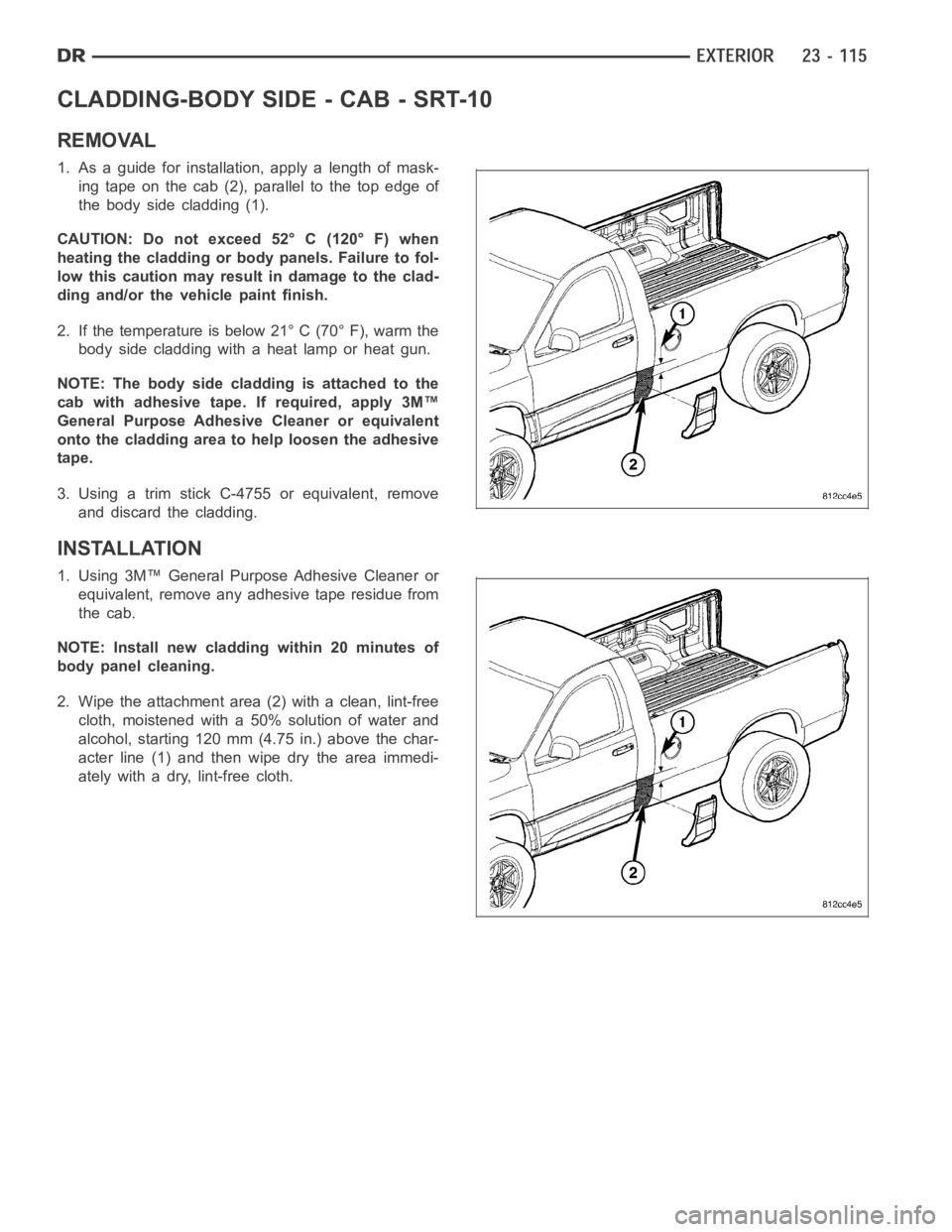
1. As a guide for installation, apply a length of mask-
ingtapeonthecab(2),paralleltothetopedgeof
the body side cladding (1).
CAUTION: Do not exceed 52° C (120° F) when
heating the cladding or body panels. Failure to fol-
low this caution may result in damage to the clad-
ding and/or the vehicle paint finish.
2. If the temperature is below 21° C (70° F), warm the
body side cladding with a heat lamp or heat gun.
NOTE: The body side cladding is attached to the
cab with adhesive tape. If required, apply 3M™
General Purpose Adhesive Cleaner or equivalent
onto the cladding area to help loosen the adhesive
tape.
3. Using a trim stick C-4755 or equivalent, remove
and discard the cladding.
INSTALLATION
1. Using 3M™ General Purpose Adhesive Cleaner or
equivalent, remove any adhesive tape residue from
the cab.
NOTE: Install new cladding within 20 minutes of
body panel cleaning.
2. Wipe the attachment area (2) with a clean, lint-free
cloth, moistened with a 50% solution of water and
alcohol, starting 120 mm (4.75 in.) above the char-
acterline(1)andthenwipedrytheareaimmedi-
ately with a dry, lint-free cloth.
Page 4454 of 5267
CLADDING-BODY SIDE - DOOR - SRT-10
REMOVAL
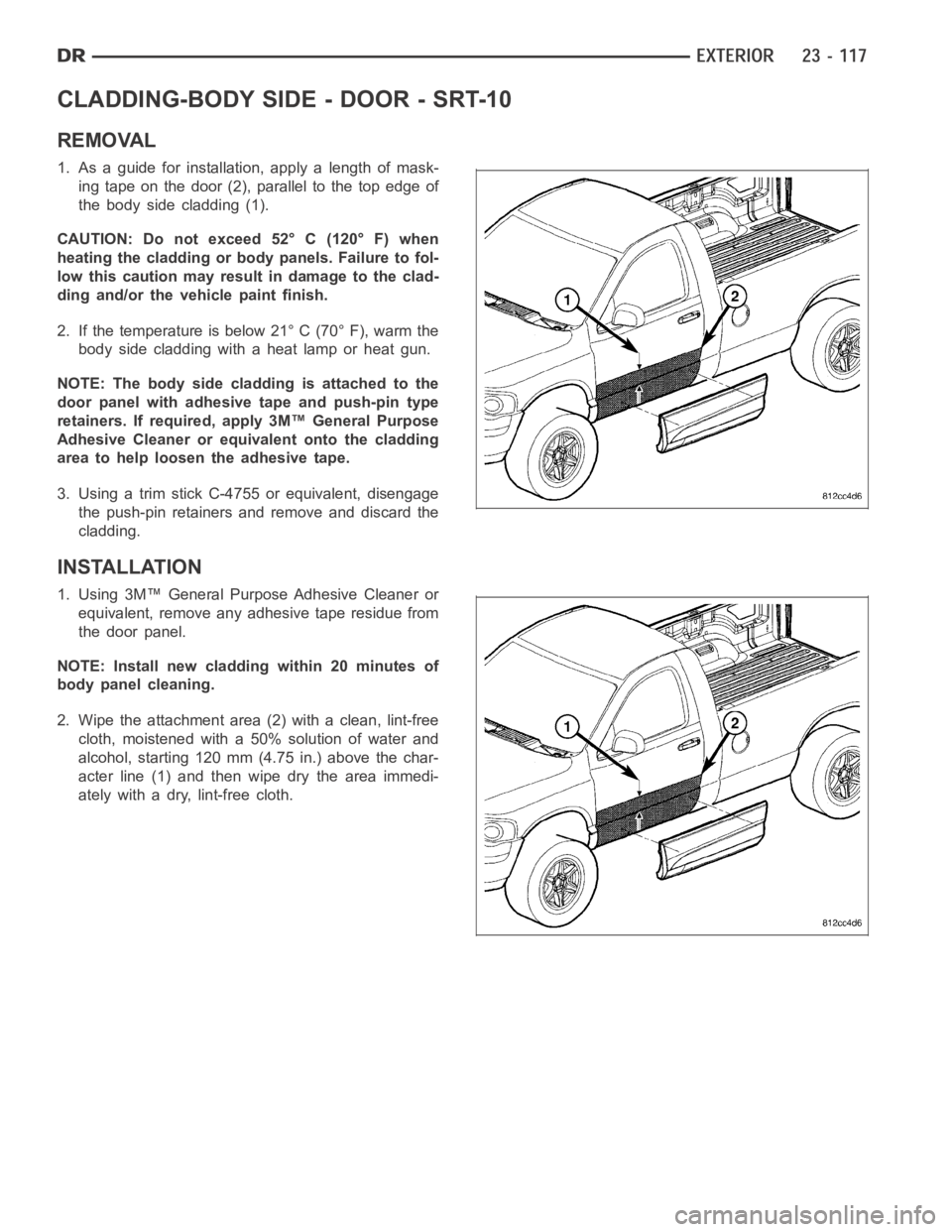
1. As a guide for installation, apply a length of mask-
ing tape on the door (2), parallel to the top edge of
the body side cladding (1).
CAUTION: Do not exceed 52° C (120° F) when
heating the cladding or body panels. Failure to fol-
low this caution may result in damage to the clad-
ding and/or the vehicle paint finish.
2. If the temperature is below 21° C (70° F), warm the
body side cladding with a heat lamp or heat gun.
NOTE: The body side cladding is attached to the
door panel with adhesive tape and push-pin type
retainers. If required, apply 3M™ General Purpose
Adhesive Cleaner or equivalent onto the cladding
area to help loosen the adhesive tape.
3. Using a trim stick C-4755 or equivalent, disengage
the push-pin retainers and remove and discard the
cladding.
INSTALLATION
1. Using 3M™ General Purpose Adhesive Cleaner or
equivalent, remove any adhesive tape residue from
the door panel.
NOTE: Install new cladding within 20 minutes of
body panel cleaning.
2. Wipe the attachment area (2) with a clean, lint-free
cloth, moistened with a 50% solution of water and
alcohol, starting 120 mm (4.75 in.) above the char-
acterline(1)andthenwipedrytheareaimmedi-
ately with a dry, lint-free cloth.
Page 4456 of 5267
CLADDING-BODY SIDE - FENDER SRT-10
REMOVAL
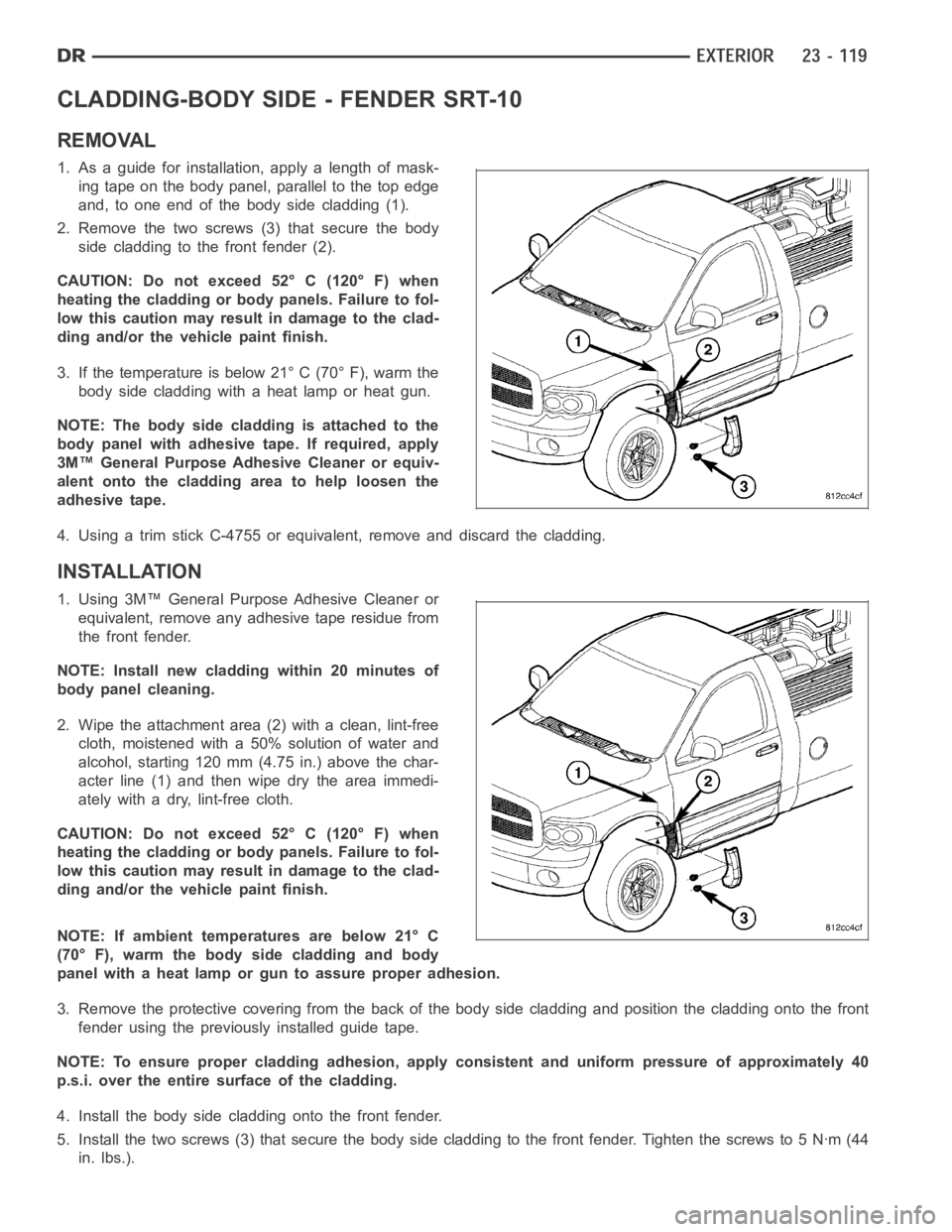
1. As a guide for installation, apply a length of mask-
ing tape on the body panel, parallel to the top edge
and, to one end of the body side cladding (1).
2. Remove the two screws (3) that secure the body
side cladding to the front fender (2).
CAUTION: Do not exceed 52° C (120° F) when
heating the cladding or body panels. Failure to fol-
low this caution may result in damage to the clad-
ding and/or the vehicle paint finish.
3. If the temperature is below 21° C (70° F), warm the
body side cladding with a heat lamp or heat gun.
NOTE: The body side cladding is attached to the
body panel with adhesive tape. If required, apply
3M™ General Purpose Adhesive Cleaner or equiv-
alent onto the cladding area to help loosen the
adhesive tape.
4. Using a trim stick C-4755 or equivalent, remove and discard the cladding.
INSTALLATION
1. Using 3M™ General Purpose Adhesive Cleaner or
equivalent, remove any adhesive tape residue from
the front fender.
NOTE: Install new cladding within 20 minutes of
body panel cleaning.
2. Wipe the attachment area (2) with a clean, lint-free
cloth, moistened with a 50% solution of water and
alcohol, starting 120 mm (4.75 in.) above the char-
acterline(1)andthenwipedrytheareaimmedi-
ately with a dry, lint-free cloth.
CAUTION: Do not exceed 52° C (120° F) when
heating the cladding or body panels. Failure to fol-
low this caution may result in damage to the clad-
ding and/or the vehicle paint finish.
NOTE: If ambient temperatures are below 21° C
(70° F), warm the body side cladding and body
panel with a heat lamp or gun to assure proper adhesion.
3. Remove the protective covering from the back of the body side cladding and position the cladding onto the front
fender using the previously installed guide tape.
NOTE: To ensure proper cladding adhesion, apply consistent and uniform pressure of approximately 40
p.s.i. over the entire surface of the cladding.
4. Install the body side cladding onto the front fender.
5. Install the two screws (3) that secure the body side cladding to the frontfender. Tighten the screws to 5 Nꞏm (44
in. lbs.).
Page 4693 of 5267
INSTALLATION
WARNING: Always keep hands and clothing clear
of the wire rope, hook and fairlead opening during
operation and when spooling. Failure to follow
these instructions may result in personal injury or
death.
CAUTION: Wire rope must spool on the winch
drum in the direction indicated.
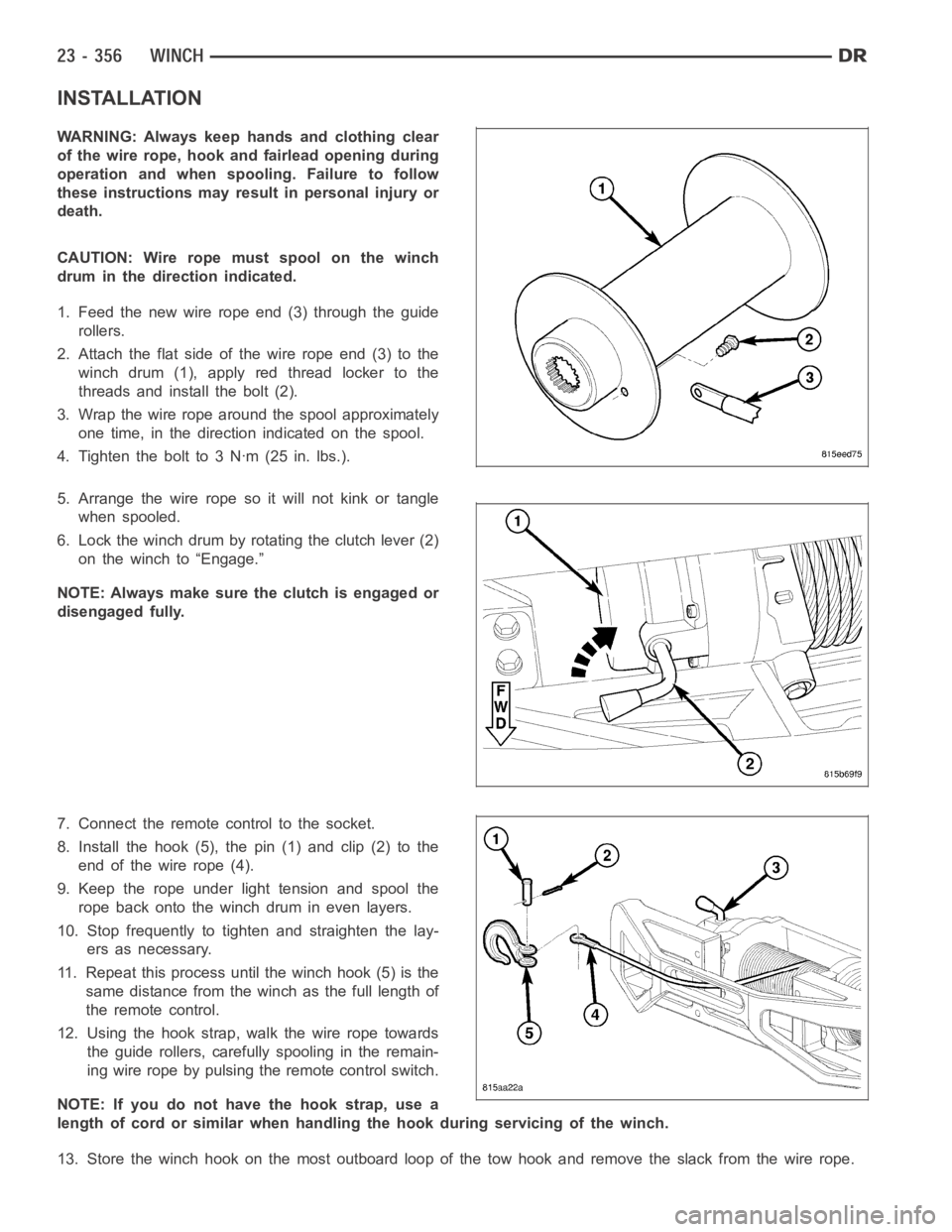
1. Feed the new wire rope end (3) through the guide
rollers.
2. Attach the flat side of the wire rope end (3) to the
winch drum (1), apply red thread locker to the
threads and install the bolt (2).
3. Wrap the wire rope around the spool approximately
one time, in the direction indicated on the spool.
4. Tighten the bolt to 3 Nꞏm (25 in. lbs.).
5. Arrange the wire rope so it will not kink or tangle
when spooled.
6. Lock the winch drum by rotating the clutch lever (2)
on the winch to “Engage.”
NOTE: Always make sure the clutch is engaged or
disengaged fully.
7. Connect the remote control to the socket.
8. Install the hook (5), the pin (1) and clip (2) to the
end of the wire rope (4).
9. Keep the rope under light tension and spool the
rope back onto the winch drum in even layers.
10. Stop frequently to tighten and straighten the lay-
ers as necessary.
11. Repeat this process until the winch hook (5) is the
same distance from the winch as the full length of
theremotecontrol.
12. Using the hook strap, walk the wire rope towards
the guide rollers, carefully spooling in the remain-
ing wire rope by pulsing the remote control switch.
NOTE: If you do not have the hook strap, use a
length of cord or similar when handling the hook during servicing of the winch.
13. Store the winch hook on the most outboard loop of the tow hook and remove the slack from the wire rope.
Page 5195 of 5267
The primary components within the assembly are: A three port solenoid thatactivates both of the functions listed
above; a pump which contains a switch, two check valves and a spring/diaphragm, a canister vent valve (CVV) seal
which contains a spring loaded vent seal valve.
Immediately after a cold start, between predetermined temperature thresholds limits, the three port solenoid is briefly
energized. This initializes the pump by drawing air into the pump cavity and also closes the vent seal. During non
test conditions the vent seal is held open by the pump diaphragm assembly which pushes it open at the full travel
position. The vent seal will remain closed while the pump is cycling due to the reed switch triggering of the three
port solenoid that prevents the diaphragm assembly from reaching full travel. After the brief initialization period, the
solenoid is de-energized allowing atmospheric pressure to enter the pumpcavity, thus permitting the spring to drive
the diaphragm which forces air out of the pump cavity and into the vent system. When the solenoid is energized
and de energized, the cycle is repeated creating flow in typical diaphragmpump fashion. The pump is controlled in
2 modes:
Pump Mode: The pump is cycled at a fixed rate to achieve a rapid pressure build in order to shorten the overall test
length.
Test Mode: The solenoid is energized with a fixed duration pulse. Subsequent fixed pulses occur when the dia-
phragm reaches the Switch closure point.
The spring in the pump is set so that the system will achieve an equalized pressure of about 7.5” H20. The cycle
rate of pump strokes is quite rapid as the system begins to pump up to this pressure. As the pressure increases, the
cycle rate starts to drop off. If there is no leak in the system, the pump would eventually stop pumping at the equal-
ized pressure. If there is a leak, it will continue to pump at a rate representative of the flow characteristic of the size
of the leak. From this information we can determine if the leak is larger than the required detection limit (currently
set at .040” orifice by CARB). If a leak is revealed during the leak test portion of the test, the test is terminated at
the end of the test mode and no further system checks will be performed.
After passing the leak detection phase of the test, system pressure is maintained by turning on the LDP’s solenoid
until the purge system is activated. Purge activation in effect creates a leak. The cycle rate is again interrogated and
when it increases due to the flow through the purge system, the leak check portion of the diagnostic is complete.
The canister vent valve will unseal the system after completion of the testsequence as the pump diaphragm assem-
bly moves to the full travel position.
Evaporative system functionality will be verified by using the stricter evap purge flow monitor. At an appropriate
warm idle the LDP will be energized to seal the canister vent. The purge flowwill be clocked up from some small
value in an attempt to see a shift in the02 control system. If fuel vapor, indicated by a shift in the 02 control, is
present the test is passed. If not, it is assumed that the purge system is notfunctioning in some respect. The LDP
is again turned off and the test is ended.
MISFIRE MONITOR
Excessive engine misfire results in increased catalyst temperature and causes an increase in HC emissions. Severe
misfires could cause catalyst damage. To prevent catalytic convertor damage, the PCM monitors engine misfire.
The Powertrain Control Module (PCM) monitors for misfire during most engine operating conditions (positive torque)
by looking at changes in the crankshaft speed. If a misfire occurs the speedof the crankshaft will vary more than
normal.
FUEL SYSTEM MONITOR
To comply with clean air regulations, vehicles are equipped with catalytic converters. These converters reduce the
emission of hydrocarbons, oxides of nitrogen and carbon monoxide. The catalyst works best when the Air Fuel (A/F)
ratio is at or near the optimum of 14.7 to 1.
The PCM is programmed to maintain the optimum air/fuel ratio of 14.7 to 1. This is done by making short term
corrections in the fuel injector pulse width based on the O2S sensor output. The programmed memory acts as a self
calibration tool that the engine controller uses to compensate for variations in engine specifications, sensor toler-
ances and engine fatigue over the life span of the engine. By monitoring theactual fuel-air ratio with the O2S sen-
sor (short term) and multiplying that with the program long-term (adaptive) memory and comparing that to the limit,
it can be determined whether it will pass an emissions test. If a malfunction occurs such that the PCM cannot main-
tain the optimum A/F ratio, then the MIL will be illuminated.