2006 DODGE RAM SRT-10 length
[x] Cancel search: lengthPage 3394 of 5267
CAUTION: It is essential that correct length bolts
be used to attach the converter to the driveplate.
Bolts that are too long will damage the clutch sur-
face inside the converter.
25. Install torque converter-to-driveplate bolts. Tighten
boltsto31Nꞏm(270in.lbs.).
26. Install starter motor and cooler line bracket.
27. Connect cooler lines to transmission.
28. Install transmission fill tube.
29. Install exhaust components, if necessary.
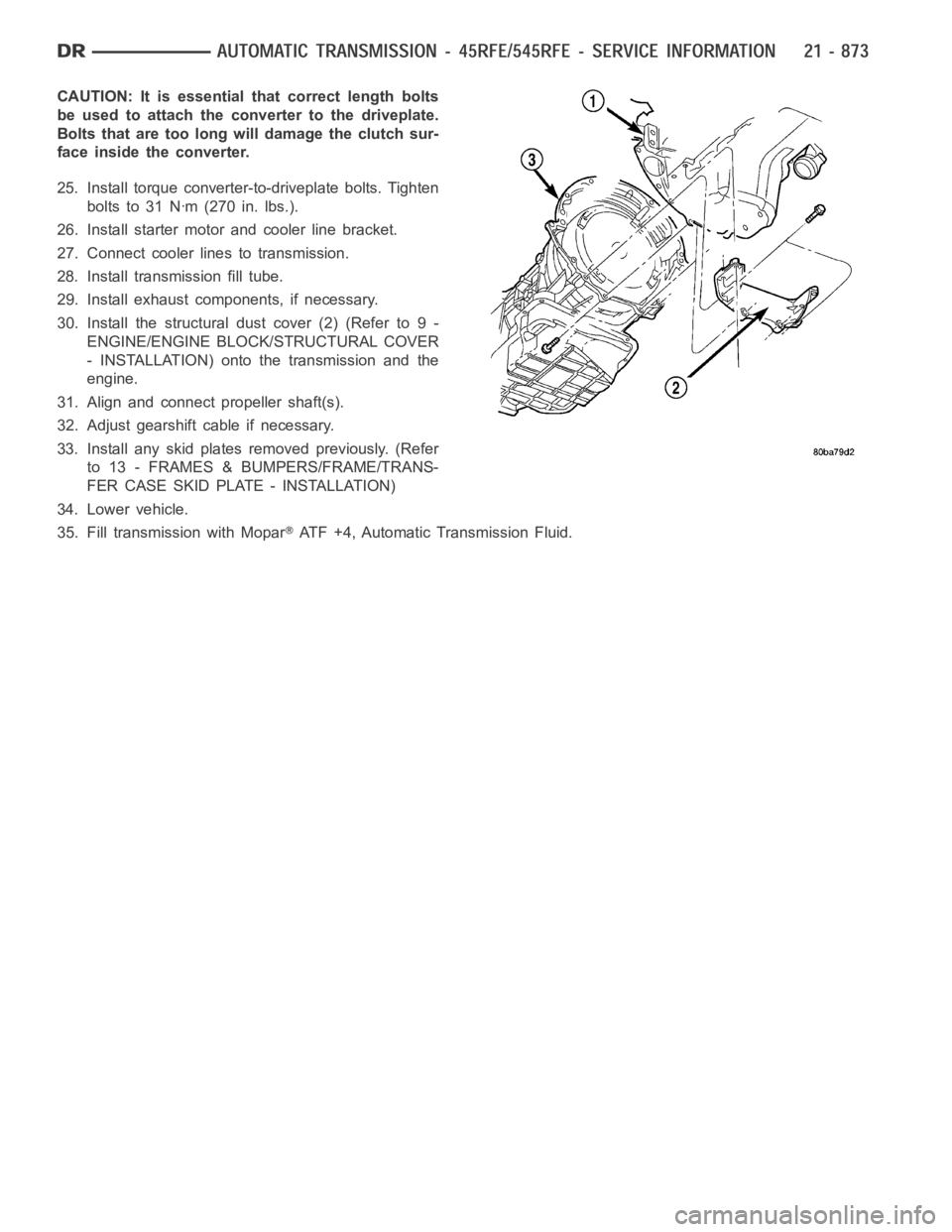
30. Install the structural dust cover (2) (Refer to 9 -
ENGINE/ENGINE BLOCK/STRUCTURAL COVER
- INSTALLATION) onto the transmission and the
engine.
31. Align and connect propeller shaft(s).
32. Adjust gearshift cable if necessary.
33. Install any skid plates removed previously. (Refer
to 13 - FRAMES & BUMPERS/FRAME/TRANS-
FER CASE SKID PLATE - INSTALLATION)
34. Lower vehicle.
35. Fill transmission with Mopar
ATF +4, Automatic Transmission Fluid.
Page 3820 of 5267
4. Removetheoverdriveunitfromthemaintransmis-
sion case. If overdrive unit is not to be serviced,
install Alignment Shaft 6227-2 into the overdrive
unit to prevent misalignment of the overdrive
clutches during service ofmain transmission com-
ponents.
5. Remove throttle and shift levers from valve body
manual shaft and throttle lever shaft.
6. Remove transmission oil pan and gasket.
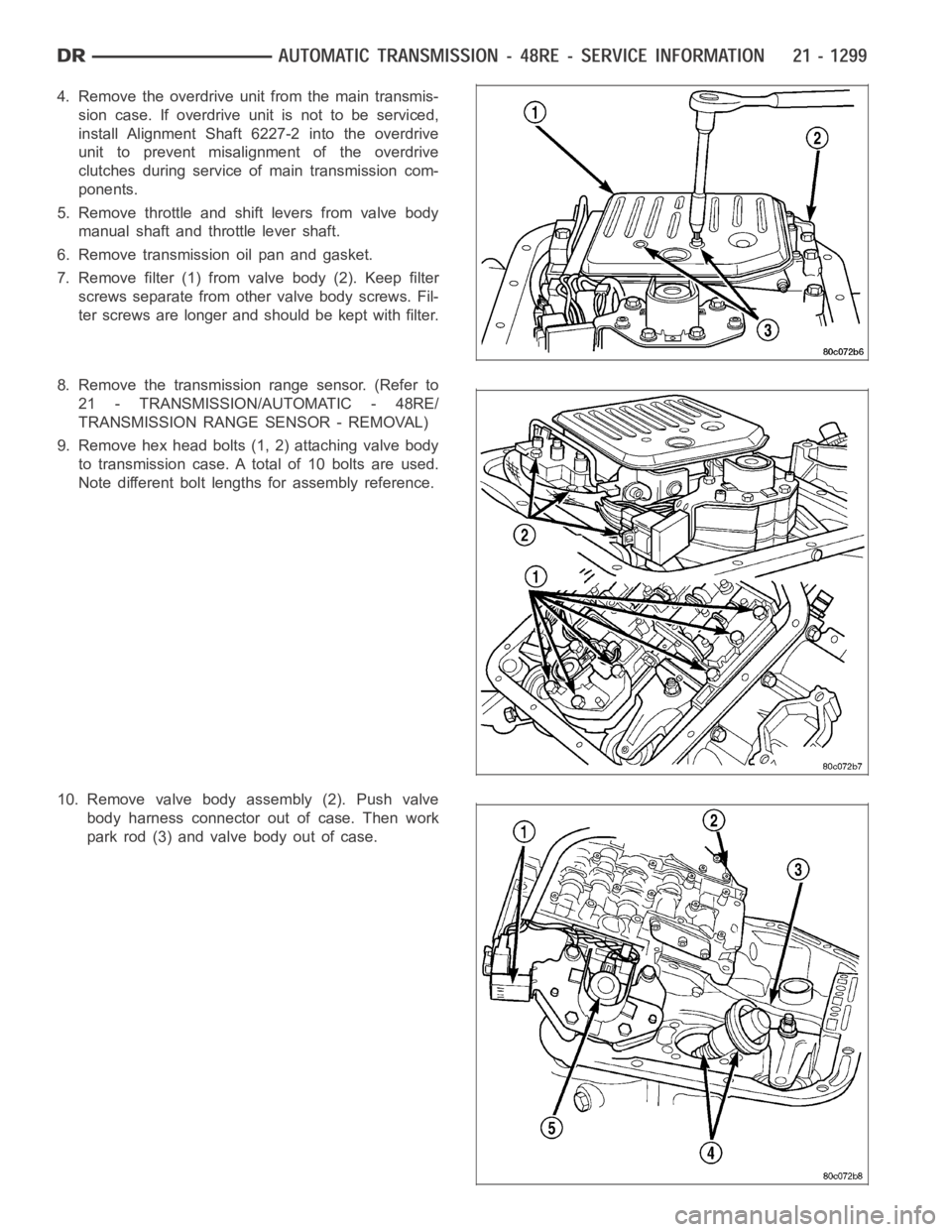
7. Remove filter (1) from valve body (2). Keep filter
screws separate from other valve body screws. Fil-
ter screws are longer and should be kept with filter.
8. Remove the transmission range sensor. (Refer to
21 - TRANSMISSION/AUTOMATIC - 48RE/
TRANSMISSION RANGE SENSOR - REMOVAL)
9. Remove hex head bolts (1, 2) attaching valve body
to transmission case. A total of 10 bolts are used.
Note different bolt lengths for assembly reference.
10. Remove valve body assembly (2). Push valve
body harness connector out of case. Then work
park rod (3) and valve body out of case.
Page 3842 of 5267
25. Connect wires to the transmission range sensor
and transmission solenoid connector. Be sure the
transmission harnesses are properly routed.
CAUTION: It is essential that correct length bolts
be used to attach the converter to the driveplate.
Bolts that are too long will damage the clutch sur-
face inside the converter.
26. Install torque converter-to-driveplate bolts.
27. Install converter housing access cover.
28. Install starter motor and cooler line bracket. (Refer
to 8 - ELECTRICAL/STARTING/STARTER
MOTOR - INSTALLATION)
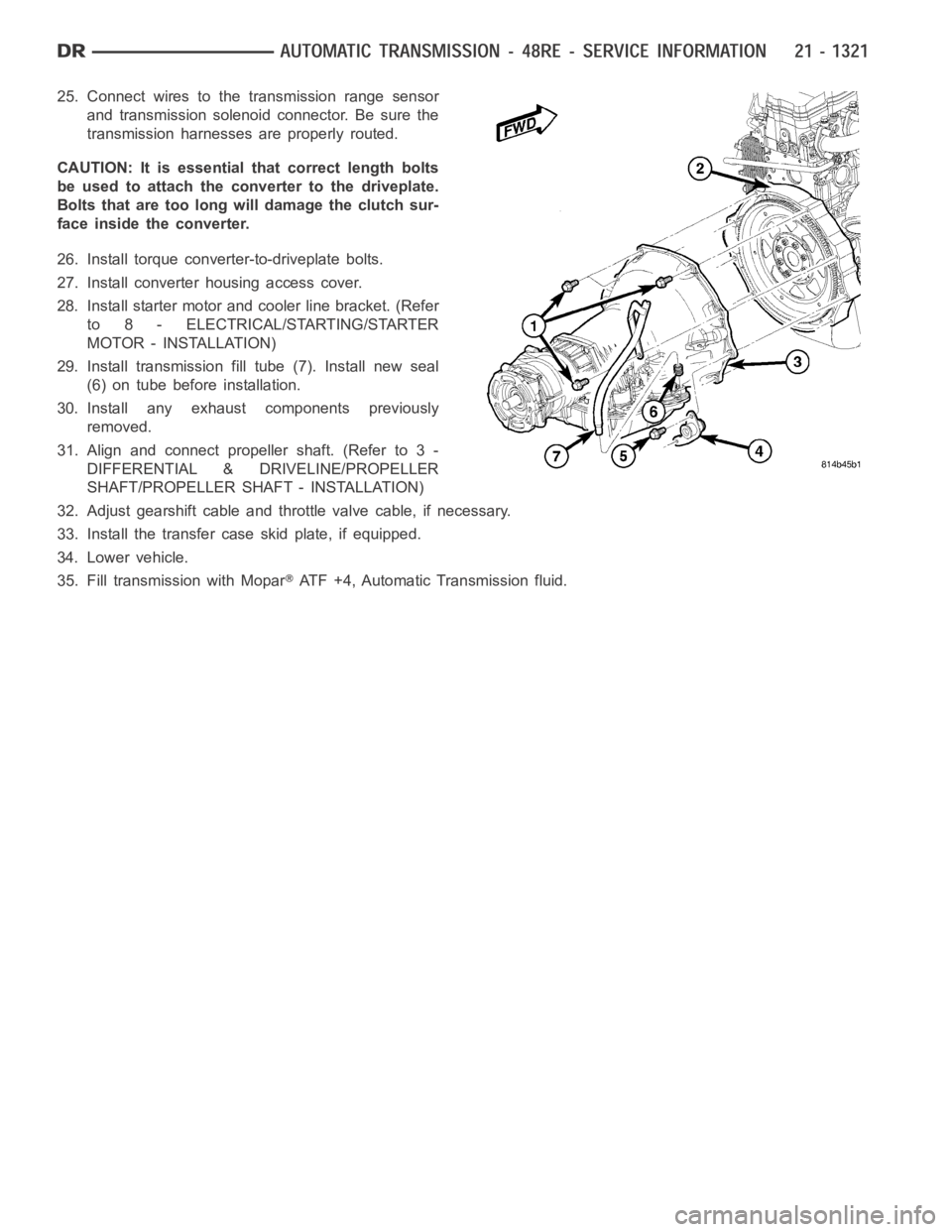
29. Install transmission fill tube (7). Install new seal
(6) on tube before installation.
30. Install any exhaust components previously
removed.
31. Align and connect propeller shaft. (Refer to 3 -
DIFFERENTIAL & DRIVELINE/PROPELLER
SHAFT/PROPELLER SHAFT - INSTALLATION)
32. Adjust gearshift cable and throttle valve cable, if necessary.
33. Install the transfer case skid plate, if equipped.
34. Lower vehicle.
35. Fill transmission with Mopar
ATF +4, Automatic Transmission fluid.
Page 3959 of 5267
VALVE-TORQUE CONVERTER DRAINBACK
DESCRIPTION
GAS ENGINES
The drainback valve is located in the transmission cooler outlet (pressure) line.
DIESEL ENGINE
The converter drainback check valve is located in the in the TOC pressure - supply line, between the engine
mounted TOC and the air to oil TOC.
OPERATION
GAS ENGINES
The valve prevents fluid from draining from the converter into the cooler and lines when the vehicle is shut down for
lengthy periods. Production valves have a hose nipple at one end, while theopposite end is threaded for a flare
fitting. All valves have an arrow (or similar mark) to indicate direction of flow through the valve.
DIESEL ENGINE
The valve prevents fluid from draining from the converter into the cooler and lines when the vehicle is shut down for
lengthy periods. Production valves have pipe thread on one end, while the opposite end is threaded for a flare
fitting, and are threaded into the oil cooler mounted on the side of the engine. All valves have an arrow (or similar
mark) to indicate direction of flow through the valve.
STANDARD PROCEDURE
GAS ENGINES
The converter drainback check valve is located in the cooler outlet (pressure) line near the radiator tank. The valve
prevents fluid drainback when the vehicle is parked for lengthy periods. The valve check ball is spring loaded and
has an opening pressure of approximately 2 psi.
The valve is serviced as an assembly; it is not repairable. Do not clean the valve if restricted, or contaminated by
sludge, or debris. If the valve fails, or if a transmission malfunction occurs that generates significant amounts of
sludge and/or clutch particles and metal shavings, the valve must be replaced.
If the valve is restricted, installed backwards, or in the wrong line, it will cause an transmission overheating condition
and possible transmission failure.
CAUTION: The drainback valve is a one-way flow device. It must be properly orientedintermsofflowdirec-
tion for the cooler to function properly. The valve must be installed in thepressure line. Otherwise flow will
be blocked and would cause an transmission overheating condition and eventual transmission failure.
DIESEL ENGINE
The converter drainback check valve is located in the in the TOC pressure - supply line, between the engine
mounted transmission oil cooler and the air to oil transmission oil cooler. The valve prevents fluid drainback when
the vehicle is parked for lengthy periods. The valve check ball is spring loaded and has an opening pressure of
approximately 2 psi.
The valve is serviced as an assembly; it is not repairable. Do not clean the valve if restricted, or contaminated by
sludge, or debris. If the valve fails, or if a transmission malfunction occurs that generates significant amounts of
sludge and/or clutch particles and metal shavings, the valve must be replaced.
If the valve is restricted, installed backwards, or in the wrong line, it will cause an transmission overheating condition
and possible transmission failure.
Page 4340 of 5267
vehicle. If the leak occurs on left turns, hoist the left side of the vehicle. If the leak occurs on right turns, hoist
the right side of the vehicle. For hoisting recommendations (Refer to LUBRICATION & MAINTENANCE/HOIST-
ING - STANDARD PROCEDURE).
WATER LEAK DETECTION
To detect a water leak point-of-entry, do a water test and watch for water tracks or droplets forming on the inside of
the vehicle. If necessary, remove interior trim covers or panels to gain visual access to the leak area. If the hose
cannot be positioned without being held, have someone help do the water test.
Some water leaks must be tested for a considerable length of time to become apparent. When a leak appears, find
the highest point of the water track or drop. The highest point usually willshow the point of entry. After leak point
has been found, repair the leak and water test to verify that the leak has stopped.
Locating the entry point of water that is leaking into a cavity between panels can be difficult. The trapped water may
splash or run from the cavity, often at adistance from the entry point. Mostwater leaks of this type become appar-
ent after accelerating, stopping, turning, or when on an incline.
MIRROR INSPECTION METHOD
When a leak point area is visually obstructed, use a suitable mirror to gainvisual access. A mirror can also be used
to deflect light to a limited-access area to assist in locating a leak point.
BRIGHT LIGHT LEAK TEST METHOD
Some water leaks in the luggage compartment can be detected without water testing. Position the vehicle in a
brightly lit area. From inside the darkened luggage compartment inspect around seals and body seams. If neces-
sary, have a helper direct a drop light over the suspected leak areas aroundthe luggage compartment. If light is
visible through a normally sealed location, water could enter through theopening.
PRESSURIZED LEAK TEST METHOD
When a water leak into the passenger compartment cannot be detected by water testing, pressurize the passenger
compartment and soap test exterior ofthe vehicle. To pressurize the passenger compartment, close all doors and
windows, start engine, and set heater control to high blower in HEAT position. If engine can not be started, connect
a charger to the battery to ensure adequate voltage to the blower. With interior pressurized, apply dish detergent
solution to suspected leak area on the exterior of the vehicle. Apply detergent solution with spray device or soft
bristle brush. If soap bubbles occur at a body seam, joint, seal or gasket, the leak entry point could be at that
location.
WIND NOISE
Wind noise is the result of most air leaks. Air leaks can be caused by poor sealing, improper body component
alignment, body seam porosity, or missing plugs in the engine compartmentor door hinge pillar areas. All body
sealing points should be airtight in normal driving conditions. Moving sealing surfaces will not always seal airtight
under all conditions. At times, side glass or door seals will allow wind noise to be noticed in the passenger com-
partment during high cross winds. Over compensating on door or glass adjustments to stop wind noise that occurs
under severe conditions can cause premature seal wear and excessive closing or latching effort. After a repair pro-
cedure has been performed, test vehicle to verify noise has stopped beforereturning vehicle to use.
VISUAL INSPECTION BEFORE TESTS
Verify that floor and body plugs are in place and body components are aligned and sealed. If component alignment
or sealing is necessary, refer to the appropriate section of this group forproper procedures.
ROAD TESTING WIND NOISE
1. Drive the vehicle to verify the general location of the wind noise.
2. Apply 50 mm (2 in.) masking tape in 150 mm (6 in.) lengths along weatherstrips, weld seams or moldings. After
each length is applied, drive the vehicle. If noise goes away after a piece of tape is applied, remove tape, locate,
and repair defect.
Page 4425 of 5267
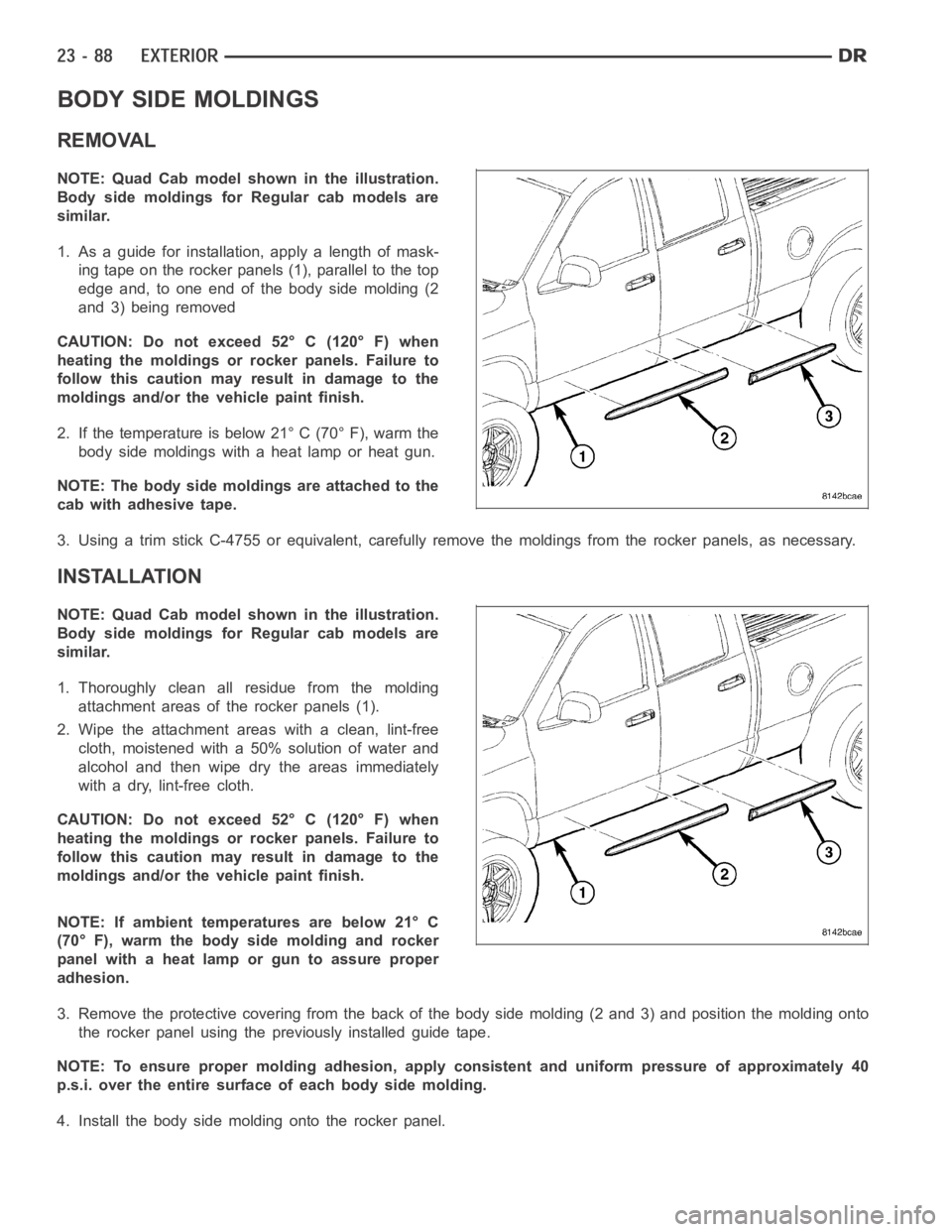
BODY SIDE MOLDINGS
REMOVAL
NOTE: Quad Cab model shown in the illustration.
Body side moldings for Regular cab models are
similar.
1. As a guide for installation, apply a length of mask-
ing tape on the rocker panels (1), parallel to the top
edge and, to one end of the body side molding (2
and 3) being removed
CAUTION: Do not exceed 52° C (120° F) when
heating the moldings or rocker panels. Failure to
follow this caution may result in damage to the
moldings and/or the vehicle paint finish.
2. If the temperature is below 21° C (70° F), warm the
body side moldings with a heat lamp or heat gun.
NOTE: The body side moldings are attached to the
cab with adhesive tape.
3. Using a trim stick C-4755 or equivalent, carefully remove the moldings from the rocker panels, as necessary.
INSTALLATION
NOTE: Quad Cab model shown in the illustration.
Body side moldings for Regular cab models are
similar.
1. Thoroughly clean all residue from the molding
attachment areas of the rocker panels (1).
2. Wipe the attachment areas with a clean, lint-free
cloth, moistened with a 50% solution of water and
alcohol and then wipe dry the areas immediately
with a dry, lint-free cloth.
CAUTION: Do not exceed 52° C (120° F) when
heating the moldings or rocker panels. Failure to
follow this caution may result in damage to the
moldings and/or the vehicle paint finish.
NOTE: If ambient temperatures are below 21° C
(70° F), warm the body side molding and rocker
panel with a heat lamp or gun to assure proper
adhesion.
3. Remove the protective covering from the back of the body side molding (2 and 3) and position the molding onto
the rocker panel using the previously installed guide tape.
NOTE: To ensure proper molding adhesion, apply consistent and uniform pressure of approximately 40
p.s.i. over the entire surface of each body side molding.
4. Install the body side molding onto the rocker panel.
Page 4430 of 5267
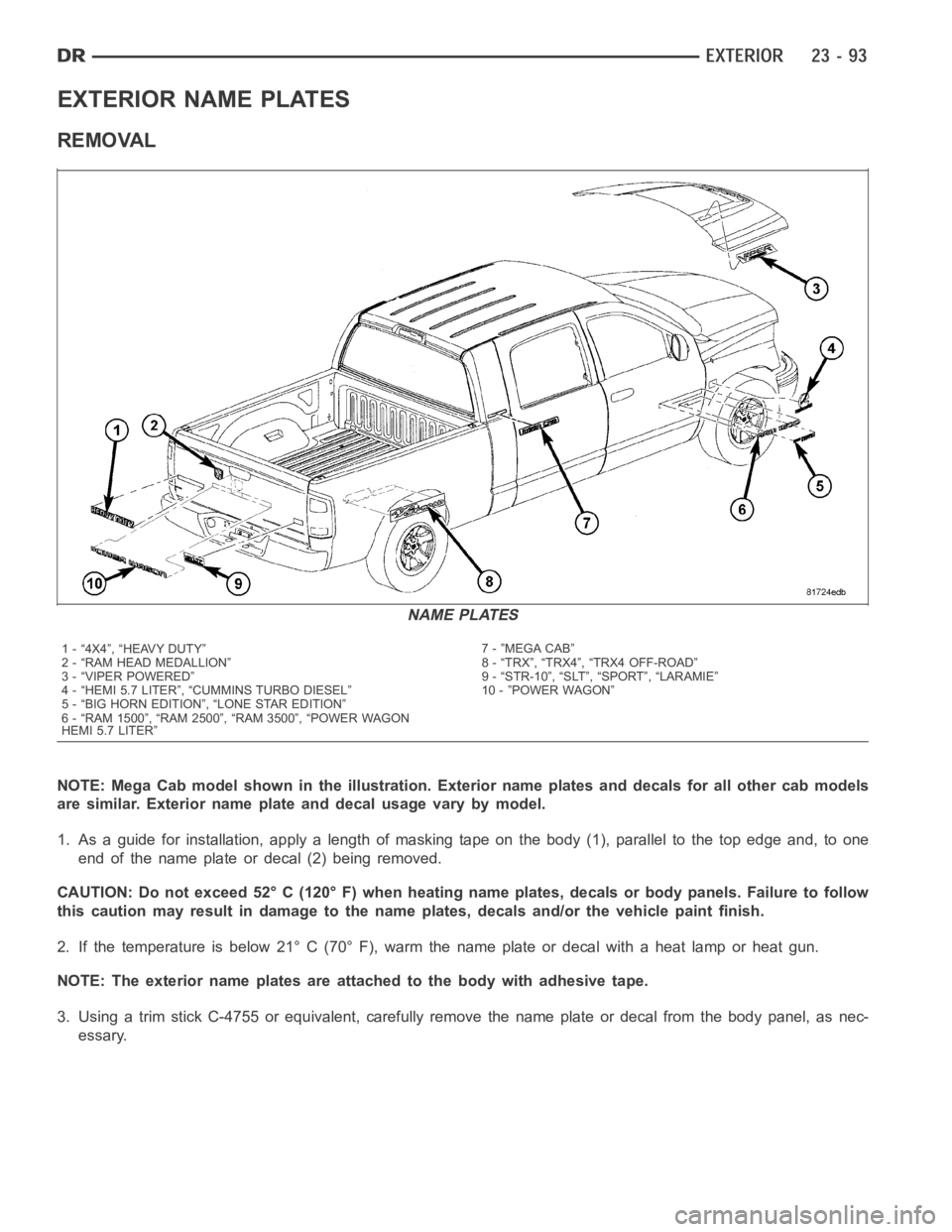
EXTERIOR NAME PLATES
REMOVAL
NOTE: Mega Cab model shown in the illustration. Exterior name plates and decals for all other cab models
are similar. Exterior name plate and decal usage vary by model.
1. As a guide for installation, apply a length of masking tape on the body (1), parallel to the top edge and, to one
end of the name plate or decal (2) being removed.
CAUTION: Do not exceed 52° C (120° F) when heating name plates, decals or body panels. Failure to follow
this caution may result in damage to the name plates, decals and/or the vehicle paint finish.
2. If the temperature is below 21° C (70° F), warm the name plate or decal witha heat lamp or heat gun.
NOTE: The exterior name plates are attached to the body with adhesive tape.
3. Using a trim stick C-4755 or equivalent, carefully remove the name plateor decal from the body panel, as nec-
essary.
NAME PLATES
1 - “4X4”, “HEAVY DUTY”
2 - “RAM HEAD MEDALLION”
3 - “VIPER POWERED”
4 - “HEMI 5.7 LITER”, “CUMMINS TURBO DIESEL”
5 - “BIG HORN EDITION”, “LONE STAR EDITION”
6 - “RAM 1500”, “RAM 2500”, “RAM 3500”, “POWER WAGON
HEMI 5.7 LITER”7 - ”MEGA CAB”
8 - “TRX”, “TRX4”, “TRX4 OFF-ROAD”
9 - “STR-10”, “SLT”, “SPORT”, “LARAMIE”
10 - ”POWER WAGON”
Page 4449 of 5267
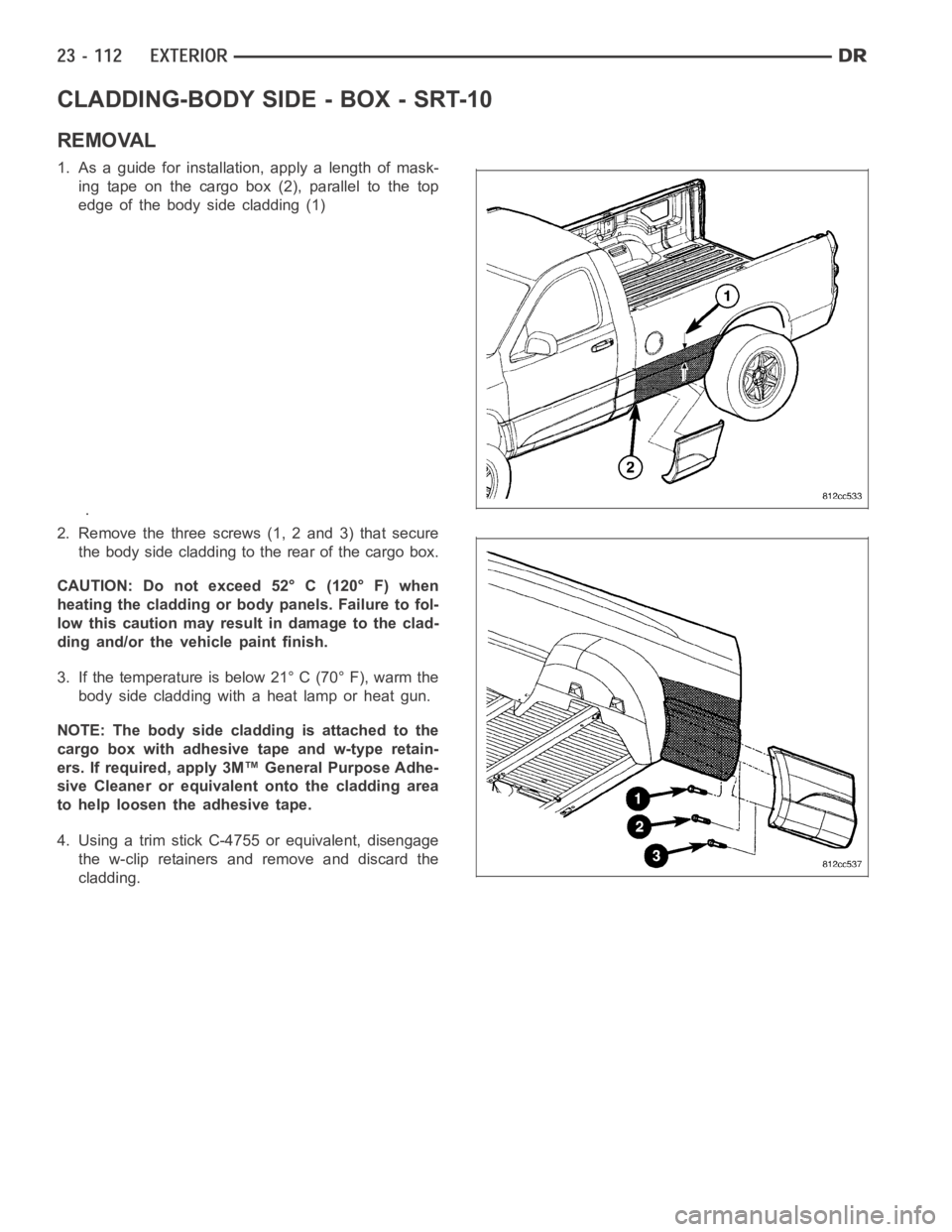
CLADDING-BODY SIDE - BOX - SRT-10
REMOVAL
1. As a guide for installation, apply a length of mask-
ing tape on the cargo box (2), parallel to the top
edge of the body side cladding (1)
.
2. Remove the three screws (1, 2 and 3) that secure
the body side cladding to the rear of the cargo box.
CAUTION: Do not exceed 52° C (120° F) when
heating the cladding or body panels. Failure to fol-
low this caution may result in damage to the clad-
ding and/or the vehicle paint finish.
3. If the temperature is below 21° C (70° F), warm the
body side cladding with a heat lamp or heat gun.
NOTE: The body side cladding is attached to the
cargo box with adhesive tape and w-type retain-
ers. If required, apply 3M™ General Purpose Adhe-
sive Cleaner or equivalent onto the cladding area
to help loosen the adhesive tape.
4. Using a trim stick C-4755 or equivalent, disengage
the w-clip retainers and remove and discard the
cladding.