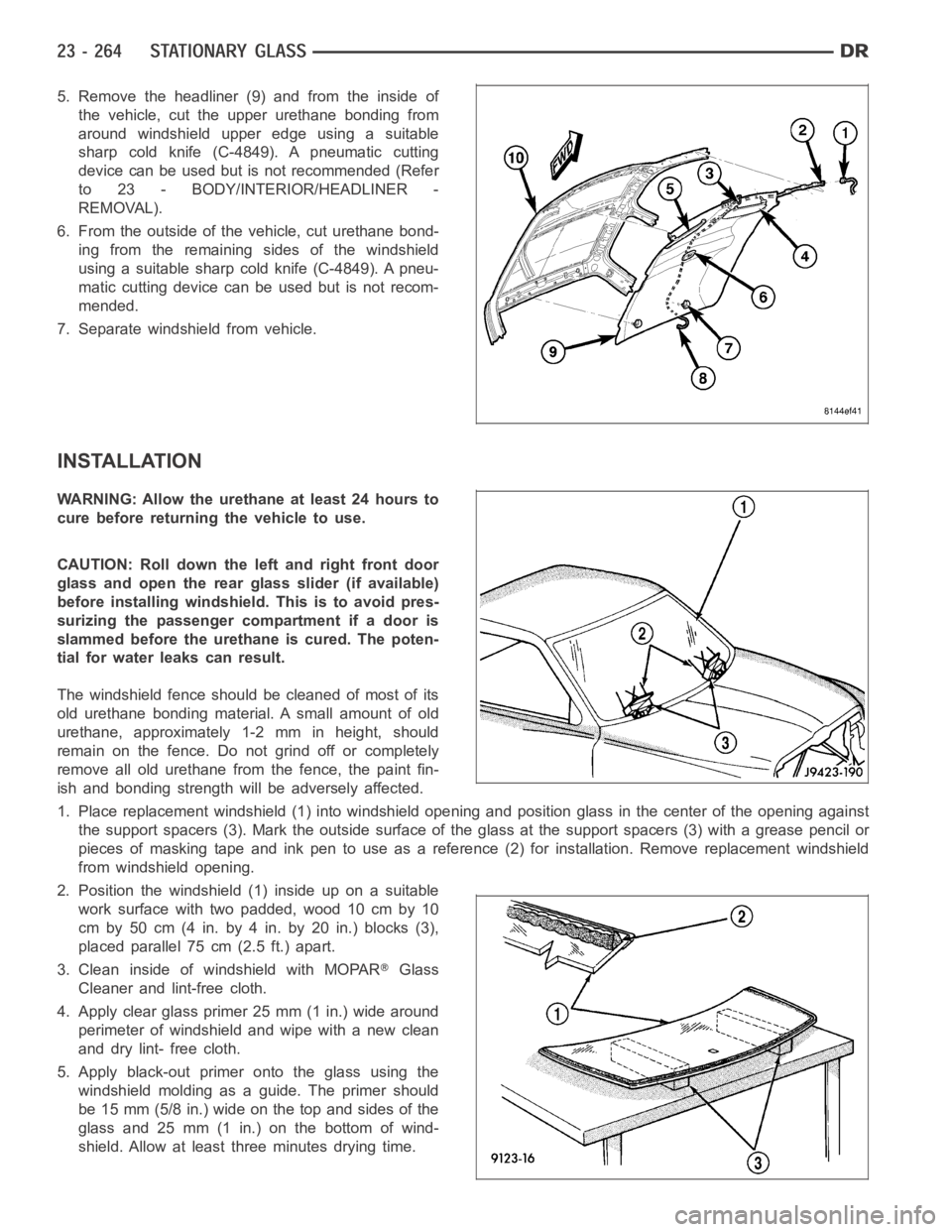
5. Remove the headliner (9) and from the inside of
the vehicle, cut the upper urethane bonding from
around windshield upper edge using a suitable
sharp cold knife (C-4849). A pneumatic cutting
device can be used but is not recommended (Refer
to 23 - BODY/INTERIOR/HEADLINER -
REMOVAL).
6. From the outside of the vehicle, cut urethane bond-
ing from the remaining sides of the windshield
using a suitable sharp cold knife (C-4849). A pneu-
matic cutting device can be used but is not recom-
mended.
7. Separate windshield from vehicle.
INSTALLATION
WARNING: Allow the urethane at least 24 hours to
cure before returning the vehicle to use.
CAUTION: Roll down the left and right front door
glass and open the rear glass slider (if available)
before installing windshield. This is to avoid pres-
surizing the passenger compartment if a door is
slammed before the urethane is cured. The poten-
tial for water leaks can result.
The windshield fence should be cleaned of most of its
old urethane bonding material. A small amount of old
urethane, approximately 1-2 mm in height, should
remain on the fence. Do not grind off or completely
remove all old urethane from the fence, the paint fin-
ish and bonding strength will be adversely affected.
1. Place replacement windshield (1) into windshield opening and positionglass in the center of the opening against
the support spacers (3). Mark the outside surface of the glass at the support spacers (3) with a grease pencil or
pieces of masking tape and ink pen to use as a reference (2) for installation. Remove replacement windshield
from windshield opening.
2. Position the windshield (1) inside up on a suitable
work surface with two padded, wood 10 cm by 10
cm by 50 cm (4 in. by 4 in. by 20 in.) blocks (3),
placed parallel 75 cm (2.5 ft.) apart.
3. Clean inside of windshield with MOPAR
Glass
Cleaner and lint-free cloth.
4. Apply clear glass primer 25 mm (1 in.) wide around
perimeter of windshield and wipe with a new clean
and dry lint- free cloth.
5. Apply black-out primer onto the glass using the
windshield molding as a guide. The primer should
be 15 mm (5/8 in.) wide on the top and sides of the
glass and 25 mm (1 in.) on the bottom of wind-
shield. Allow at least three minutes drying time.
Condition Possible Causes Correction
2. Faulty fuse.2. Check the fuse in the junction block. Repair the
shorted circuit or component and replace the fuse,
if required.
3. Faulty A/C compressor
clutch field coil.3. See A/C Compressor Clutch Field Coil in this
group. Test the compressor clutch field coil and
replace, if required.
4. Improperly installed or
faulty Evaporator
Temperature Sensor.4. See Evaporator Temperature Sensor in this
group. Correctly install or replace the sensor as
required.
5. Faulty A/C pressure
transducer.5. See A/C pressure transducer in this group. Test
the transducer and replace, if required.
6. Faulty A/C-heater control,
totally integrated power
module (TIPM), gateway
module or PCM/ECM.6. Refer to the appropriate Electrical Diagnostic
Procedures for testing of the A/C-heater control,
TIPM, gateway module or PCM/ECM. Test the
module and replace, if required.
Normal pressures, but A/C
Performance Test air
temperatures at center panel
outlet are too high.1. Excessive refrigerant oil in
system.1. See Refrigerant Oil Level in this group. Recover
the refrigerant from the refrigerant system and
inspect the refrigerant oil content. Restore the
refrigerant oil to the proper level, if required.
2. Blend door inoperative or
sealing improperly.2. See Blend Door in this group. Inspect the blend
door for proper operation and sealing and correct,
if required.
3. Blend door actuator faulty
or inoperative.3. Perform blend door actuator diagnosis, replace
if faulty.
The low side pressure is
normal or slightly low, and
the high side pressure is too
low.1. Low refrigerant system
charge.1. See Refrigerant System Leaks in this group.
Test the refrigerant system for leaks. Repair,
evacuate and charge the refrigerant system, if
required.
2. Refrigerant flow through
the accumulator is restricted.2. See Accumulator in this group. Replace the
restricted accumulator, if required.
3. Refrigerant flow through
the evaporator coil is
restricted.3. See A/C Evaporator in this group. Replace the
restricted evaporator coil, if required.
4. Faulty compressor.4. See A/C Compressor in this group. Replace the
compressor, if required.
The low side pressure is
normal or slightly high, and
the high side pressure is too
high.1. Condenser air flow
restricted.1. Check the A/C condenser for damaged fins,
foreign objects obstructing air flow through the
condenser fins, and missing or improperly
installed air seals. Refer to Cooling for more
information on air seals. Clean, repair, or replace
components as required.
2. Inoperative cooling fan.2. Refer to Cooling for more information. Test the
cooling fan and replace, if required.
3. Refrigerant system
overcharged.3. See Refrigerant System Charge in this group.
Recover the refrigerant from the refrigerant
system. Charge the refrigerant system to the
proper level, if required.
4. Air in the refrigerant
system.4. See Refrigerant System Leaks in this group.
Test the refrigerant system for leaks. Repair,
evacuate and charge the refrigerant system, if
required.