2005 NISSAN NAVARA engine control
[x] Cancel search: engine controlPage 1034 of 3171
![NISSAN NAVARA 2005 Repair Workshop Manual EC-54
TROUBLE DIAGNOSIS
15 GRIntake air control valve con-
trol solenoid valve[Engine is running]BATTERY VOLTAGE
(11 - 14V)
[Ignition switch OFF]
lFor a few seconds after turning ignition
switch OFFAp](/manual-img/5/57362/w960_57362-1033.png "NISSAN NAVARA 2005 Repair Workshop Manual EC-54
TROUBLE DIAGNOSIS
15 GRIntake air control valve con-
trol solenoid valve[Engine is running]BATTERY VOLTAGE
(11 - 14V)
[Ignition switch OFF]
lFor a few seconds after turning ignition
switch OFFAp")
EC-54
TROUBLE DIAGNOSIS
15 GRIntake air control valve con-
trol solenoid valve[Engine is running]BATTERY VOLTAGE
(11 - 14V)
[Ignition switch OFF]
lFor a few seconds after turning ignition
switch OFFApproximately 0.3V
21
22
23
24G
P
W
WFuel injector No. 2
Fuel injector No. 2
Fuel injector No. 3
Fuel injector No. 3[Engine is running]
lWarm-up condition
lIdle speed
NOTE:
The pulse cycle changes depending on rpm
at idleApproximately 7.5V
[Engine is running]
lWarm-up condition
lEngine speed: 2,000 rpmApproximately 8.0V
25
26
27
28Y
O
GR
VEGR volume control valve[Engine is running]
lWarm-up condition
lIdle speed0.1 - 14V
(Voltage signals of each ECM
terminals differ according to the
control position of EGR volume
control valve.)
29 B Fuel pump[Engine is running]
lWarm-up condition
lIdle speed0.5 - 1.0V
[Engine is running]
lWarm-up condition
lEngine speed: 2,000 rpm0.5 - 1.0V
37 G Glow relay Refer toEC-295, "
GLOW CONTROL SYSTEM". TERMI-
NAL
NO.WIRE
COLORITEM CONDITIONDATA
(DC Voltage and Pulse Signal)
MBIB1297E
MBIB1298E
MBIB0887E
MBIB0888E
Page 1040 of 3171

EC-60
TROUBLE DIAGNOSIS
ENGINE CONTROL COMPONENT PARTS/CONTROL SYSTEMS APPLICATION
X: ApplicableItemDIAGNOSTIC TEST MODE
SELF-DIAG RESULTS
DATA MON-
ITORACTIVE
TEST
DTCFREEZE
FRAME
DATA
ENGINE CONTROL COMPONENT PARTS
INPUTCrankshaft position sensor´´´
Camshaft position sensor´
Engine coolant temperature sensor´´´´
Vehicle speed signal´´´
Fuel pump temperature sensor´´
Accelerator pedal position sensor 1´´
Accelerator pedal position sensor 2´´
Fuel rail pressure sensor´´
Mass air flow sensor´´
Intake air temperature sensor´
Turbocharger boost sensor´´´
Refrigerant pressure sensor´
Battery voltage´´
Park/neutral position (PNP) switch´
Heat up switch´
Stop lamp switch´´
Barometric pressure sensor (built-into ECM)´´
ASCD steering switch´´
ASCD brake switch´´
ASCD clutch switch´´
OUTPUTFuel pump´´´
Fuel injector´´´
Glow relay´´
Cooling fan relay´´´
Turbocharger boost control solenoid valve´
Intake air control valve control solenoid valve
EGR volume control valve´´
Page 1041 of 3171
TROUBLE DIAGNOSIS
EC-61
C
D
E
F
G
H
I
J
K
L
MA
EC
INSPECTION PROCEDURE
CAUTION:
If CONSULT-II is used with no connection of CONSULT-II CONVERTER, malfunctions might be
detected in self-diagnosis depending on control unit which carry out CAN communication.
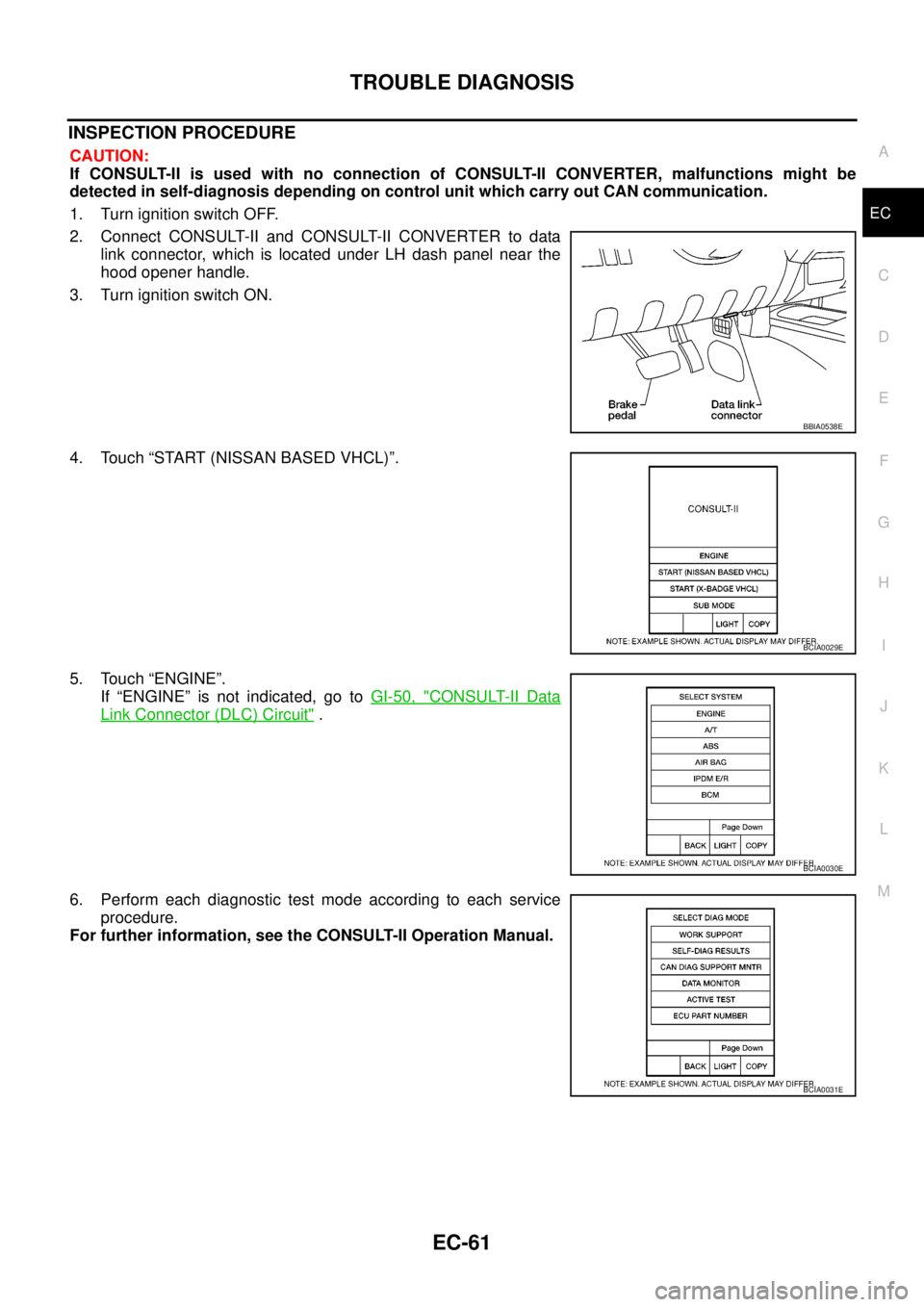
1. Turn ignition switch OFF.
2. Connect CONSULT-II and CONSULT-II CONVERTER to data
link connector, which is located under LH dash panel near the
hood opener handle.
3. Turn ignition switch ON.
4. Touch “START (NISSAN BASED VHCL)”.
5. Touch “ENGINE”.
If “ENGINE” is not indicated, go toGI-50, "
CONSULT-II Data
Link Connector (DLC) Circuit".
6. Perform each diagnostic test mode according to each service
procedure.
For further information, see the CONSULT-II Operation Manual.
BBIA0538E
BCIA0029E
BCIA0030E
BCIA0031E
Page 1042 of 3171

EC-62
TROUBLE DIAGNOSIS
WORK SUPPORT MODE
Work Item
SELF-DIAGNOSTIC MODE
Self Diagnostic Item
Regarding items detected in “SELF-DIAG RESULTS” mode, refer to —EC-6, "INDEX FOR DTC".
Freeze Frame Data
DATA MONITOR MODE
WORK ITEM DESCRIPTION USAGE
ENTER INJCTR CALIB DATA
lInjector adjustment value is written onto ECM memory. When performing Injector Adjust-
ment Value Registration.
CONFIG CLR
lASCD application status stored in ECM is initialized.
NOTE:
After the status is initialized, ECM recognizes ASCD
application status when the following condition is met.
lFor ASCD: ASCD MAIN switch is pressed.When initializing ASCD applica-
tion status stored in ECM.
INJ ADJ VAL CLR
lInjector adjustment value stored in ECM is initialized. Before changing injector adjust-
ment value stored in ECM, it is
recommended to perform this
work item.
Freeze frame data item Description
DIAG TROUBLE CODE
[PXXXX]
lThe engine control component part/control system has a trouble code, it is displayed as “PXXXX”.
(Refer toEC-6, "
INDEX FOR DTC".)
CAL/LD VALUE [%]
lThe calculated load value at the moment a malfunction is detected is displayed.
COOLANT TEMP [°C] or [°F]
lThe engine coolant temperature at the moment a malfunction is detected is displayed.
ENGINE SPEED [rpm]
lThe engine speed at the moment a malfunction is detected is displayed.
VEHICL SPEED
[km/h] or [mph]
lThe vehicle speed at the moment a malfunction is detected is displayed.
INT MANI PRES [kPa]
lThe intake manifold pressure at the moment a malfunction is detected is displayed.
MONITOR ITEMECM
INPUT
SIG-
NALMAIN
SIG-
NALSCONDITION SPECIFICATION
CKPS·RPM (TDC) [rpm]´´
lThe engine speed computed from the
crankshaft position sensor signal is
displayed.
COOLAN TEMP/S
[°C] or [°F]´´
lThe engine coolant temperature
(determined by the signal voltage of
the engine coolant temperature sen-
sor) is displayed.When the engine coolant temperature
circuit is open or short, ECM enters fail-
safe mode. The engine coolant tempera-
ture determined by the ECM is dis-
played.
VHCL SPEED SE
[km/h] or [mph]´´
lThe vehicle speed computed form the
vehicle speed signal is displayed.
FUEL TEMP SEN
[°C] or [°F]´´
lThe fuel temperature (determined by
the signal voltage of the fuel pump
temperature sensor) is displayed.
ACCEL POS SEN [V]´´
lThe accelerator pedal position sensor
1 signal voltage is displayed.This signal is converted by ECM inter-
nally. Thus, these differ from ECM termi-
nals voltage.
ACCEL SEN 2 [V]´´
lThe accelerator pedal position sensor
2 signal voltage is displayed.This signal is converted by ECM inter-
nally. Thus, these differ from ECM termi-
nals voltage.
Page 1045 of 3171
TROUBLE DIAGNOSIS
EC-65
C
D
E
F
G
H
I
J
K
L
MA
EC
*: Leaving cooling fan OFF with CONSULT-II while engine is running may cause the engine to overheat.
REAL TIME DIAGNOSIS IN DATA MONITOR MODE
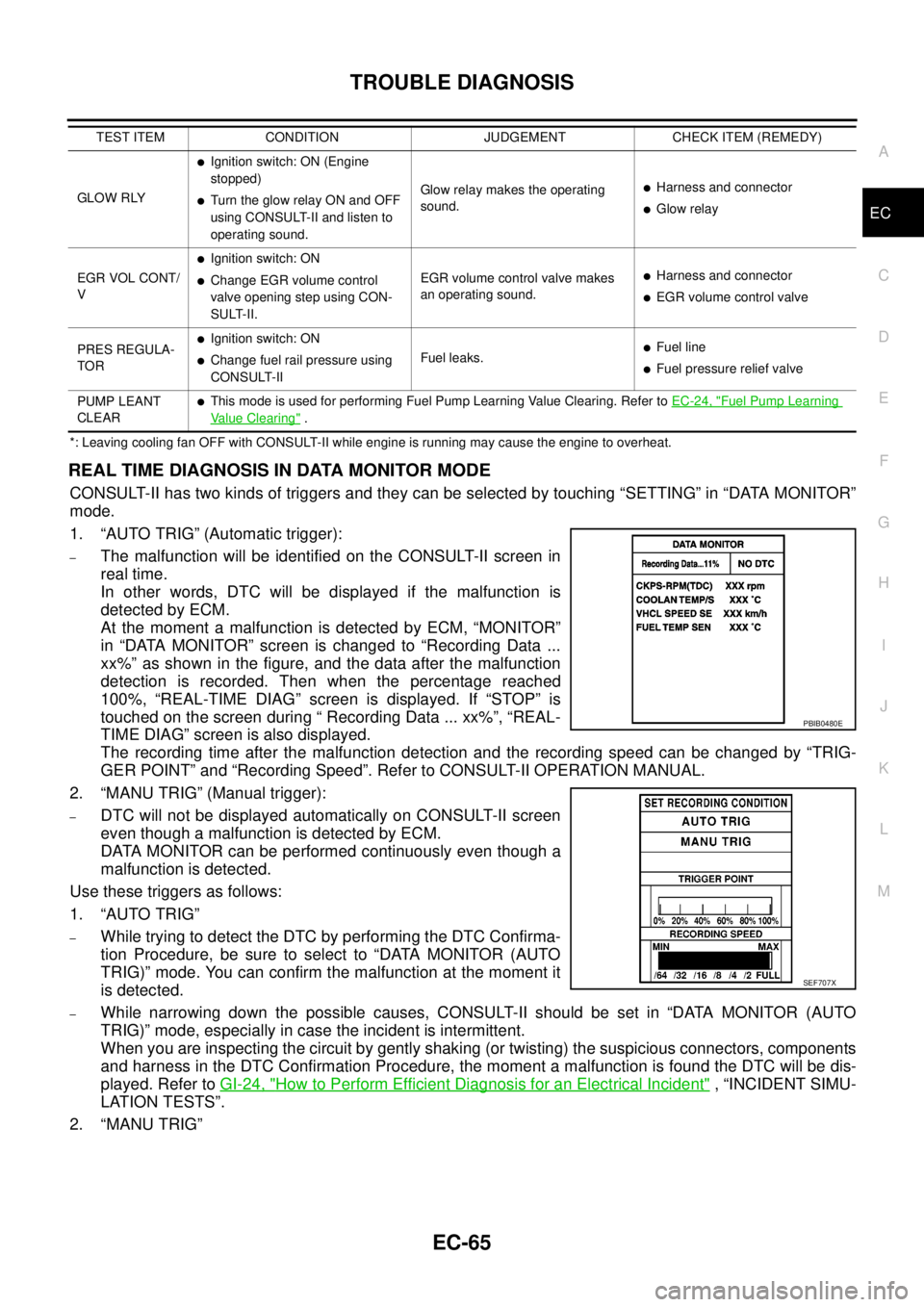
CONSULT-II has two kinds of triggers and they can be selected by touching “SETTING” in “DATA MONITOR”
mode.
1. “AUTO TRIG” (Automatic trigger):
–The malfunction will be identified on the CONSULT-II screen in
real time.
In other words, DTC will be displayed if the malfunction is
detected by ECM.
At the moment a malfunction is detected by ECM, “MONITOR”
in “DATA MONITOR” screen is changed to “Recording Data ...
xx%” as shown in the figure, and the data after the malfunction
detection is recorded. Then when the percentage reached
100%, “REAL-TIME DIAG” screen is displayed. If “STOP” is
touched on the screen during “ Recording Data ... xx%”, “REAL-
TIME DIAG” screen is also displayed.
The recording time after the malfunction detection and the recording speed can be changed by “TRIG-
GER POINT” and “Recording Speed”. Refer to CONSULT-II OPERATION MANUAL.
2. “MANU TRIG” (Manual trigger):
–DTC will not be displayed automatically on CONSULT-II screen
even though a malfunction is detected by ECM.
DATA MONITOR can be performed continuously even though a
malfunction is detected.
Use these triggers as follows:
1. “AUTO TRIG”
–While trying to detect the DTC by performing the DTC Confirma-
tion Procedure, be sure to select to “DATA MONITOR (AUTO
TRIG)” mode. You can confirm the malfunction at the moment it
is detected.
–While narrowing down the possible causes, CONSULT-II should be set in “DATA MONITOR (AUTO
TRIG)” mode, especially in case the incident is intermittent.
When you are inspecting the circuit by gently shaking (or twisting) the suspicious connectors, components
and harness in the DTC Confirmation Procedure, the moment a malfunction is found the DTC will be dis-
played. Refer toGI-24, "
How to Perform Efficient Diagnosis for an Electrical Incident", “INCIDENT SIMU-
LATION TESTS”.
2. “MANU TRIG”
GLOW RLY
lIgnition switch: ON (Engine
stopped)
lTurn the glow relay ON and OFF
using CONSULT-II and listen to
operating sound.Glow relay makes the operating
sound.lHarness and connector
lGlow relay
EGR VOL CONT/
V
lIgnition switch: ON
lChange EGR volume control
valve opening step using CON-
SULT-II.EGR volume control valve makes
an operating sound.lHarness and connector
lEGR volume control valve
PRES REGULA-
TOR
lIgnition switch: ON
lChange fuel rail pressure using
CONSULT-IIFuel leaks.lFuel line
lFuel pressure relief valve
PUMP LEANT
CLEAR
lThis mode is used for performing Fuel Pump Learning Value Clearing. Refer toEC-24, "Fuel Pump Learning
Value Clearing". TEST ITEM CONDITION JUDGEMENT CHECK ITEM (REMEDY)
PBIB0480E
SEF707X
Page 1047 of 3171

TROUBLE DIAGNOSIS
EC-67
C
D
E
F
G
H
I
J
K
L
MA
EC
P/N POSI SWlIgnition switch: ONShift lever:
P or N (A/T), Neutral (M/T)ON
Except above OFF
START SIGNAL
lIgnition switch: ON®START®ON OFF®ON®OFF
AIRCONDSIG
lEngine: After warming up, idle
the engineAir conditioner switch: OFF OFF
Air conditioner switch: ON
(Compressor operates.)ON
BRAKE SW
lIgnition switch: ONBrake pedal: Fully released OFF
Brake pedal: Slightly depressed ON
BRAKE SW2
lIgnition switch: ON
lBrake pedal: Fully released (A/T)
lClutch pedal and brake pedal:
Fully released (M/T)OFF
lBrake pedal: Slightly depressed
(A/T)
lClutch pedal and/or brake pedal:
Slightly depressed (M/T)ON
IGN SW
lIgnition switch: ON®OFF ON®OFF
WARM UP SW
lIgnition switch: ONHeat up switch: OFF OFF
Heat up switch: ON ON
MAS AIR/FL SE*
lEngine: After warming up
lAir conditioner switch: OFF
lShift lever:
P or N (A/T), Neutral (M/T)
lNo loadIgnition switch: ON
(Engine stopped)Approximately 0.4V
Idle 1.3 - 1.7V
Engine is revving from idle to about
4,000 rpm.1.3 - 1.7V to Approximately 4.0V
(Check for liner voltage rise in
response to engine being
increased to about 4,000 rpm)
MAIN INJ WID
lEngine: After warming up
lShift lever:
P or N (A/T), Neutral (M/T)
lIdle speedNo load 0.50 - 0.70 msec
Blower fan switch: ON
Rear window defogger switch: ON0.50 - 0.80 msec
PUMP CURRENT
lEngine: After warming up
lAir conditioner switch: OFF
lShift lever:
P or N (A/T), Neutral (M/T)
lNo loadIdle 1,600 - 2,000 mA
2,000 rpm 1,500 - 1,900 mA
GLOW RLY Refer toEC-295, "
GLOW CONTROL SYSTEM".
COOLING FAN
lEngine: After warming up, idle
the engine
lAir conditioner switch: OFFEngine coolant temperature:
97°C (207°F) or lessOFF
Engine coolant temperature:
Between 98°C(208°F) and 104°C
(219°F)LOW
Engine coolant temperature:
105°C(221°F) or moreHI
EGR VOL CON/V
lEngine: After warming up
lAir conditioner switch: OFF
lShift lever:
P or N (A/T), Neutral (M/T)
lNo loadAfter 1 minute at idle More than 10 steps
Revving engine from idle to 3,200
rpm0step
INT/A VOLUME
lEngine: After warming up, idle the engine 150 - 450 mg/ MONITOR ITEM CONDITION SPECIFICATION
Page 1072 of 3171
EC-92
DTC P0102, P0103 MAF SENSOR
DTC P0102, P0103 MAF SENSOR
PFP:22680
Component DescriptionEBS01KDV
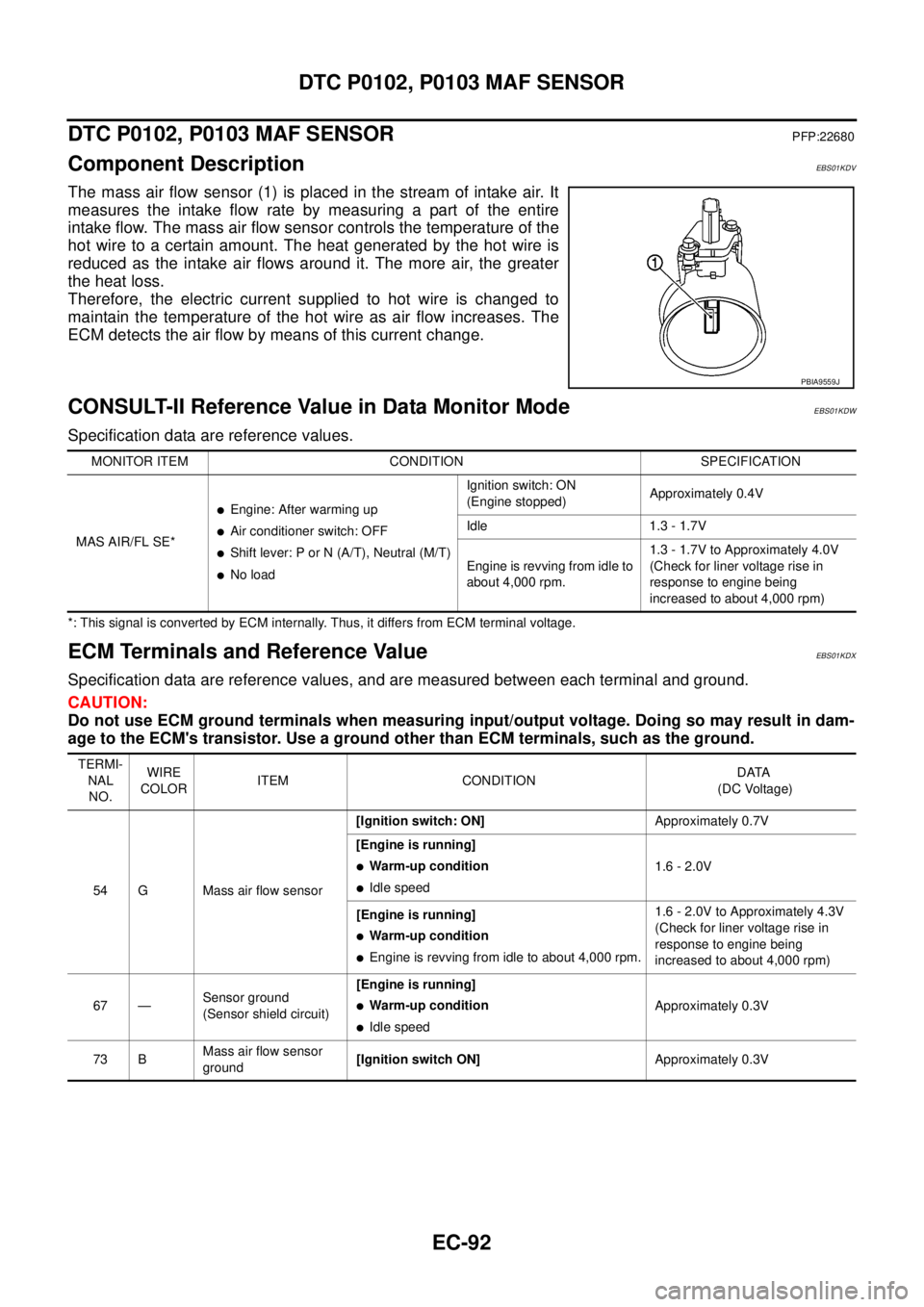
The mass air flow sensor (1) is placed in the stream of intake air. It
measures the intake flow rate by measuring a part of the entire
intake flow. The mass air flow sensor controls the temperature of the
hot wire to a certain amount. The heat generated by the hot wire is
reduced as the intake air flows around it. The more air, the greater
the heat loss.
Therefore, the electric current supplied to hot wire is changed to
maintain the temperature of the hot wire as air flow increases. The
ECM detects the air flow by means of this current change.
CONSULT-II Reference Value in Data Monitor ModeEBS01KDW
Specification data are reference values.
*: This signal is converted by ECM internally. Thus, it differs from ECM terminal voltage.
ECM Terminals and Reference ValueEBS01KDX
Specification data are reference values, and are measured between each terminal and ground.
CAUTION:
Do not use ECM ground terminals when measuring input/output voltage. Doing so may result in dam-
age to the ECM's transistor. Use a ground other than ECM terminals, such as the ground.
PBIA9559J
MONITOR ITEM CONDITION SPECIFICATION
MAS AIR/FL SE*
lEngine: After warming up
lAir conditioner switch: OFF
lShift lever: P or N (A/T), Neutral (M/T)
lNo loadIgnition switch: ON
(Engine stopped)Approximately 0.4V
Idle 1.3 - 1.7V
Engine is revving from idle to
about 4,000 rpm.1.3 - 1.7V to Approximately 4.0V
(Check for liner voltage rise in
response to engine being
increased to about 4,000 rpm)
TERMI-
NAL
NO.WIRE
COLORITEM CONDITIONDATA
(DC Voltage)
54 G Mass air flow sensor[Ignition switch: ON]Approximately 0.7V
[Engine is running]
lWarm-up condition
lIdle speed1.6 - 2.0V
[Engine is running]
lWarm-up condition
lEngine is revving from idle to about 4,000 rpm.1.6 - 2.0V to Approximately 4.3V
(Check for liner voltage rise in
response to engine being
increased to about 4,000 rpm)
67 —Sensor ground
(Sensor shield circuit)[Engine is running]
lWarm-up condition
lIdle speedApproximately 0.3V
73 BMass air flow sensor
ground[Ignition switch ON]Approximately 0.3V
Page 1086 of 3171
EC-106
DTC P0117, P0118 ECT SENSOR
Diagnostic Procedure
EBS01KEF
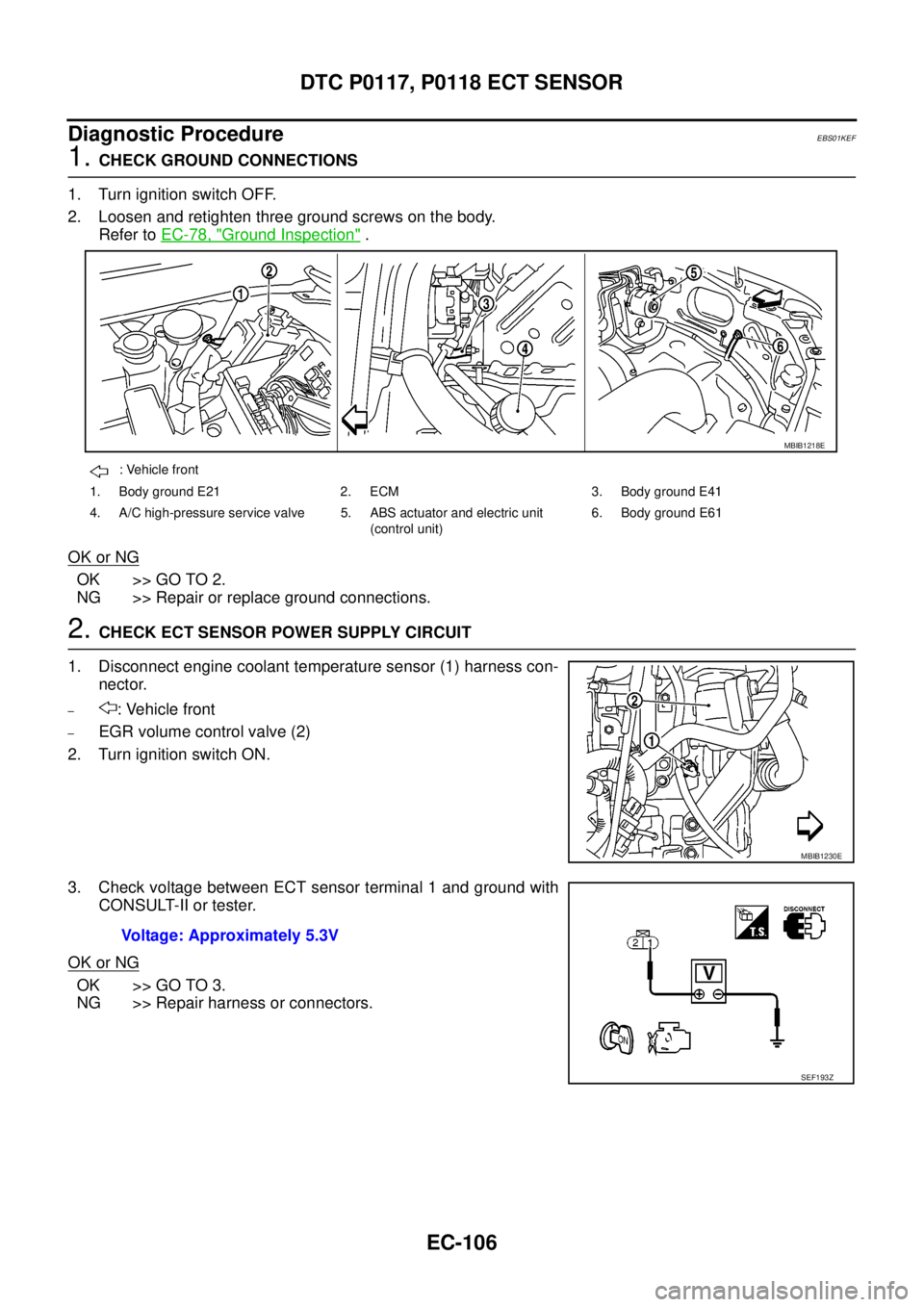
1.CHECK GROUND CONNECTIONS
1. Turn ignition switch OFF.
2. Loosen and retighten three ground screws on the body.
Refer toEC-78, "
Ground Inspection".
OK or NG
OK >> GO TO 2.
NG >> Repair or replace ground connections.
2.CHECK ECT SENSOR POWER SUPPLY CIRCUIT
1. Disconnect engine coolant temperature sensor (1) harness con-
nector.
–: Vehicle front
–EGR volume control valve (2)
2. Turn ignition switch ON.
3. Check voltage between ECT sensor terminal 1 and ground with
CONSULT-II or tester.
OK or NG
OK >> GO TO 3.
NG >> Repair harness or connectors.
: Vehicle front
1. Body ground E21 2. ECM 3. Body ground E41
4. A/C high-pressure service valve 5. ABS actuator and electric unit
(control unit)6. Body ground E61
MBIB1218E
MBIB1230E
Voltage: Approximately 5.3V
SEF193Z