100J7-02
A86262
(a)
(b)
(b)
(b)
(b)
A86263
Fuel Pipe
Clamp
Pinch
Pinch
Pull Out
A75650
Tube Connector
Pipe O-ring Nylon Tube
Quick Connector
A86264
(b) 10-16
- ENGINE CONTROL SYSTEMKNOCK SENSOR (3MZ-FE)
2021 Author�: Date�:
2005 LEXUS ES330 REPAIR MANUAL (RM1124U)
REPLACEMENT
1. DISCHARGE FUEL SYSTEM PRESSURE (See page 11-1)
2. DISCONNECT ENGINE WIRE NO. 3 (BATTERY NEGATIVE TERMINAL)
3. DRAIN ENGINE COOLANT (See page 16-9)
4. REMOVE FRONT SUSPENSION UPPER BRACE CENTER (W/O TEMS) (See page 10-1 1)
5. REMOVE V-BANK COVER SUB-ASSY (See page 10-1 1)
6. REMOVE AIR CLEANER CAP SUB-ASSY (See page 10-1 1)
7. REMOVE EMISSION CONTROL VALVE SET (See page 11-13)
8. REMOVE INTAKE AIR SURGE TANK (See page 11-13)
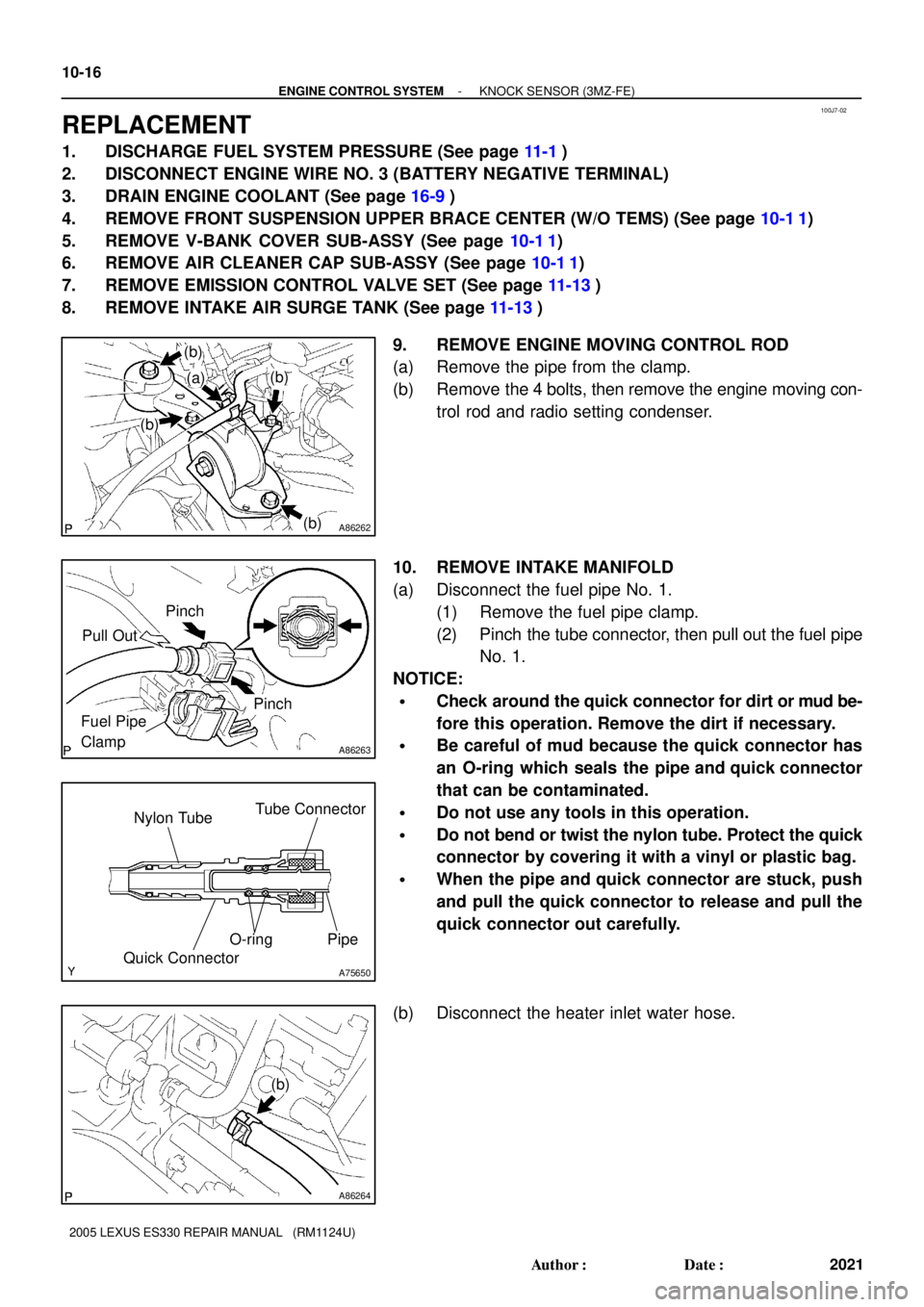
9. REMOVE ENGINE MOVING CONTROL ROD
(a) Remove the pipe from the clamp.
(b) Remove the 4 bolts, then remove the engine moving con-
trol rod and radio setting condenser.
10. REMOVE INTAKE MANIFOLD
(a) Disconnect the fuel pipe No. 1.
(1) Remove the fuel pipe clamp.
(2) Pinch the tube connector, then pull out the fuel pipe
No. 1.
NOTICE:
�Check around the quick connector for dirt or mud be-
fore this operation. Remove the dirt if necessary.
�Be careful of mud because the quick connector has
an O-ring which seals the pipe and quick connector
that can be contaminated.
�Do not use any tools in this operation.
�Do not bend or twist the nylon tube. Protect the quick
connector by covering it with a vinyl or plastic bag.
�When the pipe and quick connector are stuck, push
and pull the quick connector to release and pull the
quick connector out carefully.
(b) Disconnect the heater inlet water hose.
A86346
A59499
Vacuum Gauge
A86347DLC3
Hand-held Tester
12-4
- EMISSION CONTROLEMISSION CONTROL SYSTEM (3MZ-FE)
2065 Author�: Date�:
2005 LEXUS ES330 REPAIR MANUAL (RM1124U)
2. INSPECT FUEL CUT OFF RPM
(a) Check the operation.
(1) Increase the engine speed to at least 3,500 rpm.
(2) Use a sound scope to check the fuel injector operating noise.
(3) Check that when the throttle lever is released, the fuel injector operation noise stops momentarily
at 2,500 rpm and then resumes at 1,200 rpm.
2,500 rpm: Fuel cut off rpm
1,200 rpm: Fuel return rpm
3. VISUALLY INSPECT HOSES, CONNECTIONS AND
GASKETS
(a) Check the appearance.
(1) Check the engine assembly to see if the indicated
portions by the arrows have cracks, leaks or dam-
age.
HINT:
Separation of the engine oil level gauge, oil filler cap, PCV
hose, etc. may cause the engine to run improperly. Disconnec-
tion, looseness or cracks in the parts of the air induction system
between the throttle body and cylinder head will allow air suc-
tion and cause the engine to run improperly.
If necessary, repair the engine assembly.
4. INSPECT EVAP SYSTEM LINE
(a) Warm up the engine to the normal operating temperature.
(b) Connect the vacuum gauge (EVAP control system test
equipment vacuum gauge) to the EVAP service port on
the purge line. Then stop the engine.
(c) If you have the hand-held tester:
Force the VSV for EVAP to operate.
(1) Connect the hand-held tester to the DLC3.
(2) Start the engine.
(3) Turn the hand-held tester ON.
(4) Use the ACTIVE TEST mode on the hand-held tes-
ter to operate the VSV for EVAP.