2004 SUBARU FORESTER air box
[x] Cancel search: air boxPage 517 of 2870
EI-41
EXTERIOR/INTERIOR TRIM
Instrument Panel Assembly
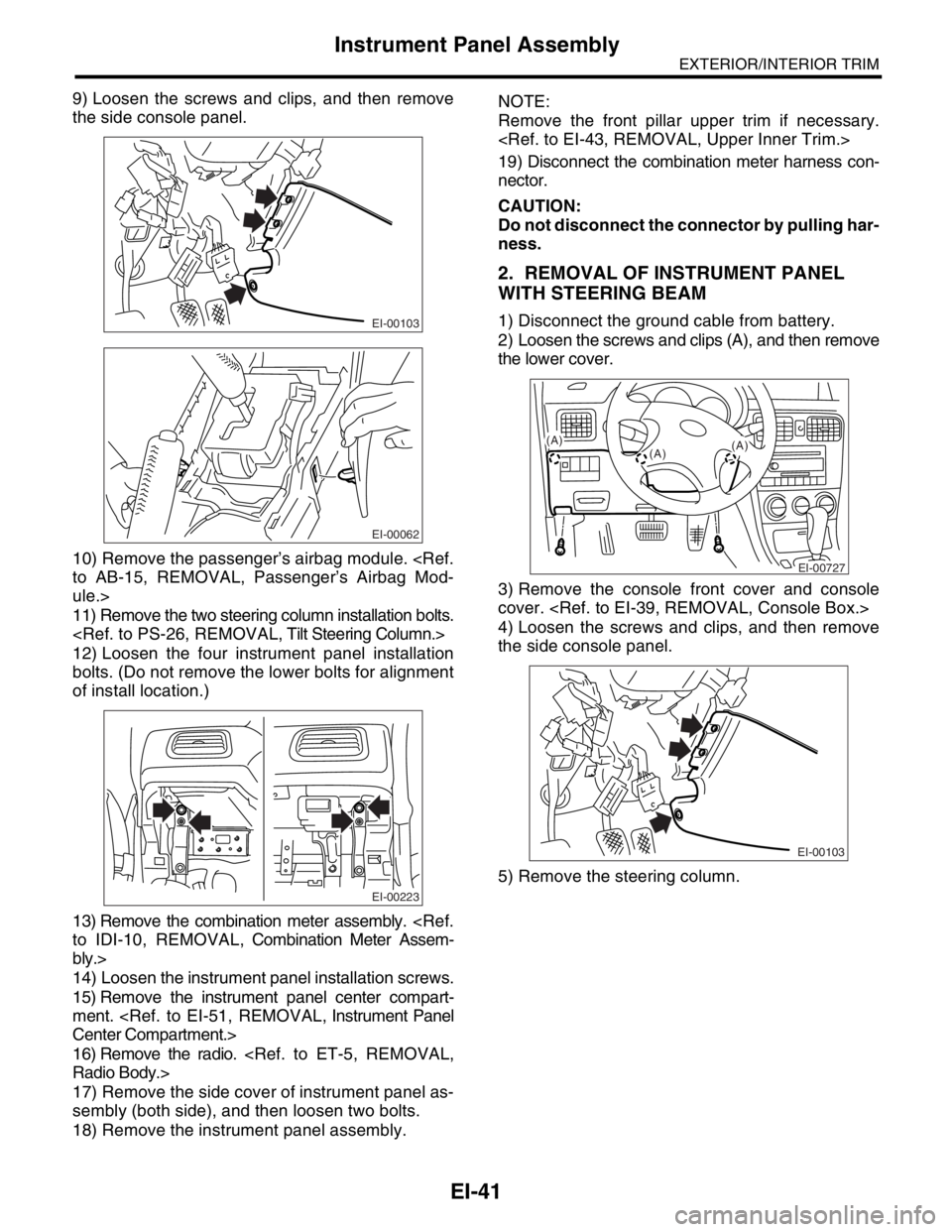
9) Loosen the screws and clips, and then remove
the side console panel.
10) Remove the passenger’s airbag module.
ule.>
11) Remove the two steering column installation bolts.
12) Loosen the four instrument panel installation
bolts. (Do not remove the lower bolts for alignment
of install location.)
13) Remove the combination meter assembly.
bly.>
14) Loosen the instrument panel installation screws.
15) Remove the instrument panel center compart-
ment.
16) Remove the radio.
17) Remove the side cover of instrument panel as-
sembly (both side), and then loosen two bolts.
18) Remove the instrument panel assembly.NOTE:
Remove the front pillar upper trim if necessary.
19) Disconnect the combination meter harness con-
nector.
CAUTION:
Do not disconnect the connector by pulling har-
ness.
2. REMOVAL OF INSTRUMENT PANEL
WITH STEERING BEAM
1) Disconnect the ground cable from battery.
2) Loosen the screws and clips (A), and then remove
the lower cover.
3) Remove the console front cover and console
cover.
4) Loosen the screws and clips, and then remove
the side console panel.
5) Remove the steering column.EI-00103
EI-00062
EI-00223
EI-00727
(A)
(A)(A)
EI-00103
Page 582 of 2870

CC(H4SO)-14
CRUISE CONTROL SYSTEM (DIAGNOSTIC)
Diagnostic Procedure with Symptom
Step Check Yes No
1 CHECK POWER SUPPLY.
1) Turn the ignition switch to OFF.
2) Disconnect the cruise control module har-
ness connector.
3) Turn the ignition switch to ON.
4) Measure the voltage between harness con-
nector terminal and chassis ground.
Connector & terminal
(B94) No. 12 (+) — Chassis ground (
−):Is the voltage more than 10 V? Go to step 2. Check the fuse
No. 18 (in fuse &
relay box).
Check the har-
ness for open or
short between
cruise control
module and fuse &
relay box.
2 CHECK GROUND CIRCUIT.
1) Turn the ignition switch OFF.
2) Measure the resistance between harness
connector terminal and chassis ground.
Connector & terminal
(B94) No. 6 — Chassis ground:Is the resistance less than 10
Ω?Power supply and
ground circuit are
OK.Repair the har-
ness.
Page 584 of 2870

CC(H4SO)-16
CRUISE CONTROL SYSTEM (DIAGNOSTIC)
Diagnostic Procedure with Symptom
Step Check Yes No
1 CHECK CRUISE CONTROL MAIN SWITCH
CIRCUIT.
1) Turn the ignition switch to OFF.
2) Disconnect the cruise control main switch
harness connector.
3) Turn the ignition switch to ON.
4) Measure the voltage between harness con-
nector terminal and chassis ground.
Connector & terminal
With indicator built in combination
meter:
(B161) No. 3 (+) — Chassis ground (
−):
With indicator built in main switch:
(B161) No. 2 (+) — Chassis ground (
−):Is the voltage more than 10 V? Go to step 2. Check the fuse
No. 18 (in fuse &
relay box).
Check the har-
ness for open or
short between
cruise control main
switch and fuse &
relay box.
2 CHECK CRUISE CONTROL MAIN SWITCH
CIRCUIT.
1) Turn the ignition switch OFF.
2) Disconnect the cruise control module har-
ness connector.
3) Measure the resistance between cruise
control module harness connector terminal
and cruise control main switch harness con-
nector terminal.
Connector & terminal
With indicator built in combination
meter:
(B94) No. 15 — (B161) No. 5:
With indicator built in main switch:
(B94) No. 15 — (B161) No. 1:Is the resistance less than 10
Ω?Go to step 3.Repair the har-
ness.
3 CHECK CRUISE CONTROL MAIN SWITCH.
Remove and check the cruise control main
switch.
switch OK?Replace the cruise
control module.Replace the cruise
control main
switch.
Page 586 of 2870

CC(H4SO)-18
CRUISE CONTROL SYSTEM (DIAGNOSTIC)
Diagnostic Procedure with Symptom
Step Check Yes No
1 CHECK CRUISE INDICATOR LIGHT CIR-
CUIT.
1) Turn the ignition switch to OFF.
2) With indicator built in combination meter:
Disconnect the combination meter harness
connector.
With indicator built in main switch:
Disconnect the cruise control main switch har-
ness connector.
3) Turn the ignition switch to ON.
4) Measure the voltage between harness con-
nector terminal and chassis ground.
Connector & terminal
With indicator built in combination
meter:
(i10) No. 9 (+) — Chassis ground (
−):
With indicator built in main switch:
(B161) No. 3 (+) — Chassis ground (
−):Is the voltage more than 10 V? Go to step 2. Check the fuse
No. 13 (in fuse &
relay box).
Check the har-
ness for open or
short between
combination meter
and fuse & relay
box.
2 CHECK CRUISE INDICATOR LIGHT CIR-
CUIT.
1) Turn the ignition switch to OFF.
2) Disconnect the cruise control module har-
ness connector.
3) Measure the resistance between cruise
control module harness connector terminal
and combination meter harness connector ter-
minal.
Connector & terminal
With indicator built in combination
meter:
(B94) No. 1 (+) — (i10) No. 16:
With indicator built in main switch:
(B94) No. 1 (+) — (B161) No. 4:Is the resistance less than 10
Ω?Go to step 3.Repair the har-
ness.
3 CHECK CRUISE INDICATOR LIGHT CIR-
CUIT.
Ground the cruise control module harness
connector terminal with a suitable wire.
Connector & terminal
(B94) No. 1 — Chassis ground:Does the cruise indicator light
illuminate?Replace the cruise
control module. With indicator
built in combina-
tion meter: Check
the cruise indicator
light bulb in combi-
nation meter, and
replace it if mal-
function
occurred.No mal-
function found,
replace the printed
circuit of combina-
tion meter.
With indicator
built in main
switch: Replace
the cruise control
main switch.
Page 590 of 2870

CC(H4SO)-22
CRUISE CONTROL SYSTEM (DIAGNOSTIC)
Diagnostic Procedure with Symptom
Step Check Yes No
1 CHECK STOP LIGHT SWITCH AND BRAKE
SWITCH CIRCUIT.
1) Turn the ignition switch to OFF.
2) Disconnect the stop light switch and brake
switch harness connector.
3) Turn the ignition switch to ON.
4) Turn the cruise control main switch to ON.
5) Measure the voltage between harness con-
nector terminal and chassis ground.
Connector & terminal
(B65) No. 2 (+) — Chassis ground (
−): Is the voltage more than 10 V? Go to step 2. Check the fuse
No. 16 (in fuse &
relay box).
Check the har-
ness for open or
short between
stop light/brake
switch and fuse &
relay box.
2 CHECK STOP LIGHT SWITCH AND BRAKE
SWITCH CIRCUIT.
Measure the voltage between harness connec-
tor terminal and chassis ground.
Connector & terminal
(B65) No. 4 (+) — Chassis ground (
−): Is the voltage more than 10 V? Go to step 3. Check the har-
ness for open or
short between
stop light/brake
switch and cruise
control module (AT
model).
Check the clutch
switch and circuit
(MT model).
3 CHECK STOP LIGHT SWITCH AND BRAKE
SWITCH CIRCUIT.
1) Turn the cruise control main switch and
ignition switch to OFF.
2) Disconnect the cruise control module har-
ness connector.
3) Measure the resistance between cruise
control module harness connector terminal
and stop light switch and brake switch harness
connector terminal.
Connector & terminal
(B94) No. 20 — (B65) No. 3:
(B94) No. 16 — (B65) No. 1: Is the resistance less than 10
Ω?Go to step 4.Repair the har-
ness.
4 CHECK STOP LIGHT SWITCH AND BRAKE
SWITCH.
Remove and check the stop light switch and
brake switch.
brake switch are OK?Stop light switch
and brake switch
circuit are OK.Replace the stop
light switch and
brake switch.
Page 624 of 2870

CC(H4DOTC 2.5)-12
CRUISE CONTROL SYSTEM (DIAGNOSTIC)
Diagnostic Procedure with Symptom
Step Check Yes No
1 CHECK CRUISE INDICATOR LIGHT CIR-
CUIT.
1) Turn the ignition switch to OFF.
2) Disconnect the combination meter harness
connector.
3) Turn the ignition switch to ON.
4) Measure the voltage between harness con-
nector terminal and chassis ground.
Connector & terminal
(i10) No. 9 (+) — Chassis ground (
−):Is the voltage more than 10 V? Go to step 2. Check the fuse
No. 14 (in fuse &
relay box).
Check the har-
ness for open or
short between
combination meter
and fuse & relay
box.
2 CHECK CRUISE INDICATOR LIGHT CIR-
CUIT.
1) Turn the ignition switch to OFF.
2) Disconnect the ECM harness connector.
3) Measure the resistance between ECM har-
ness connector terminal and combination
meter harness connector terminal.
Connector & terminal
(B134) No. 15 — (i10) No. 16:Is the resistance less than 10
Ω?Go to step 3.Repair the har-
ness.
3 CHECK CRUISE INDICATOR LIGHT CIR-
CUIT.
Ground the ECM harness connector terminal
with a suitable wire.
Connector & terminal
(B134) No. 15 — Chassis ground:Does the cruise indicator light
illuminate?Check the poor
contact of ECM
connector.Replace the meter
main assembly.
Page 631 of 2870

CC(H4DOTC 2.5)-19
CRUISE CONTROL SYSTEM (DIAGNOSTIC)
Diagnostic Procedure with Diagnostic Trouble Code (DTC)
Step Check Yes No
1 CHECK STOP LIGHT SWITCH AND BRAKE
SWITCH CIRCUIT.
1) Turn the ignition switch to OFF.
2) Disconnect the stop light switch and brake
switch harness connector.
3) Turn the ignition switch to ON.
4) Measure the voltage between harness con-
nector terminal and chassis ground.
Connector & terminal
(B65) No. 2 (+) — Chassis ground (
−): Is the voltage more than 10 V? Go to step 2. Check the fuse
No. 16 (in fuse &
relay box).
Check the har-
ness for open or
short between
stop light/brake
switch and fuse &
relay box.
2 CHECK STOP LIGHT SWITCH AND BRAKE
SWITCH CIRCUIT.
Measure the voltage between harness connec-
tor terminal and chassis ground.
Connector & terminal
(B65) No. 1 (+) — Chassis ground (
−): Is the voltage more than 10 V? Go to step 3. Check the fuse
No. 11 (in fuse &
relay box).
Check the har-
ness for open or
short between
stop light/brake
switch and fuse &
relay box.
Check the clutch
switch and circuit.
3 CHECK STOP LIGHT SWITCH AND BRAKE
SWITCH CIRCUIT.
1) Turn the ignition switch to OFF.
2) Disconnect the ECM harness connector.
3) Measure the resistance between ECM har-
ness connector terminal and stop light switch
and brake switch harness connector terminal.
Connector & terminal
(B136) No. 8 — (B65) No. 3:
(B136) No. 9 — (B65) No. 4: Is the resistance less than 10
Ω? Go to step 4.Repair the har-
ness.
4 CHECK STOP LIGHT SWITCH AND BRAKE
SWITCH.
Remove and check the stop light switch and
brake switch.
brake switch OK? Stop light switch
and brake switch
circuit are OK.Replace the stop
light switch and
brake switch.
Page 633 of 2870

CC(H4DOTC 2.5)-21
CRUISE CONTROL SYSTEM (DIAGNOSTIC)
Diagnostic Procedure with Diagnostic Trouble Code (DTC)
Step Check Yes No
1 CHECK CLUTCH SWITCH CIRCUIT.
1) Turn the ignition switch to OFF.
2) Disconnect the clutch switch harness con-
nector.
3) Turn the ignition switch to ON.
4) Measure the voltage between harness con-
nector terminal and chassis ground.
Connector & terminal
(B107) No. 2 (+) — Chassis ground (
−):Is the voltage more than 10 V? Go to step 2. Check the fuse
No. 11 (fuse &
relay box).
Check the har-
ness for open or
short between
clutch switch and
fuse & relay box.
2 CHECK CLUTCH SWITCH CIRCUIT.
1) Turn the ignition switch to OFF.
2) Disconnect the ECM harness connector.
3) Measure the resistance between clutch
switch harness connector terminal and ECM
harness connector terminal.
Connector & terminal
(B107) No. 1 — (B134) No. 1:Is the resistance less than 10
Ω? Go to step 3.Repair the har-
ness.
3 CHECK CLUTCH SWITCH.
Remove and check the clutch switch.
cuit is OK.Replace the clutch
switch.