Page 2842 of 2870
CL-16
CLUTCH SYSTEM
Clutch Disc and Cover
2. Clutch Disc and Cover
A: REMOVAL
1) Remove the transmission assembly from vehicle
body.
mission Assembly.>
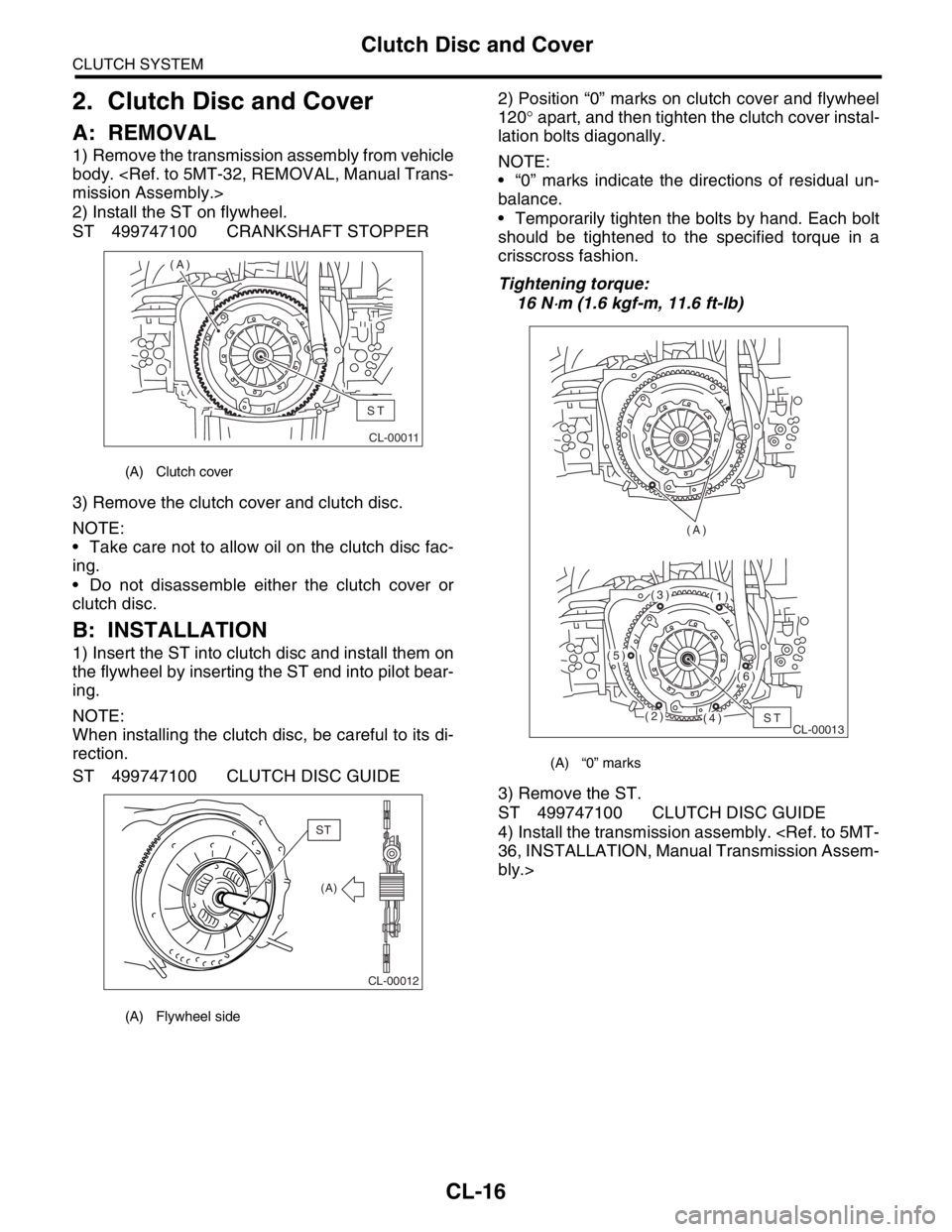
2) Install the ST on flywheel.
ST 499747100 CRANKSHAFT STOPPER
3) Remove the clutch cover and clutch disc.
NOTE:
Take care not to allow oil on the clutch disc fac-
ing.
Do not disassemble either the clutch cover or
clutch disc.
B: INSTALLATION
1) Insert the ST into clutch disc and install them on
the flywheel by inserting the ST end into pilot bear-
ing.
NOTE:
When installing the clutch disc, be careful to its di-
rection.
ST 499747100 CLUTCH DISC GUIDE2) Position “0” marks on clutch cover and flywheel
120° apart, and then tighten the clutch cover instal-
lation bolts diagonally.
NOTE:
“0” marks indicate the directions of residual un-
balance.
Temporarily tighten the bolts by hand. Each bolt
should be tightened to the specified torque in a
crisscross fashion.
Tightening torque:
16 N
⋅m (1.6 kgf-m, 11.6 ft-lb)
3) Remove the ST.
ST 499747100 CLUTCH DISC GUIDE
4) Install the transmission assembly.
36, INSTALLATION, Manual Transmission Assem-
bly.>
(A) Clutch cover
(A) Flywheel side
CL-00011
(A)
ST
CL-00012
(A)
ST
(A) “0” marks
CL-00013 (A)ST(2)
(5)
(3)(1)
(6)
(4)
Page 2843 of 2870
CL-17
CLUTCH SYSTEM
Clutch Disc and Cover
C: INSPECTION
1. CLUTCH DISC
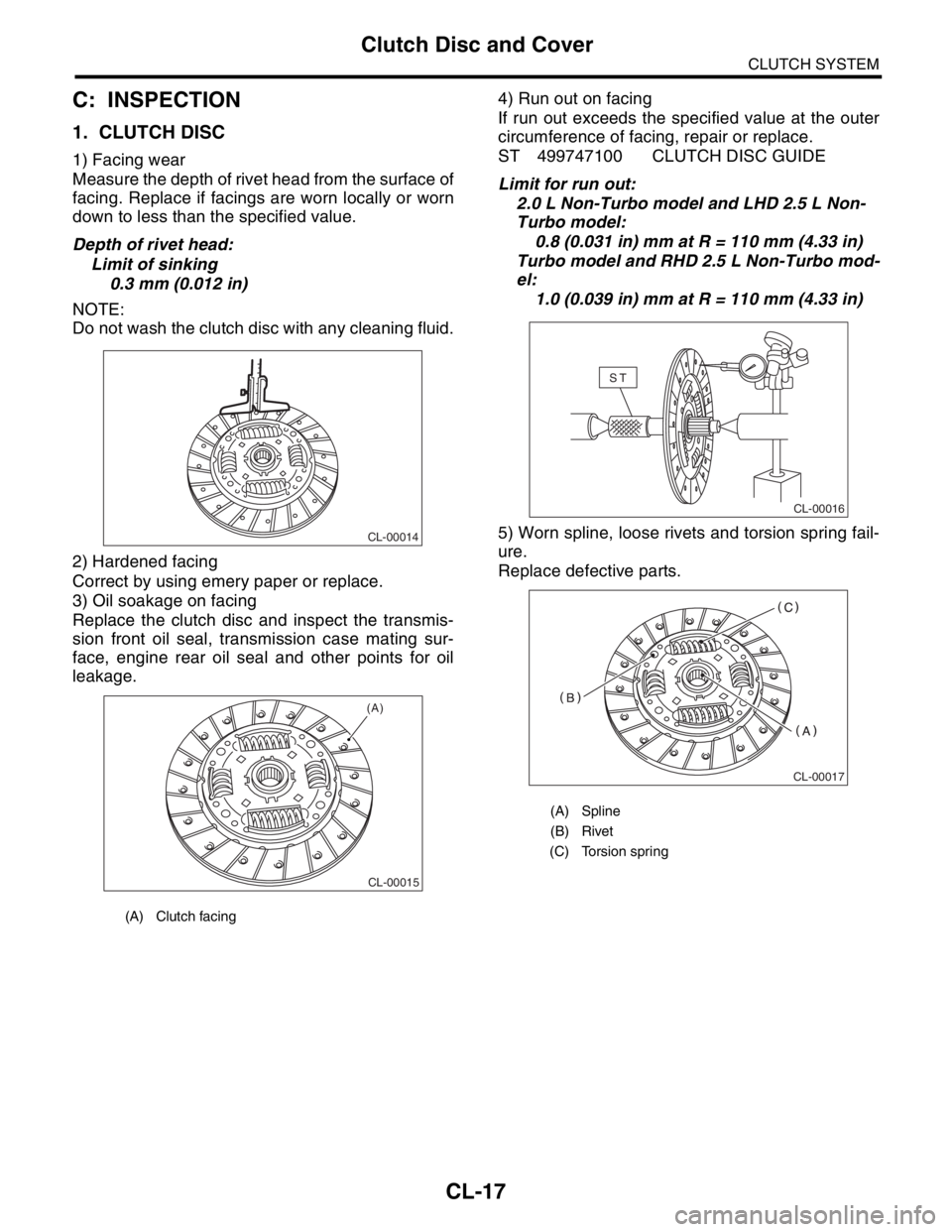
1) Facing wear
Measure the depth of rivet head from the surface of
facing. Replace if facings are worn locally or worn
down to less than the specified value.
Depth of rivet head:
Limit of sinking
0.3 mm (0.012 in)
NOTE:
Do not wash the clutch disc with any cleaning fluid.
2) Hardened facing
Correct by using emery paper or replace.
3) Oil soakage on facing
Replace the clutch disc and inspect the transmis-
sion front oil seal, transmission case mating sur-
face, engine rear oil seal and other points for oil
leakage.4) Run out on facing
If run out exceeds the specified value at the outer
circumference of facing, repair or replace.
ST 499747100 CLUTCH DISC GUIDE
Limit for run out:
2.0 L Non-Turbo model and LHD 2.5 L Non-
Turbo model:
0.8 (0.031 in) mm at R = 110 mm (4.33 in)
Turbo model and RHD 2.5 L Non-Turbo mod-
el:
1.0 (0.039 in) mm at R = 110 mm (4.33 in)
5) Worn spline, loose rivets and torsion spring fail-
ure.
Replace defective parts.
(A) Clutch facing
CL-00014
CL-00015
(A)
(A) Spline
(B) Rivet
(C) Torsion spring
CL-00016
ST
CL-00017
Page 2868 of 2870

CL-42
CLUTCH SYSTEM
General Diagnostic Table
12.General Diagnostic Table
A: INSPECTION
1. CLUTCH
Symptom Possible cause Corrective
1. Clutch slippage.
It is hard to perceive clutch slippage in
the early stage, but pay attention to the
following symptoms
Engine speed up when shifting.
High speed driving is impossible; espe-
cially rapid acceleration impossible and
vehicle speed does not increase in pro-
portion to an increase in engine speed.
Power falls, particularly when ascend-
ing a slope, and there is a smell of burn-
ing of the clutch facing.
Method of testing: Put the vehicle in
stationary condition with parking brake
fully applied. Disengage the clutch and
shift the transmission gear into the first.
Gradually allow the clutch to engage
while gradually increasing the engine
speed. The clutch function is satisfactory
if the engine stalls. However, the clutch is
slipping if the vehicle does not start off
and the engine does not stall.(a) Clutch facing smeared by oil Replace.
(b) Worn clutch facing Replace.
(c) Deteriorated diaphragm spring Replace.
(d) Distorted pressure plate or flywheel Replace.
(e) Defective release bearing holder Replace.
2. Clutch drags.
As a symptom of this trouble, a harsh
scratching noise develops and control
becomes quite difficult when shifting
gears. The symptom becomes more
apparent when shifting into the first gear.
However, because much trouble of this
sort is due to defective synchronization
mechanism, carry out the test as
described after.
Method of testing:
DIAGNOSTIC DIAGRAM OF CLUTCH
DRAG, INSPECTION, General Diagnos-
tic Table.>
It may be judged as insufficient disen-
gagement of clutch if any noise occurs
during this test.(a) Worn or rusty clutch disc hub spline Replace the clutch disc.
(b) Excessive deflection of clutch disc
facingReplace.
(c) Malfunction of crankshaft pilot bearing Replace.
(d) Cracked clutch disc facing Replace.
(e) Stuck clutch disc (smeared by oil or
water)Replace.
3. Clutch chatters.
Clutch chattering is an unpleasant vibra-
tion to the whole body when the vehicle is
just started with clutch partially engaged.(a) Adhesion of oil on the facing Replace the clutch disc.
(b) Weak or broken torsion spring Replace the clutch disc.
(c) Defective facing contact or excessive
disc wornReplace the clutch disc defection.
(d) Warped pressure plate or flywheel Replace.
(e) Loose disc rivets Replace the clutch disc.
(f) Loose engine mounting Retighten or replace the mounting.
(g) Improper adjustment of pitching stop-
perAdjustment.
Page 2869 of 2870

CL-43
CLUTCH SYSTEM
General Diagnostic Table
2. CLUTCH PEDAL
3. DIAGNOSTIC DIAGRAM OF CLUTCH DRAG
4. Noisy clutch
Examine whether the noise is generated
when the clutch is disengaged, engaged,
or partially engaged.(a) Broken, worn or unlubricated release
bearingReplace the release bearing.
(b) Insufficient lubrication of pilot bearing Replace.
(c) Loose clutch disc hub Replace the clutch disc.
(d) Loose torsion spring retainer Replace the clutch disc.
(e) Deteriorated or broken torsion spring Replace the clutch disc.
5. Clutch grabs.
When starting the vehicle with the clutch
partially engaged, the clutch engages
suddenly and the vehicle jumps instead
of making a smooth start.(a) Grease or oil on facing Replace the clutch disc.
(b) Deteriorated cushioning spring Replace the clutch disc.
(c) Worn or rusted spline of clutch disc or
main shaftTake off rust, apply grease or replace the
clutch disc or main shaft.
(d) Deteriorated or broken torsion spring Replace the clutch disc.
(e) Loose engine mounting Retighten or replace the mounting.
(f) Deteriorated diaphragm spring Replace.
Trouble Corrective action
Insufficient pedal play Adjust pedal play.
Clutch pedal free play insufficient Adjust pedal free play.
Excessively worn and damaged pedal shaft and/or bushing Replace the bushing and/or shaft with a new one.
Step Check Yes No
1 CHECK GEAR NOISE.
1) Start the engine.
2) Disengage the clutch and shift quickly from
neutral to reverse in idling condition.Is there any abnormal noise
from the transmission gear?Go to step 2.Clutch is normal.
2 CHECK GEAR NOISE.
Disengage the clutch at idle and shift from neu-
tral to reverse within 0.5 — 1.0 seconds.Is there any abnormal noise
from the transmission gear?Go to step 3.Defective trans-
mission or exces-
sive clutch drag
torque. Inspect the
pilot bearing,
clutch disc, trans-
mission and clutch
disc hub spline.
3 CHECK GEAR NOISE.
1) Disengage the clutch at idle and shift from
neutral to reverse within 0.5 — 1.0 seconds.
2) With the clutch disengaged, shift from N to
R, R to N several times.Is there any abnormal noise
from the transmission gear?Defect in clutch
disengaging.
Inspect the clutch
disc, clutch cover,
clutch release, and
clutch pedal free
play.Clutch and fly-
wheel seizure.
Inspect the clutch
disc, spline of
clutch disc hub. Symptom Possible cause Corrective