Page 1428 of 1833
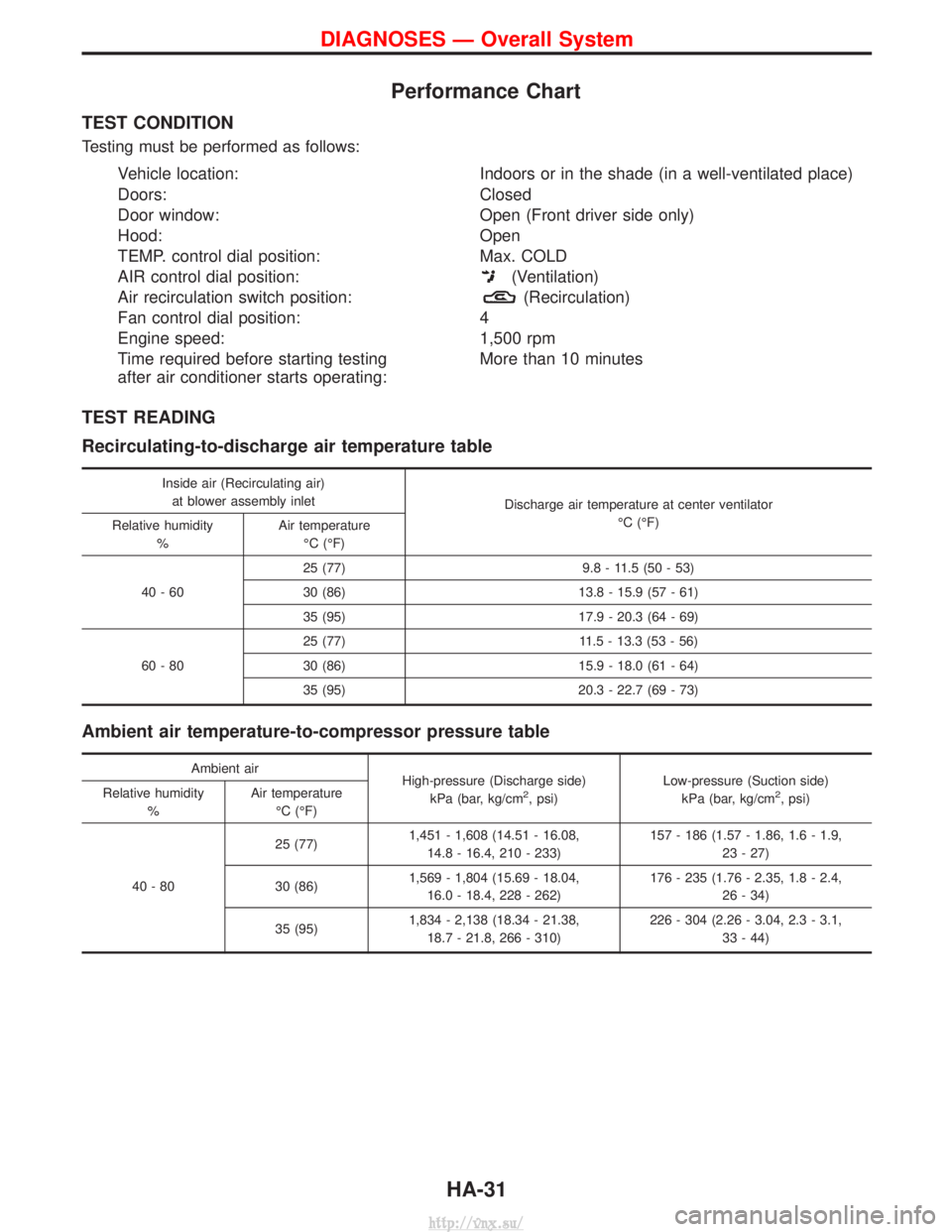
Performance Chart
TEST CONDITION
Testing must be performed as follows:
Vehicle location:Indoors or in the shade (in a well-ventilated place)
Doors: Closed
Door window: Open (Front driver side only)
Hood: Open
TEMP. control dial position: Max. COLD
AIR control dial position:
(Ventilation)
Air recirculation switch position:
(Recirculation)
Fan control dial position: 4
Engine speed: 1,500 rpm
Time required before starting testing
after air conditioner starts operating: More than 10 minutes
TEST READING
Recirculating-to-discharge air temperature table
Inside air (Recirculating air)
at blower assembly inlet Discharge air temperature at center ventilator
ÉC (ÉF)
Relative humidity
% Air temperature
ÉC (ÉF)
40-60 25 (77) 9.8 - 11.5 (50 - 53)
30 (86) 13.8 - 15.9 (57 - 61)
35 (95) 17.9 - 20.3 (64 - 69)
60-80 25 (77) 11.5 - 13.3 (53 - 56)
30 (86) 15.9 - 18.0 (61 - 64)
35 (95) 20.3 - 22.7 (69 - 73)
Ambient air temperature-to-compressor pressure table
Ambient air
High-pressure (Discharge side)
kPa (bar, kg/cm
2, psi) Low-pressure (Suction side)
kPa (bar, kg/cm2, psi)
Relative humidity
% Air temperature
ÉC (ÉF)
40-80 25 (77)
1,451 - 1,608 (14.51 - 16.08,
14.8 - 16.4, 210 - 233) 157 - 186 (1.57 - 1.86, 1.6 - 1.9,
23 - 27)
30 (86) 1,569 - 1,804 (15.69 - 18.04,
16.0 - 18.4, 228 - 262) 176 - 235 (1.76 - 2.35, 1.8 - 2.4,
26 - 34)
35 (95) 1,834 - 2,138 (18.34 - 21.38,
18.7 - 21.8, 266 - 310) 226 - 304 (2.26 - 3.04, 2.3 - 3.1,
33 - 44)
DIAGNOSES Ð Overall System
HA-31
http://vnx.su/
Page 1430 of 1833
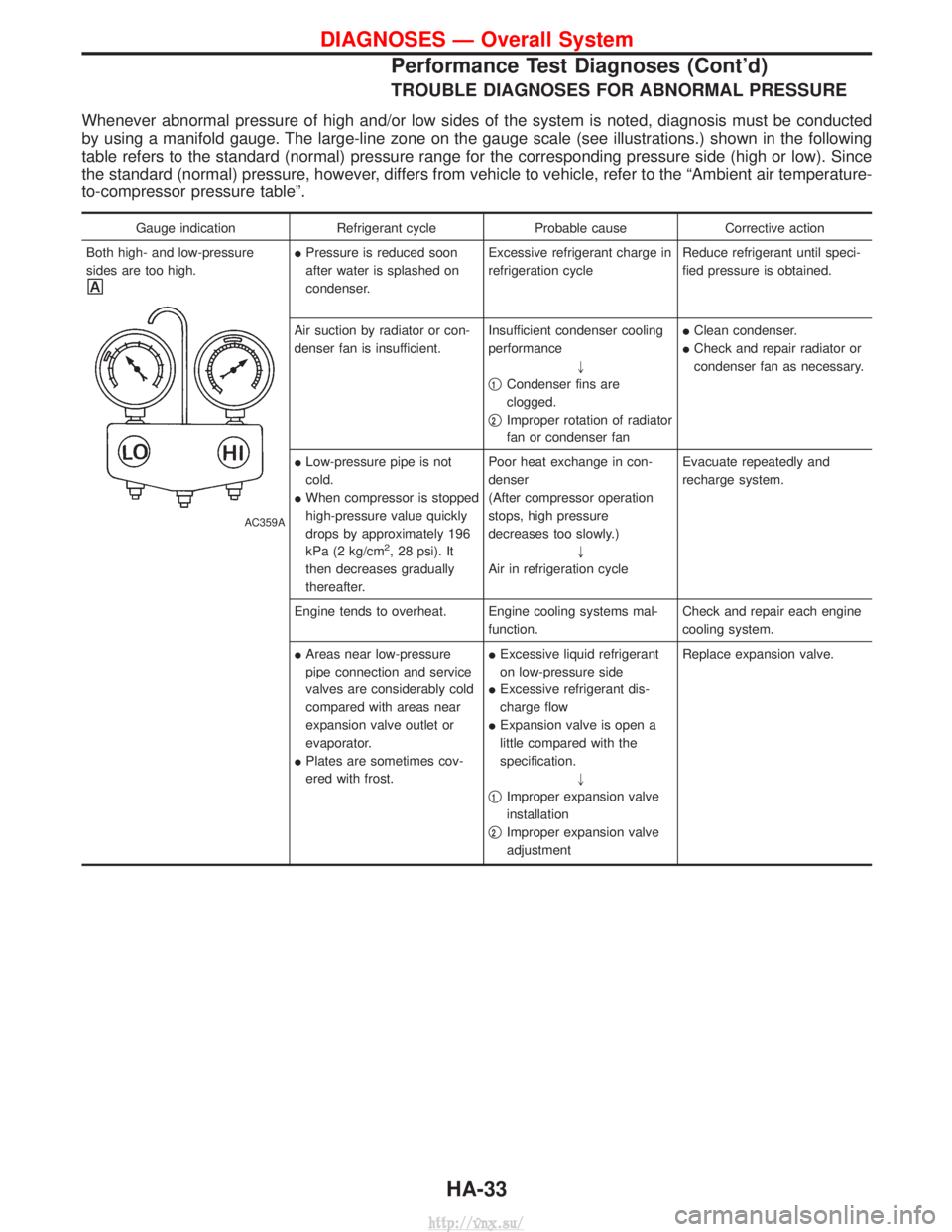
TROUBLE DIAGNOSES FOR ABNORMAL PRESSURE
Whenever abnormal pressure of high and/or low sides of the system is noted, diagnosis must be conducted
by using a manifold gauge. The large-line zone on the gauge scale (see illustrations.) shown in the following
table refers to the standard (normal) pressure range for the corresponding pressure side (high or low). Since
the standard (normal) pressure, however, differs from vehicle to vehicle, refer to the ªAmbient air temperature-
to-compressor pressure tableº.
Gauge indicationRefrigerant cycleProbable causeCorrective action
Both high- and low-pressure
sides are too high.
AC359A
I Pressure is reduced soon
after water is splashed on
condenser. Excessive refrigerant charge in
refrigeration cycle
Reduce refrigerant until speci-
fied pressure is obtained.
Air suction by radiator or con-
denser fan is insufficient. Insufficient condenser cooling
performance
"
q
1Condenser fins are
clogged.
q
2Improper rotation of radiator
fan or condenser fan I
Clean condenser.
I Check and repair radiator or
condenser fan as necessary.
I Low-pressure pipe is not
cold.
I When compressor is stopped
high-pressure value quickly
drops by approximately 196
kPa (2 kg/cm
2, 28 psi). It
then decreases gradually
thereafter. Poor heat exchange in con-
denser
(After compressor operation
stops, high pressure
decreases too slowly.)
"
Air in refrigeration cycle Evacuate repeatedly and
recharge system.
Engine tends to overheat. Engine cooling systems mal- function.Check and repair each engine
cooling system.
I Areas near low-pressure
pipe connection and service
valves are considerably cold
compared with areas near
expansion valve outlet or
evaporator.
I Plates are sometimes cov-
ered with frost. I
Excessive liquid refrigerant
on low-pressure side
I Excessive refrigerant dis-
charge flow
I Expansion valve is open a
little compared with the
specification.
"
q
1Improper expansion valve
installation
q
2Improper expansion valve
adjustment Replace expansion valve.
DIAGNOSES Ð Overall System
Performance Test Diagnoses (Cont'd)
HA-33
http://vnx.su/
Page 1436 of 1833
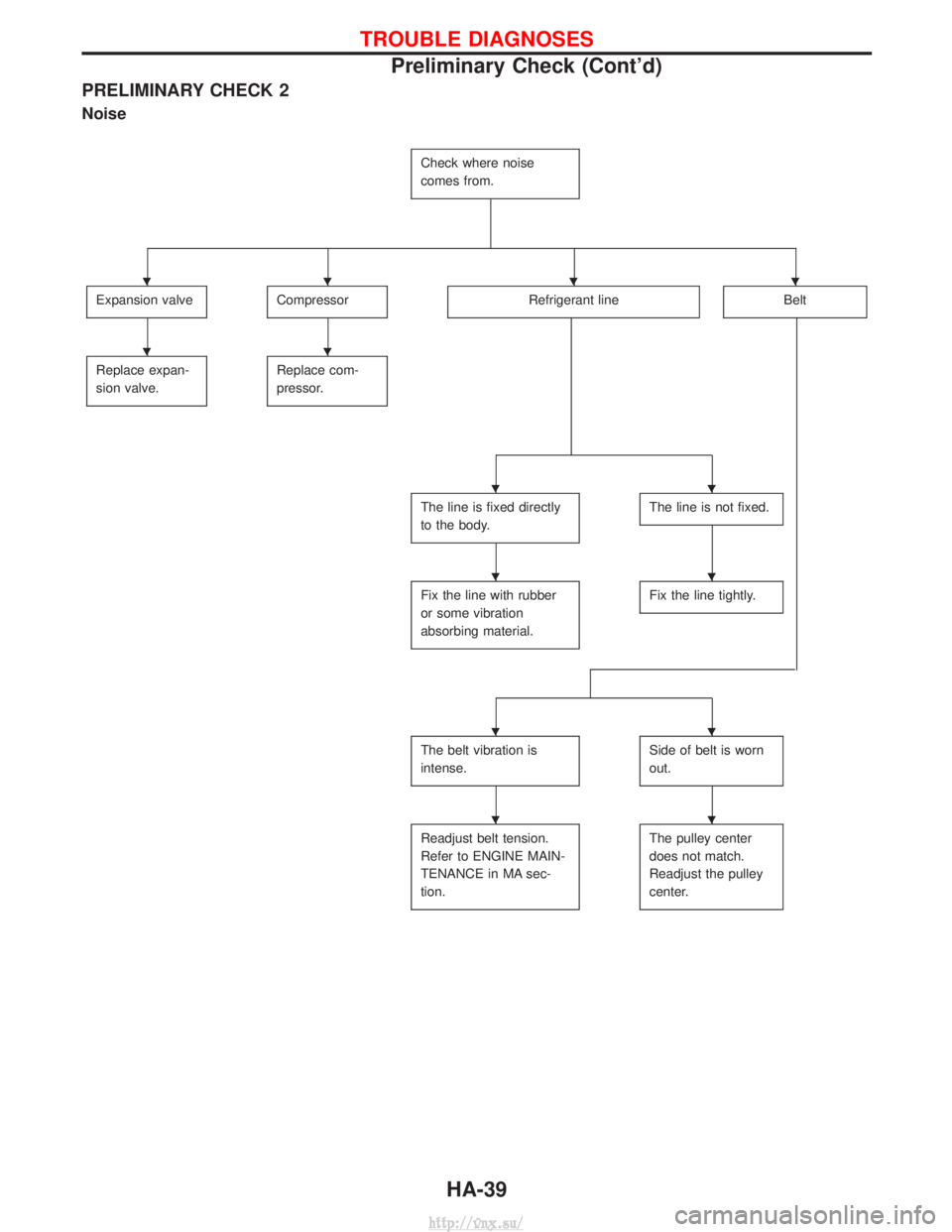
PRELIMINARY CHECK 2
Noise
Check where noise
comes from.
Expansion valveCompressorRefrigerant lineBelt
Replace expan-
sion valve.Replace com-
pressor.
The line is fixed directly
to the body.The line is not fixed.
Fix the line with rubber
or some vibration
absorbing material.Fix the line tightly.
The belt vibration is
intense.Side of belt is worn
out.
Readjust belt tension.
Refer to ENGINE MAIN-
TENANCE in MA sec-
tion.The pulley center
does not match.
Readjust the pulley
center.
HHHH
HH
HH
HH
HH
HH
TROUBLE DIAGNOSES
Preliminary Check (Cont'd)HA-39
http://vnx.su/
Page 1441 of 1833
Wiring Diagram
LHD TD27Ti ENGINE MODELS
YHA392
TROUBLE DIAGNOSES
HA-44
http://vnx.su/
Page 1443 of 1833
RHD TD27Ti ENGINE MODELS
YHA394
TROUBLE DIAGNOSES
Wiring Diagram (Cont'd)HA-46
http://vnx.su/
Page 1445 of 1833
LHD ZD30DDTi ENGINE MODELS
YHA396
TROUBLE DIAGNOSES
Wiring Diagram (Cont'd)HA-48
http://vnx.su/
Page 1447 of 1833
RHD ZD30DDTi ENGINE MODELS
YHA398
TROUBLE DIAGNOSES
Wiring Diagram (Cont'd)HA-50
http://vnx.su/
Page 1462 of 1833
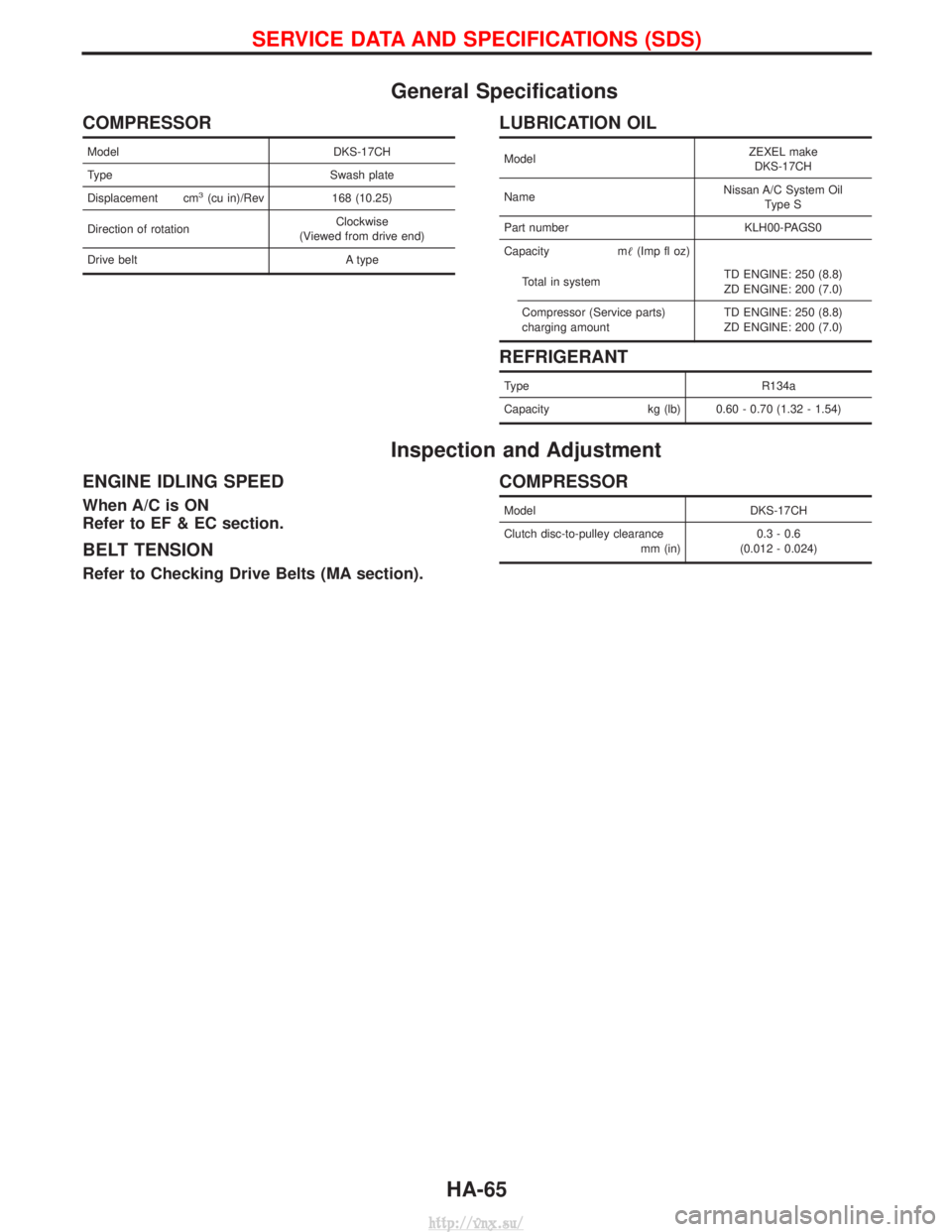
General Specifications
COMPRESSOR
ModelDKS-17CH
Type Swash plate
Displacement cm
3(cu in)/Rev 168 (10.25)
Direction of rotation Clockwise
(Viewed from drive end)
Drive belt A type
LUBRICATION OIL
ModelZEXEL make
DKS-17CH
Name Nissan A/C System Oil
Type S
Part number KLH00-PAGS0
Capacity m (Imp fl oz)
Total in system TD ENGINE: 250 (8.8)
ZD ENGINE: 200 (7.0)
Compressor (Service parts)
charging amount TD ENGINE: 250 (8.8)
ZD ENGINE: 200 (7.0)
REFRIGERANT
Type
R134a
Capacity kg (lb) 0.60 - 0.70 (1.32 - 1.54)
Inspection and Adjustment
ENGINE IDLING SPEED
When A/C is ON
Refer to EF & EC section.
BELT TENSION
Refer to Checking Drive Belts (MA section).
COMPRESSOR
Model DKS-17CH
Clutch disc-to-pulley clearance mm (in)0.3 - 0.6
(0.012 - 0.024)
SERVICE DATA AND SPECIFICATIONS (SDS)
HA-65
http://vnx.su/