Page 2988 of 4323

F19324
2WD/4HI Switch
F19325
A GND
4LO
CPU 4WD
B TR±42
± TRANSFERONE TOUCH 2±4 SELECTOR SYSTEM
2980 Author�: Date�:
2005 SEQUOIA (RM1146U)
8. INSPECT 4LO (4WD and differential lock ºLOCKº) "
2WD
(a) Start the engine.
(b) Push the 4LO switch once.
(c) Check that the 4LO indicator light stays lit after blinking.
(d) Push the differential lock switch once.
(e) Check that the center differential lock indicator light stays
lit after blinking.
(f) Push the 2WD/4HI switch once.
(g) Check that the 4LO and center differential lock indicator
lights go off after the 4LO and 4WD indicators are blink-
ing.
9. INSPECT 2WD/4HI, 4LO AND DIFFERENTIAL LOCK
SWITCH CONTINUITY
(a) Remove the instrument panel finish lower panel.
(b) Inspect the continuity between each terminal.
Switch positionTester connectionSpecified condition
Diff. Lock OFFB±8 ± A±10No continuity
Diff. Lock Hold ONB±8 ± A±10Continuity
4LO OFFB±9 ± A±10No continuity
4LO Hold ONB±9 ± A±10Continuity
2WD/4HI OFFB±10 ± A±10No continuity
2WD/4HI Hold ONB±10 ± A±10Continuity
If continuity is not as specified, replace the instrument panel fin-
ish lower panel.
Page 3040 of 4323
SA14I±10
SA±36
± SUSPENSION AND AXLEFRONT DRIVE SHAFT
3032 Author�: Date�:
2005 SEQUOIA (RM1146U)
INSTALLATION
1. INSTALL DRIVE SHAFT TO DIFFERENTIAL
(a) Install a new snap ring to the inboard joint shaft.
(b) Apply gear oil to the inboard joint shaft and differential case sliding surface.
(c) Set the snap ring with opening side facing downward.
(d) Using a brass bar and hammer, install the drive shaft.
NOTICE:
Be careful not to damage the dust cover and oil seal.
HINT:
Whether the inboard joint shaft is in contact with the pinion shaft or not can be known from the sound or feel-
ing when driving.
(e) Check that there is 2 ± 3 mm (0.08 ± 0.12 in.) of play in the axial direction.
(f) Check that the drive shaft cannot be removed by hand.
2. LH drive shaft:
INSTALL LH SHOCK ABSORBER (See page SA±70)
3. CONNECT DRIVE SHAFT TO STEERING KNUCKLE
NOTICE:
Be careful not to damage the oil seal, boots and dust seal.
4. CONNECT LOWER SUSPENSION ARM TO LOWER BALL JOINT
(a) Connect the lower suspension arm to the lower ball joint.
(b) Install the nut and a new cotter pin.
If the holes for the cotter pin are not aligned, tighten the nut further up to 60°.
HINT:
Face the hole for the cotter pin forward.
Torque: 140 N´m (1,450 kgf´cm, 103 ft´lbf)
5. INSTALL DRIVE SHAFT LOCK NUT
(a) While applying brakes, install the nut.
Torque: 235 N´m (2,400 kgf´cm, 173 ft´lbf)
(b) Install the lock cap and a new cotter pin.
If the holes for the cotter pin are not aligned, tighten the nut further up to 60°.
6. FILL DIFFERENTIAL WITH HYPOID GEAR OIL (See page SA±38)
7. INSTALL ENGINE UNDER COVER
8. INSTALL FRONT WHEEL
Torque: 110 N´m (1,150 kgf´cm, 83 ft´lbf)
Page 3160 of 4323
SA2D0±01
F16824
HIGH
NORMAL
LOW SA±156
± SUSPENSION AND AXLEELECTRONIC MODULATED AIR SUSPENSION
3152 Author�: Date�:
2005 SEQUOIA (RM1146U)
ADJUSTMENT
1. ADJUST STANDARD VEHICLE HEIGHT
(a) Release the parking brake and stabilize the suspensions by pushing up and down on the corners of
the vehicle.
(b) Place the shift lever into the ºNº position and settle the tires by moving the vehicle back and forth.
(c) Start the engine.
(d) On the height control switch, first press ºHIGHº to raise the vehicle height, and then change the switch
to ºLOWº to lower it. Perform this operation one more time.
NOTICE:
Make sure to release the parking brake and move the shift lever into the ºNº position.
2. INSPECT TIRE (See page SA±3)
3. MEASURE VEHICLE HEIGHT (See page SA±4)
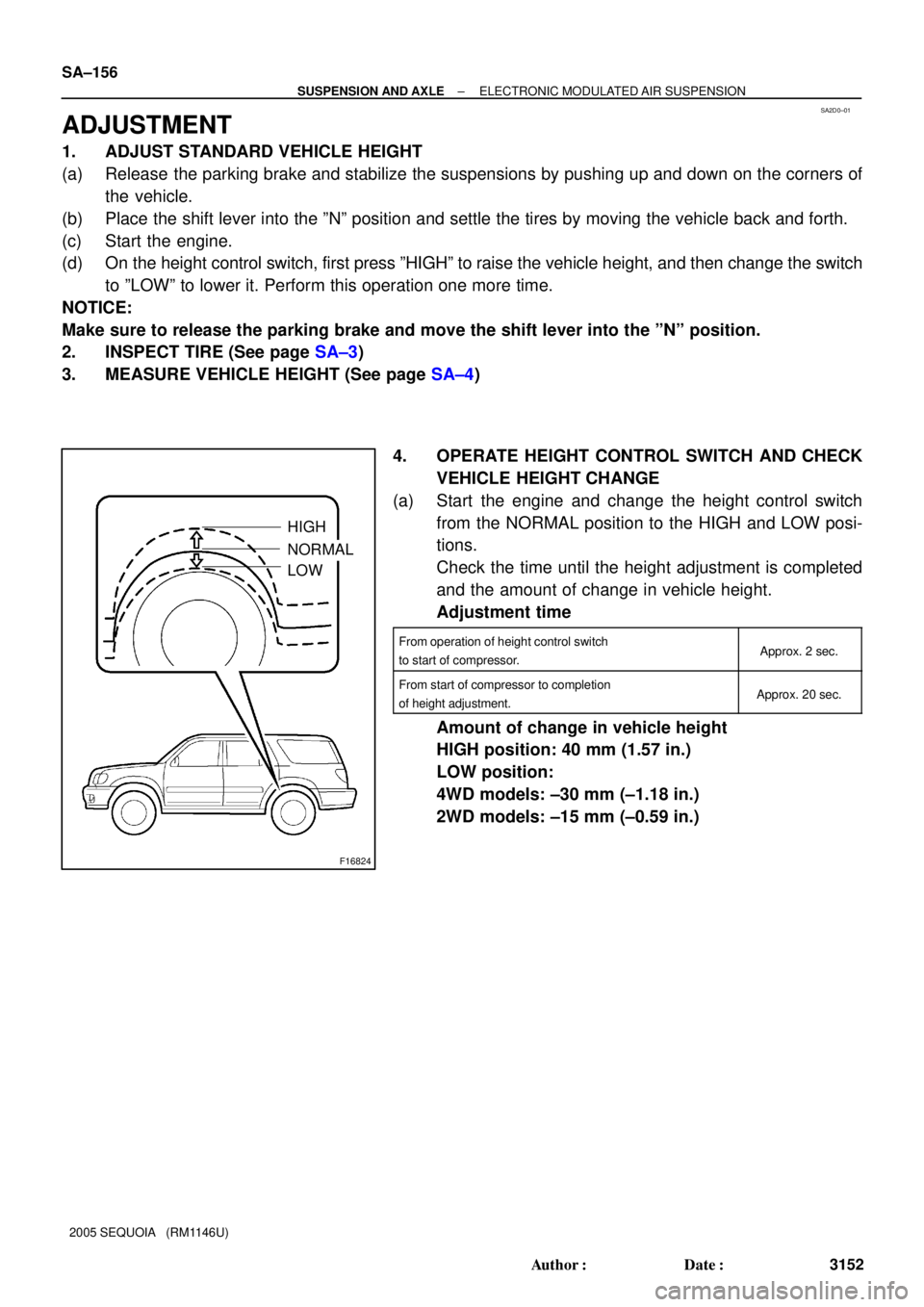
4. OPERATE HEIGHT CONTROL SWITCH AND CHECK
VEHICLE HEIGHT CHANGE
(a) Start the engine and change the height control switch
from the NORMAL position to the HIGH and LOW posi-
tions.
Check the time until the height adjustment is completed
and the amount of change in vehicle height.
Adjustment time
From operation of height control switch
to start of compressor.Approx. 2 sec.
From start of compressor to completion
of height adjustment.Approx. 20 sec.
Amount of change in vehicle height
HIGH position: 40 mm (1.57 in.)
LOW position:
4WD models: ±30 mm (±1.18 in.)
2WD models: ±15 mm (±0.59 in.)
Page 3161 of 4323
F19820
HIGH
NORMAL
LOW
± SUSPENSION AND AXLEELECTRONIC MODULATED AIR SUSPENSION
SA±157
3153 Author�: Date�:
2005 SEQUOIA (RM1146U)
(b) While adjusting vehicle height in the HIGH position, start
the engine and change the height control switch from the
HIGH position to the NORM position.
Check the time until the height adjustment is completed
and the amount of change in vehicle height.
Adjustment time
From operation of height control switch
to open of exhaust valve.Approx. 2 sec.
From open of exhaust valve to completion
of height adjustment.Approx. 30 sec.
Amount of change in vehicle height
HIGH position: 40 mm (1.57 in.)
LOW position:
4WD models: ±30 mm (±1.18 in.)
2WD models: ±15 mm (±0.59 in.)
Page 3162 of 4323
F16825
Front SA±158
± SUSPENSION AND AXLEELECTRONIC MODULATED AIR SUSPENSION
3154 Author�: Date�:
2005 SEQUOIA (RM1146U)
5. CHECK CONNECTIONS OF TUBES FOR AIR LEAK-
AGE
(a) Set the height control switch in the HIGH position and
raise the vehicle height.
(b) Stop the engine.
(c) Apply soapy water to the connections of the tubes and
check if there is any air leakage.
6. ADJUST VEHICLE HEIGHT
NOTICE:
While adjusting vehicle height, do not put anyone or any-
thing on or in the vehicle as it will affect vehicle height.
(a) Suspend the vehicle height control by pressing the height
control mode select switch.
(b) Put the vehicle on a level surface.
Page 3181 of 4323
F07754
Pedal Height Push Rod
BR107±04
R00085
Pedal Free Play BR±6
± BRAKEBRAKE PEDAL
3173 Author�: Date�:
2005 SEQUOIA (RM1146U)
BRAKE PEDAL
ON±VEHICLE INSPECTION
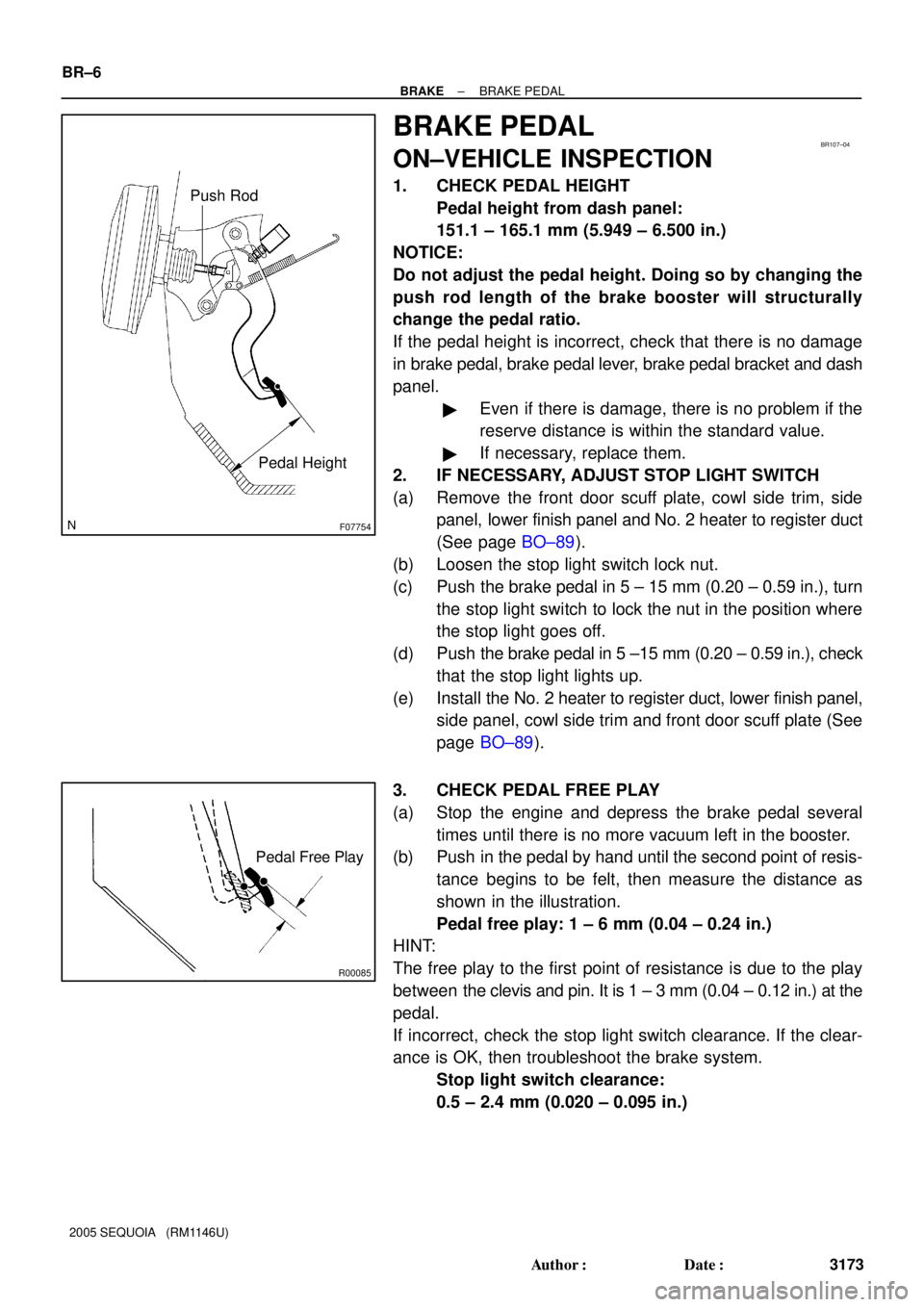
1. CHECK PEDAL HEIGHT
Pedal height from dash panel:
151.1 ± 165.1 mm (5.949 ± 6.500 in.)
NOTICE:
Do not adjust the pedal height. Doing so by changing the
push rod length of the brake booster will structurally
change the pedal ratio.
If the pedal height is incorrect, check that there is no damage
in brake pedal, brake pedal lever, brake pedal bracket and dash
panel.
�Even if there is damage, there is no problem if the
reserve distance is within the standard value.
�If necessary, replace them.
2. IF NECESSARY, ADJUST STOP LIGHT SWITCH
(a) Remove the front door scuff plate, cowl side trim, side
panel, lower finish panel and No. 2 heater to register duct
(See page BO±89).
(b) Loosen the stop light switch lock nut.
(c) Push the brake pedal in 5 ± 15 mm (0.20 ± 0.59 in.), turn
the stop light switch to lock the nut in the position where
the stop light goes off.
(d) Push the brake pedal in 5 ±15 mm (0.20 ± 0.59 in.), check
that the stop light lights up.
(e) Install the No. 2 heater to register duct, lower finish panel,
side panel, cowl side trim and front door scuff plate (See
page BO±89).
3. CHECK PEDAL FREE PLAY
(a) Stop the engine and depress the brake pedal several
times until there is no more vacuum left in the booster.
(b) Push in the pedal by hand until the second point of resis-
tance begins to be felt, then measure the distance as
shown in the illustration.
Pedal free play: 1 ± 6 mm (0.04 ± 0.24 in.)
HINT:
The free play to the first point of resistance is due to the play
between the clevis and pin. It is 1 ± 3 mm (0.04 ± 0.12 in.) at the
pedal.
If incorrect, check the stop light switch clearance. If the clear-
ance is OK, then troubleshoot the brake system.
Stop light switch clearance:
0.5 ± 2.4 mm (0.020 ± 0.095 in.)
Page 3182 of 4323
R00135
Pedal Reserve Distance
± BRAKEBRAKE PEDAL
BR±7
3174 Author�: Date�:
2005 SEQUOIA (RM1146U)
4. CHECK PEDAL RESERVE DISTANCE
Release the parking brake.
With the engine running, depress the pedal and measure the
pedal reserve distance, as shown.
Pedal reserve distance from asphalt sheet at 490 N
(50 kgf, 110.2 lbf): More than 95 mm (3.74 in.)
If the reserve distance is incorrect, troubleshoot the brake sys-
tem.
Page 3195 of 4323
BR2237
BR0AK±07
BR2238
1st3rd
2nd
GOOD
NO GOOD BR±20
± BRAKEBRAKE BOOSTER ASSEMBLY
3187 Author�: Date�:
2005 SEQUOIA (RM1146U)
BRAKE BOOSTER ASSEMBLY
ON±VEHICLE INSPECTION
1. OPERATING CHECK
(a) Depress the brake pedal several times with the engine off
and check that there is no change in the pedal reserve
distance.
(b) Depress the brake pedal and start the engine. If the pedal
goes down slightly, operation is normal.
2. AIR TIGHTNESS CHECK
(a) Start the engine and stop it after 1 or 2 minutes. Depress
the brake pedal several times slowly.
If the pedal goes down farthest the 1st time, but gradually rises
after the 2nd or 3rd time, the booster is airtight.
(b) Depress the brake pedal while the engine is running, and
stop the engine with the pedal depressed. If there is no
change in the pedal reserve travel after holding the pedal
for 30 seconds, the booster is airtight.