2001 NISSAN ALMERA fuse
[x] Cancel search: fusePage 1535 of 2898
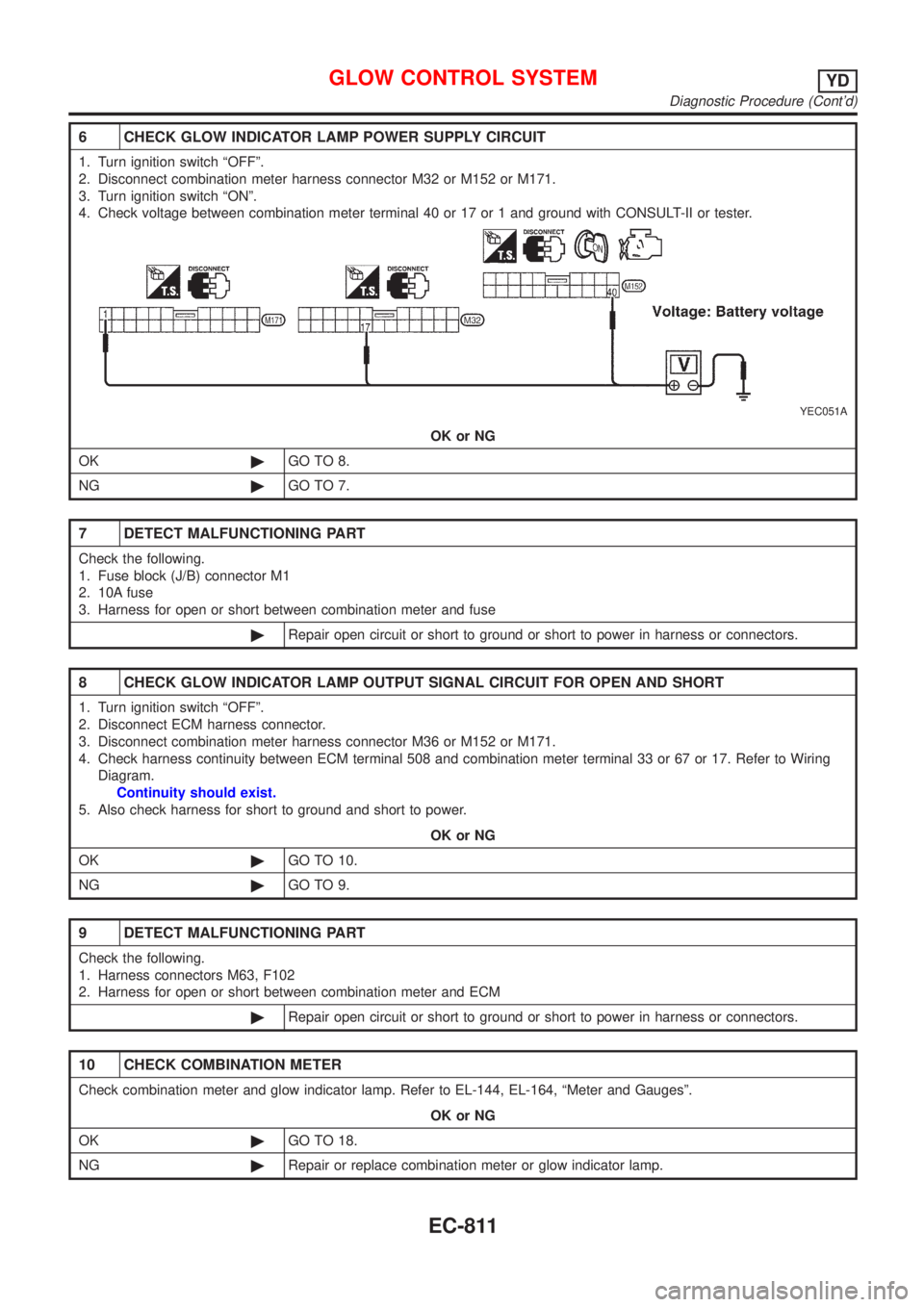
6 CHECK GLOW INDICATOR LAMP POWER SUPPLY CIRCUIT
1. Turn ignition switch ªOFFº.
2. Disconnect combination meter harness connector M32 or M152 or M171.
3. Turn ignition switch ªONº.
4. Check voltage between combination meter terminal 40 or 17 or 1 and ground with CONSULT-II or tester.
YEC051A
OK or NG
OK©GO TO 8.
NG©GO TO 7.
7 DETECT MALFUNCTIONING PART
Check the following.
1. Fuse block (J/B) connector M1
2. 10A fuse
3. Harness for open or short between combination meter and fuse
©Repair open circuit or short to ground or short to power in harness or connectors.
8 CHECK GLOW INDICATOR LAMP OUTPUT SIGNAL CIRCUIT FOR OPEN AND SHORT
1. Turn ignition switch ªOFFº.
2. Disconnect ECM harness connector.
3. Disconnect combination meter harness connector M36 or M152 or M171.
4. Check harness continuity between ECM terminal 508 and combination meter terminal 33 or 67 or 17. Refer to Wiring
Diagram.
Continuity should exist.
5. Also check harness for short to ground and short to power.
OK or NG
OK©GO TO 10.
NG©GO TO 9.
9 DETECT MALFUNCTIONING PART
Check the following.
1. Harness connectors M63, F102
2. Harness for open or short between combination meter and ECM
©Repair open circuit or short to ground or short to power in harness or connectors.
10 CHECK COMBINATION METER
Check combination meter and glow indicator lamp. Refer to EL-144, EL-164, ªMeter and Gaugesº.
OK or NG
OK©GO TO 18.
NG©Repair or replace combination meter or glow indicator lamp.
GLOW CONTROL SYSTEMYD
Diagnostic Procedure (Cont'd)
EC-811
Page 1544 of 2898
3 CHECK EGR VOLUME CONTROL VALVE POWER SUPPLY CIRCUIT-II
1. Turn ignition switch ªOFFº.
2. Disconnect ECM relay. (For ECM relay location, refer to ªEngine Control Component Parts Locationº.)
3. Check harness continuity between ECM relay terminal 5 and EGR volume control valve terminals 2 and 5. Refer to
Wiring Diagram.
Continuity should exist.
OK or NG
OK©GO TO 4.
NG©Repair open circuit or short to ground or short to power in harness or connectors.
4 CHECK EGR VOLUME CONTROL VALVE POWER SUPPLY CIRCUIT-III
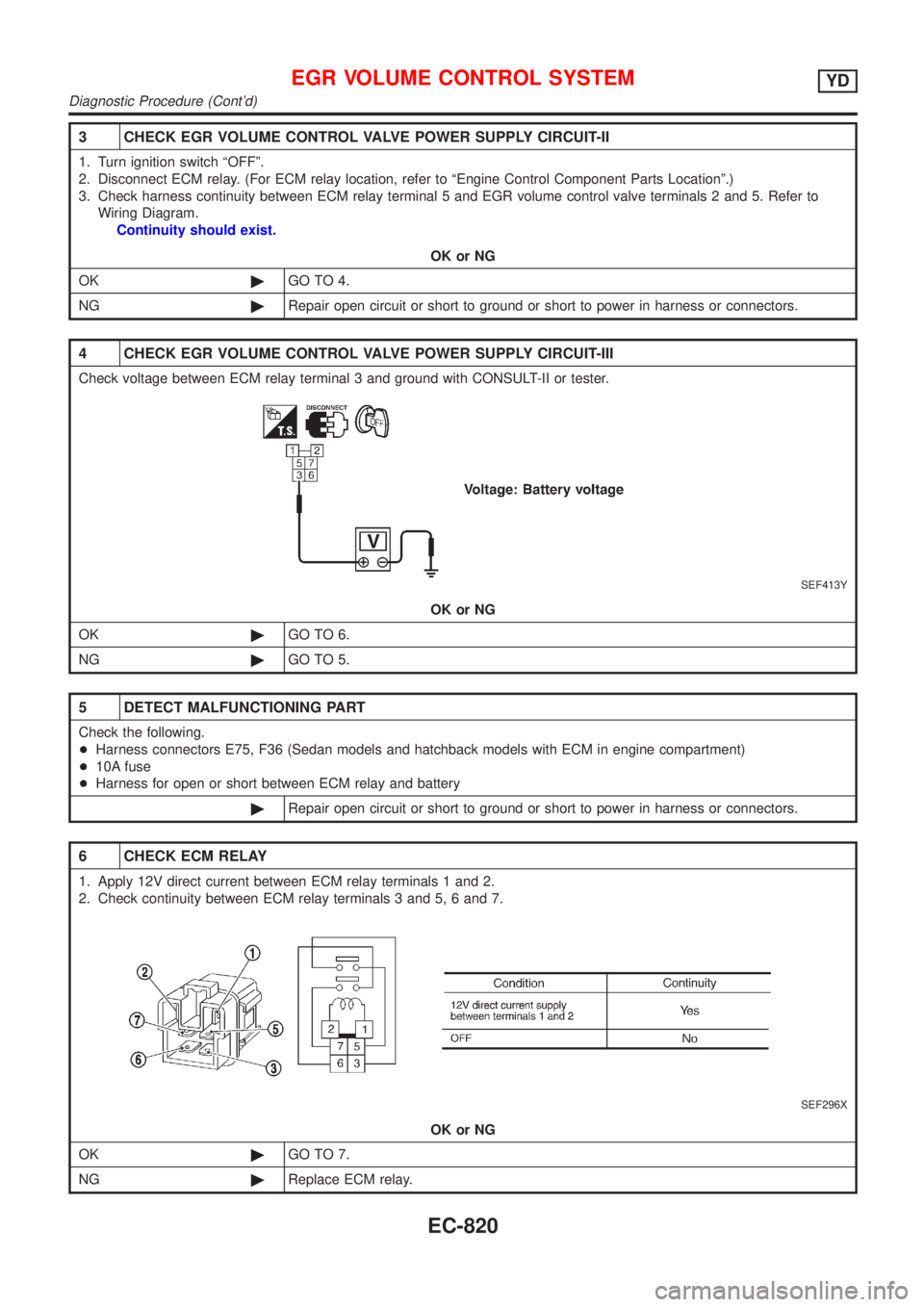
Check voltage between ECM relay terminal 3 and ground with CONSULT-II or tester.
SEF413Y
OK or NG
OK©GO TO 6.
NG©GO TO 5.
5 DETECT MALFUNCTIONING PART
Check the following.
+Harness connectors E75, F36 (Sedan models and hatchback models with ECM in engine compartment)
+10A fuse
+Harness for open or short between ECM relay and battery
©Repair open circuit or short to ground or short to power in harness or connectors.
6 CHECK ECM RELAY
1. Apply 12V direct current between ECM relay terminals 1 and 2.
2. Check continuity between ECM relay terminals 3 and 5, 6 and 7.
SEF296X
OK or NG
OK©GO TO 7.
NG©Replace ECM relay.
EGR VOLUME CONTROL SYSTEMYD
Diagnostic Procedure (Cont'd)
EC-820
Page 1548 of 2898
Diagnostic ProcedureNJEC0770
1 CHECK START SIGNAL OVERALL FUNCTION
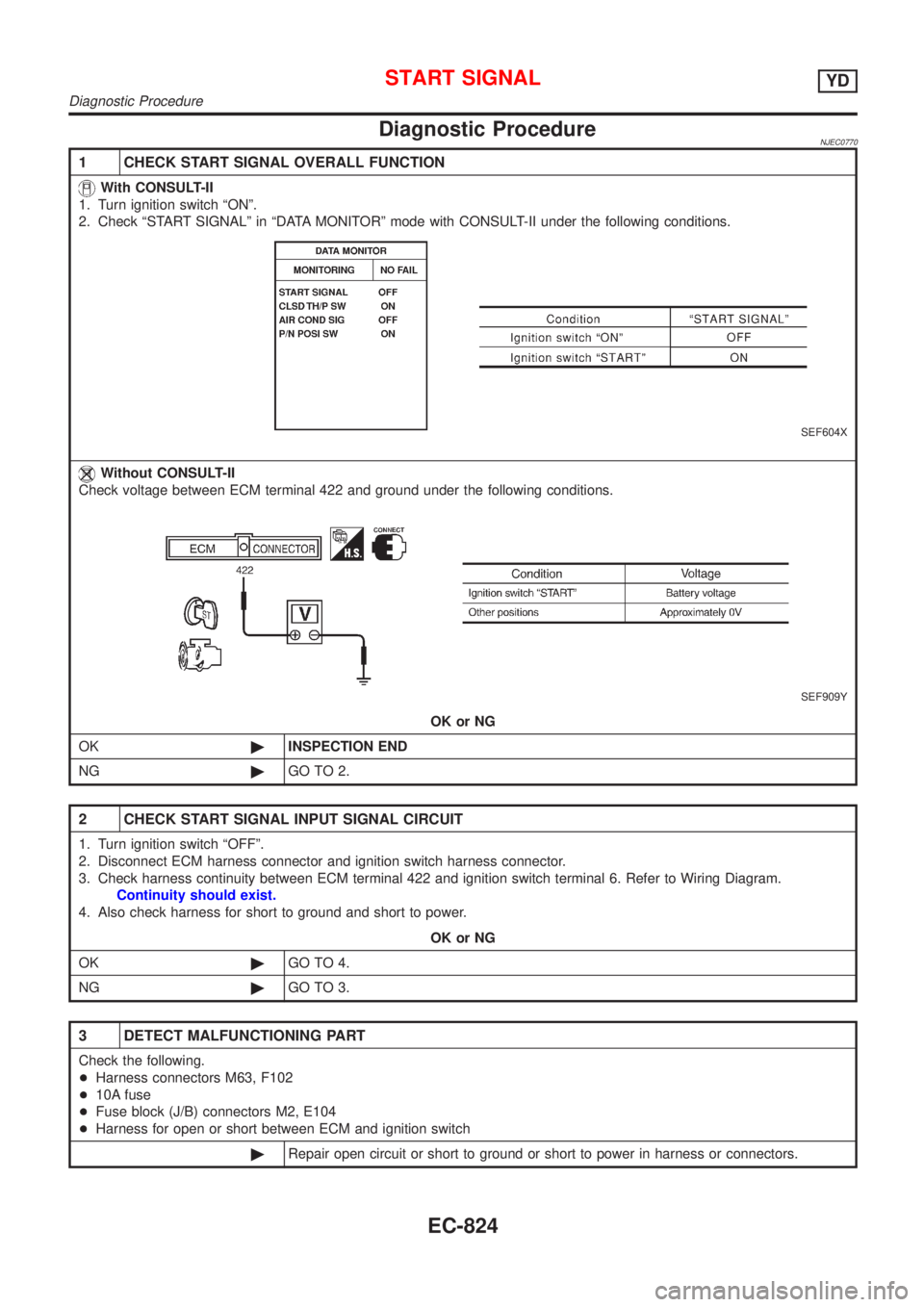
With CONSULT-II
1. Turn ignition switch ªONº.
2. Check ªSTART SIGNALº in ªDATA MONITORº mode with CONSULT-II under the following conditions.
SEF604X
Without CONSULT-II
Check voltage between ECM terminal 422 and ground under the following conditions.
SEF909Y
OK or NG
OK©INSPECTION END
NG©GO TO 2.
2 CHECK START SIGNAL INPUT SIGNAL CIRCUIT
1. Turn ignition switch ªOFFº.
2. Disconnect ECM harness connector and ignition switch harness connector.
3. Check harness continuity between ECM terminal 422 and ignition switch terminal 6. Refer to Wiring Diagram.
Continuity should exist.
4. Also check harness for short to ground and short to power.
OK or NG
OK©GO TO 4.
NG©GO TO 3.
3 DETECT MALFUNCTIONING PART
Check the following.
+Harness connectors M63, F102
+10A fuse
+Fuse block (J/B) connectors M2, E104
+Harness for open or short between ECM and ignition switch
©Repair open circuit or short to ground or short to power in harness or connectors.
START SIGNALYD
Diagnostic Procedure
EC-824
Page 1596 of 2898
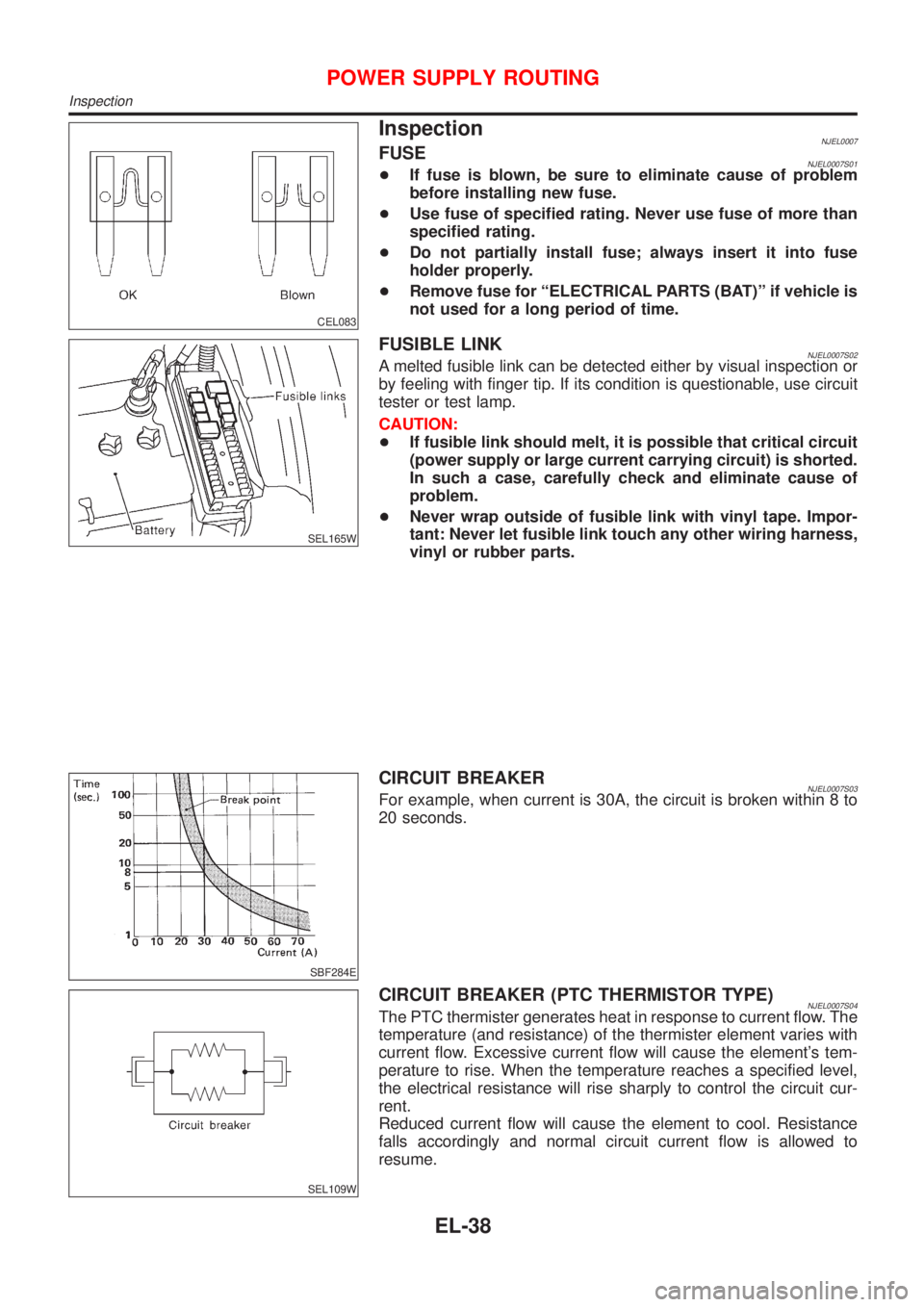
CEL083
InspectionNJEL0007FUSENJEL0007S01+If fuse is blown, be sure to eliminate cause of problem
before installing new fuse.
+Use fuse of specified rating. Never use fuse of more than
specified rating.
+Do not partially install fuse; always insert it into fuse
holder properly.
+Remove fuse for ªELECTRICAL PARTS (BAT)º if vehicle is
not used for a long period of time.
SEL165W
FUSIBLE LINKNJEL0007S02A melted fusible link can be detected either by visual inspection or
by feeling with finger tip. If its condition is questionable, use circuit
tester or test lamp.
CAUTION:
+If fusible link should melt, it is possible that critical circuit
(power supply or large current carrying circuit) is shorted.
In such a case, carefully check and eliminate cause of
problem.
+Never wrap outside of fusible link with vinyl tape. Impor-
tant: Never let fusible link touch any other wiring harness,
vinyl or rubber parts.
SBF284E
CIRCUIT BREAKERNJEL0007S03For example, when current is 30A, the circuit is broken within 8 to
20 seconds.
SEL109W
CIRCUIT BREAKER (PTC THERMISTOR TYPE)NJEL0007S04The PTC thermister generates heat in response to current flow. The
temperature (and resistance) of the thermister element varies with
current flow. Excessive current flow will cause the element's tem-
perature to rise. When the temperature reaches a specified level,
the electrical resistance will rise sharply to control the circuit cur-
rent.
Reduced current flow will cause the element to cool. Resistance
falls accordingly and normal circuit current flow is allowed to
resume.
POWER SUPPLY ROUTING
Inspection
EL-38
Page 1621 of 2898
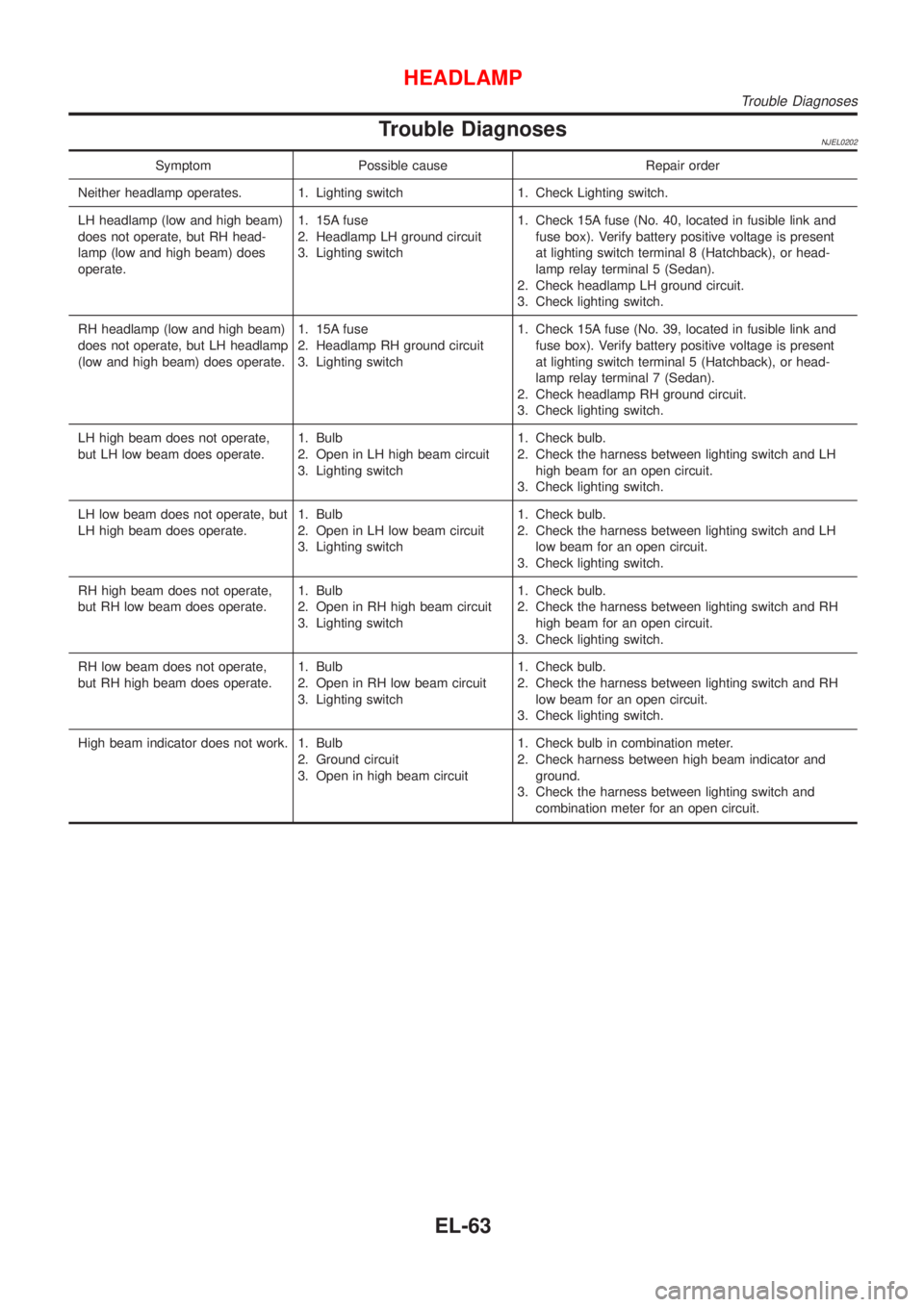
Trouble DiagnosesNJEL0202
Symptom Possible cause Repair order
Neither headlamp operates. 1. Lighting switch 1. Check Lighting switch.
LH headlamp (low and high beam)
does not operate, but RH head-
lamp (low and high beam) does
operate.1. 15A fuse
2. Headlamp LH ground circuit
3. Lighting switch1. Check 15A fuse (No. 40, located in fusible link and
fuse box). Verify battery positive voltage is present
at lighting switch terminal 8 (Hatchback), or head-
lamp relay terminal 5 (Sedan).
2. Check headlamp LH ground circuit.
3. Check lighting switch.
RH headlamp (low and high beam)
does not operate, but LH headlamp
(low and high beam) does operate.1. 15A fuse
2. Headlamp RH ground circuit
3. Lighting switch1. Check 15A fuse (No. 39, located in fusible link and
fuse box). Verify battery positive voltage is present
at lighting switch terminal 5 (Hatchback), or head-
lamp relay terminal 7 (Sedan).
2. Check headlamp RH ground circuit.
3. Check lighting switch.
LH high beam does not operate,
but LH low beam does operate.1. Bulb
2. Open in LH high beam circuit
3. Lighting switch1. Check bulb.
2. Check the harness between lighting switch and LH
high beam for an open circuit.
3. Check lighting switch.
LH low beam does not operate, but
LH high beam does operate.1. Bulb
2. Open in LH low beam circuit
3. Lighting switch1. Check bulb.
2. Check the harness between lighting switch and LH
low beam for an open circuit.
3. Check lighting switch.
RH high beam does not operate,
but RH low beam does operate.1. Bulb
2. Open in RH high beam circuit
3. Lighting switch1. Check bulb.
2. Check the harness between lighting switch and RH
high beam for an open circuit.
3. Check lighting switch.
RH low beam does not operate,
but RH high beam does operate.1. Bulb
2. Open in RH low beam circuit
3. Lighting switch1. Check bulb.
2. Check the harness between lighting switch and RH
low beam for an open circuit.
3. Check lighting switch.
High beam indicator does not work. 1. Bulb
2. Ground circuit
3. Open in high beam circuit1. Check bulb in combination meter.
2. Check harness between high beam indicator and
ground.
3. Check the harness between lighting switch and
combination meter for an open circuit.
HEADLAMP
Trouble Diagnoses
EL-63
Page 1625 of 2898
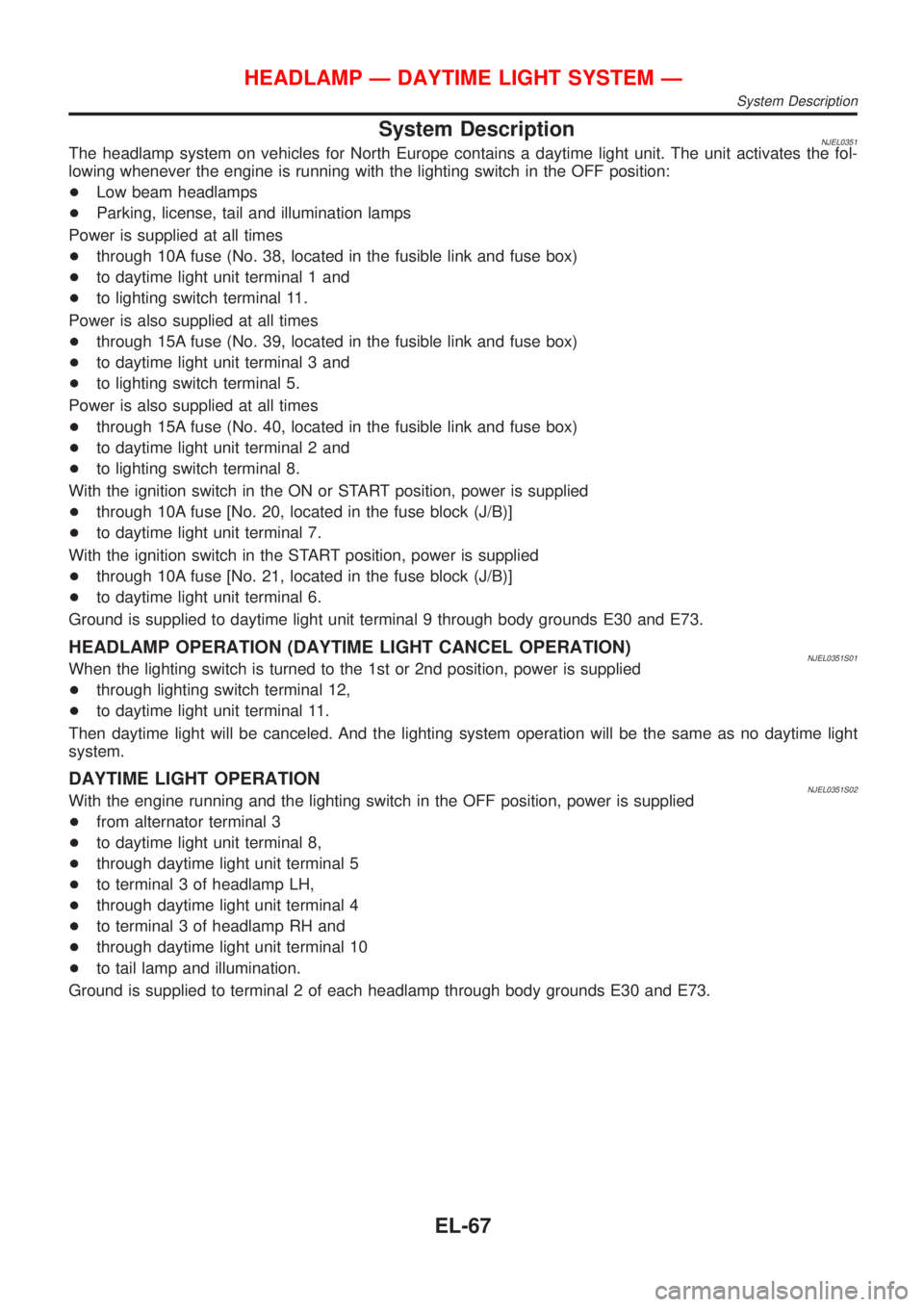
System DescriptionNJEL0351The headlamp system on vehicles for North Europe contains a daytime light unit. The unit activates the fol-
lowing whenever the engine is running with the lighting switch in the OFF position:
+Low beam headlamps
+Parking, license, tail and illumination lamps
Power is supplied at all times
+through 10A fuse (No. 38, located in the fusible link and fuse box)
+to daytime light unit terminal 1 and
+to lighting switch terminal 11.
Power is also supplied at all times
+through 15A fuse (No. 39, located in the fusible link and fuse box)
+to daytime light unit terminal 3 and
+to lighting switch terminal 5.
Power is also supplied at all times
+through 15A fuse (No. 40, located in the fusible link and fuse box)
+to daytime light unit terminal 2 and
+to lighting switch terminal 8.
With the ignition switch in the ON or START position, power is supplied
+through 10A fuse [No. 20, located in the fuse block (J/B)]
+to daytime light unit terminal 7.
With the ignition switch in the START position, power is supplied
+through 10A fuse [No. 21, located in the fuse block (J/B)]
+to daytime light unit terminal 6.
Ground is supplied to daytime light unit terminal 9 through body grounds E30 and E73.
HEADLAMP OPERATION (DAYTIME LIGHT CANCEL OPERATION)NJEL0351S01When the lighting switch is turned to the 1st or 2nd position, power is supplied
+through lighting switch terminal 12,
+to daytime light unit terminal 11.
Then daytime light will be canceled. And the lighting system operation will be the same as no daytime light
system.
DAYTIME LIGHT OPERATIONNJEL0351S02With the engine running and the lighting switch in the OFF position, power is supplied
+from alternator terminal 3
+to daytime light unit terminal 8,
+through daytime light unit terminal 5
+to terminal 3 of headlamp LH,
+through daytime light unit terminal 4
+to terminal 3 of headlamp RH and
+through daytime light unit terminal 10
+to tail lamp and illumination.
Ground is supplied to terminal 2 of each headlamp through body grounds E30 and E73.
HEADLAMP Ð DAYTIME LIGHT SYSTEM Ð
System Description
EL-67
Page 1654 of 2898
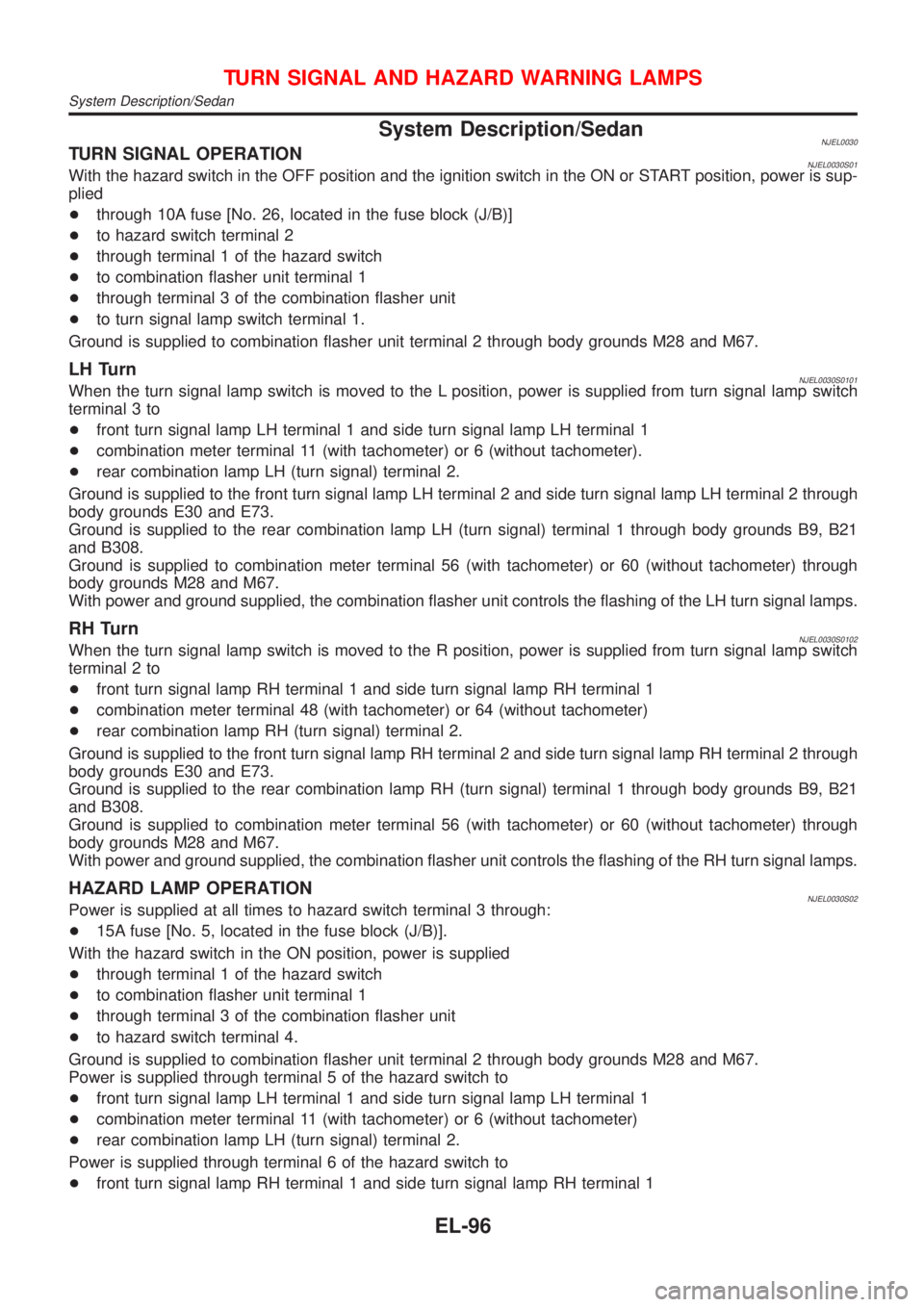
System Description/SedanNJEL0030TURN SIGNAL OPERATIONNJEL0030S01With the hazard switch in the OFF position and the ignition switch in the ON or START position, power is sup-
plied
+through 10A fuse [No. 26, located in the fuse block (J/B)]
+to hazard switch terminal 2
+through terminal 1 of the hazard switch
+to combination flasher unit terminal 1
+through terminal 3 of the combination flasher unit
+to turn signal lamp switch terminal 1.
Ground is supplied to combination flasher unit terminal 2 through body grounds M28 and M67.
LH TurnNJEL0030S0101When the turn signal lamp switch is moved to the L position, power is supplied from turn signal lamp switch
terminal 3 to
+front turn signal lamp LH terminal 1 and side turn signal lamp LH terminal 1
+combination meter terminal 11 (with tachometer) or 6 (without tachometer).
+rear combination lamp LH (turn signal) terminal 2.
Ground is supplied to the front turn signal lamp LH terminal 2 and side turn signal lamp LH terminal 2 through
body grounds E30 and E73.
Ground is supplied to the rear combination lamp LH (turn signal) terminal 1 through body grounds B9, B21
and B308.
Ground is supplied to combination meter terminal 56 (with tachometer) or 60 (without tachometer) through
body grounds M28 and M67.
With power and ground supplied, the combination flasher unit controls the flashing of the LH turn signal lamps.
RH TurnNJEL0030S0102When the turn signal lamp switch is moved to the R position, power is supplied from turn signal lamp switch
terminal 2 to
+front turn signal lamp RH terminal 1 and side turn signal lamp RH terminal 1
+combination meter terminal 48 (with tachometer) or 64 (without tachometer)
+rear combination lamp RH (turn signal) terminal 2.
Ground is supplied to the front turn signal lamp RH terminal 2 and side turn signal lamp RH terminal 2 through
body grounds E30 and E73.
Ground is supplied to the rear combination lamp RH (turn signal) terminal 1 through body grounds B9, B21
and B308.
Ground is supplied to combination meter terminal 56 (with tachometer) or 60 (without tachometer) through
body grounds M28 and M67.
With power and ground supplied, the combination flasher unit controls the flashing of the RH turn signal lamps.
HAZARD LAMP OPERATIONNJEL0030S02Power is supplied at all times to hazard switch terminal 3 through:
+15A fuse [No. 5, located in the fuse block (J/B)].
With the hazard switch in the ON position, power is supplied
+through terminal 1 of the hazard switch
+to combination flasher unit terminal 1
+through terminal 3 of the combination flasher unit
+to hazard switch terminal 4.
Ground is supplied to combination flasher unit terminal 2 through body grounds M28 and M67.
Power is supplied through terminal 5 of the hazard switch to
+front turn signal lamp LH terminal 1 and side turn signal lamp LH terminal 1
+combination meter terminal 11 (with tachometer) or 6 (without tachometer)
+rear combination lamp LH (turn signal) terminal 2.
Power is supplied through terminal 6 of the hazard switch to
+front turn signal lamp RH terminal 1 and side turn signal lamp RH terminal 1
TURN SIGNAL AND HAZARD WARNING LAMPS
System Description/Sedan
EL-96
Page 1659 of 2898
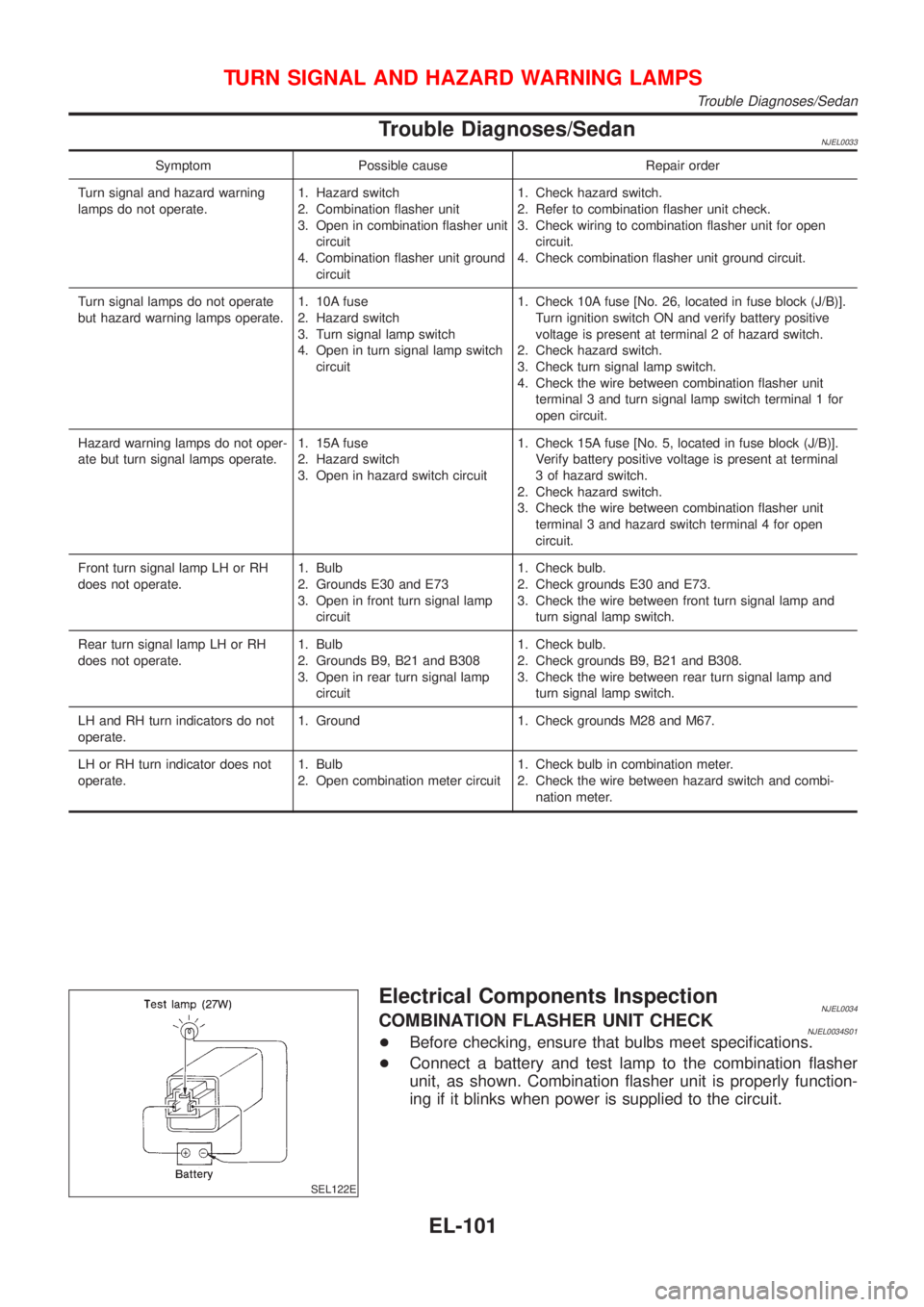
Trouble Diagnoses/SedanNJEL0033
Symptom Possible cause Repair order
Turn signal and hazard warning
lamps do not operate.1. Hazard switch
2. Combination flasher unit
3. Open in combination flasher unit
circuit
4. Combination flasher unit ground
circuit1. Check hazard switch.
2. Refer to combination flasher unit check.
3. Check wiring to combination flasher unit for open
circuit.
4. Check combination flasher unit ground circuit.
Turn signal lamps do not operate
but hazard warning lamps operate.1. 10A fuse
2. Hazard switch
3. Turn signal lamp switch
4. Open in turn signal lamp switch
circuit1. Check 10A fuse [No. 26, located in fuse block (J/B)].
Turn ignition switch ON and verify battery positive
voltage is present at terminal 2 of hazard switch.
2. Check hazard switch.
3. Check turn signal lamp switch.
4. Check the wire between combination flasher unit
terminal 3 and turn signal lamp switch terminal 1 for
open circuit.
Hazard warning lamps do not oper-
ate but turn signal lamps operate.1. 15A fuse
2. Hazard switch
3. Open in hazard switch circuit1. Check 15A fuse [No. 5, located in fuse block (J/B)].
Verify battery positive voltage is present at terminal
3 of hazard switch.
2. Check hazard switch.
3. Check the wire between combination flasher unit
terminal 3 and hazard switch terminal 4 for open
circuit.
Front turn signal lamp LH or RH
does not operate.1. Bulb
2. Grounds E30 and E73
3. Open in front turn signal lamp
circuit1. Check bulb.
2. Check grounds E30 and E73.
3. Check the wire between front turn signal lamp and
turn signal lamp switch.
Rear turn signal lamp LH or RH
does not operate.1. Bulb
2. Grounds B9, B21 and B308
3. Open in rear turn signal lamp
circuit1. Check bulb.
2. Check grounds B9, B21 and B308.
3. Check the wire between rear turn signal lamp and
turn signal lamp switch.
LH and RH turn indicators do not
operate.1. Ground 1. Check grounds M28 and M67.
LH or RH turn indicator does not
operate.1. Bulb
2. Open combination meter circuit1. Check bulb in combination meter.
2. Check the wire between hazard switch and combi-
nation meter.
SEL122E
Electrical Components InspectionNJEL0034COMBINATION FLASHER UNIT CHECKNJEL0034S01+Before checking, ensure that bulbs meet specifications.
+Connect a battery and test lamp to the combination flasher
unit, as shown. Combination flasher unit is properly function-
ing if it blinks when power is supplied to the circuit.
TURN SIGNAL AND HAZARD WARNING LAMPS
Trouble Diagnoses/Sedan
EL-101