2001 NISSAN ALMERA lock
[x] Cancel search: lockPage 71 of 2898

SAT631IA
SAT632I
SEF234G
IntroductionNJAT0023The TCM receives a signal from the vehicle speed sensor, throttle
position sensor or PNP switch and provides shift control or lock-up
control via A/T solenoid valves.
Input and output signals must always be correct and stable in the
operation of the A/T system. The A/T system must be in good
operating condition and be free of valve seizure, solenoid valve
malfunction, etc.
It is much more difficult to diagnose a problem that occurs intermit-
tently rather than continuously. Most intermittent problems are
caused by poor electric connections or improper wiring. In this
case, careful checking of suspected circuits may help prevent the
replacement of good parts.
A visual check only, may not find the cause of the problems. A road
test with CONSULT-II or a circuit tester connected should be per-
formed. Follow the ªWork Flowº. Refer to AT-73.
Before undertaking actual checks, take a few minutes to talk with
a customer who approaches with a driveability complaint. The cus-
tomer can supply good information about such problems, espe-
cially intermittent ones. Find out what symptoms are present and
under what conditions they occur. A ªDiagnostic Worksheetº like the
example (AT-70) should be used.
Start your diagnosis by looking for ªconventionalº problems first.
This will help troubleshoot driveability problems on an electronically
controlled engine vehicle.
Also check related Service bulletins for information.
TROUBLE DIAGNOSIS Ð
INTRODUCTION
EXCEPT FOR EURO-OBD
AT-69
Page 72 of 2898

DIAGNOSTIC WORKSHEET=NJAT0023S01Information from CustomerNJAT0023S0101KEY POINTS
WHAT..... Vehicle & A/T model
WHEN..... Date, Frequencies
WHERE..... Road conditions
HOW..... Operating conditions, Symptoms
Customer name MR/MS Model & Year VIN
Trans. model Engine Mileage
Incident Date Manuf. Date In Service Date
FrequencyNContinuousNIntermittent ( times a day)
SymptomsNVehicle does not move. (NAny positionNParticular position)
NNo up-shift (N1st®2ndN2nd®3rdN3rd®O/D)
NNo down-shift (NO/D®3rdN3rd®2ndN2nd®1st)
NLockup malfunction
NShift point too high or too low.
NShift shock or slip (NN®DNLockupNAny drive position)
NNoise or vibration
NNo kickdown
NNo pattern select
NOthers
()
O/D OFF indicator lamp Blinks for about 8 seconds.
NContinuously litNNot lit
Malfunction indicator (MI)NContinuously litNNot lit
TROUBLE DIAGNOSIS Ð
INTRODUCTION
EXCEPT FOR EURO-OBD
Introduction (Cont'd)
AT-70
Page 74 of 2898

4. 4-3. Cruise testAT-92
AT-95
Part-1
N8. Vehicle Cannot Be Started From D
1, AT-311.
N9. A/T Does Not Shift: D
1®D2Or Does Not Kickdown: D4®D2, AT-314.
N10. A/T Does Not Shift: D
2®D3, AT-317.
N11. A/T Does Not Shift: D
3®D4, AT-320.
N12. A/T Does Not Perform Lock-up, AT-323.
N13. A/T Does Not Hold Lock-up Condition, AT-325.
N14. Lock-up Is Not Released, AT-327.
N15. Engine Speed Does Not Return To Idle (Light Braking D
4®D3), AT-328.
Part-2AT-99
N16. Vehicle Does Not Start From D
1, AT-330.
N9. A/T Does Not Shift: D
1®D2Or Does Not Kickdown: D4®D2, AT-314.
N10. A/T Does Not Shift: D
2®D3, AT-317.
N11. A/T Does Not Shift: D
3®D4, AT-320.
Part-3AT-101
N17. A/T Does Not Shift: D
4®D3When Overdrive Control Switch ªONº®ªOFFº, AT-331
N15. Engine Speed Does Not Return To Idle (Engine Brake In D
3), AT-328.
N18. A/T Does Not Shift: D
3®22, When Selector Lever ªDº®ª2º Position, AT-332.
N15. Engine Speed Does Not Return To Idle (Engine Brake In 2
2), AT-328.
N19. A/T Does Not Shift: 2
2®11, When Selector Lever ª2º®ª1º Position, AT-333.
N20. Vehicle Does Not Decelerate By Engine Brake, AT-334.
N21. TCM Self-diagnosis Does Not Activate (PNP, Overdrive Control and Throttle Position Switches
Circuit Checks), AT-334.
NSELF-DIAGNOSTIC PROCEDURE Ð Mark detected items.
NVehicle speed sensor´A/T (Revolution sensor), AT-126.
NVehicle speed sensor´MTR, AT-131.
NThrottle position sensor, AT-134.
NShift solenoid valve A, AT-142.
NShift solenoid valve B, AT-148.
NOverrun clutch solenoid valve, AT-154.
NTorque converter clutch solenoid valve, AT-159.
NA/T fluid temperature sensor and TCM power source, AT-165.
NEngine speed signal, AT-172.
NLine pressure solenoid valve, AT-176.
NControl unit (RAM), control unit (ROM), AT-286.
NControl unit (EEP ROM), AT-288.
NPNP, overdrive control and throttle position switches, AT-334.
NBattery
NOthers
5.NFor self-diagnosis NG items, inspect each component. Repair or replace the damaged parts. AT-40
6.NPerform all ROAD TEST and re-mark required procedures. AT-85
7.NPerform the Diagnostic Procedures for all remaining items marked NG. Repair or replace the damaged
parts.
Refer to the Symptom Chart when you perform the procedures. (The chart also shows some other possible
symptoms and the component inspection orders.)AT-118
AT-105
8.NErase self-diagnosis code from TCM memories. AT-43
AT-49
TROUBLE DIAGNOSIS Ð
INTRODUCTION
EXCEPT FOR EURO-OBD
Introduction (Cont'd)
AT-72
Page 76 of 2898

SAT631IA
SAT632I
SEF234G
IntroductionNJAT0257The TCM receives a signal from the vehicle speed sensor, throttle
position sensor or PNP switch and provides shift control or lock-up
control via A/T solenoid valves.
The TCM also communicates with the ECM by means of a signal
sent from sensing elements used with the EURO-OBD related
parts of the A/T system for malfunction-diagnostic purposes. The
TCM is capable of diagnosing malfunctioning parts while the ECM
can store malfunctions in its memory.
Input and output signals must always be correct and stable in the
operation of the A/T system. The A/T system must be in good
operating condition and be free of valve seizure, solenoid valve
malfunction, etc.
It is much more difficult to diagnose a problem that occurs intermit-
tently rather than continuously. Most intermittent problems are
caused by poor electric connections or improper wiring. In this
case, careful checking of suspected circuits may help prevent the
replacement of good parts.
A visual check only, may not find the cause of the problems. A road
test with CONSULT-II (or GST) or a circuit tester connected should
be performed. Follow the ªWork Flowº. Refer to AT-78.
Before undertaking actual checks, take a few minutes to talk with
a customer who approaches with a driveability complaint. The cus-
tomer can supply good information about such problems, espe-
cially intermittent ones. Find out what symptoms are present and
under what conditions they occur. A ªDiagnostic Worksheetº like the
example (AT-75) should be used.
Start your diagnosis by looking for ªconventionalº problems first.
This will help troubleshoot driveability problems on an electronically
controlled engine vehicle.
Also check related Service bulletins for information.
TROUBLE DIAGNOSIS Ð INTRODUCTIONEURO-OBD
AT-74
Page 77 of 2898

DIAGNOSTIC WORKSHEET=NJAT0257S01Information from CustomerNJAT0257S0101KEY POINTS
WHAT..... Vehicle & A/T model
WHEN..... Date, Frequencies
WHERE..... Road conditions
HOW..... Operating conditions, Symptoms
Customer name MR/MS Model & Year VIN
Trans. model Engine Mileage
Incident Date Manuf. Date In Service Date
FrequencyNContinuousNIntermittent ( times a day)
SymptomsNVehicle does not move. (NAny positionNParticular position)
NNo up-shift (N1st®2ndN2nd®3rdN3rd®O/D)
NNo down-shift (NO/D®3rdN3rd®2ndN2nd®1st)
NLockup malfunction
NShift point too high or too low.
NShift shock or slip (NN®DNLockupNAny drive position)
NNoise or vibration
NNo kickdown
NNo pattern select
NOthers
()
O/D OFF indicator lamp Blinks for about 8 seconds.
NContinuously litNNot lit
Malfunction indicator (MI)NContinuously litNNot lit
TROUBLE DIAGNOSIS Ð INTRODUCTIONEURO-OBD
Introduction (Cont'd)
AT-75
Page 79 of 2898

4. 4-3. Cruise testAT-92
AT-95
Part-1
N8. Vehicle Cannot Be Started From D
1, AT-311.
N9. A/T Does Not Shift: D
1®D2Or Does Not Kickdown: D4®D2, AT-314.
N10. A/T Does Not Shift: D
2®D3, AT-317.
N11. A/T Does Not Shift: D
3®D4, AT-320.
N12. A/T Does Not Perform Lock-up, AT-323.
N13. A/T Does Not Hold Lock-up Condition, AT-325.
N14. Lock-up Is Not Released, AT-327.
N15. Engine Speed Does Not Return To Idle (Light Braking D
4®D3), AT-328.
Part-2AT-99
N16. Vehicle Does Not Start From D
1, AT-330.
N9. A/T Does Not Shift: D
1®D2Or Does Not Kickdown: D4®D2, AT-314.
N10. A/T Does Not Shift: D
2®D3, AT-317.
N11. A/T Does Not Shift: D
3®D4, AT-320.
Part-3AT-101
N17. A/T Does Not Shift: D
4®D3When Overdrive Control Switch ªONº®ªOFFº, AT-331
N15. Engine Speed Does Not Return To Idle (Engine Brake In D
3), AT-328.
N18. A/T Does Not Shift: D
3®22, When Selector Lever ªDº®ª2º Position, AT-332.
N15. Engine Speed Does Not Return To Idle (Engine Brake In 2
2), AT-328.
N19. A/T Does Not Shift: 2
2®11, When Selector Lever ª2º®ª1º Position, AT-333.
N20. Vehicle Does Not Decelerate By Engine Brake, AT-334.
NSELF-DIAGNOSTIC PROCEDURE Ð Mark detected items.
NPNP switch, AT-183.
NA/T fluid temperature sensor, AT-189.
NVehicle speed sensor´A/T (Revolution sensor), AT-195.
NEngine speed signal, AT-200.
NTorque converter clutch solenoid valve, AT-233.
NLine pressure solenoid valve, AT-239.
NShift solenoid valve A, AT-246.
NShift solenoid valve B, AT-252.
NThrottle position sensor, AT-258.
NOverrun clutch solenoid valve, AT-268.
NPNP, overdrive control and throttle position switches, AT-334.
NA/T fluid temperature sensor and TCM power source, AT-274.
NVehicle speed sensor´MTR, AT-281.
NControl unit (RAM), control unit (ROM), AT-286.
NControl unit (EEP ROM), AT-288.
NBattery
NOthers
5.NFor self-diagnosis NG items, inspect each component. Repair or replace the damaged parts. AT-55
6.NPerform all ROAD TEST and re-mark required procedures. AT-85
7.NPerform DTC CONFIRMATION PROCEDURE for following MIL indicating items and check out NG items.
Refer to EC-60, ªEmission-related Diagnostic Informationº.EC section
NDTC (P0731) A/T 1st gear function, AT-204.
NDTC (P0732) A/T 2nd gear function, AT-211.
NDTC (P0733) A/T 3rd gear function, AT-217.
NDTC (P0734) A/T 4th gear function, AT-223.
8.NPerform the Diagnostic Procedures for all remaining items marked NG. Repair or replace the damaged
parts.
Refer to the Symptom Chart when you perform the procedures. (The chart also shows some other possible
symptoms and the component inspection orders.)AT-105
AT-118
9.NErase DTC from TCM and ECM memories. AT-52
TROUBLE DIAGNOSIS Ð INTRODUCTIONEURO-OBD
Introduction (Cont'd)
AT-77
Page 83 of 2898
SAT513G
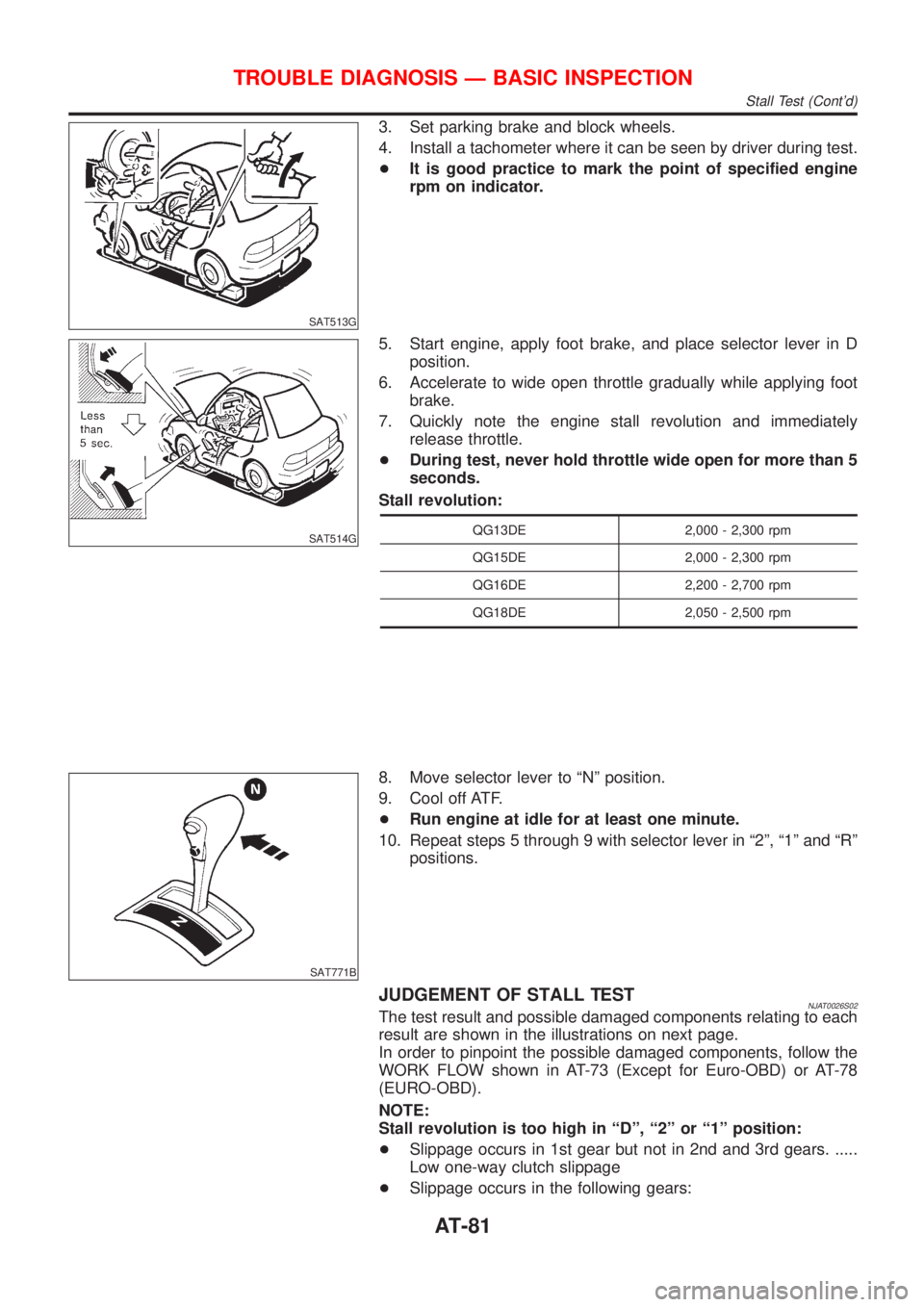
3. Set parking brake and block wheels.
4. Install a tachometer where it can be seen by driver during test.
+It is good practice to mark the point of specified engine
rpm on indicator.
SAT514G
5. Start engine, apply foot brake, and place selector lever in D
position.
6. Accelerate to wide open throttle gradually while applying foot
brake.
7. Quickly note the engine stall revolution and immediately
release throttle.
+During test, never hold throttle wide open for more than 5
seconds.
Stall revolution:
QG13DE 2,000 - 2,300 rpm
QG15DE 2,000 - 2,300 rpm
QG16DE 2,200 - 2,700 rpm
QG18DE 2,050 - 2,500 rpm
SAT771B
8. Move selector lever to ªNº position.
9. Cool off ATF.
+Run engine at idle for at least one minute.
10. Repeat steps 5 through 9 with selector lever in ª2º, ª1º and ªRº
positions.
JUDGEMENT OF STALL TESTNJAT0026S02The test result and possible damaged components relating to each
result are shown in the illustrations on next page.
In order to pinpoint the possible damaged components, follow the
WORK FLOW shown in AT-73 (Except for Euro-OBD) or AT-78
(EURO-OBD).
NOTE:
Stall revolution is too high in ªDº, ª2º or ª1º position:
+Slippage occurs in 1st gear but not in 2nd and 3rd gears. .....
Low one-way clutch slippage
+Slippage occurs in the following gears:
TROUBLE DIAGNOSIS Ð BASIC INSPECTION
Stall Test (Cont'd)
AT-81
Page 86 of 2898
SAT561J
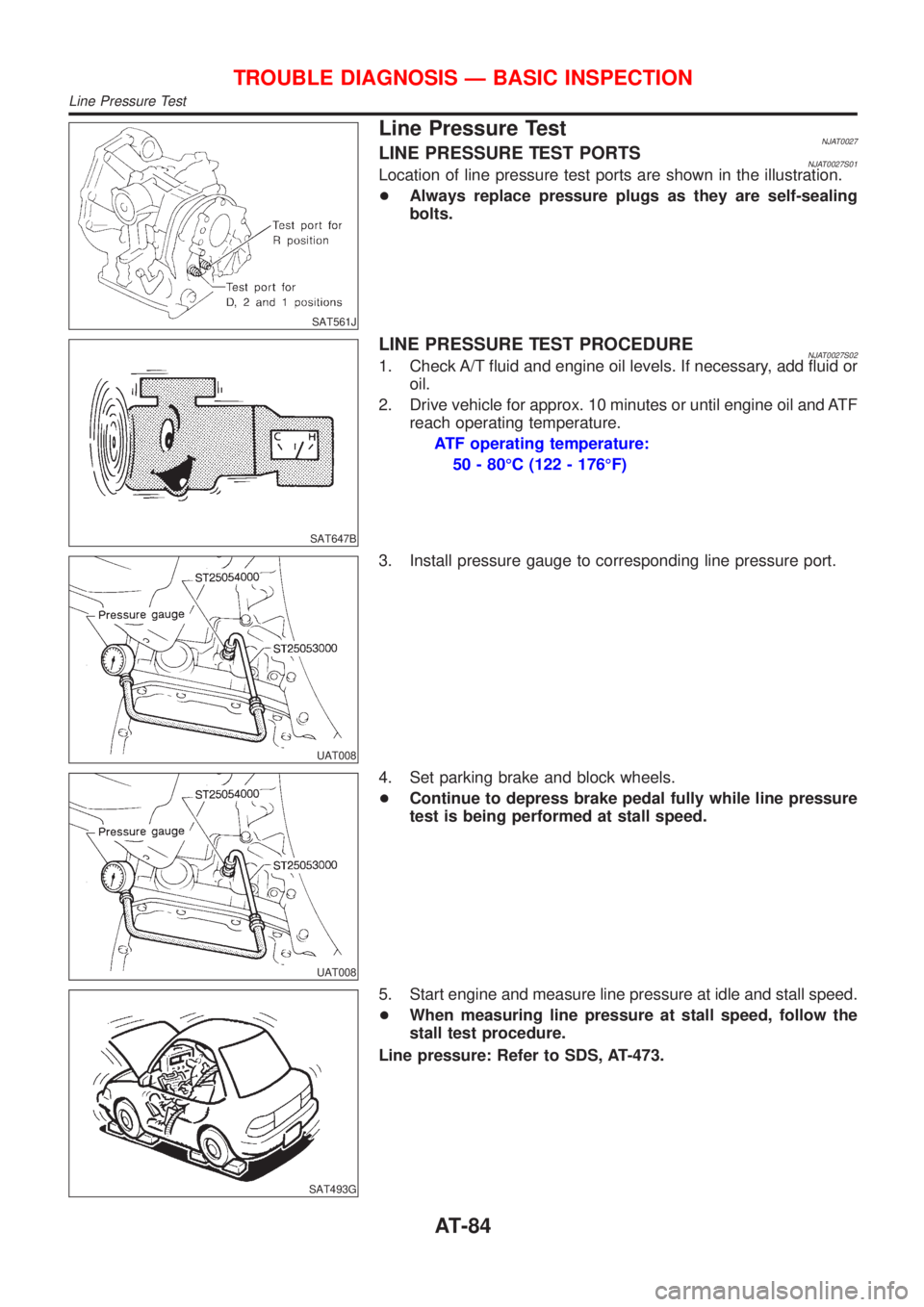
Line Pressure TestNJAT0027LINE PRESSURE TEST PORTSNJAT0027S01Location of line pressure test ports are shown in the illustration.
+Always replace pressure plugs as they are self-sealing
bolts.
SAT647B
LINE PRESSURE TEST PROCEDURENJAT0027S021. Check A/T fluid and engine oil levels. If necessary, add fluid or
oil.
2. Drive vehicle for approx. 10 minutes or until engine oil and ATF
reach operating temperature.
ATF operating temperature:
50 - 80ÉC (122 - 176ÉF)
UAT008
3. Install pressure gauge to corresponding line pressure port.
UAT008
4. Set parking brake and block wheels.
+Continue to depress brake pedal fully while line pressure
test is being performed at stall speed.
SAT493G
5. Start engine and measure line pressure at idle and stall speed.
+When measuring line pressure at stall speed, follow the
stall test procedure.
Line pressure: Refer to SDS, AT-473.
TROUBLE DIAGNOSIS Ð BASIC INSPECTION
Line Pressure Test
AT-84