2001 DODGE RAM fuses
[x] Cancel search: fusesPage 1142 of 2889
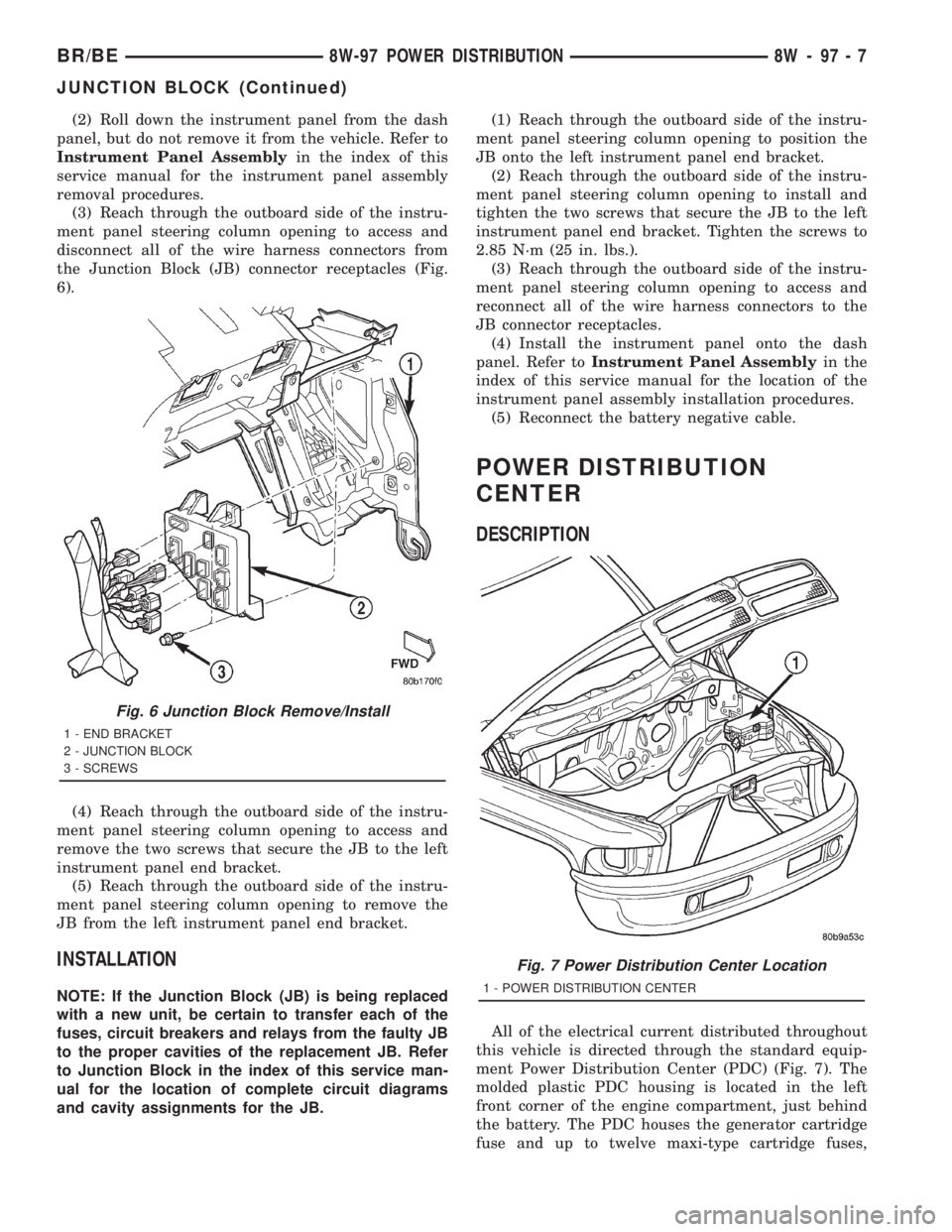
(2) Roll down the instrument panel from the dash
panel, but do not remove it from the vehicle. Refer to
Instrument Panel Assemblyin the index of this
service manual for the instrument panel assembly
removal procedures.
(3) Reach through the outboard side of the instru-
ment panel steering column opening to access and
disconnect all of the wire harness connectors from
the Junction Block (JB) connector receptacles (Fig.
6).
(4) Reach through the outboard side of the instru-
ment panel steering column opening to access and
remove the two screws that secure the JB to the left
instrument panel end bracket.
(5) Reach through the outboard side of the instru-
ment panel steering column opening to remove the
JB from the left instrument panel end bracket.
INSTALLATION
NOTE: If the Junction Block (JB) is being replaced
with a new unit, be certain to transfer each of the
fuses, circuit breakers and relays from the faulty JB
to the proper cavities of the replacement JB. Refer
to Junction Block in the index of this service man-
ual for the location of complete circuit diagrams
and cavity assignments for the JB.(1) Reach through the outboard side of the instru-
ment panel steering column opening to position the
JB onto the left instrument panel end bracket.
(2) Reach through the outboard side of the instru-
ment panel steering column opening to install and
tighten the two screws that secure the JB to the left
instrument panel end bracket. Tighten the screws to
2.85 N´m (25 in. lbs.).
(3) Reach through the outboard side of the instru-
ment panel steering column opening to access and
reconnect all of the wire harness connectors to the
JB connector receptacles.
(4) Install the instrument panel onto the dash
panel. Refer toInstrument Panel Assemblyin the
index of this service manual for the location of the
instrument panel assembly installation procedures.
(5) Reconnect the battery negative cable.
POWER DISTRIBUTION
CENTER
DESCRIPTION
All of the electrical current distributed throughout
this vehicle is directed through the standard equip-
ment Power Distribution Center (PDC) (Fig. 7). The
molded plastic PDC housing is located in the left
front corner of the engine compartment, just behind
the battery. The PDC houses the generator cartridge
fuse and up to twelve maxi-type cartridge fuses,
Fig. 6 Junction Block Remove/Install
1 - END BRACKET
2 - JUNCTION BLOCK
3 - SCREWS
Fig. 7 Power Distribution Center Location
1 - POWER DISTRIBUTION CENTER
BR/BE8W-97 POWER DISTRIBUTION 8W - 97 - 7
JUNCTION BLOCK (Continued)
Page 1143 of 2889
which replace all in-line fusible links. The PDC also
houses up to thirteen blade-type fuses (two standard-
type and eleven mini-type), up to seventeen Interna-
tional Standards Organization (ISO) relays (five
standard-type and twelve micro-type), two joint con-
nectors (one eighteen-way and one twenty-eight-way),
a forty-three-way engine wire harness in-line connec-
tor and a fuse puller.
The PDC housing is secured in the engine compart-
ment on the outboard side with two screws to the left
front inner fender shield, and with a screw on the
inboard side to the left front inner wheel house. The
PDC housing has a molded plastic cover that
includes two integral latches, one on each side. The
PDC cover is easily opened and removed for service
access and has a convenient adhesive-backed fuse
and relay layout map affixed to the inside surface of
the cover to ensure proper component identification.
The PDC unit cannot be repaired and is only ser-
viced as a unit with the headlamp and dash wire
harness. If the internal circuits or the PDC housing
are faulty or damaged, the headlamp and dash wire
harness unit must be replaced.
OPERATION
All of the current from the battery and the gener-
ator output enters the PDC through two cables with
eyelets that are secured with nuts to the two B(+)
terminal studs located just inside the inboard end of
the PDC housing. The PDC cover is unlatched and
removed to access the battery and generator output
connection B(+) terminal studs, the fuses, the relays,
the joint connectors and the engine wire harness in-
line connector. Internal connection of all of the PDC
circuits is accomplished by an intricate combination
of hard wiring and bus bars. Refer toPower Distri-
butionin the index of this service manual for the
location of complete PDC circuit diagrams.
REMOVAL
The Power Distribution Center (PDC) is serviced
as a unit with the headlamp and dash wire harness.
If any internal circuit of the PDC or the PDC hous-
ing is faulty or damaged, the entire PDC and head-
lamp and dash wire harness unit must be replaced.
(1) Disconnect and isolate the battery negative
cable.
(2) Disconnect each of the headlamp and dash wire
harness connectors. Refer toConnector Locations
in the index of this service manual for the location of
more information on the headlamp and dash wire
harness connector locations.
(3) Remove all of the fasteners that secure each of
the headlamp and dash wire harness ground eyelets
to the vehicle body and chassis components. Refer to
Connector Locationsin the index of this servicemanual for the location of more information on the
ground eyelet locations.
(4) Disengage each of the retainers that secure the
headlamp and dash wire harness to the vehicle body
and chassis components. Refer toConnector Loca-
tionsin the index of this service manual for the loca-
tion of more information on the headlamp and dash
wire harness retainer locations.
(5) Unlatch and remove the cover from the PDC.
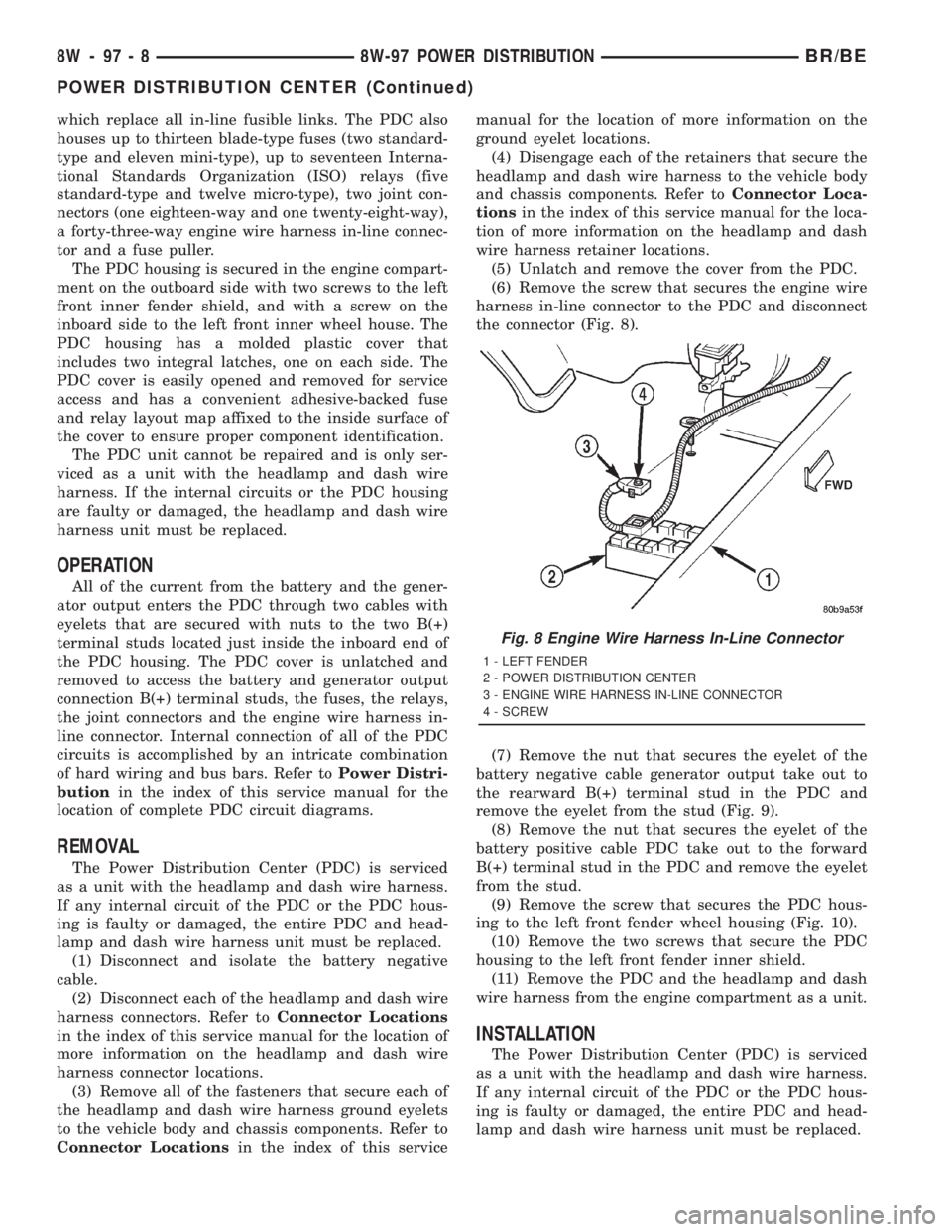
(6) Remove the screw that secures the engine wire
harness in-line connector to the PDC and disconnect
the connector (Fig. 8).
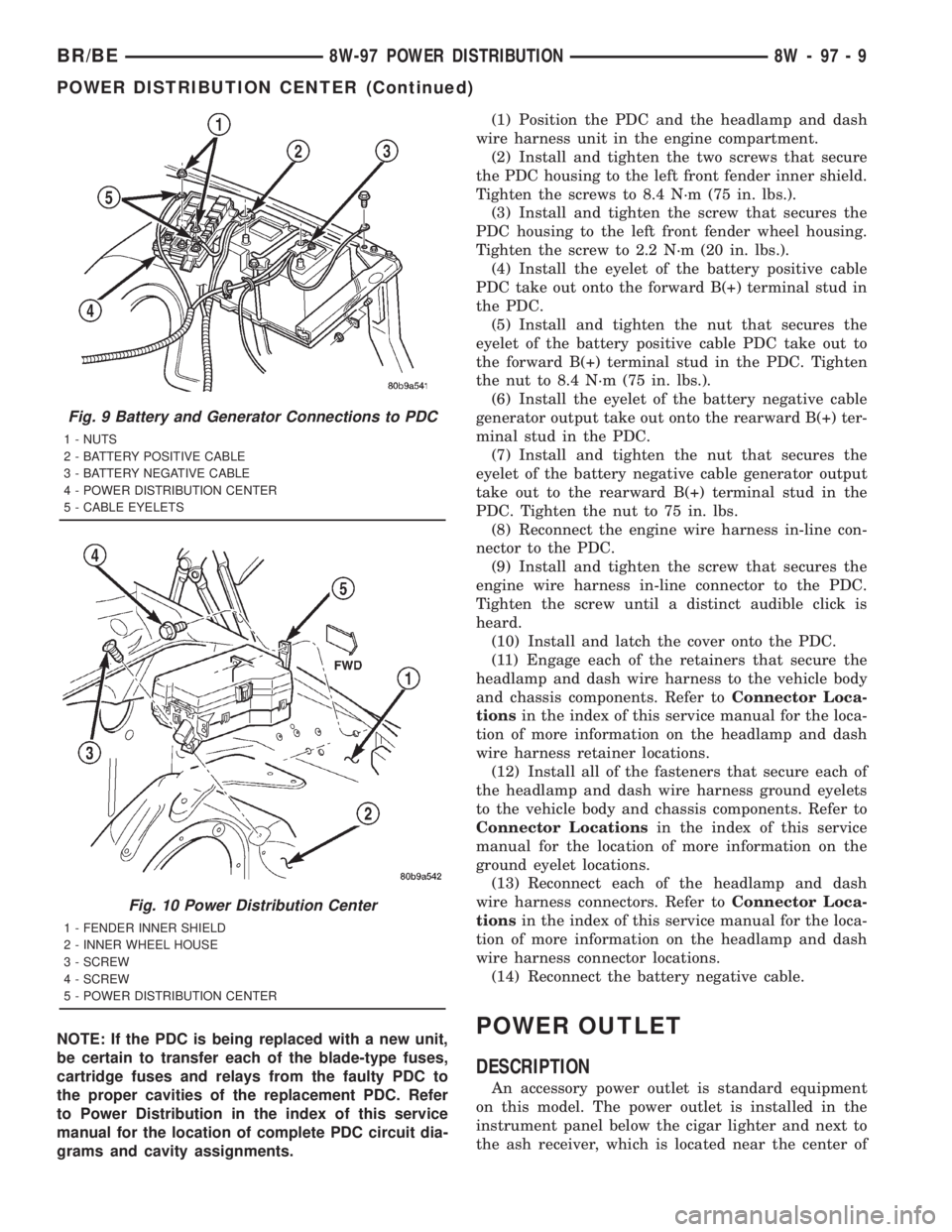
(7) Remove the nut that secures the eyelet of the
battery negative cable generator output take out to
the rearward B(+) terminal stud in the PDC and
remove the eyelet from the stud (Fig. 9).
(8) Remove the nut that secures the eyelet of the
battery positive cable PDC take out to the forward
B(+) terminal stud in the PDC and remove the eyelet
from the stud.
(9) Remove the screw that secures the PDC hous-
ing to the left front fender wheel housing (Fig. 10).
(10) Remove the two screws that secure the PDC
housing to the left front fender inner shield.
(11) Remove the PDC and the headlamp and dash
wire harness from the engine compartment as a unit.
INSTALLATION
The Power Distribution Center (PDC) is serviced
as a unit with the headlamp and dash wire harness.
If any internal circuit of the PDC or the PDC hous-
ing is faulty or damaged, the entire PDC and head-
lamp and dash wire harness unit must be replaced.
Fig. 8 Engine Wire Harness In-Line Connector
1 - LEFT FENDER
2 - POWER DISTRIBUTION CENTER
3 - ENGINE WIRE HARNESS IN-LINE CONNECTOR
4 - SCREW
8W - 97 - 8 8W-97 POWER DISTRIBUTIONBR/BE
POWER DISTRIBUTION CENTER (Continued)
Page 1144 of 2889
NOTE: If the PDC is being replaced with a new unit,
be certain to transfer each of the blade-type fuses,
cartridge fuses and relays from the faulty PDC to
the proper cavities of the replacement PDC. Refer
to Power Distribution in the index of this service
manual for the location of complete PDC circuit dia-
grams and cavity assignments.(1) Position the PDC and the headlamp and dash
wire harness unit in the engine compartment.
(2) Install and tighten the two screws that secure
the PDC housing to the left front fender inner shield.
Tighten the screws to 8.4 N´m (75 in. lbs.).
(3) Install and tighten the screw that secures the
PDC housing to the left front fender wheel housing.
Tighten the screw to 2.2 N´m (20 in. lbs.).
(4) Install the eyelet of the battery positive cable
PDC take out onto the forward B(+) terminal stud in
the PDC.
(5) Install and tighten the nut that secures the
eyelet of the battery positive cable PDC take out to
the forward B(+) terminal stud in the PDC. Tighten
the nut to 8.4 N´m (75 in. lbs.).
(6) Install the eyelet of the battery negative cable
generator output take out onto the rearward B(+) ter-
minal stud in the PDC.
(7) Install and tighten the nut that secures the
eyelet of the battery negative cable generator output
take out to the rearward B(+) terminal stud in the
PDC. Tighten the nut to 75 in. lbs.
(8) Reconnect the engine wire harness in-line con-
nector to the PDC.
(9) Install and tighten the screw that secures the
engine wire harness in-line connector to the PDC.
Tighten the screw until a distinct audible click is
heard.
(10) Install and latch the cover onto the PDC.
(11) Engage each of the retainers that secure the
headlamp and dash wire harness to the vehicle body
and chassis components. Refer toConnector Loca-
tionsin the index of this service manual for the loca-
tion of more information on the headlamp and dash
wire harness retainer locations.
(12) Install all of the fasteners that secure each of
the headlamp and dash wire harness ground eyelets
to the vehicle body and chassis components. Refer to
Connector Locationsin the index of this service
manual for the location of more information on the
ground eyelet locations.
(13) Reconnect each of the headlamp and dash
wire harness connectors. Refer toConnector Loca-
tionsin the index of this service manual for the loca-
tion of more information on the headlamp and dash
wire harness connector locations.
(14) Reconnect the battery negative cable.POWER OUTLET
DESCRIPTION
An accessory power outlet is standard equipment
on this model. The power outlet is installed in the
instrument panel below the cigar lighter and next to
the ash receiver, which is located near the center of
Fig. 9 Battery and Generator Connections to PDC
1 - NUTS
2 - BATTERY POSITIVE CABLE
3 - BATTERY NEGATIVE CABLE
4 - POWER DISTRIBUTION CENTER
5 - CABLE EYELETS
Fig. 10 Power Distribution Center
1 - FENDER INNER SHIELD
2 - INNER WHEEL HOUSE
3 - SCREW
4 - SCREW
5 - POWER DISTRIBUTION CENTER
BR/BE8W-97 POWER DISTRIBUTION 8W - 97 - 9
POWER DISTRIBUTION CENTER (Continued)
Page 2678 of 2889
hook formations on the lower edge of the glove box
door are engaged with and pivot on three hinge pins
integral to the lower edge of the instrument panel
support structure. The glove box door also serves as
the passenger side knee blocker. A honeycomb struc-
ture between the inner and outer glove box door pan-
els helps to absorb the impact load and distribute it
to the instrument panel structure.
²Steering Column Opening Cover- The steer-
ing column opening cover serves as the driver side
knee blocker. This molded plastic cover has an inte-
gral ribbed plastic liner concealed behind it, for
increased strength and integrity. The steering column
opening cover transfers impact loads to the instru-
ment panel structural support.
²Top Cover- The instrument panel top cover or
base trim is the molded, grained, and color impreg-
nated plastic outer skin of the instrument panel
structural support.
Hard wired circuitry connects the electrical compo-
nents on the instrument panel to each other through
the electrical system of the vehicle. These hard wired
circuits are integral to several wire harnesses, which
are routed throughout the vehicle and retained by
many different methods. These circuits may be con-
nected to each other, to the vehicle electrical system
and to the instrument panel components through the
use of a combination of soldered splices, splice block
connectors and many different types of wire harness
terminal connectors and insulators. Refer to the
appropriate wiring information. The wiring informa-
tion includes complete circuit diagrams, proper wire
and connector repair procedures, further details on
wire harness routing and retention, as well as pin-
out and location views for the various wire harness
connectors, splices, and grounds.
OPERATION
The instrument panel serves as the command cen-
ter of the vehicle, which necessarily makes it a very
complex unit. The instrument panel is designed to
house the controls and monitors for standard and
optional powertrains, climate control systems, audio
systems, safety systems, and many other comfort or
convenience items. When the components of the
instrument panel structural support are properly
assembled and secured in the vehicle they provide
superior instrument panel stiffness and integrity to
help reduce buzzes, squeaks, and rattles. This type of
construction also provides improved energy absorp-
tion which, in conjunction with the dual airbags and
seat belts, helps to improve occupant protection.
The instrument panel is also designed so that all of
the various controls can be safely reached and the
monitors can be easily viewed by the vehicle operator
when driving, while still allowing relative ease ofaccess to each of these items for service. Modular
instrument panel construction allows all of the
gauges and controls to be serviced from the front of
the panel. In addition, most of the instrument panel
electrical components can be accessed without com-
plete instrument panel removal. However, if neces-
sary, the instrument panel can be removed from the
vehicle as an assembly.
The steering column opening cover with its inte-
gral knee blocker located on the driver side of the
instrument panel works in conjunction with the air-
bag system in a frontal vehicle impact to keep the
driver properly positioned for an airbag deployment.
In addition, removal of this component provides
access to the steering column mounts, the steering
column wiring, the Junction Block (JB) (removal of a
snap-fit fuse access panel on the left end of the
instrument panel allows access to the fuses and cir-
cuit breakers), the Central Timer Module (CTM), the
Infinity speaker filter choke and relay unit, much of
the instrument panel wiring, and the gear selector
indicator cable (automatic transmission).
In a frontal collision, the glove box door on the pas-
senger side of the instrument panel provides the
same function for the front seat passenger as the
knee blocker does for the driver. The glove box door
also incorporates a recessed latch handle. Removal of
the glove box provides access to the passenger airbag,
the glove box lamp and switch, the radio antenna
coaxial cable, the heating and air conditioning vac-
uum harness connector, and additional instrument
panel wiring.
Removal of the instrument panel cluster bezel
allows access to the headlamp switch, instrument
cluster, radio, passenger airbag on-off switch, heated
seat switches (if equipped), and the heating and air
conditioning control. Removal of the instrument clus-
ter allows access to the cluster illumination and indi-
cator bulbs, and more of the instrument panel
wiring. Complete instrument panel removal is
required for service of most components internal to
the heating and air conditioning system housing,
including the heater core and the evaporator.
See the owner's manual in the vehicle glove box for
more information on the features, use and operation
of all of the components and systems mounted on or
in the instrument panel.
BR/BEINSTRUMENT PANEL SYSTEM 23 - 105
INSTRUMENT PANEL SYSTEM (Continued)
Page 2732 of 2889
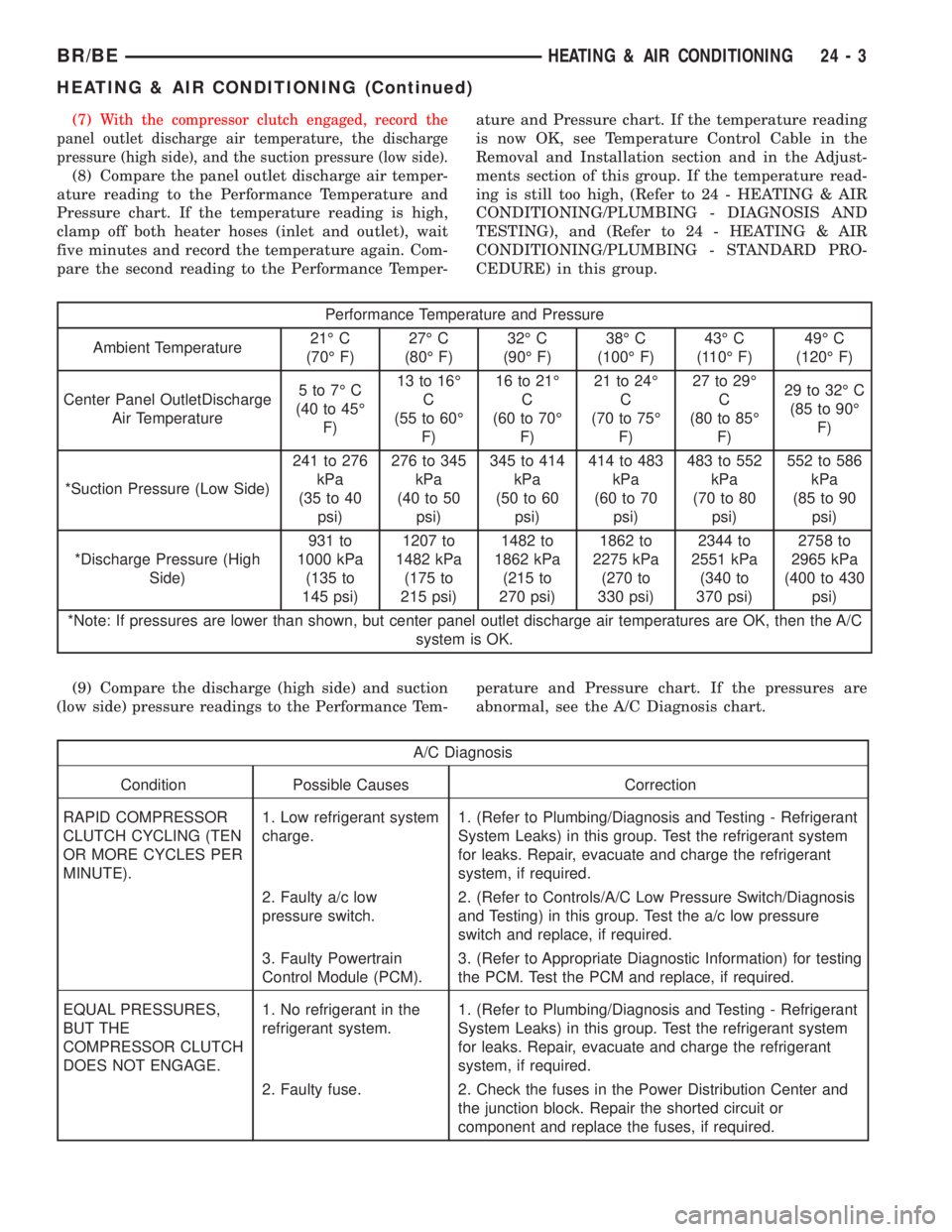
(7)With the compressor clutch engaged, record the
panel outlet discharge air temperature, the discharge
pressure (high side), and the suction pressure (low side).
(8) Compare the panel outlet discharge air temper-
ature reading to the Performance Temperature and
Pressure chart. If the temperature reading is high,
clamp off both heater hoses (inlet and outlet), wait
five minutes and record the temperature again. Com-
pare the second reading to the Performance Temper-ature and Pressure chart. If the temperature reading
is now OK, see Temperature Control Cable in the
Removal and Installation section and in the Adjust-
ments section of this group. If the temperature read-
ing is still too high, (Refer to 24 - HEATING & AIR
CONDITIONING/PLUMBING - DIAGNOSIS AND
TESTING), and (Refer to 24 - HEATING & AIR
CONDITIONING/PLUMBING - STANDARD PRO-
CEDURE) in this group.
Performance Temperature and Pressure
Ambient Temperature21É C
(70É F)27É C
(80É F)32É C
(90É F)38É C
(100É F)43É C
(110É F)49É C
(120É F)
Center Panel OutletDischarge
Air Temperature5to7ÉC
(40 to 45É
F)13 to 16É
C
(55 to 60É
F)16 to 21É
C
(60 to 70É
F)21 to 24É
C
(70 to 75É
F)27 to 29É
C
(80 to 85É
F)29 to 32É C
(85 to 90É
F)
*Suction Pressure (Low Side)241 to 276
kPa
(35 to 40
psi)276 to 345
kPa
(40 to 50
psi)345 to 414
kPa
(50 to 60
psi)414 to 483
kPa
(60 to 70
psi)483 to 552
kPa
(70 to 80
psi)552 to 586
kPa
(85 to 90
psi)
*Discharge Pressure (High
Side)931 to
1000 kPa
(135 to
145 psi)1207 to
1482 kPa
(175 to
215 psi)1482 to
1862 kPa
(215 to
270 psi)1862 to
2275 kPa
(270 to
330 psi)2344 to
2551 kPa
(340 to
370 psi)2758 to
2965 kPa
(400 to 430
psi)
*Note: If pressures are lower than shown, but center panel outlet discharge air temperatures are OK, then the A/C
system is OK.
(9) Compare the discharge (high side) and suction
(low side) pressure readings to the Performance Tem-perature and Pressure chart. If the pressures are
abnormal, see the A/C Diagnosis chart.
A/C Diagnosis
Condition Possible Causes Correction
RAPID COMPRESSOR
CLUTCH CYCLING (TEN
OR MORE CYCLES PER
MINUTE).1. Low refrigerant system
charge.1. (Refer to Plumbing/Diagnosis and Testing - Refrigerant
System Leaks) in this group. Test the refrigerant system
for leaks. Repair, evacuate and charge the refrigerant
system, if required.
2. Faulty a/c low
pressure switch.2. (Refer to Controls/A/C Low Pressure Switch/Diagnosis
and Testing) in this group. Test the a/c low pressure
switch and replace, if required.
3. Faulty Powertrain
Control Module (PCM).3. (Refer to Appropriate Diagnostic Information) for testing
the PCM. Test the PCM and replace, if required.
EQUAL PRESSURES,
BUT THE
COMPRESSOR CLUTCH
DOES NOT ENGAGE.1. No refrigerant in the
refrigerant system.1. (Refer to Plumbing/Diagnosis and Testing - Refrigerant
System Leaks) in this group. Test the refrigerant system
for leaks. Repair, evacuate and charge the refrigerant
system, if required.
2. Faulty fuse. 2. Check the fuses in the Power Distribution Center and
the junction block. Repair the shorted circuit or
component and replace the fuses, if required.
BR/BEHEATING & AIR CONDITIONING 24 - 3
HEATING & AIR CONDITIONING (Continued)
Page 2742 of 2889
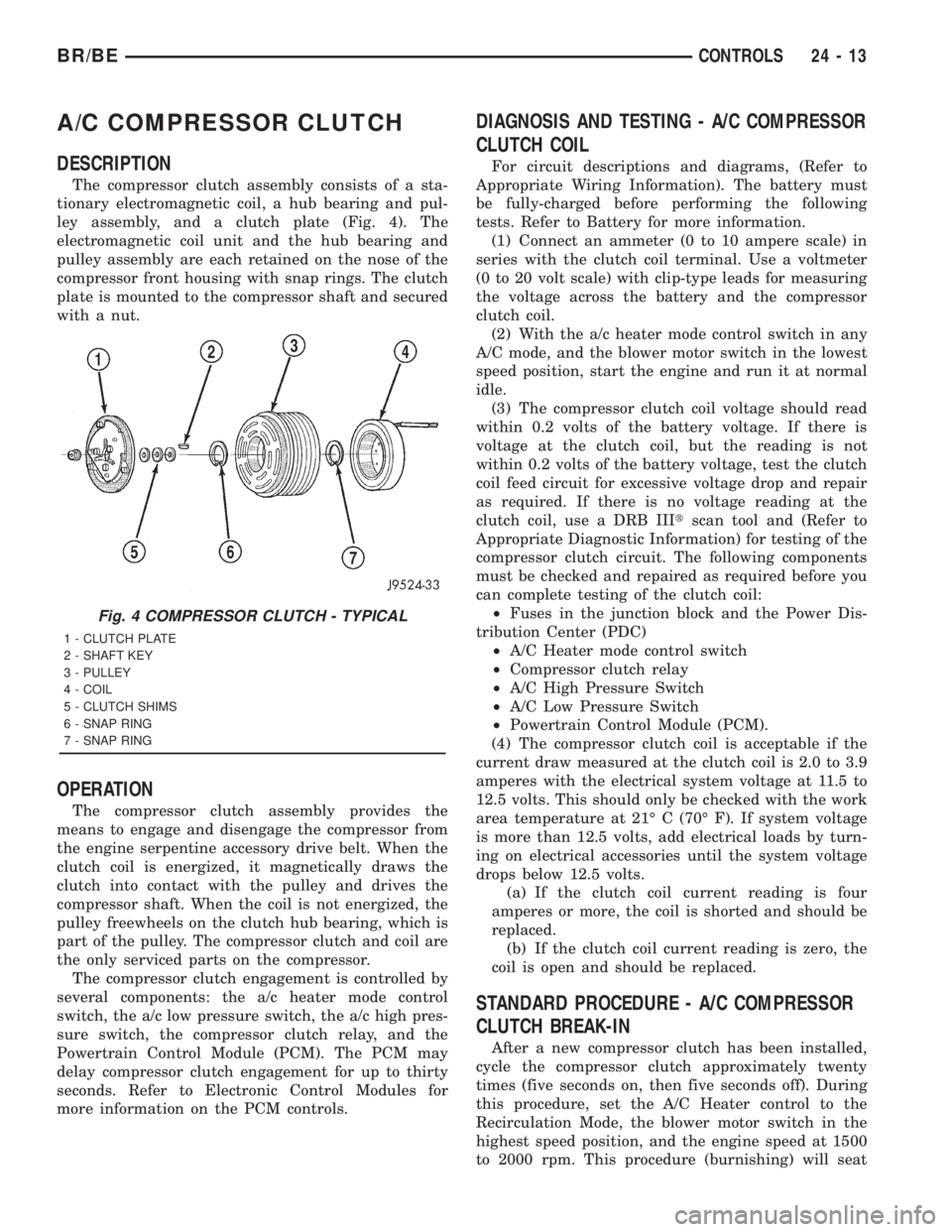
A/C COMPRESSOR CLUTCH
DESCRIPTION
The compressor clutch assembly consists of a sta-
tionary electromagnetic coil, a hub bearing and pul-
ley assembly, and a clutch plate (Fig. 4). The
electromagnetic coil unit and the hub bearing and
pulley assembly are each retained on the nose of the
compressor front housing with snap rings. The clutch
plate is mounted to the compressor shaft and secured
with a nut.
OPERATION
The compressor clutch assembly provides the
means to engage and disengage the compressor from
the engine serpentine accessory drive belt. When the
clutch coil is energized, it magnetically draws the
clutch into contact with the pulley and drives the
compressor shaft. When the coil is not energized, the
pulley freewheels on the clutch hub bearing, which is
part of the pulley. The compressor clutch and coil are
the only serviced parts on the compressor.
The compressor clutch engagement is controlled by
several components: the a/c heater mode control
switch, the a/c low pressure switch, the a/c high pres-
sure switch, the compressor clutch relay, and the
Powertrain Control Module (PCM). The PCM may
delay compressor clutch engagement for up to thirty
seconds. Refer to Electronic Control Modules for
more information on the PCM controls.
DIAGNOSIS AND TESTING - A/C COMPRESSOR
CLUTCH COIL
For circuit descriptions and diagrams, (Refer to
Appropriate Wiring Information). The battery must
be fully-charged before performing the following
tests. Refer to Battery for more information.
(1) Connect an ammeter (0 to 10 ampere scale) in
series with the clutch coil terminal. Use a voltmeter
(0 to 20 volt scale) with clip-type leads for measuring
the voltage across the battery and the compressor
clutch coil.
(2) With the a/c heater mode control switch in any
A/C mode, and the blower motor switch in the lowest
speed position, start the engine and run it at normal
idle.
(3) The compressor clutch coil voltage should read
within 0.2 volts of the battery voltage. If there is
voltage at the clutch coil, but the reading is not
within 0.2 volts of the battery voltage, test the clutch
coil feed circuit for excessive voltage drop and repair
as required. If there is no voltage reading at the
clutch coil, use a DRB IIItscan tool and (Refer to
Appropriate Diagnostic Information) for testing of the
compressor clutch circuit. The following components
must be checked and repaired as required before you
can complete testing of the clutch coil:
²Fuses in the junction block and the Power Dis-
tribution Center (PDC)
²A/C Heater mode control switch
²Compressor clutch relay
²A/C High Pressure Switch
²A/C Low Pressure Switch
²Powertrain Control Module (PCM).
(4) The compressor clutch coil is acceptable if the
current draw measured at the clutch coil is 2.0 to 3.9
amperes with the electrical system voltage at 11.5 to
12.5 volts. This should only be checked with the work
area temperature at 21É C (70É F). If system voltage
is more than 12.5 volts, add electrical loads by turn-
ing on electrical accessories until the system voltage
drops below 12.5 volts.
(a) If the clutch coil current reading is four
amperes or more, the coil is shorted and should be
replaced.
(b) If the clutch coil current reading is zero, the
coil is open and should be replaced.
STANDARD PROCEDURE - A/C COMPRESSOR
CLUTCH BREAK-IN
After a new compressor clutch has been installed,
cycle the compressor clutch approximately twenty
times (five seconds on, then five seconds off). During
this procedure, set the A/C Heater control to the
Recirculation Mode, the blower motor switch in the
highest speed position, and the engine speed at 1500
to 2000 rpm. This procedure (burnishing) will seat
Fig. 4 COMPRESSOR CLUTCH - TYPICAL
1 - CLUTCH PLATE
2 - SHAFT KEY
3 - PULLEY
4 - COIL
5 - CLUTCH SHIMS
6 - SNAP RING
7 - SNAP RING
BR/BECONTROLS 24 - 13
Page 2828 of 2889
Items found requiring adjustment and/or repair
should be corrected before delivery of the vehicle.
NOTE: It is the dealer's responsibility to protect
new vehicles from damage and deterioration prior
to retail delivery both before and after new vehicle
preparation.
The information includes the following features:
Inspection points are cross-referenced to the New
Vehicle Preparation Form as follows:
²Titles indicate the general area being inspected
or the types of checks being made (i.e., underhood,
body-exterior, road test, etc.).
²Sub-Titles identify the types of items to be
inspected in that area (i.e., lines/hoses, wiring, etc.).
Procedures follow a logical order to prevent dupli-
cation and wasted effort.
Tips to help you do a better job are found as
NOTES.
RECEIVING
INSPECTION
The following procedures are recommended for
your own protection upon receipt of new vehicles.
When a new car is delivered by the carrier, it should
be inspected to ensure that it is in good condition
and to determine if there is any shortage or transpor-
tation damage.
EXTERIOR
Upon receipt of a new vehicle, check immediately
for:
²Under carriage damage
²Chipped or cracked windshield, broken windows,
and loose or missing moldings and name-plates
²Dents, scrapes, scratches, chips, dirt in paints or
other damage to the body exterior
²Damaged or missing side view mirror(s)
²Missing wheel nuts
²Broken or missing lenses
²Chafing, bruises, cuts, or scrapes on tire side-
walls or tread
²Missing underhood items
²Missing fuel filler cap
²Shipped loose items-license plate bracket, spare
tire, jack and tire wrench, radio antenna, floor mats,
wheel covers, cargo nets, fuses and other items²Ensure that IOD fuse is removed
²Check battery test indicator when easily visible,
or use voltmeter (battery must be at 12.4 volts or
greater). Charge to ensure green dot-visibility, per-
manent damage may occur if battery remains in a
discharged state for any length of time.
INTERIOR
Check interior items such as:
²Rearview mirror
²Accessory control knobs
²Smokers package items
²Keys
²Radio
²Special equipment items listed on shipper
²Owner's Manual and Consumer information Bro-
chures (normally stored in the glove box).
²Cuts, abrasions or stains on interior trim.
NOTE: Remember a careful look at new vehicles
when they are received may prevent problems when
preparing vehicles for delivery to your customers.
MAJOR INSPECTION POINTS
(1) Check operation of hood latch and safety catch-
adjust as required.
(2) Check all fluids for proper level and top off
with the proper fluid as required-engine oil, auto-
matic transmission fluid, brake master cylinder,
clutch master cylinder, power steering, windshield
washer, and cooling system. (Vehicle must be at nor-
mal operating temperature for some of these checks.)
(3) Check brake, clutch, fuel, and power steering
lines and hoses for leaks and clearance from moving
and hot objects-reroute to the proper location and
tighten as required.
(4) Check battery state of charge-recharge if neces-
sary, to ensure green dot is visible or instrument
panel voltmeter indicates 12.4 volts or greater.
(5) Check routing and connections of underhood
wiring, vacuum hoses, refrigerant lines and coolant
hoses for leaks, loose connections and clearance from
moving objects reroute and tighten connections as
required. Install IOD fuse on applicable vehicles.
NOTE: Reset radio, clock, compass, etc., after
installing, if vehicle is being delivered.
BR/BENEW VEHICLE PREPARATION 30 - 3
INTRODUCTION (Continued)
Page 2863 of 2889
FUEL TRANSFER PUMP - OPERATION....14-79
FUEL TRANSFER PUMP - REMOVAL......14-83
FUEL TRANSFER PUMP PRESSURE -
DIAGNOSIS AND TESTING.............14-80
FUSE - DESCRIPTION, GENERATOR
CARTRIDGE.......................8W-97-4
FUSE - DESCRIPTION, IOD...........8W-97-4
FUSE - INSTALLATION, GENERATOR
CARTRIDGE.......................8W-97-4
FUSE - INSTALLATION, IOD..........8W-97-5
FUSE - OPERATION, GENERATOR
CARTRIDGE.......................8W-97-4
FUSE - OPERATION, IOD.............8W-97-5
FUSE - REMOVAL, GENERATOR
CARTRIDGE.......................8W-97-4
FUSE - REMOVAL, IOD..............8W-97-5
FUSES POWERING SEVERAL LOADS -
STANDARD PROCEDURE, TESTING
FOR SHORT TO GROUND ON.........8W-01-7
GAP AND FLUSH MEASUREMENTS,
SPECIFICATIONS - BODY...............23-56
GAS ENGINE - DIAGNOSIS AND TESTING . . 11-4
GAS ENGINE - DIAGNOSIS AND
TESTING, COOLING SYSTEM.............7-7
GAS ENGINES - DESCRIPTION,
COMPONENT MONITORS..............25-18
GAS ENGINES - DESCRIPTION, FUEL
REQUIREMENTS.......................0-1
GAS ENGINES - INSTALLATION..........8P-4
GAS ENGINES - OPERATION............25-18
GAS ENGINES - OPERATION, NON-
MONITORED CIRCUITS................25-22
GAS ENGINES - OPERATION, PCM.......8E-17
GAS ENGINES - REMOVAL..............8P-4
GAS ENGINES - SPECIFICATIONS, FUEL
SYSTEM PRESSURE...................14-4
GAS FUEL INJECTION - SPECIFICATIONS,
TORQUE............................14-35
GASKET - DESCRIPTION, CYLINDER
COVER..............................9-79
GASKET - DESCRIPTION, CYLINDER
HEAD COVER.........................9-22
GASKET - OPERATION, CYLINDER HEAD
COVER..............................9-22
GASKET FAILURE - DIAGNOSIS AND
TESTING, CYLINDER HEAD . . . 9-136,9-191,9-22,
9-79
GASKETS & SEALERS - STANDARD
PROCEDURE, FORM-IN-PLACE.....9-11,9-125,
9-180,9-237,9-68
GASOLINE - NEGATIVE CABLE
INSTALLATION.......................8F-24
GASOLINE - NEGATIVE CABLE REMOVAL . . 8F-23
GASOLINE - POSITIVE CABLE
INSTALLATION.......................8F-23
GASOLINE - POSITIVE CABLE REMOVAL . . 8F-23
GASOLINE ENGINE - INSTALLATION......19-35
GASOLINE ENGINE - REMOVAL.........19-33
GAUGE - DESCRIPTION, ENGINE
TEMPERATURE......................8J-19
GAUGE - DESCRIPTION, FUEL...........8J-20
GAUGE - DESCRIPTION, OIL PRESSURE . . 8J-25
GAUGE - DESCRIPTION, VOLTAGE.......8J-33
GAUGE - OPERATION, ENGINE
TEMPERATURE......................8J-19
GAUGE - OPERATION, FUEL............8J-20
GAUGE - OPERATION, OIL PRESSURE....8J-26
GAUGE - OPERATION, VOLTAGE.........8J-34
GAUGE SENDING UNIT - DIAGNOSIS
AND TESTING, FUEL...................14-8
GAUGES - DIAGNOSIS AND TESTING,
PRESSURE..........................22-7
GAUGES INDICATOR - DESCRIPTION,
CHECK.............................8J-17
GAUGES INDICATOR - OPERATION,
CHECK.............................8J-17
GAUGES/WARNING LIGHTS -
INSPECTION........................30-19
GEAR - ADJUSTMENTS................19-16
GEAR - DESCRIPTION.................19-14
GEAR - INSTALLATION................19-16
GEAR - INSTALLATION, PINION
GEAR/RING
......................3-42,3-74
GEAR - OPERATION
...................19-14
GEAR - REMOVAL
....................19-16
GEAR - REMOVAL, PINION GEAR/RING
....3-40,
3-72
GEAR HOUSING - INSTALLATION
........9-305GEAR HOUSING - REMOVAL............9-304
GEAR HOUSING COVER - INSTALLATION . . 9-307
GEAR HOUSING COVER - REMOVAL.....9-306
GEAR HOUSING PLUG - INSTALLATION,
STEERING..........................19-27
GEAR HOUSING PLUG - REMOVAL,
STEERING..........................19-27
GEAR LEAKAGE - DIAGNOSIS AND
TESTING, POWER STEERING...........19-14
GEAR SELECTOR INDICATOR -
DESCRIPTION.......................8J-21
GEAR SELECTOR INDICATOR -
OPERATION.........................8J-21
GEAR SHIFT LEVER - INSTALLATION.....19-13
GEAR SHIFT LEVER - REMOVAL.........19-13
GEAR, SPECIAL TOOLS - POWER
STEERING..........................19-20
GEAR, SPECIFICATIONS - POWER
STEERING..........................19-19
GEAR/RING GEAR - INSTALLATION,
PINION.........................3-42,3-74
GEAR/RING GEAR - REMOVAL, PINION....3-40,
3-72
GEAR/RING GEAR/TONE RING -
INSTALLATION, PINION . 3-105,3-137,3-166,3-195
GEAR/RING GEAR/TONE RING -
REMOVAL, PINION....3-103,3-135,3-165,3-193
GEAR/TONE RING - INSTALLATION,
PINION GEAR/RING....3-105,3-137,3-166,3-195
GEAR/TONE RING - REMOVAL, PINION
GEAR/RING..........3-103,3-135,3-165,3-193
GEARTRAIN/OUTPUT SHAFT -
ASSEMBLY, PLANETARY . . 21-241,21-412,21-588,
21-760
GEARTRAIN/OUTPUT SHAFT -
DESCRIPTION, PLANETARY.....21-240,21-410,
21-585,21-757
GEARTRAIN/OUTPUT SHAFT -
DISASSEMBLY, PLANETARY.....21-240,21-411,
21-586,21-757
GEARTRAIN/OUTPUT SHAFT -
INSPECTION, PLANETARY......21-241,21-411,
21-587,21-760
GEARTRAIN/OUTPUT SHAFT -
OPERATION,
PLANETARY......21-240,21-410,21-585,21-757
GENERAL - WARNINGS.............8W-01-5
GENERATOR - DESCRIPTION...........8F-29
GENERATOR - INSTALLATION...........8F-30
GENERATOR - OPERATION.............8F-29
GENERATOR - REMOVAL...............8F-30
GENERATOR CARTRIDGE FUSE -
DESCRIPTION.....................8W-97-4
GENERATOR CARTRIDGE FUSE -
INSTALLATION....................8W-97-4
GENERATOR CARTRIDGE FUSE -
OPERATION.......................8W-97-4
GENERATOR CARTRIDGE FUSE -
REMOVAL........................8W-97-4
GENERATOR RATINGS, SPECIFICATIONS . . 8F-28
GENERATOR/CHARGING SYSTEM -
SPECIFICATIONS, TORQUE.............8F-28
GLASS - DESCRIPTION, STATIONARY....23-145
GLASS - INSTALLATION, BACKLITE VENT . 23-147
GLASS - INSTALLATION, DOOR.........23-69
GLASS - INSTALLATION, SIDE VIEW
MIRROR...........................23-98
GLASS - OPERATION, STATIONARY.....23-145
GLASS - REMOVAL, BACKLITE VENT....23-147
GLASS - REMOVAL, DOOR.............23-69
GLASS - REMOVAL, SIDE VIEW MIRROR . . 23-98
GLASS RUN CHANNEL - INSTALLATION . . . 23-70
GLASS RUN CHANNEL - REMOVAL......23-70
GLASS RUN WEATHERSTRIP -
INSTALLATION, FRONT DOOR..........23-154
GLASS RUN WEATHERSTRIP -
REMOVAL, FRONT DOOR.............23-153
GLOVE BOX - ASSEMBLY.............23-112
GLOVE BOX - DISASSEMBLY..........23-112
GLOVE BOX - INSTALLATION..........23-113
GLOVE BOX - REMOVAL
..............23-112
GLOVE BOX LAMP AND SWITCH -
INSTALLATION
.......................8L-35
GLOVE BOX LAMP AND SWITCH -
REMOVAL
..........................8L-35
GLOVE BOX LATCH STRIKER -
INSTALLATION
......................23-113
GLOVE BOX LATCH STRIKER - REMOVAL
. 23-113GLOVE BOX OPENING UPPER TRIM -
INSTALLATION......................23-114
GLOVE BOX OPENING UPPER TRIM -
REMOVAL.........................23-114
GOVERNOR - DESCRIPTION,
ELECTRONIC.....21-194,21-365,21-540,21-710
GOVERNOR - INSTALLATION,
ELECTRONIC.....21-197,21-367,21-543,21-713
GOVERNOR - OPERATION, ELECTRONIC . 21-194,
21-365,21-541,21-711
GOVERNOR - REMOVAL, ELECTRONIC . . 21-196,
21-367,21-542,21-712
GRAB HANDLE - INSTALLATION,
A-PILLAR..........................23-119
GRAB HANDLE - REMOVAL, A-PILLAR . . . 23-119
GRADING - STANDARD PROCEDURE,
PISTON............................9-282
GRID - DESCRIPTION, HEATED MIRROR . . . 8G-4
GRID - DIAGNOSIS AND TESTING,
HEATED MIRROR.....................8G-4
GRID - OPERATION, HEATED MIRROR.....8G-4
GRILLE - INSTALLATION...............23-91
GRILLE - INSTALLATION, COWL.........23-90
GRILLE - REMOVAL..................23-91
GRILLE - REMOVAL, COWL............23-90
GRILLE FRAME - INSTALLATION.........23-92
GRILLE FRAME - REMOVAL............23-91
GRILLES - INSTALLATION, DEMISTER....24-32
GRILLES - REMOVAL, DEMISTER........24-31
GROUND - DESCRIPTION, SIGNAL........8E-17
GROUND - STANDARD PROCEDURE,
TESTING FOR A SHORT TO..........8W-01-6
GROUND ON FUSES POWERING
SEVERAL LOADS - STANDARD
PROCEDURE, TESTING FOR SHORT TO . 8W-01-7
GROUND STRAP - INSTALLATION,
CAB-TO- BED........................8A-14
GROUND STRAP - INSTALLATION,
ENGINE-TO-BODY....................8A-13
GROUND STRAP - INSTALLATION,
HEATER CORE.......................8A-15
GROUND STRAP - REMOVAL, CAB-TO-
BED ...............................8A-14
GROUND STRAP - REMOVAL,
ENGINE-TO-BODY....................8A-13
GROUND STRAP - REMOVAL, HEATER
CORE..............................8A-14
GROUNDS - DESCRIPTION, POWER......8E-17
GUIDES AND SPRINGS - STANDARD
PROCEDURE, VALVES.........9-138,9-25,9-82
HANDLE - INSTALLATION, A-PILLAR
GRAB.............................23-119
HANDLE - INSTALLATION, ASSIST......23-124
HANDLE - INSTALLATION, EXTERIOR.....23-70
HANDLE - INSTALLATION, LATCH........23-65
HANDLE - INSTALLATION, SHUTFACE.....23-83
HANDLE - REMOVAL, A-PILLAR GRAB . . . 23-119
HANDLE - REMOVAL, ASSIST..........23-124
HANDLE - REMOVAL, EXTERIOR........23-70
HANDLE - REMOVAL, LATCH...........23-65
HANDLE - REMOVAL, SHUTFACE........23-83
HANDLE ACTUATOR - INSTALLATION,
INSIDE........................23-71,23-80
HANDLE ACTUATOR - REMOVAL,
INSIDE
........................23-71,23-80
HANDLE ESCUTCHEON - INSTALLATION
. . 23-63
HANDLE ESCUTCHEON - REMOVAL
......23-63
HANDLING - INSPECTION, STEERING
.....30-15
HANDLING NON-DEPLOYED AIRBAGS -
STANDARD PROCEDURE
...............8O-4
HARNESS - DIAGNOSIS AND TESTING,
WIRING
..........................8W-01-5
HAT PARK BRAKE SHOES - 2500/3500 -
INSTALLATION, REAR DRUM IN
..........5-42
HAT PARK BRAKE SHOES - 2500/3500 -
REMOVAL, REAR DRUM IN
..............5-41
HAZARD WARNING SYSTEM -
DESCRIPTION, TURN SIGNAL
............8L-2
HAZARD WARNING SYSTEM -
DIAGNOSIS AND TESTING, TURN
SIGNAL
.............................8L-3
HAZARD WARNING SYSTEM -
OPERATION, TURN SIGNAL
.............8L-2
HEAD - CLEANING, CYLINDER
. 9-137,9-193,9-23,
9-248,9-80
HEAD - DESCRIPTION, CYLINDER
. . 9-136,9-191,
9-22,9-246,9-79
16 INDEXBR/BE
Description Group-Page Description Group-Page Description Group-Page