2001 DODGE RAM lock
[x] Cancel search: lockPage 317 of 2889
Oil contamination indicates a leak at either the
rear main seal or transmission input shaft. Oil leak-
age produces a residue of oil on the housing interior
and on the clutch cover and flywheel. Heat buildup
caused by slippage between the cover, disc and fly-
wheel, can sometimes bake the oil residue onto the
components. The glaze-like residue ranges in color
from amber to black.
Road splash contamination means dirt/water is
entering the clutch housing due to loose bolts, hous-
ing cracks or through hydraulic line openings. Driv-
ing through deep water puddles can force water/road
splash into the housing through such openings.
Clutch fluid leaks are usually from damaged slave
cylinder push rod seals.
IMPROPER RELEASE OR CLUTCH ENGAGEMENT
Clutch release or engagement problems are caused
by wear or damage to one or more clutch compo-
nents. A visual inspection of the release components
will usually reveal the problem part.
Release problems can result in hard shifting and
noise. Items to look for are: leaks at the clutch cylin-
ders and interconnecting line; loose slave cylinder
bolts; worn/loose release fork and pivot stud; dam-
aged release bearing; and a worn clutch disc, or pres-
sure plate.
Normal condensation in vehicles that are stored or
out of service for long periods of time can generate
enough corrosion to make the disc stick to the fly-
wheel, or pressure plate. If this condition is experi-
enced, correction only requires that the disc be
loosened manually through the inspection plate open-
ing.
Engagement problems usually result in slip, chat-
ter/shudder, and noisy operation. The primary causes
are clutch disc contamination; clutch disc wear; mis-
alignment, or distortion; flywheel damage; or a com-
bination of the foregoing. A visual inspection is
required to determine the part actually causing the
problem.
CLUTCH MISALIGNMENT
Clutch components must be in proper alignment
with the crankshaft and transmission input shaft.
Misalignment caused by excessive runout or warpage
of any clutch component will cause grab, chatter and
improper clutch release.
CLUTCH COVER AND DISC RUNOUT
Check the clutch disc before installation. Axial
(face) runout of anewdisc should not exceed 0.50
mm (0.020 in.). Measure runout about 6 mm (1/4 in.)
from the outer edge of the disc facing. Obtain
another disc if runout is excessive.Check condition of the clutch before installation. A
warped cover or diaphragm spring will cause grab
and incomplete release or engagement. Be careful
when handling the cover and disc. Impact can distort
the cover, diaphragm spring, release fingers and the
hub of the clutch disc.
Use an alignment tool when positioning the disc on
the flywheel. The tool prevents accidental misalign-
ment which could result in cover distortion and disc
damage.
A frequent cause of clutch cover distortion (and con-
sequent misalignment) is improper bolt tightening.
CLUTCH FLYWHEEL RUNOUT
Check flywheel runout whenever misalignment is
suspected. Flywheel runout should not exceed 0.08
mm (0.003 in.). Measure runout at the outer edge of
the flywheel face with a dial indicator. Mount the
indicator on the rear face of the engine block.
Common causes of runout are:
²heat warpage
²improper machining
²incorrect bolt tightening
²improper seating on crankshaft flange shoulder
²foreign material on crankshaft flange
Flywheel machining is not recommended. The fly-
wheel clutch surface is machined to a unique contour
and machining will negate this feature. However,
minor flywheel scoring can be cleaned up by hand with
180 grit emery, or with surface grinding equipment.
Remove only enough material to reduce scoring
(approximately 0.001 - 0.003 in.). Heavy stock removal
isnot recommended.
Replace the flywheel if scoring
is severe and deeper than 0.076 mm (0.003 in.).
Excessive stock removal can result in flywheel crack-
ing or warpage after installation; it can also weaken
the flywheel and interfere with proper clutch release.
Clean the crankshaft flange before mounting the
flywheel. Dirt and grease on the flange surface may
cock the flywheel causing excessive runout. Use new
bolts when remounting a flywheel and secure the
bolts with MopartLock And Seal. Tighten flywheel
bolts to specified torque only. Overtightening can dis-
tort the flywheel hub causing runout.
DIAGNOSIS CHART
The clutch inspection chart (Fig. 3) outlines items to
be checked before and during clutch installation. Use
the chart as a check list to help avoid overlooking
potential problem sources during service operations.
The diagnosis charts describe common clutch prob-
lems, causes and correction. Fault conditions are listed
at the top of each chart. Conditions, causes and correc-
tive action are outlined in the indicated columns.
The charts are provided as a convenient reference
when diagnosing faulty clutch operation.
6 - 4 CLUTCHBR/BE
CLUTCH (Continued)
Page 321 of 2889
OPERATION
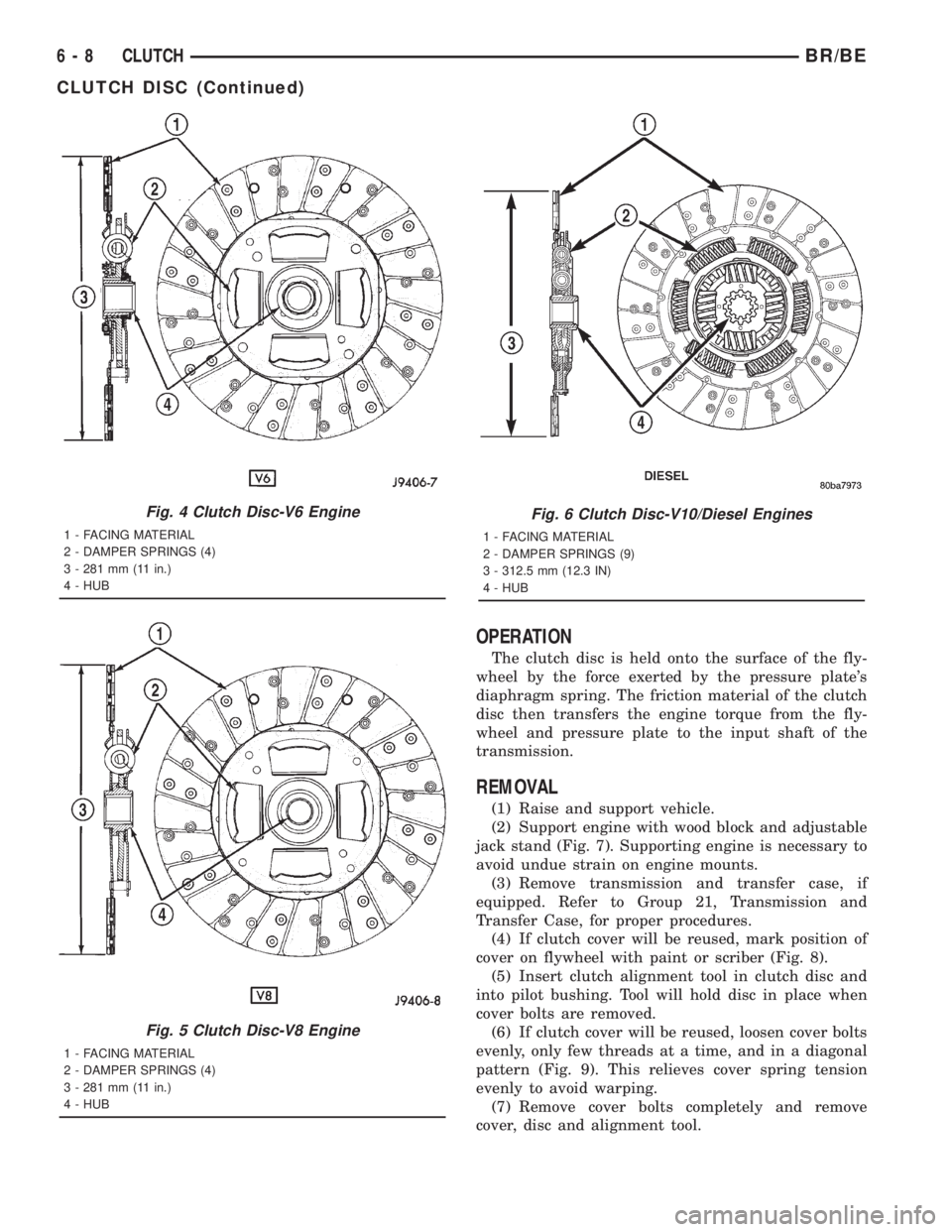
The clutch disc is held onto the surface of the fly-
wheel by the force exerted by the pressure plate's
diaphragm spring. The friction material of the clutch
disc then transfers the engine torque from the fly-
wheel and pressure plate to the input shaft of the
transmission.
REMOVAL
(1) Raise and support vehicle.
(2) Support engine with wood block and adjustable
jack stand (Fig. 7). Supporting engine is necessary to
avoid undue strain on engine mounts.
(3) Remove transmission and transfer case, if
equipped. Refer to Group 21, Transmission and
Transfer Case, for proper procedures.
(4) If clutch cover will be reused, mark position of
cover on flywheel with paint or scriber (Fig. 8).
(5) Insert clutch alignment tool in clutch disc and
into pilot bushing. Tool will hold disc in place when
cover bolts are removed.
(6) If clutch cover will be reused, loosen cover bolts
evenly, only few threads at a time, and in a diagonal
pattern (Fig. 9). This relieves cover spring tension
evenly to avoid warping.
(7) Remove cover bolts completely and remove
cover, disc and alignment tool.
Fig. 4 Clutch Disc-V6 Engine
1 - FACING MATERIAL
2 - DAMPER SPRINGS (4)
3 - 281 mm (11 in.)
4 - HUB
Fig. 5 Clutch Disc-V8 Engine
1 - FACING MATERIAL
2 - DAMPER SPRINGS (4)
3 - 281 mm (11 in.)
4 - HUB
Fig. 6 Clutch Disc-V10/Diesel Engines
1 - FACING MATERIAL
2 - DAMPER SPRINGS (9)
3 - 312.5 mm (12.3 IN)
4 - HUB
6 - 8 CLUTCHBR/BE
CLUTCH DISC (Continued)
Page 322 of 2889
INSTALLATION
(1) Check runout and free operation of new clutch
disc.
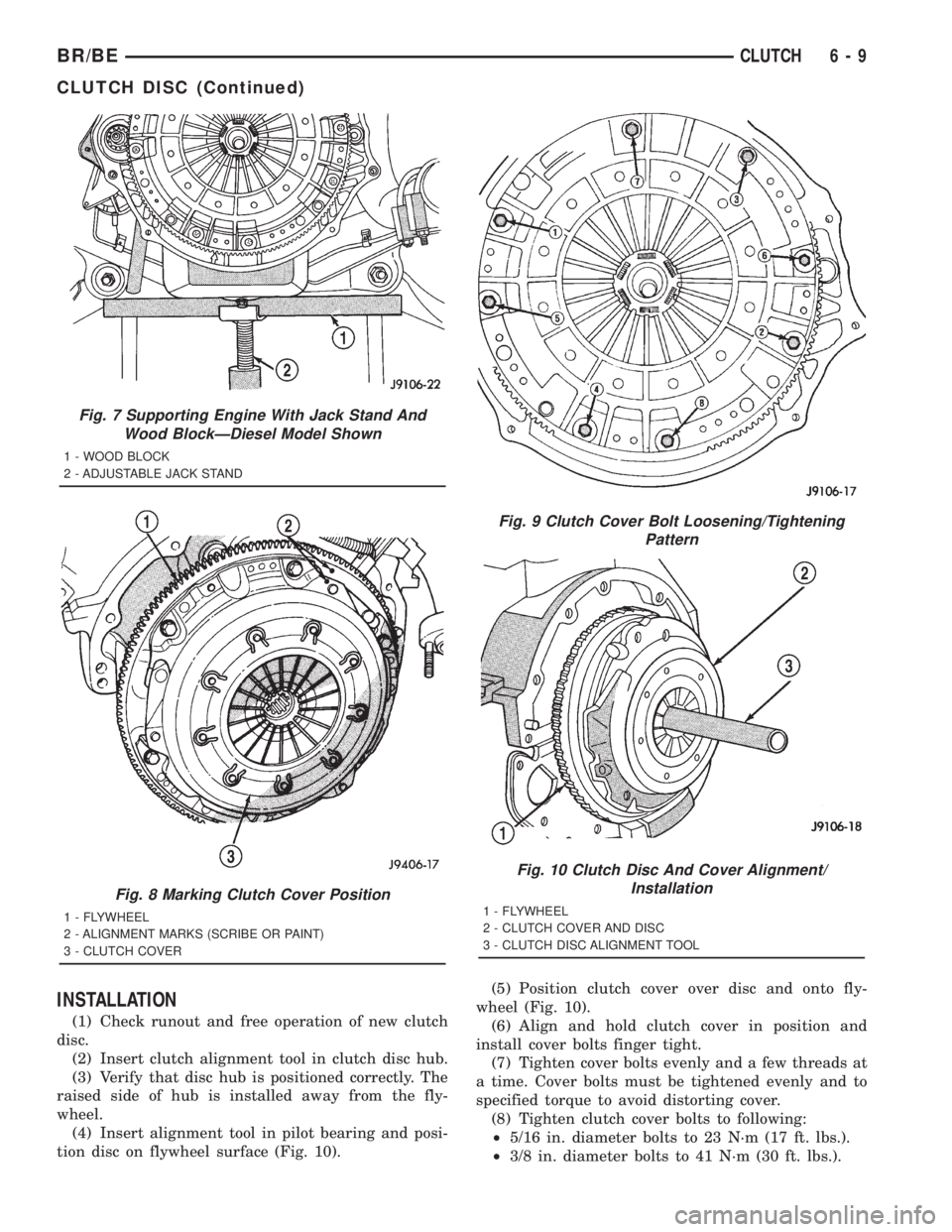
(2) Insert clutch alignment tool in clutch disc hub.
(3) Verify that disc hub is positioned correctly. The
raised side of hub is installed away from the fly-
wheel.
(4) Insert alignment tool in pilot bearing and posi-
tion disc on flywheel surface (Fig. 10).(5) Position clutch cover over disc and onto fly-
wheel (Fig. 10).
(6) Align and hold clutch cover in position and
install cover bolts finger tight.
(7) Tighten cover bolts evenly and a few threads at
a time. Cover bolts must be tightened evenly and to
specified torque to avoid distorting cover.
(8) Tighten clutch cover bolts to following:
²5/16 in. diameter bolts to 23 N´m (17 ft. lbs.).
²3/8 in. diameter bolts to 41 N´m (30 ft. lbs.).
Fig. 7 Supporting Engine With Jack Stand And
Wood BlockÐDiesel Model Shown
1 - WOOD BLOCK
2 - ADJUSTABLE JACK STAND
Fig. 8 Marking Clutch Cover Position
1 - FLYWHEEL
2 - ALIGNMENT MARKS (SCRIBE OR PAINT)
3 - CLUTCH COVER
Fig. 9 Clutch Cover Bolt Loosening/Tightening
Pattern
Fig. 10 Clutch Disc And Cover Alignment/
Installation
1 - FLYWHEEL
2 - CLUTCH COVER AND DISC
3 - CLUTCH DISC ALIGNMENT TOOL
BR/BECLUTCH 6 - 9
CLUTCH DISC (Continued)
Page 325 of 2889
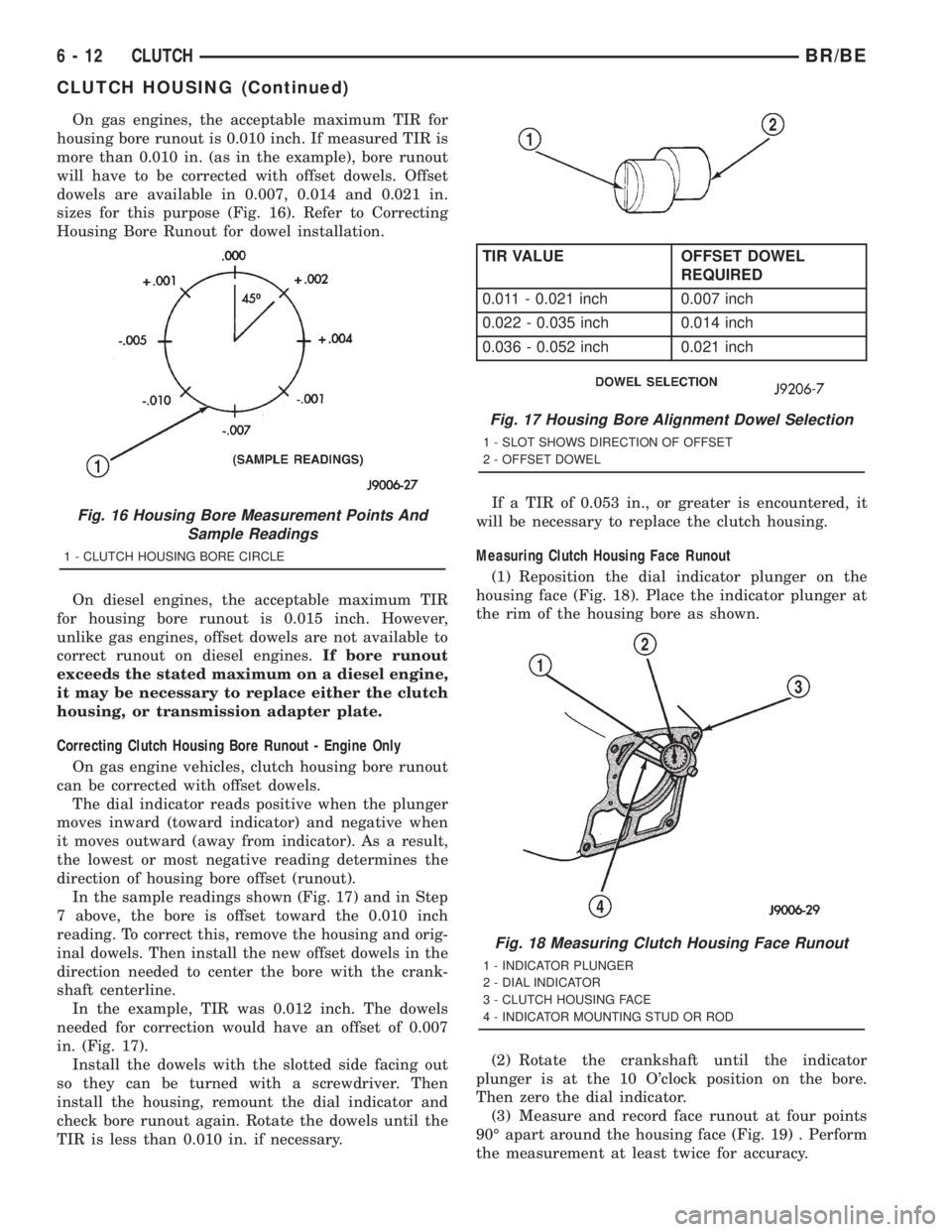
On gas engines, the acceptable maximum TIR for
housing bore runout is 0.010 inch. If measured TIR is
more than 0.010 in. (as in the example), bore runout
will have to be corrected with offset dowels. Offset
dowels are available in 0.007, 0.014 and 0.021 in.
sizes for this purpose (Fig. 16). Refer to Correcting
Housing Bore Runout for dowel installation.
On diesel engines, the acceptable maximum TIR
for housing bore runout is 0.015 inch. However,
unlike gas engines, offset dowels are not available to
correct runout on diesel engines.If bore runout
exceeds the stated maximum on a diesel engine,
it may be necessary to replace either the clutch
housing, or transmission adapter plate.
Correcting Clutch Housing Bore Runout - Engine Only
On gas engine vehicles, clutch housing bore runout
can be corrected with offset dowels.
The dial indicator reads positive when the plunger
moves inward (toward indicator) and negative when
it moves outward (away from indicator). As a result,
the lowest or most negative reading determines the
direction of housing bore offset (runout).
In the sample readings shown (Fig. 17) and in Step
7 above, the bore is offset toward the 0.010 inch
reading. To correct this, remove the housing and orig-
inal dowels. Then install the new offset dowels in the
direction needed to center the bore with the crank-
shaft centerline.
In the example, TIR was 0.012 inch. The dowels
needed for correction would have an offset of 0.007
in. (Fig. 17).
Install the dowels with the slotted side facing out
so they can be turned with a screwdriver. Then
install the housing, remount the dial indicator and
check bore runout again. Rotate the dowels until the
TIR is less than 0.010 in. if necessary.If a TIR of 0.053 in., or greater is encountered, it
will be necessary to replace the clutch housing.
Measuring Clutch Housing Face Runout
(1) Reposition the dial indicator plunger on the
housing face (Fig. 18). Place the indicator plunger at
the rim of the housing bore as shown.
(2) Rotate the crankshaft until the indicator
plunger is at the 10 O'clock position on the bore.
Then zero the dial indicator.
(3) Measure and record face runout at four points
90É apart around the housing face (Fig. 19) . Perform
the measurement at least twice for accuracy.
Fig. 16 Housing Bore Measurement Points And
Sample Readings
1 - CLUTCH HOUSING BORE CIRCLE
Fig. 17 Housing Bore Alignment Dowel Selection
1 - SLOT SHOWS DIRECTION OF OFFSET
2 - OFFSET DOWEL
TIR VALUE OFFSET DOWEL
REQUIRED
0.011 - 0.021 inch 0.007 inch
0.022 - 0.035 inch 0.014 inch
0.036 - 0.052 inch 0.021 inch
Fig. 18 Measuring Clutch Housing Face Runout
1 - INDICATOR PLUNGER
2 - DIAL INDICATOR
3 - CLUTCH HOUSING FACE
4 - INDICATOR MOUNTING STUD OR ROD
6 - 12 CLUTCHBR/BE
CLUTCH HOUSING (Continued)
Page 326 of 2889
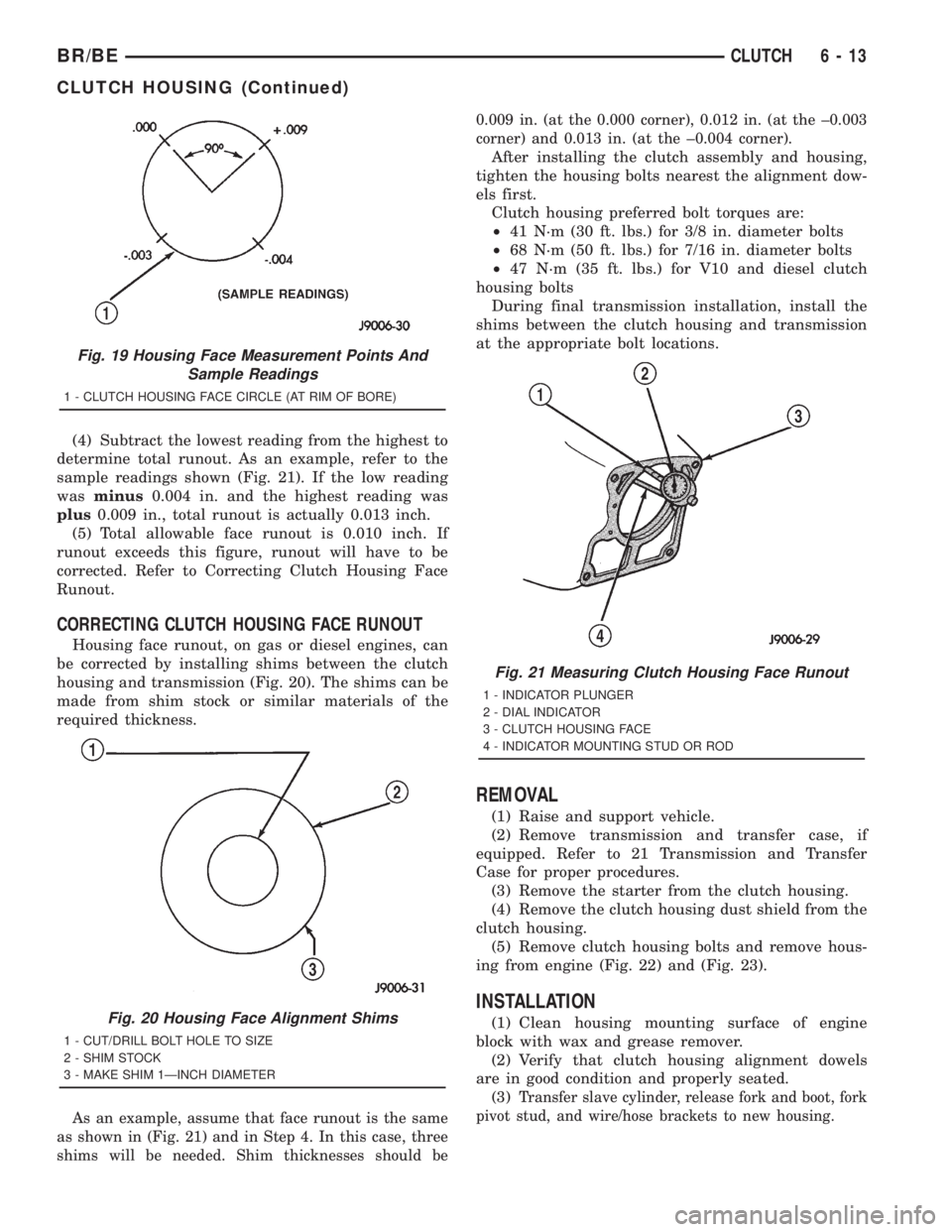
(4) Subtract the lowest reading from the highest to
determine total runout. As an example, refer to the
sample readings shown (Fig. 21). If the low reading
wasminus0.004 in. and the highest reading was
plus0.009 in., total runout is actually 0.013 inch.
(5) Total allowable face runout is 0.010 inch. If
runout exceeds this figure, runout will have to be
corrected. Refer to Correcting Clutch Housing Face
Runout.
CORRECTING CLUTCH HOUSING FACE RUNOUT
Housing face runout, on gas or diesel engines, can
be corrected by installing shims between the clutch
housing and transmission (Fig. 20). The shims can be
made from shim stock or similar materials of the
required thickness.
As an example, assume that face runout is the same
as shown in (Fig. 21) and in Step 4. In this case, three
shims will be needed. Shim thicknesses should be0.009 in. (at the 0.000 corner), 0.012 in. (at the ±0.003
corner) and 0.013 in. (at the ±0.004 corner).
After installing the clutch assembly and housing,
tighten the housing bolts nearest the alignment dow-
els first.
Clutch housing preferred bolt torques are:
²41 N´m (30 ft. lbs.) for 3/8 in. diameter bolts
²68 N´m (50 ft. lbs.) for 7/16 in. diameter bolts
²47 N´m (35 ft. lbs.) for V10 and diesel clutch
housing bolts
During final transmission installation, install the
shims between the clutch housing and transmission
at the appropriate bolt locations.
REMOVAL
(1) Raise and support vehicle.
(2) Remove transmission and transfer case, if
equipped. Refer to 21 Transmission and Transfer
Case for proper procedures.
(3) Remove the starter from the clutch housing.
(4) Remove the clutch housing dust shield from the
clutch housing.
(5) Remove clutch housing bolts and remove hous-
ing from engine (Fig. 22) and (Fig. 23).
INSTALLATION
(1) Clean housing mounting surface of engine
block with wax and grease remover.
(2) Verify that clutch housing alignment dowels
are in good condition and properly seated.
(3)
Transfer slave cylinder, release fork and boot, fork
pivot stud, and wire/hose brackets to new housing.
Fig. 19 Housing Face Measurement Points And
Sample Readings
1 - CLUTCH HOUSING FACE CIRCLE (AT RIM OF BORE)
Fig. 20 Housing Face Alignment Shims
1 - CUT/DRILL BOLT HOLE TO SIZE
2 - SHIM STOCK
3 - MAKE SHIM 1ÐINCH DIAMETER
Fig. 21 Measuring Clutch Housing Face Runout
1 - INDICATOR PLUNGER
2 - DIAL INDICATOR
3 - CLUTCH HOUSING FACE
4 - INDICATOR MOUNTING STUD OR ROD
BR/BECLUTCH 6 - 13
CLUTCH HOUSING (Continued)
Page 327 of 2889
(4) Lubricate release fork and pivot contact sur-
faces with MopartHigh Temperature wheel bearing
grease before installation.
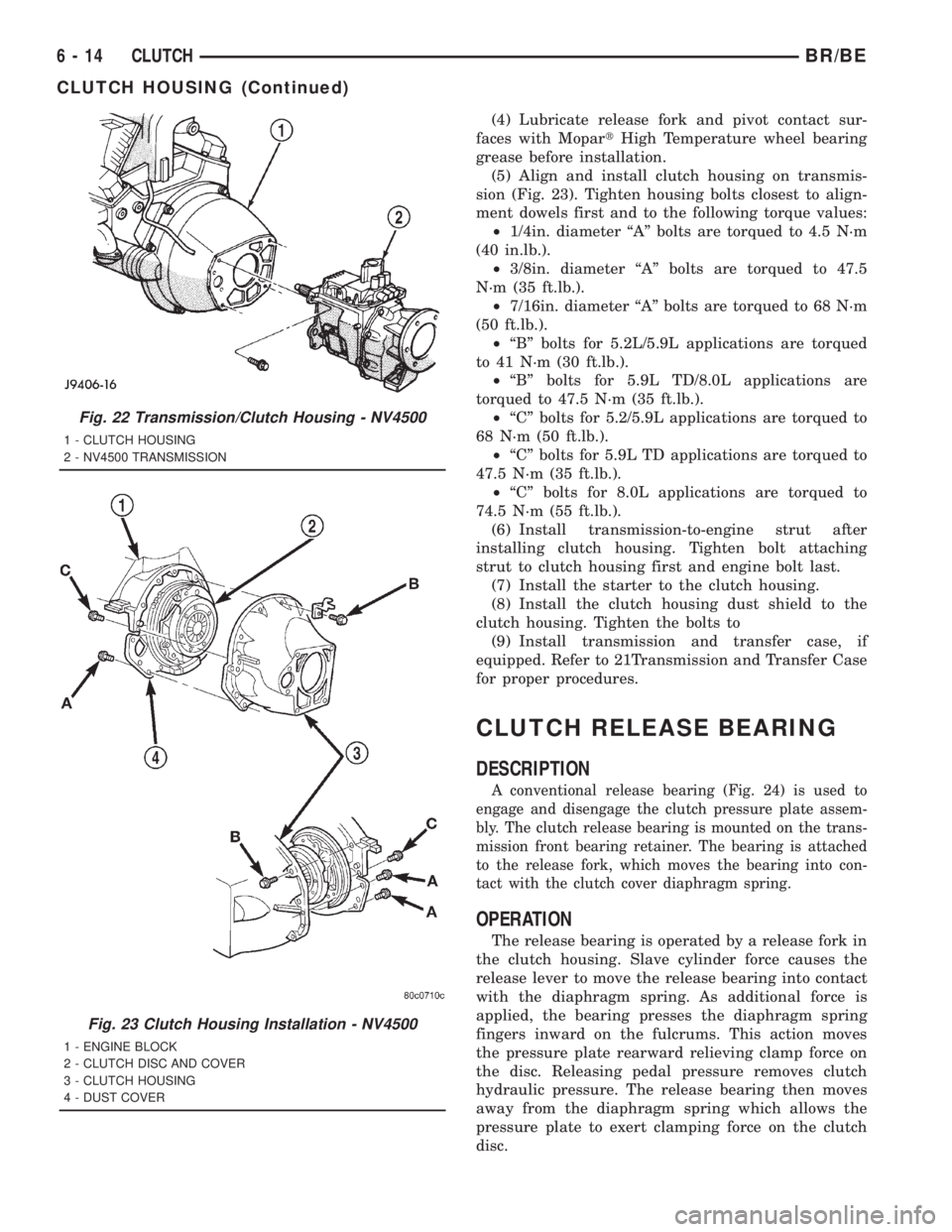
(5) Align and install clutch housing on transmis-
sion (Fig. 23). Tighten housing bolts closest to align-
ment dowels first and to the following torque values:
²1/4in. diameter ªAº bolts are torqued to 4.5 N´m
(40 in.lb.).
²3/8in. diameter ªAº bolts are torqued to 47.5
N´m (35 ft.lb.).
²7/16in. diameter ªAº bolts are torqued to 68 N´m
(50 ft.lb.).
²ªBº bolts for 5.2L/5.9L applications are torqued
to 41 N´m (30 ft.lb.).
²ªBº bolts for 5.9L TD/8.0L applications are
torqued to 47.5 N´m (35 ft.lb.).
²ªCº bolts for 5.2/5.9L applications are torqued to
68 N´m (50 ft.lb.).
²ªCº bolts for 5.9L TD applications are torqued to
47.5 N´m (35 ft.lb.).
²ªCº bolts for 8.0L applications are torqued to
74.5 N´m (55 ft.lb.).
(6) Install transmission-to-engine strut after
installing clutch housing. Tighten bolt attaching
strut to clutch housing first and engine bolt last.
(7) Install the starter to the clutch housing.
(8) Install the clutch housing dust shield to the
clutch housing. Tighten the bolts to
(9) Install transmission and transfer case, if
equipped. Refer to 21Transmission and Transfer Case
for proper procedures.
CLUTCH RELEASE BEARING
DESCRIPTION
A conventional release bearing (Fig. 24) is used to
engage and disengage the clutch pressure plate assem-
bly. The clutch release bearing is mounted on the trans-
mission front bearing retainer. The bearing is attached
to the release fork, which moves the bearing into con-
tact with the clutch cover diaphragm spring.
OPERATION
The release bearing is operated by a release fork in
the clutch housing. Slave cylinder force causes the
release lever to move the release bearing into contact
with the diaphragm spring. As additional force is
applied, the bearing presses the diaphragm spring
fingers inward on the fulcrums. This action moves
the pressure plate rearward relieving clamp force on
the disc. Releasing pedal pressure removes clutch
hydraulic pressure. The release bearing then moves
away from the diaphragm spring which allows the
pressure plate to exert clamping force on the clutch
disc.
Fig. 22 Transmission/Clutch Housing - NV4500
1 - CLUTCH HOUSING
2 - NV4500 TRANSMISSION
Fig. 23 Clutch Housing Installation - NV4500
1 - ENGINE BLOCK
2 - CLUTCH DISC AND COVER
3 - CLUTCH HOUSING
4 - DUST COVER
6 - 14 CLUTCHBR/BE
CLUTCH HOUSING (Continued)
Page 330 of 2889
shaft speeds and releasing the energy back into the
system when the crankshaft slows down.
DIAGNOSIS AND TESTING - FLYWHEEL
Check flywheel runout whenever misalignment is
suspected. Flywheel runout should not exceed 0.08
mm (0.003 in.). Measure runout at the outer edge of
the flywheel face with a dial indicator. Mount the
indicator on a stud installed in place of one of the fly-
wheel bolts.
Common causes of runout are:
²heat warpage
²improper machining
²incorrect bolt tightening
²improper seating on crankshaft flange shoulder
²foreign material on crankshaft flange
Flywheel machining is not recommended. The fly-
wheel clutch surface is machined to a unique contour
and machining will negate this feature. However,
minor flywheel scoring can be cleaned up by hand with
180 grit emery, or with surface grinding equipment.
Remove only enough material to reduce scoring
(approximately 0.001 - 0.003 in.). Heavy stock removal
isnot recommended.
Replace the flywheel if scoring
is severe and deeper than 0.076 mm (0.003 in.).
Excessive stock removal can result in flywheel crack-
ing or warpage after installation; it can also weaken
the flywheel and interfere with proper clutch release.
Clean the crankshaft flange before mounting the
flywheel. Dirt and grease on the flange surface may
cock the flywheel causing excessive runout. Use new
bolts when remounting a flywheel and secure the
bolts with MopartLock And Seal. Tighten flywheel
bolts to specified torque only. Overtightening can dis-
tort the flywheel hub causing runout.
DISASSEMBLY
NOTE: If the teeth are worn or damaged, the fly-
wheel should be replaced as an assembly. This is
the recommended and preferred method of repair.
In cases where a new flywheel is not readily avail-
able, (V10/Diesel Engine only) a replacement ring
gear can be installed. The following procedure must
be observed to avoid damaging the flywheel and
replacement gear.
WARNING: WEAR PROTECTIVE GOGGLES OR
SAFETY GLASSES WHILE CUTTING RING GEAR.
(1) Mark position of the old gear for alignment ref-
erence on the flywheel. Use a scriber for this pur-
pose.
(2) Remove the old gear by cutting most of the way
through it (at one point) with an abrasive cut-off
wheel. Then complete removal with a cold chisel or
punch.
ASSEMBLY
NOTE: The ring gear is a shrink fit on the flywheel.
This means the gear must be expanded by heating
in order to install it. The method of heating and
expanding the gear is extremely important. Every
surface of the gear must be heated at the same
time to produce uniform expansion. An oven or
similar enclosed heating device must be used. Tem-
perature required for uniform expansion is approxi-
mately 375É F.
CAUTION: Do not use an oxy/acetylene torch to
remove the old gear, or to heat and expand a new
gear. The high temperature of the torch flame can
cause localized heating that will damage the fly-
wheel. In addition, using the torch to heat a replace-
ment gear will cause uneven heating and
expansion. The torch flame can also anneal the
gear teeth resulting in rapid wear and damage after
installation.
WARNING: WEAR PROTECTIVE GOGGLES OR
SAFETY GLASSES AND HEAT RESISTENT GLOVES
WHEN HANDLING A HEATED RING GEAR.
(1) The heated gear must be installed evenly to
avoid misalignment or distortion.
(2) Position and install the heated ring gear on the
flywheel with a shop press and a suitable press
plates.
(3) Place flywheel on work bench and let it cool in
normal shop air. Allow the ring gear to cool down
completely before installation it on the engine.
CAUTION: Do not use water or compressed air to
cool the flywheel. The rapid cooling produced by
water or compressed air will distort or crack the
new gear.
PILOT BEARING
DESCRIPTION
Vehicles equipped with a manual transmission uti-
lize a pilot bearing. This bearing is located in the
back of the engine crankshaft. Depending on the type
of engine or application, the pilot bearing can be a
solid soft metallic bushing or a fully caged needle
bearing. The pilot bearing's main functions are to
support the transmission input shaft, maintain
proper alignment of the clutch assembly and allow
the transmission main shaft to rotate at a different
speed than the engine mounted crankshaft.
BR/BECLUTCH 6 - 17
FLYWHEEL (Continued)
Page 331 of 2889
OPERATION
The pilot bearing supports the transmission input
shaft, maintains proper clutch assembly alignment
and allows the transmission input shaft to rotate at a
different speed (RPM) than the engine mounted
crankshaft.
When the clutch pedal is depressed (with vehicle in
drive mode) the clutch disc slows and stops therefore,
the transmission input shaft slows and stops as well.
The pilot bearing allows the engine crankshaft to
continue to rotate even though the transmission
input shaft is stationary.
REMOVAL
(1) Remove transmission, transfer case, if
equipped, and clutch housing. Refer to Group 21,
Transmission and Transfer Case, for proper proce-
dures.
(2) Remove clutch cover and disc.
(3) Using a suitable blind hole puller, remove pilot
bearing.
INSTALLATION
(1) Clean bearing bore with solvent and wipe dry
with shop towel.
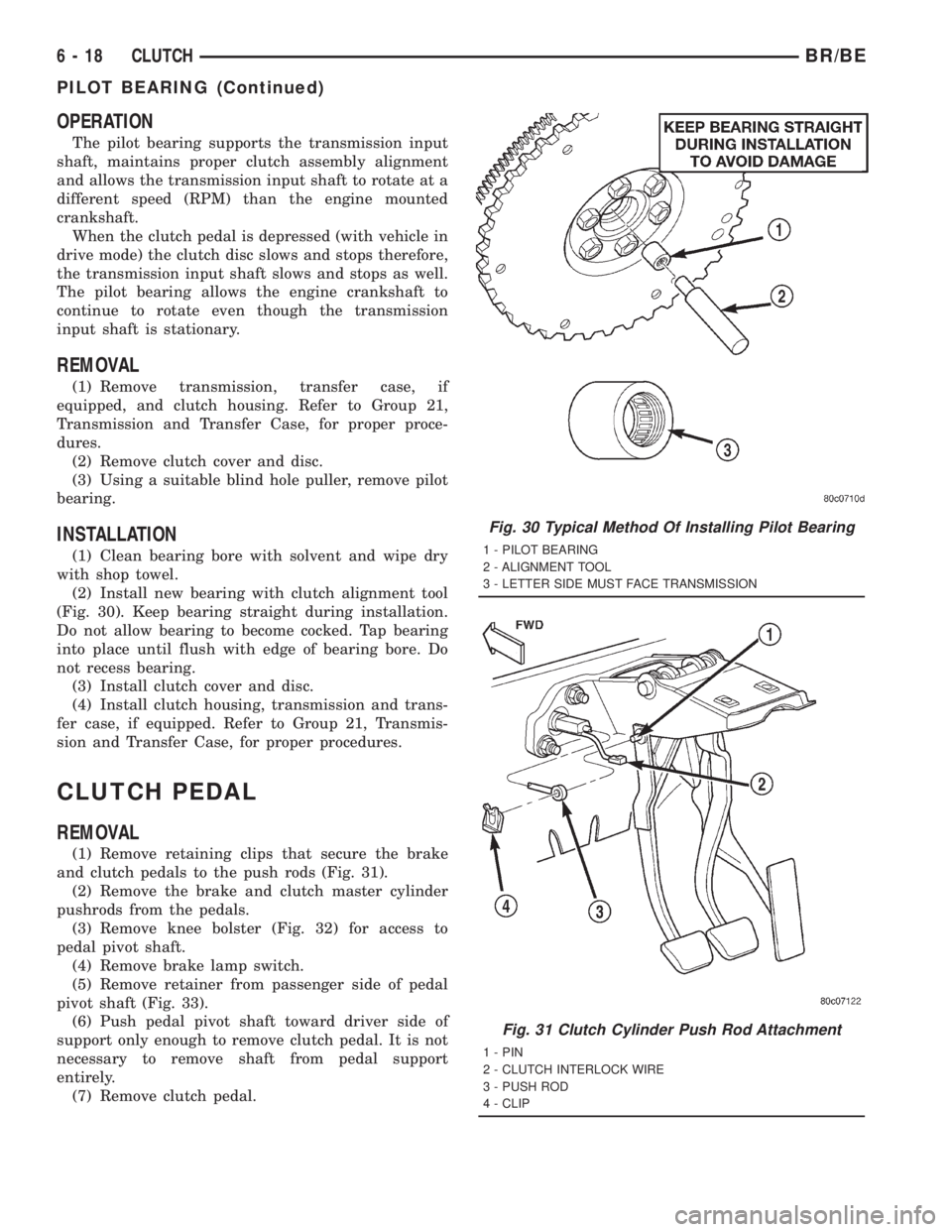
(2) Install new bearing with clutch alignment tool
(Fig. 30). Keep bearing straight during installation.
Do not allow bearing to become cocked. Tap bearing
into place until flush with edge of bearing bore. Do
not recess bearing.
(3) Install clutch cover and disc.
(4) Install clutch housing, transmission and trans-
fer case, if equipped. Refer to Group 21, Transmis-
sion and Transfer Case, for proper procedures.
CLUTCH PEDAL
REMOVAL
(1) Remove retaining clips that secure the brake
and clutch pedals to the push rods (Fig. 31).
(2) Remove the brake and clutch master cylinder
pushrods from the pedals.
(3) Remove knee bolster (Fig. 32) for access to
pedal pivot shaft.
(4) Remove brake lamp switch.
(5) Remove retainer from passenger side of pedal
pivot shaft (Fig. 33).
(6) Push pedal pivot shaft toward driver side of
support only enough to remove clutch pedal. It is not
necessary to remove shaft from pedal support
entirely.
(7) Remove clutch pedal.
Fig. 30 Typical Method Of Installing Pilot Bearing
1 - PILOT BEARING
2 - ALIGNMENT TOOL
3 - LETTER SIDE MUST FACE TRANSMISSION
Fig. 31 Clutch Cylinder Push Rod Attachment
1 - PIN
2 - CLUTCH INTERLOCK WIRE
3 - PUSH ROD
4 - CLIP
6 - 18 CLUTCHBR/BE
PILOT BEARING (Continued)