2001 CHRYSLER VOYAGER battery
[x] Cancel search: batteryPage 1382 of 4284
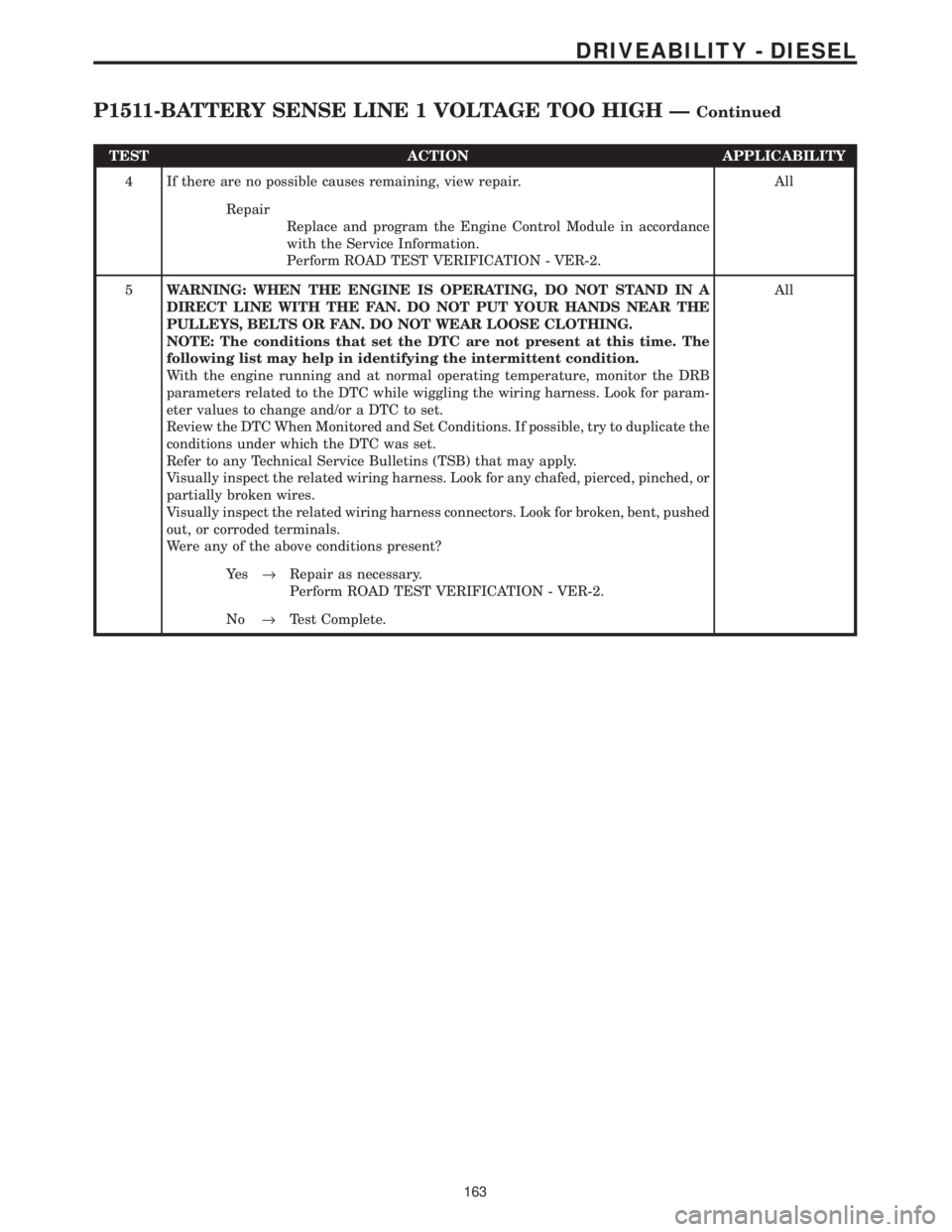
TEST ACTION APPLICABILITY
4 If there are no possible causes remaining, view repair. All
Repair
Replace and program the Engine Control Module in accordance
with the Service Information.
Perform ROAD TEST VERIFICATION - VER-2.
5WARNING: WHEN THE ENGINE IS OPERATING, DO NOT STAND IN A
DIRECT LINE WITH THE FAN. DO NOT PUT YOUR HANDS NEAR THE
PULLEYS, BELTS OR FAN. DO NOT WEAR LOOSE CLOTHING.
NOTE: The conditions that set the DTC are not present at this time. The
following list may help in identifying the intermittent condition.
With the engine running and at normal operating temperature, monitor the DRB
parameters related to the DTC while wiggling the wiring harness. Look for param-
eter values to change and/or a DTC to set.
Review the DTC When Monitored and Set Conditions. If possible, try to duplicate the
conditions under which the DTC was set.
Refer to any Technical Service Bulletins (TSB) that may apply.
Visually inspect the related wiring harness. Look for any chafed, pierced, pinched, or
partially broken wires.
Visually inspect the related wiring harness connectors. Look for broken, bent, pushed
out, or corroded terminals.
Were any of the above conditions present?All
Ye s®Repair as necessary.
Perform ROAD TEST VERIFICATION - VER-2.
No®Test Complete.
163
DRIVEABILITY - DIESEL
P1511-BATTERY SENSE LINE 1 VOLTAGE TOO HIGH ÐContinued
Page 1383 of 4284
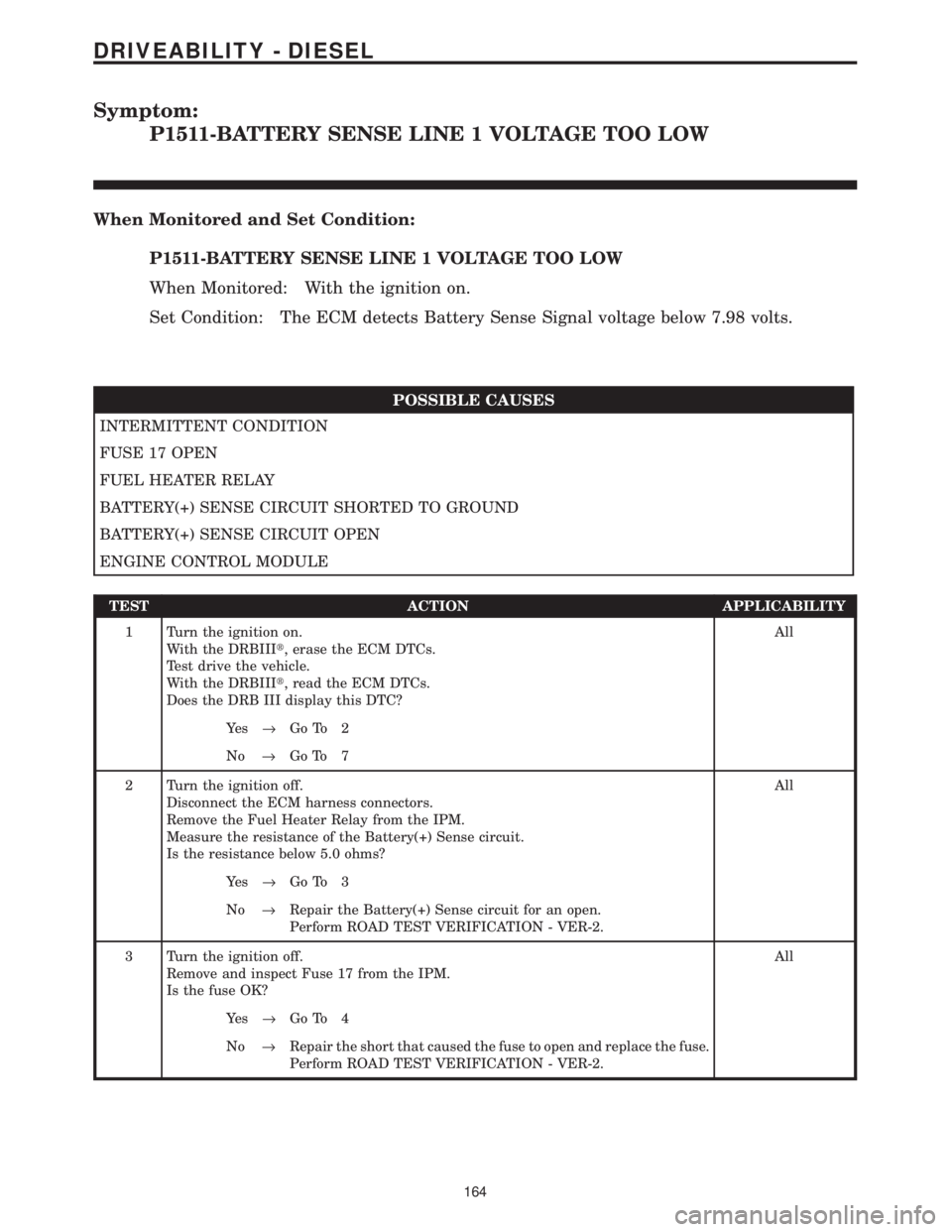
Symptom:
P1511-BATTERY SENSE LINE 1 VOLTAGE TOO LOW
When Monitored and Set Condition:
P1511-BATTERY SENSE LINE 1 VOLTAGE TOO LOW
When Monitored: With the ignition on.
Set Condition: The ECM detects Battery Sense Signal voltage below 7.98 volts.
POSSIBLE CAUSES
INTERMITTENT CONDITION
FUSE 17 OPEN
FUEL HEATER RELAY
BATTERY(+) SENSE CIRCUIT SHORTED TO GROUND
BATTERY(+) SENSE CIRCUIT OPEN
ENGINE CONTROL MODULE
TEST ACTION APPLICABILITY
1 Turn the ignition on.
With the DRBIIIt, erase the ECM DTCs.
Test drive the vehicle.
With the DRBIIIt, read the ECM DTCs.
Does the DRB III display this DTC?All
Ye s®Go To 2
No®Go To 7
2 Turn the ignition off.
Disconnect the ECM harness connectors.
Remove the Fuel Heater Relay from the IPM.
Measure the resistance of the Battery(+) Sense circuit.
Is the resistance below 5.0 ohms?All
Ye s®Go To 3
No®Repair the Battery(+) Sense circuit for an open.
Perform ROAD TEST VERIFICATION - VER-2.
3 Turn the ignition off.
Remove and inspect Fuse 17 from the IPM.
Is the fuse OK?All
Ye s®Go To 4
No®Repair the short that caused the fuse to open and replace the fuse.
Perform ROAD TEST VERIFICATION - VER-2.
164
DRIVEABILITY - DIESEL
Page 1384 of 4284
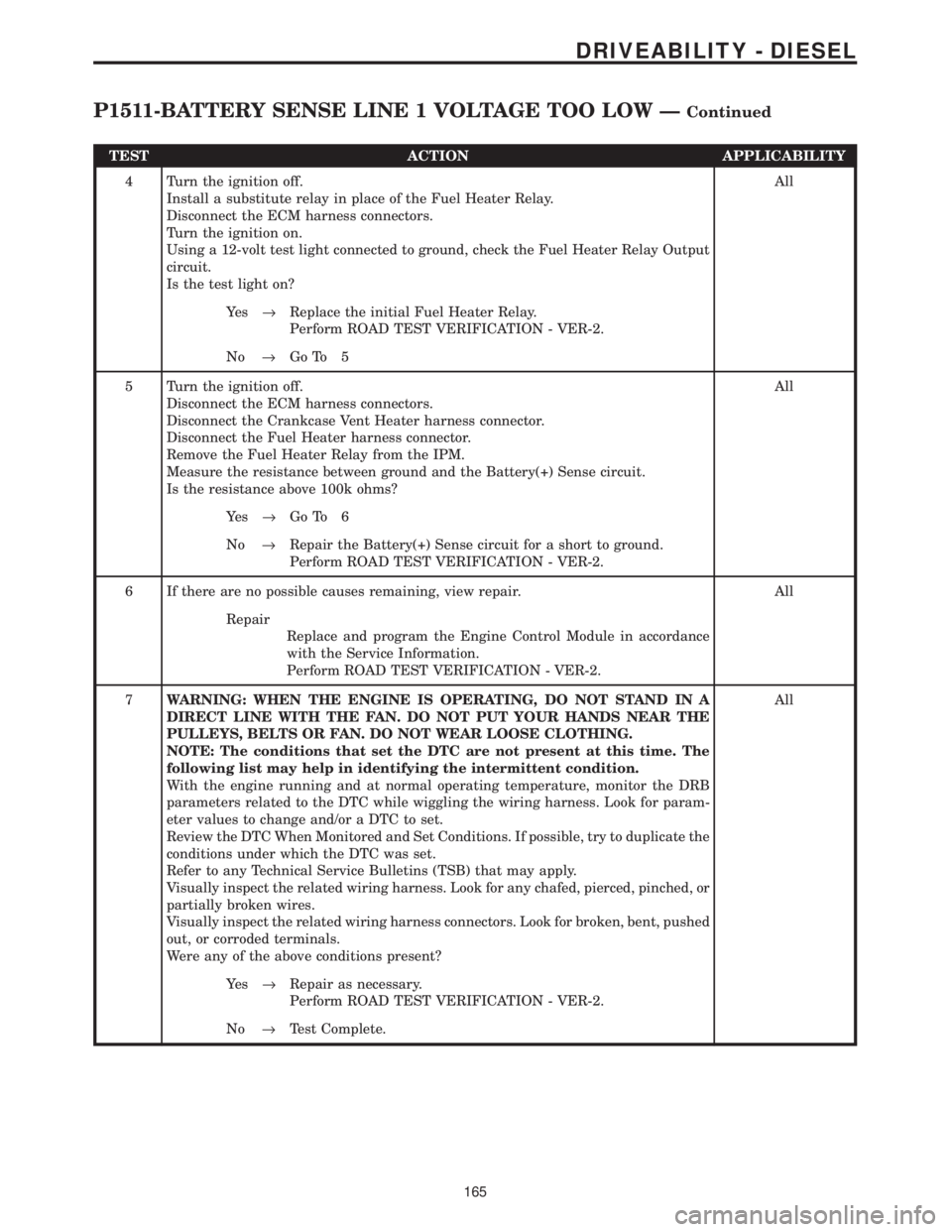
TEST ACTION APPLICABILITY
4 Turn the ignition off.
Install a substitute relay in place of the Fuel Heater Relay.
Disconnect the ECM harness connectors.
Turn the ignition on.
Using a 12-volt test light connected to ground, check the Fuel Heater Relay Output
circuit.
Is the test light on?All
Ye s®Replace the initial Fuel Heater Relay.
Perform ROAD TEST VERIFICATION - VER-2.
No®Go To 5
5 Turn the ignition off.
Disconnect the ECM harness connectors.
Disconnect the Crankcase Vent Heater harness connector.
Disconnect the Fuel Heater harness connector.
Remove the Fuel Heater Relay from the IPM.
Measure the resistance between ground and the Battery(+) Sense circuit.
Is the resistance above 100k ohms?All
Ye s®Go To 6
No®Repair the Battery(+) Sense circuit for a short to ground.
Perform ROAD TEST VERIFICATION - VER-2.
6 If there are no possible causes remaining, view repair. All
Repair
Replace and program the Engine Control Module in accordance
with the Service Information.
Perform ROAD TEST VERIFICATION - VER-2.
7WARNING: WHEN THE ENGINE IS OPERATING, DO NOT STAND IN A
DIRECT LINE WITH THE FAN. DO NOT PUT YOUR HANDS NEAR THE
PULLEYS, BELTS OR FAN. DO NOT WEAR LOOSE CLOTHING.
NOTE: The conditions that set the DTC are not present at this time. The
following list may help in identifying the intermittent condition.
With the engine running and at normal operating temperature, monitor the DRB
parameters related to the DTC while wiggling the wiring harness. Look for param-
eter values to change and/or a DTC to set.
Review the DTC When Monitored and Set Conditions. If possible, try to duplicate the
conditions under which the DTC was set.
Refer to any Technical Service Bulletins (TSB) that may apply.
Visually inspect the related wiring harness. Look for any chafed, pierced, pinched, or
partially broken wires.
Visually inspect the related wiring harness connectors. Look for broken, bent, pushed
out, or corroded terminals.
Were any of the above conditions present?All
Ye s®Repair as necessary.
Perform ROAD TEST VERIFICATION - VER-2.
No®Test Complete.
165
DRIVEABILITY - DIESEL
P1511-BATTERY SENSE LINE 1 VOLTAGE TOO LOW ÐContinued
Page 1402 of 4284
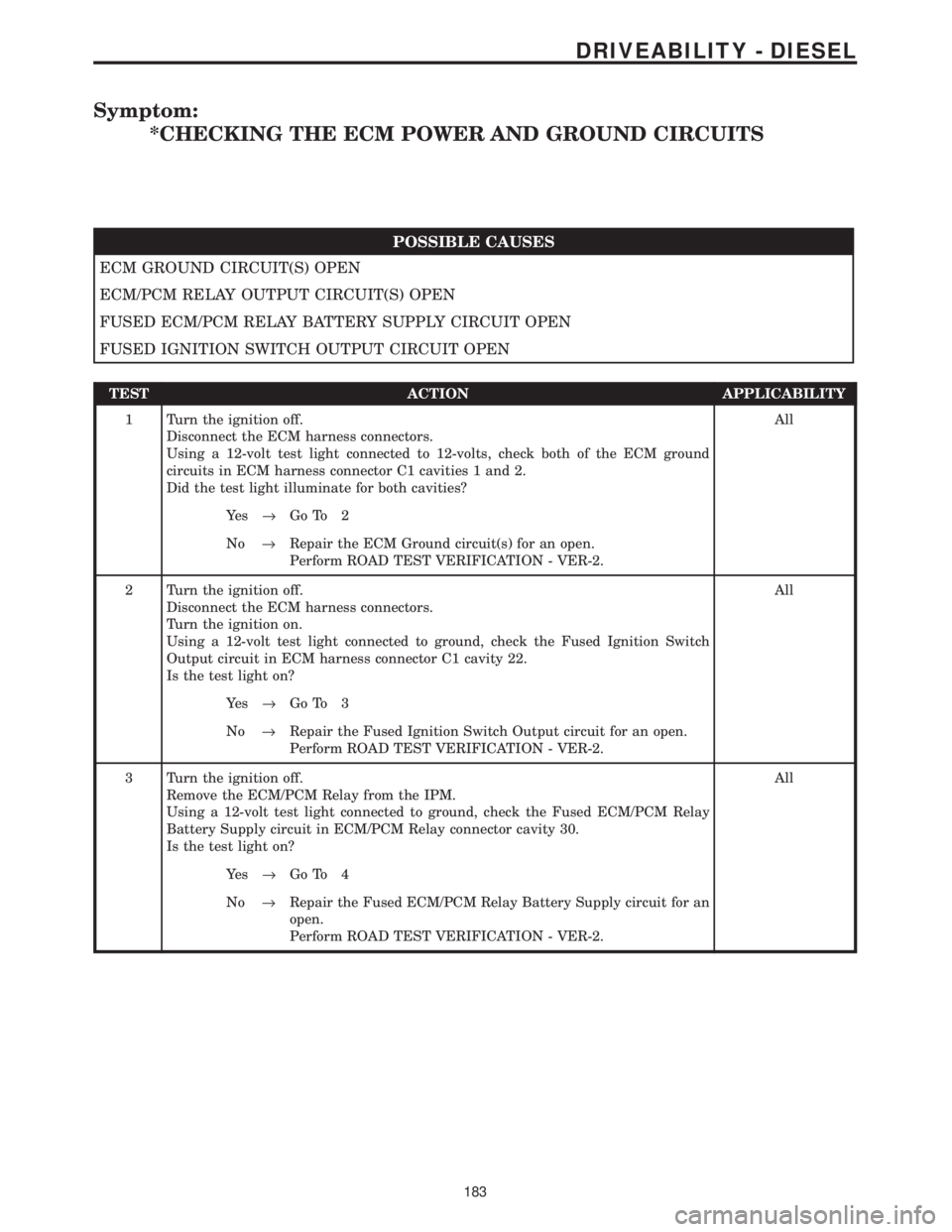
Symptom:
*CHECKING THE ECM POWER AND GROUND CIRCUITS
POSSIBLE CAUSES
ECM GROUND CIRCUIT(S) OPEN
ECM/PCM RELAY OUTPUT CIRCUIT(S) OPEN
FUSED ECM/PCM RELAY BATTERY SUPPLY CIRCUIT OPEN
FUSED IGNITION SWITCH OUTPUT CIRCUIT OPEN
TEST ACTION APPLICABILITY
1 Turn the ignition off.
Disconnect the ECM harness connectors.
Using a 12-volt test light connected to 12-volts, check both of the ECM ground
circuits in ECM harness connector C1 cavities 1 and 2.
Did the test light illuminate for both cavities?All
Ye s®Go To 2
No®Repair the ECM Ground circuit(s) for an open.
Perform ROAD TEST VERIFICATION - VER-2.
2 Turn the ignition off.
Disconnect the ECM harness connectors.
Turn the ignition on.
Using a 12-volt test light connected to ground, check the Fused Ignition Switch
Output circuit in ECM harness connector C1 cavity 22.
Is the test light on?All
Ye s®Go To 3
No®Repair the Fused Ignition Switch Output circuit for an open.
Perform ROAD TEST VERIFICATION - VER-2.
3 Turn the ignition off.
Remove the ECM/PCM Relay from the IPM.
Using a 12-volt test light connected to ground, check the Fused ECM/PCM Relay
Battery Supply circuit in ECM/PCM Relay connector cavity 30.
Is the test light on?All
Ye s®Go To 4
No®Repair the Fused ECM/PCM Relay Battery Supply circuit for an
open.
Perform ROAD TEST VERIFICATION - VER-2.
183
DRIVEABILITY - DIESEL
Page 1429 of 4284
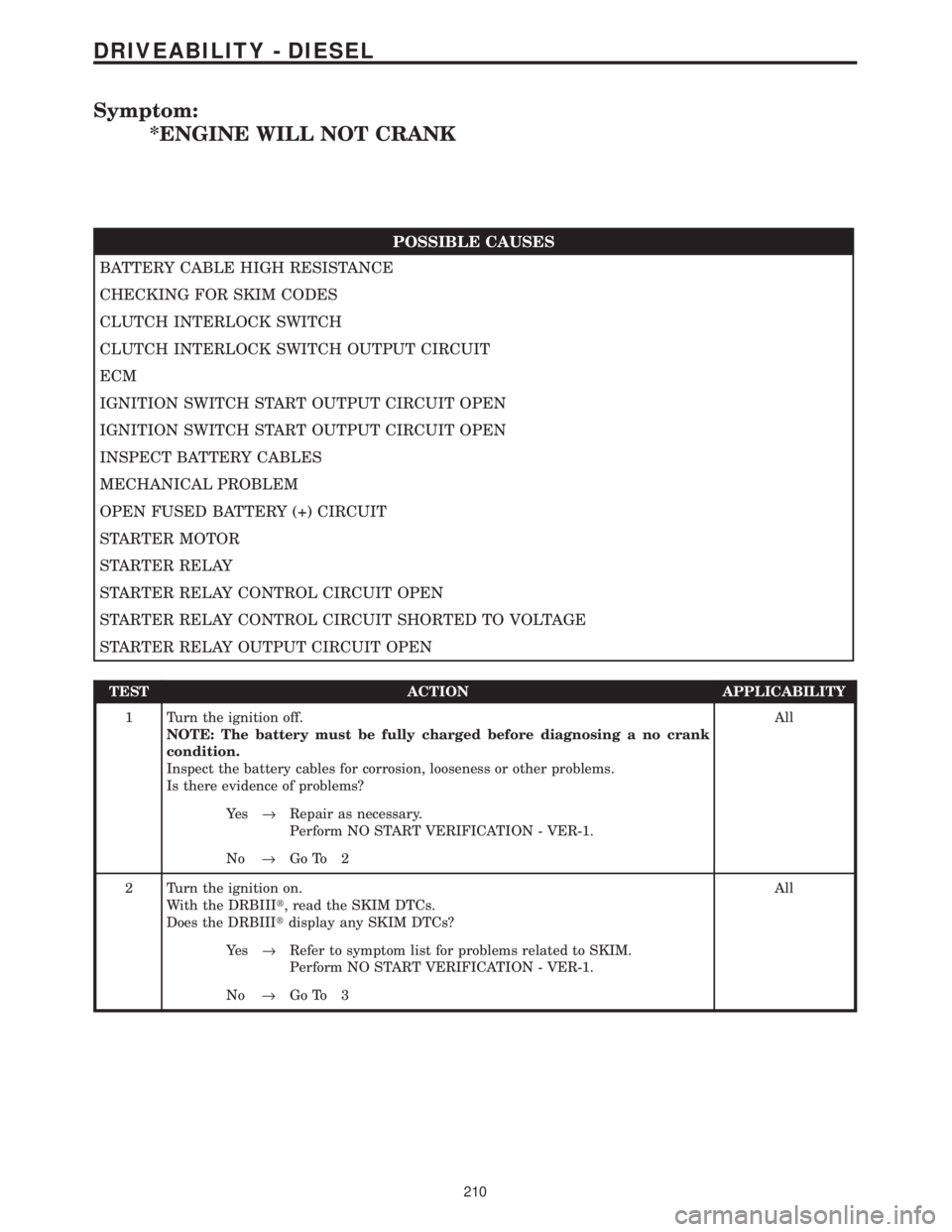
Symptom:
*ENGINE WILL NOT CRANK
POSSIBLE CAUSES
BATTERY CABLE HIGH RESISTANCE
CHECKING FOR SKIM CODES
CLUTCH INTERLOCK SWITCH
CLUTCH INTERLOCK SWITCH OUTPUT CIRCUIT
ECM
IGNITION SWITCH START OUTPUT CIRCUIT OPEN
IGNITION SWITCH START OUTPUT CIRCUIT OPEN
INSPECT BATTERY CABLES
MECHANICAL PROBLEM
OPEN FUSED BATTERY (+) CIRCUIT
STARTER MOTOR
STARTER RELAY
STARTER RELAY CONTROL CIRCUIT OPEN
STARTER RELAY CONTROL CIRCUIT SHORTED TO VOLTAGE
STARTER RELAY OUTPUT CIRCUIT OPEN
TEST ACTION APPLICABILITY
1 Turn the ignition off.
NOTE: The battery must be fully charged before diagnosing a no crank
condition.
Inspect the battery cables for corrosion, looseness or other problems.
Is there evidence of problems?All
Ye s®Repair as necessary.
Perform NO START VERIFICATION - VER-1.
No®Go To 2
2 Turn the ignition on.
With the DRBIIIt, read the SKIM DTCs.
Does the DRBIIItdisplay any SKIM DTCs?All
Ye s®Refer to symptom list for problems related to SKIM.
Perform NO START VERIFICATION - VER-1.
No®Go To 3
210
DRIVEABILITY - DIESEL
Page 1432 of 4284
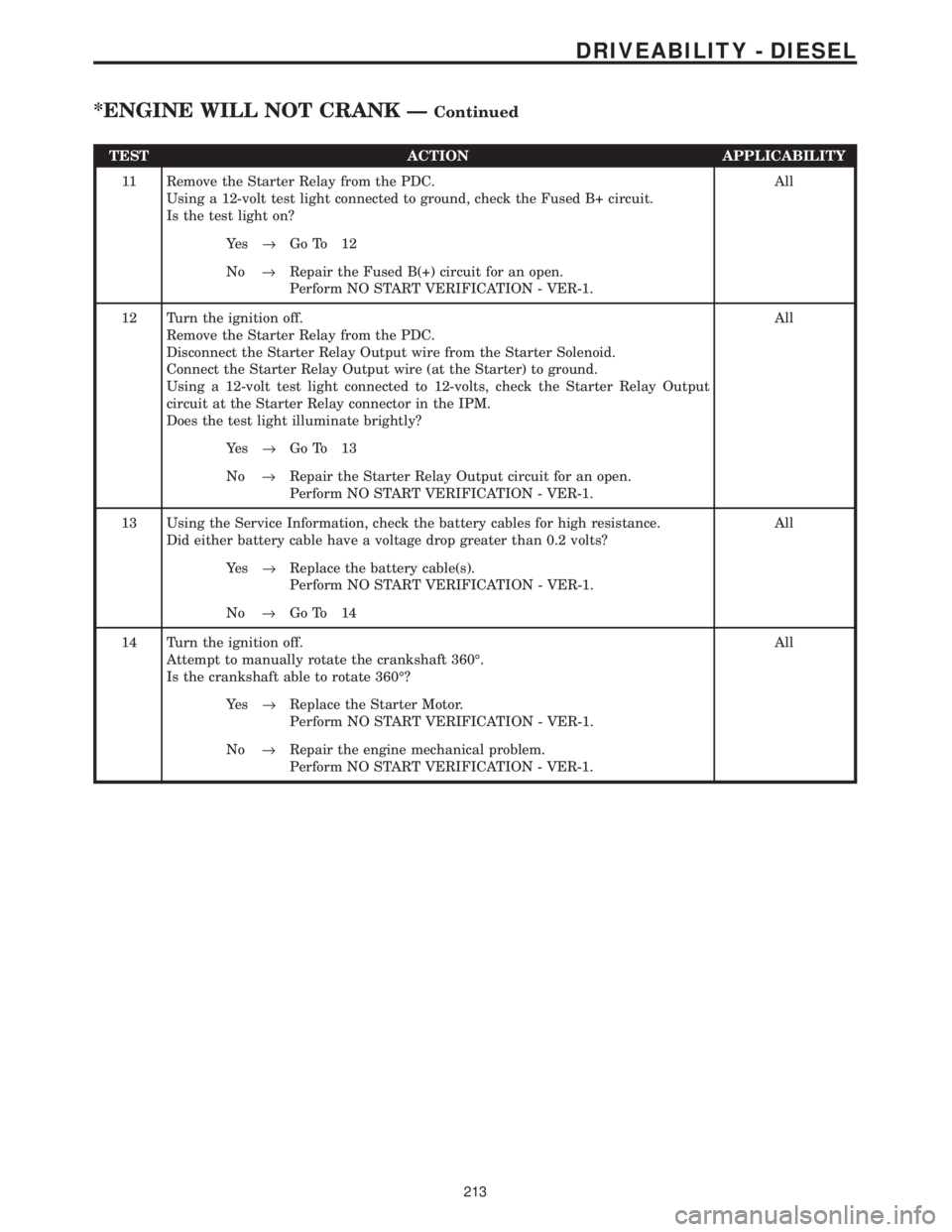
TEST ACTION APPLICABILITY
11 Remove the Starter Relay from the PDC.
Using a 12-volt test light connected to ground, check the Fused B+ circuit.
Is the test light on?All
Ye s®Go To 12
No®Repair the Fused B(+) circuit for an open.
Perform NO START VERIFICATION - VER-1.
12 Turn the ignition off.
Remove the Starter Relay from the PDC.
Disconnect the Starter Relay Output wire from the Starter Solenoid.
Connect the Starter Relay Output wire (at the Starter) to ground.
Using a 12-volt test light connected to 12-volts, check the Starter Relay Output
circuit at the Starter Relay connector in the IPM.
Does the test light illuminate brightly?All
Ye s®Go To 13
No®Repair the Starter Relay Output circuit for an open.
Perform NO START VERIFICATION - VER-1.
13 Using the Service Information, check the battery cables for high resistance.
Did either battery cable have a voltage drop greater than 0.2 volts?All
Ye s®Replace the battery cable(s).
Perform NO START VERIFICATION - VER-1.
No®Go To 14
14 Turn the ignition off.
Attempt to manually rotate the crankshaft 360É.
Is the crankshaft able to rotate 360É?All
Ye s®Replace the Starter Motor.
Perform NO START VERIFICATION - VER-1.
No®Repair the engine mechanical problem.
Perform NO START VERIFICATION - VER-1.
213
DRIVEABILITY - DIESEL
*ENGINE WILL NOT CRANK ÐContinued
Page 1443 of 4284
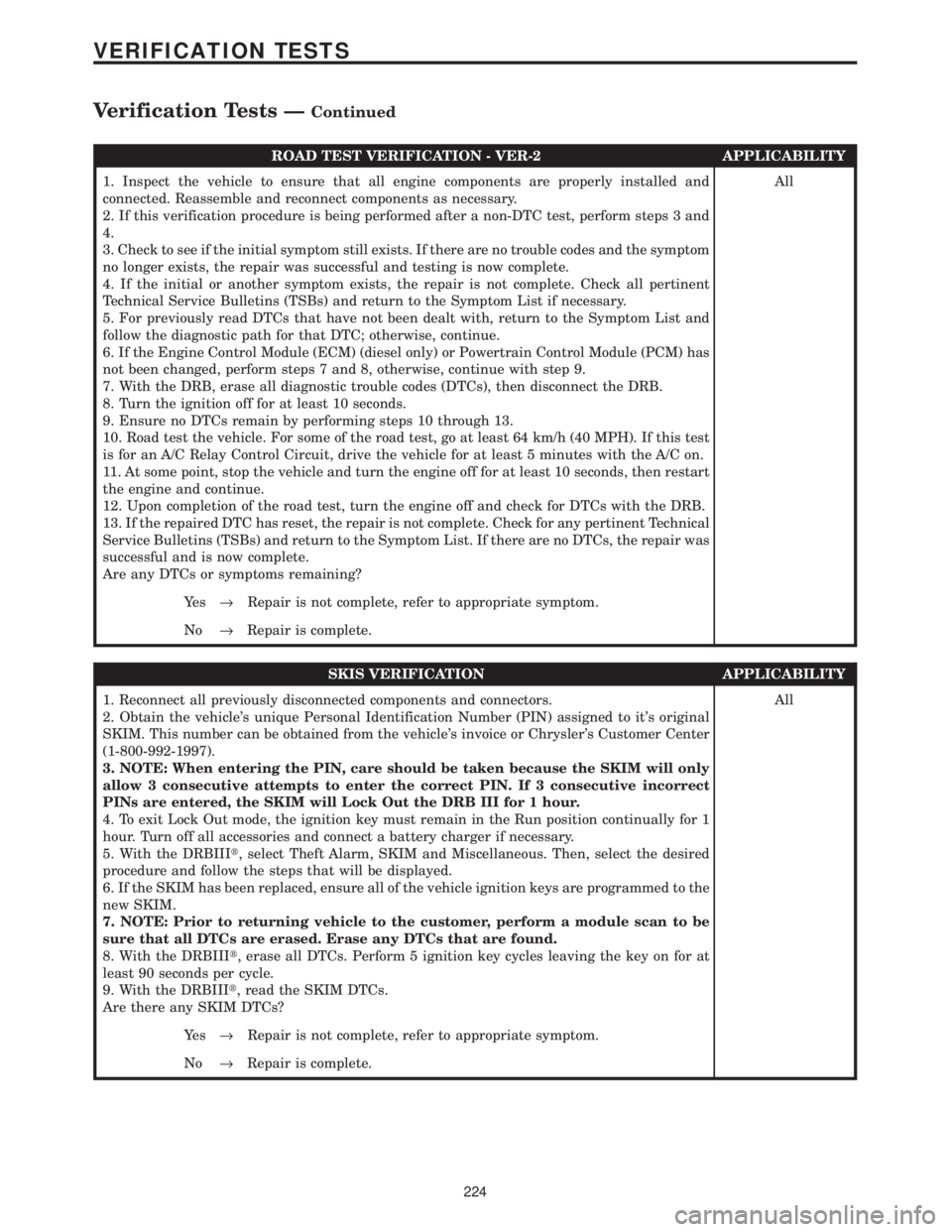
ROAD TEST VERIFICATION - VER-2 APPLICABILITY
1. Inspect the vehicle to ensure that all engine components are properly installed and
connected. Reassemble and reconnect components as necessary.
2. If this verification procedure is being performed after a non-DTC test, perform steps 3 and
4.
3. Check to see if the initial symptom still exists. If there are no trouble codes and the symptom
no longer exists, the repair was successful and testing is now complete.
4. If the initial or another symptom exists, the repair is not complete. Check all pertinent
Technical Service Bulletins (TSBs) and return to the Symptom List if necessary.
5. For previously read DTCs that have not been dealt with, return to the Symptom List and
follow the diagnostic path for that DTC; otherwise, continue.
6. If the Engine Control Module (ECM) (diesel only) or Powertrain Control Module (PCM) has
not been changed, perform steps 7 and 8, otherwise, continue with step 9.
7. With the DRB, erase all diagnostic trouble codes (DTCs), then disconnect the DRB.
8. Turn the ignition off for at least 10 seconds.
9. Ensure no DTCs remain by performing steps 10 through 13.
10. Road test the vehicle. For some of the road test, go at least 64 km/h (40 MPH). If this test
is for an A/C Relay Control Circuit, drive the vehicle for at least 5 minutes with the A/C on.
11. At some point, stop the vehicle and turn the engine off for at least 10 seconds, then restart
the engine and continue.
12. Upon completion of the road test, turn the engine off and check for DTCs with the DRB.
13. If the repaired DTC has reset, the repair is not complete. Check for any pertinent Technical
Service Bulletins (TSBs) and return to the Symptom List. If there are no DTCs, the repair was
successful and is now complete.
Are any DTCs or symptoms remaining?All
Ye s®Repair is not complete, refer to appropriate symptom.
No®Repair is complete.
SKIS VERIFICATION APPLICABILITY
1. Reconnect all previously disconnected components and connectors.
2. Obtain the vehicle's unique Personal Identification Number (PIN) assigned to it's original
SKIM. This number can be obtained from the vehicle's invoice or Chrysler's Customer Center
(1-800-992-1997).
3. NOTE: When entering the PIN, care should be taken because the SKIM will only
allow 3 consecutive attempts to enter the correct PIN. If 3 consecutive incorrect
PINs are entered, the SKIM will Lock Out the DRB III for 1 hour.
4. To exit Lock Out mode, the ignition key must remain in the Run position continually for 1
hour. Turn off all accessories and connect a battery charger if necessary.
5. With the DRBIIIt, select Theft Alarm, SKIM and Miscellaneous. Then, select the desired
procedure and follow the steps that will be displayed.
6. If the SKIM has been replaced, ensure all of the vehicle ignition keys are programmed to the
new SKIM.
7. NOTE: Prior to returning vehicle to the customer, perform a module scan to be
sure that all DTCs are erased. Erase any DTCs that are found.
8. With the DRBIIIt, erase all DTCs. Perform 5 ignition key cycles leaving the key on for at
least 90 seconds per cycle.
9. With the DRBIIIt, read the SKIM DTCs.
Are there any SKIM DTCs?All
Ye s®Repair is not complete, refer to appropriate symptom.
No®Repair is complete.
224
VERIFICATION TESTS
Verification Tests ÐContinued
Page 1450 of 4284
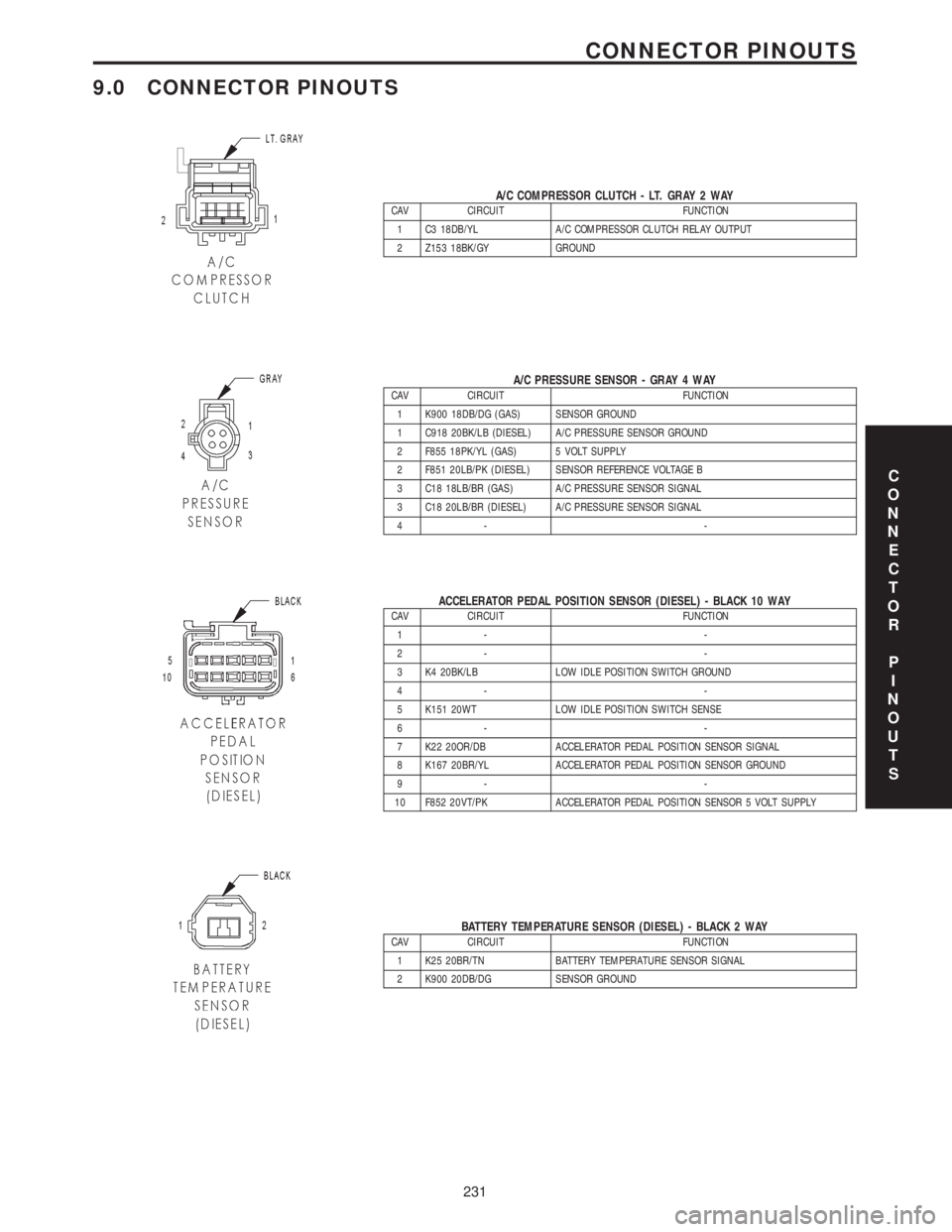
9.0 CONNECTOR PINOUTS
A/C COMPRESSOR CLUTCH - LT. GRAY 2 WAYCAV CIRCUIT FUNCTION
1 C3 18DB/YL A/C COMPRESSOR CLUTCH RELAY OUTPUT
2 Z153 18BK/GY GROUND
A/C PRESSURE SENSOR - GRAY 4 WAYCAV CIRCUIT FUNCTION
1 K900 18DB/DG (GAS) SENSOR GROUND
1 C918 20BK/LB (DIESEL) A/C PRESSURE SENSOR GROUND
2 F855 18PK/YL (GAS) 5 VOLT SUPPLY
2 F851 20LB/PK (DIESEL) SENSOR REFERENCE VOLTAGE B
3 C18 18LB/BR (GAS) A/C PRESSURE SENSOR SIGNAL
3 C18 20LB/BR (DIESEL) A/C PRESSURE SENSOR SIGNAL
4- -
ACCELERATOR PEDAL POSITION SENSOR (DIESEL) - BLACK 10 WAYCAV CIRCUIT FUNCTION
1- -
2- -
3 K4 20BK/LB LOW IDLE POSITION SWITCH GROUND
4- -
5 K151 20WT LOW IDLE POSITION SWITCH SENSE
6- -
7 K22 20OR/DB ACCELERATOR PEDAL POSITION SENSOR SIGNAL
8 K167 20BR/YL ACCELERATOR PEDAL POSITION SENSOR GROUND
9- -
10 F852 20VT/PK ACCELERATOR PEDAL POSITION SENSOR 5 VOLT SUPPLY
BATTERY TEMPERATURE SENSOR (DIESEL) - BLACK 2 WAYCAV CIRCUIT FUNCTION
1 K25 20BR/TN BATTERY TEMPERATURE SENSOR SIGNAL
2 K900 20DB/DG SENSOR GROUND
C
O
N
N
E
C
T
O
R
P
I
N
O
U
T
S
231
CONNECTOR PINOUTS