2001 CHRYSLER VOYAGER heating
[x] Cancel search: heatingPage 3792 of 4284
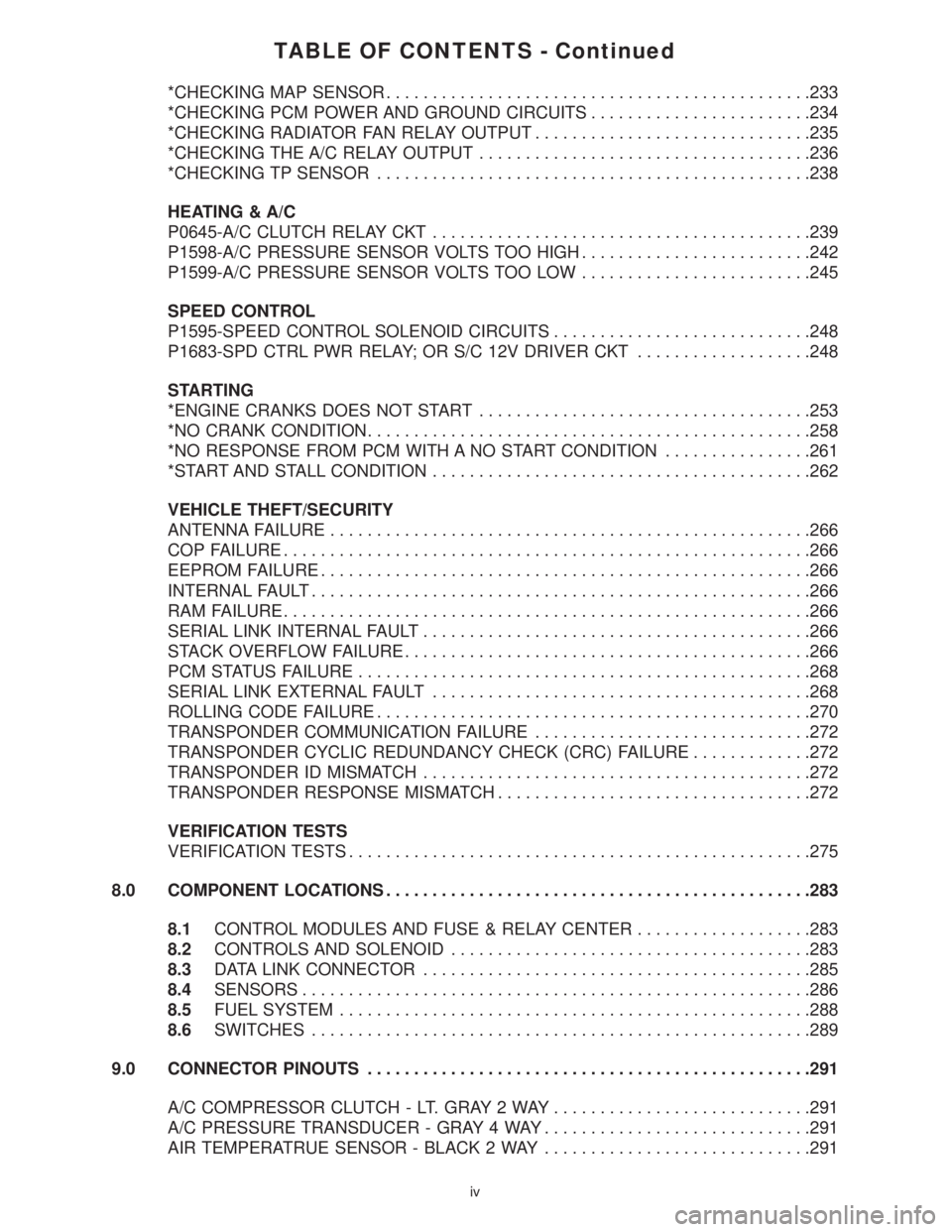
TABLE OF CONTENTS - Continued
*CHECKING MAP SENSOR..............................................233
*CHECKING PCM POWER AND GROUND CIRCUITS........................234
*CHECKING RADIATOR FAN RELAY OUTPUT..............................235
*CHECKING THE A/C RELAY OUTPUT....................................236
*CHECKING TP SENSOR...............................................238
HEATING & A/C
P0645-A/C CLUTCH RELAY CKT.........................................239
P1598-A/C PRESSURE SENSOR VOLTS TOO HIGH.........................242
P1599-A/C PRESSURE SENSOR VOLTS TOO LOW.........................245
SPEED CONTROL
P1595-SPEED CONTROL SOLENOID CIRCUITS............................248
P1683-SPD CTRL PWR RELAY; OR S/C 12V DRIVER CKT...................248
STARTING
*ENGINE CRANKS DOES NOT START....................................253
*NO CRANK CONDITION................................................258
*NO RESPONSE FROM PCM WITH A NO START CONDITION................261
*START AND STALL CONDITION.........................................262
VEHICLE THEFT/SECURITY
ANTENNA FAILURE....................................................266
COP FAILURE.........................................................266
EEPROM FAILURE.....................................................266
INTERNAL FAULT......................................................266
RAM FAILURE.........................................................266
SERIAL LINK INTERNAL FAULT..........................................266
STACK OVERFLOW FAILURE............................................266
PCM STATUS FAILURE.................................................268
SERIAL LINK EXTERNAL FAULT.........................................268
ROLLING CODE FAILURE...............................................270
TRANSPONDER COMMUNICATION FAILURE..............................272
TRANSPONDER CYCLIC REDUNDANCY CHECK (CRC) FAILURE.............272
TRANSPONDER ID MISMATCH..........................................272
TRANSPONDER RESPONSE MISMATCH..................................272
VERIFICATION TESTS
VERIFICATION TESTS..................................................275
8.0 COMPONENT LOCATIONS..............................................283
8.1CONTROL MODULES AND FUSE & RELAY CENTER...................283
8.2CONTROLS AND SOLENOID.......................................283
8.3DATA LINK CONNECTOR..........................................285
8.4SENSORS.......................................................286
8.5FUEL SYSTEM...................................................288
8.6SWITCHES......................................................289
9.0 CONNECTOR PINOUTS................................................291
A/C COMPRESSOR CLUTCH - LT. GRAY 2 WAY............................291
A/C PRESSURE TRANSDUCER - GRAY 4 WAY.............................291
AIR TEMPERATRUE SENSOR - BLACK 2 WAY.............................291
iv
Page 3925 of 4284
Symptom:
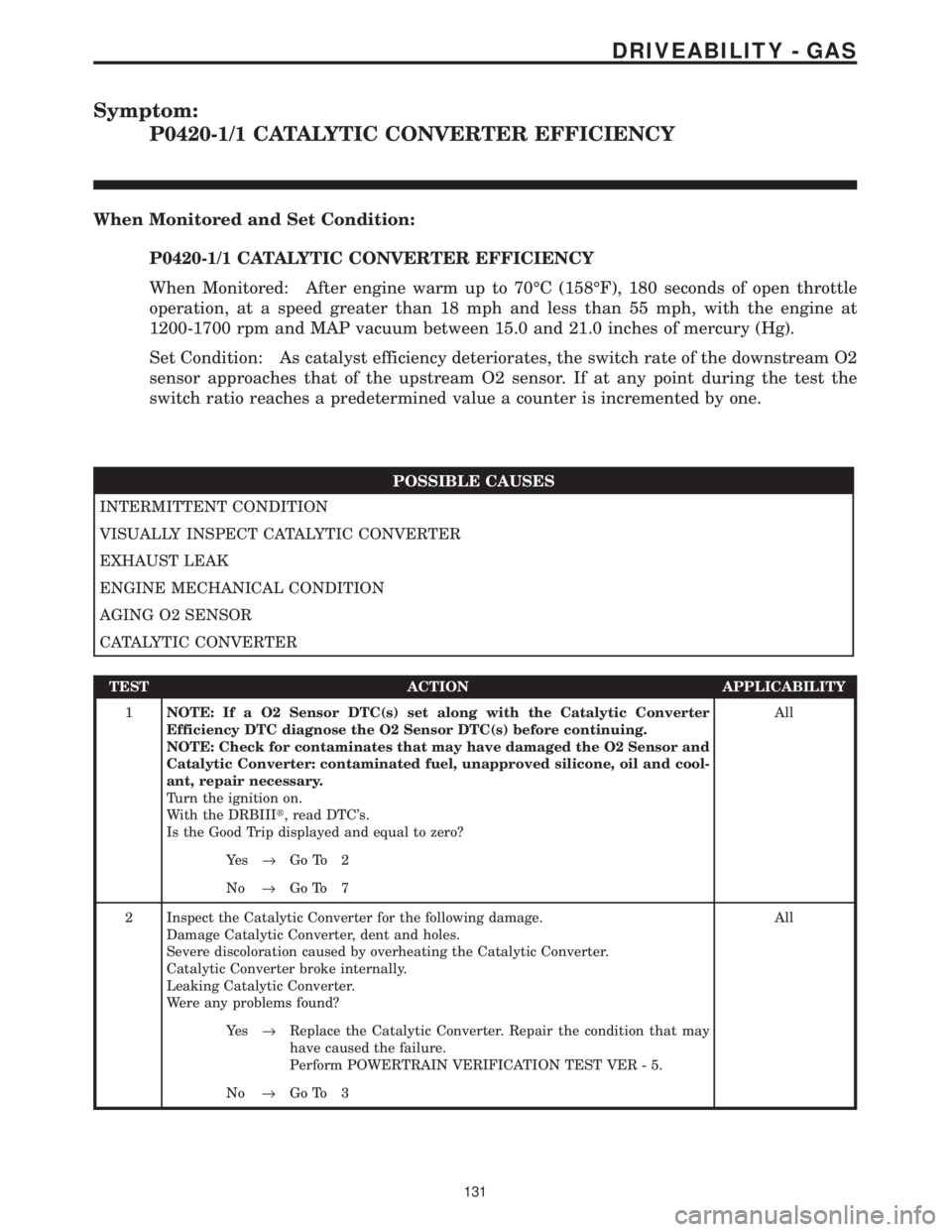
P0420-1/1 CATALYTIC CONVERTER EFFICIENCY
When Monitored and Set Condition:
P0420-1/1 CATALYTIC CONVERTER EFFICIENCY
When Monitored: After engine warm up to 70ÉC (158ÉF), 180 seconds of open throttle
operation, at a speed greater than 18 mph and less than 55 mph, with the engine at
1200-1700 rpm and MAP vacuum between 15.0 and 21.0 inches of mercury (Hg).
Set Condition: As catalyst efficiency deteriorates, the switch rate of the downstream O2
sensor approaches that of the upstream O2 sensor. If at any point during the test the
switch ratio reaches a predetermined value a counter is incremented by one.
POSSIBLE CAUSES
INTERMITTENT CONDITION
VISUALLY INSPECT CATALYTIC CONVERTER
EXHAUST LEAK
ENGINE MECHANICAL CONDITION
AGING O2 SENSOR
CATALYTIC CONVERTER
TEST ACTION APPLICABILITY
1NOTE: If a O2 Sensor DTC(s) set along with the Catalytic Converter
Efficiency DTC diagnose the O2 Sensor DTC(s) before continuing.
NOTE: Check for contaminates that may have damaged the O2 Sensor and
Catalytic Converter: contaminated fuel, unapproved silicone, oil and cool-
ant, repair necessary.
Turn the ignition on.
With the DRBIIIt, read DTC's.
Is the Good Trip displayed and equal to zero?All
Ye s®Go To 2
No®Go To 7
2 Inspect the Catalytic Converter for the following damage.
Damage Catalytic Converter, dent and holes.
Severe discoloration caused by overheating the Catalytic Converter.
Catalytic Converter broke internally.
Leaking Catalytic Converter.
Were any problems found?All
Ye s®Replace the Catalytic Converter. Repair the condition that may
have caused the failure.
Perform POWERTRAIN VERIFICATION TEST VER - 5.
No®Go To 3
131
DRIVEABILITY - GAS
Page 4033 of 4284
Symptom:
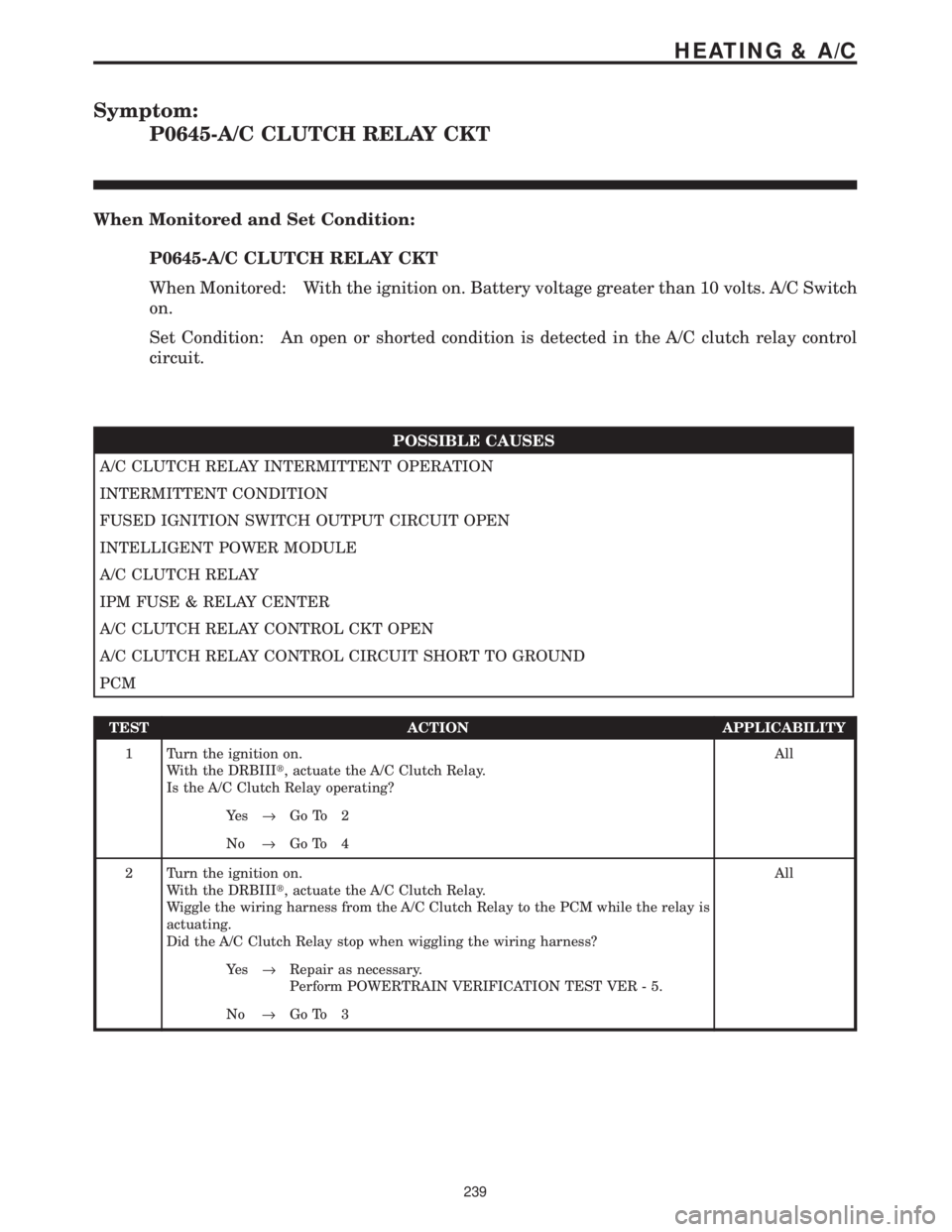
P0645-A/C CLUTCH RELAY CKT
When Monitored and Set Condition:
P0645-A/C CLUTCH RELAY CKT
When Monitored: With the ignition on. Battery voltage greater than 10 volts. A/C Switch
on.
Set Condition: An open or shorted condition is detected in the A/C clutch relay control
circuit.
POSSIBLE CAUSES
A/C CLUTCH RELAY INTERMITTENT OPERATION
INTERMITTENT CONDITION
FUSED IGNITION SWITCH OUTPUT CIRCUIT OPEN
INTELLIGENT POWER MODULE
A/C CLUTCH RELAY
IPM FUSE & RELAY CENTER
A/C CLUTCH RELAY CONTROL CKT OPEN
A/C CLUTCH RELAY CONTROL CIRCUIT SHORT TO GROUND
PCM
TEST ACTION APPLICABILITY
1 Turn the ignition on.
With the DRBIIIt, actuate the A/C Clutch Relay.
Is the A/C Clutch Relay operating?All
Ye s®Go To 2
No®Go To 4
2 Turn the ignition on.
With the DRBIIIt, actuate the A/C Clutch Relay.
Wiggle the wiring harness from the A/C Clutch Relay to the PCM while the relay is
actuating.
Did the A/C Clutch Relay stop when wiggling the wiring harness?All
Ye s®Repair as necessary.
Perform POWERTRAIN VERIFICATION TEST VER - 5.
No®Go To 3
239
HEATING & A/C
Page 4034 of 4284
TEST ACTION APPLICABILITY
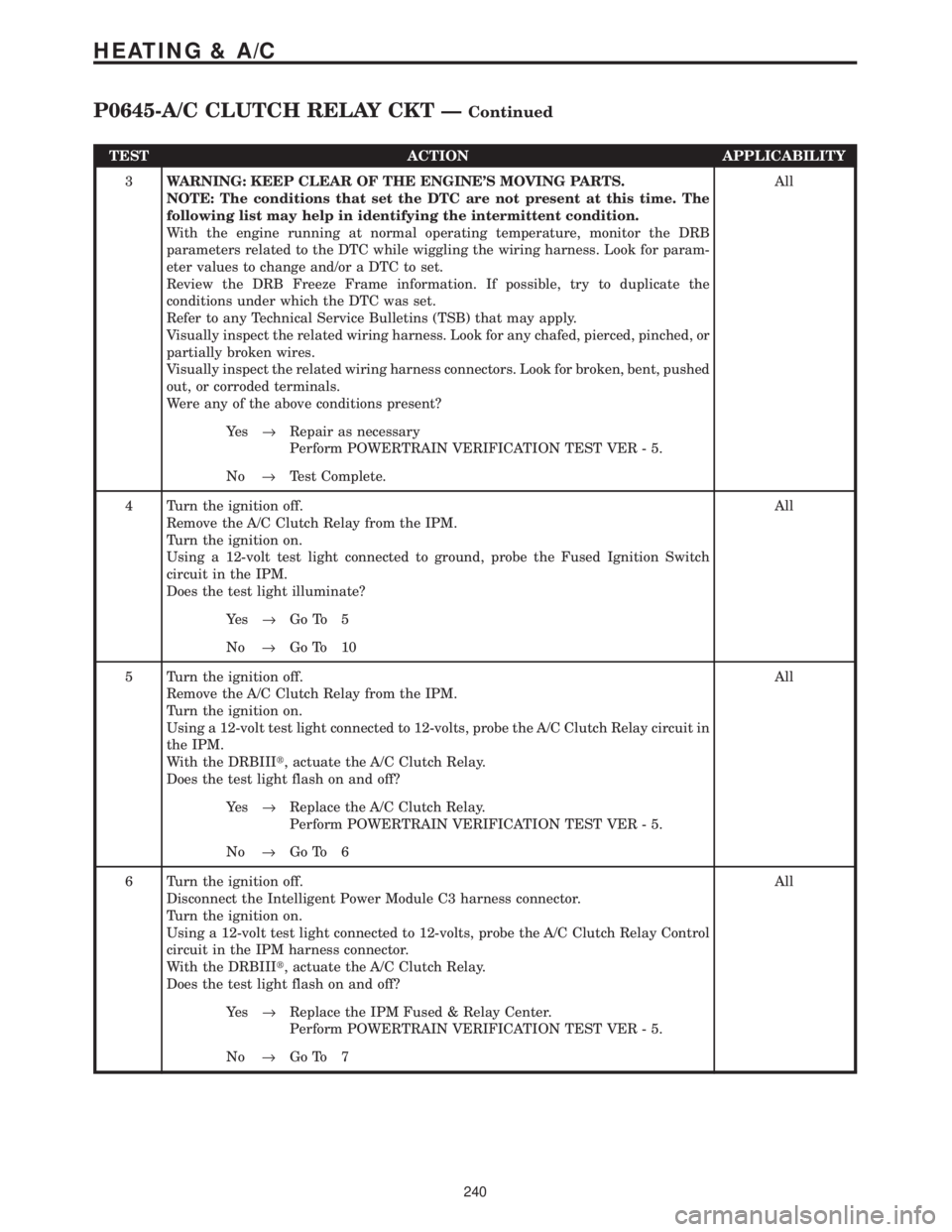
3WARNING: KEEP CLEAR OF THE ENGINE'S MOVING PARTS.
NOTE: The conditions that set the DTC are not present at this time. The
following list may help in identifying the intermittent condition.
With the engine running at normal operating temperature, monitor the DRB
parameters related to the DTC while wiggling the wiring harness. Look for param-
eter values to change and/or a DTC to set.
Review the DRB Freeze Frame information. If possible, try to duplicate the
conditions under which the DTC was set.
Refer to any Technical Service Bulletins (TSB) that may apply.
Visually inspect the related wiring harness. Look for any chafed, pierced, pinched, or
partially broken wires.
Visually inspect the related wiring harness connectors. Look for broken, bent, pushed
out, or corroded terminals.
Were any of the above conditions present?All
Ye s®Repair as necessary
Perform POWERTRAIN VERIFICATION TEST VER - 5.
No®Test Complete.
4 Turn the ignition off.
Remove the A/C Clutch Relay from the IPM.
Turn the ignition on.
Using a 12-volt test light connected to ground, probe the Fused Ignition Switch
circuit in the IPM.
Does the test light illuminate?All
Ye s®Go To 5
No®Go To 10
5 Turn the ignition off.
Remove the A/C Clutch Relay from the IPM.
Turn the ignition on.
Using a 12-volt test light connected to 12-volts, probe the A/C Clutch Relay circuit in
the IPM.
With the DRBIIIt, actuate the A/C Clutch Relay.
Does the test light flash on and off?All
Ye s®Replace the A/C Clutch Relay.
Perform POWERTRAIN VERIFICATION TEST VER - 5.
No®Go To 6
6 Turn the ignition off.
Disconnect the Intelligent Power Module C3 harness connector.
Turn the ignition on.
Using a 12-volt test light connected to 12-volts, probe the A/C Clutch Relay Control
circuit in the IPM harness connector.
With the DRBIIIt, actuate the A/C Clutch Relay.
Does the test light flash on and off?All
Ye s®Replace the IPM Fused & Relay Center.
Perform POWERTRAIN VERIFICATION TEST VER - 5.
No®Go To 7
240
HEATING & A/C
P0645-A/C CLUTCH RELAY CKT ÐContinued
Page 4035 of 4284
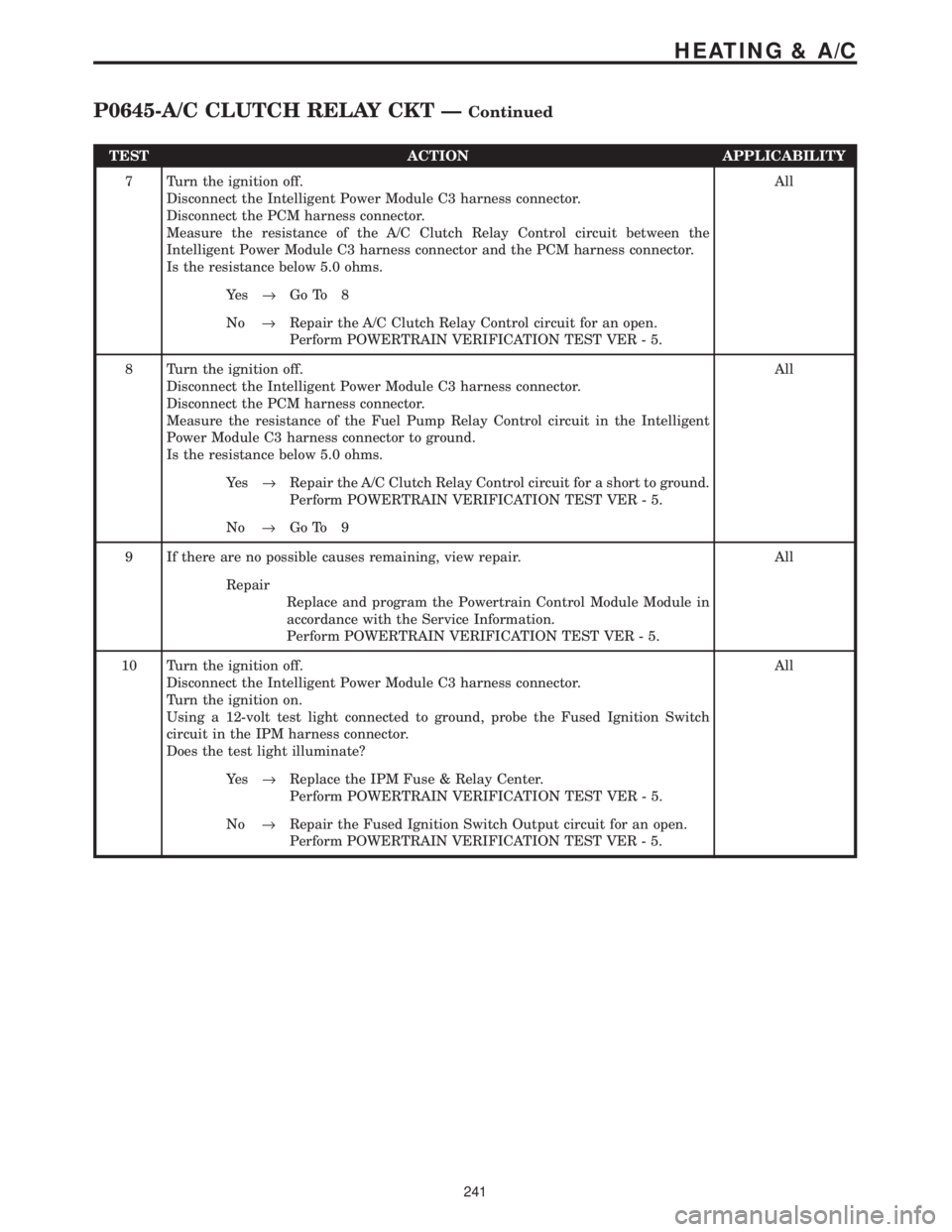
TEST ACTION APPLICABILITY
7 Turn the ignition off.
Disconnect the Intelligent Power Module C3 harness connector.
Disconnect the PCM harness connector.
Measure the resistance of the A/C Clutch Relay Control circuit between the
Intelligent Power Module C3 harness connector and the PCM harness connector.
Is the resistance below 5.0 ohms.All
Ye s®Go To 8
No®Repair the A/C Clutch Relay Control circuit for an open.
Perform POWERTRAIN VERIFICATION TEST VER - 5.
8 Turn the ignition off.
Disconnect the Intelligent Power Module C3 harness connector.
Disconnect the PCM harness connector.
Measure the resistance of the Fuel Pump Relay Control circuit in the Intelligent
Power Module C3 harness connector to ground.
Is the resistance below 5.0 ohms.All
Ye s®Repair the A/C Clutch Relay Control circuit for a short to ground.
Perform POWERTRAIN VERIFICATION TEST VER - 5.
No®Go To 9
9 If there are no possible causes remaining, view repair. All
Repair
Replace and program the Powertrain Control Module Module in
accordance with the Service Information.
Perform POWERTRAIN VERIFICATION TEST VER - 5.
10 Turn the ignition off.
Disconnect the Intelligent Power Module C3 harness connector.
Turn the ignition on.
Using a 12-volt test light connected to ground, probe the Fused Ignition Switch
circuit in the IPM harness connector.
Does the test light illuminate?All
Ye s®Replace the IPM Fuse & Relay Center.
Perform POWERTRAIN VERIFICATION TEST VER - 5.
No®Repair the Fused Ignition Switch Output circuit for an open.
Perform POWERTRAIN VERIFICATION TEST VER - 5.
241
HEATING & A/C
P0645-A/C CLUTCH RELAY CKT ÐContinued
Page 4036 of 4284
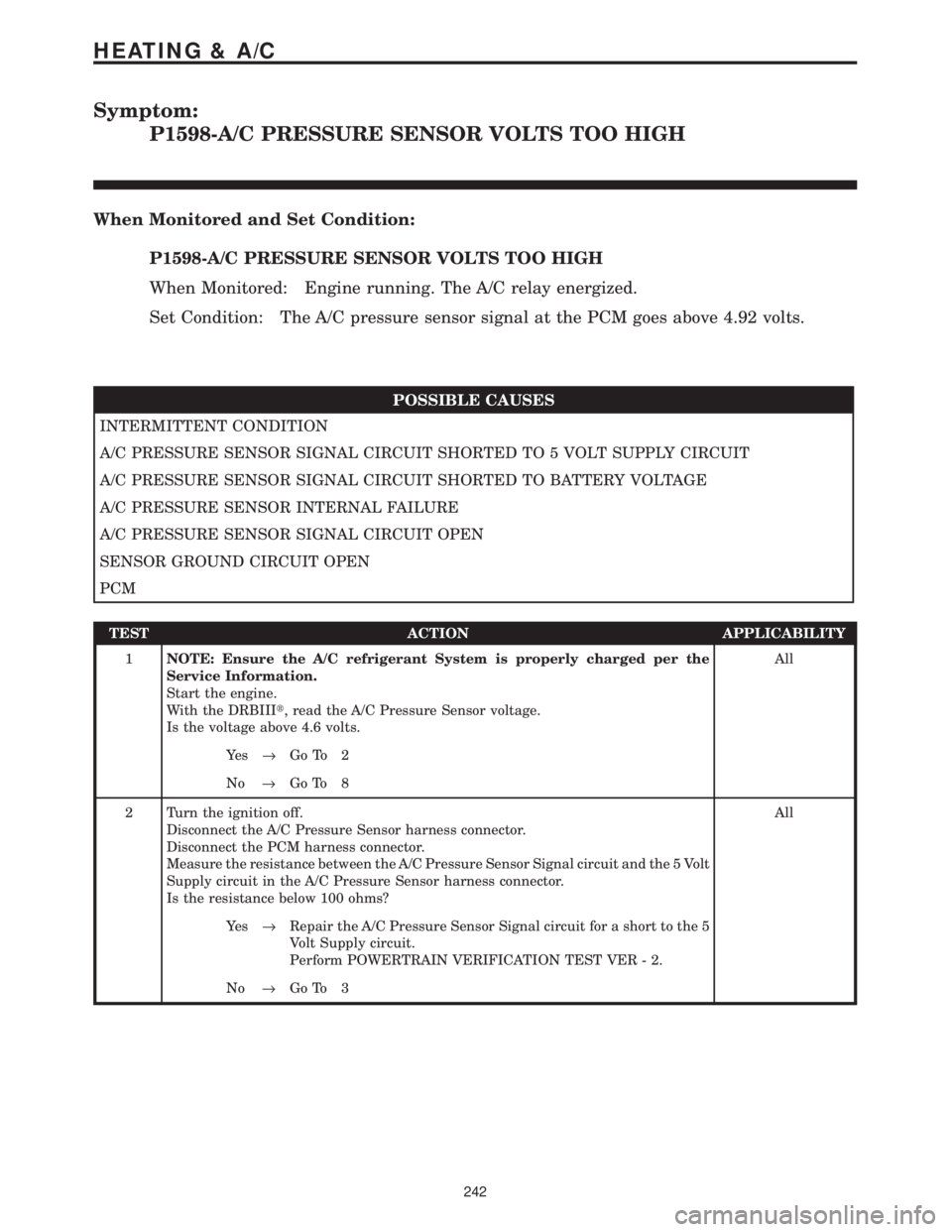
Symptom:
P1598-A/C PRESSURE SENSOR VOLTS TOO HIGH
When Monitored and Set Condition:
P1598-A/C PRESSURE SENSOR VOLTS TOO HIGH
When Monitored: Engine running. The A/C relay energized.
Set Condition: The A/C pressure sensor signal at the PCM goes above 4.92 volts.
POSSIBLE CAUSES
INTERMITTENT CONDITION
A/C PRESSURE SENSOR SIGNAL CIRCUIT SHORTED TO 5 VOLT SUPPLY CIRCUIT
A/C PRESSURE SENSOR SIGNAL CIRCUIT SHORTED TO BATTERY VOLTAGE
A/C PRESSURE SENSOR INTERNAL FAILURE
A/C PRESSURE SENSOR SIGNAL CIRCUIT OPEN
SENSOR GROUND CIRCUIT OPEN
PCM
TEST ACTION APPLICABILITY
1NOTE: Ensure the A/C refrigerant System is properly charged per the
Service Information.
Start the engine.
With the DRBIIIt, read the A/C Pressure Sensor voltage.
Is the voltage above 4.6 volts.All
Ye s®Go To 2
No®Go To 8
2 Turn the ignition off.
Disconnect the A/C Pressure Sensor harness connector.
Disconnect the PCM harness connector.
Measure the resistance between the A/C Pressure Sensor Signal circuit and the 5 Volt
Supply circuit in the A/C Pressure Sensor harness connector.
Is the resistance below 100 ohms?All
Ye s®Repair the A/C Pressure Sensor Signal circuit for a short to the 5
Volt Supply circuit.
Perform POWERTRAIN VERIFICATION TEST VER - 2.
No®Go To 3
242
HEATING & A/C
Page 4037 of 4284
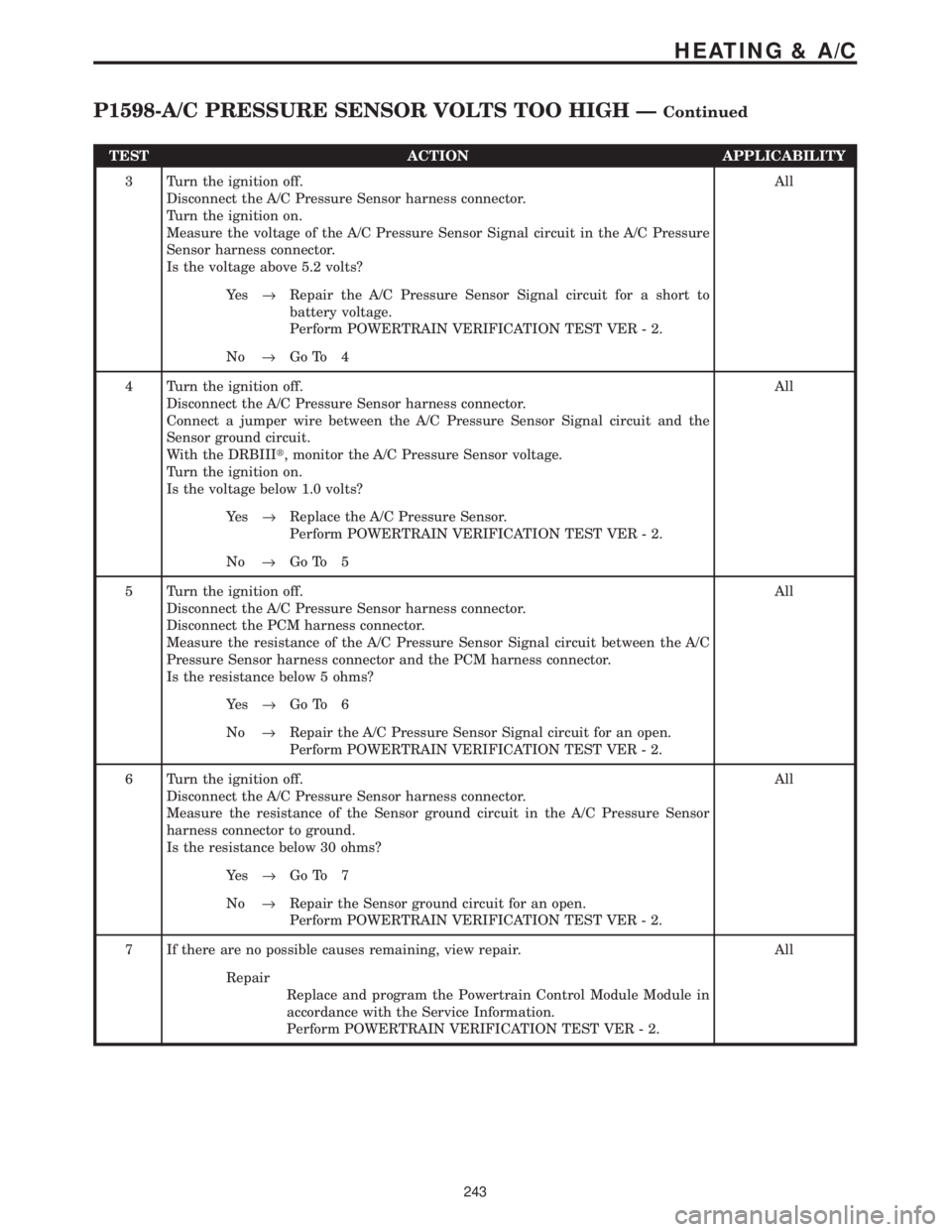
TEST ACTION APPLICABILITY
3 Turn the ignition off.
Disconnect the A/C Pressure Sensor harness connector.
Turn the ignition on.
Measure the voltage of the A/C Pressure Sensor Signal circuit in the A/C Pressure
Sensor harness connector.
Is the voltage above 5.2 volts?All
Ye s®Repair the A/C Pressure Sensor Signal circuit for a short to
battery voltage.
Perform POWERTRAIN VERIFICATION TEST VER - 2.
No®Go To 4
4 Turn the ignition off.
Disconnect the A/C Pressure Sensor harness connector.
Connect a jumper wire between the A/C Pressure Sensor Signal circuit and the
Sensor ground circuit.
With the DRBIIIt, monitor the A/C Pressure Sensor voltage.
Turn the ignition on.
Is the voltage below 1.0 volts?All
Ye s®Replace the A/C Pressure Sensor.
Perform POWERTRAIN VERIFICATION TEST VER - 2.
No®Go To 5
5 Turn the ignition off.
Disconnect the A/C Pressure Sensor harness connector.
Disconnect the PCM harness connector.
Measure the resistance of the A/C Pressure Sensor Signal circuit between the A/C
Pressure Sensor harness connector and the PCM harness connector.
Is the resistance below 5 ohms?All
Ye s®Go To 6
No®Repair the A/C Pressure Sensor Signal circuit for an open.
Perform POWERTRAIN VERIFICATION TEST VER - 2.
6 Turn the ignition off.
Disconnect the A/C Pressure Sensor harness connector.
Measure the resistance of the Sensor ground circuit in the A/C Pressure Sensor
harness connector to ground.
Is the resistance below 30 ohms?All
Ye s®Go To 7
No®Repair the Sensor ground circuit for an open.
Perform POWERTRAIN VERIFICATION TEST VER - 2.
7 If there are no possible causes remaining, view repair. All
Repair
Replace and program the Powertrain Control Module Module in
accordance with the Service Information.
Perform POWERTRAIN VERIFICATION TEST VER - 2.
243
HEATING & A/C
P1598-A/C PRESSURE SENSOR VOLTS TOO HIGH ÐContinued
Page 4038 of 4284
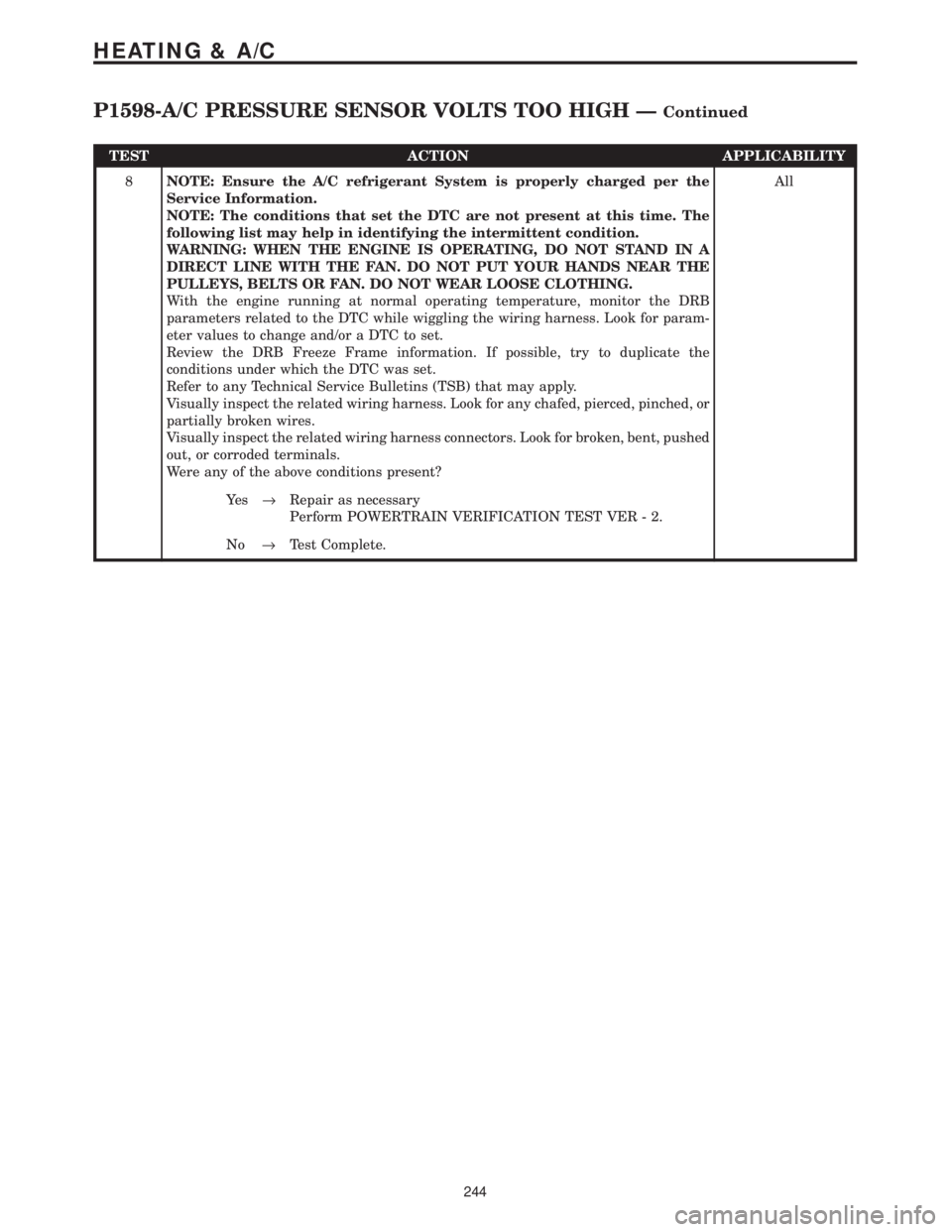
TEST ACTION APPLICABILITY
8NOTE: Ensure the A/C refrigerant System is properly charged per the
Service Information.
NOTE: The conditions that set the DTC are not present at this time. The
following list may help in identifying the intermittent condition.
WARNING: WHEN THE ENGINE IS OPERATING, DO NOT STAND IN A
DIRECT LINE WITH THE FAN. DO NOT PUT YOUR HANDS NEAR THE
PULLEYS, BELTS OR FAN. DO NOT WEAR LOOSE CLOTHING.
With the engine running at normal operating temperature, monitor the DRB
parameters related to the DTC while wiggling the wiring harness. Look for param-
eter values to change and/or a DTC to set.
Review the DRB Freeze Frame information. If possible, try to duplicate the
conditions under which the DTC was set.
Refer to any Technical Service Bulletins (TSB) that may apply.
Visually inspect the related wiring harness. Look for any chafed, pierced, pinched, or
partially broken wires.
Visually inspect the related wiring harness connectors. Look for broken, bent, pushed
out, or corroded terminals.
Were any of the above conditions present?All
Ye s®Repair as necessary
Perform POWERTRAIN VERIFICATION TEST VER - 2.
No®Test Complete.
244
HEATING & A/C
P1598-A/C PRESSURE SENSOR VOLTS TOO HIGH ÐContinued