2001 CHRYSLER VOYAGER coolant temperature
[x] Cancel search: coolant temperaturePage 1217 of 4284
TABLE OF CONTENTS - Continued
P0703-BRAKE SWITCH SIGNAL CKTS PLAUS W/REDUNDANT CONTACT
AFTER INITIALIZATION.................................................149
P0833-CLUTCH PEDAL PLAUSIBILITY....................................153
P1130-FUEL RAIL PRESSURE MALFUNCTION LEAKAGE DETECTED..........155
P1130-FUEL RAIL PRESSURE MALFUNCTION PRESSURE TOO HIGH-SHUT
OFF .................................................................155
P1130-FUEL RAIL PRESSURE MALFUNCTION PRESSURE TOO LOW.........155
P1130-FUEL RAIL PRESSURE MALFUNCTION SOLENOID OPEN.............155
P1131-FUEL PRESSURE SOLENOID OPEN CIRCUIT........................158
P1131-FUEL PRESSURE SOLENOID PLAUSIBILITY IN AFTER-RUN............158
P1131-FUEL PRESSURE SOLENOID SHORT CIRCUIT.......................158
P1511-BATTERY SENSE LINE 1 VOLTAGE TOO HIGH.......................162
P1511-BATTERY SENSE LINE 1 VOLTAGE TOO LOW.......................164
P1605-IGNITION SWITCH PLAUSIBILITY..................................166
P1685-SKIM SYSTEM INVALID KEY CODE RECEIVED.......................168
P1685-SKIM SYSTEM INVALID SECRET KEY IN EEPROM....................168
P1685-SKIM SYSTEM KEY COMMUNICATION TIMED OUT...................168
P1685-SKIM SYSTEM SKIM ERROR......................................168
P1685-SKIM SYSTEM WRITE ACCESS TO EEPROM FAILURE................168
P2120-ACC PEDAL POSITION SENSOR 1 CKT PLAUSIBILITY................170
P2120-ACC PEDAL POSITION SENSOR 1 CKT PLAUSIBILITY WITH BRAKE
SWITCH..............................................................170
P2120-ACC PEDAL POSITION SENSOR 1 CKT PLAUSIBILITY WITH
POTENTIOMETER.....................................................170
P2120-ACC PEDAL POSITION SENSOR 1 CKT SIGNAL VOLTAGE TOO HIGH . . .170
P2120-ACC PEDAL POSITION SENSOR 1 CKT SIGNAL VOLTAGE TOO LOW . . .170
P2120-ACC PEDAL POSITION SENSOR 1 CKT SUPPLY VOLTAGE TOO
HIGH OR LOW........................................................170
*CHECKING THE A/C CLUTCH OPERATION...............................179
*CHECKING THE ACCELERATOR PEDAL POSITION SENSOR CALIBRATION . . .181
*CHECKING THE BOOST PRESSURE SENSOR CALIBRATION................182
*CHECKING THE ECM POWER AND GROUND CIRCUITS....................183
*CHECKING THE EGR SYSTEM..........................................185
*CHECKING THE ELECTRIC RADIATOR FAN OPERATION...................186
*CHECKING THE ENGINE COOLANT TEMPERATURE SENSOR CALIBRATION . .193
*CHECKING THE ENGINE MECHANICAL SYSTEMS.........................194
*CHECKING THE GLOW PLUG OPERATION...............................195
*CHECKING THE LIFT PUMP MOTOR OPERATION.........................197
*CHECKING THE MAF SENSOR CALIBRATION.............................200
*CHECKING THE SPEED CONTROL OPERATION...........................201
*CHECKING THE VEHICLE SPEED SIGNAL................................204
*ENGINE CRANKS BUT WILL NOT START.................................207
*ENGINE WILL NOT CRANK.............................................210
VEHICLE THEFT/SECURITY
ANTENNA FAILURE....................................................214
COP FAILURE.........................................................214
EEPROM FAILURE.....................................................214
INTERNAL FAULT......................................................214
RAM FAILURE.........................................................214
SERIAL LINK INTERNAL FAULT..........................................214
STACK OVERFLOW FAILURE............................................214
PCM STATUS FAILURE.................................................216
iv
Page 1218 of 4284
TABLE OF CONTENTS - Continued
SERIAL LINK EXTERNAL FAULT.........................................216
ROLLING CODE FAILURE...............................................218
VIN MISMATCH........................................................218
TRANSPONDER COMMUNICATION FAILURE..............................220
TRANSPONDER CYCLIC REDUNDANCY CHECK (CRC) FAILURE.............220
TRANSPONDER ID MISMATCH..........................................220
TRANSPONDER RESPONSE MISMATCH..................................220
VERIFICATION TESTS
VERIFICATION TESTS..................................................223
8.0 COMPONENT LOCATIONS..............................................227
8.1CONTROL MODULES.............................................227
8.2CONTROLS AND SOLENOIDS......................................227
8.3DATA LINK CONNECTOR..........................................227
8.4FUEL SYSTEM...................................................228
8.5RELAYS.........................................................228
8.6SENSORS.......................................................229
8.7SWITCHES......................................................230
9.0 CONNECTOR PINOUTS................................................231
A/C COMPRESSOR CLUTCH - LT. GRAY 2 WAY............................231
A/C PRESSURE SENSOR - GRAY 4 WAY..................................231
ACCELERATOR PEDAL POSITION SENSOR (DIESEL) - BLACK 10 WAY........231
BATTERY TEMPERATURE SENSOR (DIESEL) - BLACK 2 WAY................231
BOOST PRESSURE SENSOR (DIESEL) - BLACK 4 WAY.....................232
BRAKE LAMP SWITCH - BLACK 6 WAY...................................232
CAMSHAFT POSITION SENSOR (DIESEL) - BLACK 3 WAY...................232
CLUTCH PEDAL UPSTOP SWITCH (DIESEL) - RED 2 WAY...................232
CRANKSHAFT POSITION SENSOR (DIESEL) - BLACK 3 WAY................232
DATA LINK CONNECTOR - BLACK 16 WAY................................233
EGR SOLENOID (DIESEL) - LT. GRAY 2 WAY...............................233
ENGINE CONTROL MODULE C1 (DIESEL) - BLACK 81 WAY..................234
ENGINE CONTROL MODULE C1 (DIESEL) - BLACK 81 WAY..................235
ENGINE CONTROL MODULE C2 (DIESEL) - BLACK 40 WAY..................236
ENGINE COOLANT TEMP SENSOR (DIESEL) - BLUE 2 WAY.................236
ENGINE OIL PRESSURE SENSOR (DIESEL) - BLACK 3 WAY.................237
ENGINE OIL TEMPERATURE SENSOR (DIESEL) - BLACK 2 WAY.............237
FUEL HEATER (DIESEL) - BLACK 2 WAY..................................237
FUEL INJECTOR NO. 1 (DIESEL) - BLACK 2 WAY...........................237
FUEL INJECTOR NO. 2 (DIESEL) - BLACK 2 WAY...........................237
FUEL INJECTOR NO. 3 (DIESEL) - BLACK 2 WAY...........................238
FUEL INJECTOR NO. 4 (DIESEL) - BLACK 2 WAY...........................238
FUEL PRESSURE SENSOR (DIESEL) - BLACK 3 WAY.......................238
FUEL PRESSURE SOLENOID (DIESEL) - BLACK 2 WAY.....................238
GENERATOR - BLACK 2 WAY...........................................238
GLOW PLUG RELAY (DIESEL) - BLACK 4 WAY.............................239
INTELLIGENT POWER MODULE C3 (DIESEL) - YELLOW/RED 20 WAY.........239
LEFT SPEED CONTROL SWITCH - WHITE 2 WAY..........................239
LIFT PUMP MOTOR (DIESEL) - BLACK 2 WAY..............................239
MASS AIR FLOW SENSOR (DIESEL) - ORANGE 5 WAY......................240
v
Page 1221 of 4284
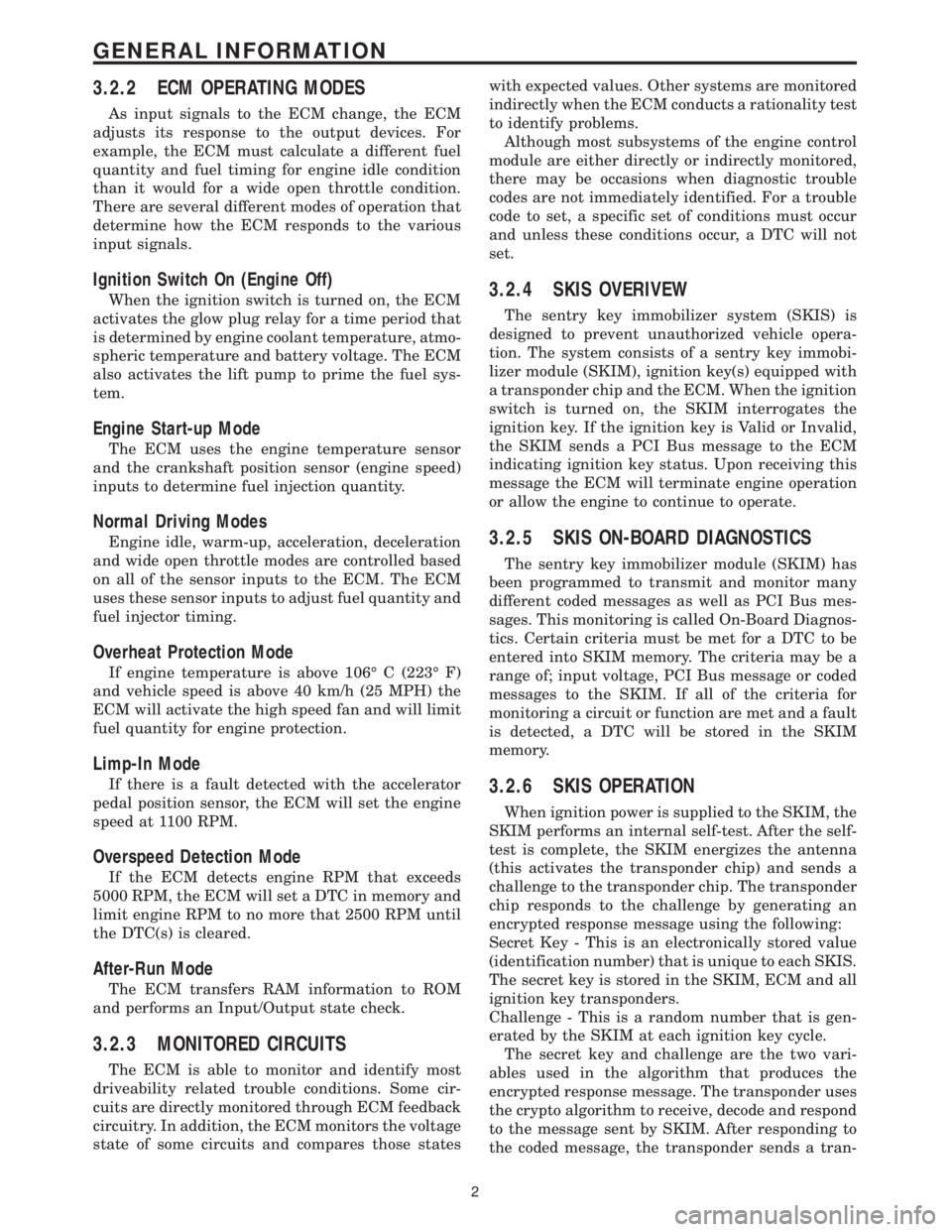
3.2.2 ECM OPERATING MODES
As input signals to the ECM change, the ECM
adjusts its response to the output devices. For
example, the ECM must calculate a different fuel
quantity and fuel timing for engine idle condition
than it would for a wide open throttle condition.
There are several different modes of operation that
determine how the ECM responds to the various
input signals.
Ignition Switch On (Engine Off)
When the ignition switch is turned on, the ECM
activates the glow plug relay for a time period that
is determined by engine coolant temperature, atmo-
spheric temperature and battery voltage. The ECM
also activates the lift pump to prime the fuel sys-
tem.
Engine Start-up Mode
The ECM uses the engine temperature sensor
and the crankshaft position sensor (engine speed)
inputs to determine fuel injection quantity.
Normal Driving Modes
Engine idle, warm-up, acceleration, deceleration
and wide open throttle modes are controlled based
on all of the sensor inputs to the ECM. The ECM
uses these sensor inputs to adjust fuel quantity and
fuel injector timing.
Overheat Protection Mode
If engine temperature is above 106É C (223É F)
and vehicle speed is above 40 km/h (25 MPH) the
ECM will activate the high speed fan and will limit
fuel quantity for engine protection.
Limp-In Mode
If there is a fault detected with the accelerator
pedal position sensor, the ECM will set the engine
speed at 1100 RPM.
Overspeed Detection Mode
If the ECM detects engine RPM that exceeds
5000 RPM, the ECM will set a DTC in memory and
limit engine RPM to no more that 2500 RPM until
the DTC(s) is cleared.
After-Run Mode
The ECM transfers RAM information to ROM
and performs an Input/Output state check.
3.2.3 MONITORED CIRCUITS
The ECM is able to monitor and identify most
driveability related trouble conditions. Some cir-
cuits are directly monitored through ECM feedback
circuitry. In addition, the ECM monitors the voltage
state of some circuits and compares those stateswith expected values. Other systems are monitored
indirectly when the ECM conducts a rationality test
to identify problems.
Although most subsystems of the engine control
module are either directly or indirectly monitored,
there may be occasions when diagnostic trouble
codes are not immediately identified. For a trouble
code to set, a specific set of conditions must occur
and unless these conditions occur, a DTC will not
set.
3.2.4 SKIS OVERIVEW
The sentry key immobilizer system (SKIS) is
designed to prevent unauthorized vehicle opera-
tion. The system consists of a sentry key immobi-
lizer module (SKIM), ignition key(s) equipped with
a transponder chip and the ECM. When the ignition
switch is turned on, the SKIM interrogates the
ignition key. If the ignition key is Valid or Invalid,
the SKIM sends a PCI Bus message to the ECM
indicating ignition key status. Upon receiving this
message the ECM will terminate engine operation
or allow the engine to continue to operate.
3.2.5 SKIS ON-BOARD DIAGNOSTICS
The sentry key immobilizer module (SKIM) has
been programmed to transmit and monitor many
different coded messages as well as PCI Bus mes-
sages. This monitoring is called On-Board Diagnos-
tics. Certain criteria must be met for a DTC to be
entered into SKIM memory. The criteria may be a
range of; input voltage, PCI Bus message or coded
messages to the SKIM. If all of the criteria for
monitoring a circuit or function are met and a fault
is detected, a DTC will be stored in the SKIM
memory.
3.2.6 SKIS OPERATION
When ignition power is supplied to the SKIM, the
SKIM performs an internal self-test. After the self-
test is complete, the SKIM energizes the antenna
(this activates the transponder chip) and sends a
challenge to the transponder chip. The transponder
chip responds to the challenge by generating an
encrypted response message using the following:
Secret Key - This is an electronically stored value
(identification number) that is unique to each SKIS.
The secret key is stored in the SKIM, ECM and all
ignition key transponders.
Challenge - This is a random number that is gen-
erated by the SKIM at each ignition key cycle.
The secret key and challenge are the two vari-
ables used in the algorithm that produces the
encrypted response message. The transponder uses
the crypto algorithm to receive, decode and respond
to the message sent by SKIM. After responding to
the coded message, the transponder sends a tran-
2
GENERAL INFORMATION
Page 1227 of 4284
4.3 WARNINGS AND CAUTIONS
4.3.1 ROAD TEST WARNINGS
Some complaints will require a test drive as part
of the repair verification procedure. The purpose of
the test drive is to try to duplicate the diagnostic
code or symptom condition.
CAUTION: BEFORE ROAD TESTING A
VEHICLE, BE SURE THAT ALL
COMPONENTS ARE REASSEMBLED. DUR-
ING THE TEST DRIVE, DO NOT HANG THE
DRBIIITFROM THE REAR VIEW MIRROR. DO
NOT ATTEMPT TO READ THE DRBIIITWHILE
DRIVING. HAVE AN ASSISTANT AVAILABLE
TO OPERATE THE DRBIIIT.
4.3.2 VEHICLE DAMAGE CAUTIONS
Before disconnecting any control module, make
sure the ignition is off. Failure to do so could
damage the module. When testing voltage or circuit
integrity at any control module, use the terminal
side (not the wire end) of the harness connector. Do
not probe through the insulation; this will damage
it and eventually cause it to fail because of corro-
sion.
Be careful when performing electrical test so as to
prevent accidental shorting of terminals. Such a
mistake can damage fuses or components. Also, a
second code could be set, making diagnosis of the
original problem more difficult.
5.0 REQUIRED TOOLS AND
EQUIPMENT
DRBIIIt(diagnostic read-out box) scan tool
vacuum gauge
ammeter
ohmmeter
jumper wires and probes
oscilloscope
6.0 GLOSSARY OF TERMS
A/Cair conditioning
APPaccelerator pedal position (sensor)
backfire,
popbackfuel ignites in either the intake or
the exhaust system
BCMbody control module
BPboost pressure (sensor)CKPcrankshaft position (sensor)
CMPcamshaft position (sensor)
cuts out,
missesa steady pulsation or the inability of
the engine to maintain a consistent
rpm
DLCdata link connector
detona-
tion,
spark
knocka mild to severe ping, especially un-
der loaded engine conditions
ECMengine control module
ECTengine coolant temperature (sensor)
EGRexhaust gas recirculation
(solenoid/valve)
hard
startthe engine takes longer than usual
to start, even though it is able to
crank at normal speed.
IATintake air temperature (sensor)
IPMintelligent power module
lack of
power,
sluggishthe engine power output has been
reduced
MAFmass air flow (sensor)
MILmalfunction indicator lamp
msmillisecond(s)
PDCpower distribution center
poor fuel
economythere is significantly less fuel mile-
age than other vehicles of the same
design and configuration
runs
rough/
unstable
idlethe engine runs unevenly at idle
causing the engine to shake if it is
severe enough
S/Cspeed control
SKIMsentry key immobilizer module
SKISsentry key immobilizer system
start and
stallThe engine starts but immediately
dies (stalls)
surgeengine rpm fluctuation without cor-
responding change in accelerator
pedal position
SRCsignal range check
WIFwater in fuel (sensor)
VSSvehicle speed sensor
8
GENERAL INFORMATION
Page 1248 of 4284
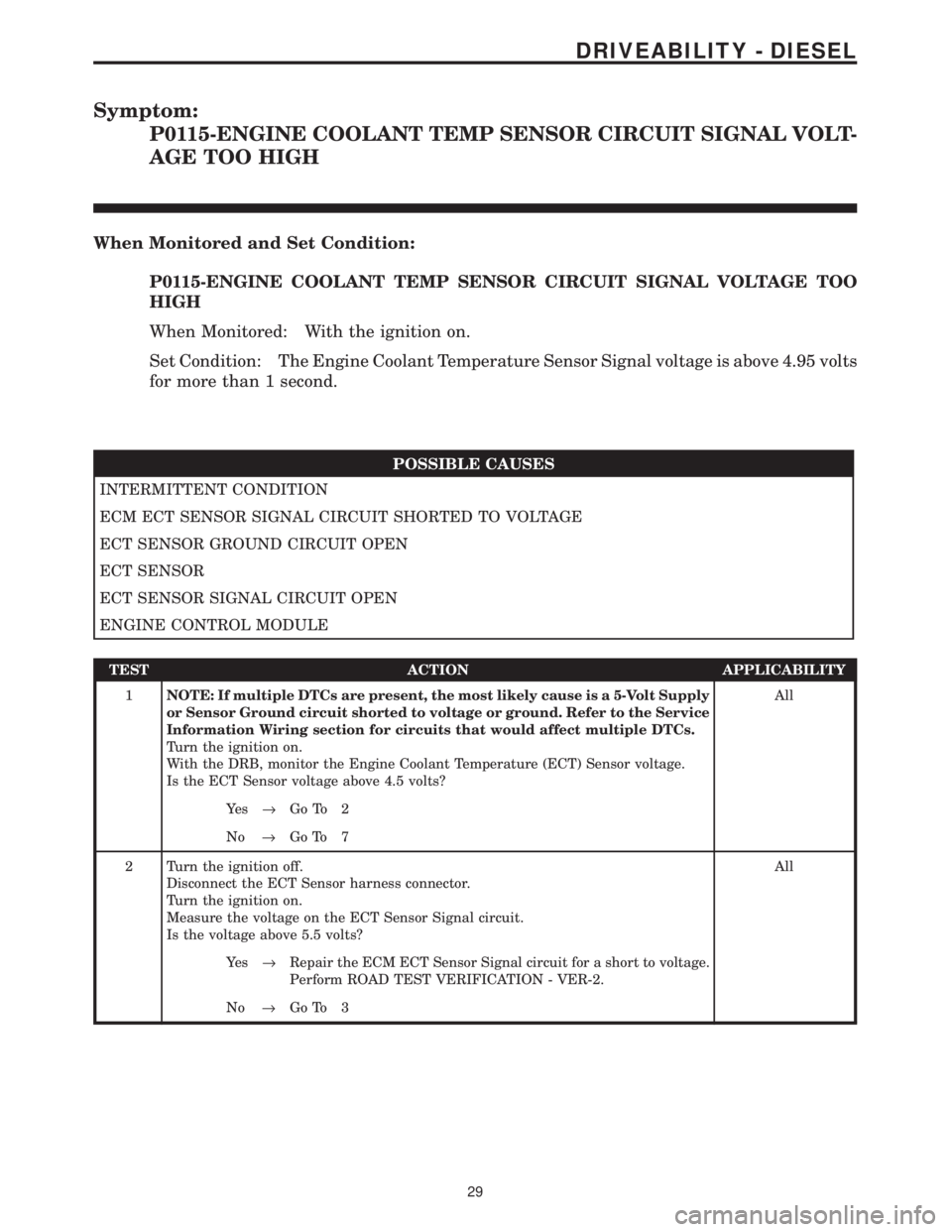
Symptom:
P0115-ENGINE COOLANT TEMP SENSOR CIRCUIT SIGNAL VOLT-
AGE TOO HIGH
When Monitored and Set Condition:
P0115-ENGINE COOLANT TEMP SENSOR CIRCUIT SIGNAL VOLTAGE TOO
HIGH
When Monitored: With the ignition on.
Set Condition: The Engine Coolant Temperature Sensor Signal voltage is above 4.95 volts
for more than 1 second.
POSSIBLE CAUSES
INTERMITTENT CONDITION
ECM ECT SENSOR SIGNAL CIRCUIT SHORTED TO VOLTAGE
ECT SENSOR GROUND CIRCUIT OPEN
ECT SENSOR
ECT SENSOR SIGNAL CIRCUIT OPEN
ENGINE CONTROL MODULE
TEST ACTION APPLICABILITY
1NOTE: If multiple DTCs are present, the most likely cause is a 5-Volt Supply
or Sensor Ground circuit shorted to voltage or ground. Refer to the Service
Information Wiring section for circuits that would affect multiple DTCs.
Turn the ignition on.
With the DRB, monitor the Engine Coolant Temperature (ECT) Sensor voltage.
Is the ECT Sensor voltage above 4.5 volts?All
Ye s®Go To 2
No®Go To 7
2 Turn the ignition off.
Disconnect the ECT Sensor harness connector.
Turn the ignition on.
Measure the voltage on the ECT Sensor Signal circuit.
Is the voltage above 5.5 volts?All
Ye s®Repair the ECM ECT Sensor Signal circuit for a short to voltage.
Perform ROAD TEST VERIFICATION - VER-2.
No®Go To 3
29
DRIVEABILITY - DIESEL
Page 1250 of 4284
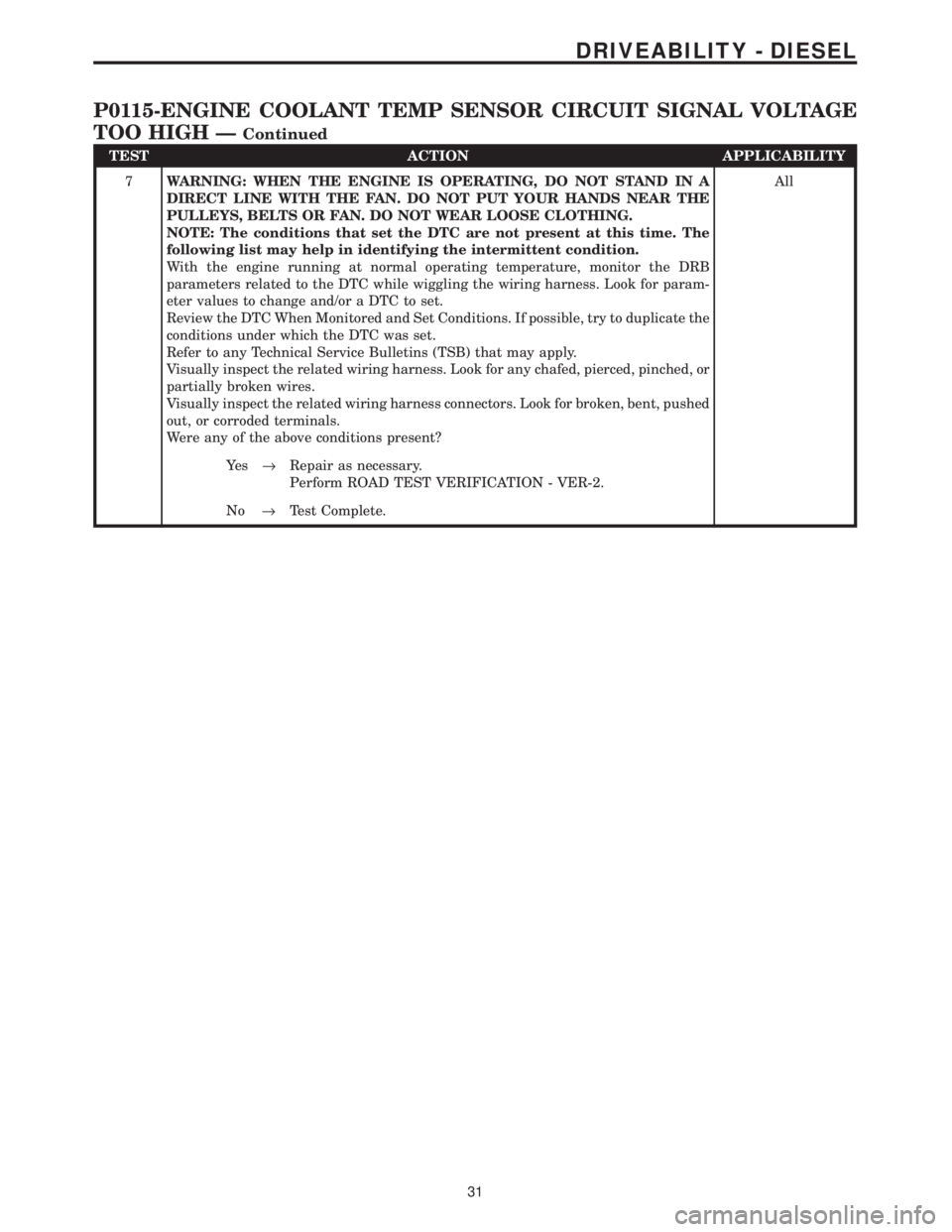
TEST ACTION APPLICABILITY
7WARNING: WHEN THE ENGINE IS OPERATING, DO NOT STAND IN A
DIRECT LINE WITH THE FAN. DO NOT PUT YOUR HANDS NEAR THE
PULLEYS, BELTS OR FAN. DO NOT WEAR LOOSE CLOTHING.
NOTE: The conditions that set the DTC are not present at this time. The
following list may help in identifying the intermittent condition.
With the engine running at normal operating temperature, monitor the DRB
parameters related to the DTC while wiggling the wiring harness. Look for param-
eter values to change and/or a DTC to set.
Review the DTC When Monitored and Set Conditions. If possible, try to duplicate the
conditions under which the DTC was set.
Refer to any Technical Service Bulletins (TSB) that may apply.
Visually inspect the related wiring harness. Look for any chafed, pierced, pinched, or
partially broken wires.
Visually inspect the related wiring harness connectors. Look for broken, bent, pushed
out, or corroded terminals.
Were any of the above conditions present?All
Ye s®Repair as necessary.
Perform ROAD TEST VERIFICATION - VER-2.
No®Test Complete.
31
DRIVEABILITY - DIESEL
P0115-ENGINE COOLANT TEMP SENSOR CIRCUIT SIGNAL VOLTAGE
TOO HIGH Ð
Continued
Page 1251 of 4284
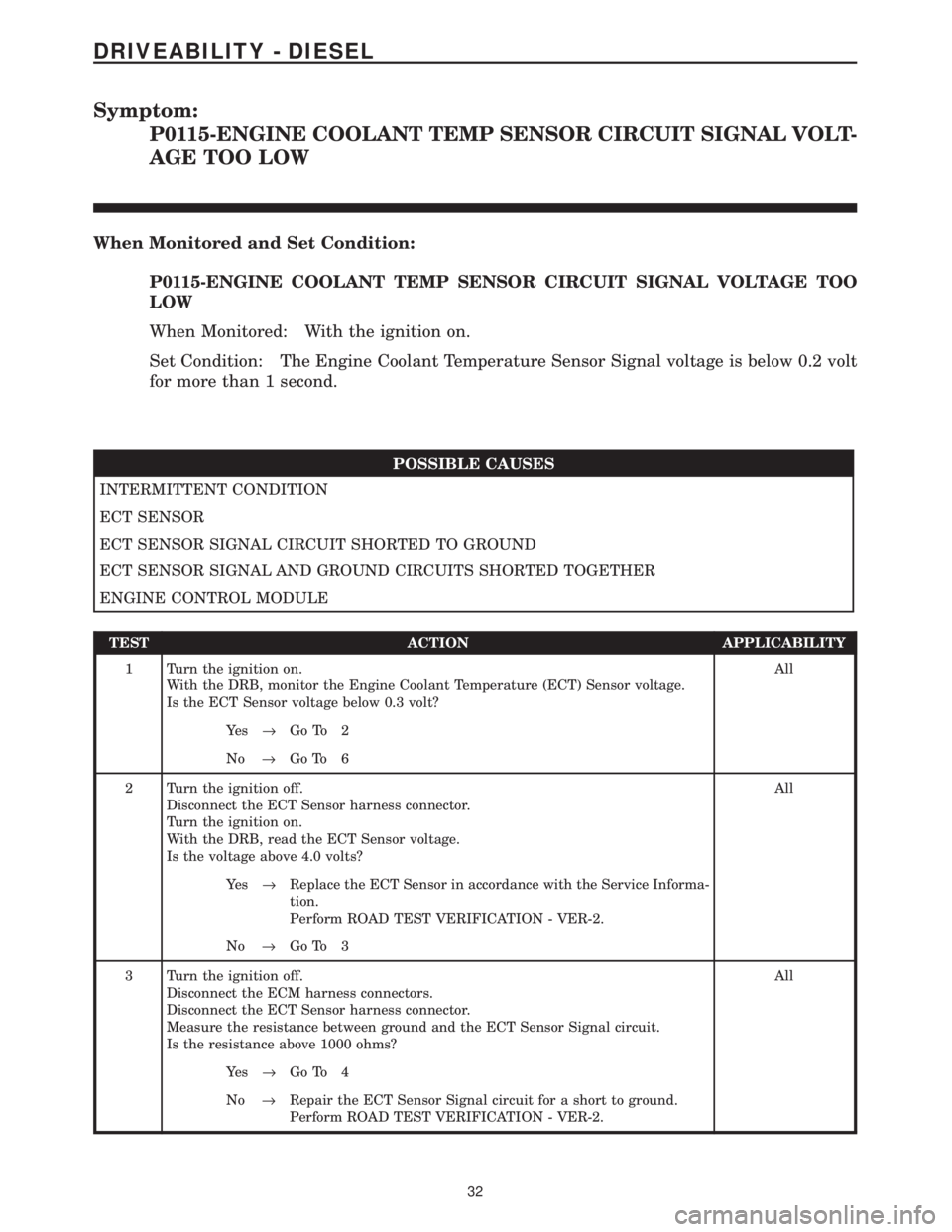
Symptom:
P0115-ENGINE COOLANT TEMP SENSOR CIRCUIT SIGNAL VOLT-
AGE TOO LOW
When Monitored and Set Condition:
P0115-ENGINE COOLANT TEMP SENSOR CIRCUIT SIGNAL VOLTAGE TOO
LOW
When Monitored: With the ignition on.
Set Condition: The Engine Coolant Temperature Sensor Signal voltage is below 0.2 volt
for more than 1 second.
POSSIBLE CAUSES
INTERMITTENT CONDITION
ECT SENSOR
ECT SENSOR SIGNAL CIRCUIT SHORTED TO GROUND
ECT SENSOR SIGNAL AND GROUND CIRCUITS SHORTED TOGETHER
ENGINE CONTROL MODULE
TEST ACTION APPLICABILITY
1 Turn the ignition on.
With the DRB, monitor the Engine Coolant Temperature (ECT) Sensor voltage.
Is the ECT Sensor voltage below 0.3 volt?All
Ye s®Go To 2
No®Go To 6
2 Turn the ignition off.
Disconnect the ECT Sensor harness connector.
Turn the ignition on.
With the DRB, read the ECT Sensor voltage.
Is the voltage above 4.0 volts?All
Ye s®Replace the ECT Sensor in accordance with the Service Informa-
tion.
Perform ROAD TEST VERIFICATION - VER-2.
No®Go To 3
3 Turn the ignition off.
Disconnect the ECM harness connectors.
Disconnect the ECT Sensor harness connector.
Measure the resistance between ground and the ECT Sensor Signal circuit.
Is the resistance above 1000 ohms?All
Ye s®Go To 4
No®Repair the ECT Sensor Signal circuit for a short to ground.
Perform ROAD TEST VERIFICATION - VER-2.
32
DRIVEABILITY - DIESEL
Page 1252 of 4284
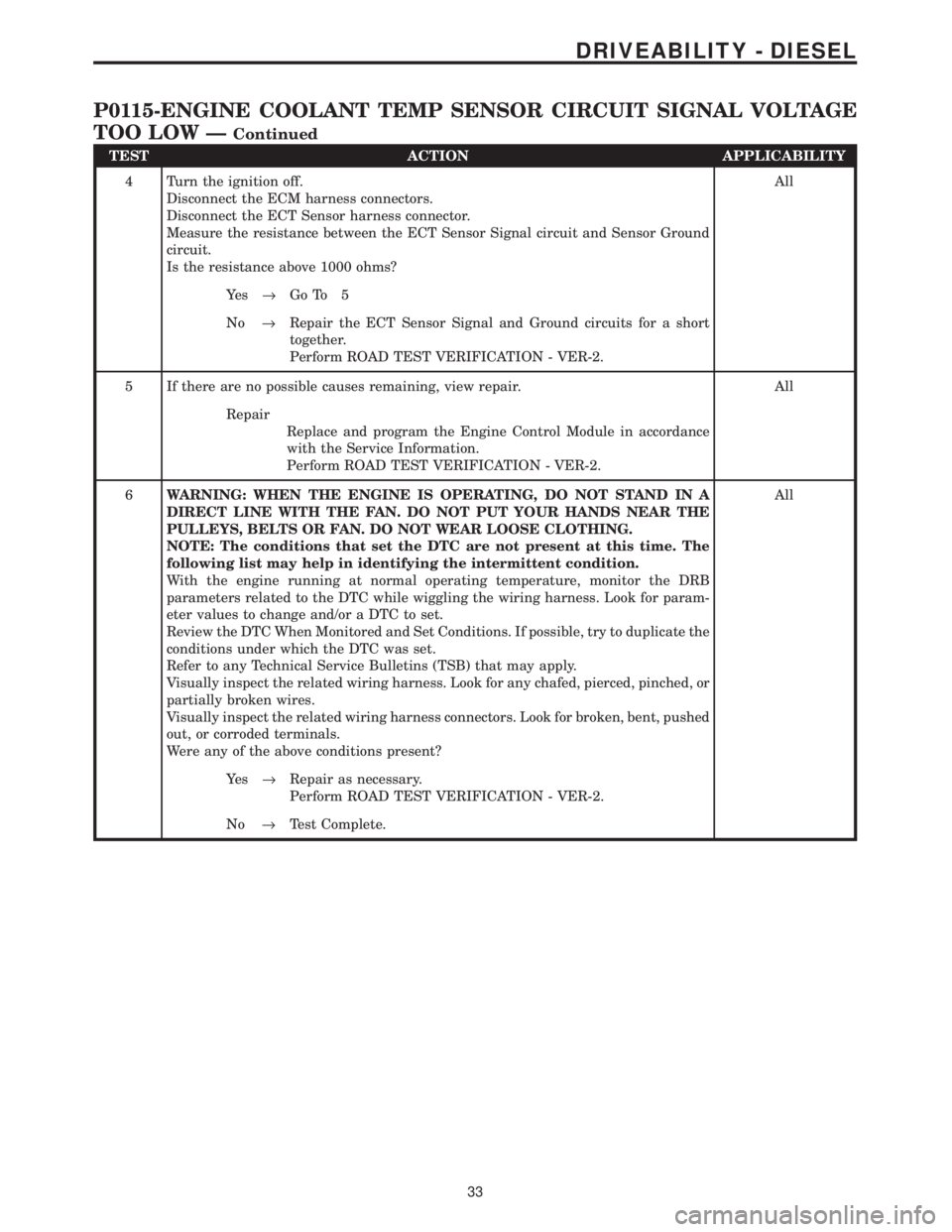
TEST ACTION APPLICABILITY
4 Turn the ignition off.
Disconnect the ECM harness connectors.
Disconnect the ECT Sensor harness connector.
Measure the resistance between the ECT Sensor Signal circuit and Sensor Ground
circuit.
Is the resistance above 1000 ohms?All
Ye s®Go To 5
No®Repair the ECT Sensor Signal and Ground circuits for a short
together.
Perform ROAD TEST VERIFICATION - VER-2.
5 If there are no possible causes remaining, view repair. All
Repair
Replace and program the Engine Control Module in accordance
with the Service Information.
Perform ROAD TEST VERIFICATION - VER-2.
6WARNING: WHEN THE ENGINE IS OPERATING, DO NOT STAND IN A
DIRECT LINE WITH THE FAN. DO NOT PUT YOUR HANDS NEAR THE
PULLEYS, BELTS OR FAN. DO NOT WEAR LOOSE CLOTHING.
NOTE: The conditions that set the DTC are not present at this time. The
following list may help in identifying the intermittent condition.
With the engine running at normal operating temperature, monitor the DRB
parameters related to the DTC while wiggling the wiring harness. Look for param-
eter values to change and/or a DTC to set.
Review the DTC When Monitored and Set Conditions. If possible, try to duplicate the
conditions under which the DTC was set.
Refer to any Technical Service Bulletins (TSB) that may apply.
Visually inspect the related wiring harness. Look for any chafed, pierced, pinched, or
partially broken wires.
Visually inspect the related wiring harness connectors. Look for broken, bent, pushed
out, or corroded terminals.
Were any of the above conditions present?All
Ye s®Repair as necessary.
Perform ROAD TEST VERIFICATION - VER-2.
No®Test Complete.
33
DRIVEABILITY - DIESEL
P0115-ENGINE COOLANT TEMP SENSOR CIRCUIT SIGNAL VOLTAGE
TOO LOW Ð
Continued