Page 241 of 4770

5. REMOVE AIR CLEANER CAP, RESONATOR AND
AIR CLEANER HOSE
(a) Disconnect the intake air temperature sensor connector.
(b) California only:
Disconnect the air hose from the air cleaner hose.
(c) Loosen the air cleaner hose clamp bolt.
(d) Disconnect the 4 air cleaner cap clips.
(e) Disconnect the air cleaner hose from the throttle
body, and remove the air cleaner cap together with
the resonator and air cleaner hose.
INJECTORS REMOVAL
(See Components for Removal and Installation)
1. DISCONNECT NEGATIVE (±) TERMINAL CABLE
FROM BATTERY
CAUTION: Work must be started after 90 seconds from
the time the ignition switch i: turned to the ªLOCKº
position and the negative (±) terminal cable is discon±
nected from the battery.
2. DRAIN ENGINE COOLANT
3. A/T:
DISCONNECT THROTTLE CABLE FROM
THROTTLE BODY
4. DISCONNECT ACCELERATOR CABLE FROM
THROTTLE BODY
6. REMOVE THROTTLE BODY
(a) Disconnect throttle position sensor connector.
(b) Disconnect IAC valve connector.
± 5S±FE ENGINEMFI/SFI SYSTEMEG1±191
Page 257 of 4770
5. REMOVE AIR CLEANER CAP, RESONATOR AND
AIR CLEANER HOSE
(a) Disconnect the intake air temperature sensor connec±
tor.
(b) California only:
Disconnect the air hose from the air cleaner hose.
(c) Loosen the air cleaner hose clamp bolt.
(d) Disconnect the 4 air cleaner cap clips.
(e) Disconnect the air cleaner hose from the throttle
body, and remove the air cleaner cap together with
the resonator and air cleaner hose. 1. DISCONNECT NEGATIVE (±) TERMINAL CABLE
FROM BATTERY
CAUTION: Work must be started after 90 seconds from
the time the ignition switch is turned to the ªLOCKº
position and the negative (±) terminal cable is discon±
nected from the battery.
2. DRAIN ENGINE COOLANT
3. DISCONNECT ACCELERATOR CABLE FROM
THROTTLE LINKAGE
4. A/T:
DISCONNECT THROTTLE CABLE FROM
THROTTLE LINKAGE
6. REMOVE THROTTLE BODY
(a) Disconnect the throttle position sensor connector.
(b) Disconnect the IAC valve connector.
THROTTLE BODY REMOVAL
± 5S±FE ENGINEMFI/SFI SYSTEMEG1±207
Page 259 of 4770

(b) Apply vacuum to the throttle opener.
(c) Insert a 0.60 mm (0.024 in.) thickness gauge between
the throttle stop screw and stop lever.
(d) Connect the test probe of an ohmmeter to the termi±
nals IDL and E2 of the sensor.
(e) Gradually turn the sensor clockwise until the ohmmeter
deflects, and secure it with the 2 set screws. 3. INSPECT THROTTLE POSITION SENSOR
(a) Apply vacuum to the throttle opener.
(b) Insert a thickness gauge between the throttle stop
screw and stop lever.
(c) Using an ohmmeter, measure the resistance between
each terminal. 2. INSPECT THROTTLE VALVE
(a) Apply vacuum to the throttle opener.
(b) Check that there is no clearance between the throttle
stop screw and throttle lever when the throttle valve
is fully closed.
4. IF NECESSARY, ADJUST THROTTLE POSITION
SENSOR
(a) Loosen the 2 set screws of the sensor.
Clearance between
lever and stop screw
Throttle valve fully
open 0.50 mm (0.020 in.)
0.70 mm (0.028 in.)Between terminals
2.0 ± 10.2 k� 2.3 k� or less 0.2 ± 5.7 k�
0 mm (0 in.)
2.5 ± 5.9 k� Resistance
VTA ± E2
VTA ± E2IDL±E2IDL±E2
Infinity
VC ± E2
± 5S±FE ENGINEMFI/SFI SYSTEMEG1±209
Page 287 of 4770
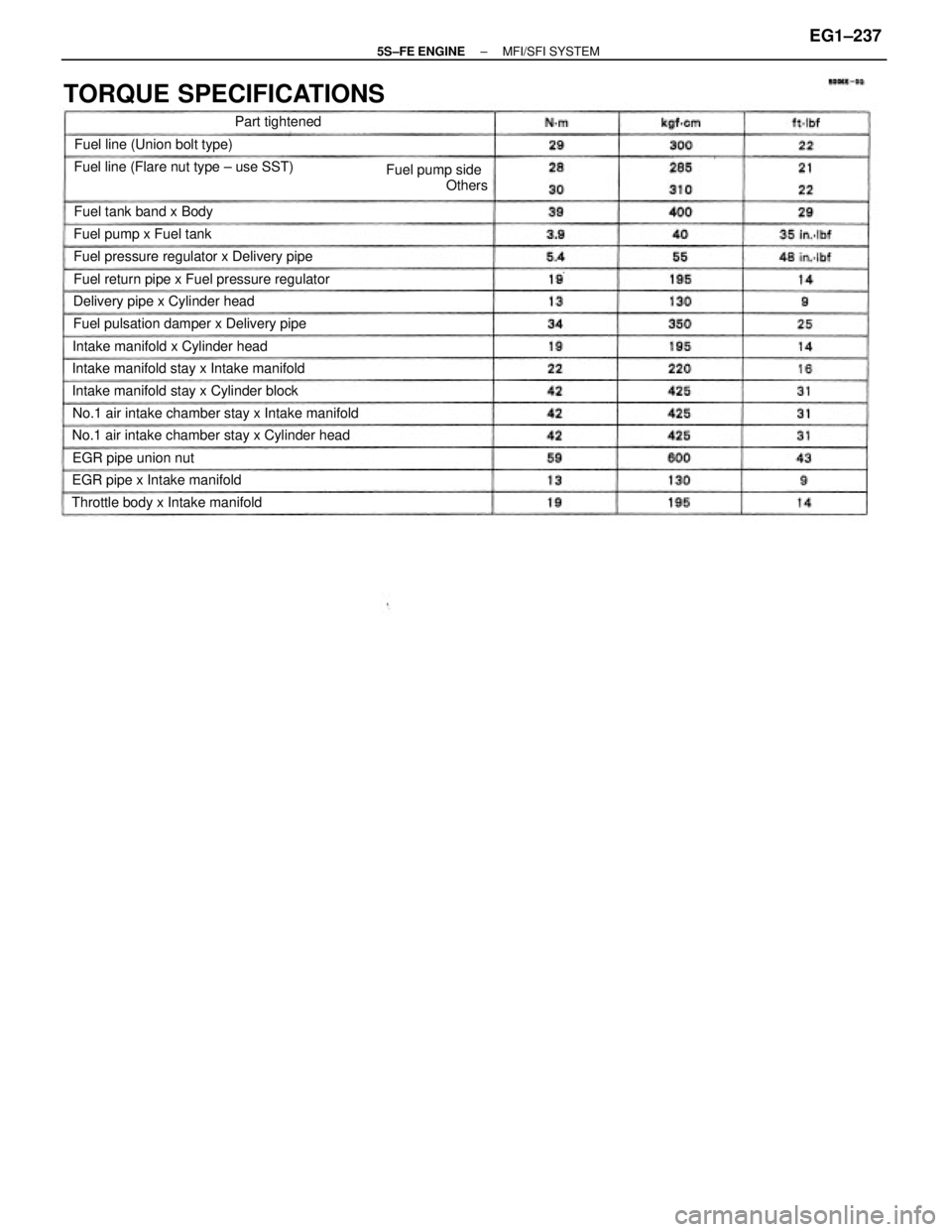
TORQUE SPECIFICATIONS
No.1 air intake chamber stay x Intake manifold
No.1 air intake chamber stay x Cylinder headFuel return pipe x Fuel pressure regulator Fuel pressure regulator x Delivery pipe
Fuel pulsation damper x Delivery pipe
Intake manifold stay x Intake manifold
Intake manifold stay x Cylinder blockFuel line (Flare nut type ± use SST)
Throttle body x Intake manifoldIntake manifold x Cylinder headDelivery pipe x Cylinder head
EGR pipe x Intake manifoldFuel pump side
Others Fuel line (Union bolt type)
Fuel pump x Fuel tankFuel tank band x Body
EGR pipe union nutPart tightened
± 5S±FE ENGINEMFI/SFI SYSTEMEG1±237
Page 288 of 4770
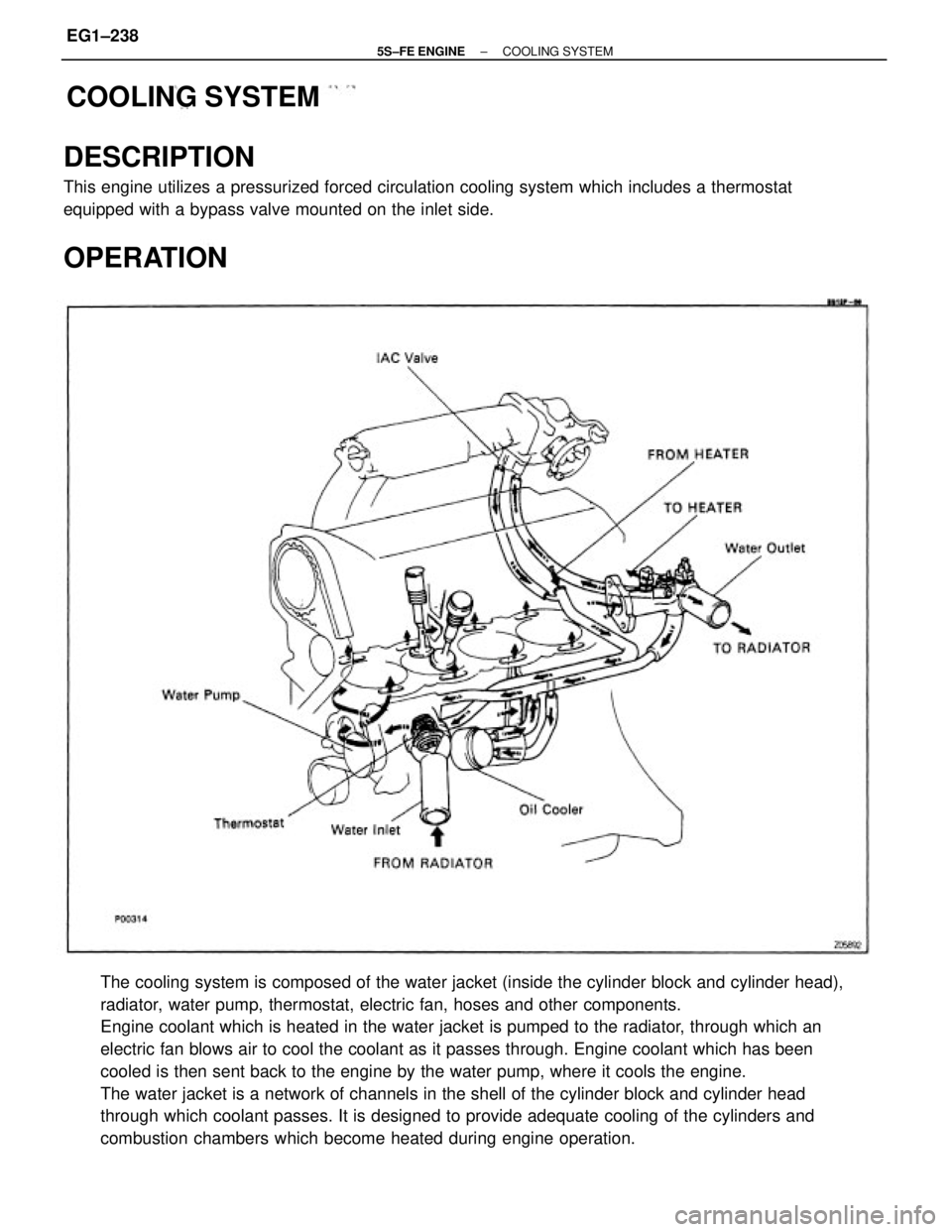
The cooling system is composed of the water jacket (inside the cylinder block and cylinder head),
radiator, water pump, thermostat, electric fan, hoses and other components.
Engine coolant which is heated in the water jacket is pumped to the radiator, through which an
electric fan blows air to cool the coolant as it passes through. Engine coolant which has been
cooled is then sent back to the engine by the water pump, where it cools the engine.
The water jacket is a network of channels in the shell of the cylinder block and cylinder head
through which coolant passes. It is designed to provide adequate cooling of the cylinders and
combustion chambers which become heated during engine operation.
DESCRIPTION
This engine utilizes a pressurized forced circulation cooling system which includes a thermostat
equipped with a bypass valve mounted on the inlet side.
OPERATIONCOOLING SYSTEM
± 5S±FE ENGINECOOLING SYSTEMEG1±238
Page 289 of 4770

RADIATOR
The radiator performs the function of cooling the coolant which has passed through the water
jacket and become hot, and it is mounted in the front of the vehicle. The radiator consists of an
upper tank and lower tank, and a core which connects the two tanks. The upper tank contains the
inlet for coolant from the water jacket and the filler inlet. It also has a hose attached through
which excess coolant or steam can flow. The lower tank has an outlet and drain cock for the
coolant. The core contains many tubes through which coolant flows from the upper tank to the
lower tank as well as to cooling fins which radiate heat away from the coolant in the tubes. The
air sucked through the radiator by the electric fan, as well as the wind generated by the vehicle's
travel, passes through the radiator, cooling the coolant. Models with automatic transmission
include an automatic transmission fluid cooler built into the lower tank of the radiator. A fan with
an electric motor is mounted behind the radiator to assist the flow of air through the radiator. The
fan operates when the engine coolant temperature becomes high in order to prevent it from be-
coming too high.
RADIATOR CAP
The radiator cap is a pressure type cap which seals the radiator, resulting in pressurization of the
radiator as the coolant expands. The pressurization prevents the coolant from boiling even when
the engine coolant temperature exceeds 100°C (212°F). A relief valve (pressurization valve) and a
vacuum valve (negative pressure valve) are built into the radiator cap. The relief valve opens and
lets steam escape through the overflow pipe when the pressure generated inside the cooling sys-
tem exceeds the limit (coolant temperature: 110±120°C (230±248°F), pressure; 58.8103.0 kpa
(0.6±1.05 kgf/cm
2, 8.5±14.9 psi). The vacuum valve opens to alleviate the vacuum which develops
in the cooling system after the engine is stopped and the engine coolant temperature drops. The
valve's opening allows the coolant in the reservoir tank to return to the cooling system.
RESERVOIR TANK
The reservoir tank is used to catch coolant which overflows from the cooling system as a result
of volumetric expansion when the coolant is heated. The coolant in the reservoir tank returns to
the radiator when the coolant temperature drops, thus keeping the radiator full at all times and
avoiding needless coolant loss.
Check the reservoir tank level to learn if the coolant needs to be replenished.
WATER PUMP
The water pump is used for forced circulation of coolant through the cooling system. It is
mounted on the front of the cylinder block and driven by a timing belt.
THERMOSTAT
The thermostat has a wax type bypass valve and is mounted in the water inlet housing. The
thermostat includes a type of automatic valve operated by fluctuations in the engine coolant
temperature. This valve closes when the engine coolant temperature drops, preventing the
circulation of coolant through the engine and thus permitting the engine to warm up rapidly. The
valve opens when the engine coolant temperature has risen, allowing the circulation of coolant.
Wax inside the thermostat expands when heated and contracts when cooled. Heating the wax
thus generates pressure which overpowers the force of the spring which keeps the valve closed,
thus opening the valve. When the wax cools, its contraction allows the force of the spring to take
effect once more, closing the valve. The thermostat in this engine operates at a temperature of
82�C (180�F).
± 5S±FE ENGINECOOLING SYSTEMEG1±239
Page 291 of 4770

2. CHECK ENGINE COOLANT QUALITY
There should not be any excessive deposits of rust or
scales around the radiator cap or radiator filler hole,
and the engine coolant should be free from oil.
If excessively dirty, replace the engine coolant.
3. REPLACE ENGINE COOLANT
(a) Remove the radiator cap.
CAUTION: To avoid the danger of being burned, do not
remove It while the engine and radiator are still hot, as
fluid and steam can be blown out under pressure.
(b) Drain the engine coolant from the radiator drain cock
and engine drain plug. (Engine drain plug at the right
rear of cylinder block.)
(c) Close the drain cock and plug.
Torque (Engine drain plug):
13 N±m (130 kgf±cm, 9 ft±lbf)
(d) Slowly fill the system with coolant.
Use a good brand of ethylene±glycol base
coolant and mix it according to the
manufacturer 's directions.
Using engine coolant which includes more than
5096 ethylene±glycol (but not more than 7096) is
recommended.
NOTICE:
wDo not use a alcohol type coolant.
wThe engine coolant should be mixed with demineral±
ized water or distilled water.
Capacity (w/ Heater):
8.3 liters (6.7 US qts, 5.5 Imp.qts)
(a) Reinstall the radiator cap.
(f) Warm up the engine and check for leaks.
(g) Recheck the engine coolant level and refill as neces±
sary.
COOLANT CHECK AND
REPLACEMENT
1. CHECK ENGINE COOLANT LEVEL AT RESERVOIR
TANK
The engine coolant level should be between the
ºLOWº and ªFULLº lines.
If low, check for leaks and add engine coolant up to
the ªFULLº line.
± 5S±FE ENGINECOOLING SYSTEMEG1±241
Page 292 of 4770
WATER PUMP REMOVAL
1. DISCONNECT NEGATIVE (±) TERMINAL CABLE
FROM BATTERY
CAUTION: Work must be started after 90 seconds
from the time the Ignition switch is turned to the
ªLOCKº position and the negative (±) terminal cable
is disconnected from the battery.
2. DRAIN ENGINE COOLANT (See page EG1±241)
3. REMOVE TIMING BELT (See page EG1±26)
4. REMOVE NO. 1 IDLER PULLEY AND TENSION
SPRING
Remove the bolt, pulley and tension spring.
WATER PUMP
COMPONENTS FOR REMOVAL AND
INSTALLATION
± 5S±FE ENGINECOOLING SYSTEMEG1±242