Page 23 of 4770

3
CAMRY ± NEW FEATURES
172CM14
Fuel
Pressure
SensorFuel Temp.
SensorFuel
Pressure
RegulatorFuel Shutoff ValveFuel Tank
Fuel Shutoff ValveRelief Valve
Inlet Check
Valve
Fuel Temp.
Sensor
Coupler
Tank Valve Assembly
Vent Tube Manual
Shutoff
Valve Oil
Separator
Fuel Shutoff Valve Injectors
Delivery Pipe Discharge
ValveFuel
Pressure
SensorFuel
Filter43
6. Fuel System
General
�The compressed gas [maximum pressure approximately 250 kg / cm
2 (3600 psi, 24.8 MPa) @ 21�C
(70�F)] from the CNG fuel tank located in the rear section of the vehicle is routed via a fuel filter to the
engine compartment. The pressure of the fuel is then reduced to 8 kg / cm
2 (114 psi, 785 kPa).
�A pressure regulator and injectors designed exclusively for CNG application have been adopted.
�A fuel pressure sensor and a fuel temperature sensor that are used for the correction of the fuel injection
volume are located on the delivery pipe.
�The fuel tank, pressure regulator, and the delivery pipe are provided with shutoff valves that shut off the
fuel when the ignition switch is turned OFF.
In addition, these valves shut off the fuel when the engine stalls, the SRS airbag is deployed, or the pres-
sure in the main pipe becomes abnormally low.
�A fuel temperature sensor for the fuel gauge is mounted on the tank valve assembly, and a fuel pressure
sensor is mounted immediately upstream of the pressure regulator.
� Fuel System Diagram �
Page 24 of 4770
CAMRY ± NEW FEATURES
167CN08
Tank Valve
AssemblyTank Band
Coil Springs
167CN26
Tank Valve AssemblyFuel
Temperature
Sensor 44
Fuel Tank
�A fuel tank made with carbon fiber and alumi-
num lining has been adopted to prevent weight
increase.
�Because the fuel tank expands along with the
increase in the pressure of the compressed gas,
the tank bands contain coil springs to accom-
modate the fluctuation in the perimeter of the
tank.
�The fuel tank is provided with a tank valve as-
sembly.
Tank Valve Assembly
1) General
The tank valve assembly is mounted on the
tank and consists of a fuel shutoff valve, inlet
check valve, relief valve and two manual cut-
off valves.
Page 55 of 4770
(09248±05011) Valve Lifter Press
(09248±05021) Valve Lifter Stopper
09226±10010 Crankshaft Front & Rear Bearing
Replacer
09616±30011 Steering Worm Bearing Adjusting
Screw Wrench09224±74010 Engine Balancer Backlash
Adjusting Tool
09330±00021 Companion Flange Holding Tool09248±55020 Valve Clearance Adjust Tool Set
RECOMMENDED TOOLS
09816±30010 Oil Pressure Switch Socket09278±54012 Drive Shaft Holding Tool09249±63010 Torque Wrench Adaptor
09843±18020 Diagnosis Check Wire
09090±04010 Engine Sling Device
09200±00010 Engine Adjust KitCamshaft timing pulley
For suspension engineCrankshaft pulley
Oil pump pulley
Knock sensor
± 5S±FE ENGINEENGINE MECHANICALEG1±5
Page 58 of 4770

ENGINE OIL INSPECTION
1. CHECK OIL QUALITY
Check the oil for deterioration, entry of water, dis±
coloring or thinning.
If oil quality is visibly poor, replace it.
Oil grade:
API grade SG or SH, Energy Conserving II multi±
grade engine oil or ILSAC multigrade engine oil.
Recommended viscosity is as shown in the illustra±
tion.
TUNE±UP
ENGINE COOLANT INSPECTION
1. CHECK ENGINE COOLANT LEVEL AT RESERVOIR
TANK
The engine coolant level should be between the
ªLOWº and ªFULLº lines at low temperature.
If low, check for leaks and add engine coolant up to
the ªFULLº
2. CHECK ENGINE COOLANT QUALITY
There should be no excessive deposits of rust or
scales around the radiator cap or radiator filler hole,
and the engine coolant should be free from oil.
If excessively dirty, replace the engine coolant.
2. CHECK ENGINE OIL LEVEL
The oil level should be between the ªLº and ªFº marks
on the dipstick.
If low, check for leakage and add oil up to the ªFº
mark.
± 5S±FE ENGINEENGINE MECHANICALEG1±8
Page 60 of 4770

3. Delco Battery:
CHECK HYDROMETER
Green Dot visible:
Battery is adequately charged
Dark (Green Dot not visible):
Battery must be charged
Clear or Light Yellow:
Replace battery
HINT: There is no need to add water during the entire
service life of the battery.
AIR FILTER INSPECTION
1. INSPECT AIR FILTER
Visually check that the element is not excessively
dirty, damaged or oily.
2. CLEAN AIR FILTER
Clean the element with compressed air.
First blow air from the inside thoroughly. Then blow
off the outside of the element.B. Except Maintenance Free Battery
Check the specific gravity of each cell.
Standard specific gravity:
55D23L battery for GNB Incorporated
1.25 ± 1.27 at 205C (685F)
55D23L battery for JOHNSON CONTROLS
1.26 ± 1.28 at 275C (815F)
80D26L battery for GNB Incorporated
1.27 ± 1.29 at 205C (685F)
80D26L battery for JOHNSON CONTROLS
1.28 ± 1.30 at 27�C (81�F)
If the gravity is less than specification, charge the
battery.
HINT: Check the indicator as shown in the illustration.
HIGH±TENSION CORDS INSPECTION
1. DISCONNECT HIGH±TENSION CORDS FROM
SPARK PLUGS
Disconnect the high ± tension cords at the rubber
boot. Do not pull on the high±tension cords.
NOTICE: Pulling on or bending the cords may damage the
conductor inside.
± 5S±FE ENGINEENGINE MECHANICALEG1±10
Page 61 of 4770
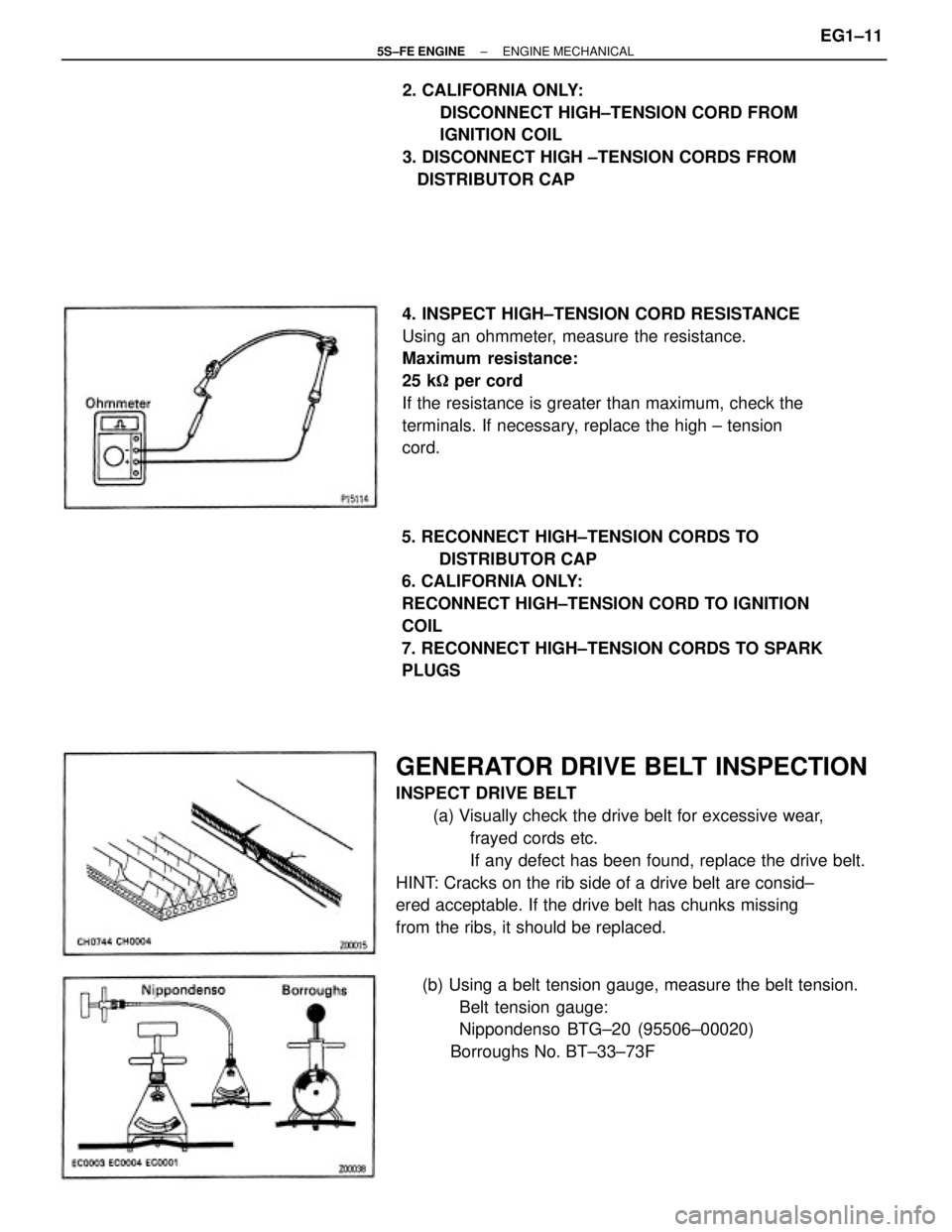
GENERATOR DRIVE BELT INSPECTION
INSPECT DRIVE BELT
(a) Visually check the drive belt for excessive wear,
frayed cords etc.
If any defect has been found, replace the drive belt.
HINT: Cracks on the rib side of a drive belt are consid±
ered acceptable. If the drive belt has chunks missing
from the ribs, it should be replaced.4. INSPECT HIGH±TENSION CORD RESISTANCE
Using an ohmmeter, measure the resistance.
Maximum resistance:
25 k� per cord
If the resistance is greater than maximum, check the
terminals. If necessary, replace the high ± tension
cord.
5. RECONNECT HIGH±TENSION CORDS TO
DISTRIBUTOR CAP
6. CALIFORNIA ONLY:
RECONNECT HIGH±TENSION CORD TO IGNITION
COIL
7. RECONNECT HIGH±TENSION CORDS TO SPARK
PLUGS2. CALIFORNIA ONLY:
DISCONNECT HIGH±TENSION CORD FROM
IGNITION COIL
3. DISCONNECT HIGH ±TENSION CORDS FROM
DISTRIBUTOR CAP
(b) Using a belt tension gauge, measure the belt tension.
Belt tension gauge:
Nippondenso BTG±20 (95506±00020)
Borroughs No. BT±33±73F
± 5S±FE ENGINEENGINE MECHANICALEG1±11
Page 63 of 4770

4. INSPECT VALVE CLEARANCE
(a) Check only the valves indicated.
Using a thickness gauge, measure the clearance
between the valve lifter and camshaft.
Record the out± of ±specification valve clear±
ance measurements. They will be used later to
determine the required replacement adjusting
shim.
Valve clearance (Cold):
Intake
0.19 ± 0.29 mm (0.007 ± 0.011 in.)
Exhaust
0.28 ± 0.38 mm (0.011 ± 0.015 in.) 3. SET NO.1 CYLINDER TO TDC/COMPRESSION
(a) Turn the crankshaft pulley and align its groove with
timing mark ª0º of the No.1 timing belt cover.
(b) Check that the valve lifters on the No.1 cylinder are
loose and valve lifters on the No.4 are tight.
If not, turn the crankshaft one revolution (360*) and
align the mark as above.
(b) Turn the crankshaft one revolution (360�) and align
the mark as above. (See procedure in step 3)
(c) Check only the valves indicated as shown. Measure
the valve clearance. (See procedure in step (a)) HINT: Arrange the grommets in correct order, so that
they can be reinstalled into their original positions.
This minimizes any possibility of oil leakage due to
reuse of grommets.
± 5S±FE ENGINEENGINE MECHANICALEG1±13
Page 70 of 4770
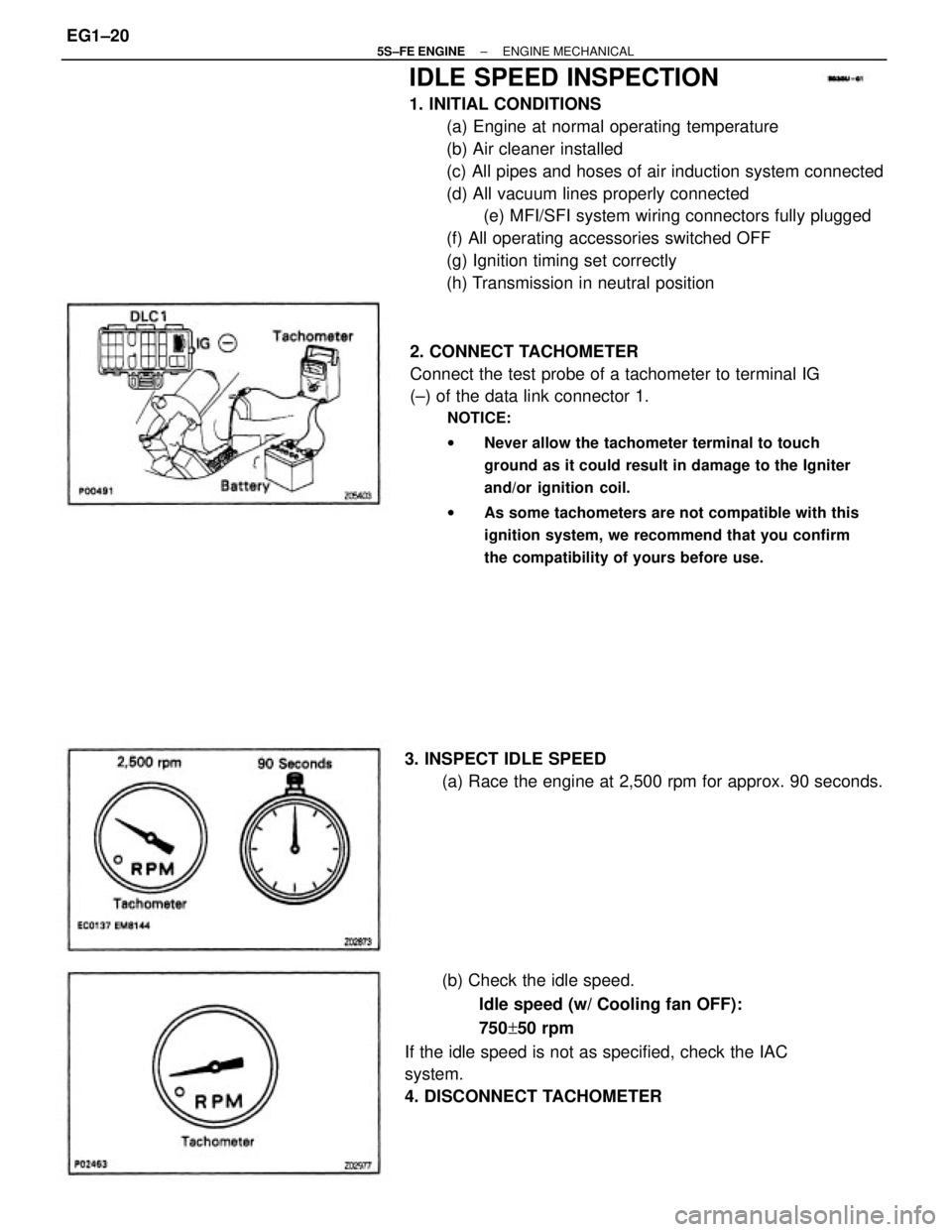
IDLE SPEED INSPECTION
1. INITIAL CONDITIONS
(a) Engine at normal operating temperature
(b) Air cleaner installed
(c) All pipes and hoses of air induction system connected
(d) All vacuum lines properly connected
(e) MFI/SFI system wiring connectors fully plugged
(f) All operating accessories switched OFF
(g) Ignition timing set correctly
(h) Transmission in neutral position
2. CONNECT TACHOMETER
Connect the test probe of a tachometer to terminal IG
(±) of the data link connector 1.
NOTICE:
wNever allow the tachometer terminal to touch
ground as it could result in damage to the Igniter
and/or ignition coil.
wAs some tachometers are not compatible with this
ignition system, we recommend that you confirm
the compatibility of yours before use.
(b) Check the idle speed.
Idle speed (w/ Cooling fan OFF):
750+50 rpm
If the idle speed is not as specified, check the IAC
system.
4. DISCONNECT TACHOMETER 3. INSPECT IDLE SPEED
(a) Race the engine at 2,500 rpm for approx. 90 seconds.
± 5S±FE ENGINEENGINE MECHANICALEG1±20

