Page 44 of 1033
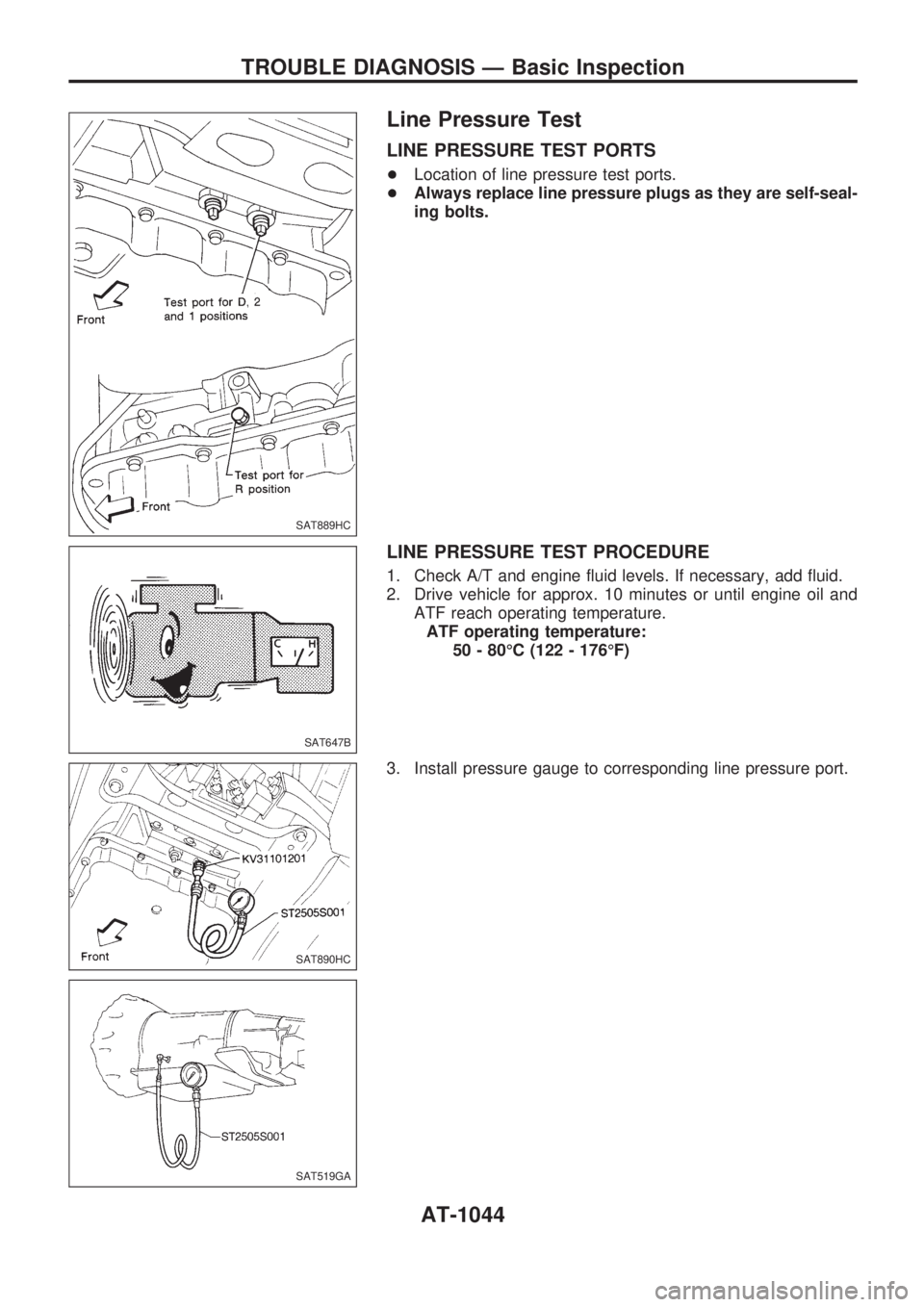
8. Move selector lever to ªNº position.
9. Cool off ATF.
+Run engine at idle for at least one minute.
10. Repeat steps 5 through 9 with selector lever in ª2º, ª1º and
ªRº positions.
JUDGEMENT OF STALL TEST
The test result and possible damaged components relating to each result are shown in the illustration.
In order to pinpoint the possible damaged components, follow the WORK FLOW shown in AT-1040.
Note
Stall revolution is too high in ªDº or ª2º position:
+Slippage occurs in 1st gear but not in 2nd and 3rd gears. ..... Low one-way clutch slippage
+Slippage occurs at the following gears:
1st through 3rd gears in ªDº position and engine brake functions.
1st and 2nd gears in ª2º position and engine brake functions with accelerator pedal released (fully closed
throttle). ..... Forward clutch or forward one-way clutch slippage
Stall revolution is too high in ªRº position:
+Engine brake does not function in ª1º position. ..... Low & reverse brake slippage
+Engine brake functions in ª1º position. ..... Reverse clutch slippage
Stall revolution within specifications:
+Vehicle does not achieve speed of more than 80 km/h (50 MPH). ..... One-way clutch seizure in torque
converter housing
CAUTION:
Be careful since automatic fluid temperature increases abnormally.
+Slippage occurs in 3rd and 4th gears in ªDº position. ..... High clutch slippage
+Slippage occurs in 2nd and 4th gear in ªDº position. ..... Brake band slippage
Stall revolution less than specifications:
+Poor acceleration during starts. ..... One-way clutch seizure in torque converter
SAT771B
TROUBLE DIAGNOSIS Ð Basic Inspection
Stall Test (Cont'd)
AT-1042
Page 46 of 1033
Line Pressure Test
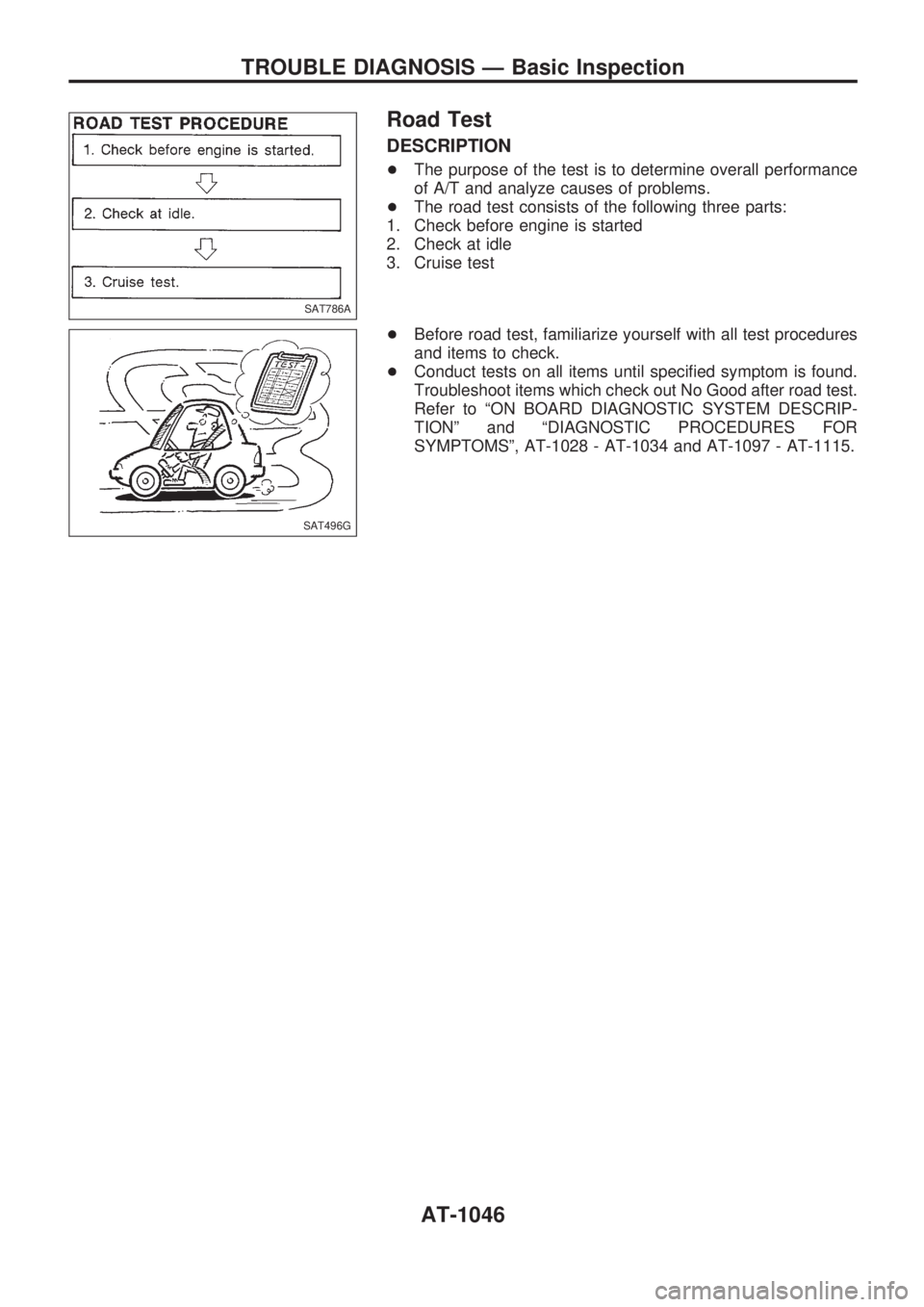
LINE PRESSURE TEST PORTS
+Location of line pressure test ports.
+Always replace line pressure plugs as they are self-seal-
ing bolts.
LINE PRESSURE TEST PROCEDURE
1. Check A/T and engine fluid levels. If necessary, add fluid.
2. Drive vehicle for approx. 10 minutes or until engine oil and
ATF reach operating temperature.
ATF operating temperature:
50 - 80ÉC (122 - 176ÉF)
3. Install pressure gauge to corresponding line pressure port.
SAT889HC
SAT647B
SAT890HC
SAT519GA
TROUBLE DIAGNOSIS Ð Basic Inspection
AT-1044
Page 47 of 1033
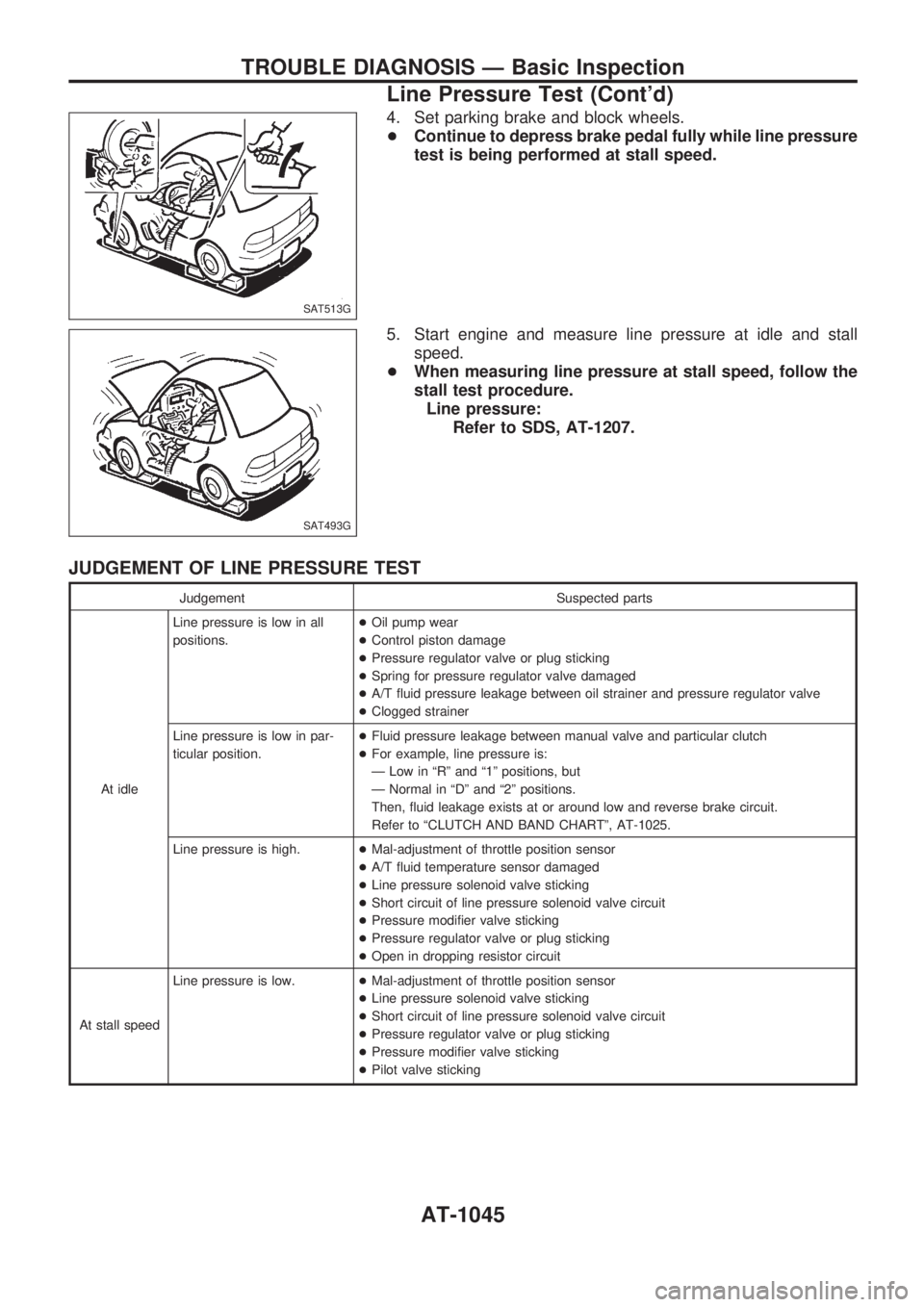
4. Set parking brake and block wheels.
+Continue to depress brake pedal fully while line pressure
test is being performed at stall speed.
5. Start engine and measure line pressure at idle and stall
speed.
+When measuring line pressure at stall speed, follow the
stall test procedure.
Line pressure:
Refer to SDS, AT-1207.
JUDGEMENT OF LINE PRESSURE TEST
Judgement Suspected parts
At idleLine pressure is low in all
positions.+Oil pump wear
+Control piston damage
+Pressure regulator valve or plug sticking
+Spring for pressure regulator valve damaged
+A/T fluid pressure leakage between oil strainer and pressure regulator valve
+Clogged strainer
Line pressure is low in par-
ticular position.+Fluid pressure leakage between manual valve and particular clutch
+For example, line pressure is:
Ð Low in ªRº and ª1º positions, but
Ð Normal in ªDº and ª2º positions.
Then, fluid leakage exists at or around low and reverse brake circuit.
Refer to ªCLUTCH AND BAND CHARTº, AT-1025.
Line pressure is high.+Mal-adjustment of throttle position sensor
+A/T fluid temperature sensor damaged
+Line pressure solenoid valve sticking
+Short circuit of line pressure solenoid valve circuit
+Pressure modifier valve sticking
+Pressure regulator valve or plug sticking
+Open in dropping resistor circuit
At stall speedLine pressure is low.+Mal-adjustment of throttle position sensor
+Line pressure solenoid valve sticking
+Short circuit of line pressure solenoid valve circuit
+Pressure regulator valve or plug sticking
+Pressure modifier valve sticking
+Pilot valve sticking
SAT513G
SAT493G
TROUBLE DIAGNOSIS Ð Basic Inspection
Line Pressure Test (Cont'd)
AT-1045
Page 48 of 1033
Road Test
DESCRIPTION
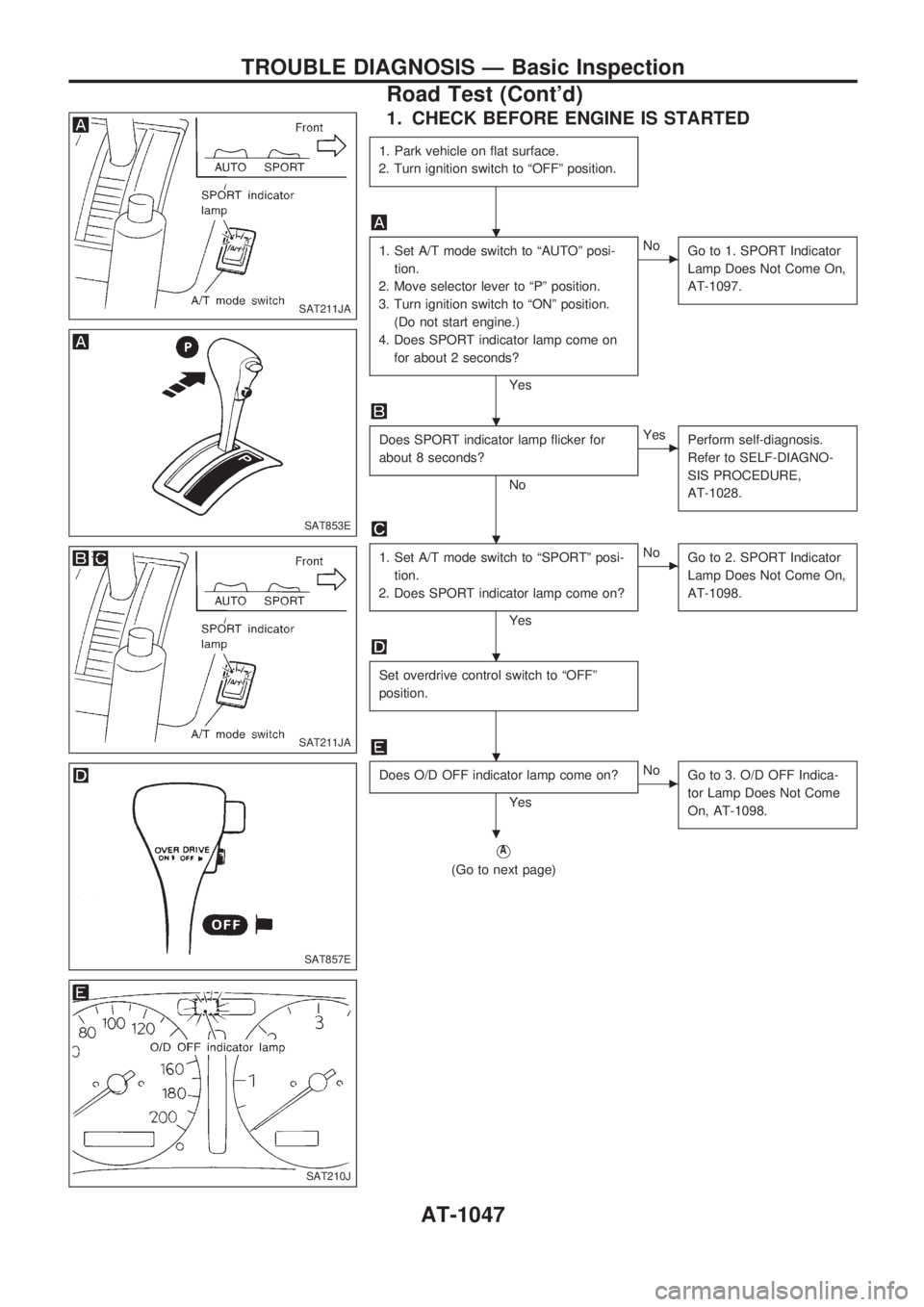
+The purpose of the test is to determine overall performance
of A/T and analyze causes of problems.
+The road test consists of the following three parts:
1. Check before engine is started
2. Check at idle
3. Cruise test
+Before road test, familiarize yourself with all test procedures
and items to check.
+Conduct tests on all items until specified symptom is found.
Troubleshoot items which check out No Good after road test.
Refer to ªON BOARD DIAGNOSTIC SYSTEM DESCRIP-
TIONº and ªDIAGNOSTIC PROCEDURES FOR
SYMPTOMSº, AT-1028 - AT-1034 and AT-1097 - AT-1115.
SAT786A
SAT496G
TROUBLE DIAGNOSIS Ð Basic Inspection
AT-1046
Page 49 of 1033
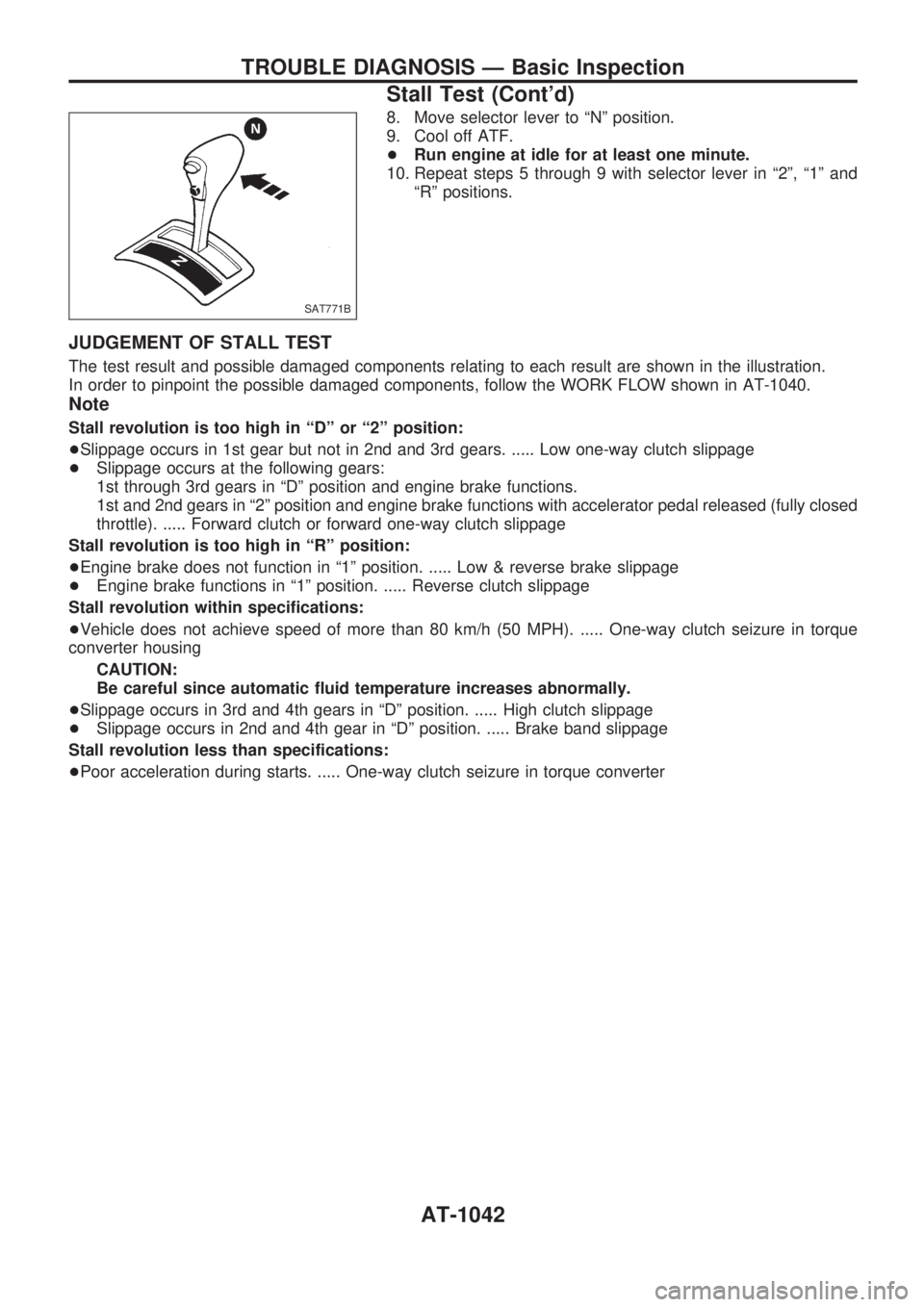
1. CHECK BEFORE ENGINE IS STARTED
1. Park vehicle on flat surface.
2. Turn ignition switch to ªOFFº position.
1. Set A/T mode switch to ªAUTOº posi-
tion.
2. Move selector lever to ªPº position.
3. Turn ignition switch to ªONº position.
(Do not start engine.)
4. Does SPORT indicator lamp come on
for about 2 seconds?
Yes
cNo
Go to 1. SPORT Indicator
Lamp Does Not Come On,
AT-1097.
Does SPORT indicator lamp flicker for
about 8 seconds?
No
cYes
Perform self-diagnosis.
Refer to SELF-DIAGNO-
SIS PROCEDURE,
AT-1028.
1. Set A/T mode switch to ªSPORTº posi-
tion.
2. Does SPORT indicator lamp come on?
Yes
cNo
Go to 2. SPORT Indicator
Lamp Does Not Come On,
AT-1098.
Set overdrive control switch to ªOFFº
position.
Does O/D OFF indicator lamp come on?
Yes
cNo
Go to 3. O/D OFF Indica-
tor Lamp Does Not Come
On, AT-1098.
VA
(Go to next page)
SAT211JA
SAT853E
SAT211JA
SAT857E
SAT210J
.
.
.
.
.
.
TROUBLE DIAGNOSIS Ð Basic Inspection
Road Test (Cont'd)
AT-1047
Page 51 of 1033
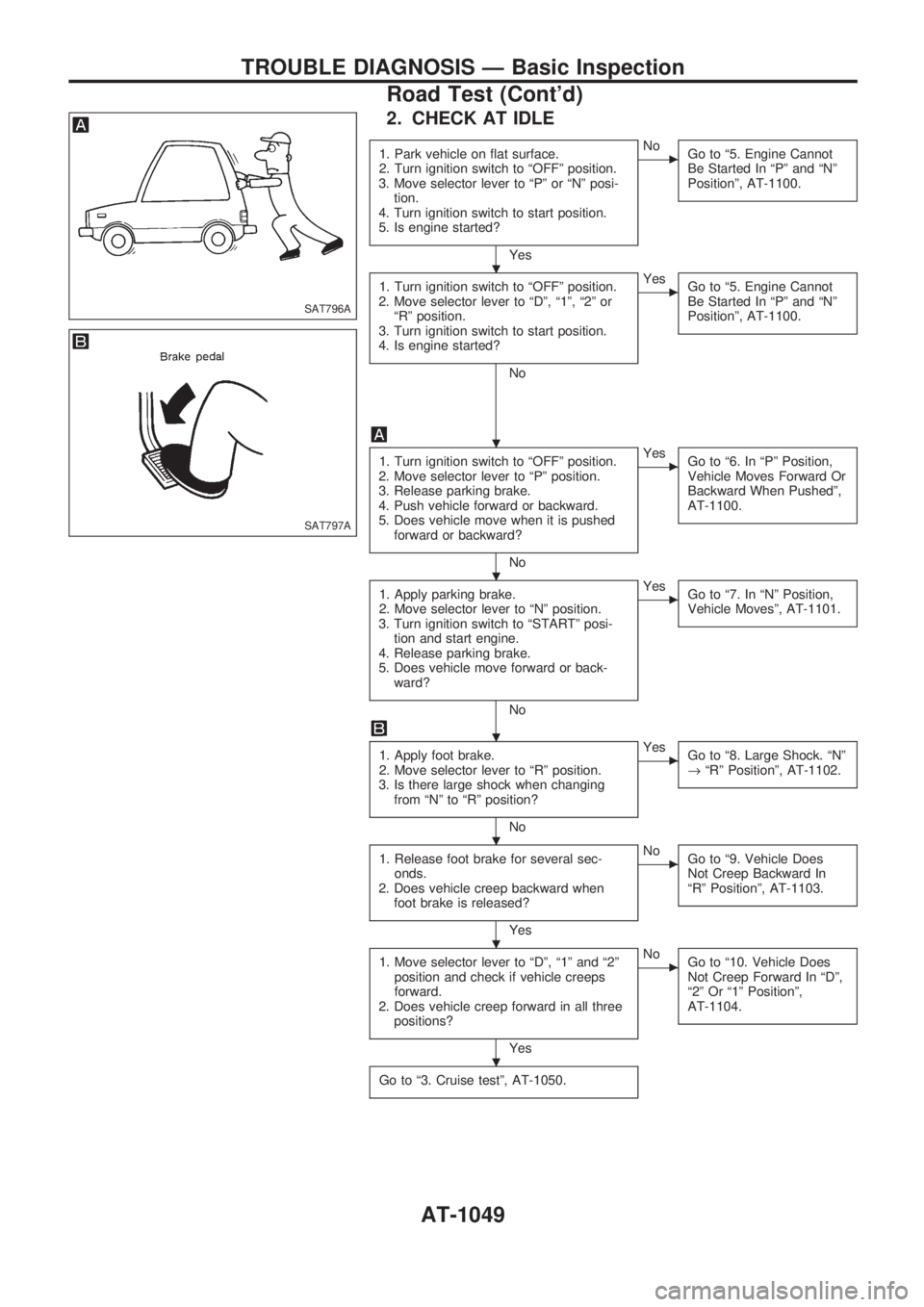
2. CHECK AT IDLE
1. Park vehicle on flat surface.
2. Turn ignition switch to ªOFFº position.
3. Move selector lever to ªPº or ªNº posi-
tion.
4. Turn ignition switch to start position.
5. Is engine started?
Yes
cNo
Go to ª5. Engine Cannot
Be Started In ªPº and ªNº
Positionº, AT-1100.
1. Turn ignition switch to ªOFFº position.
2. Move selector lever to ªDº, ª1º, ª2º or
ªRº position.
3. Turn ignition switch to start position.
4. Is engine started?
No
cYes
Go to ª5. Engine Cannot
Be Started In ªPº and ªNº
Positionº, AT-1100.
1. Turn ignition switch to ªOFFº position.
2. Move selector lever to ªPº position.
3. Release parking brake.
4. Push vehicle forward or backward.
5. Does vehicle move when it is pushed
forward or backward?
No
cYes
Go to ª6. In ªPº Position,
Vehicle Moves Forward Or
Backward When Pushedº,
AT-1100.
1. Apply parking brake.
2. Move selector lever to ªNº position.
3. Turn ignition switch to ªSTARTº posi-
tion and start engine.
4. Release parking brake.
5. Does vehicle move forward or back-
ward?
No
cYes
Go to ª7. In ªNº Position,
Vehicle Movesº, AT-1101.
1. Apply foot brake.
2. Move selector lever to ªRº position.
3. Is there large shock when changing
from ªNº to ªRº position?
No
cYes
Go to ª8. Large Shock. ªNº
®ªRº Positionº, AT-1102.
1. Release foot brake for several sec-
onds.
2. Does vehicle creep backward when
foot brake is released?
Yes
cNo
Go to ª9. Vehicle Does
Not Creep Backward In
ªRº Positionº, AT-1103.
1. Move selector lever to ªDº, ª1º and ª2º
position and check if vehicle creeps
forward.
2. Does vehicle creep forward in all three
positions?
Yes
cNo
Go to ª10. Vehicle Does
Not Creep Forward In ªDº,
ª2º Or ª1º Positionº,
AT-1104.
Go to ª3. Cruise testº, AT-1050.
SAT796A
SAT797A
.
.
.
.
.
.
.
TROUBLE DIAGNOSIS Ð Basic Inspection
Road Test (Cont'd)
AT-1049
Page 55 of 1033
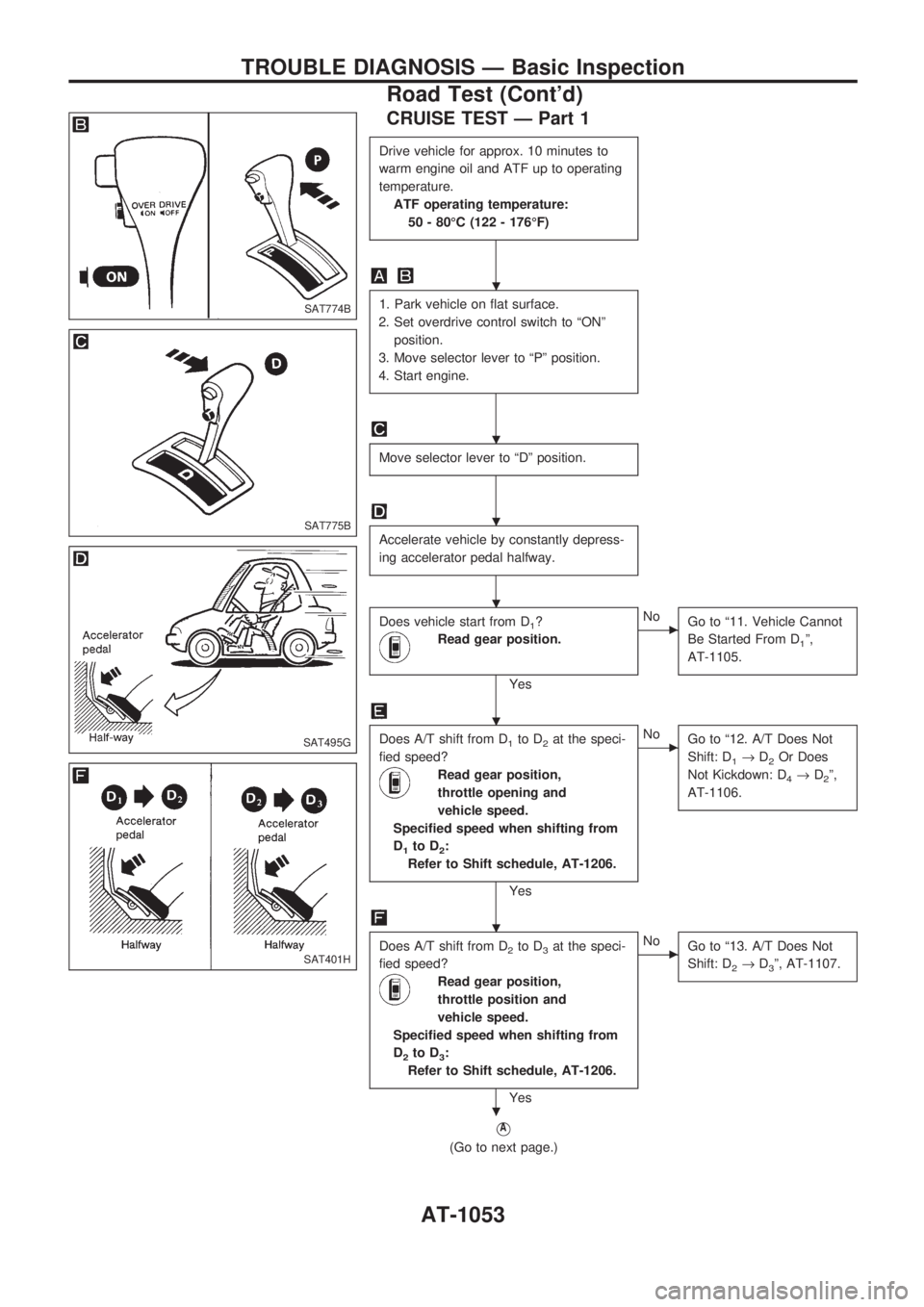
CRUISE TEST Ð Part 1
Drive vehicle for approx. 10 minutes to
warm engine oil and ATF up to operating
temperature.
ATF operating temperature:
50 - 80ÉC (122 - 176ÉF)
1. Park vehicle on flat surface.
2. Set overdrive control switch to ªONº
position.
3. Move selector lever to ªPº position.
4. Start engine.
Move selector lever to ªDº position.
Accelerate vehicle by constantly depress-
ing accelerator pedal halfway.
Does vehicle start from D1?
Read gear position.
Yes
cNo
Go to ª11. Vehicle Cannot
Be Started From D
1º,
AT-1105.
Does A/T shift from D1to D2at the speci-
fied speed?
Read gear position,
throttle opening and
vehicle speed.
Specified speed when shifting from
D
1to D2:
Refer to Shift schedule, AT-1206.
Yes
cNo
Go to ª12. A/T Does Not
Shift: D
1®D2Or Does
Not Kickdown: D
4®D2º,
AT-1106.
Does A/T shift from D2to D3at the speci-
fied speed?
Read gear position,
throttle position and
vehicle speed.
Specified speed when shifting from
D
2to D3:
Refer to Shift schedule, AT-1206.
Yes
cNo
Go to ª13. A/T Does Not
Shift: D
2®D3º, AT-1107.
VA
(Go to next page.)
SAT774B
SAT775B
SAT495G
SAT401H
.
.
.
.
.
.
.
TROUBLE DIAGNOSIS Ð Basic Inspection
Road Test (Cont'd)
AT-1053
Page 56 of 1033
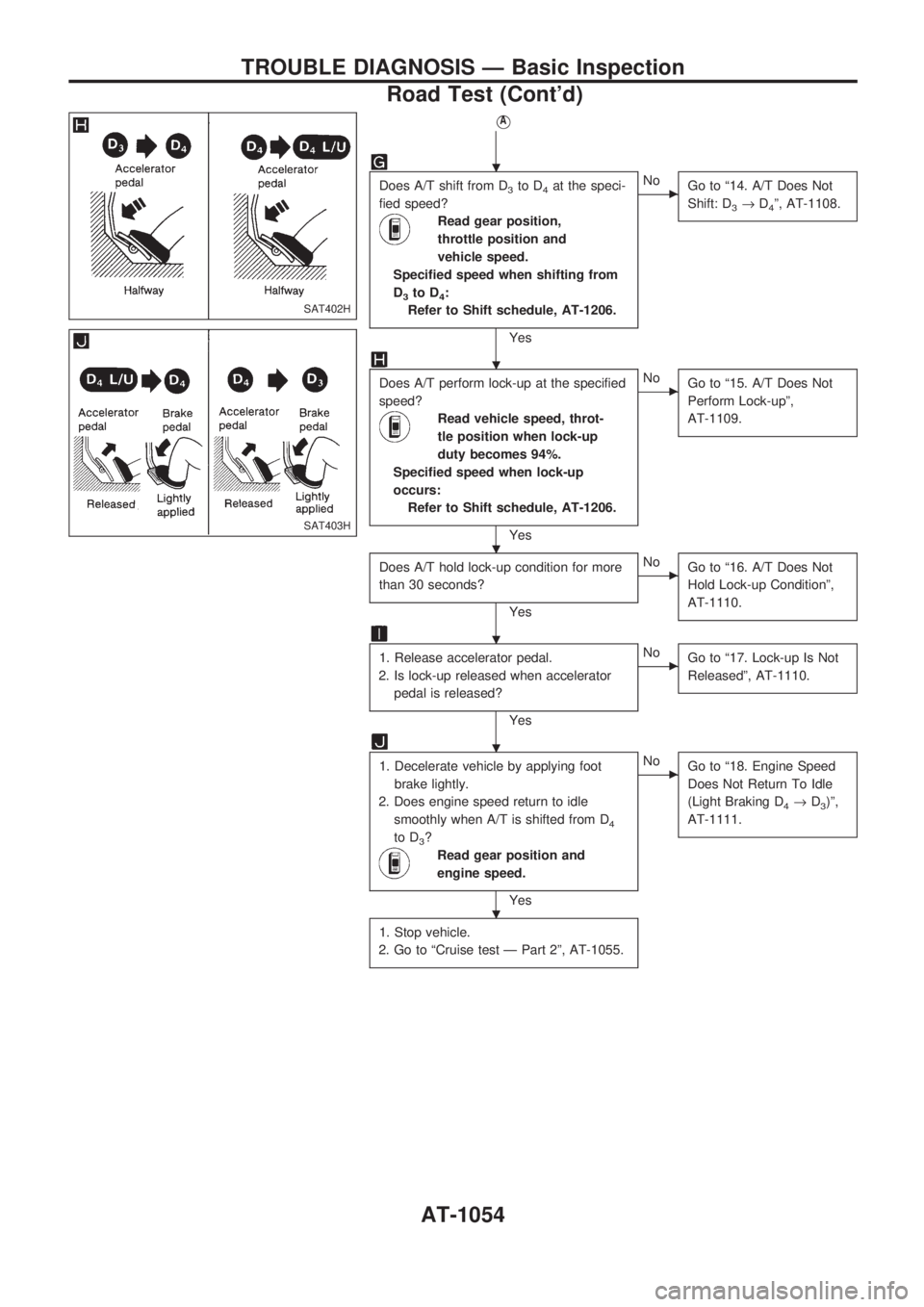
VA
Does A/T shift from D3to D4at the speci-
fied speed?
Read gear position,
throttle position and
vehicle speed.
Specified speed when shifting from
D
3to D4:
Refer to Shift schedule, AT-1206.
Yes
cNo
Go to ª14. A/T Does Not
Shift: D
3®D4º, AT-1108.
Does A/T perform lock-up at the specified
speed?
Read vehicle speed, throt-
tle position when lock-up
duty becomes 94%.
Specified speed when lock-up
occurs:
Refer to Shift schedule, AT-1206.
Yes
cNo
Go to ª15. A/T Does Not
Perform Lock-upº,
AT-1109.
Does A/T hold lock-up condition for more
than 30 seconds?
Yes
cNo
Go to ª16. A/T Does Not
Hold Lock-up Conditionº,
AT-1110.
1. Release accelerator pedal.
2. Is lock-up released when accelerator
pedal is released?
Yes
cNo
Go to ª17. Lock-up Is Not
Releasedº, AT-1110.
1. Decelerate vehicle by applying foot
brake lightly.
2. Does engine speed return to idle
smoothly when A/T is shifted from D
4to D3?
Read gear position and
engine speed.
Yes
cNo
Go to ª18. Engine Speed
Does Not Return To Idle
(Light Braking D
4®D3)º,
AT-1111.
1. Stop vehicle.
2. Go to ªCruise test Ð Part 2º, AT-1055.
SAT402H
SAT403H
.
.
.
.
.
.
TROUBLE DIAGNOSIS Ð Basic Inspection
Road Test (Cont'd)
AT-1054