2000 DODGE NEON engine
[x] Cancel search: enginePage 1116 of 1285
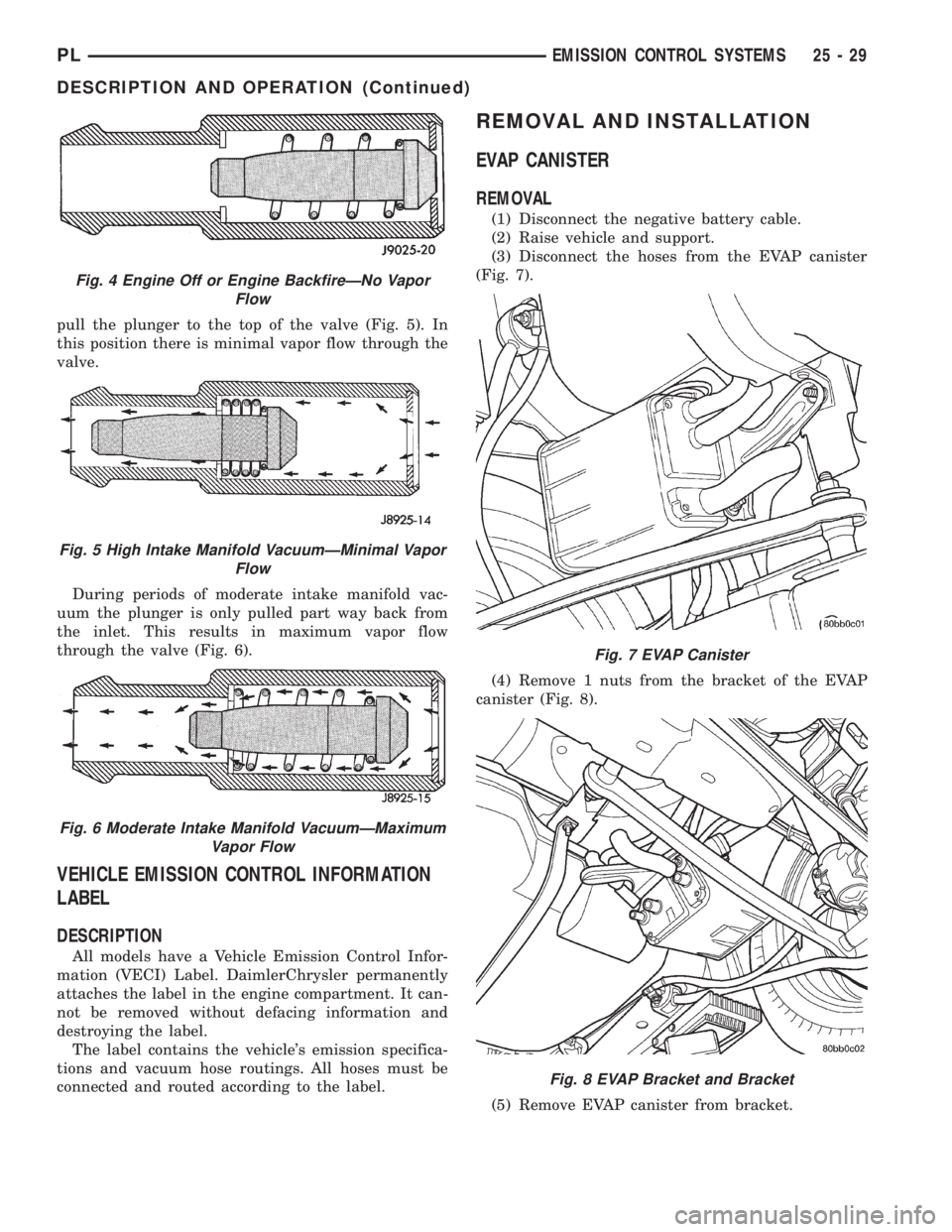
pull the plunger to the top of the valve (Fig. 5). In
this position there is minimal vapor flow through the
valve.
During periods of moderate intake manifold vac-
uum the plunger is only pulled part way back from
the inlet. This results in maximum vapor flow
through the valve (Fig. 6).
VEHICLE EMISSION CONTROL INFORMATION
LABEL
DESCRIPTION
All models have a Vehicle Emission Control Infor-
mation (VECI) Label. DaimlerChrysler permanently
attaches the label in the engine compartment. It can-
not be removed without defacing information and
destroying the label.
The label contains the vehicle's emission specifica-
tions and vacuum hose routings. All hoses must be
connected and routed according to the label.
REMOVAL AND INSTALLATION
EVAP CANISTER
REMOVAL
(1) Disconnect the negative battery cable.
(2) Raise vehicle and support.
(3) Disconnect the hoses from the EVAP canister
(Fig. 7).
(4) Remove 1 nuts from the bracket of the EVAP
canister (Fig. 8).
(5) Remove EVAP canister from bracket.
Fig. 4 Engine Off or Engine BackfireÐNo Vapor
Flow
Fig. 5 High Intake Manifold VacuumÐMinimal Vapor
Flow
Fig. 6 Moderate Intake Manifold VacuumÐMaximum
Vapor Flow
Fig. 7 EVAP Canister
Fig. 8 EVAP Bracket and Bracket
PLEMISSION CONTROL SYSTEMS 25 - 29
DESCRIPTION AND OPERATION (Continued)
Page 1117 of 1285
INSTALLATION
(1) Install EVAP canister to Bracket (Fig. 8).
(2) Install 2 nuts to EVAP canister and bracket
and tighten nuts to 6.7 N´m (60 in. lbs.).
(3) Connect hoses.
(4) Install EVAP canister and bracket to vehicle
and tighten nut 22.4 N´m (250 in. lbs.).
(5) Lower vehicle.
(6) Connect negative battery cable.
LEAK DETECTION PUMP
REMOVAL
(1) Raise and support vehicle on a hoist.
(2) Push locking tab on electrical connector to
unlock and remove connector.
(3) loosen the sway bar bracket to remove the
pump bracket.
(4) Remove pump and bracket as an assembly.
(5) Disconnect lines from LDP.
(6) Remove filter.
(7) Remove pump from bracket.
INSTALLATION
(1) Install pump to bracket and tighten bolts to 1.2
N´m (10.6 in. lbs.).
(2) Install filter and tighten to 2.8 N´m (25 in.
lbs.).
(3)Before installing hoses to LDP, make sure
they are not cracked or split. If a hose leaks, it
will cause the Check Engine Lamp to illumi-
nate.Connect lines to the LDP.
NOTE: The LDP bracket must be between the rail
and sway bar bracket.
(4) Install pump and bracket assembly to body and
tighten bolts to 5.0 N´m (45 in. lbs.).
(5) Install sway bar bracket bolt and tighten bolts
to 33.8 N´m (25 ft. lbs.).
(6) Install electrical connector to pump and push
locking tab to lock.
(7) Lower vehicle(8) Use the DRB scan tool, verify proper operation
of LDP.
PROPORTIONAL PURGE SOLENOID VALVE
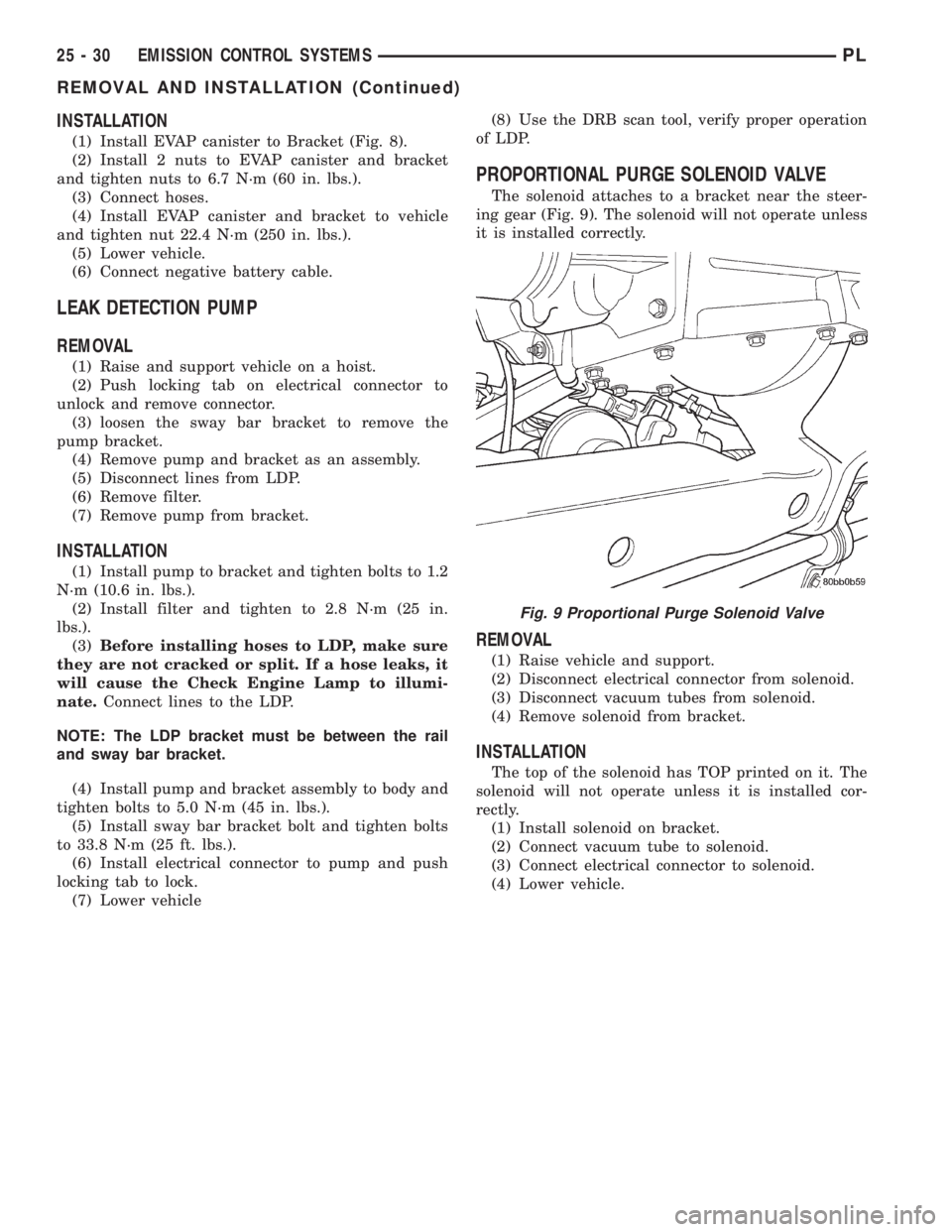
The solenoid attaches to a bracket near the steer-
ing gear (Fig. 9). The solenoid will not operate unless
it is installed correctly.
REMOVAL
(1) Raise vehicle and support.
(2) Disconnect electrical connector from solenoid.
(3) Disconnect vacuum tubes from solenoid.
(4) Remove solenoid from bracket.
INSTALLATION
The top of the solenoid has TOP printed on it. The
solenoid will not operate unless it is installed cor-
rectly.
(1) Install solenoid on bracket.
(2) Connect vacuum tube to solenoid.
(3) Connect electrical connector to solenoid.
(4) Lower vehicle.
Fig. 9 Proportional Purge Solenoid Valve
25 - 30 EMISSION CONTROL SYSTEMSPL
REMOVAL AND INSTALLATION (Continued)
Page 1118 of 1285
BODY
TABLE OF CONTENTS
page page
PAINT................................... 1
STATIONARY GLASS........................ 4
SEATS ................................... 8BODY COMPONENTS...................... 12
SPECIFICATIONS......................... 60
PAINT
TABLE OF CONTENTS
page page
DESCRIPTION AND OPERATION
PAINT CODE.............................1
BASE COAT/CLEAR COAT FINISH.............1
WET SANDING, BUFFING, AND POLISHING.....1PAINTED SURFACE TOUCH-UP..............1
SPECIFICATIONS
AFTERMARKET PAINT REPAIR PRODUCTS.....2
DESCRIPTION AND OPERATION
PAINT CODE
A paint code is provided on the body code plate
located in the engine compartment. Refer to the
Introduction section at the front of this manual for
body code plate description. The paint and trim codes
are also included on the Vehicle Safety Label located
on the driver's door end frame.
BASE COAT/CLEAR COAT FINISH
On most vehicles a two-part paint application (base
coat/clear coat) is used. Color paint that is applied to
primer is called base coat. The clear coat protects the
base coat from ultraviolet light and provides a dura-
ble high-gloss finish.
CAUTION: Do not use abrasive chemicals or com-
pounds on painted surfaces. Damage to finish can
result.
Do not use harsh alkaline based cleaning sol-
vents on painted surfaces. Damage to finish or
color can result.
WET SANDING, BUFFING, AND POLISHING
Minor acid etching, orange peel, or smudging in
clear coat or single-stage finishes can be reduced
with light wet sanding, hand buffing, and polishing.
If the finish has been wet sanded in the past, itcannot be repeated. Wet sanding operation
should be performed by a trained automotive
paint technician.
CAUTION: Do not remove clear coat finish, if
equipped. Base coat paint must retain clear coat for
durability.
PAINTED SURFACE TOUCH-UP
When a painted metal surface has been scratched
or chipped, it should be touched-up as soon as possi-
ble to avoid corrosion. For best results, use Mopart
Scratch Filler/Primer, Touch-Up Paints and Clear Top
Coat. Refer to Introduction group of this manual for
Body Code Plate information.
CAUTION: USE A OSHA APPROVED BREATHING
FILTER WHEN SPRAYING PAINT OR SOLVENTS IN
A CONFINED AREA. PERSONAL INJURY CAN
RESULT.
TOUCH-UP PROCEDURE
(1) Scrape loose paint and corrosion from inside
scratch or chip.
(2) Clean affected area with MopartTar/Road Oil
Remover, and allow to dry.
(3) Fill the inside of the scratch or chip with a coat
of filler/primer. Do not overlap primer onto good sur-
PLBODY 23 - 1
Page 1135 of 1285
DIAGNOSIS AND TESTING
WATER LEAKS
Water leaks can be caused by poor sealing,
improper body component alignment, body seam
porosity, missing plugs, or blocked drain holes. Cen-
trifugal and gravitational force can cause water to
drip from a location away from the actual leak point,
making leak detection difficult. All body sealing
points should be water tight in normal wet-driving
conditions. Water flowing downward from the front of
the vehicle should not enter the passenger or luggage
compartment. Moving sealing surfaces will not
always seal water tight under all conditions. At
times, side glass or door seals will allow water to
enter the passenger compartment during high pres-
sure washing or hard driving rain (severe) condi-
tions. Overcompensating on door or glass
adjustments to stop a water leak that occurs under
severe conditions can cause premature seal wear and
excessive closing or latching effort. After completing
a repair, water-test vehicle to verify leak has stopped
before returning vehicle to use.
VISUAL INSPECTION BEFORE WATER LEAK TESTS
Verify that floor and body plugs are in place, body
drains are clear, and body components are properly
aligned and sealed. If component alignment or seal-
ing is necessary, refer to the appropriate section of
this group for proper procedures.
WATER LEAK TESTS
WARNING: DO NOT USE ELECTRIC SHOP LIGHTS
OR TOOLS IN WATER TEST AREA. PERSONAL
INJURY CAN RESULT.
When the conditions causing a water leak have
been determined, simulate the conditions as closely
as possible.
²If a leak occurs with the vehicle parked in a
steady light rain, flood the leak area with an open-
ended garden hose.
²If a leak occurs while driving at highway speeds
in a steady rain, test the leak area with a reasonable
velocity stream or fan spray of water. Direct the
spray in a direction comparable to actual conditions.
²If a leak occurs when the vehicle is parked on an
incline, hoist the end or side of the vehicle to simu-
late this condition. This method can be used when
the leak occurs when the vehicle accelerates, stops or
turns. If the leak occurs on acceleration, hoist the
front of the vehicle. If the leak occurs when braking,
hoist the back of the vehicle. If the leak occurs on left
turns, hoist the left side of the vehicle. If the leak
occurs on right turns, hoist the right side of the vehi-cle. For hoisting recommendations refer to Group 0,
Lubrication and Maintenance, General Information
section.
WATER LEAK DETECTION
To detect a water leak point-of-entry, do a water
test and watch for water tracks or droplets forming
on the inside of the vehicle. If necessary, remove inte-
rior trim covers or panels to gain visual access to the
leak area. If the hose cannot be positioned without
being held, have someone help do the water test.
Some water leaks must be tested for a considerable
length of time to become apparent. When a leak
appears, find the lowest point of the water track or
drop. After leak point has been found, repair the leak
and water test to verify that the leak has stopped.
Locating the entry point of water that is leaking
into a cavity between panels can be difficult. The
trapped water may splash or run from the cavity,
often at a distance from the entry point. Most water
leaks of this type become apparent after accelerating,
stopping, turning, or when on an incline.
MIRROR INSPECTION METHOD
When a leak point area is visually obstructed, use
a suitable mirror to gain visual access. A mirror can
also be used to deflect light to a limited-access area
to assist in locating a leak point.
BRIGHT LIGHT LEAK TEST METHOD
Some water leaks in the luggage compartment can
be detected without water testing. Position the vehi-
cle in a brightly lit area. From inside the darkened
luggage compartment inspect around seals and body
seams. If necessary, have a helper direct a drop light
over the suspected leak areas around the luggage
compartment. If light is visible through a normally
sealed location, water could enter through the open-
ing.
PRESSURIZED LEAK TEST METHOD
When a water leak into the passenger compart-
ment cannot be detected by water testing, pressurize
the passenger compartment and soap test exterior of
the vehicle. To pressurize the passenger compart-
ment, close all doors and windows, start engine, and
set heater control to high blower in HEAT position. If
engine can not be started, connect a charger to the
battery to ensure adequate voltage to the blower.
With interior pressurized, apply dish detergent solu-
tion to suspected leak area on the exterior of the
vehicle. Apply detergent solution with spray device or
soft bristle brush. If soap bubbles occur at a body
seam, joint, seal or gasket, the leak entry point could
be at that location.
23 - 18 BODYPL
Page 1136 of 1285
WIND NOISE
Wind noise is the result of most air leaks. Air leaks
can be caused by poor sealing, improper body compo-
nent alignment, body seam porosity, or missing plugs
in the engine compartment or door hinge pillar areas.
All body sealing points should be airtight in normal
driving conditions. Moving sealing surfaces will not
always seal airtight under all conditions. At times,
side glass or door seals will allow wind noise to be
noticed in the passenger compartment during high
cross winds. Over compensating on door or glass
adjustments to stop wind noise that occurs under
severe conditions can cause premature seal wear and
excessive closing or latching effort. After a repair pro-
cedure has been performed, test vehicle to verify
noise has stopped before returning vehicle to use.
Wind noise can also be caused by improperly fitted
exterior moldings or body ornamentation. Loose
moldings can flutter, creating a buzzing or chattering
noise. An open cavity or protruding edge can create a
whistling or howling noise. Inspect the exterior of the
vehicle to verify that these conditions do not exist.
VISUAL INSPECTION BEFORE TESTS
Verify that floor and body plugs are in place and
body components are aligned and sealed. If compo-
nent alignment or sealing is necessary, refer to the
appropriate section of this group for proper proce-
dures.
ROAD TESTING WIND NOISE
(1) Drive the vehicle to verify the general location
of the wind noise.
(2) Apply 50 mm (2 in.) masking tape in 150 mm
(6 in.) lengths along weatherstrips, weld seams or
moldings. After each length is applied, drive the vehi-
cle. If noise goes away after a piece of tape is applied,
remove tape, locate, and repair defect.
POSSIBLE CAUSE OF WIND NOISE
²Moldings standing away from body surface can
catch wind and whistle.
²Gaps in sealed areas behind overhanging body
flanges can cause wind-rushing sounds.
²Misaligned movable components.
²Missing or improperly installed plugs in pillars.
²Weld burn through holes.
SERVICE PROCEDURES
HEAT STAKING
(1) Remove trim panel.
(2) Bend or move the trim panel components at
the heat staked joints. Observe the heat staked loca-
tions and/or component seams for looseness.(3) Heat stake the components.
(a) If the heat staked or component seam loca-
tion is loose, hold the two components tightly
together and using a soldering gun with a flat tip,
melt the material securing the components
together. Do not over heat the affected area, dam-
age to the exterior of the trim panel may occur.
(b) If the heat staked material is broken or miss-
ing, use a hot glue gun to apply new material to
the area to be repaired. The panels that are being
heat staked must be held together while the apply-
ing the glue. Once the new material is in place, it
may be necessary to use a soldering gun to melt
the newly applied material. Do not over heat the
affected area, damage to the exterior of the trim
panel may occur.
(4) Allow the repaired area to cool and verify the
repair.
(5) Install trim panel.
PLASTIC BODY PANEL REPAIR
DESCRIPTION OPERATION
Resin Transfer Molded (RTM) body panels are rein-
forced with a continuous fiberglass mesh. Epoxy
resin is injected into a gel-coated and fiberglass-lined
mold to form a body panel. Sheet molded compound
(SMC) body panels are constructed with fiberglass
strands usually 1 inch or shorter, epoxy resin formed
into sheet stock and pressed in mold flowing material
to form a sheet molded compound (SMC) body panel.
RTM and SMC body panels can be repaired with
epoxy adhesive after market products. Refer to
instructions provided by the manufacturer of prod-
ucts being used to repair RTM or SMC. Daimler-
Chrysler Corporation recommends that a trained
automotive body technician perform body panel
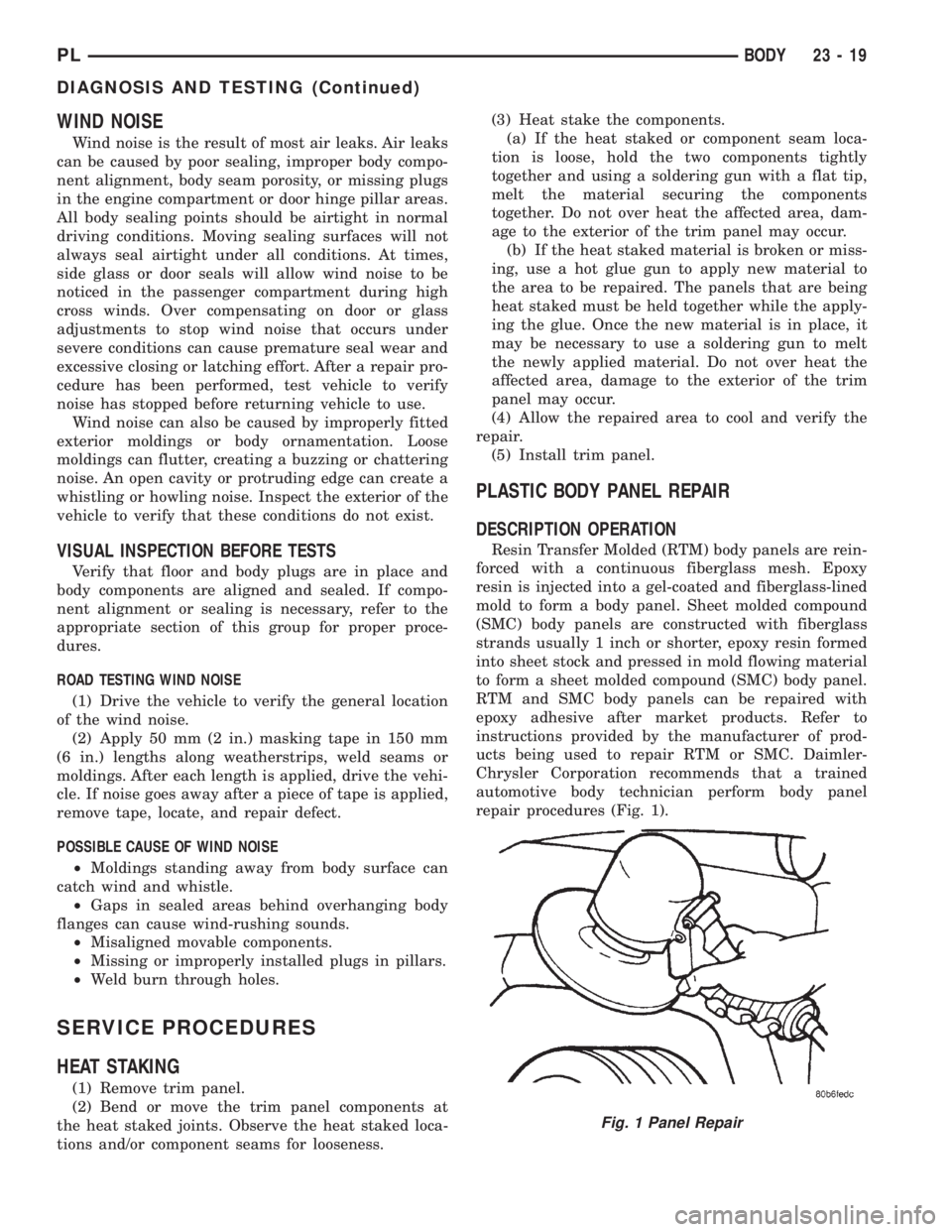
repair procedures (Fig. 1).
Fig. 1 Panel Repair
PLBODY 23 - 19
DIAGNOSIS AND TESTING (Continued)
Page 1143 of 1285
HOOD
REMOVAL
(1) Raise hood to full up position.
(2) Disengage under hood lamp wire connector
from engine compartment wire harness.
(3) Remove hood cover (Fig. 20).
(4) Mark all bolt and hinge attachment locations
with a grease pencil or other suitable device to pro-
vide reference marks for installation. When installing
hood, align all marks and secure bolts. The hood
should be aligned to 4 mm (0.160 in.) gap to the front
fenders and flush across the top surfaces along fend-
ers.
(5) Remove the top bolts attaching hood to hinge
and loosen the bottom bolts until they can be
removed by hand.
(6) With assistance from a helper at the opposite
side of the vehicle to support the hood, remove bot-
tom bolts attaching hood to hinge.
(7) Remove the hood from the vehicle.
INSTALLATION
(1) Place hood in position on vehicle. With assis-
tance from a helper at the opposite side of the vehicle
to support the hood, install bottom bolts to hold hood
to hinge finger tight.
(2) Install top bolts attaching hood to hinge finger
tight.
(3) Position bolts at marks and tighten bolts. The
hood should be aligned to 4 mm (0.160 in.) gap to the
front fenders and flush across the top surfaces along
fenders.(4) Install hood cover.
(5) Engage under hood lamp wire connector to
engine compartment wire harness.
(6) Verify hood operation and alignment.
HOOD SILENCER
REMOVAL
(1) Release hood latch and open hood.
(2) Disconnect hood lamp wire connector and
remove hood lamp (Fig. 21).
(3) Remove fasteners attaching hood silencer to
hood.
(4) Remove hood silencer from vehicle.
INSTALLATION
(1) Place hood silencer in position on vehicle.
(2) Install fastener attaching hood silencer to hood.
(3) Install hood lamp and connect wire connector.
(4) Close hood.
HOOD HINGE
REMOVAL
(1) Support hood on the side that requires hinge
replacement.
(2) Mark all bolt and hinge attachment locations
with a grease pencil or other suitable device to pro-
vide reference marks for installation. When installing
hood hinge, align all marks and secure bolts. The
hood should be aligned to 4 mm (0.160 in.) gap to the
front fenders and flush across the top surfaces along
fenders. Shims can be added or removed under hood
hinge to achieve proper hood height.
(3) Remove bolts holding hood to hinge.
(4) Remove bolts holding hood hinge to load beam
flange and separate hinge from vehicle. If necessary,
paint new hinge before installation.
INSTALLATION
(1) If necessary, paint new hinge before installa-
tion.
(2) Place hinge in position on vehicle.
(3) Install bolts to hold hood hinge to front fender
flange.
(4) Install bolts to hold hood to hinge.
(5) Align all marks and secure bolts. The hood
should be aligned to 4 mm (0.160 in.) gap to the front
fenders and flush across the top surfaces along fend-
ers. Shims can be added or removed under hood
hinge to achieve proper hood height.
(6) Remove support from under hood and verify
hood operation.
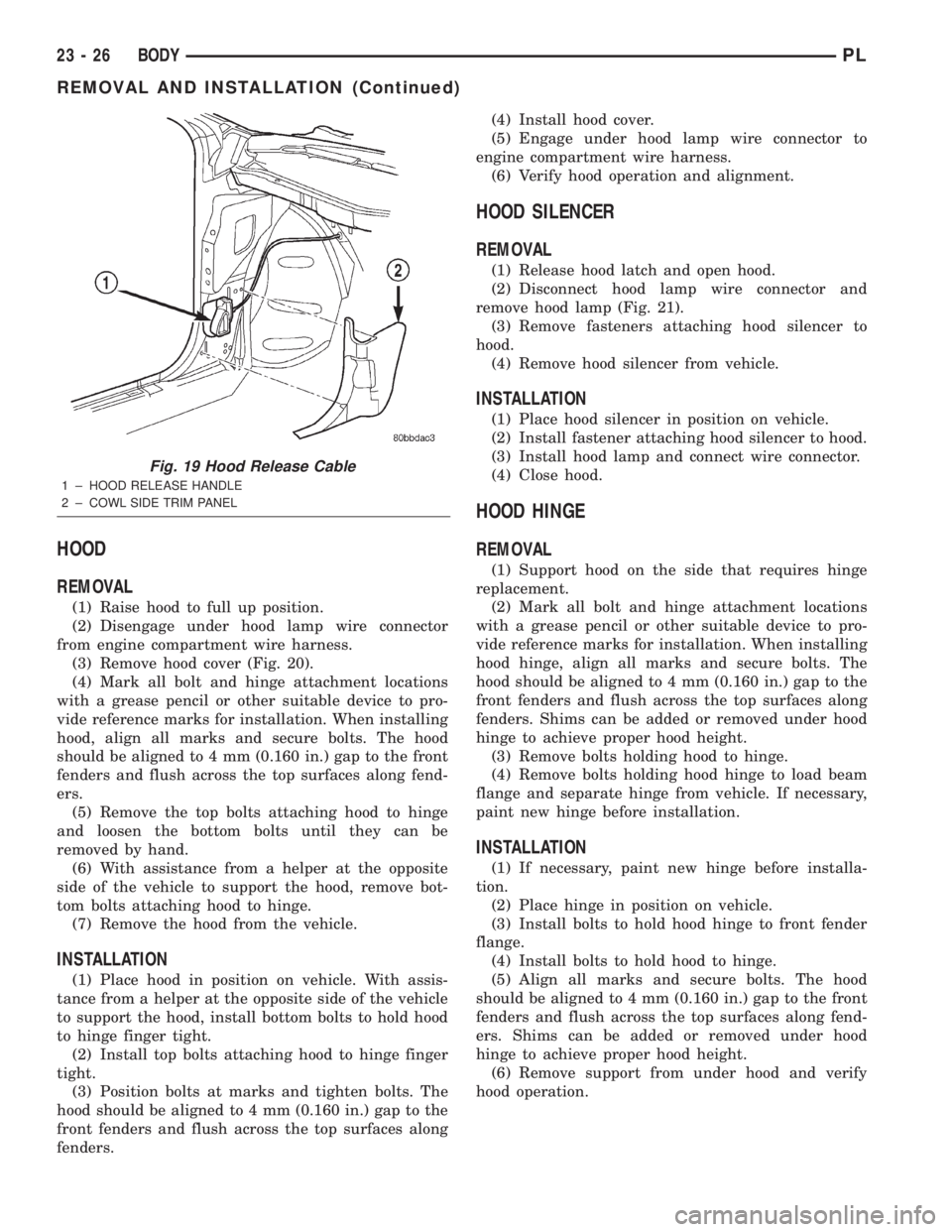
Fig. 19 Hood Release Cable
1 ± HOOD RELEASE HANDLE
2 ± COWL SIDE TRIM PANEL
23 - 26 BODYPL
REMOVAL AND INSTALLATION (Continued)
Page 1145 of 1285
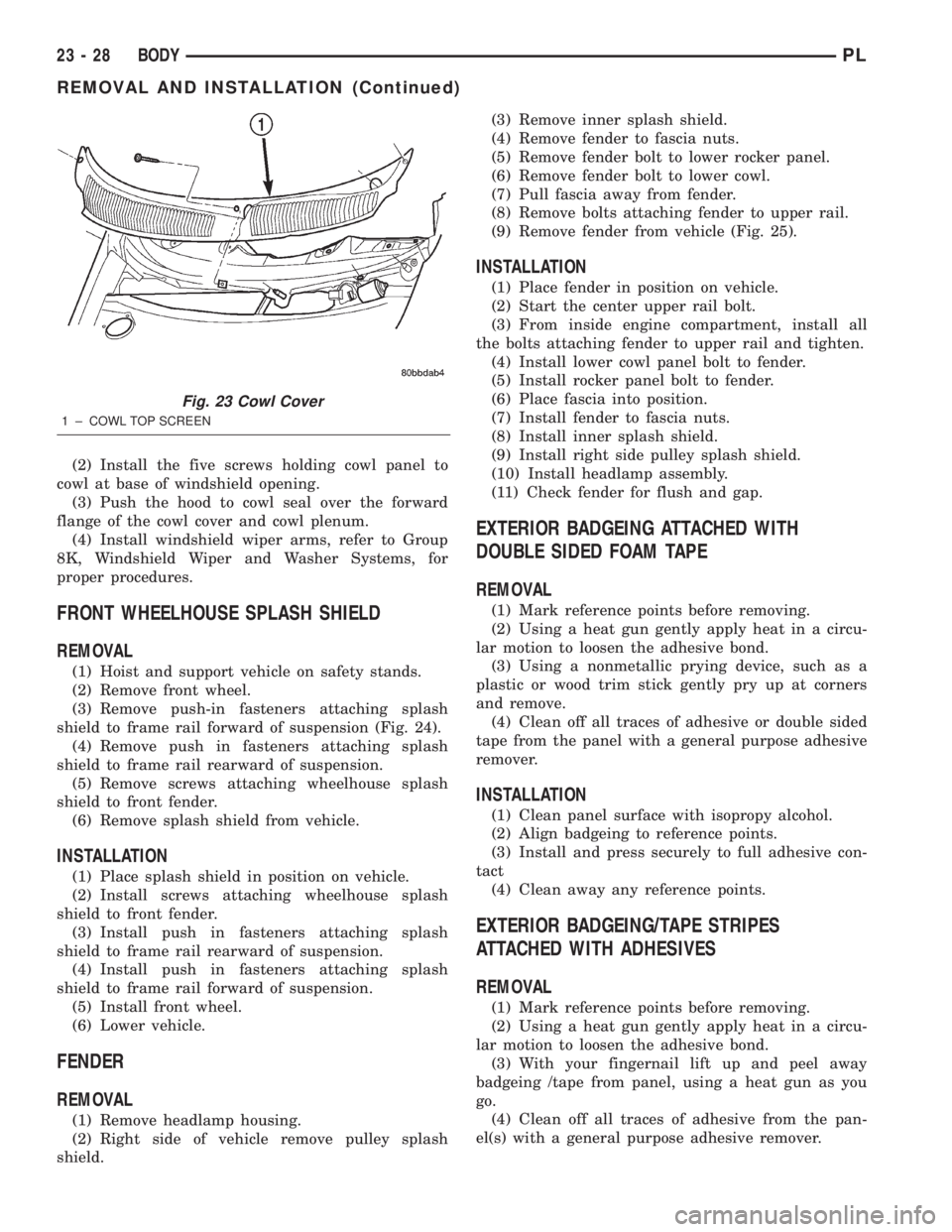
(2) Install the five screws holding cowl panel to
cowl at base of windshield opening.
(3) Push the hood to cowl seal over the forward
flange of the cowl cover and cowl plenum.
(4) Install windshield wiper arms, refer to Group
8K, Windshield Wiper and Washer Systems, for
proper procedures.
FRONT WHEELHOUSE SPLASH SHIELD
REMOVAL
(1) Hoist and support vehicle on safety stands.
(2) Remove front wheel.
(3) Remove push-in fasteners attaching splash
shield to frame rail forward of suspension (Fig. 24).
(4) Remove push in fasteners attaching splash
shield to frame rail rearward of suspension.
(5) Remove screws attaching wheelhouse splash
shield to front fender.
(6) Remove splash shield from vehicle.
INSTALLATION
(1) Place splash shield in position on vehicle.
(2) Install screws attaching wheelhouse splash
shield to front fender.
(3) Install push in fasteners attaching splash
shield to frame rail rearward of suspension.
(4) Install push in fasteners attaching splash
shield to frame rail forward of suspension.
(5) Install front wheel.
(6) Lower vehicle.
FENDER
REMOVAL
(1) Remove headlamp housing.
(2) Right side of vehicle remove pulley splash
shield.(3) Remove inner splash shield.
(4) Remove fender to fascia nuts.
(5) Remove fender bolt to lower rocker panel.
(6) Remove fender bolt to lower cowl.
(7) Pull fascia away from fender.
(8) Remove bolts attaching fender to upper rail.
(9) Remove fender from vehicle (Fig. 25).
INSTALLATION
(1) Place fender in position on vehicle.
(2) Start the center upper rail bolt.
(3) From inside engine compartment, install all
the bolts attaching fender to upper rail and tighten.
(4) Install lower cowl panel bolt to fender.
(5) Install rocker panel bolt to fender.
(6) Place fascia into position.
(7) Install fender to fascia nuts.
(8) Install inner splash shield.
(9) Install right side pulley splash shield.
(10) Install headlamp assembly.
(11) Check fender for flush and gap.
EXTERIOR BADGEING ATTACHED WITH
DOUBLE SIDED FOAM TAPE
REMOVAL
(1) Mark reference points before removing.
(2) Using a heat gun gently apply heat in a circu-
lar motion to loosen the adhesive bond.
(3) Using a nonmetallic prying device, such as a
plastic or wood trim stick gently pry up at corners
and remove.
(4) Clean off all traces of adhesive or double sided
tape from the panel with a general purpose adhesive
remover.
INSTALLATION
(1) Clean panel surface with isopropy alcohol.
(2) Align badgeing to reference points.
(3) Install and press securely to full adhesive con-
tact
(4) Clean away any reference points.
EXTERIOR BADGEING/TAPE STRIPES
ATTACHED WITH ADHESIVES
REMOVAL
(1) Mark reference points before removing.
(2) Using a heat gun gently apply heat in a circu-
lar motion to loosen the adhesive bond.
(3) With your fingernail lift up and peel away
badgeing /tape from panel, using a heat gun as you
go.
(4) Clean off all traces of adhesive from the pan-
el(s) with a general purpose adhesive remover.
Fig. 23 Cowl Cover
1 ± COWL TOP SCREEN
23 - 28 BODYPL
REMOVAL AND INSTALLATION (Continued)
Page 1176 of 1285

SPECIFICATIONS
BODY LUBRICATION
LUBRICATION REQUIREMENTS
Body mechanisms and linkages should be
inspected, cleaned, and lubricated, as required, to
maintain ease of operation and to provide protection
against rust and wear. When performing other
underhood services, the hood latch release mecha-
nism and safety catch should be inspected, cleaned,
and lubricated. During the winter season, external
door lock cylinders should be lubricated to assure
proper operation when exposed to water and ice.
Prior to the application of any lubricant, the parts
concerned should be wiped clean to remove dust and
grit. If necessary, a suitable solvent can be used to
clean the item to be lubricated. After lubricating a
component, any excess oil or grease should be
removed.
LUBRICANT APPLICATION
DOOR LOCK CYLINDERS
(1) Apply a small amount of lubricant directly into
the lock cylinder.
(2) Apply a small amount of lubricant to the key.
(3) Insert key into lock cylinder and cycle the
mechanism from the locked to the unlocked position.
NOTE: Do not add more lubricant.
(4) Cycle the lock cylinder mechanism several
times to allow the lubricant to flow throughout the
cylinder.
(5) Wipe all lubricant from exterior of lock cylinder
and key.
ALL OTHER BODY MECHANISMS
(1) Clean component as described above.(2) Apply specified lubricant to all pivoting and
sliding contact areas of component.
LUBRICANT USAGE
ENGINE OIL
²Decklid Hinges
MOPARTSPRAY WHITE LUBE OR EQUIVALENT
²Ash Receiver
²Fuel Filler Door Remote Control Latch Mecha-
nism
²Parking Brake Mechanism
²Sliding Seat Tracks
²Decklid Latch
MOPARTMULTIPURPOSE GREASE OR
EQUIVALENT
²All Other Hood Mechanisms
MOPARTLOCK CYLINDER LUBRICANT OR
EQUIVALENT
²Door Lock Cylinders
²Decklid Lock Cylinder
SPECIAL TOOLS
BODY
STICK, TRIM C 4755
PLBODY 23 - 59