2000 DODGE NEON brakes
[x] Cancel search: brakesPage 92 of 1285
Some discoloration or wear of the rotor surface is
normal and does not require resurfacing when lin-
ings are replaced. If cracks or burned spots are evi-
dent, the rotor must be replaced.
ROTOR MINIMUM THICKNESS
Measure rotor thickness at the center of the brake
shoe contact surface. Replace the rotor if it is worn
below minimum thickness or if machining the rotor
will cause its thickness to fall below specifications.
CAUTION: Do not machine the rotor if it will cause
the rotor to fall below minimum thickness.
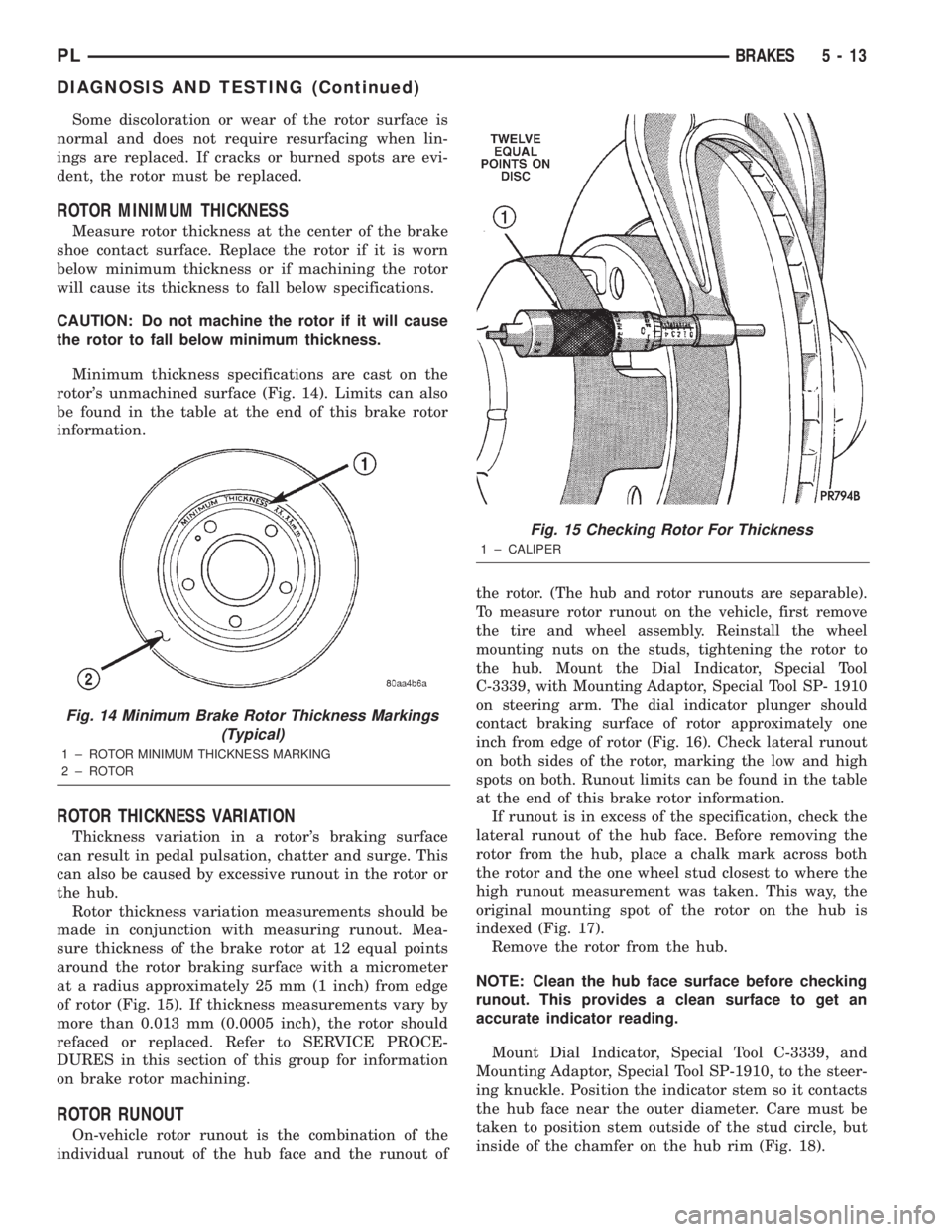
Minimum thickness specifications are cast on the
rotor's unmachined surface (Fig. 14). Limits can also
be found in the table at the end of this brake rotor
information.
ROTOR THICKNESS VARIATION
Thickness variation in a rotor's braking surface
can result in pedal pulsation, chatter and surge. This
can also be caused by excessive runout in the rotor or
the hub.
Rotor thickness variation measurements should be
made in conjunction with measuring runout. Mea-
sure thickness of the brake rotor at 12 equal points
around the rotor braking surface with a micrometer
at a radius approximately 25 mm (1 inch) from edge
of rotor (Fig. 15). If thickness measurements vary by
more than 0.013 mm (0.0005 inch), the rotor should
refaced or replaced. Refer to SERVICE PROCE-
DURES in this section of this group for information
on brake rotor machining.
ROTOR RUNOUT
On-vehicle rotor runout is the combination of the
individual runout of the hub face and the runout ofthe rotor. (The hub and rotor runouts are separable).
To measure rotor runout on the vehicle, first remove
the tire and wheel assembly. Reinstall the wheel
mounting nuts on the studs, tightening the rotor to
the hub. Mount the Dial Indicator, Special Tool
C-3339, with Mounting Adaptor, Special Tool SP- 1910
on steering arm. The dial indicator plunger should
contact braking surface of rotor approximately one
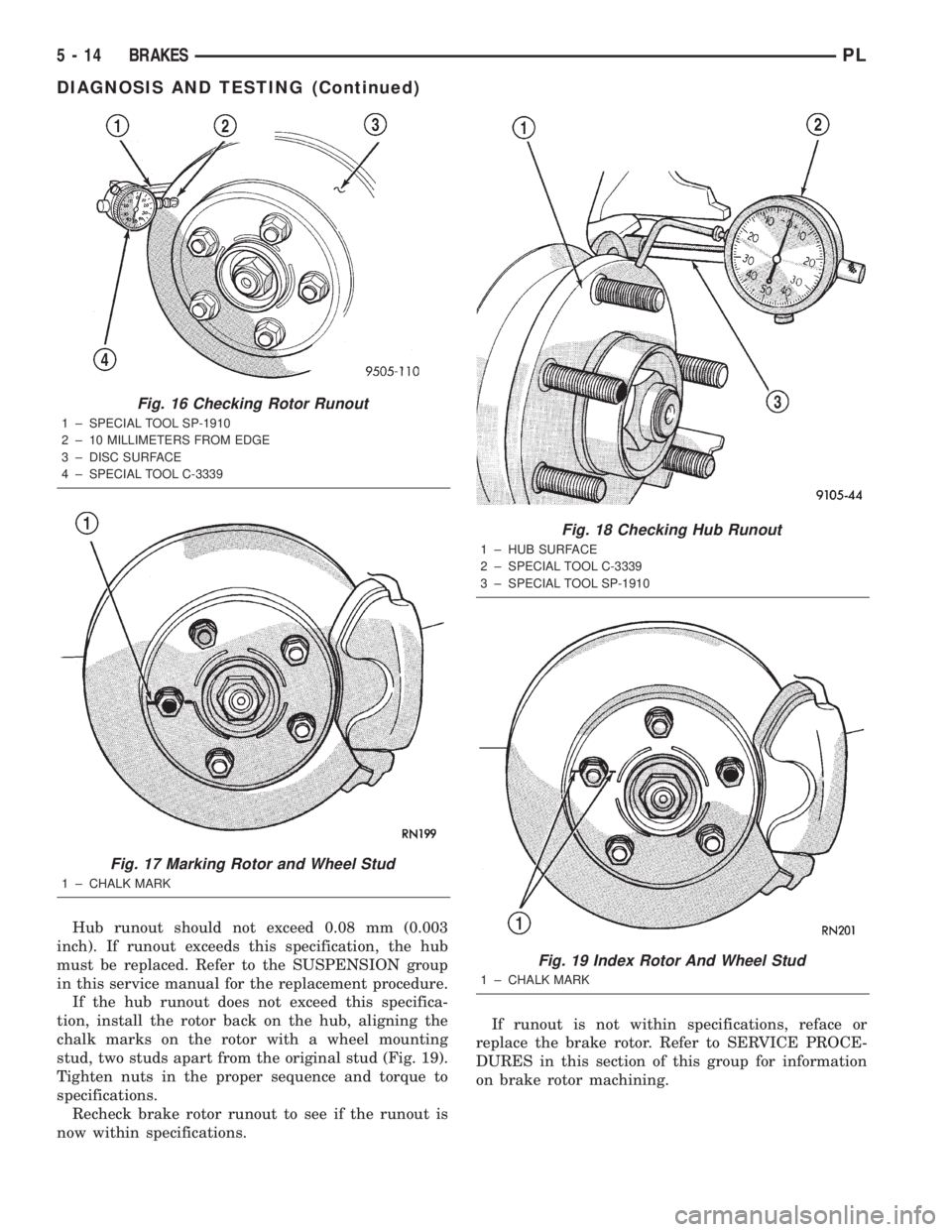
inch from edge of rotor (Fig. 16). Check lateral runout
on both sides of the rotor, marking the low and high
spots on both. Runout limits can be found in the table
at the end of this brake rotor information.
If runout is in excess of the specification, check the
lateral runout of the hub face. Before removing the
rotor from the hub, place a chalk mark across both
the rotor and the one wheel stud closest to where the
high runout measurement was taken. This way, the
original mounting spot of the rotor on the hub is
indexed (Fig. 17).
Remove the rotor from the hub.
NOTE: Clean the hub face surface before checking
runout. This provides a clean surface to get an
accurate indicator reading.
Mount Dial Indicator, Special Tool C-3339, and
Mounting Adaptor, Special Tool SP-1910, to the steer-
ing knuckle. Position the indicator stem so it contacts
the hub face near the outer diameter. Care must be
taken to position stem outside of the stud circle, but
inside of the chamfer on the hub rim (Fig. 18).
Fig. 14 Minimum Brake Rotor Thickness Markings
(Typical)
1 ± ROTOR MINIMUM THICKNESS MARKING
2 ± ROTOR
Fig. 15 Checking Rotor For Thickness
1 ± CALIPER
PLBRAKES 5 - 13
DIAGNOSIS AND TESTING (Continued)
Page 93 of 1285
Hub runout should not exceed 0.08 mm (0.003
inch). If runout exceeds this specification, the hub
must be replaced. Refer to the SUSPENSION group
in this service manual for the replacement procedure.
If the hub runout does not exceed this specifica-
tion, install the rotor back on the hub, aligning the
chalk marks on the rotor with a wheel mounting
stud, two studs apart from the original stud (Fig. 19).
Tighten nuts in the proper sequence and torque to
specifications.
Recheck brake rotor runout to see if the runout is
now within specifications.If runout is not within specifications, reface or
replace the brake rotor. Refer to SERVICE PROCE-
DURES in this section of this group for information
on brake rotor machining.
Fig. 16 Checking Rotor Runout
1 ± SPECIAL TOOL SP-1910
2 ± 10 MILLIMETERS FROM EDGE
3 ± DISC SURFACE
4 ± SPECIAL TOOL C-3339
Fig. 17 Marking Rotor and Wheel Stud
1 ± CHALK MARK
Fig. 18 Checking Hub Runout
1 ± HUB SURFACE
2 ± SPECIAL TOOL C-3339
3 ± SPECIAL TOOL SP-1910
Fig. 19 Index Rotor And Wheel Stud
1 ± CHALK MARK
5 - 14 BRAKESPL
DIAGNOSIS AND TESTING (Continued)
Page 94 of 1285
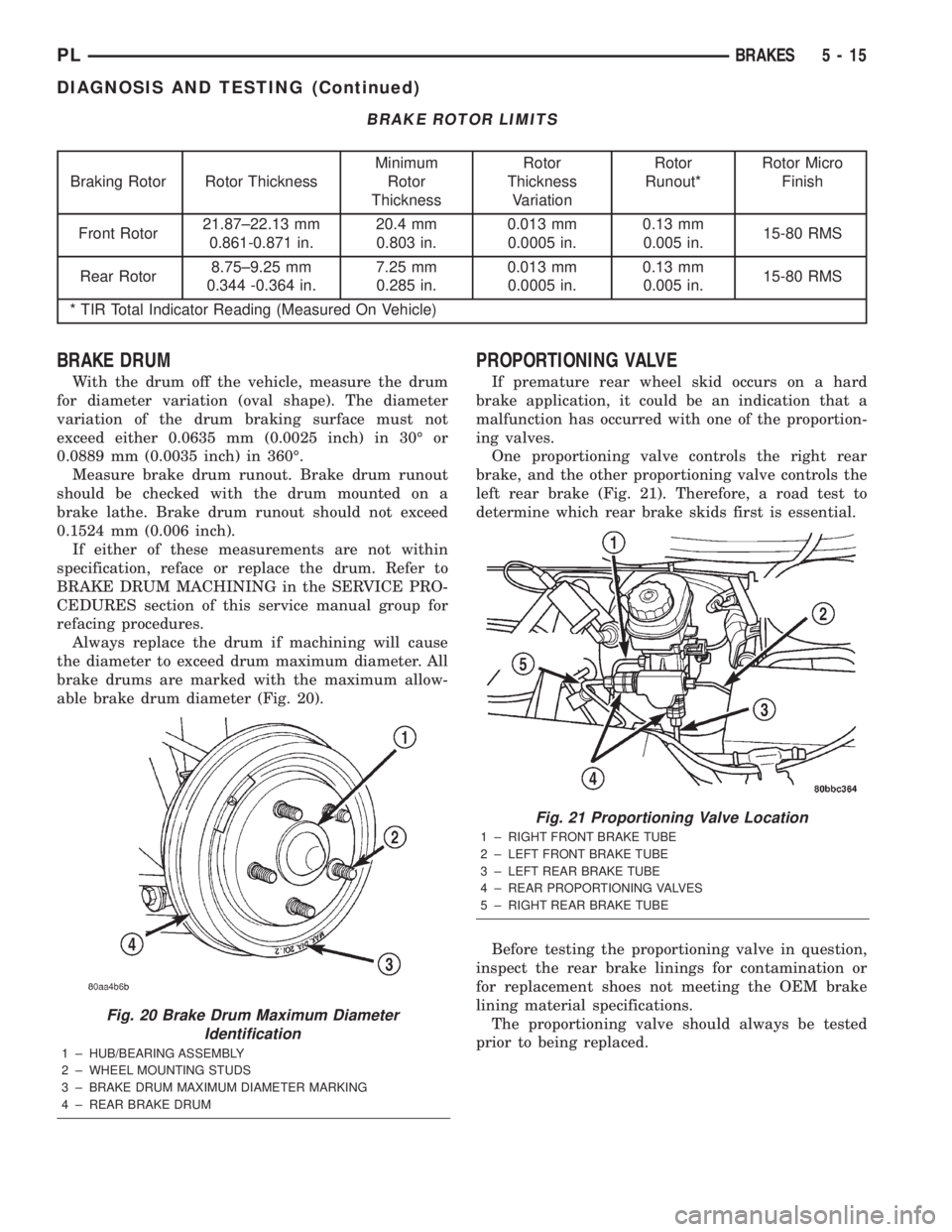
BRAKE ROTOR LIMITS
Braking Rotor Rotor ThicknessMinimum
Rotor
ThicknessRotor
Thickness
VariationRotor
Runout*Rotor Micro
Finish
Front Rotor21.87±22.13 mm
0.861-0.871 in.20.4 mm
0.803 in.0.013 mm
0.0005 in.0.13 mm
0.005 in.15-80 RMS
Rear Rotor8.75±9.25 mm
0.344 -0.364 in.7.25 mm
0.285 in.0.013 mm
0.0005 in.0.13 mm
0.005 in.15-80 RMS
* TIR Total Indicator Reading (Measured On Vehicle)
BRAKE DRUM
With the drum off the vehicle, measure the drum
for diameter variation (oval shape). The diameter
variation of the drum braking surface must not
exceed either 0.0635 mm (0.0025 inch) in 30É or
0.0889 mm (0.0035 inch) in 360É.
Measure brake drum runout. Brake drum runout
should be checked with the drum mounted on a
brake lathe. Brake drum runout should not exceed
0.1524 mm (0.006 inch).
If either of these measurements are not within
specification, reface or replace the drum. Refer to
BRAKE DRUM MACHINING in the SERVICE PRO-
CEDURES section of this service manual group for
refacing procedures.
Always replace the drum if machining will cause
the diameter to exceed drum maximum diameter. All
brake drums are marked with the maximum allow-
able brake drum diameter (Fig. 20).
PROPORTIONING VALVE
If premature rear wheel skid occurs on a hard
brake application, it could be an indication that a
malfunction has occurred with one of the proportion-
ing valves.
One proportioning valve controls the right rear
brake, and the other proportioning valve controls the
left rear brake (Fig. 21). Therefore, a road test to
determine which rear brake skids first is essential.
Before testing the proportioning valve in question,
inspect the rear brake linings for contamination or
for replacement shoes not meeting the OEM brake
lining material specifications.
The proportioning valve should always be tested
prior to being replaced.
Fig. 20 Brake Drum Maximum Diameter
Identification
1 ± HUB/BEARING ASSEMBLY
2 ± WHEEL MOUNTING STUDS
3 ± BRAKE DRUM MAXIMUM DIAMETER MARKING
4 ± REAR BRAKE DRUM
Fig. 21 Proportioning Valve Location
1 ± RIGHT FRONT BRAKE TUBE
2 ± LEFT FRONT BRAKE TUBE
3 ± LEFT REAR BRAKE TUBE
4 ± REAR PROPORTIONING VALVES
5 ± RIGHT REAR BRAKE TUBE
PLBRAKES 5 - 15
DIAGNOSIS AND TESTING (Continued)
Page 95 of 1285
The in-line proportioning valves used on this vehi-
cle require special pressure fittings to test the pro-
portioning valves for proper proportioning valve
function. The pressure fittings are installed before
and after the proportioning valve being tested to ver-
ify proportioning valve is maintaining the required
hydraulic pressure to the rear wheel brake which it
controls.
The testing of proportioning valves for this vehicle,
if equipped with ABS, can be found in the
ANTILOCK BRAKE SYSTEM section.
PROPORTIONING VALVE TEST
The test procedure is the same for either rear pro-
portioning valve. After road testing the vehicle to
determine which wheel skids first, follow the proce-
dure below for testing the suspect proportioning
valve.
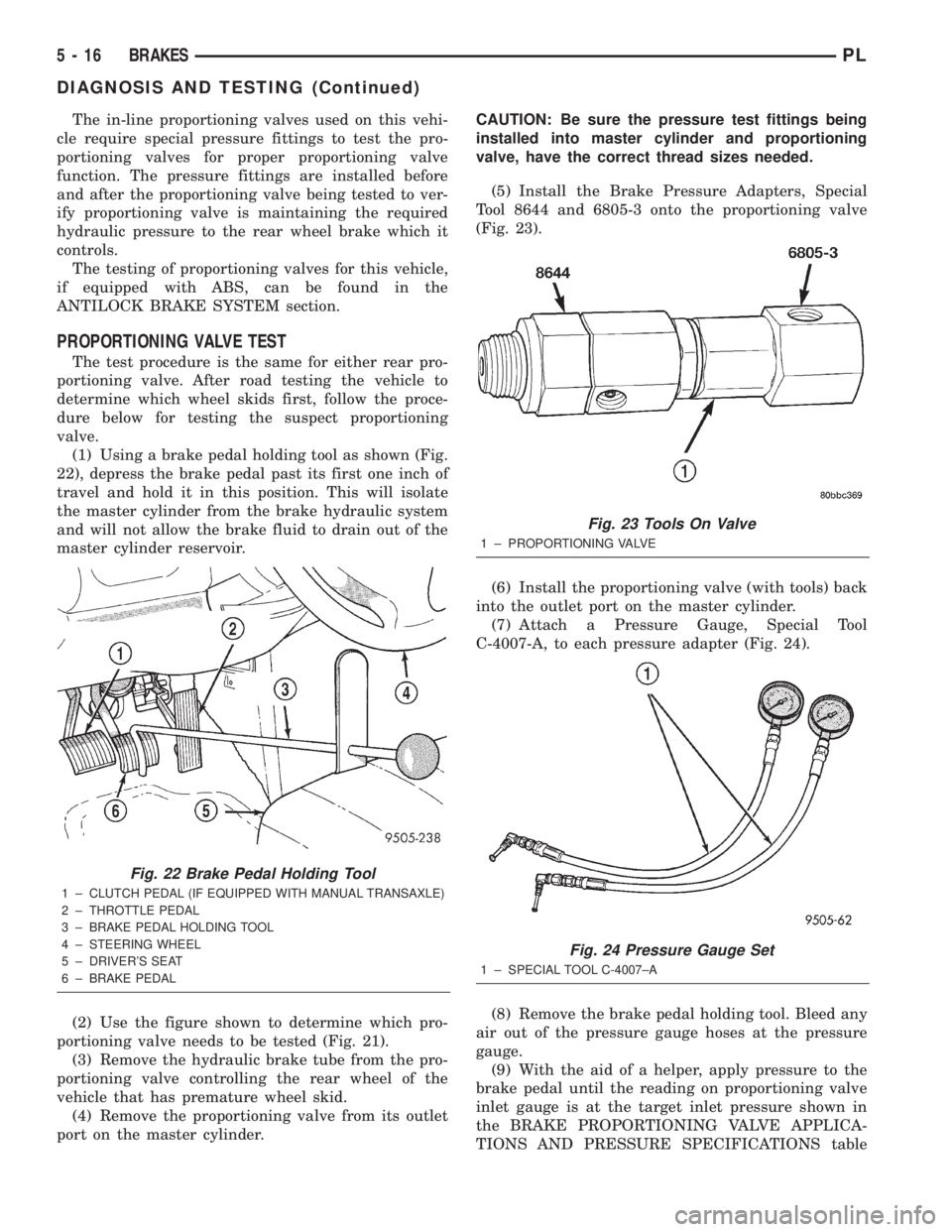
(1) Using a brake pedal holding tool as shown (Fig.
22), depress the brake pedal past its first one inch of
travel and hold it in this position. This will isolate
the master cylinder from the brake hydraulic system
and will not allow the brake fluid to drain out of the
master cylinder reservoir.
(2) Use the figure shown to determine which pro-
portioning valve needs to be tested (Fig. 21).
(3) Remove the hydraulic brake tube from the pro-
portioning valve controlling the rear wheel of the
vehicle that has premature wheel skid.
(4) Remove the proportioning valve from its outlet
port on the master cylinder.CAUTION: Be sure the pressure test fittings being
installed into master cylinder and proportioning
valve, have the correct thread sizes needed.
(5) Install the Brake Pressure Adapters, Special
Tool 8644 and 6805-3 onto the proportioning valve
(Fig. 23).
(6) Install the proportioning valve (with tools) back
into the outlet port on the master cylinder.
(7) Attach a Pressure Gauge, Special Tool
C-4007-A, to each pressure adapter (Fig. 24).
(8) Remove the brake pedal holding tool. Bleed any
air out of the pressure gauge hoses at the pressure
gauge.
(9) With the aid of a helper, apply pressure to the
brake pedal until the reading on proportioning valve
inlet gauge is at the target inlet pressure shown in
the BRAKE PROPORTIONING VALVE APPLICA-
TIONS AND PRESSURE SPECIFICATIONS table
Fig. 22 Brake Pedal Holding Tool
1 ± CLUTCH PEDAL (IF EQUIPPED WITH MANUAL TRANSAXLE)
2 ± THROTTLE PEDAL
3 ± BRAKE PEDAL HOLDING TOOL
4 ± STEERING WHEEL
5 ± DRIVER'S SEAT
6 ± BRAKE PEDAL
Fig. 23 Tools On Valve
1 ± PROPORTIONING VALVE
Fig. 24 Pressure Gauge Set
1 ± SPECIAL TOOL C-4007±A
5 - 16 BRAKESPL
DIAGNOSIS AND TESTING (Continued)
Page 96 of 1285
following this procedure. If the inlet gauge pressure
overshoots its target pressure when the pedal is
depressed, release the brake pedal, relieving the
pressure in the system, before reapplying the pedal
to reach the target pressure at the inlet gauge. This
is necessary to get an accurate reading of the outlet
pressure.
(10) Once inlet pressure has been achieved, check
the pressure reading on the proportioning valve out-
let gauge. If the proportioning valve outlet pressure
does not agree with value shown in the table, replace
the proportioning valve. If proportioning valve is
within pressure specifications, the valve is good and
does not require replacement.(11)Reinstall the brake holding tool on the brake
pedal and remove the test equipment from the vehicle.
(12) Remove the tools from the proportioning
valve.
(13) Install the proportioning valve in the master
cylinder and hand tighten until the proportioning
valve is fully installed and its O-ring seal is seated
into the master cylinder. Torque the proportioning
valve to 40 N´m (30 ft. lbs.).
(14) Install the brake tube on the proportioning
valve. Torque the tube nut to 17 N´m (145 in. lbs.).
(15) Bleed the affected brake line. See BASE
BRAKE BLEEDING in this section of this service
manual group.
BRAKE PROPORTIONING VALVE APPLICATIONS AND PRESSURE SPECIFICATIONS
Sales
CodeBrake System Type Split Point Slope IdentificationInlet
PressureOutlet Pressure
BRA 14º Disc/Drum 300 psi 0.34 Black Band 1000 psi 550-650 psi
BRD 14º Disc/Disc 400 psi 0.43 Bar Code Band 1000 psi 600-700 psi
BRAKE FLUID CONTAMINATION
Indications of fluid contamination are swollen or
deteriorated rubber parts. Swelling indicates the
presence of petroleum in the brake fluid.
To test for contamination, put a small amount of
drained brake fluid in clear glass jar. If the fluid sep-
arates into layers, there is mineral oil or other fluid
contamination of the brake fluid.
If the brake fluid is contaminated, drain and thor-
oughly flush the brake system. Replace all the rubber
parts or components containing rubber coming into
contact with the brake fluid including: the master
cylinder; proportioning valves; caliper seals; wheel
cylinder seals; ABS hydraulic control unit; and all
hydraulic fluid hoses.
SERVICE PROCEDURES
BRAKE FLUID LEVEL CHECKING
Brake fluid level should be checked a minimum of
twice a year.
Master cylinder reservoirs are marked, FULL and
MIN, indicating the allowable brake fluid level range
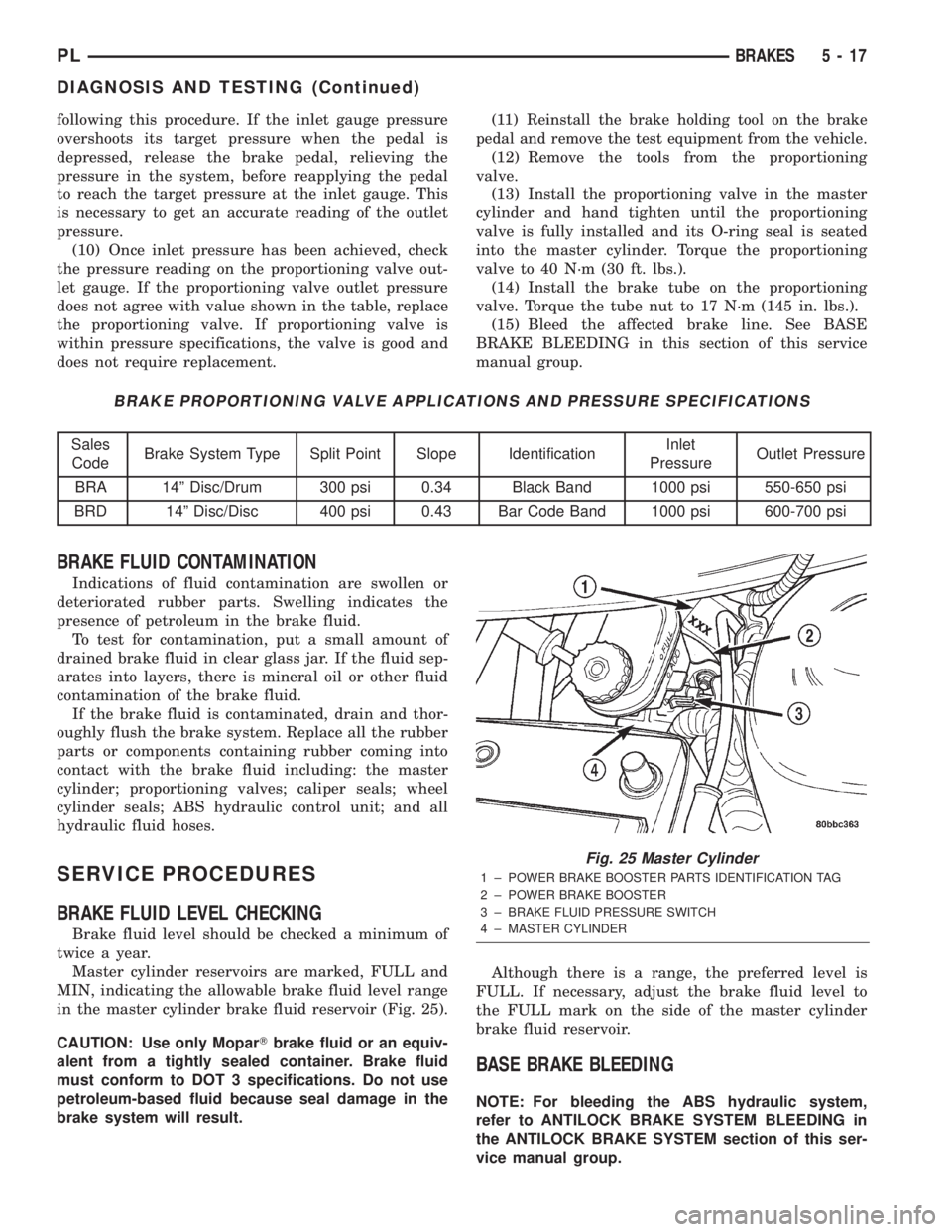
in the master cylinder brake fluid reservoir (Fig. 25).
CAUTION: Use only MoparTbrake fluid or an equiv-
alent from a tightly sealed container. Brake fluid
must conform to DOT 3 specifications. Do not use
petroleum-based fluid because seal damage in the
brake system will result.Although there is a range, the preferred level is
FULL. If necessary, adjust the brake fluid level to
the FULL mark on the side of the master cylinder
brake fluid reservoir.
BASE BRAKE BLEEDING
NOTE: For bleeding the ABS hydraulic system,
refer to ANTILOCK BRAKE SYSTEM BLEEDING in
the ANTILOCK BRAKE SYSTEM section of this ser-
vice manual group.
Fig. 25 Master Cylinder
1 ± POWER BRAKE BOOSTER PARTS IDENTIFICATION TAG
2 ± POWER BRAKE BOOSTER
3 ± BRAKE FLUID PRESSURE SWITCH
4 ± MASTER CYLINDER
PLBRAKES 5 - 17
DIAGNOSIS AND TESTING (Continued)
Page 97 of 1285
CAUTION: Before removing the master cylinder
cap, wipe it clean to prevent dirt and other foreign
matter from dropping into the master cylinder res-
ervoir.
CAUTION: Use only MoparTbrake fluid or an equiv-
alent from a fresh, tightly sealed container. Brake
fluid must conform to DOT 3 specifications.
Do not pump the brake pedal at any time while
having a bleeder screw open during the bleeding pro-
cess. This will only increase the amount of air in the
system and make additional bleeding necessary.
Do not allow the master cylinder reservoir to run
out of brake fluid while bleeding the system. An
empty reservoir will allow additional air into the
brake system. Check the fluid level frequently and
add fluid as needed.
The following wheel circuit sequence for bleeding
the brake hydraulic system should be used to ensure
adequate removal of all trapped air from the hydrau-
lic system.
²Left rear wheel
²Right front wheel
²Right rear wheel
²Left front wheel
MANUAL BLEEDING
NOTE: To bleed the brakes manually, the aid of a
helper will be required.
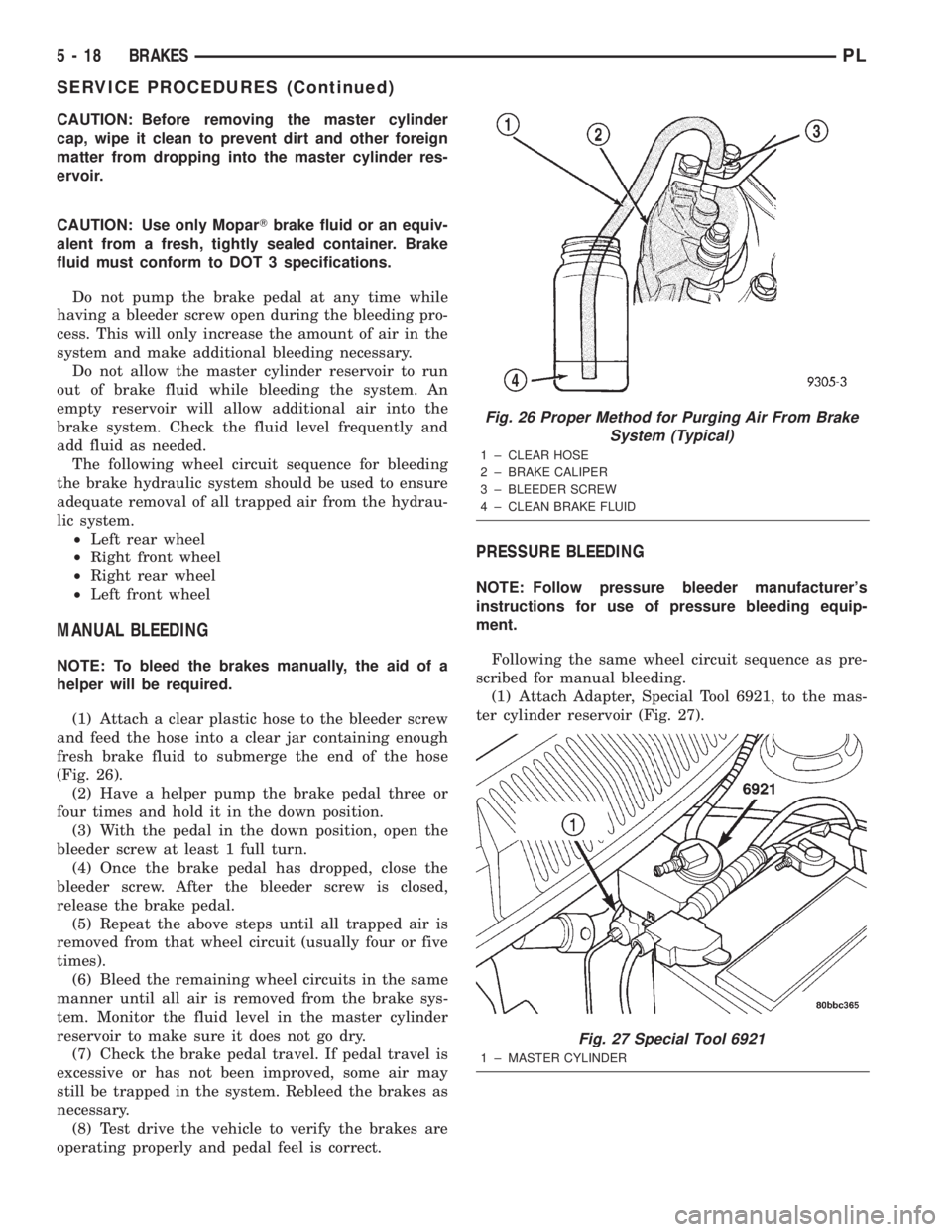
(1) Attach a clear plastic hose to the bleeder screw
and feed the hose into a clear jar containing enough
fresh brake fluid to submerge the end of the hose
(Fig. 26).
(2) Have a helper pump the brake pedal three or
four times and hold it in the down position.
(3) With the pedal in the down position, open the
bleeder screw at least 1 full turn.
(4) Once the brake pedal has dropped, close the
bleeder screw. After the bleeder screw is closed,
release the brake pedal.
(5) Repeat the above steps until all trapped air is
removed from that wheel circuit (usually four or five
times).
(6) Bleed the remaining wheel circuits in the same
manner until all air is removed from the brake sys-
tem. Monitor the fluid level in the master cylinder
reservoir to make sure it does not go dry.
(7) Check the brake pedal travel. If pedal travel is
excessive or has not been improved, some air may
still be trapped in the system. Rebleed the brakes as
necessary.
(8) Test drive the vehicle to verify the brakes are
operating properly and pedal feel is correct.
PRESSURE BLEEDING
NOTE: Follow pressure bleeder manufacturer's
instructions for use of pressure bleeding equip-
ment.
Following the same wheel circuit sequence as pre-
scribed for manual bleeding.
(1) Attach Adapter, Special Tool 6921, to the mas-
ter cylinder reservoir (Fig. 27).
Fig. 26 Proper Method for Purging Air From Brake
System (Typical)
1 ± CLEAR HOSE
2 ± BRAKE CALIPER
3 ± BLEEDER SCREW
4 ± CLEAN BRAKE FLUID
Fig. 27 Special Tool 6921
1 ± MASTER CYLINDER
5 - 18 BRAKESPL
SERVICE PROCEDURES (Continued)
Page 98 of 1285
(2) Attach Bleeder Tank, Special Tool C-3496-B, or
an equivalent, to the adapter on the master cylinder.
(3) Attach a clear plastic hose to the bleeder screw
and feed the hose into a clear jar containing enough
fresh brake fluid to submerge the end of the hose
(Fig. 26).
(4) Open the bleeder screw at least one full turn or
more to obtain a steady stream of brake fluid.
(5) After approximately 4±8 ounces of fluid have
been bled through the brake circuit and an air-free
flow is maintained in the clear plastic hose and jar,
close the bleeder screw.
(6) Repeat this procedure at all the remaining
bleeder screws.
(7) Check the brake pedal travel. If pedal travel is
excessive or has not been improved, some air may
still be trapped in the system. Rebleed the brakes as
necessary.
(8) Test drive the vehicle to verify the brakes are
operating properly and pedal feel is correct.
MASTER CYLINDER BLEEDING
(1) Clamp the master cylinder in a vise.
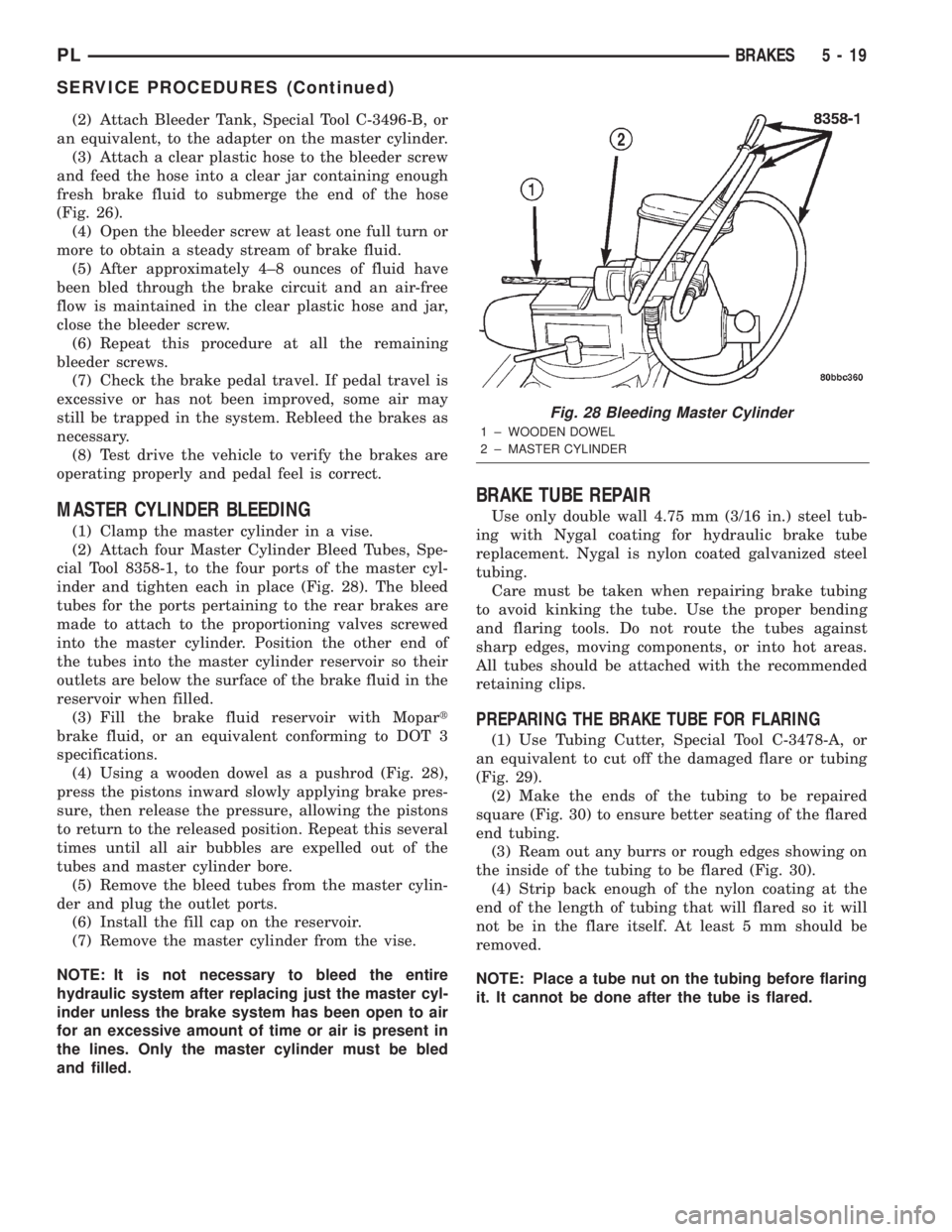
(2) Attach four Master Cylinder Bleed Tubes, Spe-
cial Tool 8358-1, to the four ports of the master cyl-
inder and tighten each in place (Fig. 28). The bleed
tubes for the ports pertaining to the rear brakes are
made to attach to the proportioning valves screwed
into the master cylinder. Position the other end of
the tubes into the master cylinder reservoir so their
outlets are below the surface of the brake fluid in the
reservoir when filled.
(3) Fill the brake fluid reservoir with Mopart
brake fluid, or an equivalent conforming to DOT 3
specifications.
(4) Using a wooden dowel as a pushrod (Fig. 28),
press the pistons inward slowly applying brake pres-
sure, then release the pressure, allowing the pistons
to return to the released position. Repeat this several
times until all air bubbles are expelled out of the
tubes and master cylinder bore.
(5) Remove the bleed tubes from the master cylin-
der and plug the outlet ports.
(6) Install the fill cap on the reservoir.
(7) Remove the master cylinder from the vise.
NOTE: It is not necessary to bleed the entire
hydraulic system after replacing just the master cyl-
inder unless the brake system has been open to air
for an excessive amount of time or air is present in
the lines. Only the master cylinder must be bled
and filled.
BRAKE TUBE REPAIR
Use only double wall 4.75 mm (3/16 in.) steel tub-
ing with Nygal coating for hydraulic brake tube
replacement. Nygal is nylon coated galvanized steel
tubing.
Care must be taken when repairing brake tubing
to avoid kinking the tube. Use the proper bending
and flaring tools. Do not route the tubes against
sharp edges, moving components, or into hot areas.
All tubes should be attached with the recommended
retaining clips.
PREPARING THE BRAKE TUBE FOR FLARING
(1) Use Tubing Cutter, Special Tool C-3478-A, or
an equivalent to cut off the damaged flare or tubing
(Fig. 29).
(2) Make the ends of the tubing to be repaired
square (Fig. 30) to ensure better seating of the flared
end tubing.
(3) Ream out any burrs or rough edges showing on
the inside of the tubing to be flared (Fig. 30).
(4) Strip back enough of the nylon coating at the
end of the length of tubing that will flared so it will
not be in the flare itself. At least 5 mm should be
removed.
NOTE: Place a tube nut on the tubing before flaring
it. It cannot be done after the tube is flared.
Fig. 28 Bleeding Master Cylinder
1 ± WOODEN DOWEL
2 ± MASTER CYLINDER
PLBRAKES 5 - 19
SERVICE PROCEDURES (Continued)
Page 99 of 1285
DOUBLE INVERTED TUBING FLARES
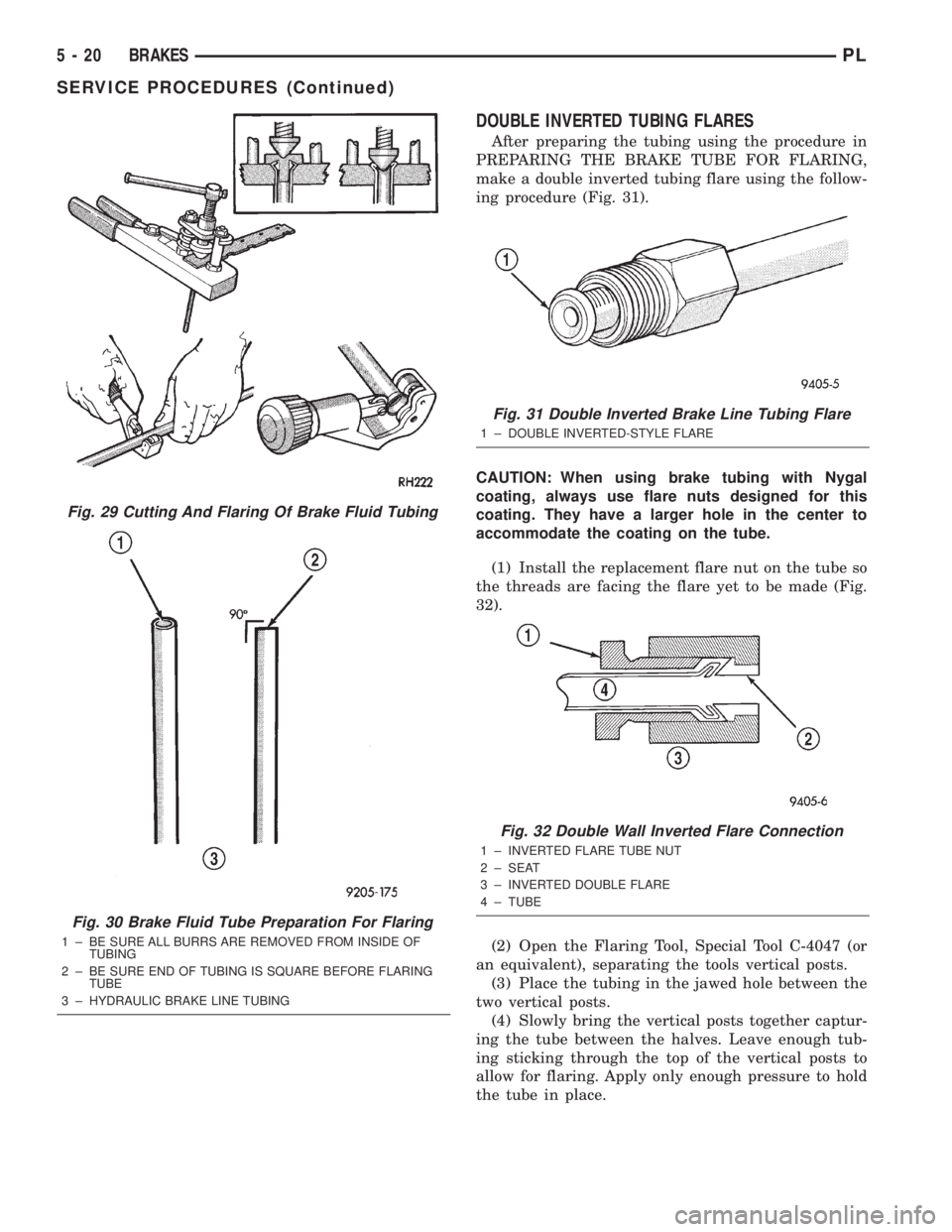
After preparing the tubing using the procedure in
PREPARING THE BRAKE TUBE FOR FLARING,
make a double inverted tubing flare using the follow-
ing procedure (Fig. 31).
CAUTION: When using brake tubing with Nygal
coating, always use flare nuts designed for this
coating. They have a larger hole in the center to
accommodate the coating on the tube.
(1) Install the replacement flare nut on the tube so
the threads are facing the flare yet to be made (Fig.
32).
(2) Open the Flaring Tool, Special Tool C-4047 (or
an equivalent), separating the tools vertical posts.
(3) Place the tubing in the jawed hole between the
two vertical posts.
(4) Slowly bring the vertical posts together captur-
ing the tube between the halves. Leave enough tub-
ing sticking through the top of the vertical posts to
allow for flaring. Apply only enough pressure to hold
the tube in place.
Fig. 29 Cutting And Flaring Of Brake Fluid Tubing
Fig. 30 Brake Fluid Tube Preparation For Flaring
1 ± BE SURE ALL BURRS ARE REMOVED FROM INSIDE OF
TUBING
2 ± BE SURE END OF TUBING IS SQUARE BEFORE FLARING
TUBE
3 ± HYDRAULIC BRAKE LINE TUBING
Fig. 31 Double Inverted Brake Line Tubing Flare
1 ± DOUBLE INVERTED-STYLE FLARE
Fig. 32 Double Wall Inverted Flare Connection
1 ± INVERTED FLARE TUBE NUT
2 ± SEAT
3 ± INVERTED DOUBLE FLARE
4 ± TUBE
5 - 20 BRAKESPL
SERVICE PROCEDURES (Continued)