2000 DODGE NEON ECU
[x] Cancel search: ECUPage 813 of 1285
(3) Start the two rear crossmember mounting bolts
into the tapping plates mounted in the body. The
right side bolt can be viewed in the mounting bolt
figure (Fig. 5). The left side bolt is located in the
same location on the other side of the vehicle. Next,
install the two front mounting bolts attaching front
suspension crossmember to frame rails of vehicle.
Lightly tighten all four mounting bolts to a approxi-
mately 2 N´m (20 in. lbs.) to hold the front suspen-
sion crossmember in position.
NOTE: When reinstalling the front suspension
crossmember back in the vehicle, it is very impor-
tant that the crossmember be attached to the body
in exactly the same spot as when it was removed.
Otherwise, the vehicle's wheel alignment settings
(caster and camber) will be lost.
(4) Using a soft face hammer, tap the front suspen-
sion crossmember back-and-forth or side-to-side until
it is aligned with the previously scribed positioning
marks on the body of the vehicle (Fig. 6). Once the
front suspension crossmember is correctly positioned,
tighten the rear two crossmember mounting bolts to
a torque of 203 N´m (150 ft. lbs.), then tighten the
front two crossmember mounting bolts to a torque of
142 N´m (105 ft. lbs.).
(5) Tighten the lower control arm front pivot bolts
to a torque of 163 N´m (120 ft. lbs.).
(6) Attach the steering gear to the front suspen-
sion crossmember (Fig. 4). Install the four power
steering gear mounting bolts. Tighten the mounting
bolts to a torque of 61 N´m (45 ft. lbs.).
(7) Remove the wire or cord suspending the power
steering gear to the underbody.
(8) If the vehicle is equipped with a power steering
fluid cooler, install the two screws securing the cooler
to the front suspension crossmember. They are
located behind the cooler.
(9)
Install each ball joint stud into the steering
knuckle aligning the bolt hole in the knuckle boss with
the notch formed in the side of the ball joint stud.
(10) Install a new ball joint stud pinch bolt and
nut (Fig. 2). Tighten the nut to a torque of 95 N´m
(70 ft. lbs.).
(11) Fasten the engine torque strut to the right
forward corner of the front suspension crossmember
using its mounting bolt (Fig. 5). Follow the procedure
described in the ENGINE service manual group to
properly align and tighten the torque strut and it's
mounting bolts.
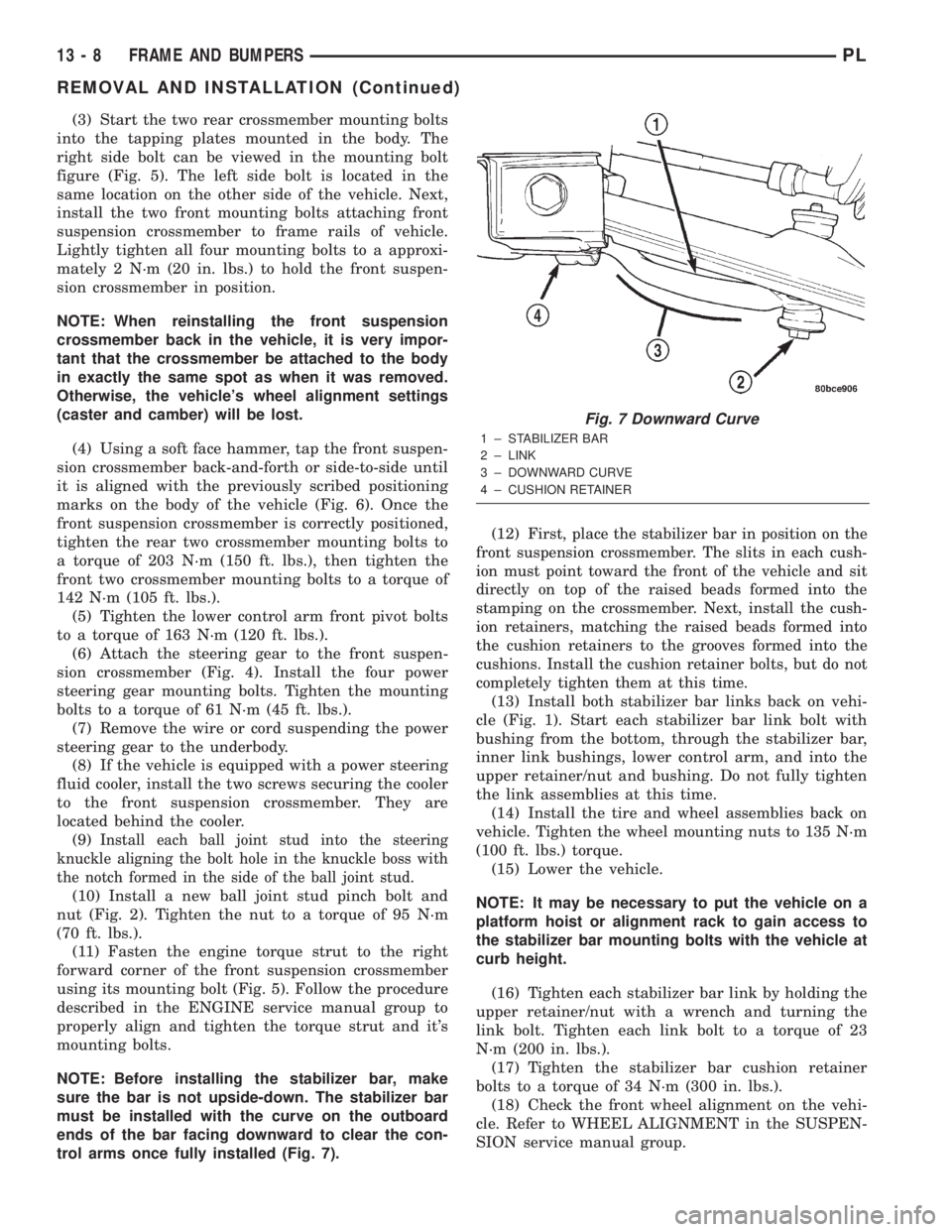
NOTE: Before installing the stabilizer bar, make
sure the bar is not upside-down. The stabilizer bar
must be installed with the curve on the outboard
ends of the bar facing downward to clear the con-
trol arms once fully installed (Fig. 7).(12)
First, place the stabilizer bar in position on the
front suspension crossmember. The slits in each cush-
ion must point toward the front of the vehicle and sit
directly on top of the raised beads formed into the
stamping on the crossmember. Next, install the cush-
ion retainers, matching the raised beads formed into
the cushion retainers to the grooves formed into the
cushions. Install the cushion retainer bolts, but do not
completely tighten them at this time.
(13) Install both stabilizer bar links back on vehi-
cle (Fig. 1). Start each stabilizer bar link bolt with
bushing from the bottom, through the stabilizer bar,
inner link bushings, lower control arm, and into the
upper retainer/nut and bushing. Do not fully tighten
the link assemblies at this time.
(14) Install the tire and wheel assemblies back on
vehicle. Tighten the wheel mounting nuts to 135 N´m
(100 ft. lbs.) torque.
(15) Lower the vehicle.
NOTE: It may be necessary to put the vehicle on a
platform hoist or alignment rack to gain access to
the stabilizer bar mounting bolts with the vehicle at
curb height.
(16) Tighten each stabilizer bar link by holding the
upper retainer/nut with a wrench and turning the
link bolt. Tighten each link bolt to a torque of 23
N´m (200 in. lbs.).
(17) Tighten the stabilizer bar cushion retainer
bolts to a torque of 34 N´m (300 in. lbs.).
(18) Check the front wheel alignment on the vehi-
cle. Refer to WHEEL ALIGNMENT in the SUSPEN-
SION service manual group.
Fig. 7 Downward Curve
1 ± STABILIZER BAR
2 ± LINK
3 ± DOWNWARD CURVE
4 ± CUSHION RETAINER
13 - 8 FRAME AND BUMPERSPL
REMOVAL AND INSTALLATION (Continued)
Page 829 of 1285
FUEL TUBES/LINES/HOSES AND CLAMPS
OPERATION
Also refer to Quick-Connect Fittings.
WARNING: THE FUEL SYSTEM IS UNDER A CON-
STANT PRESSURE (EVEN WITH THE ENGINE OFF).
BEFORE SERVICING ANY FUEL SYSTEM HOSES,
FITTINGS OR LINES, THE FUEL SYSTEM PRES-
SURE MUST BE RELEASED. REFER TO THE FUEL
SYSTEM PRESSURE RELEASE PROCEDURE IN
THIS GROUP.
Inspect all hose connections such as clamps, cou-
plings and fittings to make sure they are secure and
leaks are not present. The component should be
replaced immediately if there is any evidence of deg-
radation that could result in failure.
Never attempt to repair a plastic fuel line/tube.
Replace as necessary.
Avoid contact of any fuel tubes/hoses with other
vehicle components that could cause abrasions or
scuffing. Be sure that the plastic fuel lines/tubes areproperly routed to prevent pinching and to avoid heat
sources.
The lines/tubes/hoses used on fuel injected vehicles
are of a special construction. This is due to the
higher fuel pressures and the possibility of contami-
nated fuel in this system. If it is necessary to replace
these lines/tubes/hoses, only those marked EFM/EFI
may be used.
If equipped:The hose clamps used to secure rub-
ber hoses on fuel injected vehicles are of a special
rolled edge construction. This construction is used to
prevent the edge of the clamp from cutting into the
hose. Only these rolled edge type clamps may be
used in this system. All other types of clamps may
cut into the hoses and cause high-pressure fuel leaks.
Use new original equipment type hose clamps.
Tighten hose clamps to 3 N´m (25 in. lbs.) torque.
SERVICE PROCEDURES
FUEL SYSTEM PRESSURE RELEASE
PROCEDURE
(1) Remove Fuel Pump relay from Power Distribu-
tion Center (PDC). For location of relay, refer to label
on underside of PDC cover.
(2) Start and run engine until it stalls.
(3) Attempt restarting engine until it will no
longer run.
(4) Turn ignition key to OFF position.
CAUTION: Steps 1, 2, 3 and 4 must be performed to
relieve high pressure fuel from within fuel rail. Do
not attempt to use following steps to relieve this
pressure as excessive fuel will be forced into a cyl-
inder chamber.
(5) Place a rag or towel below fuel line quick-con-
nect fitting at fuel rail.
(6) Return fuel pump relay to PDC.
(7) One or more Diagnostic Trouble Codes (DTC's)
may have been stored in PCM memory due to fuel
pump relay removal. The DRB IIItscan tool must be
used to erase a DTC.
INJECTOR CONNECTOR
REMOVAL
(1) Disconnect electrical connectors at the fuel
injectors. To remove connector refer to (Fig. 8). Pull
the red colored slider away from injector (1). While
pulling the slider, depress tab (2) and remove connec-
tor (3) from injector. The factory fuel injection wiring
harness is numerically tagged (INJ 1, INJ 2, etc.) for
injector position identification. If harness is not
tagged, make note of wiring location before removal.
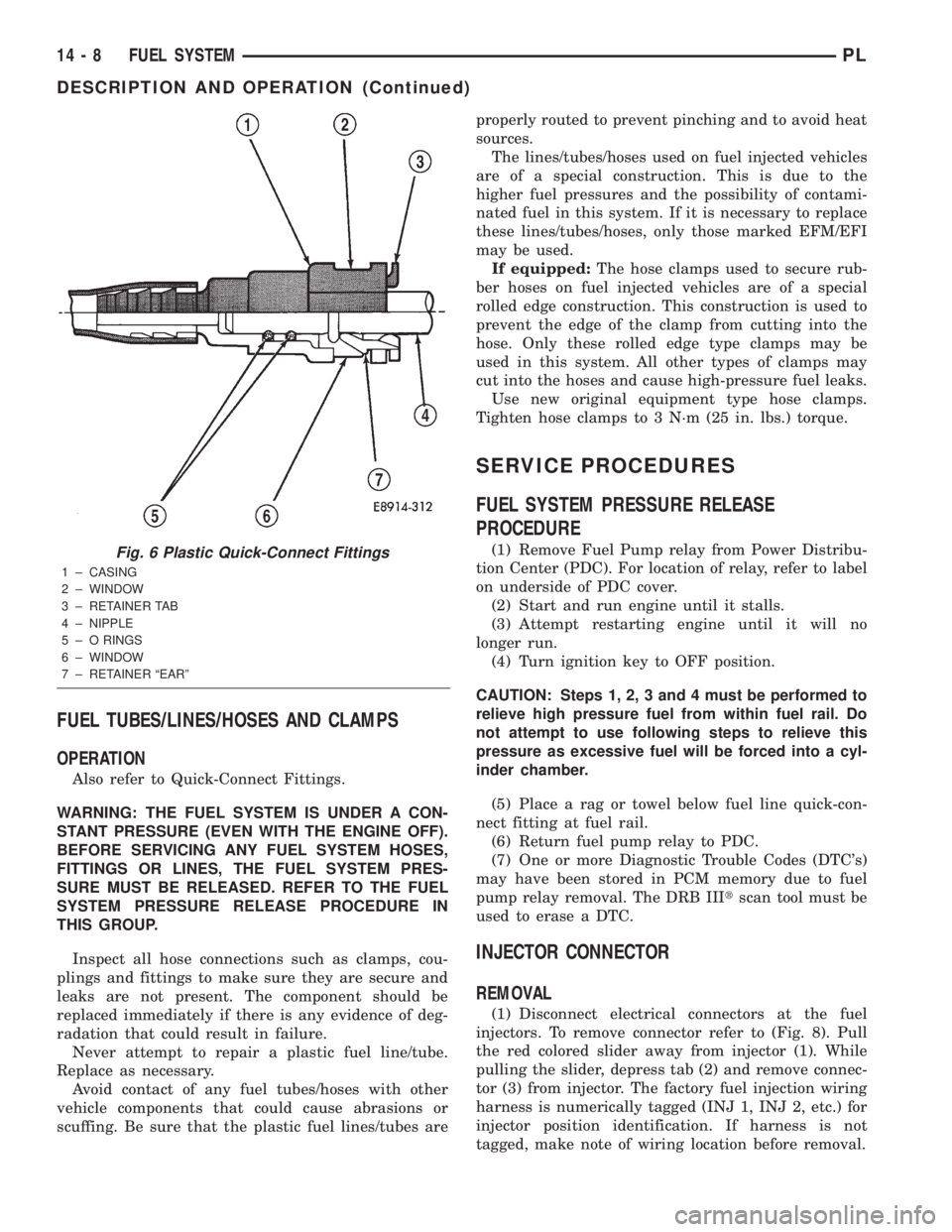
Fig. 6 Plastic Quick-Connect Fittings
1 ± CASING
2 ± WINDOW
3 ± RETAINER TAB
4 ± NIPPLE
5 ± O RINGS
6 ± WINDOW
7 ± RETAINER ªEARº
14 - 8 FUEL SYSTEMPL
DESCRIPTION AND OPERATION (Continued)
Page 831 of 1285
(3) Squeeze retainer tabs together and pull fuel
tube/quick-connect fitting assembly off of fuel tube
nipple. The retainer will remain on fuel tube.
INSTALLATION
CAUTION: Never install a quick-connect fitting
without the retainer being either on the fuel tube or
already in the quick-connect fitting. In either case,
ensure the retainer locks securely into the quick-
connect fitting by firmly pulling on fuel tube and fit-
ting to ensure it is secured.
(1) Using a clean lint free cloth, clean the fuel tube
nipple and retainer.
(2) Prior to connecting the fitting to the fuel tube,
coat the fuel tube nipple with clean 30 weight engine
oil.
(3) Push the quick-connect fitting over the fuel
tube until theretainer seats and a click is heard.
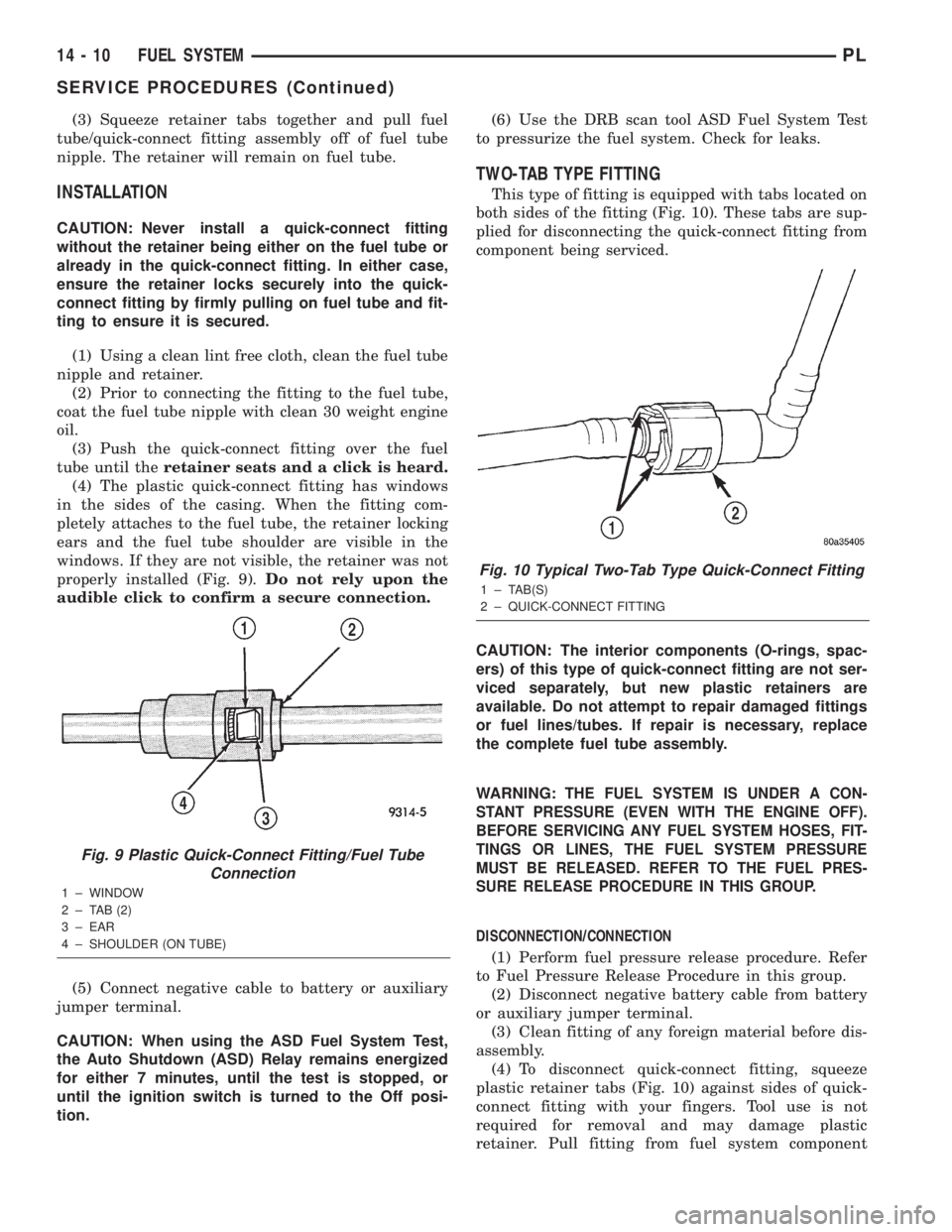
(4) The plastic quick-connect fitting has windows
in the sides of the casing. When the fitting com-
pletely attaches to the fuel tube, the retainer locking
ears and the fuel tube shoulder are visible in the
windows. If they are not visible, the retainer was not
properly installed (Fig. 9).Do not rely upon the
audible click to confirm a secure connection.
(5) Connect negative cable to battery or auxiliary
jumper terminal.
CAUTION: When using the ASD Fuel System Test,
the Auto Shutdown (ASD) Relay remains energized
for either 7 minutes, until the test is stopped, or
until the ignition switch is turned to the Off posi-
tion.(6) Use the DRB scan tool ASD Fuel System Test
to pressurize the fuel system. Check for leaks.
TWO-TAB TYPE FITTING
This type of fitting is equipped with tabs located on
both sides of the fitting (Fig. 10). These tabs are sup-
plied for disconnecting the quick-connect fitting from
component being serviced.
CAUTION: The interior components (O-rings, spac-
ers) of this type of quick-connect fitting are not ser-
viced separately, but new plastic retainers are
available. Do not attempt to repair damaged fittings
or fuel lines/tubes. If repair is necessary, replace
the complete fuel tube assembly.
WARNING:
THE FUEL SYSTEM IS UNDER A CON-
STANT PRESSURE (EVEN WITH THE ENGINE OFF).
BEFORE SERVICING ANY FUEL SYSTEM HOSES, FIT-
TINGS OR LINES, THE FUEL SYSTEM PRESSURE
MUST BE RELEASED. REFER TO THE FUEL PRES-
SURE RELEASE PROCEDURE IN THIS GROUP.
DISCONNECTION/CONNECTION
(1) Perform fuel pressure release procedure. Refer
to Fuel Pressure Release Procedure in this group.
(2) Disconnect negative battery cable from battery
or auxiliary jumper terminal.
(3) Clean fitting of any foreign material before dis-
assembly.
(4) To disconnect quick-connect fitting, squeeze
plastic retainer tabs (Fig. 10) against sides of quick-
connect fitting with your fingers. Tool use is not
required for removal and may damage plastic
retainer. Pull fitting from fuel system component
Fig. 9 Plastic Quick-Connect Fitting/Fuel Tube
Connection
1 ± WINDOW
2 ± TAB (2)
3 ± EAR
4 ± SHOULDER (ON TUBE)
Fig. 10 Typical Two-Tab Type Quick-Connect Fitting
1 ± TAB(S)
2 ± QUICK-CONNECT FITTING
14 - 10 FUEL SYSTEMPL
SERVICE PROCEDURES (Continued)
Page 873 of 1285
POWER STEERING FLUID HOSES
The power steering fluid hoses connect the compo-
nents of the power steering system. They transfer
fluid from one component to the next.
The power steering fluid pressure hose is a high
pressure hose that connects the power steering pump
to the gear. At both ends of the flexible hose portion
are steel fittings that are pressure crimped to the
flexible hose. A standard tube nut fitting with an
O-ring is used at each end to connect it to either the
power steering pump or the gear.
The power steering fluid return hose is a special
rubber hose that connects the power steering gear or
the power steering fluid cooler on some models, back
to the fluid reservoir mounted on the power steering
pump. The power steering gear has a steel fitting
attached to its outlet port that the return hose is
pushed onto. On vehicles equipped with a power
steering fluid cooler, the return hose attaches to the
cooler outlet tube instead of the steering gear steel
fitting. The hose is secured to either component using
a standard adjustable clamp. The other end of the
power steering fluid return hose attaches to the
power steering fluid reservoir on the power steering
pump using a standard adjustable clamp.
POWER STEERING FLUID COOLER
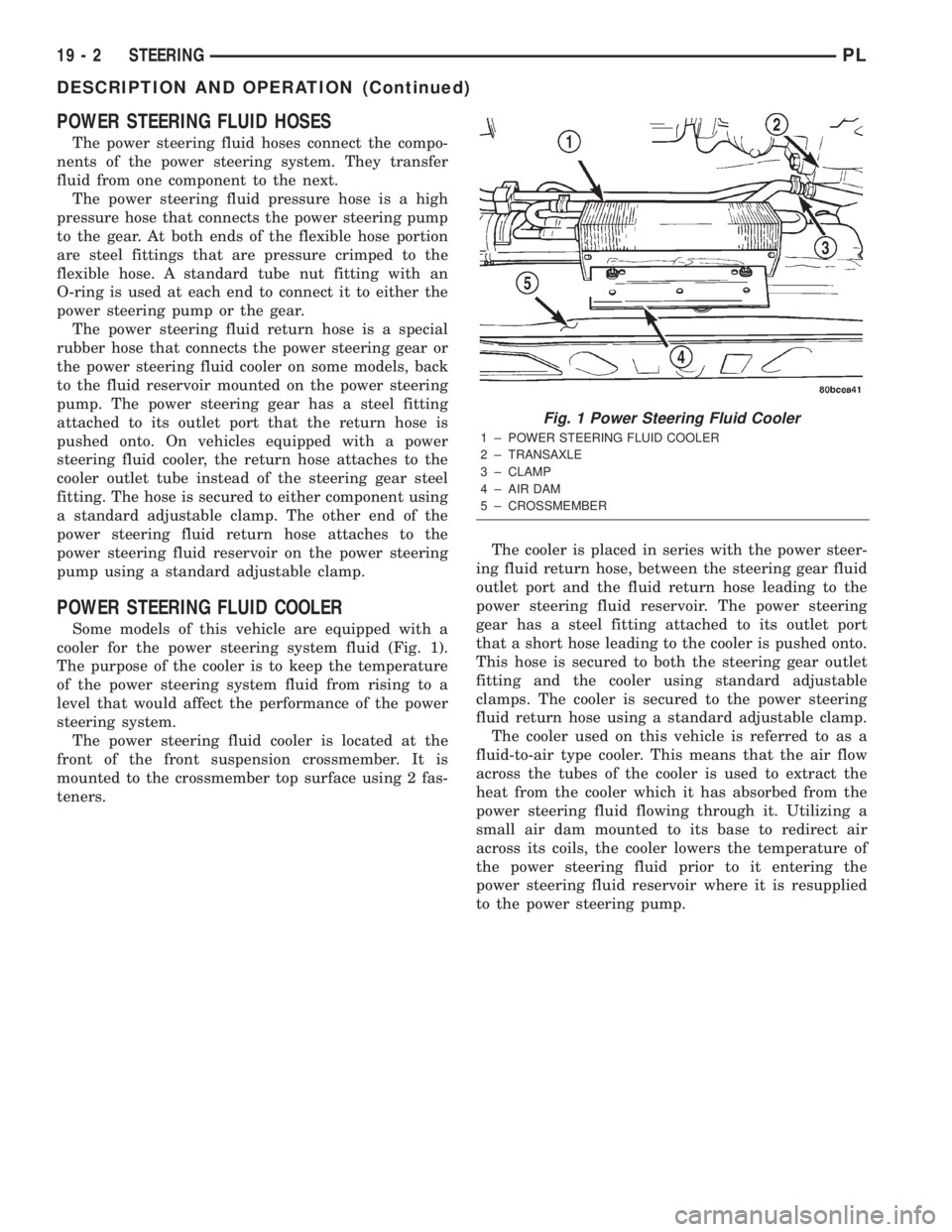
Some models of this vehicle are equipped with a
cooler for the power steering system fluid (Fig. 1).
The purpose of the cooler is to keep the temperature
of the power steering system fluid from rising to a
level that would affect the performance of the power
steering system.
The power steering fluid cooler is located at the
front of the front suspension crossmember. It is
mounted to the crossmember top surface using 2 fas-
teners.The cooler is placed in series with the power steer-
ing fluid return hose, between the steering gear fluid
outlet port and the fluid return hose leading to the
power steering fluid reservoir. The power steering
gear has a steel fitting attached to its outlet port
that a short hose leading to the cooler is pushed onto.
This hose is secured to both the steering gear outlet
fitting and the cooler using standard adjustable
clamps. The cooler is secured to the power steering
fluid return hose using a standard adjustable clamp.
The cooler used on this vehicle is referred to as a
fluid-to-air type cooler. This means that the air flow
across the tubes of the cooler is used to extract the
heat from the cooler which it has absorbed from the
power steering fluid flowing through it. Utilizing a
small air dam mounted to its base to redirect air
across its coils, the cooler lowers the temperature of
the power steering fluid prior to it entering the
power steering fluid reservoir where it is resupplied
to the power steering pump.
Fig. 1 Power Steering Fluid Cooler
1 ± POWER STEERING FLUID COOLER
2 ± TRANSAXLE
3 ± CLAMP
4 ± AIR DAM
5 ± CROSSMEMBER
19 - 2 STEERINGPL
DESCRIPTION AND OPERATION (Continued)
Page 882 of 1285
CAUTION: Do not force the pump to operate
against the stops for more than 5 seconds at a time
as pump damage may result.
(6) Completely open the valve on the Power Steer-
ing Analyzer flow meter. Turn the steering wheel to
the extreme left until the stop in the steering gear is
met, then turn the steering wheel to the right until
the right stop is met. Record the highest indicated
pressure at each position. Compare the recorded
readings to the specifications. If the highest output
pressure reading against one stop is within 50 psi of
the highest reading at the other stop, the steering
gear is leaking internally and must be replaced.
If the power steering gear requires replacement,
refer to the section POWER STEERING GEAR
within this group for the removal and installation
procedure.
SERVICE PROCEDURES
POWER STEERING SYSTEM FLUID LEVEL
CHECK
WARNING: FLUID LEVEL SHOULD BE CHECKED
WITH THE ENGINE OFF TO PREVENT PERSONAL
INJURY FROM MOVING PARTS.
Before opening power steering system, wipe the
reservoir filler cap free of dirt and debris. Remove
the cap and check the fluid level on its dipstick.
When the fluid is at normal ambient temperature,
approximately 21ÉC to 27ÉC (70ÉF to 80ÉF), the dip-
stick level should indicateCOLD. Do not overfill the
power steering system. In all power steering systems,
use only Mopar Power Steering Fluid, or its equiva-
lent.
NOTE: Do not use any type of automatic transmis-
sion fluid in the power steering system.
REMOVAL AND INSTALLATION
SERVICE WARNINGS AND CAUTIONS
WARNING: POWER STEERING FLUID, ENGINE
PARTS AND EXHAUST SYSTEM MAY BE
EXTREMELY HOT IF ENGINE HAS BEEN RUNNING.
DO NOT START ENGINE WITH ANY LOOSE OR DIS-
CONNECTED HOSES. DO NOT ALLOW HOSES TO
TOUCH HOT EXHAUST MANIFOLD OR CATALYST.WARNING: FLUID LEVEL SHOULD BE CHECKED
WITH THE ENGINE OFF TO PREVENT PERSONAL
INJURY FROM MOVING PARTS.
CAUTION: When the system is open, cap all open
ends of the hoses, power steering pump fittings or
power steering gear ports to prevent entry of for-
eign material into the components.
NOTE: Do not use any type of automatic transmis-
sion fluid in the power steering system.
POWER STEERING FLUID PRESSURE HOSE
NOTE: Before proceeding with this removal and
installation procedure, review SERVICE WARNINGS
AND CAUTIONS at the beginning of REMOVAL AND
INSTALLATION in this section.
REMOVAL
(1) Siphon as much fluid as possible from the
power steering fluid reservoir.
(2) Raise the vehicle. Refer to HOISTING in the
LUBRICATION AND MAINTENANCE group in this
service manual for the correct lifting procedure.
(3) Back out the tube nut securing the power
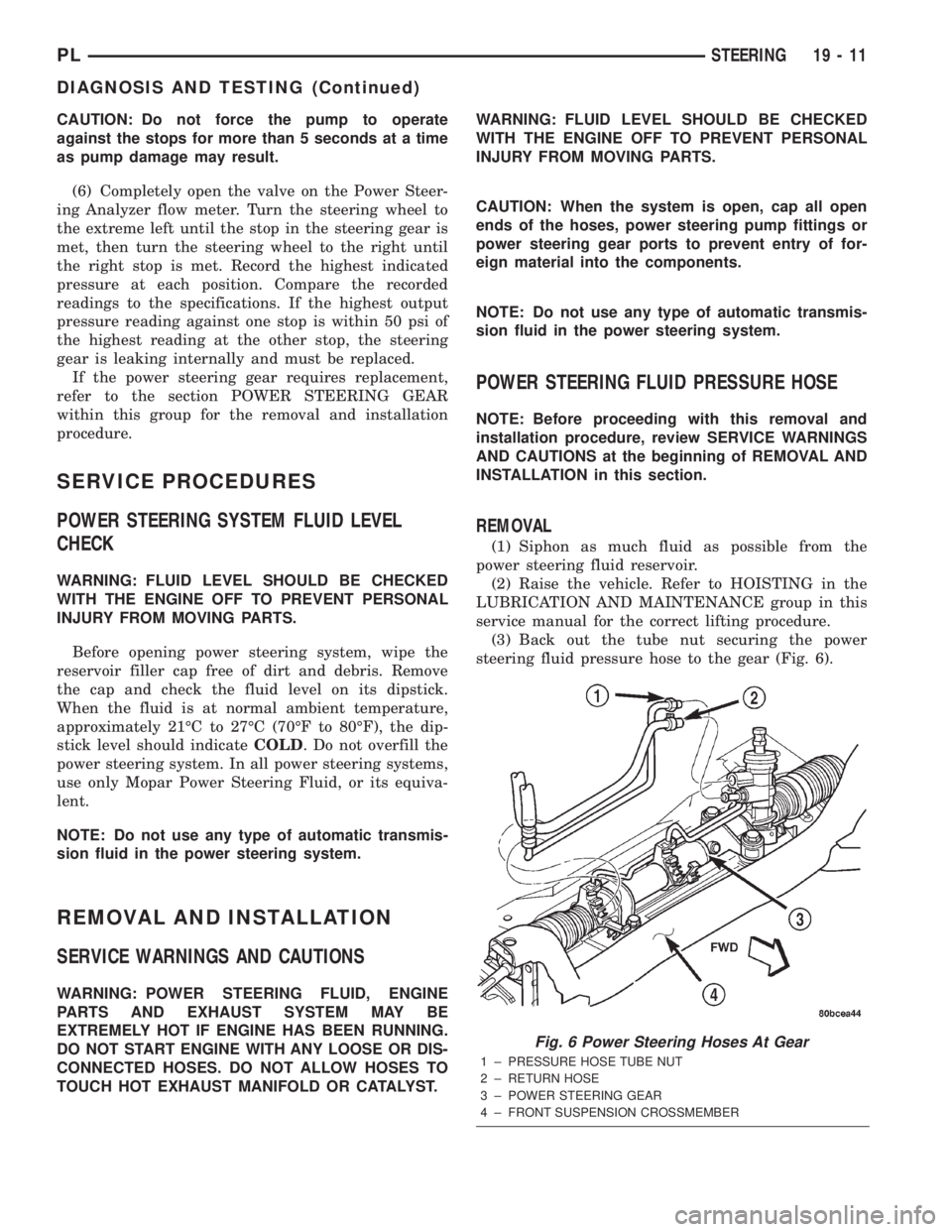
steering fluid pressure hose to the gear (Fig. 6).
Fig. 6 Power Steering Hoses At Gear
1 ± PRESSURE HOSE TUBE NUT
2 ± RETURN HOSE
3 ± POWER STEERING GEAR
4 ± FRONT SUSPENSION CROSSMEMBER
PLSTEERING 19 - 11
DIAGNOSIS AND TESTING (Continued)
Page 883 of 1285
(4) Open the routing clips on the right side of the
power steering gear and remove the power steering
fluid pressure hose tube from the routing clips. At
the same time, remove the pressure hose tube from
the gear.
(5) Lower the vehicle.
(6) Remove the bolt securing the hose routing clip
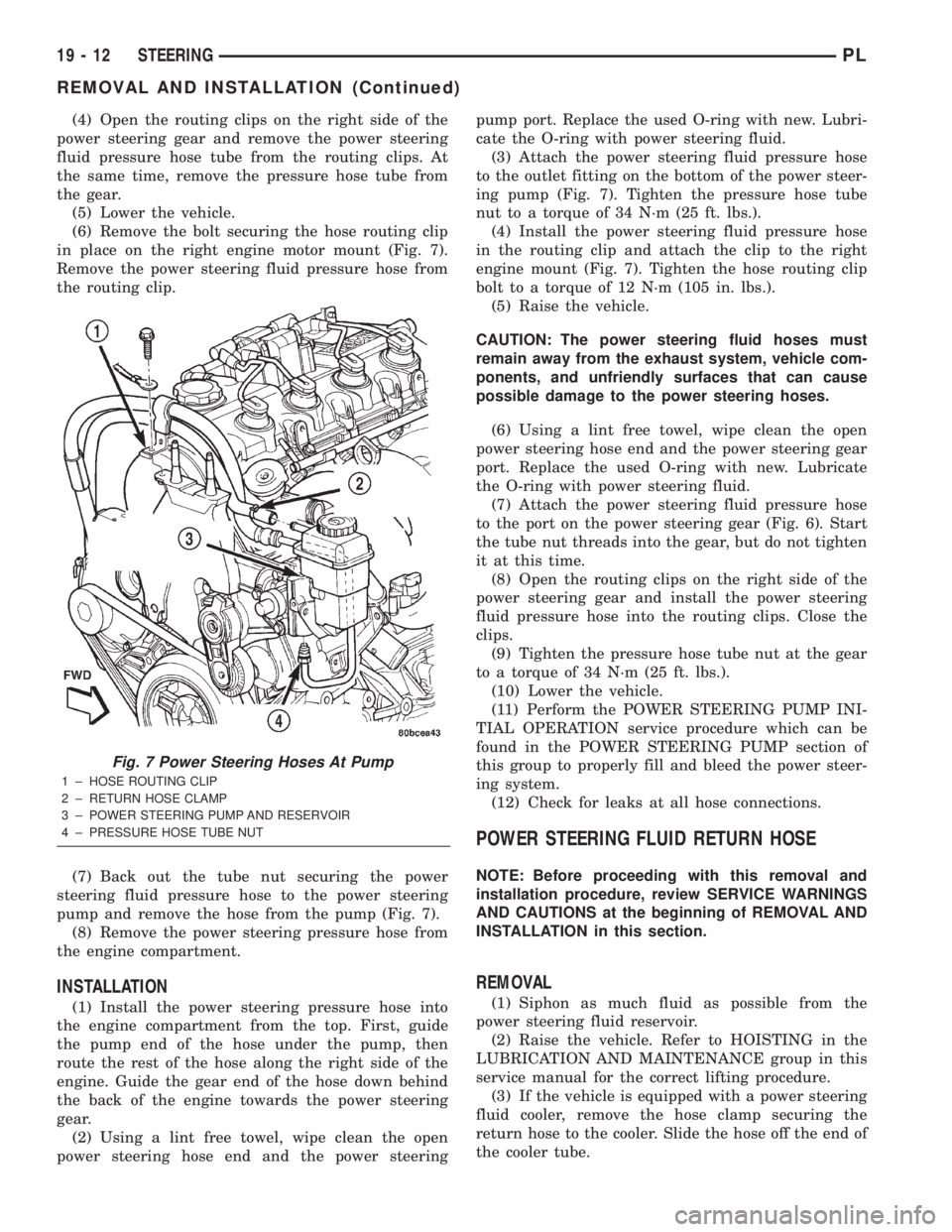
in place on the right engine motor mount (Fig. 7).
Remove the power steering fluid pressure hose from
the routing clip.
(7) Back out the tube nut securing the power
steering fluid pressure hose to the power steering
pump and remove the hose from the pump (Fig. 7).
(8) Remove the power steering pressure hose from
the engine compartment.
INSTALLATION
(1) Install the power steering pressure hose into
the engine compartment from the top. First, guide
the pump end of the hose under the pump, then
route the rest of the hose along the right side of the
engine. Guide the gear end of the hose down behind
the back of the engine towards the power steering
gear.
(2) Using a lint free towel, wipe clean the open
power steering hose end and the power steeringpump port. Replace the used O-ring with new. Lubri-
cate the O-ring with power steering fluid.
(3) Attach the power steering fluid pressure hose
to the outlet fitting on the bottom of the power steer-
ing pump (Fig. 7). Tighten the pressure hose tube
nut to a torque of 34 N´m (25 ft. lbs.).
(4) Install the power steering fluid pressure hose
in the routing clip and attach the clip to the right
engine mount (Fig. 7). Tighten the hose routing clip
bolt to a torque of 12 N´m (105 in. lbs.).
(5) Raise the vehicle.
CAUTION: The power steering fluid hoses must
remain away from the exhaust system, vehicle com-
ponents, and unfriendly surfaces that can cause
possible damage to the power steering hoses.
(6) Using a lint free towel, wipe clean the open
power steering hose end and the power steering gear
port. Replace the used O-ring with new. Lubricate
the O-ring with power steering fluid.
(7) Attach the power steering fluid pressure hose
to the port on the power steering gear (Fig. 6). Start
the tube nut threads into the gear, but do not tighten
it at this time.
(8) Open the routing clips on the right side of the
power steering gear and install the power steering
fluid pressure hose into the routing clips. Close the
clips.
(9) Tighten the pressure hose tube nut at the gear
to a torque of 34 N´m (25 ft. lbs.).
(10) Lower the vehicle.
(11) Perform the POWER STEERING PUMP INI-
TIAL OPERATION service procedure which can be
found in the POWER STEERING PUMP section of
this group to properly fill and bleed the power steer-
ing system.
(12) Check for leaks at all hose connections.
POWER STEERING FLUID RETURN HOSE
NOTE: Before proceeding with this removal and
installation procedure, review SERVICE WARNINGS
AND CAUTIONS at the beginning of REMOVAL AND
INSTALLATION in this section.
REMOVAL
(1) Siphon as much fluid as possible from the
power steering fluid reservoir.
(2) Raise the vehicle. Refer to HOISTING in the
LUBRICATION AND MAINTENANCE group in this
service manual for the correct lifting procedure.
(3) If the vehicle is equipped with a power steering
fluid cooler, remove the hose clamp securing the
return hose to the cooler. Slide the hose off the end of
the cooler tube.
Fig. 7 Power Steering Hoses At Pump
1 ± HOSE ROUTING CLIP
2 ± RETURN HOSE CLAMP
3 ± POWER STEERING PUMP AND RESERVOIR
4 ± PRESSURE HOSE TUBE NUT
19 - 12 STEERINGPL
REMOVAL AND INSTALLATION (Continued)
Page 884 of 1285
(4) If the vehicle is not equipped with a power
steering fluid cooler:
²Remove the hose clamp securing the return hose
to the steel fitting in the outlet port on the power
steering gear (Fig. 6).
²Slide the hose off the end of the steel fitting.
²Pull the hose loose from the C-clamps on the two
routing clips located on the front of the steering gear
(Fig. 6).
(5) Lower the vehicle.
(6) Remove the bolt securing the hose routing clip
in place on the right engine mount (Fig. 7). Remove
the power steering fluid return hose from the routing
clip.
(7) Remove the hose clamp securing the return
hose to the power steering fluid reservoir (Fig. 7).
Slide the hose off the end of the reservoir fitting.
(8) Remove the power steering return hose from
the engine compartment.
INSTALLATION
(1) Slide a hose clamp onto the power steering
pump end of the hose far enough to clear the fitting
on the power steering fluid reservoir once the hose is
installed.
(2) Install the power steering return hose into the
engine compartment from the top. First, guide the
pump end of the hose onto the fitting on the power
steering fluid reservoir, then route the rest of the
hose along the right side of the engine (Fig. 7). Guide
the gear end of the hose down behind the back of the
engine towards the power steering gear.
(3) Expand the hose clamp and slide it onto the
fluid reservoir fitting. Secure the clamp once it is
past the bead formed into the fluid reservoir fitting.
(4) Install the power steering fluid return hose in
the hose routing clip and attach the clip to the right
engine mount (Fig. 7). Tighten the hose routing clip
bolt to a torque of 12 N´m (105 in. lbs.).
(5) Raise the vehicle.
CAUTION: The power steering fluid hoses must
remain away from the exhaust system, vehicle com-
ponents, and unfriendly surfaces that can cause
possible damage to the power steering hoses.
(6) Using a lint free towel, wipe clean the open
power steering hose end and the power steering gear
port fitting or power steering fluid cooler port.
(7) Install a hose clamp onto the end of the hose
far enough to clear the fitting on the steering gear or
cooler once the hose is installed.
(8) If the vehicle is equipped with a power steering
fluid cooler, slide the hose onto the end of the cooler
tube. Install the hose clamp past the bead formed
into the cooler tube and secure in place.(9) If the vehicle is not equipped with a power
steering fluid cooler:
²Slide the hose onto the end of the steel fitting in
the steering gear outlet port (Fig. 6).
²Install the hose clamp past the bead formed into
the steel fitting and secure in place.
²Align and attach the hose to the C-clamps on
the two routing clips located on the front of the steer-
ing gear (Fig. 6).
(10) Lower the vehicle.
(11) Perform the POWER STEERING PUMP INI-
TIAL OPERATION service procedure which can be
found in the POWER STEERING PUMP section of
this group to properly fill and bleed the power steer-
ing system.
(12) Check for leaks at all hose connections.
POWER STEERING FLUID COOLER
NOTE: Before proceeding with this removal and
installation procedure, review SERVICE WARNINGS
AND CAUTIONS at the beginning of REMOVAL AND
INSTALLATION in this section.
REMOVAL
(1) Siphon as much fluid as possible from the
power steering fluid reservoir.
(2) Raise the vehicle. Refer to HOISTING in the
LUBRICATION AND MAINTENANCE group in this
service manual for the correct lifting procedure.
(3) Remove the hose clamp, attaching the power
steering fluid return hose to the power steering fluid
cooler. Remove the return hose from the cooler.
(4) Remove the hose clamp attaching the power
steering cooler fluid hose to the steel fitting in the
power steering gear outlet port (Fig. 8).
(5) Remove the two screws securing the cooler to
the front suspension crossmember. They are located
behind the cooler. They can be accessed from above.
(6) Open the routing clip on the right front of the
power steering gear housing and remove the cooler
tube from it.
(7) Remove the cooler from the vehicle.
INSTALLATION
(1) Slide a hose clamp onto the end of the power
steering cooler fluid hose far enough to clear the steel
fitting on the power steering gear once the hose is
installed.
(2) Slide the hose (with cooler attached) onto the
fitting on the steering gear, then align the tube on
back of the cooler with the open routing clip on the
right front of the power steering gear housing, and
snap it into place. Close the clip.
PLSTEERING 19 - 13
REMOVAL AND INSTALLATION (Continued)
Page 885 of 1285

(3) Install the hose clamp on the power steering
cooler fluid hose past the bead formed into the steel
fitting and secure in place.
(4) Install the two screws attaching the cooler to
the front suspension crossmember. Tighten the cooler
attaching screws to a torque of 10 N´m (90 in. lbs.).
(5) Install the power steering fluid return hose on
the power steering fluid cooler tube. Install the hose
clamp on the power steering return hose securing it
to the power steering cooler. Be sure the hose clamp
is installed on the return hose past the bead on the
end of the cooler tube.
(6) Lower the vehicle.
(7) Perform the POWER STEERING PUMP INI-
TIAL OPERATION service procedure which can be
found in the POWER STEERING PUMP section of
this group to properly fill and bleed the power steer-
ing system.
(8) Check for leaks at all connections.
POWER STEERING FLUID PRESSURE SWITCH
NOTE: Before proceeding with this removal and
installation procedure, review SERVICE WARNINGS
AND CAUTIONS at the beginning of REMOVAL AND
INSTALLATION in this section.
REMOVAL
(1) Disconnect negative battery cable from the neg-
ative post of the battery. Be sure cable is isolated
from negative post on battery.(2) Raise the vehicle. Refer to HOISTING in the
LUBRICATION AND MAINTENANCE group in this
service manual for the correct lifting procedure.
(3) Locate the power steering fluid pressure switch
on the back side of the power steering gear (Fig. 9).
(4) Remove the vehicle wiring harness connector
from the power steering fluid pressure switch.
NOTE: When removing and installing the power
steering pressure switch, use a 7/8 inch deep well
socket. The deep well socket will prevent damage
to the plastic electrical connector area of the power
steering fluid pressure switch.
(5) Unscrew and remove the power steering fluid
pressure switch from the power steering gear.
INSTALLATION
(1) By hand, screw the power steering pressure
switch into the power steering gear until it is fully
seated (Fig. 9). Tighten the power steering pressure
switch to a maximum torque of 8 N´m (70 in. lbs.).
Over-torquing will result in stripping the threads out
of the power steering pressure switch port in the
steering gear.
(2) Install the vehicle wiring harness connector. Be
sure the latch on the wiring harness connector is
fully engaged with the locking tab on the power
steering pressure switch.
(3) Lower the vehicle.
(4) Fill the power steering fluid reservoir to the
correct fluid level. Use only MopartPower Steering
Fluid, or equivalent.
(5) Connect the negative cable to the negative post
of the battery.
Fig. 8 Power Steering Fluid Cooler
1 ± POWER STEERING FLUID COOLER
2 ± TRANSAXLE
3 ± CLAMP
4 ± AIR DAM
5 ± CROSSMEMBER
Fig. 9 Switch Location
1 ± WIRING HARNESS CONNECTOR
2 ± POWER STEERING GEAR
3 ± POWER STEERING FLUID PRESSURE SWITCH
4 ± REAR OF FRONT SUSPENSION CROSSMEMBER
19 - 14 STEERINGPL
REMOVAL AND INSTALLATION (Continued)