2000 DODGE NEON ECU
[x] Cancel search: ECUPage 507 of 1285

15
MODULE ENTRY
KEYLESS
REMOTE
20
13 26
X161
20
WT
15A
FUSE
13
POWER
DISTRIBUTION
CENTER BATT A0
4
2 14
SIREN
3
G103 S117
C104C19
19
C305
C3014 11 A11 M1
20
PK
M1
20
PK
X5
22
WT/RD
X5
20
WT/RD
X5
20
WT/RDX5
20
WT/RD
G120
18
WT/DBG120
18
WT/BK
G120
18
WT/DB
G120
18
WT/DB
Z1
18
BK
LHD RHD
SENSOR INTRUSION
LAMP/
DOME
DISPLAY
BACKLIGHT DISPLAY
BACKLIGHT FUSED
B(+)
GROUNDJAPAN JAPAN
S120 S103
ANTENNA ANTENNA
INTRUSION
SENSOR
SIGNAL DISPLAY
BACKLIGHT SIGNALSENSOR INTRUSION
RHD
Z1
12
BK
13(8W-10-12)(8W-10-2)
(8W-10-3) (8W-10-7)
(8W-15-7) (8W-15-7)(8W-44-2) (8W-10-12)
8W - 39 - 14 8W-39 VEHICLE THEFT SECURITY SYSTEM
BUILT-UP-EXPORTPL
008W-10PLI03914
Page 595 of 1285

MODULE ENTRY
KEYLESS
REMOTE
16 24
1
2
SWITCH CYLINDER
KEY
TRUNK DECKLID
SOLENOID
2C302
G301 S311 S312
C3052
C30246
A21
G71
20
VT/YL
G71
20
VT/YL
G71
20
VT/YL
Q2
16
LG/BK
Q2
16
LG/BK
Q2
16
LG/BK
Z1
18
BKZ1
18
BK
Z1
16
BK
Z1
18
BK
DECKLID
RELEASE
RELAY
OUTPUTDECKLID
SECURITY
SWITCH
SENSE
12 A2
21
Z1
18
BK
G304
Z1
18
BK
(8W-39-5)
(8W-15-12)
(8W-15-13) (8W-15-12)
(8W-15-13) (8W-15-12)
(8W-15-13)
(8W-15-12)
(8W-15-13)
8W - 61 - 6 8W-61 POWER DOOR LOCKSPL
008W-10PLI06106
Page 649 of 1285

LHD
RHD
Z2 22BK/LGGROUND
F9 20RD/BKFUSED B(+)
PASSENGER DOOR SWITCH MUX
P96 20LG/BK
- -
L7 20BK/YLDIMMER SWITCH LOW BEAM OUTPUT
REMOTE KEYLESS
ENTRY MODULE
1411
12
13
9 5
6
8 7 3
4 2 1CIRCUIT CAV
10
21 15
18
19 17 16
20
24 23 22
25
26
F35 18RDHEADLAMP SWITCH OUTPUT
P33 18OR/BKFUSED B(+)
P34 18PK/BKDOOR LOCK DRIVER
P36 18PK/VTDOOR UNLOCK DRIVER
M9 20DB/ORDOOR UNLOCK DRIVER
PASSENGER DOOR AJAR/ RKE SENSE
P97 20LGDRIVER DOOR SWITCH MUX
Z1 20BKGROUND
X161 20WTRKE ANTENNA
X5 22WT/RDDISPLAY BACKLIGHT
Q2 16LG/BKDECKLID RELEASE RELAY OUTPUT
G69 20BK/ORVTSS INDICATOR DRIVER
X3 22BK/RDHORN RELAY CONTROL
D25 20VT/YLPCI BUS
G120 18WT/BKINTRUSION SENSOR SIGNAL
M1 20PKFUSED B(+)
G5 20DB/WTFUSED IGNITION SWITCH OUTPUT (ST-RUN)
G70 20BR/TNHOOD AJAR SWITCH SENSE
G71 20VT/YLDECKLID SECURITY SWITCH SENSE
G75 18TNDRIVER DOOR AJAR SWITCH SENSE
X161 20WTJAPAN ANTENNA L4 16VT/WT
BUILT-UP-EXPORT
1
13
14
26REAR WINDOW DEFOGGER RELAY OUTPUT
C15 12BKPANEL LAMPS DRIVER
E2 20OR Z2 22BK/LGGROUND F20 20WTFUSED IGNITION SWITCH OUTPUT (RUN) A4 12BK/RDFUSED B(+)
SWITCH
51
DEFOGGER REAR WINDOW
FUNCTION
CAV CIRCUIT
1
2
4 3
5
F35 18RD/YL
FUSED B(+) 3
5
C15 12BK/WTRAER WINDOW DEFOGGER RELAY OUTPUT
INTRUSION SENSOR SIGNAL
G120 18WT/DB20
BLACK
BLACK
FUNCTION
8W - 80 - 40 8W-80 CONNECTOR PIN-OUTSPL
J008W-10PLI08040
Page 656 of 1285

Z1 20BK
2 CAV
1CIRCUIT
GROUNDFUNCTION
M1 20PK FUSED B(+)
UNDERHOOD
LAMP
CONTROL SERVOVEHICLE SPEED
41BLACK
GROUND 20BK Z1 4SPEED CONTROL BRAKE LAMP SWITCH OUTPUT 20DB/RD V30 3
SPEED CONTROL VENT SOLENOID CONTROL 20LG/RD V35 2
SPEED CONTROL VACUUM SOLENOID CONTROL 20TN/RD V36 1
FUNCTION CIRCUIT CAV
21
3 Z1 20BK GROUND
4 E2 22OR PANEL LAMPS DRIVER 4
1
SWITCH TRACTION CONTROL
TRACTION CONTROL SWITCH SENSE B27 20RD/YL 2- 1
FUNCTION CIRCUIT CAV
-
2
1
DECKLID SECURITY SWITCH SENSE G71 20VT/YL
GROUND
Z1 18BKFUNCTION
CAV CIRCUIT
1
2
CAV CIRCUIT FUNCTION
1- -
2 K54 18OR/BK TORQUE CONVERTER CLUTCH SOLENOID CONTROL
3 F12 18DB/WT FUSED IGNITION SWITCH OUTPUT (ST-RUN)
BLACK
1
23
TORQUE CONVERTER
CLUTCH SOLENOID
(ATX)
TRUNK KEY
CYLINDER SWITCH
BLACK
GRAY
WHITE
PL8W-80 CONNECTOR PIN-OUTS 8W - 80 - 47
PLI08047008W-10
Page 725 of 1285
MOPARtGASKET SEALANT
MopartGasket Sealant is a slow drying, perma-
nently soft sealer. This material is recommended for
sealing threaded fittings and gaskets against leakage
of oil and coolant. Can be used on threaded and
machined parts under all temperatures. This mate-
rial is used on engines with multi-layer steel (MLS)
cylinder head gaskets. This material also will pre-
vent corrosion. MopartGasket Sealant is available in
a 13 oz. aerosol can or 4 oz./16 oz. can w/applicator.
FORM-IN-PLACE GASKET AND SEALER
APPLICATION
Assembling parts using a form-in-place gasket
requires care but it's easier then using precut gas-
kets.
MopartGasket Maker material should be applied
sparingly 1 mm (0.040 in.) diameter or less of sealant
to one gasket surface. Be certain the material sur-
rounds each mounting hole. Excess material can eas-
ily be wiped off. Components should be torqued in
place within 15 minutes. The use of a locating dowel
is recommended during assembly to prevent smear-
ing material off the location.
MopartEngine RTV GEN II or ATF RTV gasket
material should be applied in a continuous bead
approximately 3 mm (0.120 in.) in diameter. All
mounting holes must be circled. For corner sealing, a
3.17 or 6.35 mm (1/8 or 1/4 in.) drop is placed in the
center of the gasket contact area. Uncured sealant
may be removed with a shop towel. Components
should be torqued in place while the sealant is still
wet to the touch (within 10 minutes). The usage of a
locating dowel is recommended during assembly to
prevent smearing material off the location.
MopartGasket Sealant in an aerosol can should be
applied using a thin, even coat sprayed completely
over both surfaces to be joined, and both sides of a
gasket. Then proceed with assembly. Material in a
can w/applicator can be brushed on evenly over the
sealing surfaces. Material in an aerosol can should be
used on engines with multi-layer steel gaskets.
ENGINE GASKET SURFACE PREPARATION
To ensure engine gasket sealing, proper surface
preparation must be performed, especially with the
use of aluminum engine components and multi-layer
steel cylinder head gaskets.
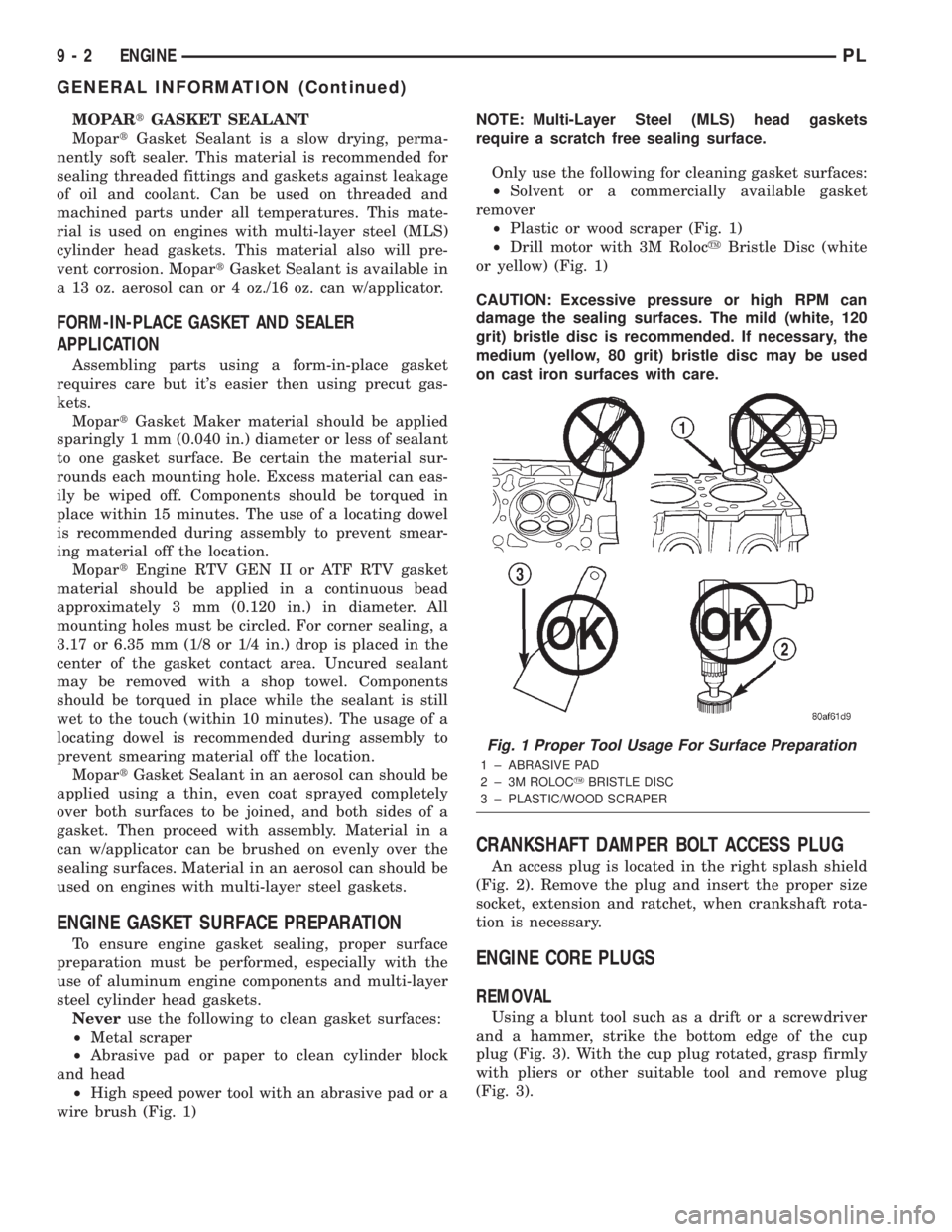
Neveruse the following to clean gasket surfaces:
²Metal scraper
²Abrasive pad or paper to clean cylinder block
and head
²High speed power tool with an abrasive pad or a
wire brush (Fig. 1)NOTE: Multi-Layer Steel (MLS) head gaskets
require a scratch free sealing surface.
Only use the following for cleaning gasket surfaces:
²Solvent or a commercially available gasket
remover
²Plastic or wood scraper (Fig. 1)
²Drill motor with 3M RolocyBristle Disc (white
or yellow) (Fig. 1)
CAUTION: Excessive pressure or high RPM can
damage the sealing surfaces. The mild (white, 120
grit) bristle disc is recommended. If necessary, the
medium (yellow, 80 grit) bristle disc may be used
on cast iron surfaces with care.
CRANKSHAFT DAMPER BOLT ACCESS PLUG
An access plug is located in the right splash shield
(Fig. 2). Remove the plug and insert the proper size
socket, extension and ratchet, when crankshaft rota-
tion is necessary.
ENGINE CORE PLUGS
REMOVAL
Using a blunt tool such as a drift or a screwdriver
and a hammer, strike the bottom edge of the cup
plug (Fig. 3). With the cup plug rotated, grasp firmly
with pliers or other suitable tool and remove plug
(Fig. 3).
Fig. 1 Proper Tool Usage For Surface Preparation
1 ± ABRASIVE PAD
2 ± 3M ROLOCYBRISTLE DISC
3 ± PLASTIC/WOOD SCRAPER
9 - 2 ENGINEPL
GENERAL INFORMATION (Continued)
Page 731 of 1285
ENGINE DIAGNOSIS
TABLE OF CONTENTS
page page
DIAGNOSIS AND TESTING
GENERAL INFORMATION...................8
INTAKE MANIFOLD LEAKAGE DIAGNOSIS......8
CYLINDER COMPRESSION PRESSURE TEST . . . 8
CYLINDER COMBUSTION PRESSURE
LEAKAGE TEST.........................9LASH ADJUSTER (TAPPET) NOISE
DIAGNOSIS............................9
ENGINE OIL LEAK INSPECTION..............9
ENGINE DIAGNOSISÐPERFORMANCE........11
ENGINE DIAGNOSISÐMECHANICAL.........12
DIAGNOSIS AND TESTING
GENERAL INFORMATION
Engine diagnosis is helpful in determining the
causes of malfunctions not detected and remedied by
routine maintenance.
These malfunctions may be classified as either
mechanical (e.g., a strange noise), or performance
(e.g., engine idles rough and stalls).
Refer to the Service DiagnosisÐMechanical Chart
and the Service DiagnosisÐPerformance Chart, for
possible causes and corrections of malfunctions. Refer
to Group 14, Fuel System, for the fuel system diag-
nosis.
Additional tests and diagnostic procedures may be
necessary for specific engine malfunctions that can-
not be isolated with the Service Diagnosis charts.
Information concerning additional tests and diagno-
sis is provided within the following:
²Cylinder Compression Pressure Test
²Cylinder Combustion Pressure Leakage Test
²Engine Cylinder Head Gasket Failure Diagnosis
²Intake Manifold Leakage Diagnosis
INTAKE MANIFOLD LEAKAGE DIAGNOSIS
An intake manifold air leak is characterized by
lower than normal manifold vacuum. Also, one or
more cylinders may not be functioning.
WARNING: USE EXTREME CAUTION WHEN THE
ENGINE IS OPERATING. DO NOT STAND IN A
DIRECT LINE WITH THE FAN. DO NOT PUT YOUR
HANDS NEAR THE PULLEYS, BELTS OR THE FAN.
DO NOT WEAR LOOSE CLOTHING.
(1) Start the engine.
(2) Spray a small stream of water (Spray Bottle) at
the suspected leak area.
(3) If engine RPM'S change, the area of the sus-
pected leak has been found.
(4) Repair as required.
CYLINDER COMPRESSION PRESSURE TEST
The results of a cylinder compression pressure test
can be utilized to diagnose several engine malfunc-
tions.
Ensure the battery is completely charged and the
engine starter motor is in good operating condition.
Otherwise the indicated compression pressures may
not be valid for diagnosis purposes.
(1) Check engine oil level and add oil if necessary.
(2) Drive the vehicle until engine reaches normal
operating temperature. Select a route free from traf-
fic and other forms of congestion, observe all traffic
laws, and accelerate through the gears several times
briskly.
(3) Remove all spark plugs from engine. As spark
plugs are being removed, check electrodes for abnor-
mal firing indicators fouled, hot, oily, etc. Record cyl-
inder number of spark plug for future reference.
(4) Disconnect coil wire from distributor and
secure to good ground to prevent a spark from start-
ing a fire (Conventional Ignition System). For Direct
Ignition System DIS disconnect the coil connector.
(5) Be sure throttle blade is fully open during the
compression check.
(6) Insert compression gage adaptor into the #1
spark plug hole in cylinder head. Crank engine until
maximum pressure is reached on gage. Record this
pressure as #1 cylinder pressure.
(7) Repeat the previous step for all remaining cyl-
inders.
(8) Compression should not be less than (689 kPa)
100 psi and not vary more than 25 percent from cyl-
inder to cylinder.
(9) If one or more cylinders have abnormally low
compression pressures, repeat the compression test.
(10) If the same cylinder or cylinders repeat an
abnormally low reading on the second compression
test, it could indicate the existence of a problem in
the cylinder in question.The recommended com-
pression pressures are to be used only as a
guide to diagnosing engine problems. An engine
9 - 8 ENGINEPL
Page 798 of 1285
EXHAUST SYSTEM
TABLE OF CONTENTS
page page
DESCRIPTION AND OPERATION
EXHAUST SYSTEM........................1
EXHAUST FLEX-JOINT COUPLING............1
CATALYTIC CONVERTER....................1
EXHAUST HEAT SHIELDS..................3
DIAGNOSIS AND TESTING
EXHAUST SYSTEM DIAGNOSIS CHART.......4
REMOVAL AND INSTALLATION
EXHAUST PIPE AND MUFFLER..............4CATALYTIC CONVERTER....................7
CLEANING AND INSPECTION
EXHAUST SYSTEM........................8
ADJUSTMENTS
EXHAUST SYSTEM ALIGNMENT.............8
SPECIFICATIONS
TORQUE SPECIFICATION CHART.............8
DESCRIPTION AND OPERATION
EXHAUST SYSTEM
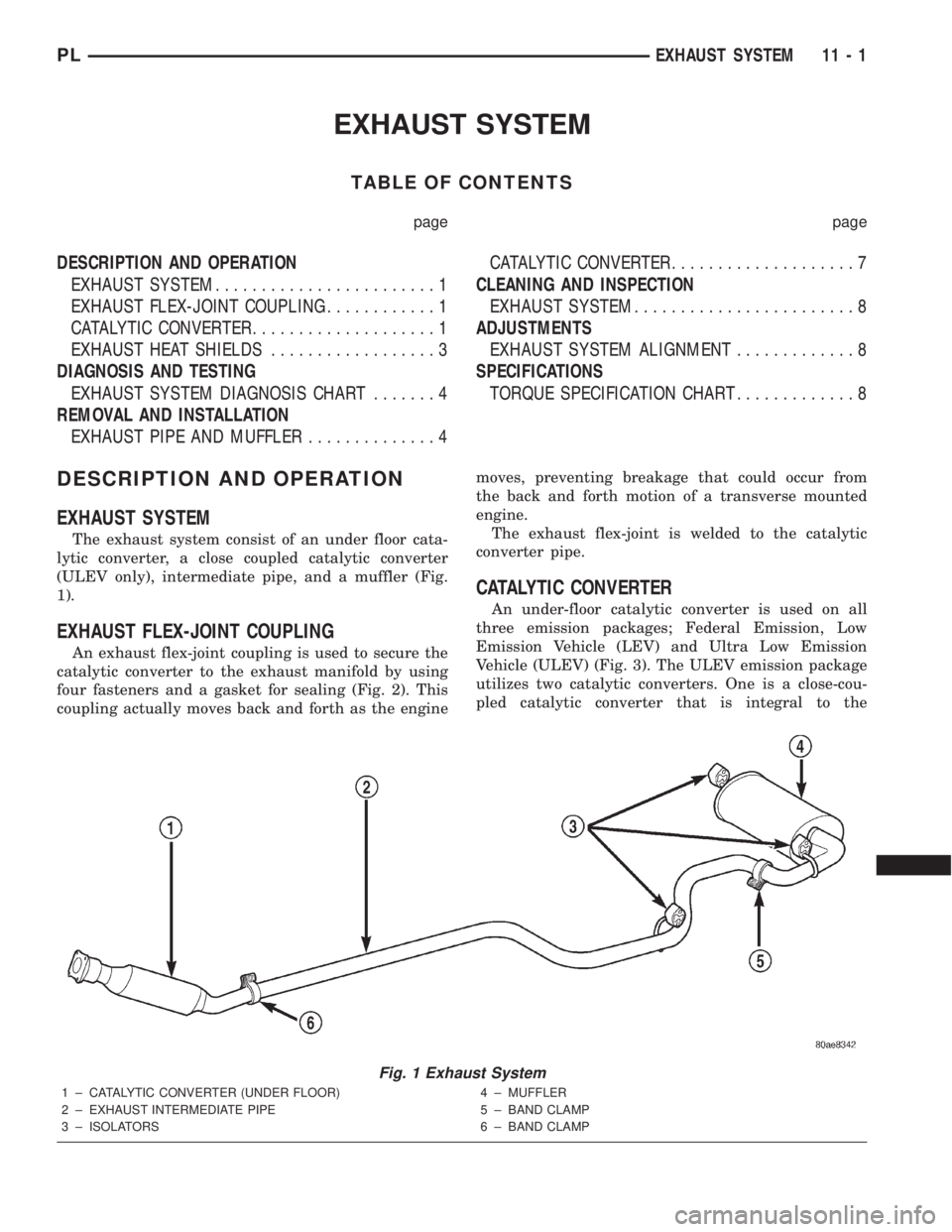
The exhaust system consist of an under floor cata-
lytic converter, a close coupled catalytic converter
(ULEV only), intermediate pipe, and a muffler (Fig.
1).
EXHAUST FLEX-JOINT COUPLING
An exhaust flex-joint coupling is used to secure the
catalytic converter to the exhaust manifold by using
four fasteners and a gasket for sealing (Fig. 2). This
coupling actually moves back and forth as the enginemoves, preventing breakage that could occur from
the back and forth motion of a transverse mounted
engine.
The exhaust flex-joint is welded to the catalytic
converter pipe.
CATALYTIC CONVERTER
An under-floor catalytic converter is used on all
three emission packages; Federal Emission, Low
Emission Vehicle (LEV) and Ultra Low Emission
Vehicle (ULEV) (Fig. 3). The ULEV emission package
utilizes two catalytic converters. One is a close-cou-
pled catalytic converter that is integral to the
Fig. 1 Exhaust System
1 ± CATALYTIC CONVERTER (UNDER FLOOR)
2 ± EXHAUST INTERMEDIATE PIPE
3 ± ISOLATORS4 ± MUFFLER
5 ± BAND CLAMP
6 ± BAND CLAMP
PLEXHAUST SYSTEM 11 - 1
Page 811 of 1285
CAUTION: After removing the steering knuckle from
the ball joint stud, do not pull outward on the knuckle.
Pulling the steering knuckle outward at this point can
separate the inner C/V joint on the driveshaft. Refer to
FRONT DRIVESHAFTS in the DIFFERENTIAL AND
DRIVELINE group for further information.
NOTE: Use caution when separating the ball joint
stud from the steering knuckle, so the ball joint seal
does not get cut.
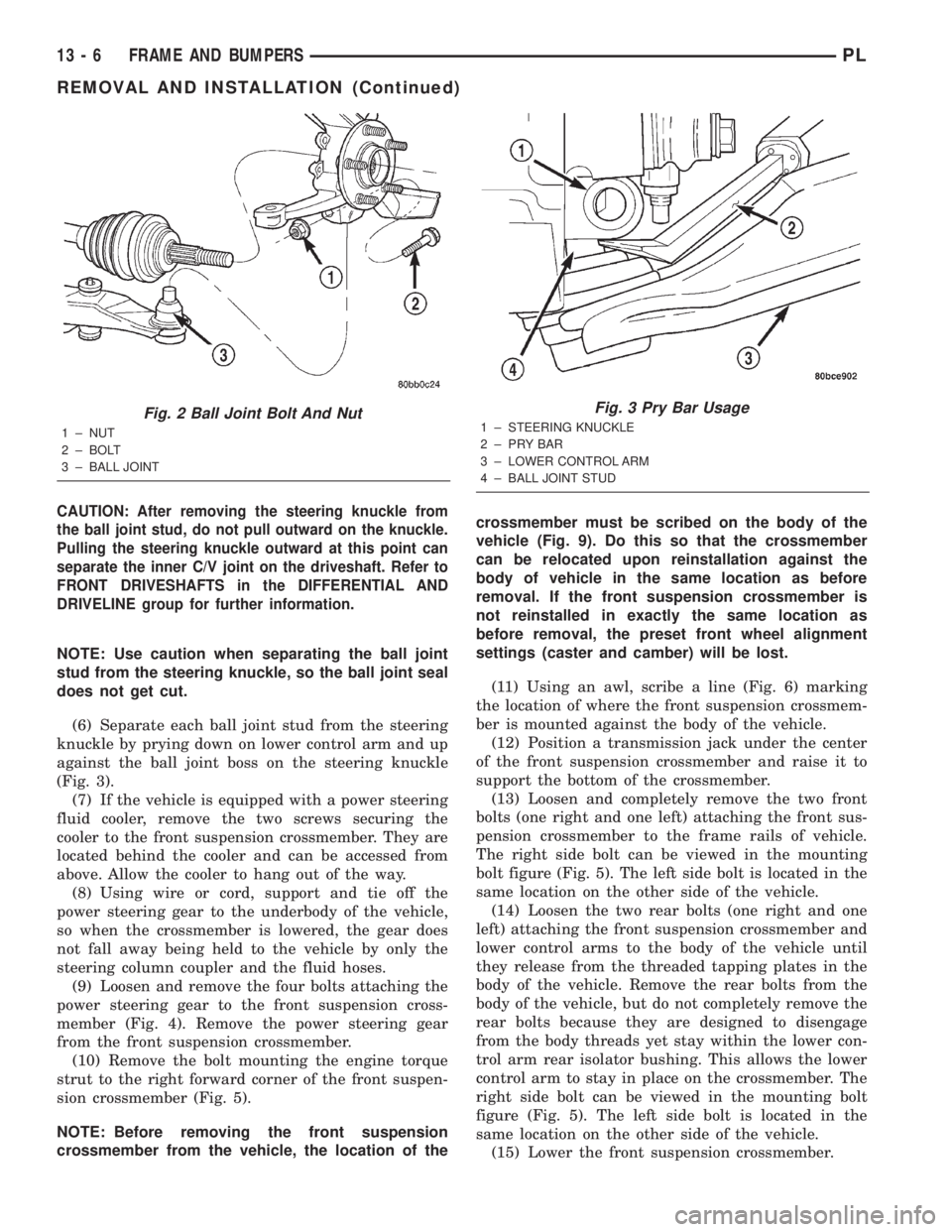
(6) Separate each ball joint stud from the steering
knuckle by prying down on lower control arm and up
against the ball joint boss on the steering knuckle
(Fig. 3).
(7) If the vehicle is equipped with a power steering
fluid cooler, remove the two screws securing the
cooler to the front suspension crossmember. They are
located behind the cooler and can be accessed from
above. Allow the cooler to hang out of the way.
(8) Using wire or cord, support and tie off the
power steering gear to the underbody of the vehicle,
so when the crossmember is lowered, the gear does
not fall away being held to the vehicle by only the
steering column coupler and the fluid hoses.
(9) Loosen and remove the four bolts attaching the
power steering gear to the front suspension cross-
member (Fig. 4). Remove the power steering gear
from the front suspension crossmember.
(10) Remove the bolt mounting the engine torque
strut to the right forward corner of the front suspen-
sion crossmember (Fig. 5).
NOTE: Before removing the front suspension
crossmember from the vehicle, the location of thecrossmember must be scribed on the body of the
vehicle (Fig. 9). Do this so that the crossmember
can be relocated upon reinstallation against the
body of vehicle in the same location as before
removal. If the front suspension crossmember is
not reinstalled in exactly the same location as
before removal, the preset front wheel alignment
settings (caster and camber) will be lost.
(11) Using an awl, scribe a line (Fig. 6) marking
the location of where the front suspension crossmem-
ber is mounted against the body of the vehicle.
(12) Position a transmission jack under the center
of the front suspension crossmember and raise it to
support the bottom of the crossmember.
(13) Loosen and completely remove the two front
bolts (one right and one left) attaching the front sus-
pension crossmember to the frame rails of vehicle.
The right side bolt can be viewed in the mounting
bolt figure (Fig. 5). The left side bolt is located in the
same location on the other side of the vehicle.
(14) Loosen the two rear bolts (one right and one
left) attaching the front suspension crossmember and
lower control arms to the body of the vehicle until
they release from the threaded tapping plates in the
body of the vehicle. Remove the rear bolts from the
body of the vehicle, but do not completely remove the
rear bolts because they are designed to disengage
from the body threads yet stay within the lower con-
trol arm rear isolator bushing. This allows the lower
control arm to stay in place on the crossmember. The
right side bolt can be viewed in the mounting bolt
figure (Fig. 5). The left side bolt is located in the
same location on the other side of the vehicle.
(15) Lower the front suspension crossmember.
Fig. 2 Ball Joint Bolt And Nut
1 ± NUT
2 ± BOLT
3 ± BALL JOINT
Fig. 3 Pry Bar Usage
1 ± STEERING KNUCKLE
2±PRYBAR
3 ± LOWER CONTROL ARM
4 ± BALL JOINT STUD
13 - 6 FRAME AND BUMPERSPL
REMOVAL AND INSTALLATION (Continued)