2000 AUDI ALLROAD ABS
[x] Cancel search: ABSPage 11 of 306

GENERA L
ILL USTR ATION----------------------
Warning and indicator lights
Symbol Page Symbol
Page
EPC Electronic
power control
123 Brake
• 126
BRAKE
(USA models)
;oo� Side
marker lights I headlights 123
� Self-le
veling suspension 12
3 (CD) Brake
• 12
6
(Canada models)
@ Electronic
Stability Program (ESP) 12
4
0 Gener
ator, Battery voltage
127, 143
� Electronic
immobilizer 12
4
t Safety
belt 127
¢!:} Turn
signals, emergency flasher 12
5, 152
� D High
beam 125
� Malfunction Indicator Lamp (MIL) 12
5
CHECK
AIR Airbag system 25, 125
BAG OK
Auto-Check
system ok I no failure
140
in the checked systems
-�- Coolant
temperature
• 141
and level
� Oil pressure
• 14
3
ABS Anti-lock
brake system
125
(USA models) BRAKE
Brake
lights malfunc tion
141
LIGHT (USA
models)
9) Anti-lock
brake system
125
(Canada models) (@) Brake
lights malfunc tion
141
(Canada models)
10
Page 16 of 306

The
higher the speed of the vehicle and the
greater the passengers' weight, the more
energy there is to be "absorbed" in an acci
dent.
Vehicle speed is the most significant factor.
If the speed doubles from 15 to 30 mph (25
to 50 km/hl. the energy increases 4 times!
Because these passengers are not using
safety belts, they will keep moving at the
same speed the vehicle was moving just
before the crash, until something stops
them -here, the wall. The same
principles apply to people sitting
in a car that is involved in a frontal collision.
Even at city speeds of 20 to 30 mph (30 to
50 km/h), the forces acting on the body can
reach one ton (2000 lbs, or 1 000 kg) or
more. At greater speeds, these forces are
even higher.
People who do not use safety belts are also
not attached to their car. In a frontal collision
they will also continue to move forward at
the speed their car was travelling just be
fore the impact. SA
FETY FIRST
Un belted occupants are not able to resist
the tremendous forces of impact by holding
tight or bracing themselves. Without the
benefit of safety restraint systems, the un
restra ined occupant will slam violently into
the steering wheel, dashboard, windshield,
or whatever else is in the way. Their impact
with the vehicle interior has all the energy
they had just before the crash.
15
Page 17 of 306

SA
FETY FIRST
Don't rely on airbags alone for protection.
Even when they deploy, airbags provide
only supplemental protection. Airbags are
not supposed to deploy in all kinds of acci
dents. Although your Audi is equipped with
airbags for the driver and front seat passen
ger, all vehicle occupants, including the
driver, still have to wear safety belts- re
gardless of whether their seating position
has an airbag.
Remember too, that airbags will deploy only
once and that your safety belts are always
there to offer protection in those accidents
in which airbags are not supposed to deploy
or when they have already deployed.
Unbelted occupants can also be thrown out
of the car where even more severe or fatal
injuries can occur.
16 Unbelted
passengers in the rear seats en
danger not only themselves but also other
passengers. In a frontal collision they will be
thrown forward violently, where they can hit
and injure the driver or front seat passenger.
Safety belts protect
Safety belts used properly can make a big
difference. Safety belts help to keep pas
sengers in their seats, gradually reduce en
ergy levels applied to the body in an acci
dent, and help prevent the uncontrolled
movement that can cause serious injuries.
In addition, safety belts reduce the danger
of being thrown out of the car. Safety
belts attach passengers to the car
and give them the benefit of being slowed
down more gently or "softly" through the
"give" in the safety belts, crumple zones
and other safety features engineered into
today's cars. By "absorbing" the kinetic en
ergy over a longer period of time, the forces
on the body become more "tolerable" and
less likely to cause injury.
Page 43 of 306
SA
FETY RRST-----------------------------------------------------
�WARNING continued
• Do not cover, obstruct, or
change the steering wheel horn
pad or airbag cover or the instru
ment panel, particularly in the area
of the passenger side airbag mod
ule.
• For cleaning the horn pad or in
strument panel, use only a soft,
dry cloth or one moistened with
plain water. Solvents or cleaners
could damage the airbag cover. Do
not make any repairs, adjust
ments, or modifications to any
parts of the airbag system.
• Do not modify the front bumper
or vehicle body structure.
42 ftl
WARNING continued
• Never place protective seat cov
ers or replacement upholstery
over the front and rear seatbacks
that have not been specifically ap
proved by Audi. Since the side air
bags deploy out of the side of the
seatback, it would not be able to
deploy and protect properly.
• Do not use additional seat cush
ions that cover or interfere with
the areas where the side airbags
inflate.
• Damage to the original seat cov
ers or to the seam in the area of the
side airbag module must be re
paired immediately by an autho
rized Audi Dealer.
• The airbag system must be re
placed by your authorized Audi
Dealer no later than 14 years after
the manu facture date of your ve
hicle. �,
WARNING continued
• The manufacture date can be
found on the Safety Compliance
Sticker located on the left door
jamb as well as on the Vehicle
Identification Label in your
Maintenance booklet. It is abso
lutely essential to observe this
date in order to assure that the sy
stem is in good working order.
• If components of the airbag sys
tem must be discarded, or ifthe ve
hicle must be scrapped, certain
safety precautions must be ob
served. Your authorized Audi
Dealer knows these precautions
and can give you the necessary in
forma tion. Failure to follow these
precautions and procedures could
increase the risk of personal in
jury.
Page 50 of 306
-------------------------------------------------SAFETY ARST
In a collision, airbags must inflate within a
blink of an eye and with considerable force.
In order to do its job, the airbag needs room
to inflate so that it will be there to protect
the occupant as the occupant moves for
ward into the airbag.
A vehicle occupant who is out of position
and to close to the airbag gets in the way of
on infloting nirbag. When an occupant is too close he or she will be stru ck violently and
will r� ceive serious or possibly even fatal in
jury.
In order for the airbag to offer protection, it
is important that all vehicle occupants, es
pecially children who must ride on the front
seat in excep tional situations, be properly
restra ined and as far away from the airbag
as possible. By keeping room between your
body and the front of the passenger
compartment, the airbag can inflate fully
and completely and provide supplemental
pro tection in certain frontal collisions. �W
ARNING
Never let a child stand or kneel on
any seat, particularly the front
seat. Never let a child ride in the
cargo area of your car. If a child is
leaning forward, sitting sideways
or out of position in any way, the
child is more likely to be injured in
a crash and will receive serious or
fatal injuries if the child comes
into contact with an airbag as it in
flates.
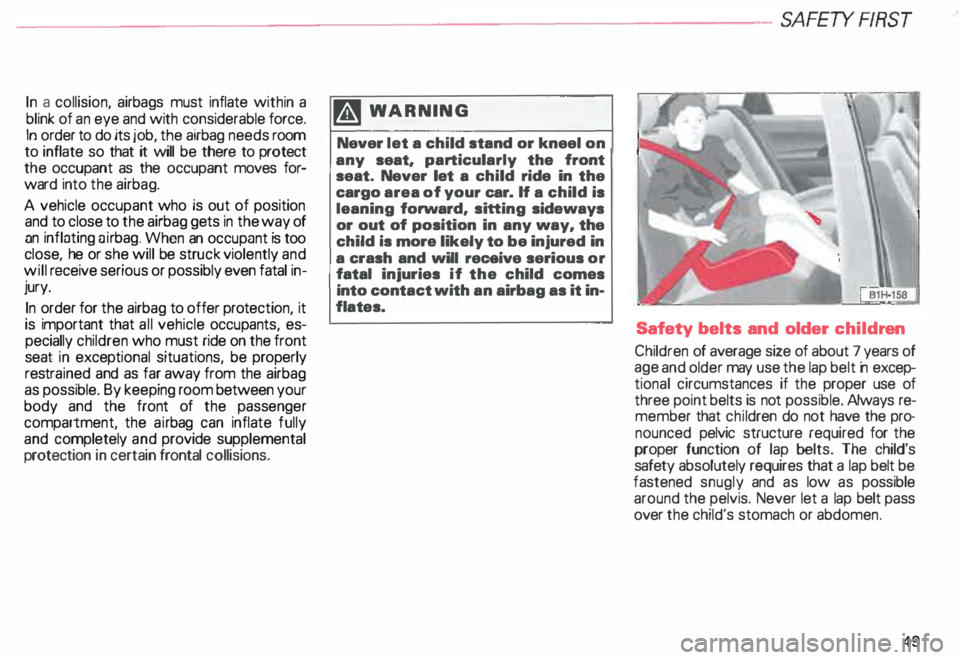
Safety belts and older children
Children of average size of about 7 years of
age and older may use the lap belt in excep
tional circumstances if the proper use of
three point belts is not possible. Always re
member that children do not have the pro
nounced pelvic structure required for the
proper function of lap belts. The child's
safety absolutely requires that a lap belt be
fastened snugly and as low as possible
around the pelvis. Never let a lap belt pass
over the child's stomach or abdomen.
49
Page 125 of 306

CONTROLS AND
EQUIPMEN T--------------------
If the warning light is flashing, it can also
mean that the vehicle is riding ''too high"
(above the highest level). Once again, do
not drive off until the warning light stops
flashing.
If the .warning light stays on continuous ly,
there 1s a problem with the ride height ad
JUStment system. The light will also come
on continuously if the vehicle is on an ex
treme incline.
Tro uble in the ESP may also cause the warn
ing light to remain on continuously.
A system failure can cause the vehicle to
have too little or too much ground clear
ance. Drive very carefully and slowly to your
nearest authorized Audi dealer and have the
fault corrected.
See page 153 for additional information.
12 4 Electronic Stability
Program {ESP)
The indicator light lights up when the igni
tion is turned on, and it must go out after
about 2 seconds.
When the ESP system is in control mode,
this indicator light will flash while the ve
hicle is being operated.
When you start the engine, the ESP
may shut off for safety reasons. The indica
tor light also turns on to indicate this statu s.
If this should happen, you can reactivate the
ESP by turning the ignition off and then on
� gain. This indicator light will go out, indicat
Ing that the system is once again operating
properly.
If the system is off or is malfunctioning, the
indi cator light will remain on.
Since the ESP system works together with
the ABS system, the ESP indicator light will
also come on if the ABS stops operating. Electronic
immobilizer
�
When you turn on the ignition, the vehicle
key data are automatically scanned. The in
dicator light will come on briefly, indicating
that the data verification procedure has
been acknowledged.
If a non-coded vehicle key was used (for ex
ample a duplic ate key), the control light
goes to a continuous flashing mode. If this
happens, the vehicle cannot be started. See
also page 57
Page 126 of 306

---------------------CONTROLS AND EQUIPMENT
Turn signals and
emergency flasher
Refer to "Turn signal I headlight d1mmer
switch lever and emergency flasher" on
pages 152 and 156 for details.
High beam �D
The indicator light lights up when the high
beams are switched on or when the head
light flasher is used.
See "Turn signal I headlight dimmer switch
lever" on page 156 for details.
Malfunction Indicator
�
Lamp (MIL) CHECK
The Malfunction Indicator Lamp is part of
the On Board Diagnostic system (OBD).
The lamp comes on when the ignition is
switched on and will go out after the engine
is started and the idle has stabilized. This is
to assure you that the Malfunction Indicator
Lamp is working properly.
For more details, see page 128. Airbag
System AIR
BAG
The ind icator light for the airbag and belt
tensioner system must come on when
the ignition is switched on, and go out after
a few seconds. If the light does not go out,
or if it comes on while you are driving, this
ind icates a fault in the airbag I belt tensioner
syste m.
If the indicator light does not come on when
the ignition is switched on, this also indi
cates a system malfunction. If any of these
conditions occur, have the air bag system in
spected immediately by your authorized
Audi Dealer.
For more details, see page 25. Anti-lock
Brake System
USA models:
Canada models: ABS
8
This warn ing light monitors the ABS and
EDL (Electronic Differential Lock,
sys tems.
The light will come on for a few seconds
when the ignition is switched on. The light
will go out after an automatic check se
quence.
For additional information on the ABS sy
stem, see page 202.
� WARNING
If the ABS warning light does not
go out, or if it comes on while driv
ing, the ABS system is not working
properly. The vehicle can then be
stopped only with the standard
brakes (without ABS,. You won't
have the protection ABS provides.
Contact your Audi Dealer as soon
as possible.
125
Page 127 of 306
CONTROLS
AND EQUIPMENT---------------------
If there is an ABS problem:
o The ABS warning light to come
on. The vehicle can still be braked,
however, the ABS will not work. See
your authorized Audl Dealer as soon
as possible.
• The ABS warning light and the
brake warning light come on to
gether. The ABS will not work and
you will notice a change in braking
characteristics and performance.
�W ARNING
If both warning lights (ABS and
BRAKE warning light) come on at
the same time, the rear wheels
could lock up first under hard
braking. Rear wheel brake lock-up
can cause loss of vehicle control
and an accident. Have your vehicle
repaired immediately by your au
thorized Audi Dealer or a qualified
workshop. Drive slowly and avoid
sudden, hard brake application.
12 6 If
the ABS fails, the ESP warning light will
come on. See page and pages 202 -205.
Electronic differential lock (EDL)
The electronic differential lock works in con
junction with the ABS system. A fault in the
ABS causes therefore a malfunction of the
electr onic differential lock.
For more details on how the EDL works, go
to page 204.
Brake
USA models:
BRAKE
Canada models:
(Q))
The light comes on while the engine is
cranking. It goes out after the engine has
been started and the parking brake is fully
released. This is your assurance that the
brake warning light is functioning properly. A If the brake warning light does ¥ not light up when the engine is
cra nking or the parking brake is ap
plied, there may be a malfunction in
the electrical system. In this case,
contact your Audi Dealer.
When the light comes on, an audible warn
ing signal is also given.
�W ARNING
• If both warning lights (ABS and
BRAKE warning light) come on at
the same time, the rear wheels
could lock up first under hard
braking. Rear wheel brake lock-up
can cause loss of vehicle control
and an accident. Have your vehicle
repaired immediately by your au
thorized Audi Dealer or a qualified
workshop. Drive slowly and avoid
sudden, hard brake application.