2000 AUDI ALLROAD ABS
[x] Cancel search: ABSPage 203 of 306
VE
HICL E OPER ATION------------------------
Functioning of Anti-Lock Brake
System (ABS)
The ABS contributes effectively to vehicle
control since it prevents the wheels from
locking when the brakes are applied. This
means that the vehicle remains steerable
and is less likely to skid.
Nota
Yo u don't have to "pump" the brake.
Just hold the brake pedal down.
However, do not expect that the ABS short
ens braking distance under all circum
stances. When driving on gravel or on newly
fallen snow on top of icy surfaces, braking
distance may be even longer , therefore, un
der these circumstances, it is especially im
portant that you drive slowly and with great
care.
202 How the
ABS system works
An automatic check is made when a speed
of about 4 mph (6 km/h) is reached.
When this happens a pumping noise can be
heard.
If an individual wheel begins to rotate too
slowly in relation to vehicle speed and tends
to lock, the ABS automatically reduces
brake pressure to prevent that wheel from
locking.
This automatic adjustment process
will cause a slight vibration of the
brake pedal and soma noises to alert
you that vehicle speed must be
adapted to existing road and traffic
conditions. Enhanced
ABS function {Offroad
Mode)
To improve braking on loose terrain (for ex
ample: gravel, scree, mud, slush, snow),
turn off the ESP (see page 205), which will
switch the ABS to a special mode designed
for off-road requirements.
In this mode, the ABS control system is
changed to allow a "wedge" of loose rock
or soil to form in the front of the wheels.
This improves braking performance.
The ESP indicator light in the instrument
cluster will come on when you have
switched to this special ABS mode (see
page 124).
This special ABS mode will remain active up
to about 40 mph (60 km/h). ABS operation
is not affected at speeds over 40 mph
(60 km/h).
To turn his special ABS mode off, press the
ESP button (To activate ESP, see page 152).
The ABS off-road mode will also be deacti
vated when vou turn off the engine.
Page 204 of 306
�W
ARNING
Although the ABS is very effec
tive, always remember that brak
ing capability is lim ited by tire
tracti on.
Always adjust your driving speed
accor ding to the road and traffic
conditions. Do not let the extra
safety afforded by the ABS tempt
you into taking extra risks. The
ABS cannot overcome the laws of
physics.
If ABS is not functioning properly, a warning
light will come on. See page 125 for addi
tional details. Conditions
affecting
braking efficiency
Moisture or road salt
�W ARNING
• Under certain climatic and oper
ating conditions such as passing
through water, driving in heavy
rain or after washing the vehicle,
the effectiveness of the brakes
can be reduced. In winter, ice can
accumulate on the brake pads, lin
ings, discs and drums. Cautiously
apply brakes for a test. Brakes will
dry and ice coatings will be
cleaned off after a few cautious
brake applications. VE
HICLE OPERATION
� WARNING continued
• Driving for an extended period
of time on salt-covered roads with
out using your brakes can also af
fect braking efficiency. Clean off
accumulated salt coating from
brake discs and pads with a few
cautious brake applications.
Overhea ting the brakes
�W ARNIN G
• Do not "ride the brakes" by rest
ing your foot on the pedal when
you do not intend to brake. This
may cause the brakes to overheat,
premature wear and Increased
stopping distance.
Always heed all WAR NINGS
on next page.
203
Page 205 of 306

VE
HICL E OPERA TION-----------------------
'4 WARN ING continued
• Before descending a steep
grade, reduce speed and shift
transmission into a lower gear or
lower driving position. Do not ride
the brakes or hold the pedal down
too long or too often. This could
cause the brakes to get hot and di
minish braking efficiency.
• If you damage the front spoiler,
or if you install a different spoiler,
be sure the air flow to the front
brakes is not obstructed. Other
wise the brake system could over
heat reducing the effective ness of
the entire brake system.
• Failure of one brake circuit will
impair the braking capability re
sulting in an increased stopping
distance.
Avoid driving the vehicle and have
it towed to the nearest Audi Dealer
or qualified workshop.
204 Electronic differential lock
(EDL)
The EDL operates in conjunction with the
ABS. The EDL acts automatically, i.e. with
out the driver's intervention.
With the aid of the ABS sensors, this sy
stem monitors the speed of the driven
wheels up to about 50 mph, 80 km/h .
Within the speed range at which this sy
stem operates, if the wheels spin (e.g. on
slippery surfaces) they are braked in a con
trolled manner , and more of the engine's
power is directed to whiche ver wheels
achieve greater traction.
Please note:
• When driving off, always be sure to keep
road conditions in mind as you accelerate.
If a drive wheel spins because it's on a slip
perier surface, gradually increase the pres
sure on the accelerator pedal until the car
starts to move. •
When accelerating on slippery surfaces,
such as on ice or snow, always be careful
when depressing the accelerator pedal.
Even with the EDL working, the drive
wheels can spin and reduce your ability to
control your car.
• To prevent the disc brake of the braked
wheel from overheating, if subjected to ex
cessive loads the EDL cuts out temporarily.
The vehicle remains operational and be
haves in the same way as a vehicle without
EDL
If a fault occurs in the ABS the EDL is also
not functioning. This is ind icated by the ABS
warning light-see page 125.
ftl WARNING
The increased safety afforded by
EDL does not mean that you can
take safety risks. Always adapt
your driving style to the road con
ditions and traffic situation.
Page 206 of 306
Electronic
Stability Program (ESP)
The Electronic Stability Program helps to
control the vehicle in critical maneuvers like
curves.
When the vehicle starts up and accelerates,
the wheels are prevented from spinning by
adjusting the engine power to conform to all
road conditions. This improves vehicle sta
bil ity.
The system operates across the entire
speed range in combination with the ABS
syst em. If the Anti-Lock Brake System
(ABS) malfunctions, the ESP will also shut
down.
When you turn on the engine, the ESP will
automatically be activated and will perform
a self-test. The
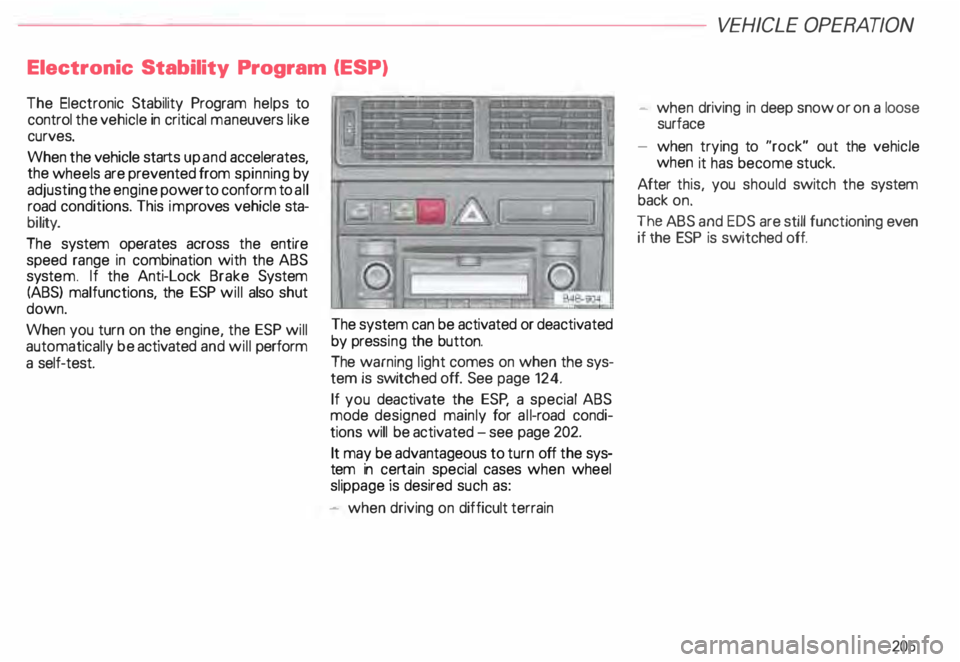
system can be activated or deactivated
by press ing the button.
The warning light comes on when the sys
tem is switch ed off. See page 124.
If you deactivate the ESP, a special ABS
mode designed mainly for all-road condi
tions will be activated - see page 202.
It may be advantageous to turn off the sys
tem in certain special cases when wheel
slippage is desired such as:
- when driving on difficult terrain VE
HICL E OPER ATION
- when driving in deep snow or on a loose
surface
- when trying to "rock" out the vehicle
when it has become stuck.
After this, you should switch the system
back on.
The ABS and EDS are still functioning even
if the ESP is switched off.
205
Page 207 of 306

VEHICLE
OPER ATION----------------------
Operation
The Anti-Lock Brake System (ABS) and the
Electronic Differential Lock (EDU are inte
grat _ed in the Electronic Stability Progr am. In
a _ddrtron to the data provided by these func
tions, the ESP control unit requires addition
al measurement data provided by hig h-per
forman ?e sensors. The rotat ional speed of
the veh1cle about its vertical axis, vehicle lat
eral acceleration, brake pressure and the
steering angle are measured.
The direction in which the driverwishes to
travel is determined with the aid of the
stee �ing angle and the vehicle speed and is
contmually compared with the actual be
havior of the vehicle.
If the data do not match - for example when
a vehrcle is beginning to spin out of control
- the ESP applies the brakes to the appropri
ate wheels for the given situation and, if
necessar y, changes the vehicle traction
forces so as to reduce the slipping of individ
ual wheels (ASR anti-slip regulation).
206 The
vehicle is then stabilized by the forces
a ?tin � on the wheel during braking. If the ve
hicle IS overstee ring (rear tends to skid out
of the turn), the brakes are mainly applied on
the wheel that is on the outside ofthe curve.
In the case of a vehicle that is und ersteering
(tendency to slide out of the curve). the
brakes are applied at the rear wheel that is
on the inside of the curve. An audible signal
�rll accompany the brake application func
tion.
All �SP senso rs a�e monitored continuously
wh1le the vehicle IS being driven. However,
when the vehicle is driven at low speed on
ex tremely rugged terrain, it is not always
possrble to monrtor the ESP sensors contin
uously. Thus, in rare and exceptional cases
the ESP itself can deactivate (ESP and ABS
ind icator lights will be lit continuously).
In this case. the ride level adjustment sys
tem lowers the vehicle to the normal level
If this happens, you may need to select th�
ride level again (see page 153).
Operation of the ESP and ABS is restored
whenever you restart the engine. m
WAR NING
! he Electronic Stability Program
•• nevertheless subject to the laws
of physics. It is particularly impor
tant to pay attention to this fact on
wet and slippery roads.
It is therefore important that you
always adapt your driving to the
condition of the road and traffic
conditions. Do not allow the in
creased safety provided by the
Electro nic Stability Program sys
tem to lull you into accepting addi
tional safety risks.
Page 212 of 306
-----------------------VEHICL E OPER ATION
Tr ailer towing tips
Yo ur vehicle handles differently when tow
ing a trailer because of the additional weight
and weight distribution. Safety, perfor
mance and economy will greatly depend on
how carefully you load your trailer and oper
ate your rig.
Before you actually tow your trailer, practice
turning, stopping and backing up in an area
away from traffic until you learn the feel of
your vehicle and trailer unit.
Backing up is difficult and requir es practice.
Steering while backing up is generally oppo
site of that when backing your vehicle with
out a trailer.
Maintain a greater distance between your
vehicle and the one in front of you. You will
need more room to stop.
To compensate for the trailer, you will need
a larger than normal turning radius. When
passing, remember that you cannot
accelerate as fast as you normally would be
cause of the added load. Make sure you
have enough room to pass. After passing,
allow plenty of room for your trailer before
changing lanes again.
Avoid jerky starts, sharp turns or rapid lane
changes.
After parking, always block the wheels of
both vehicle and trailer. Do not park with a
trailer on a slope. If it cannot be avoided, do
so only after doing the following:
• Apply foot brake.
• Have someone place chocks under both
vehicle and trailer wheels.
• With chocks in place, slowly release
brakes until wheel blocks absorb the load.
• Turn wheels to curb.
o Apply parking brake.
• Place automatic transmission in "P". If
you move the selector lever of the auto
matic transmission to "P" before applying
the parking brake and before blocking the
wheels, you may require more force later to
move the lever out of the "P" position.
When restarting after parking on a slope, re
verse the procedure:
• Start the engine.
• Shift transmission into gear.
o Release the parking brake and slowly
move away from the wheel blocks.
• Stop and have someone retrieve the
wheel blocks.
Notes
• Do not tow a trailer during the
break-in period of your vehicle.
• If you tow a trailer, your Audi may require
more frequent maintenance due to the ex
tra load -see also page 228.
211
Page 243 of 306
VE
HICLE CA
RE----------------------------------------------------
Brake fluid
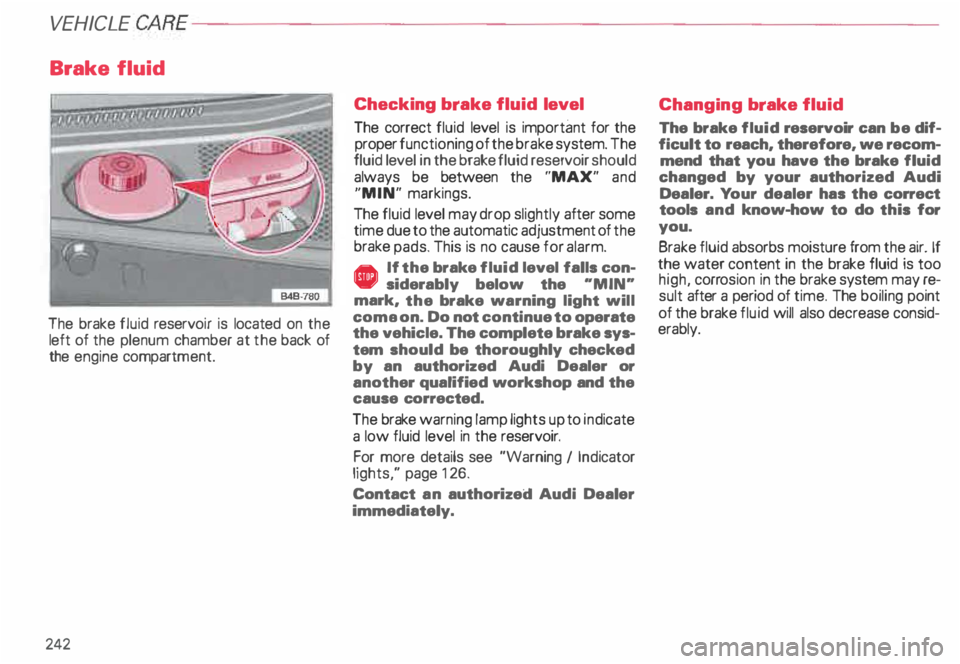
The brake fluid reservo ir is located on the
left of the plenum chamber at the back of
the engine compartm ent.
242 Checking
brake fluid level
The correct fluid level is important for the
proper functioning of the brake system. The
fluid level in the brake fluid reservoir should
always be between the "MAX" and
"MIN" markings.
The fluid level may drop slightly after some
time due to the automatic adjustment of the
brake pads. This is no cause for alarm.
• If the brake fluid level falls con
siderably below the "MIN"
mark, the brake warning light will
coma on. Do not continue to operate
the vehicle. The complete brake sys
tem should be thoroughly checked
by an authorized Audi Dealer or
another qualified workshop and the
cause corrected.
The brake warning lamp lights up to indicate
a low fluid level in the reservoir.
For more details see "Warning I Ind icator
lights," page 126.
Contact an authorized Audi Dealer
immediately. Changing
brake fluid
The brake fluid reservoir can be dif
ficult to reach, therefore, we recom
mend that you have the brake fluid
changed by your authorized Audi
Dealer. Your dealer has the correct
tools and know-how to do this for
you.
Brake fluid absorbs moisture from the air. If
the water content in the brake fluid is too
high, corrosion in the brake system may re
sult after a period of time. The boiling point
of the brake fluid will also decrease consid
erably.
Page 276 of 306

Fuse
arrangement
No. 1 - Heated washer jets !
B45-087C I
A 11
- .. 5
2 - Turn signals . . . . . . . . .
. 10
3 - Headlight washer (relay)
illum ination for glove compartment,
climate control, Automatic
Tr ansmission, instrument cluster ... 5
4 - License plate light . . . 5
l) Amps No.
A1l
5 - Ins trument cluster, seat heating,
test connection for cruise control,
bulb monitor, Automatic
Tr ansmis sion display, switch lighting,
mirror switches and actuators,
airbag warning light, outside
temperature indicator, climate
control, solar roof, acoustic parking
assistance system, navigation
system, car telephone, 4 Level Air
Suspension ............ .. ...... 1 0
6 - Power locking system . . . . . . . . . 5
7 - Anti-lock brake system (ABS),
brake light switch . . . . . . . . . . . . 1 0
8 - Car telephone . . . . . . . . . . . . . . .
. 5
9 - Heated mirrors . . . . . . . . . . . . . . 1 0
1 0- Automatic headlight adjustment
. 5
11 -Cruise control
(Automatic Transmission) . . .
1 0
12- On Board Diagnostic system .... _ 10
13 -Brake lights . . . . . . 1 0 DO-IT-YOURSELF
SERVICE
No. 14 -Interior lights, reading lights,
anti-theft alarm system,
vanity mirror, seat memory ....... 10
15 -Instrument cluster, climate control,
mirror and seat mem ory, .
navigation system . . . . . . . . . . . . . . 1 0
16- Electronic Stability Programm ..... 5
17 -Navigation system, 4 Level Air
Suspension, automatic headlight
adjustment .............. ...... 10
18-Hig h-beam, right ......... ....... 10
19 -H igh-beam, left . . . . . . . . . . . . .. 1 0
20 � Low beam, right, headlight
adjustment . . . . . . . . . . . . . . . • . .
15
21 -Low beam, left, headlight
adjustment . . . . . . . . . . . . . . . .. 15
22 -Side marker and tail light, right . 5
23 -Side marker and tail light, left . . . . . 5
24 -Wiper and washer system . . 25
25 -Blower for heating (climate
control), solar roof 30
275