2000 AUDI ALLROAD page 57
[x] Cancel search: page 57Page 62 of 306

Unlocking the
vehicle and
opening doors
To unlock and open door from
outside
• Press unlock button on your remote con
trol twice or turn the key in the lock of the
driver's door or the rear lid two times to the
unlock position.
• Open doors by pulling the outside door
handle.
When you unlock your vehicle:
- the locking knobs in all doors will rise,
- the anti-theft alarm system is turned off,
- the anti-theft alarm system readiness
lights in the front doors goes out,
- the .vehicle interior lights come on for
about 30 seconds. See page 171.
- the seat and mirror memory is activated
and the driver's seat, exterior mirror and
steering wheel positions are retrieved.
See pages 74 and 83 for more details. To
unlock and open door from
inside
Each door can be unlocked independently
of the power locking system from the inside
by pulling the inside door handle:
Pulling the handle one time raises the
locking knob only.
Pulling the handle two times opens the
door.
Locking the vehicle
To lock vehicle from outside
• Close all windows and doors properly.
• Press lock button on your remote control
or turn the key in the lock of the driver's door
or the rear lid to the lock position.
When you lock the vehicle:
- all doors and the rear lid are locked, (the
locking knobs in all doors will lower),
- the anti-t .heft alarm system is turned on,
the vehicle interior lights turn off, and
the anti-theft alarm system readiness
lights near the locking knobs in the front
doors will start to blink. CONT
ROLS AND EQUIPMENT
To lock vehicle from Inside
Yo u can lock the vehicle from inside by
- depressing the locking knobs in the
doors or by
- pressing the lower part of power locking
switch. See next column.
Please note:
The anti-theft alarm system will not be
turned on when you lock the vehicle from in
side.
If the driver's door is open, or not
closed properly, you will not be able to
lock this door.
61
Page 64 of 306
B
-Child lock engaged
When the child lock is engaged (position 8),
the inside door handle is now locked and
you can only open the door from the out
side. The locking knob must be raised in or
der to open the door.
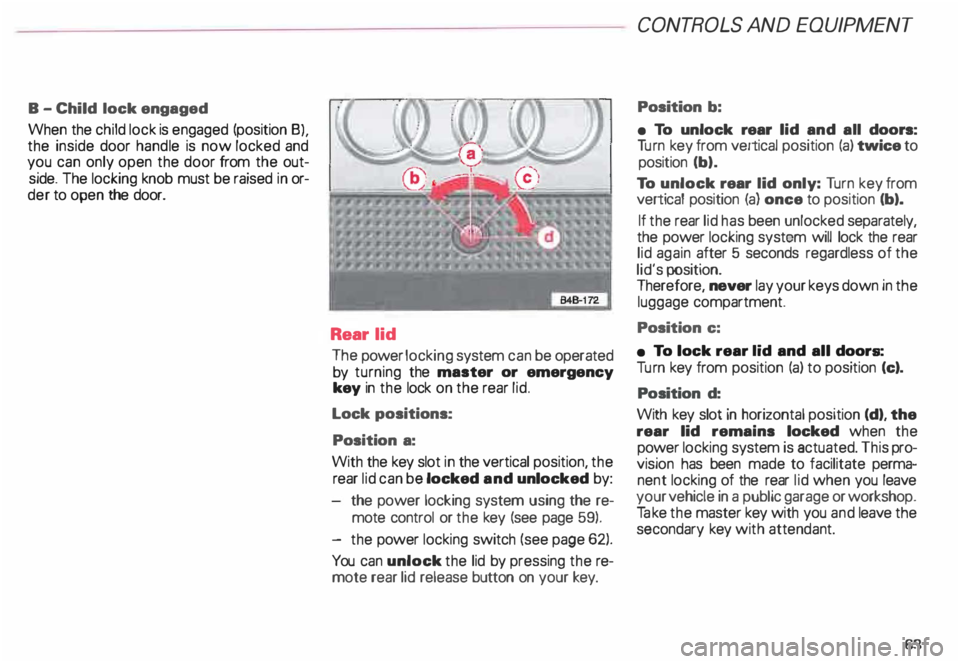
Rear lid
The power locking system can be operated
by turning the master or emergency
key in the lock on the rear lid.
Lock positions:
Position a:
With the key slot in the vertical position, the
rear lid can be locked and unlocked by:
the power locking system using the re
mote control or the key (see page 59).
- the power locking switch (see page 62).
You can unlock the lid by pressing the re
mote rear lid release button on your key. CONT
ROLS AND EQUIPMEN T
Position b:
• To unlock rear lid and all doors:
Tu rn key from vertical position (a) twice to
position (b).
To unlock rear lid only: Turn key from
vertical position (a) once to position (b).
If the rear lid has been unlocked separately,
the power locking system will lock the rear
lid again after 5 seconds regardless of the
lid's position.
Therefore, never lay your keys down in the
luggage compartment.
Position c:
• To lock rear lid and all doors:
Tu rn key from position (a) to position (c).
Position d:
With key slot in horizontal position (d), the
rear lid remains locked when the
power locking system is actuated. This pro
vision has been made to facilitate perma
nent locking of the rear lid when you leave
your vehicle in a public garage or workshop.
Ta ke the master key with you and leave the
secondary key with attendant.
63
Page 65 of 306
CONT
ROLS AND
EQUIPMENT------
L-----------------------�[_��� B-�3;�
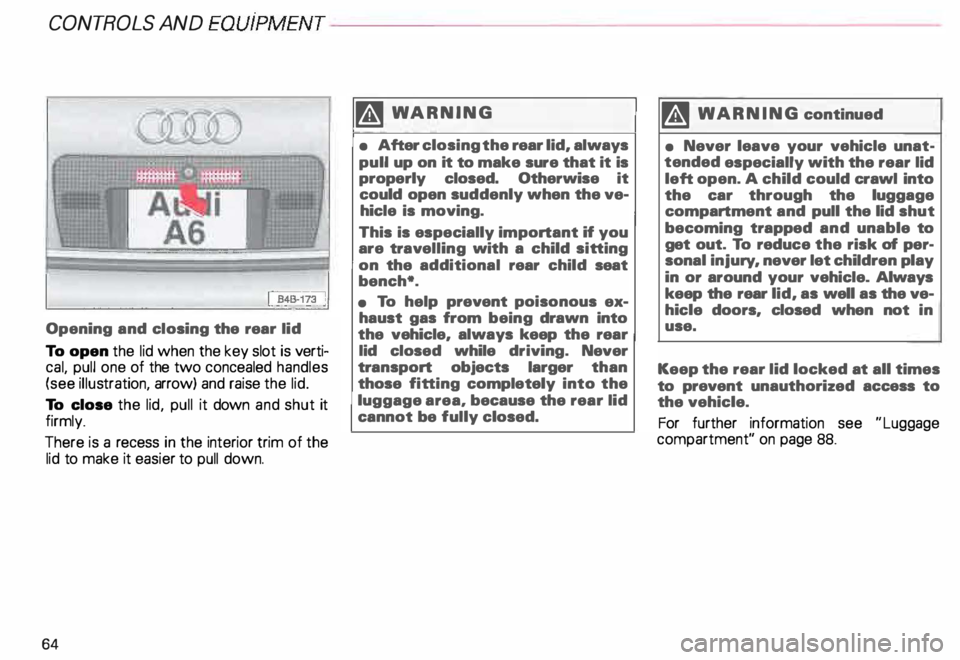
Opening and closing the rear lid
To open the lid when the key slot is verti
cal, pull one of the two concealed handles
(see illustration, arrow) and raise the lid.
To close the lid, pull it down and shut it
firmly_
There is a recess in the interior trim of the
lid to make it easier to pull down.
64 �W
ARNING
• After closing the rear lid, always
pull up on it to make sure that it is
properly closed. Otherwise it
could open suddenly when the ve
hicle is moving.
This is especially important if you
are trav elling with a child sitting
on the additional rear child seat
bench*.
• To help prevent poisonous ex
haust gas from being drawn into
the vehicle, always keep the rear
lid closed while driving. Never
tra nsport objects larger than
those fitting completely into the
luggage area, because the rear lid
cannot be fully closed. �,
WARNING continued
• Never leave your vehicle unat
tended especially with the rear lid
left open. A child could crawl into
the car through the luggage
compartment and pull the lid shut
becoming trapped and unable to
get out. To reduce the risk of per
sonal injury, never let children play
in or around your vehicle. Always
keep the rear lid, as well as the ve
hicle doors, closed when not in
use.
Keep the rear lid locked at all times
to prevent unauthorized access to
the vehicle.
For further information see "Luggage
compartment" on page 88.
Page 67 of 306

CONT
ROLS AND EQUIPMENT---------------------
With the vehicle locked and child safe
ty lock activated, you can also open the rear
lid in an emergency without having to use a
key.
To do this, a passenger in the car must lift
the lever on the inside of the rear lid (arrow) .
Then the rear lid can be opened from the
outside.
66 General
notes
Power locking system
• In the event of an accident with airbag
deployment all locked doors will be auto
matically unlocked to give access to the ve
hicle occupants from the outside.
• If the power locking system should fail,
you can still open the fuel tank flap in an
emergency, see page 224. Remote
control function
• The remote control system can be af
fected by other systems operating in the
same frequency range close to the vehicle,
such as mobile telephones, television
broadcas ting stations, etc.
• Do no use the remote control if you are
inside the car, otherwise you may uninten
tionally lock the vehicle, and then you would
set off the anti-theft alarm when you try to
start the engine or open a door.
If the ignition is switched on, the remote
control system is deactiv ated.
• Reactiv ating remote control.
If you replace a lost key, or if any repair and
I or exchange work is performed on the re
ceiver, an authorized Audi Dealer must reac
tivate the syste m. Only then can the key
less remote system be used again.
Page 75 of 306
CONTROLS AND EQUIPMENT---------------------
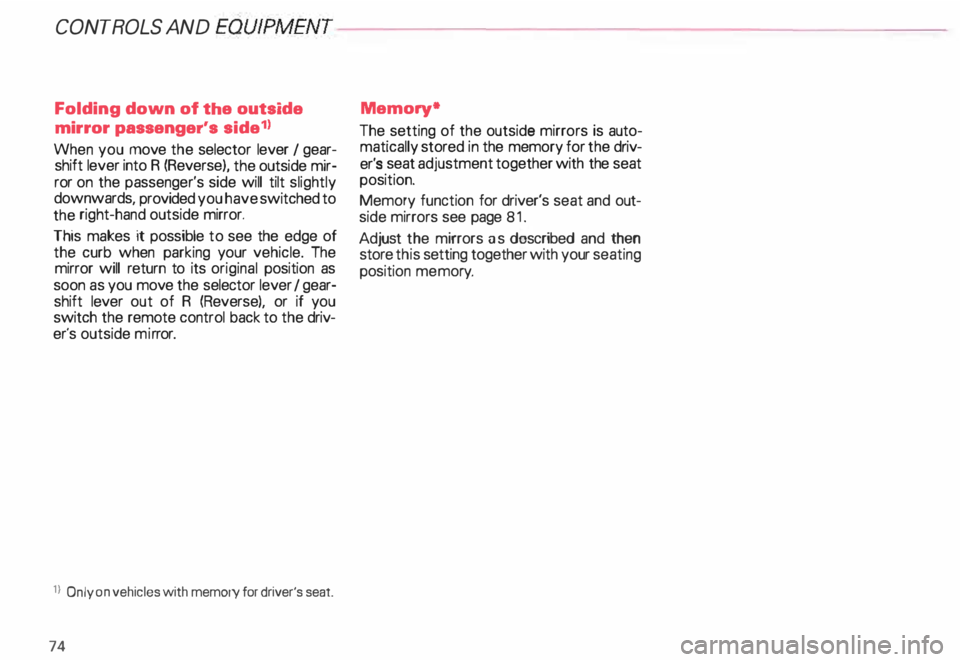
Folding down of the outside
mirror passenger•s side1l
When you move the selector lever I gear
shift lever into R (Reverse), the outside mir
ror on the passenger's side will tilt slightly
downwards, provided you have switched to
the right-hand outside mirror.
This makes it possible to see the edge of
the curb when parking your vehicle. The
mirror will return to its original position as
soon as you move the selector lever I gear
shift lever out of R (Reverse), or if you
switch the remote control back to the driv
er's outside mirror.
1 l Only on
vehicles with memory for driver's seat.
74 Memory*
The setting of the outside mirrors is auto
matically stored in the memory for the driv
er's seat adjustment together with the seat
position.
Memory function for driver's seat and out
side mirrors see page 81.
Adjust the mirrors os described and then
store this setting together with your seating
position memory.
Page 77 of 306

CONTROLS ANDEOUWMENT-----------------------------------------
Front seats
The correct positioning of the seats is im
porta nt:
so that you can reach all the controls on
the vehicle quickly and safely;
so that you can drive or ride relaxed and
help reduce fatigue;
and for maximum protection of
fered by the safety belts and air
bag system.
Therefore, always adjust the position of the
seat as described on the following pages.
Remember to adjust the seats before fas
tening the safety belts and before driving
off. Always be sure to follow these general
guidelines:
76 m
WARNING
• Always sit as far away from the
stee ring wheel and the instrument
panel as possible.
• Never sit less than 10 inches
(25 em.) from the steering wheel
and the instrument panel.
• Do not adjust seats while the ve
hicle is moving. Your seat may
move unexpectedly, causing sud·
den loss of vehicle control and
personal injury.
• Passengers must always keep
their feet on the floor whenever
the vehicle is moving. Never place
feet on the dashboard or on top of
the seats. In an accident, serious
personal injury can result from an
improper seating position. BSN-163
Driver's seat
To avoid contact with the airbag while it is
unfolding, the driver must not sit any closer
to the steering wheel than necessary and al
ways properly wear available three point
belts.
Page 78 of 306
·---------------------CONTROLS AND
EQUIPMENT
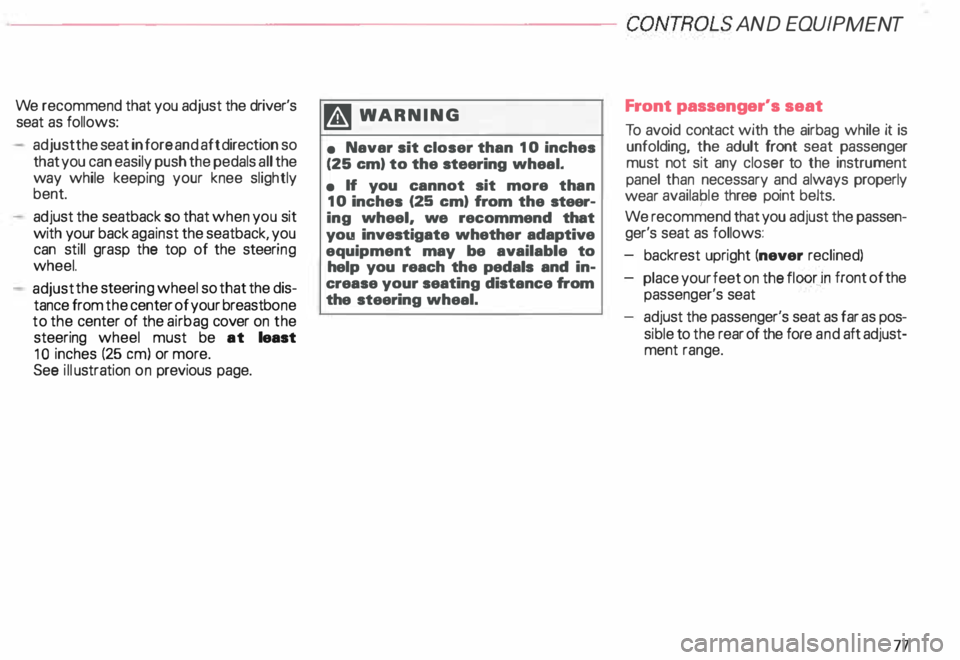
We recommend that you adjust the driver's
seat as follows:
adjust the seat in fore and aft direction so
that you can easily push the pedals all the
way while keeping your knee slightly
bent.
adjust the seatback so that when you sit
with your back against the seatback, you
can still grasp the top of the steeri ng
wheel.
adjust the steeri ng wheel so that the dis
tance from the center of your breastb one
to the center of the airbag cover on the
steering wheel must be at least
10 inches (25 em) or more.
See illustration on previous page. �W
ARNING
• Navar sit closer than 10 inches
(25 em) to the steering wheal.
• If you cannot sit more than
10 inches (25 em) from the steer
ing wheel, we recommend that
you investigate whether adaptive
equipment may be available to
help you reach the pedals and in
crease your seating distance from
the steering wheal. Front
passenger's seat
To avoid contact with the airbag while it is
unfolding, the adult front seat passenger
must not sit any closer to the instrument
panel than necessary and always properly
wear availaple three point belts.
We recommend that you adjust the passen
ger's seat as follows:
backrest upright (never reclined)
place your feet on the
floor _in front
of the
passenger's seat
adjust the passenger's seat as far as pos
sible to the rear of the fore and aft adjust
ment range.
77
Page 79 of 306
CONT
ROLS AND
EQUIPMENT---------------------
�W ARNING
• Always keep both feet on the
floor in front of the seat.
• Never place your feet on the in
strument panel or on the seat. If
the airbag inflates and your feet
are on the instrument panel or on
the seat, you could receive serious
personal injuries to the legs, hips
and even the head if the airbag in
flates.
For safety information on transporti ng chil
dren on the front passenger seat be sure to
read all the information on"ln fant seats,
Convertible seats and Booster seats", see
page 44.
78 �W
ARNING
• To reduce the risk of personal in
jury in an accident, front seat pas
sengers must never ride in a mov
ing vehicle with the seatback re
clined. Safety belts offer protec
tion only when the seatback is up
right and belts are properly posi
tioned on the body. The more the
seatback is reclined, the greater
the risk of perso nal injury from an
out-of -position safety belt.
• Never store items under the
seats. Loose objects can interfere
with the seat latching mechanism
and can also cause personal injury
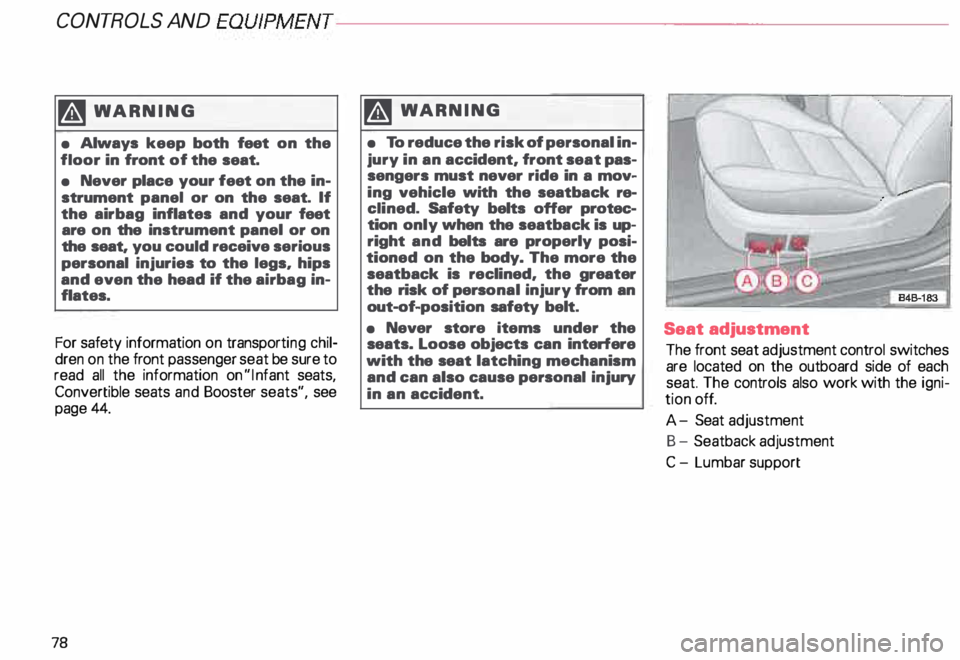
in an accident. Seat
adjustment
The front seat adjustment control switches
are located on the outboard side of each
seat. The controls also work with the igni
tion off.
A- Seat adjustment
B- Seatback adjustment
C - Lumbar support