2000 AUDI ALLROAD belt
[x] Cancel search: beltPage 51 of 306
SAFETYRRST-----------------------------------------------------
�W ARNING
Failure to properly route safety
balta over a childs body will cause
severe injuries in an accident.
The lap belt portion of the three
point belt as wall as any lap belt
alone must always pass as low as
possible across the pelvis, never
over the stomach or abdomen.
Yo unger children should use a lap belt only
in very exceptio nal situations and only if no
child restraint system for the child' s size and
weight or safer alternative means of trans
portation of the child is available. In these
excep tional situations, the use of a lap belt
is better than permitting the child to remain
totally unrestrained. But remember: a lap
belt cannot provide the same level of
protect ion as a proper child restra int.
50 �W
ARNING
• An improperly worn safety belt
will not provide the best protec
tion in an accident and may causa
serious personal injury. Always
make sure that children and other
vehicle occupants properly wear
available restraint systems. Care
fully follow the Instructions pro
vided by the manufacturers of
child restra ints.
• Commercially available child
seats are required to comply with
U. S. Federal Motor Vehicle Safety
Standard (FMVSS) 213 (in Canada
CMVSS 213).
• These standards include instal
lation requirements for using the
lap portion of a combination lap
shoulder belt such as those
installed in your vehicle. fA,
WARNING continued
• When buying a child restraint,
select one that fits your child and
vehicle.
• Only use child restraint systems
that fully contact the flat portion
of the seat cushion. The child seat
must not tip or lean to either side.
Audi does not recommend using
child seats that rest on legs or
tube-like frames. They do not pro
vida adequate contact with the
seat.
• Improperly or inadequately
installed child restraint systems
can increase the risk of injury to
children in accidents. Therefore,
always carefully read and follow
all instructions on installation and
use that come with the system.
Page 52 of 306
Securing a child seat
Convertible Locking Retractor
The retractors for the rear seat three-po int
safety belts and the front passenger three
point safety belt have a conver tible locking
feature in addition to the emergency locking
feature.
If you need to install a child seat at an outer
seating position, you must first activate the
conver tible locking feature. Then secure the
child seat by using the seat belt. �W
ARNING
• Never install rear-facing child
seats or infant carriers on the front
passenger seat. A child will be se
riously injured and can be killed
when the passenger airbag in
flates.
• The inflating airbag will hit the
child seat or infant carrier with
great force and will smash the
child seat and child against the
backrest. center arm rest. or door.
• Always install rear-facing child
seats or infant carriers on the rear
seat if the front passenger airbag
has not been deactivated. SA
FETY FIRST
�W ARNING
• Forward-fa cing child seats or in
fant carriers installed on the front
passenger's seat may interfere
with the deployment of the airbag
and cause serious injury to the
child. Allow a child to travel on the
front passenger's seat only in a for
ward- facing child restraint system
specif ically designed and ap
proved by the child restraint
manufacturer for use in the front
with airbags. Make sure the pas
senger seat is in the rearmost posi
tion. It is always safer to install a
child seat in the rear.
51
Page 53 of 306
SA
FETYRRST---------------------------------------------------
Activ ating the convertible
locking retractor
• Slowly pull the belt all the way out.
• Hold on to the safety belt while securing
the safety belt around the child restraint per
the instructions found in the child restraint's
owner's manual.
• Insert the belt tongue into the buckle for
that seating position. Pull on the belt to
make sure the safety belt is properly
fas tened.
• Guide the remaining portion of the belt
back in place, allowing the retractor to take
up the slack. Press the child restraint
against the seat cushion as you guide the
belt into the retractor so that the belt ten
sion holds the child restraint firmly in place.
• While the safety belt is retra cting, you
will hear a continuous clicking noise from
the retractor; that means that the convert
ible locking retractor has been activated.
52 •
To covert the safety belt into standard
use after the child restraint is removed, re
lease the tongue from the buckle and allow
the safety belt to fully retract again. The re
tractor will then operate in the normal emer
gency locking mode for the occupant re
straint.
�W ARNING
Always buckle the child seat firm
ly in place even if your child is not
sitting in it. A loose child seat can
fly around during a sudden stop or
in an accident.
Deactivating the convertible
locking retractor
The convertible locking retractor is deacti
vated by unfaste ning the safety belt (see
page 24). Allow the safety belt to retract
completely to its stowed position. The
safety belt can now be used as an ordinary
three-point safety belt without the addi
tional locking feature. If
the convertible locking feature has been
inadvertently activated, the safety belt
must be unfastened to deactivate this fea
ture. If the convertible locking feature is not
deactivated, the safety belt will gradually
become tighter and uncomfortable to wear.
The convertible locking feature must be de
activated to restore normal belt operation
and greater occupant comfort.
�W ARNING
Never unfasten the safety belt to
deactivate the convertible locking
retractor while the vehicle is in
motion. You would not be pro
tected at all and could suffer seri
ous injury in an accident.
Page 54 of 306
Child
restra int anchorages for
the rear seats
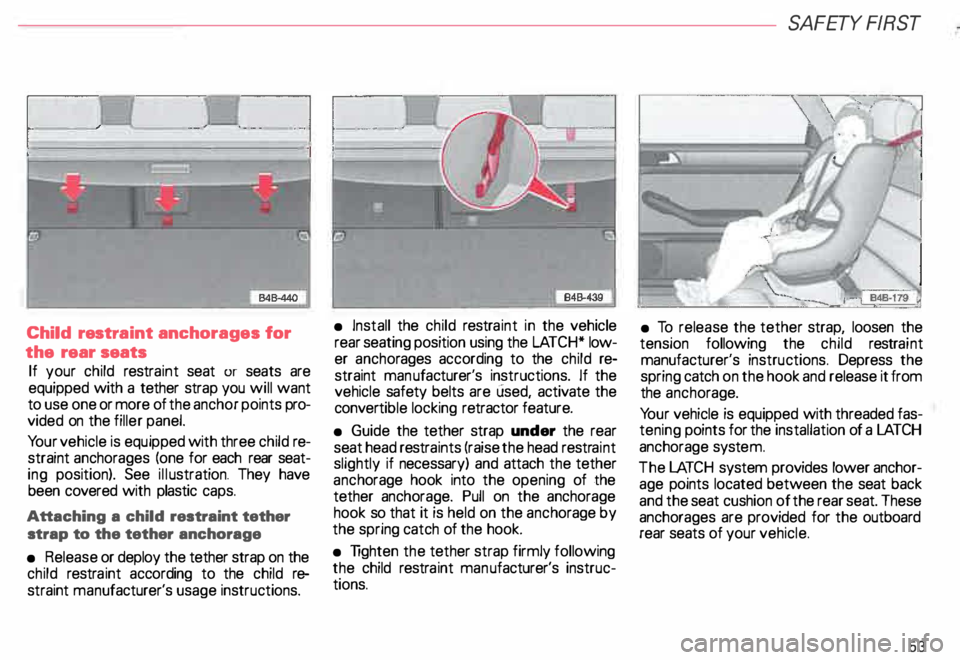
If your child restraint seat or seats are
equipped with a tether strap you will want
to use one or more of the anchor points pro
vided on the filler panel.
Yo ur vehicle is equipped with three child re
straint anchorages (one for each rear seat
ing position). See illustration. They have
been covered with plastic caps.
Attaching a child restraint tether
strap to the tether anchorage
• Release or deploy the tether strap on the
child restraint according to the child re
straint manufacturer's usage instructions. •
Install the child restra int in the vehicle
rear seating position using the LATCH* low
er ancho rages according to the child re
straint manufacturer's instructions. If the
vehicle safety belts are used, activate the
conver tible locking retractor feature.
• Guide the tether strap under the rear
seat head restraints (raise the head restraint
slightly if necessary) and attach the tether
anch orage hook into the opening of the
tether anchorage. Pull on the anchorage
hook so that it is held on the anch orage by
the spring catch of the hook.
• Tighten the tether strap firmly following
the child restra int man ufacturer's instruc
tions. SA
FETY FIRST
• To release the tether strap, loosen the
tension following the child restraint
manufacturer's instructions. Depress the
spring catch on the hook and release it from
the anch orage.
Yo ur vehicle is equipped with threaded fas
tening points for the installation of a LA TCH
anchorage system.
The LATCH system provides lower anchor
age points located between the seat back
and the seat cushion of the rear seat. These
anchorages are provided for the outboard
rear seats of your vehicle.
53
Page 55 of 306
SAFETYRRST----------------------------------------------------
These LATCH anchorage points are only in
tended for the installation and attachment
of child restra ints specially certified for use
with LATCH anchorages. Child restraints
that are not equipped with the LATC H an
chorages can still be installed using the ve
hicle seat belts.
Some child restra ints are certified for instal
lation either with LATCH ancho rages or the
vehicle safety belt. It is recommended that
such child restraints be used with the
LATCH anchorages because this system
will provide the easiest and more secure
installation.
LA TCH anchor ages are designed to be used
only with child restraints adapted for them.
Always refer to the child restra int manufac
turer's instructions for proper installation of
the child restra int using the vehicle LATCH
lower anchorage or safety belts. Never use
the LATC H lower ancho rages to attach safe
ty belts or other kinds of occupant re
straints.
54 �W
ARNING
• Do not drive the vehicle without
the head restraints provided. Head
restraints are designed to help re
duce injuries.
• The child restraint anchorages
are only to be used to hold a child
restra int system in its place.
• Child restraint anchorages are
designed to withstand only those
loads imposed by correctly fitted
child restraints. Under no circum
stances are they to be used for
adult seat balta or harnesses.
• Do not mount two child re
straint seats on one anchor point.
• Always follow the instructions
provided by the manufacturer of
the child restraint which you
intend to install in your Audi. Side
airbags and child safety
Yo ur Audi comes equipped with 2 front air
bags (driver and front passenger) and 4 side
airbags (in the front and rear*) which offer
the occu pants increased protection in the
event of a lateral collision.
In or�er t� assure this additional protection,
the s1de a1rbag must inflate within milli-sec
onds during a collision. When the airbag is
a ?tivated, it breaks through a seam on the
s1de of the seatback identified by the AIR
BAG label, and inflates between the pas
senger and side trim panel at very high
speed.
The side airbag inflates with such a high
f ? rce, that it could injure a child seriously if
h1s I her seating position is not proper up
nght, or 1f 1tems are positioned in the area
where the airbag inflates.
Page 76 of 306
Head
restra ints
Position the head restra ints accor ding to the
occupant's height. Properly positioned head
restra ints, together with the use of safety
belts offer effective protection in most acci
dent situations.
g WARNING
Head restraints are designed to
help reduce injuries in an accident.
Do not drive the vehicle without
the head restraints in place and
properly adjusted.
For maximum protection, the upper edge of
the head restra ints should be at least at
eye level, or high er. ' 848·181
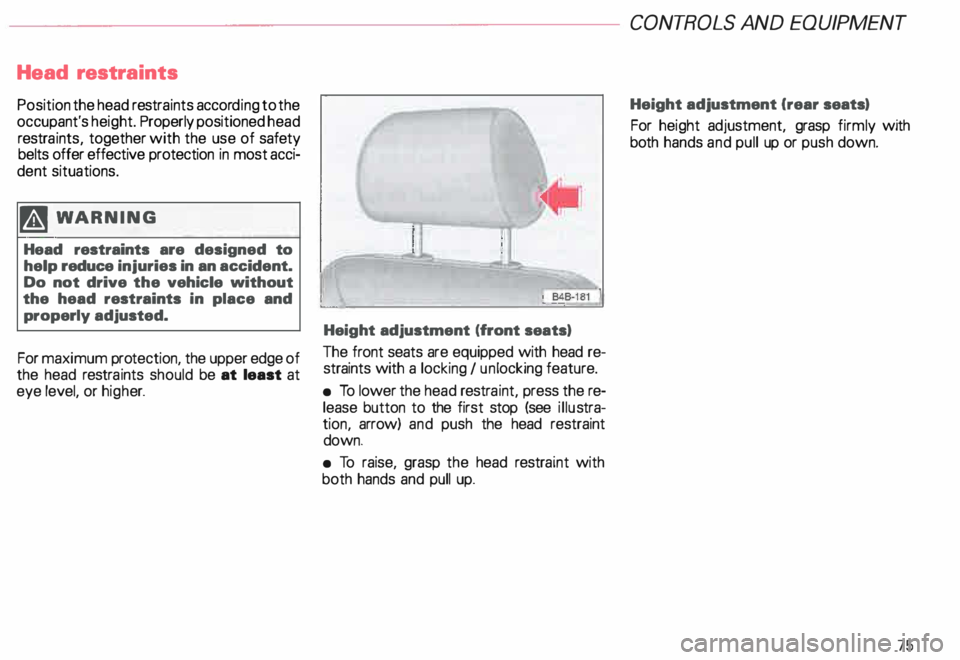
Height adjustment (front seats)
The front seats are equipped with head re
straints with a locking I un locking feature.
• To lower the head restra int, press the re
lease button to the first stop (see illustra
tion, arrow) and push the head restraint
down.
• To raise, grasp the head restraint with
both hands and pull up. CONT
ROLS AND EQUIPMEN T
Height adjustment Crear seats)
For height adjustment, grasp firmly with
both hands and pull up or push down.
75
Page 77 of 306

CONTROLS ANDEOUWMENT-----------------------------------------
Front seats
The correct positioning of the seats is im
porta nt:
so that you can reach all the controls on
the vehicle quickly and safely;
so that you can drive or ride relaxed and
help reduce fatigue;
and for maximum protection of
fered by the safety belts and air
bag system.
Therefore, always adjust the position of the
seat as described on the following pages.
Remember to adjust the seats before fas
tening the safety belts and before driving
off. Always be sure to follow these general
guidelines:
76 m
WARNING
• Always sit as far away from the
stee ring wheel and the instrument
panel as possible.
• Never sit less than 10 inches
(25 em.) from the steering wheel
and the instrument panel.
• Do not adjust seats while the ve
hicle is moving. Your seat may
move unexpectedly, causing sud·
den loss of vehicle control and
personal injury.
• Passengers must always keep
their feet on the floor whenever
the vehicle is moving. Never place
feet on the dashboard or on top of
the seats. In an accident, serious
personal injury can result from an
improper seating position. BSN-163
Driver's seat
To avoid contact with the airbag while it is
unfolding, the driver must not sit any closer
to the steering wheel than necessary and al
ways properly wear available three point
belts.
Page 78 of 306
·---------------------CONTROLS AND
EQUIPMENT
We recommend that you adjust the driver's
seat as follows:
adjust the seat in fore and aft direction so
that you can easily push the pedals all the
way while keeping your knee slightly
bent.
adjust the seatback so that when you sit
with your back against the seatback, you
can still grasp the top of the steeri ng
wheel.
adjust the steeri ng wheel so that the dis
tance from the center of your breastb one
to the center of the airbag cover on the
steering wheel must be at least
10 inches (25 em) or more.
See illustration on previous page. �W
ARNING
• Navar sit closer than 10 inches
(25 em) to the steering wheal.
• If you cannot sit more than
10 inches (25 em) from the steer
ing wheel, we recommend that
you investigate whether adaptive
equipment may be available to
help you reach the pedals and in
crease your seating distance from
the steering wheal. Front
passenger's seat
To avoid contact with the airbag while it is
unfolding, the adult front seat passenger
must not sit any closer to the instrument
panel than necessary and always properly
wear availaple three point belts.
We recommend that you adjust the passen
ger's seat as follows:
backrest upright (never reclined)
place your feet on the
floor _in front
of the
passenger's seat
adjust the passenger's seat as far as pos
sible to the rear of the fore and aft adjust
ment range.
77