2000 AUDI ALLROAD belt
[x] Cancel search: beltPage 28 of 306
--------------------------------------------------SAFETYRRST
�W ARNING
• To reduce the risk of injury
when the front airbags inflate, the
driver and passenger should al
ways sit in an upright position and
must never lean against or place
any part of your body too close to
the area where the front alrbags
are located.
• See "Imp ortance of proper seat
ing position" in this section at
pages 29 and 37 and heed all
WA RNINGS.
G Occupants who are unbelted,
out of position or too close to the
airbag can be seriously injured by
an airbag as it unfolds with great
force in the blink of an eye. For
seat adjustment, see page 76. Remember
too, airbags will deploy only
once and only in certain kinds of accidents
- your safety belts are a�ways t� ere t? off �r
protection in those acc1dents m wh1ch air
bags are not supposed to deploy or when
they have already deployed.
An airbag is not a substitute �or the safety
belt. It is part of the overall veh1cle safety sy
stem. The airbag system works most effec
tively when used with the safety belts.
Therefore, always wear your safety belts.
See pages 14 to 24.
It is important to remember that 'JI:'hile the
supplemental airbag system . IS d� s�g �ed to
reduce the likelihood of senous lnJUnes, 1t
can cause swelling, bruising, and minor
abrasions. How
the front airbag system works
The airbag system is designed so that in a
severe frontal collision the driver and
front passenger airbags are triggered. Th�
front airbags will not inflate in frontal colli
sions in which vehicle deceleration is not
high enough, or in side or rear collisions, or
in rollovers.
It is not possible to define an airbag trig�er
ing range that will cover every poss1ble
angle of impact, since the circumstances
will vary considerably between one acci
dent and another.
Important factors include, for example, the
nature ( hard or soft) of the object which the
car hits, the angle of impact, vehicle speed,
and etc.
27
Page 29 of 306
SAFETYRRST---------------------------------------------------
The triggering of the airbag system de
pends on the vehicle deceleration rate
caused by the collision and registered by
the control unit. If this rate is below the ref
erence value programmed into the control
unit, the airbags will not be triggered, even
though the car may be badly damaged as a
result of the accident.
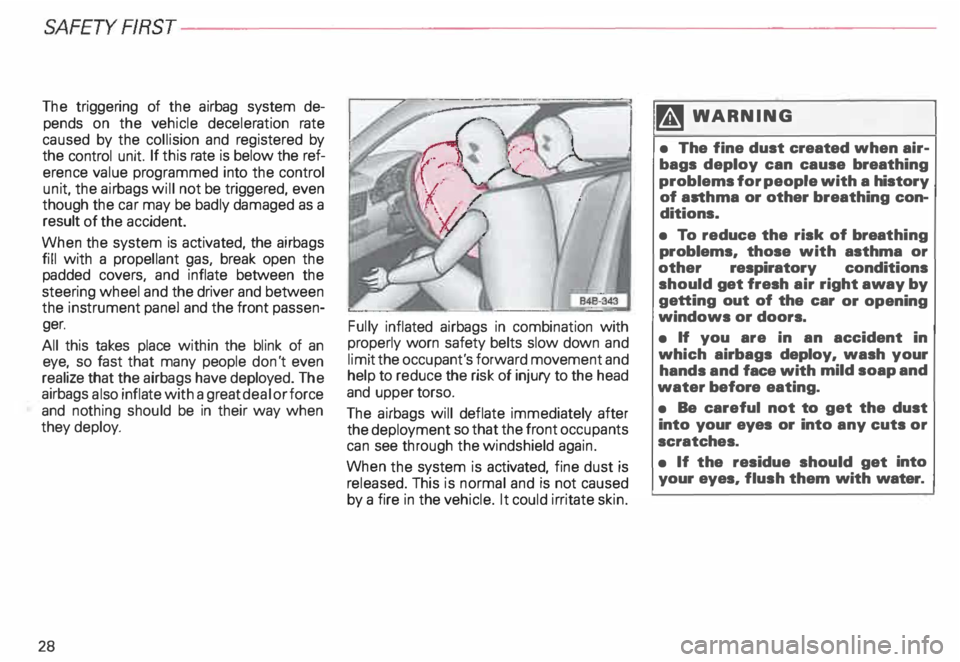
When the system is activated, the airbags
fill with a propellant gas, break open the
padded covers, and inflate between the
steering wheel and the driver and between
the instrument panel and the front passen
ger.
All this takes place within the blink of an
eye, so fast that many people don't even
realize that the airbags have deployed. The
airbags also inflate with a great deal or force
and nothing should be in their way when
they deploy.
28 Fully
inflated airbags in combination with
properly worn safety belts slow down and
limit the occupant's forward movement and
help to reduce the risk of injury to the head
and upper torso.
The airbags will deflate immediately after
the deployment so that the front occupants
can see through the windshield again.
When the system is activated, fine dust is
released. This is normal and is not caused
by a fire in the vehicle. It could irritate skin. �W
ARNING
• The fine dust created when air
bags deploy can cause breathing
problems for people with a history
of asthma or other breathing con
ditions.
• To reduce the risk of brea thing
problems, those with asthma or
other respiratory conditions
should get fresh air right away by
getting out of the car or opening
windows or doors.
• If you are in an accident in
which airbags deploy, wash your
hands and face with mild soap and
water before eating.
• Be careful not to get the dust
into your eyes or into any cuts or
scratches.
• If the residue should get into
your eyes, flush them with water.
Page 30 of 306
--------------------------SAFETY FIRST
Importance
of proper seating
position
In a collision airbags must inflate within a
blink of an eye and with considerable force.
The supplemental airbags could injure you
if you are not seated properly. Therefore in
order to help the airbag to do its job, it is im
portant, both as a driver and as a passenger
to sit properly at all times. By keeping room
between your body and the front of the pas
senger compartment, the airbag can inflate
fully and completely and provide supple
mental protection in certain frontal colli
sions. See page 76 for information on the
adjustment of the front seats and also
"Front seats" page 78, for details on the op
eration of the seat adjustment controls. It's
especially importantthat children be proper
ly restrained. See chapter "Child safety",
page 44. �W
ARNING
• Sitting too close to the stee ring
wheel or instrument panel will de
crease the effe ctiveness of the air
bags and will increase the risk of
personal injury in an accident.
• If you are unrestrained, leaning
forward, sitting sideways or out of
position in any way. your risk of in
jury is much higher. You will also
receive serious or fatal injuries
from the airbag if you are up
against it or too close to it when it
inflates.
• To reduce the risk of injury
when an alrbag inflates, always
wear safety belts properly.
See "How to wear the safety belts
properly" on page 18. '4
WARNING continued
• Children age 12 or younger
should always ride in the rear seat.
If children are not properly re
strained, they may be severely in
jured or killed when an airbag
inflates. Never let children ride un
restr ained or improperly re
strained in the vehicle.
• Adjust the front seats properly.
- Never ride with the backrest re-
clined.
- Always sit as far as possible
from the the stee ring wheel or
the instrument panel.
Always heed all WA RNINGS
on next page.
29
Page 36 of 306
-----------------------------------------------------SAFETYRRST
The supplemental side airbags inflate only
in severe side collisions occuring on
the impact side of the vehicle.
The supplemental side airbags will
not inflate ...
• if the ignition is switched off
• in frontal collisions
• in side collisions in which vehicle
deceleration is not high enough
• in rear collisions
• in rollovers.
Under some accident conditions, both front
and side airbags may inflate.
Remember too, airbags will deploy only
once and only in certain kinds of accidents
- your safety belts are always there to offer
protection in those accidents in which air
bags are not supposed to deploy or when
they have already deployed. A
side airbag is not a substitute for the
safety belt. It is part of the overall vehicle
safety system. The airbag system works
most effectively when used with the safety
belts. Therefore, always wear your safety
belts. See pages 14 to 24.
It is important to remember that while the
supplemental side airbag system is de
signed to reduce the likelihood of serious in·
juries, it can cause swelling, bruising, and
minor abrasions.
How the supplemental side airbag
system works
In a side collision the supplemental side air
bags can help to reduce the risk of injury to
the upper part of the body on the side of the
car that is struck in a side collision.
In order to assure this additional protection,
the side airbag must inflate within the blink
of an eye during a collision. It
is )'lOt possible to define an airbag trigger
ing range that will cover every possible
angle of impact, since the circumstances
will vary considerably between one acci
dent and another.
Important factors include, for example, the
nature ( hard or soft ) of the object which the
car hits, the angle of impact, vehicle speed,
and etc.
The triggering of the airbag system de
pends on the vehicle deceleration rate
caused by the collision and registered by
the control unit. If this rate is below the ref
erence value programmed into the control
unit, the. airbags will not be triggered, even
though the car may be badly damaged as a
result of the accident.
35
Page 40 of 306
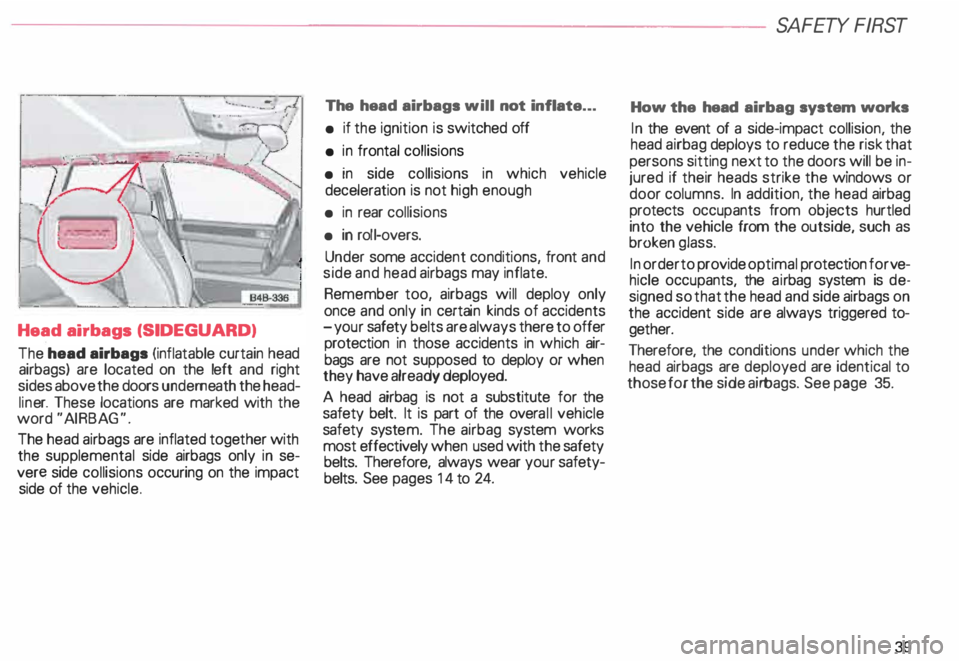
Head airbags (SIDEGUARD)
The head airbags (inflatable curtain head
airbags) are located on the left and right
sides above the doors underne ath the head
lin er. These locations are marked with the
word "AIRBAG".
The head airbags are inflated together with
the supplemental side airbags only in se
vere side collisions occuring on the impact
side of the vehicle. The
head airbags will not inflate ...
• if the ignition is switched off
• in frontal collisions
• in side collisions in which vehicle
deceleration is not high enough
• in rear collisions
• in roll-overs.
Under some accident conditions, front and
side and head airbags may inflate.
Remember too, airbags will deploy only
once and only in certain kinds of accidents
-y our safety belts are always there to offer
protection in those accidents in which air
bags are not supposed to deploy or when
they have already deployed.
A head airbag is not a substitute for the
safety belt It is part of the overa ll vehicle
safety system. The airbag system works
most effectively when used with the safety
belts. Therefore, always wear your safety
belts. See pages 14 to 24. SA
FETY FIRST
How the head airbag system works
In the event of a side-impact collision, the
head airbag deploys to reduce the risk that
persons sitting next to the doors will be in
jured if their heads strike the windows or
door columns. In addition, the head airbag
protects occupants from objects hurtled
into the vehicle from the outside, such as
broken glass.
In order to provide optimal protection for ve
hicle occupants, the airbag system is de
signed so that the head and side airbags on
the accident side are always triggered to
gether.
Therefore, the conditions under which the
head airbags are deployed are identical to
those for the side airbags. See page 35.
39
Page 45 of 306

SAFET YRRST---------------------------------------
Child safety
The physical principles of what happens
when your car is in an accident, illustrated
on pages 14-17 , apply also to children. But
unlike adults and teenagers. their muscles
and bones a.re not fully developed. In many
respects chrldren are at greater risk of seri
ous injury in accidents than are adults.
Because children's bodies are not fully de
veloped, they require restraint systems es
pecially designed for their size. weight, and
body structure. Many countries and all
states of the United States and provinces of
Canada have laws requiring the use of ap
proved child restraint systems for infants
and small children.
Child restraints, like adult safety belts, must
be used properly to be effective. Used im
properly, they can increase the risk of seri
ous injury in an accident.
44 �W
ARNING
• Accident statistics have shown
that children are generally safer in
the rear seat area than in the front
seating position. Always restrain
any child age 12 and under in the
rear.
• . All ve�icle occupants and espe
Cially children must be restra ined
properly whenever riding in a ve
hicle. An unrestrained or improp
erly restra ined child could be in
jur
_ed b
y stri king the interior or by
bemg eJected from the vehicle dur
ing a sudden maneuver or impact. J'A1
WARNING
continued
An unrestrained or improperly re
strained child is also at greater
risk of injury or death through con
ta c:t with �n inflating airbag. A
su1table child restraint properly
installed and used at one of the
rear seating positions provides the
highest degree of protec tion for
infants and small children in most
accidents.
Consult the child seat manufacturer's in
structions to be sure the seat is right for
your child's size.
Page 49 of 306
SA
FETY FIRST--
Booster seats
Children up to 7 years old (55 1bs, or 25 kg)
are best protect ed in child safety seats de
signed for their age and weight. Experts say
that the skeletal structure, particularly the
pelvis, of these children is not fully devel
oped, and they should not use the vehicle
safety belts.
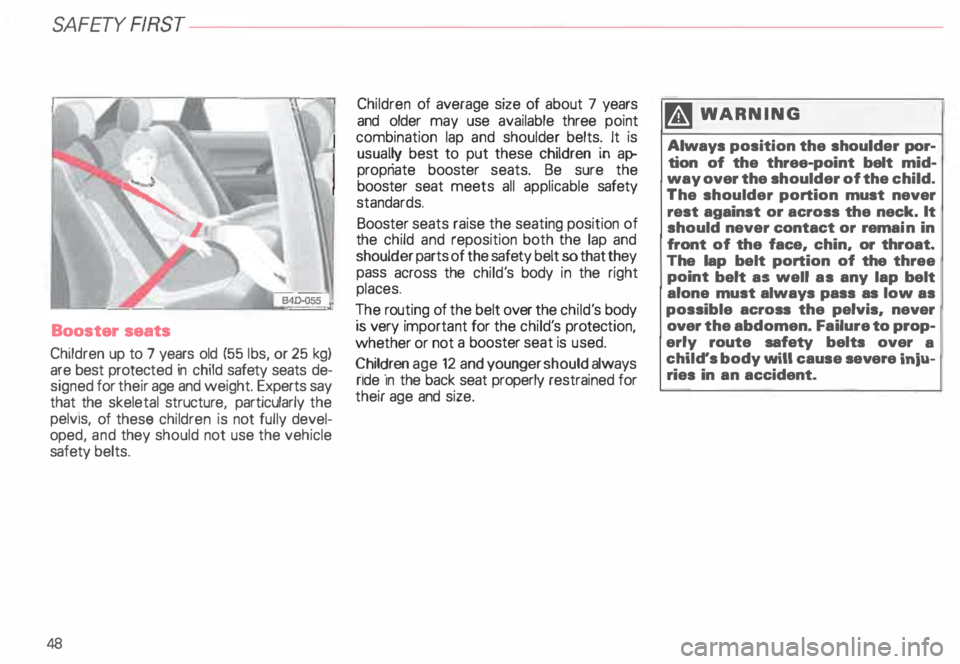
48 Children
of average size of about 7 years
and older may use available three point
combination lap and shoulder belts. It is
usual �y best to put these children in ap
propnate booster seats. Be sure the
booster seat meets all applicable safety
standards.
Booster seats raise the seating position of
the child and reposition both the lap and
shoulder parts of the safety belt so that they
pass across the child' s body in the right
places.
} he rou.ting of the belt over the child' s body
IS very Important for the child' s protec tion,
whether or not a booster seat is used.
Chil �ren age 12 and younger should always
nde 1n the back seat properly restrained for
their age and size. �W
ARNING
� lways position the shoulder por
tion of the three-point belt mid
way over the shoulder of the child.
The shoulder portion must never
rest against or across the neck. It
should never contact or rema in in
front of the face, chin, or throat.
The lap belt portion of the three
point belt as well as any lap belt
alone must always pass as low as
possible across the pelvis, never
over the abdomen. Failure to prop
erly route safety belts over a
chil d's body will cause severe iniu
ries in an accident.
Page 50 of 306
-------------------------------------------------SAFETY ARST
In a collision, airbags must inflate within a
blink of an eye and with considerable force.
In order to do its job, the airbag needs room
to inflate so that it will be there to protect
the occupant as the occupant moves for
ward into the airbag.
A vehicle occupant who is out of position
and to close to the airbag gets in the way of
on infloting nirbag. When an occupant is too close he or she will be stru ck violently and
will r� ceive serious or possibly even fatal in
jury.
In order for the airbag to offer protection, it
is important that all vehicle occupants, es
pecially children who must ride on the front
seat in excep tional situations, be properly
restra ined and as far away from the airbag
as possible. By keeping room between your
body and the front of the passenger
compartment, the airbag can inflate fully
and completely and provide supplemental
pro tection in certain frontal collisions. �W
ARNING
Never let a child stand or kneel on
any seat, particularly the front
seat. Never let a child ride in the
cargo area of your car. If a child is
leaning forward, sitting sideways
or out of position in any way, the
child is more likely to be injured in
a crash and will receive serious or
fatal injuries if the child comes
into contact with an airbag as it in
flates.
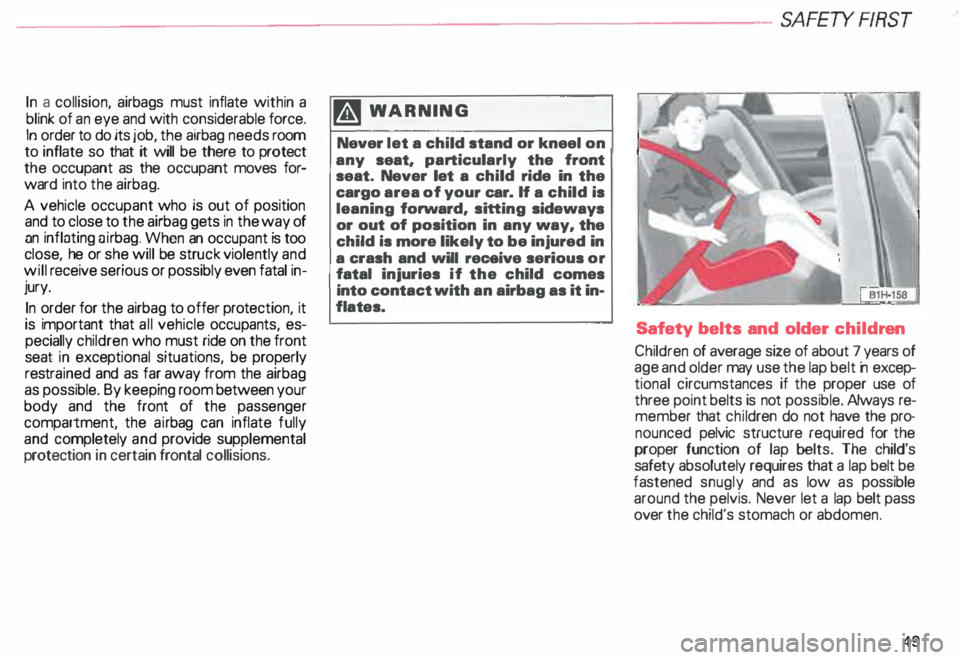
Safety belts and older children
Children of average size of about 7 years of
age and older may use the lap belt in excep
tional circumstances if the proper use of
three point belts is not possible. Always re
member that children do not have the pro
nounced pelvic structure required for the
proper function of lap belts. The child's
safety absolutely requires that a lap belt be
fastened snugly and as low as possible
around the pelvis. Never let a lap belt pass
over the child's stomach or abdomen.
49